What is Gond Pardhan (Tree Spirit Painting)?
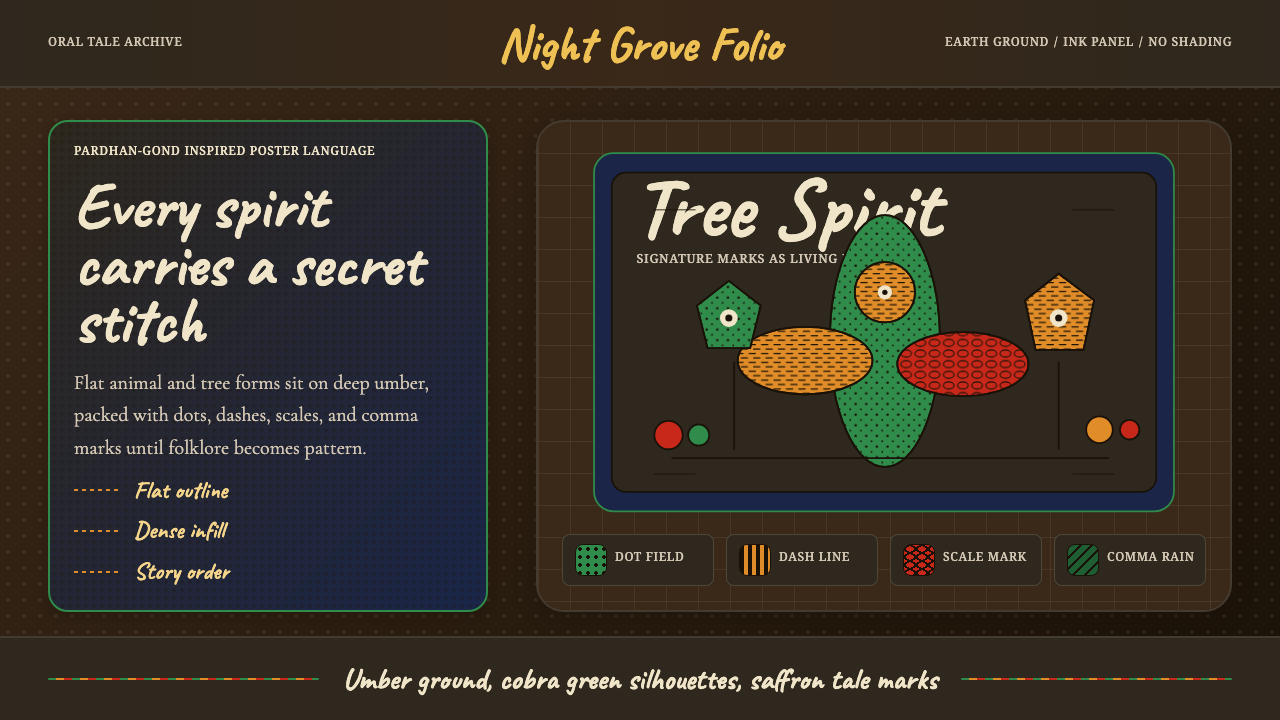
Gond Pardhan painting turns every animal and tree into a universe of fine marks — a living visual language where folklore, identity, and pattern are inseparable.
Gond Pardhan (Tree Spirit Painting) in brief
Gond Pardhan painting is the most graphic-design-fluent tribal art tradition in India. Artists from the Pardhan-Gond community of central India fill the silhouettes of animals, trees, birds, and spirit figures with intricate personal patterns of dots, dashes, fish-scale marks, and comma-shaped strokes. The result is a dense, tapestry-like surface where every shape is simultaneously an outline and an ecosystem of marks — flat, bold, and charged with symbolic meaning.
The visual logic is immediately distinctive. Forms are rendered as hard outlines with no modeling or shading; depth comes not from light and shadow but from the rhythmic density of the infill pattern. Each artist develops a personal signature vocabulary of marks, so that two painters depicting the same cobra or peepal tree will produce works that are clearly related yet individually distinct — the tradition functions both as shared grammar and as personal handwriting.
The style sits comfortably alongside contemporary graphic design and illustration. Its commitment to flat outline, dense pattern, and high-contrast color relationships gives it a poster-like visual strength that translates readily into digital surfaces. At the same time, it carries a depth of symbolic and narrative content that purely decorative pattern-making lacks — every figure tells a story from the Gond oral tradition, and the patterns themselves are understood as expressions of the living energy, or jiv, that animates all things.
Where does Gond Pardhan (Tree Spirit Painting) come from?
The Gond are one of India's largest indigenous communities, with a continuous presence across Madhya Pradesh, Chhattisgarh, Maharashtra, and surrounding regions spanning many centuries. The Pardhan are a hereditary bardic sub-group within the broader Gond world whose traditional role was to sing and recite the community's epic oral histories — genealogies, cosmological myths, and tales of forest spirits — accompanied by a stringed instrument called the bana. Visual art was always embedded in this bardic function: Pardhan artists traditionally painted walls and floors for ritual occasions, using the same figures and motifs that appeared in the songs.
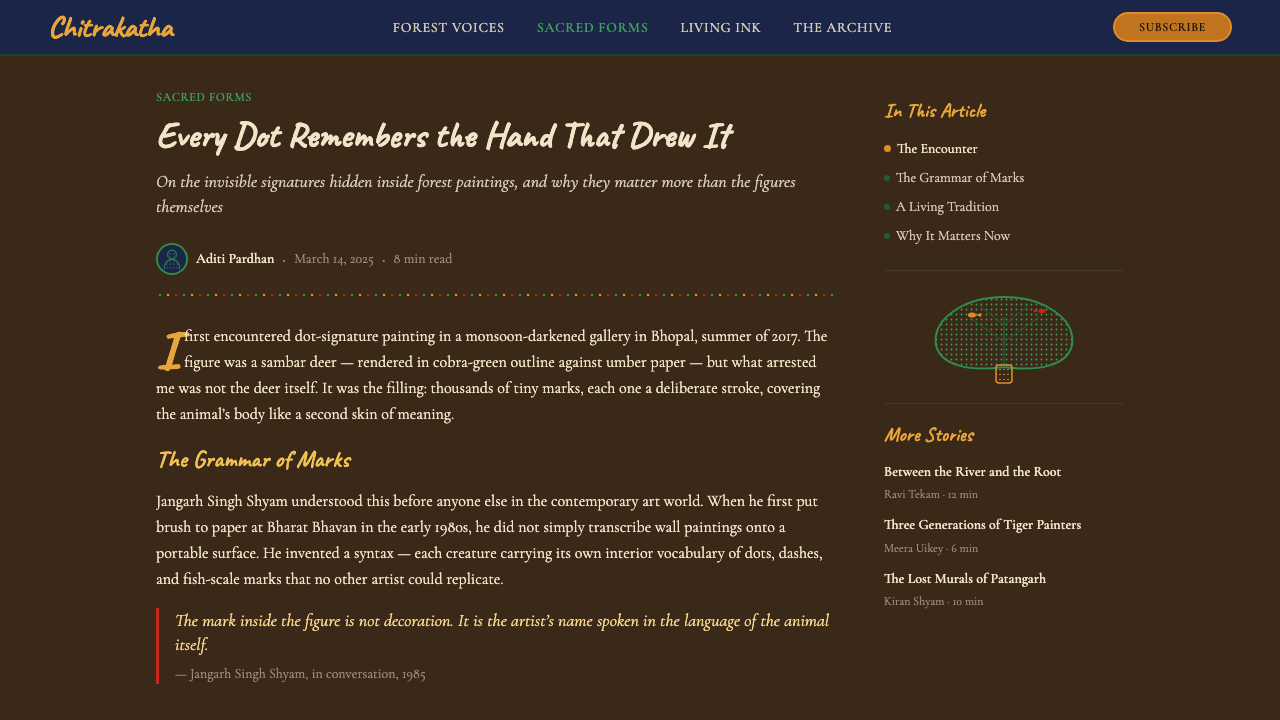
The transition from wall and floor painting to paper and canvas is closely associated with a single pivotal event: the arrival of Jangarh Singh Shyam at Bharat Bhavan, a government-supported interdisciplinary arts centre in Bhopal, in 1981. The sculptor and curator Jagdish Swaminathan, who founded Bharat Bhavan, recognized Jangarh's extraordinary visual intelligence and invited him to work at the centre. Jangarh adapted his traditional imagery — the snake-goddess Nag Devi, the tiger spirit, the haunted peepal tree — to ink on paper, producing a body of work that was exhibited internationally and collected by major institutions. This shift in medium opened the tradition to the art market and to global visibility without requiring any fundamental change in the visual grammar itself.
Jangarh's approach came to be known as Jangarh Kalam — a named lineage honoring him as the tradition's founding modernizer. After his death in 2001, the practice was carried forward by a generation of artists he had trained and inspired, including Bhajju Shyam, Durga Bai, and Venkat Raman Singh Shyam, each of whom extended the vocabulary into new subjects and formats while maintaining the foundational logic of outline and infill. The movement that Bharat Bhavan catalyzed is now recognized internationally as one of the most significant revivals of indigenous visual culture in contemporary India.
The tradition's geographic heartland is the Patangarh region of Mandla district in Madhya Pradesh, where Jangarh Singh Shyam was born, and the surrounding villages of the Dindori and Mandla areas. Bhopal became the institutional center. London, Paris, and New York became exhibition destinations. This global circulation did not dilute the tradition's identity — artists continued to draw on the same cosmological repertoire of forest spirits, sacred animals, and mythic trees — but it introduced new scales, new contexts, and new dialogues with contemporary art practices that continue to evolve today.
What defines the Gond Pardhan (Tree Spirit Painting) look?
Flat Outline Form
Every figure — animal, tree, human, or spirit — is rendered as a bold, unmodeled silhouette. There is no shading, no gradation of tone, no attempt to suggest three-dimensional volume through light and dark. The outline itself carries all the weight: thick, decisive, and continuous. This flatness is not a simplification but a deliberate structural choice that makes the infill pattern visible and gives every image its poster-like graphic strength.
Signature Infill Patterns
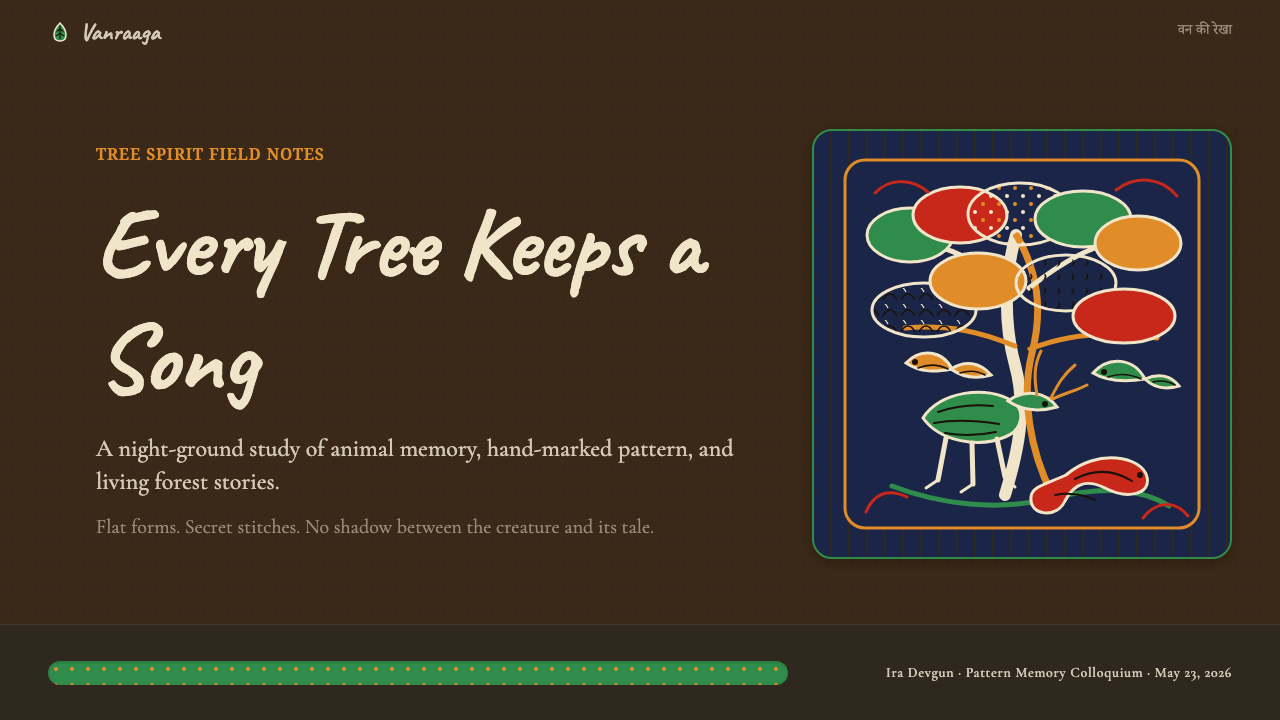
The interior of every outline is filled entirely with fine, rhythmically repeated marks: dots arranged in rows or clusters, short parallel dashes, fish-scale arcs, comma strokes, or crosshatch grids. Each artist develops a personal repertoire of marks that functions as a visual signature — identifiable across their body of work even when the subject matter changes. The infill transforms the silhouette from a simple shape into a densely worked surface that rewards close looking.
High-Contrast Color Palette
Traditional Gond Pardhan work uses a limited but intensely saturated palette: deep ochres and umbers as ground colors, with figures rendered in cobra green, crimson, golden yellow, and midnight black. The color relationships are bold and unmodulated — flat areas of a single hue abutting other flat areas without blending or transition. Contemporary practitioners have expanded the palette while retaining the principle of high contrast and flat application. The dark ground — umber, black, or deep olive — is characteristic, giving the style its nocturnal, spirit-world atmosphere.
Narrative Symbolism
Subject matter is drawn from the Gond cosmological tradition: the tree of life Sulphen, the cobra goddess Nag Devi, the peepal tree as a dwelling of forest spirits, the deer, the owl, and the tiger as figures of particular spiritual significance. These are not decorative choices — each figure carries a specific narrative and ritual identity within the community's oral tradition. The visual system functions simultaneously as art and as a form of cultural memory, with images that encode stories, beliefs, and relationships with the natural world.
Personal as Grammar
Unlike many folk traditions where visual conventions are strictly fixed by community norms, Gond Pardhan practice explicitly values individual artistic voice within the shared framework. The tradition expects each artist to develop a personal mark vocabulary rather than copying a master's style precisely. This means that while the structural logic — outline, infill, flat color, dark ground — is stable across the tradition, the expressive range is wide. Two artists painting the same subject will produce works that are clearly kin but unmistakably individual.
Scale Indifference
Gond Pardhan imagery scales gracefully from a small sketch to a large mural because the logic of the style is modular: the infill pattern can be made coarser or finer to suit the available surface, and the bold outline ensures legibility at distance. This makes the style well-suited to contexts where the same visual identity must work across very different formats — a phone screen and a conference room wall, for instance, or a postage-stamp-sized icon and a full-page illustration.
Organic Geometry
Where Bauhaus geometry is the geometry of the ruler and compass — hard circles, squares, and triangles — Gond Pardhan geometry is the geometry of living things. Spirals echo shells and coiled snakes; radiating marks suggest feathers and fins; branching lines echo roots and antlers. The patterns are governed by biological logic rather than mathematical precision. Curves are hand-drawn and slightly irregular; the overall effect is simultaneously highly ordered and visibly alive.

Who shaped Gond Pardhan (Tree Spirit Painting)?
Born in Patangarh, Madhya Pradesh, Jangarh Singh Shyam is the artist who transformed Gond Pardhan painting from a wall-based ritual practice into an internationally recognized art form. His arrival at Bharat Bhavan in Bhopal in 1981, at the invitation of Jagdish Swaminathan, opened the path from village walls to paper, canvas, and the global art market. Jangarh developed the iconic visual grammar that defines the tradition: flat bold outline, dense personal-mark infill, and a palette anchored by deep grounds with luminous figure colors. His untimely death in 2001 while on an artist residency in Japan was mourned as a significant loss, but the school of painting that bears his name — Jangarh Kalam — has grown into a multi-generational movement.
A nephew of Jangarh Singh Shyam and one of the most internationally celebrated artists working in the Gond Pardhan tradition, Bhajju Shyam is best known outside India for his illustrated book The London Jungle Book (2004), in which he reinterprets London life through the visual grammar of Gond painting — an Underground tunnel becomes a giant worm, Big Ben a decorated pillar, the Thames a serpentine spirit. The book brought the tradition to a global literary and design audience. Bhajju's work demonstrates the tradition's capacity to turn any subject — however urban and contemporary — into a Gond cosmological encounter.
One of the foremost women artists to emerge from the Gond Pardhan tradition, Durga Bai has expanded the tradition's subject matter to include everyday life — women at work, children at play, domestic scenes — alongside the cosmological and ritual figures more typical of male practitioners. Her work is notable for its warm palette and for a compositional openness that allows figures more breathing room than the densely packed surfaces of some peers. Durga Bai has also been involved in educational initiatives bringing Gond painting to children in Indian schools, extending the tradition's reach into a new context.
Another nephew of Jangarh Singh Shyam, Venkat Raman Singh Shyam is known for pushing the tradition into larger formats and more complex compositional arrangements, including work that fills entire walls with interlocked figures forming a continuous visual narrative. His book collaboration with the author Joëlle Zask, Finding My Way (2018), extended the autobiographical potential of the tradition. Venkat Raman's practice demonstrates how Gond Pardhan can absorb the ambitions of contemporary art practice — installation scale, book form, international exhibition — without abandoning the mark-making logic that defines it.
How do you use Gond Pardhan (Tree Spirit Painting) today?
Gond Pardhan is one of the more distinctive and immediately recognizable tribal art styles available for contemporary design use, which makes it both powerful and demanding to apply well. The style's visual density — every surface filled with fine marks — means that it performs best when given space to breathe on the page or screen. Crowding a Gond-derived composition with additional type or UI elements will overwhelm both the art and the interface. The right approach is to treat a Gond Pardhan element as a hero — give it generous white or deep-ground space, and let the surrounding design serve it rather than compete with it.
For presentation slides, Gond Pardhan works especially well as a cover image or section-break visual, where a single large figure — a tree, a cobra, a deer — can occupy most of the canvas against a deep umber or black ground. The figure's intricate infill reads as sophisticated craftsmanship at a glance and rewards closer examination. Content slides should keep Gond-derived imagery confined to structural role — a corner motif, a decorative rule, an icon — rather than attempting to use it as background for body text, where the pattern density will fight the type. Data slides are generally unsuitable for direct Gond Pardhan imagery; instead, the style's palette and outline logic can inform chart color choices and border treatments.
For web interfaces, the style is well-suited to hero sections, section backgrounds with heavy opacity reduction, or as part of an illustration-forward brand identity for products in cultural, artisan, wellness, or storytelling categories. Dashboard and pricing-page applications are harder: the visual density of authentic Gond imagery does not reduce cleanly to small-scale UI components. A more successful approach is to derive a simplified motif — a single animal outline, a repeating dot-and-dash border, a reduced color palette — and build the UI system from those abstracted elements rather than from full-complexity artworks.
For editorial and marketing design, the style is a natural fit for contexts where cultural richness, craft authenticity, and narrative depth are desired values. Book covers, magazine feature spreads, campaign imagery for heritage brands, and packaging for artisan or sustainably-sourced products all benefit from the style's combination of bold graphic clarity and intricate surface detail. The dark ground palette — deep umber, midnight black, deep forest green — photographs well and prints richly, making it suitable for both digital and offset applications. For marketing copy, the style pairs naturally with language that foregrounds story, origin, and human craft rather than performance metrics or technological capability.
A common mistake when working with Gond Pardhan imagery is treating the infill patterns as purely decorative texture to be applied freely across a layout. In the authentic tradition, every pattern is specific to a figure and carries relational meaning — it is not wallpaper. When using Gond-derived imagery in commercial design, the responsible approach is to treat the figures and their associated patterns with specificity: choose figures that have a narrative connection to the product's context, and avoid reducing the patterns to repeating tile backgrounds detached from the figures they were created to animate. Similarly, expanding the palette beyond the tradition's characteristic high-saturation, high-contrast relationships — in particular, introducing soft pastels or gradient transitions — will undermine the visual logic that makes the style coherent and striking.
Gond Pardhan (Tree Spirit Painting) — FAQ
Is Gond Pardhan painting the same as Warli or Madhubani?
They are distinct traditions that share some surface similarities as Indian folk arts but differ significantly in visual grammar, community origin, and symbolic content. Warli painting, from Maharashtra, uses white marks on a red or brown ground and a geometric figure vocabulary centered on the triangle. Madhubani, from Bihar, uses fine line drawing with bright flat colors and a compositional density that fills space with interlocked figures and decorative borders. Gond Pardhan is distinguished by its dark grounds, its high-contrast saturated figure colors, its personal-mark infill system, and its specific cosmological subject matter rooted in the Gond oral tradition. Each tradition has its own integrity and should not be blended casually.
How should designers handle attribution and cultural sensitivity when using this style?
Gond Pardhan is a living tradition with named contemporary artists, not a historical style whose originators are long dead. This means that using the visual grammar — outline, infill, palette — in a commercial context carries an ethical dimension that designers should take seriously. Best practice includes: crediting the tradition by name in the work or its documentation, avoiding direct copying of specific artworks by living artists without permission, and where possible, commissioning Gond Pardhan artists directly for commercial projects rather than using the style without engagement with its practitioners. The Jangarh Kalam foundation and various artist collectives in Madhya Pradesh provide routes to authentic collaboration.
Can the style work in light or white-background contexts, or is the dark ground essential?
The dark ground is not architecturally essential to the visual grammar — the outline and infill system can be read on a light background — but it is strongly characteristic and historically motivated. On a white or cream ground, the style reads differently: the figures feel more graphic and illustrative, less atmospheric and nocturnal. Contemporary Gond Pardhan artists do sometimes work on lighter grounds, particularly in children's books and educational contexts where the visual vocabulary is being introduced to new audiences. For design applications, a light-ground treatment can work well for contexts that call for accessibility and a lighter emotional register — educational materials, print for younger audiences, or companion graphics to a primarily typographic layout. The dark ground remains the more immersive and culturally resonant choice.
What is the difference between Jangarh Kalam and older traditional Gond Pardhan wall painting?
Traditional Pardhan wall and floor paintings were made with natural earth pigments on earthen or lime-plastered surfaces, often for specific ritual occasions such as festivals or life-cycle ceremonies. The imagery was governed by community convention rather than individual artistic choice — certain figures appeared in certain contexts, rendered in ways recognizable to the whole community. Jangarh Kalam, the paper-and-ink practice pioneered by Jangarh Singh Shyam, introduces individual artistic authorship as an explicit value: artists sign their work, develop personal mark vocabularies, and make compositional choices that reflect individual sensibility rather than solely community convention. The visual grammar descends directly from the wall tradition, but Jangarh Kalam is art-world work — made for exhibition, collection, and the open market — in ways that traditional wall painting was not.
Does Gond Pardhan work for animated or motion design contexts?
The style has natural properties that lend themselves to motion: the bold outline creates a clear boundary for animation, the infill patterns can be progressively revealed to create a compelling build effect, and the tradition's inherent narrative content gives animators obvious story material to work with. Effective motion approaches include: drawing-on animation where the outline appears first and the infill marks accumulate progressively; pattern-reveal transitions where the infill emerges from darkness as if being painted live; and character animation that respects the flat, non-volumetric quality of the figures — Gond Pardhan animals and spirits should move like cut-out or shadow-puppet figures, not like three-dimensional rendered characters. The style does not suit particle systems, physics-based motion, or any animation approach that introduces depth, lighting, or volumetric rendering.
Related design styles
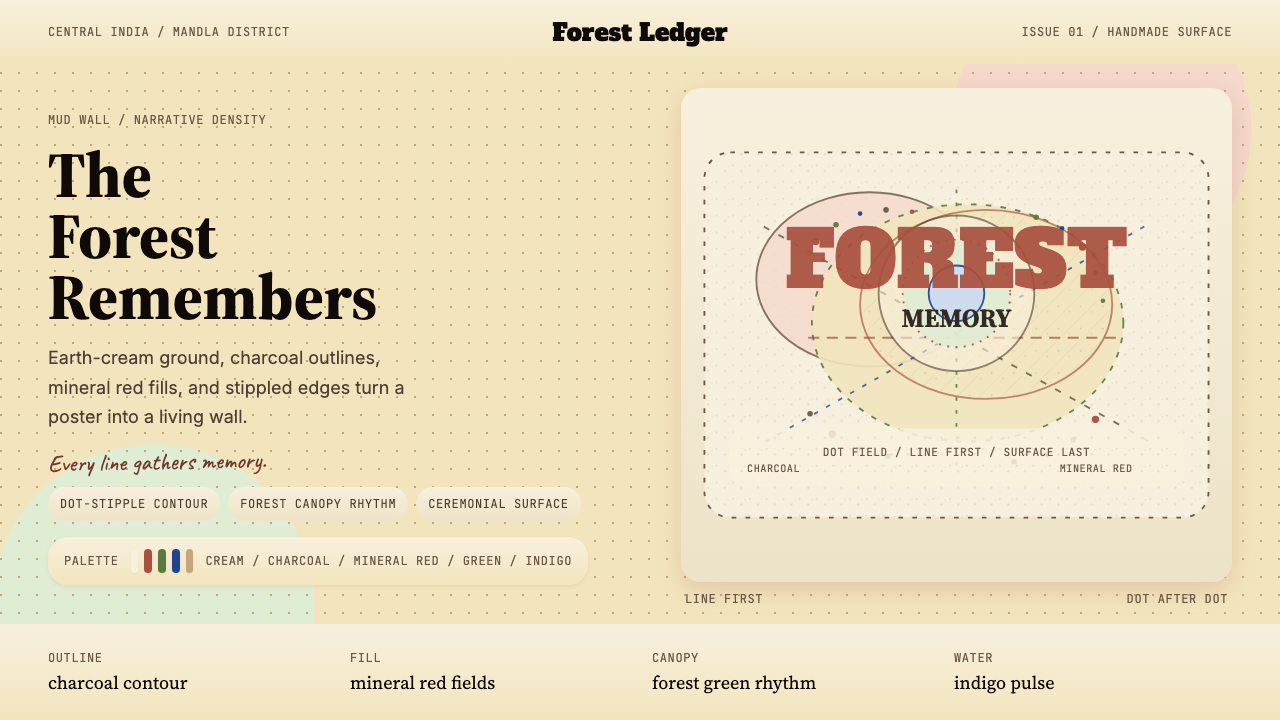 Gond Tribal Art (Madhya Pradesh)The wall becomes a forest. Earth-cream, charcoal, and stippled red make it ce…
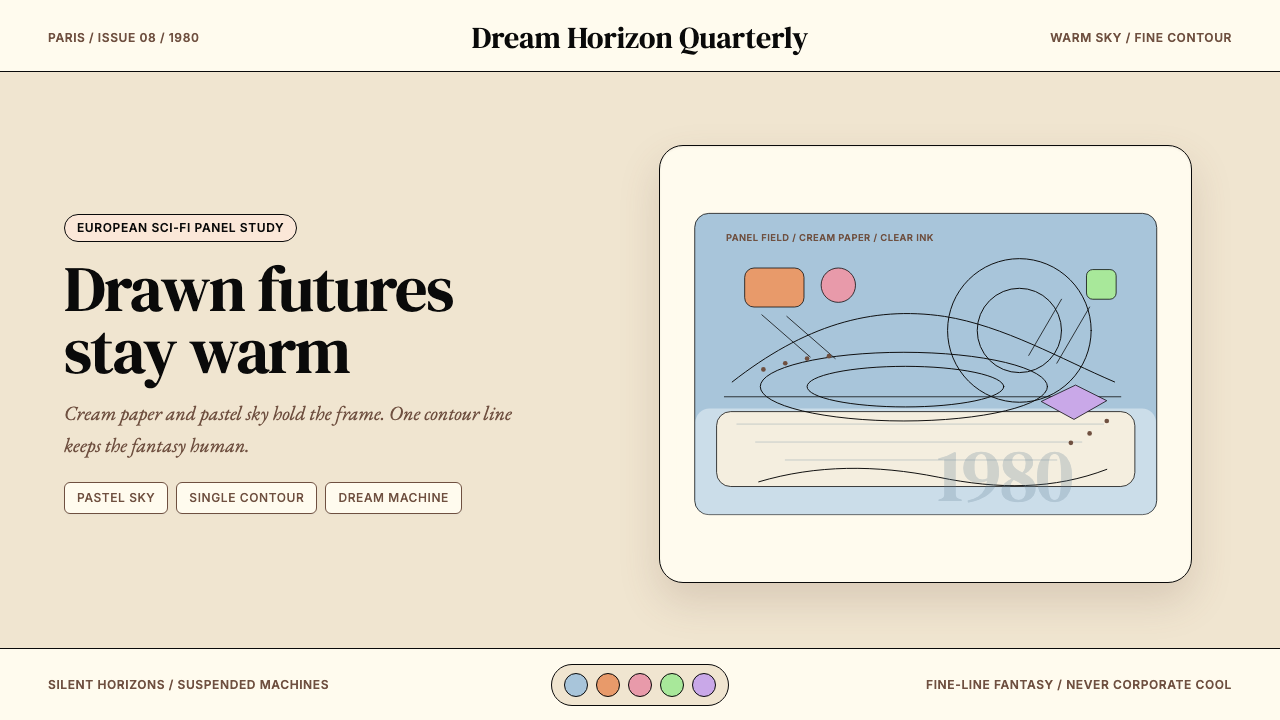 Moebius (Jean Giraud)Dreams stay warm. Cream paper, pastel sky, fine black contours.
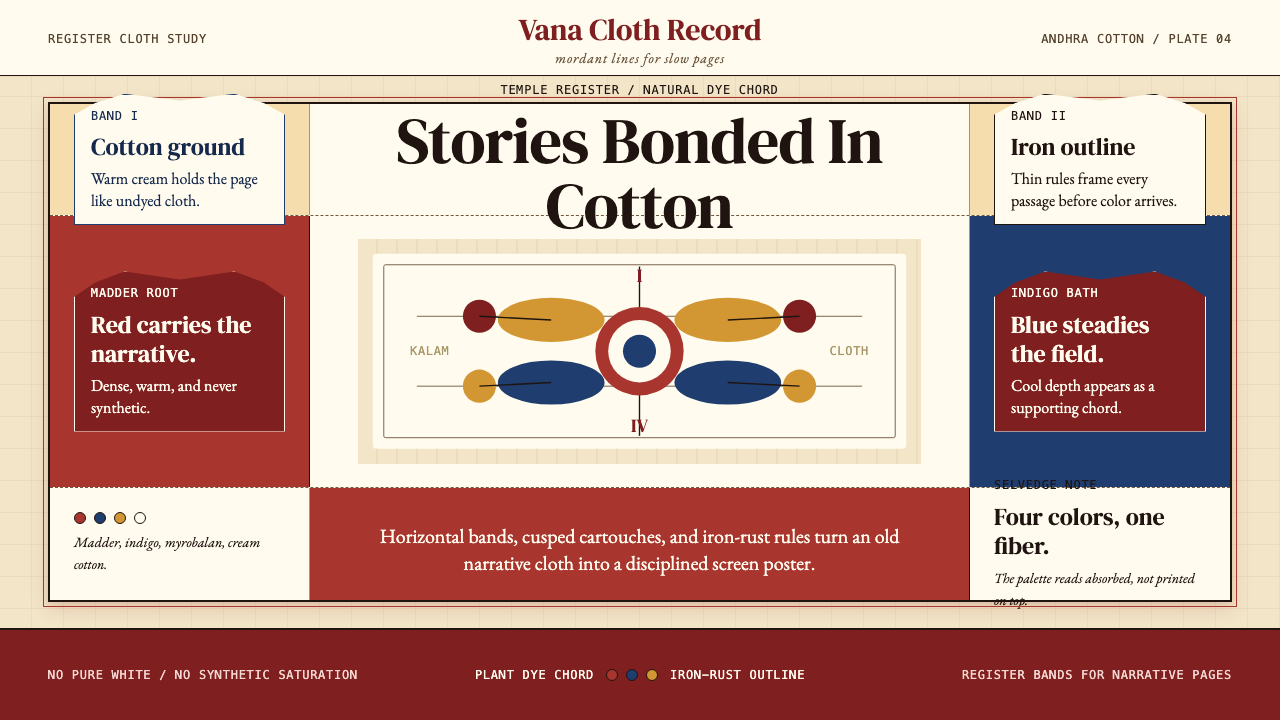 Kalamkari (Andhra Pradesh)Cloth becomes narrative. Madder bands, indigo panels, and iron rules stack li…
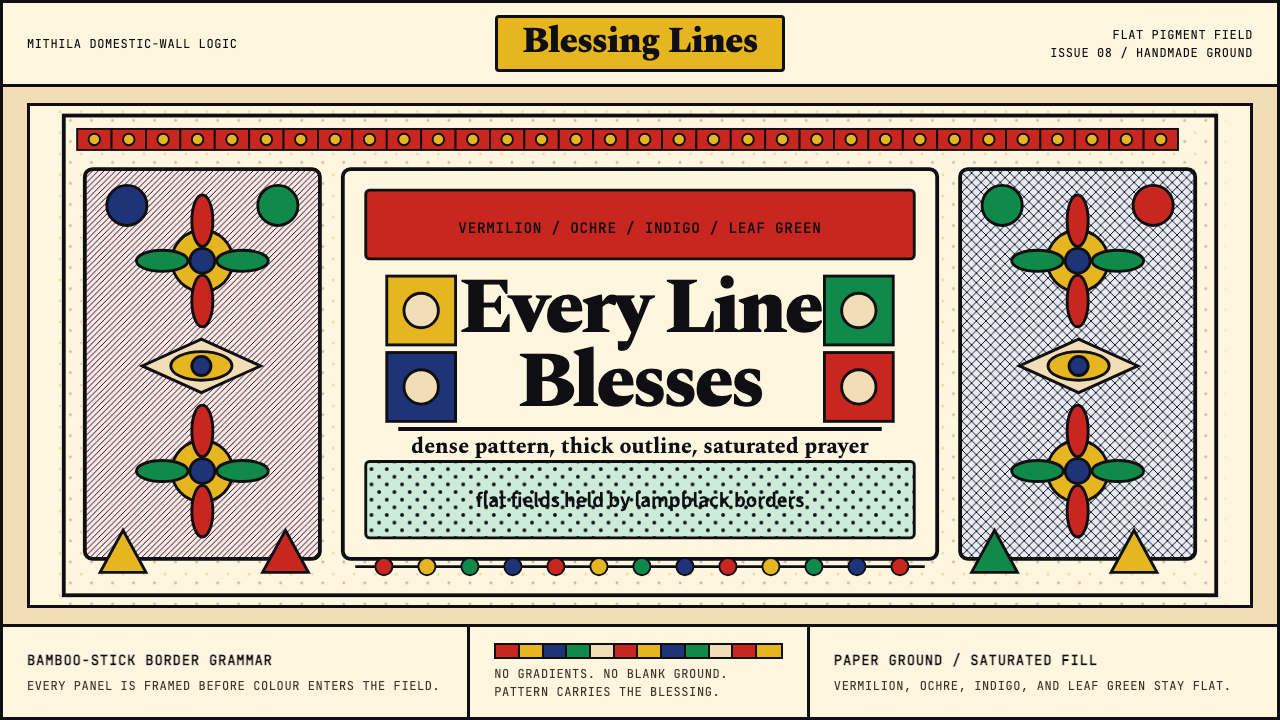 Mithila (Madhubani) PaintingEvery inch is blessed. Lampblack borders lock vermilion, ochre, indigo, and l…
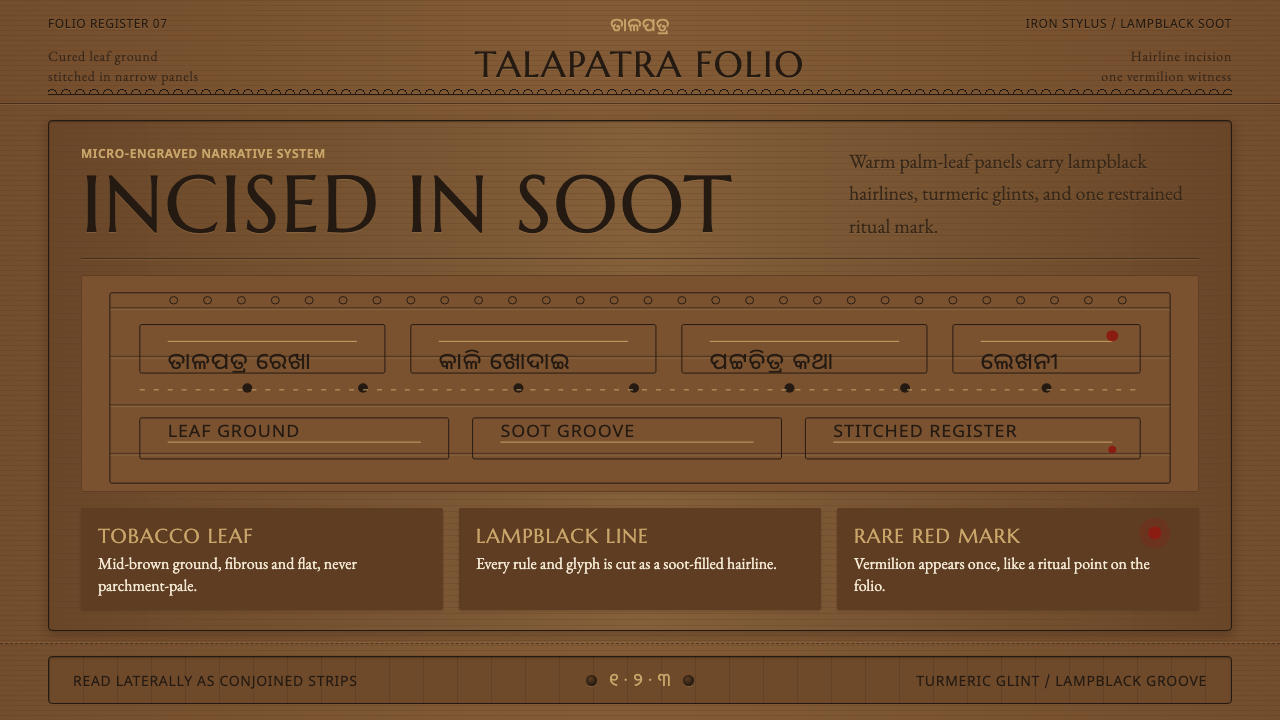 Odisha Palm-Leaf EtchingSacred narrative goes microscopic. Lampblack hairlines cut tobacco-brown leaf…
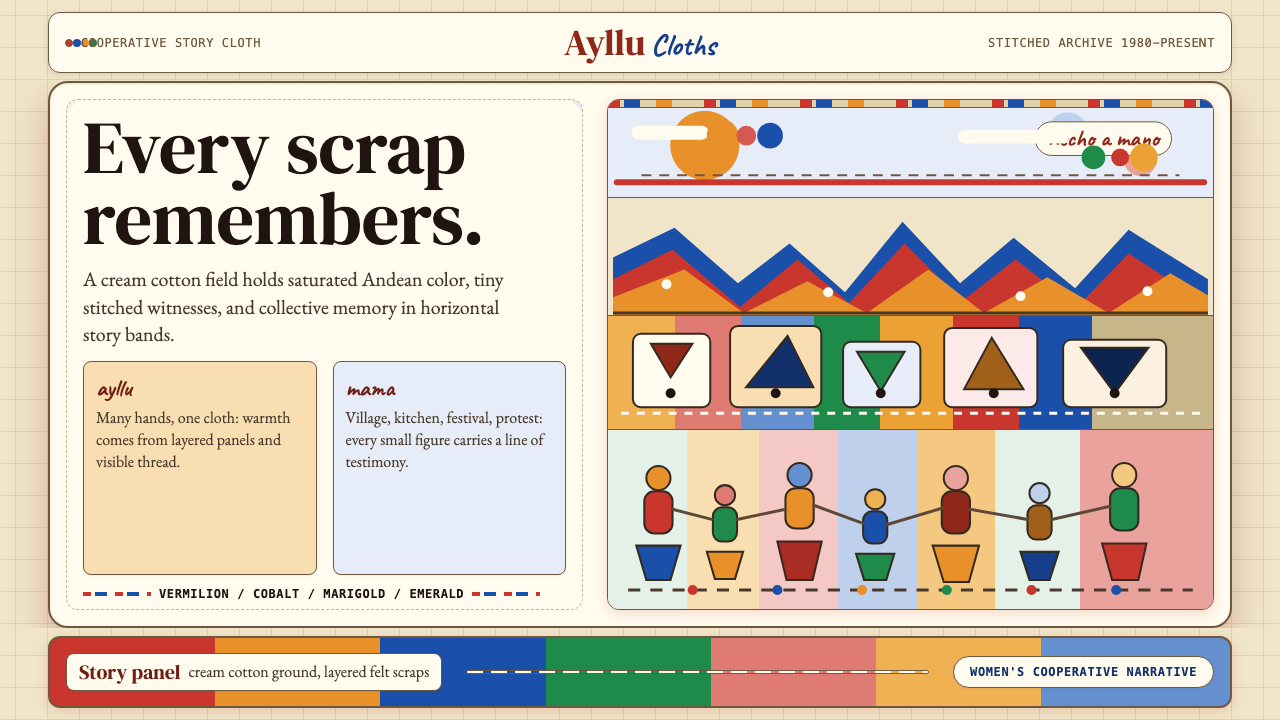 Peruvian Arpillera (Story-Cloth)Narrative warmth in scraps. Vermilion, cobalt and marigold stack into stitche…