What is Bengali Kantha Running Stitch?
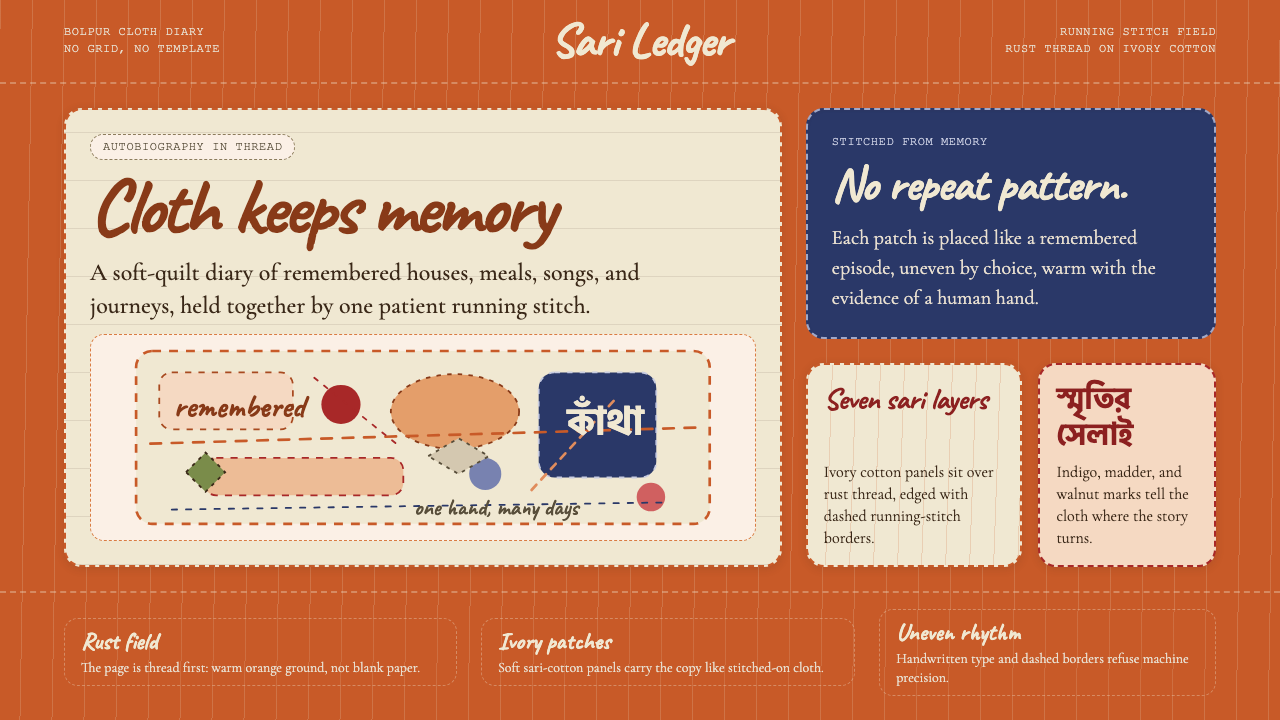
Bengali kantha is South Asia's most autobiographical textile tradition — women stitching family memory, village life, and sacred imagery directly into layered sari cloth with a simple running stitch and no pattern book.
Bengali Kantha Running Stitch in brief
Bengali kantha is a form of hand embroidery that originated among the women of Bengal — a region that today spans the Indian state of West Bengal and the nation of Bangladesh. The word kantha means simply 'patched cloth' or 'old cloth,' and the tradition grew from an entirely practical act: layering worn-out saris and wrapping cloth, then stitching them together so they would not fall apart. Over generations this humble repair work became a vehicle for artistic expression of extraordinary depth, with the running stitch evolving from a structural necessity into the primary mark-making tool of an entire visual language.
What distinguishes kantha from other embroidery traditions is its radical informality. There are no transferred patterns, no specialist tools, no formal instruction in the manner of guild crafts. Each piece is invented by its maker, drawing on a shared visual vocabulary — fish, turtles, lotuses, the tree of life, figures from the Ramayana and Mahabharata, scenes of planting and harvest — but assembled entirely from personal memory and individual judgment. The same fish motif looks different from one maker to the next because it has been drawn in thread from the inside out, not copied from a template. This makes every finished kantha a document of its maker's hand and eye as much as a textile object.
The visual result is a dense, warm, and layered surface unlike anything produced by loom or machine. The ground cloth — typically a soft ivory or natural cotton from recycled sari — shows through in the spaces between stitch lines, giving the work an organic, breathing quality. Motifs accumulate in a field-like arrangement that Western art history might call 'horror vacui' but that Kantha practitioners treat as natural abundance: the textile world, like the natural world, is full. The running stitch itself creates a subtle texture and ripple across the whole surface, so that even the background is never flat.
Where does Bengali Kantha Running Stitch come from?
The earliest documented kantha quilts date to the sixteenth century, though the practice almost certainly predates written records. Historical sources from the Mughal period mention layered quilted textiles from Bengal, and references to kantha-like objects appear in Bengali devotional literature from the medieval era. The tradition developed in a specific material context: Bengal was one of the most important cotton and silk weaving regions in the pre-colonial world, and worn cloth had accumulated meaning as well as practical value. Recycling cloth — particularly cloth that had touched the body through daily life and ritual — was an act of conservation that also preserved the cloth's accumulated sanctity.
The geographic heartland of kantha in India is Birbhum, Bolpur, and Murshidabad districts of West Bengal, with important parallel traditions in the Jessore and Rajshahi districts of Bangladesh. These regions share a similar agricultural economy, a syncretic religious culture blending Hindu and Muslim practices, and a dense tradition of folk arts including song, dance, and narrative painting. Kantha emerged as the women's counterpart to these other traditions — an art form practiced in domestic space, during leisure hours, by women who were not classified as professional artists and who left behind no individual signatures on their work. Attribution in historical kanthas is almost always by region and approximate era rather than by named maker.
The Santiniketan revival, beginning in the early twentieth century and associated with the circle around Rabindranath Tagore, brought kantha from domestic obscurity into the consciousness of the Bengal cultural renaissance. Tagore himself was interested in folk and craft traditions as living alternatives to both colonial culture and Westernized modernity. His collaborators and students began collecting kanthas, writing about them, and encouraging their production as conscious art rather than anonymous craft. The scholar and art historian Stella Kramrisch produced some of the first rigorous scholarly documentation of kantha in the 1930s, establishing it as a subject for serious study and drawing international attention to the tradition.
The partition of Bengal in 1947 — and then the liberation of Bangladesh in 1971 — disrupted but ultimately did not destroy the tradition. Kanthas crossed the new borders in refugee bundles, and communities on both sides of the partition line continued to make them. In the 1980s and 1990s, a significant contemporary revival took place in Bangladesh, driven partly by development organizations that recognized kantha as a sustainable livelihood for rural women. Shamlu Dudeja's Crafts Council of West Bengal and parallel organizations in Dhaka worked to bring kantha makers into contact with urban and international markets, a process that generated both economic opportunity and debates about authenticity, commercialization, and the relationship between individual creative expression and market demand.
What defines the Bengali Kantha Running Stitch look?
The Running Stitch as Mark
The kantha running stitch is the single technique on which the entire visual language rests. It is not an outline stitch, not a fill stitch, and not a couching technique — it is a continuous in-and-out movement through layered cloth that simultaneously holds the layers together and draws the image. The stitch travels in lines that may be straight, curved, or wave-like depending on what is being depicted. In background areas, horizontal rows of running stitch create a rippled texture across the entire cloth surface. In figural areas, the stitches follow the contours of the motif, describing form from the inside rather than tracing an outline. The visual effect is one of animated energy: the surface shimmers slightly because cloth puckers gently between stitch lines.
Color from Thread
Traditional kantha color comes entirely from thread drawn from the borders of the saris being recycled. Bengali saris characteristically have bright-colored borders — saffron orange, rust red, deep indigo, peacock green — while their body is cream or natural white. When the border threads are unraveled and used for embroidery, the palette is automatically anchored to those warm, saturated accent tones set against a cool neutral ground. Rust orange and terracotta dominate in much historical kantha work, with accents of deep blue-green and occasional yellow or vermilion. Contemporary kantha may use commercially purchased thread in a wider range of colors, but the traditional palette reads as warm, folk, and organically saturated — not pastel, not primary, and not corporate.
Folk Figuration
Kantha figures are not naturalistic representations but schematic folk symbols with immediate cultural legibility. Fish — the most universal motif — are drawn with a single continuous line suggesting body and tail, sometimes with geometric scale patterns filling the form. Lotuses are depicted in strict frontality, their petals arranged as a formal diagram rather than a botanical observation. Human figures are flat, frontal, and proportioned according to symbolic logic rather than anatomical accuracy: heads may be large to convey importance, limbs simplified to geometric sticks, costumes indicated by a few key marks. Elephants, horses, palanquins, and scenes of royal procession appear in kanthas made for wedding and ceremonial use. Religious scenes — Krishna dancing, the goddess Durga arrayed with weapons, scenes from the life of the Buddha — are rendered in the same flattened, intimate style, making the sacred feel domestic and the domestic feel sacred.
Asymmetric Narrative Layout
Kantha composition does not observe a single organizing axis or a formal border-and-field hierarchy of the type common in court embroidery traditions. Instead, the surface is populated through accumulation: a central motif — often a lotus medallion or a tree of life — anchors the middle, and surrounding space is filled with secondary figures, narrative scenes, and decorative fills that obey their own internal logic. Borders, when they appear, are typically running stitch lines in alternating colors rather than elaborate woven edges. The overall effect is not chaotic but conversational: different parts of the textile speak to each other across the surface, and the eye travels without a prescribed route. Some kanthas read as pure pattern fields; others as compressed narrative sequences where multiple stories unfold simultaneously in different registers of the cloth.
Layered Ground and Texture
The substrate of kantha is itself a composite object. Multiple layers of worn sari cloth — sometimes three, sometimes as many as seven — are aligned and secured before embroidery begins. The number of layers affects the weight, warmth, and drape of the finished piece. Because the cloth has been washed many times, it has a softness and suppleness that new cotton lacks. The running stitch not only secures these layers but draws them slightly together, creating a gentle quilted puckering across the entire surface. This puckering is not a flaw to be corrected but a defining quality of the kantha aesthetic: it signals handmade origin and gives the textile a dimensional quality that flatly-woven fabric cannot replicate. In design applications, this quality is evoked through the use of rough, slightly irregular textures and the deliberate avoidance of smooth, machined surfaces.
Hand-Drawn Letterform Quality
Where text appears in kantha — in dedications, prayers, or as part of narrative scenes — it is stitched freehand without guidelines, producing letterforms that slant, wobble, and vary in spacing in ways that no typeface can fully simulate. This quality has become part of the broader kantha aesthetic vocabulary in contemporary design applications: type that mimics the looseness of handwriting, with variable baseline and stroke weight, signals the same intimacy and personal authorship that characterizes the textile tradition. The visual effect is not sloppy but warmly imprecise — evidence of a human hand making individual decisions at each moment of execution.
Sacred and Domestic Intertwined
Kantha objects occupy multiple registers simultaneously: a quilt is a useful object that keeps a child warm, a record of the maker's life and skill, a gift that carries devotional intent, and a depository of sacred imagery. This multiplicity is not a contradiction to be resolved but a feature of the tradition's cultural logic. The same textile may include a representation of a deity and a scene of market life and a decorative fish border, not because the maker was confused about categories but because in the world view from which kantha grows, these categories are not in opposition. Design applications that draw on this tradition work best when they embrace similar multiplicity: warmth and narrative, the decorative and the meaningful, the formal and the handmade, coexisting in the same surface.
Who shaped Bengali Kantha Running Stitch?
A master kantha maker from Birbhum district in West Bengal, Pratima Devi became one of the most celebrated practitioners of the tradition in the twentieth century. Her work was distinguished by exceptional stitch density, an elaborate compositional vision that could encompass dozens of narrative episodes within a single textile, and an ability to maintain visual coherence across a complex and crowded surface. Her pieces entered museum collections in India and abroad and helped establish kantha as a serious subject for curatorial attention rather than simply a category of folk craft.
Shamlu Dudeja was the founder of the Crafts Council of West Bengal and one of the most influential figures in bringing kantha to national and international recognition in the late twentieth century. Her organizational work connected rural kantha makers with urban collectors, exhibition venues, and export markets, creating sustainable economic pathways that allowed the tradition to continue. Her approach was careful to balance market adaptation with preservation of the tradition's expressive freedom: she resisted standardization and instead encouraged makers to continue working from personal vision rather than market templates.
Stella Kramrisch was an Austrian-born art historian who spent decades in India and became one of the foundational scholars of Indian art in the twentieth century. Her essay on kantha, published in the Journal of the Indian Society of Oriental Art in 1939, was the first rigorous scholarly treatment of the tradition in English and remains a key reference document. Kramrisch situated kantha within the larger context of Bengali folk art and ritual practice, demonstrating that it was a systematic visual tradition with its own iconographic rules and symbolic depth rather than a naive or accidental form of decoration.
Niaz Zaman is a Bangladeshi scholar and writer whose book The Art of Kantha Embroidery, first published in 1981, provided the most comprehensive documentation of the tradition from the Bangladeshi perspective up to that point. Zaman's work was particularly important for establishing the significance of the Bangladeshi kantha tradition alongside its West Bengali counterpart, demonstrating that the practice had developed distinct regional characteristics in terms of motif vocabulary, compositional organization, and use of color. Her research drew on fieldwork with active kantha makers and provided the scholarly foundation for subsequent revival and documentation efforts in Bangladesh.
Tagore's relationship to kantha was indirect but historically significant. As the animating intelligence of the Santiniketan cultural project — the school and ashram he founded near Bolpur in Birbhum district — Tagore created an institutional environment where Bengali folk arts were treated as aesthetically serious and culturally vital. His explicit interest in rural craft traditions and his critique of colonial cultural hierarchies that devalued non-Western and non-elite art forms made Santiniketan a place where kantha could be appreciated, collected, and eventually studied. The Santiniketan revival of kantha in the early twentieth century was inseparable from the broader cultural politics that Tagore represented.
How do you use Bengali Kantha Running Stitch today?
The kantha aesthetic translates into contemporary design contexts most successfully when treated as a philosophy of warmth, accumulation, and personal storytelling rather than as a surface pattern to be applied. The three defining qualities — hand-drawn line quality, warm organic color, and field-like compositional abundance — each require deliberate translation decisions that preserve the spirit without literally copying textile technique.
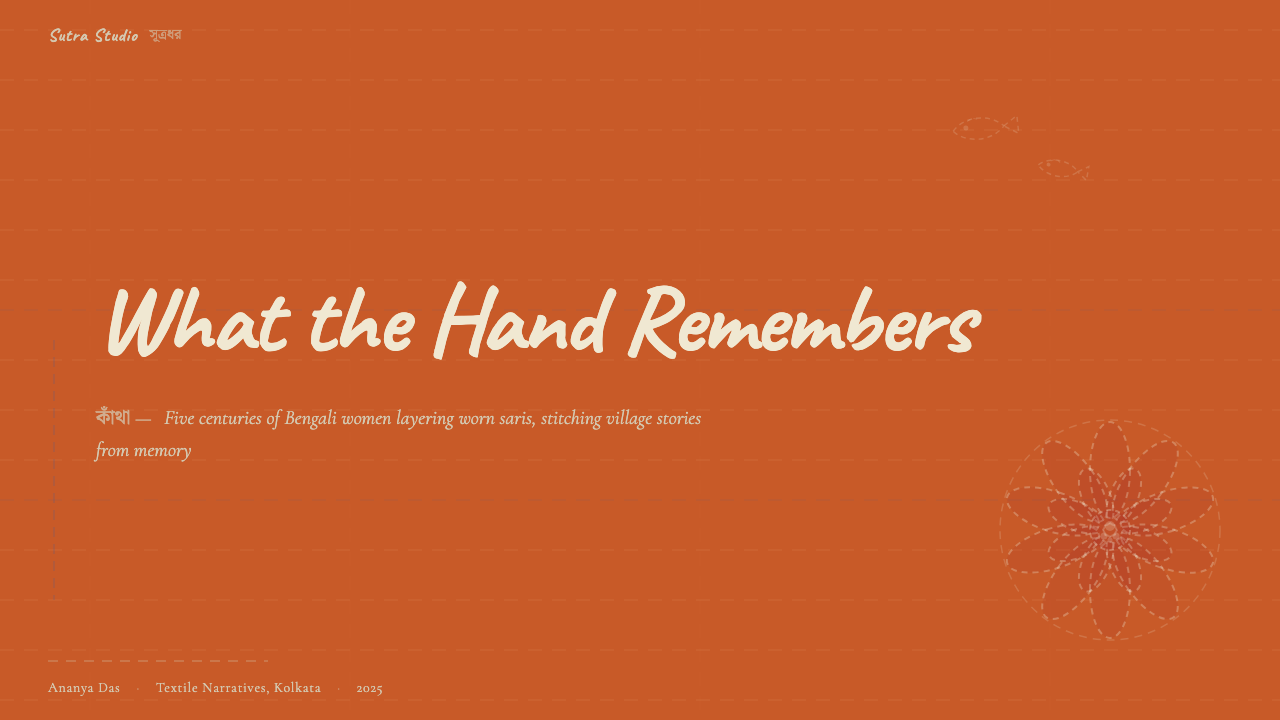
For presentation slides, kantha works best as a storytelling framework. Cover slides benefit from a centered composition with an organic, hand-drawn focal element — a lotus form, a stylized tree, or a folk figure — set against a warm cream or natural ground. The composition should feel slightly asymmetric and human-scaled rather than mechanically centered. Content slides work well with a warm background, generous white space, and typographic choices that lean toward handwritten or semi-casual letterforms rather than crisp geometric sans-serifs. Data slides can use the kantha color vocabulary — rust, terracotta, deep teal — applied to chart elements, with textured or slightly irregular fills that soften the mechanical precision of standard chart software. The overall emotional register should be intimate and narrative rather than authoritative and conclusive.
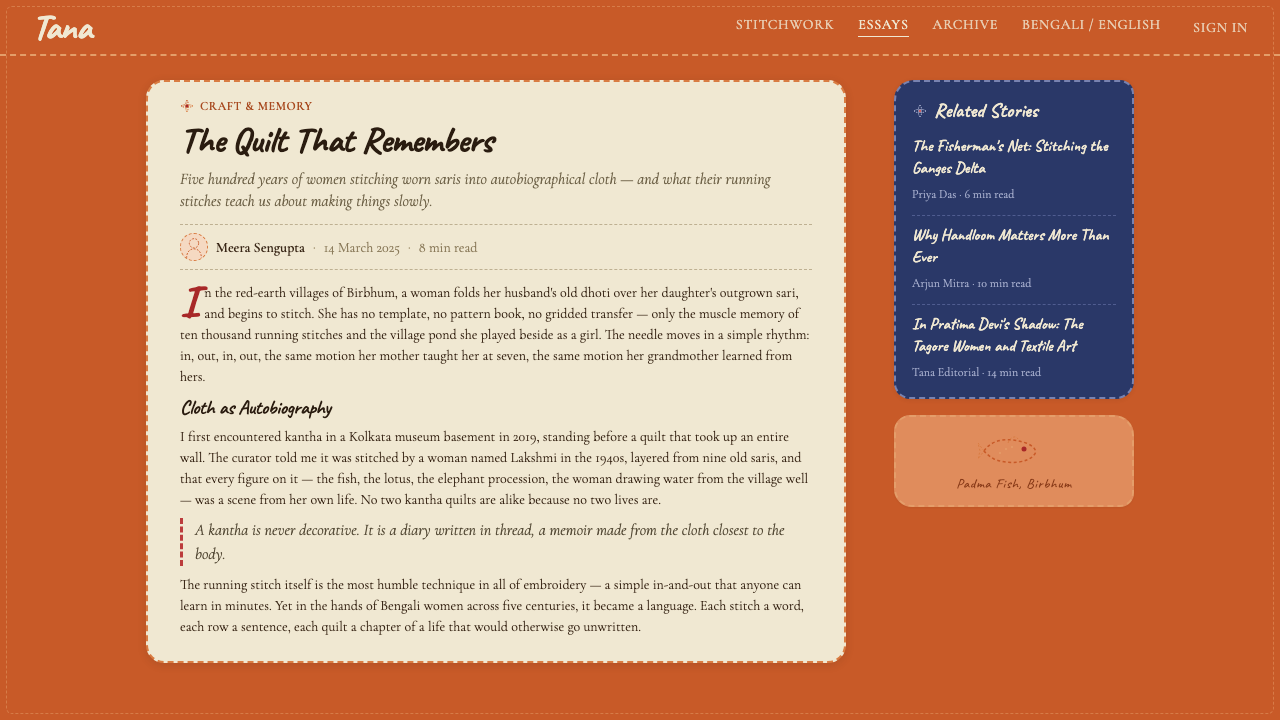
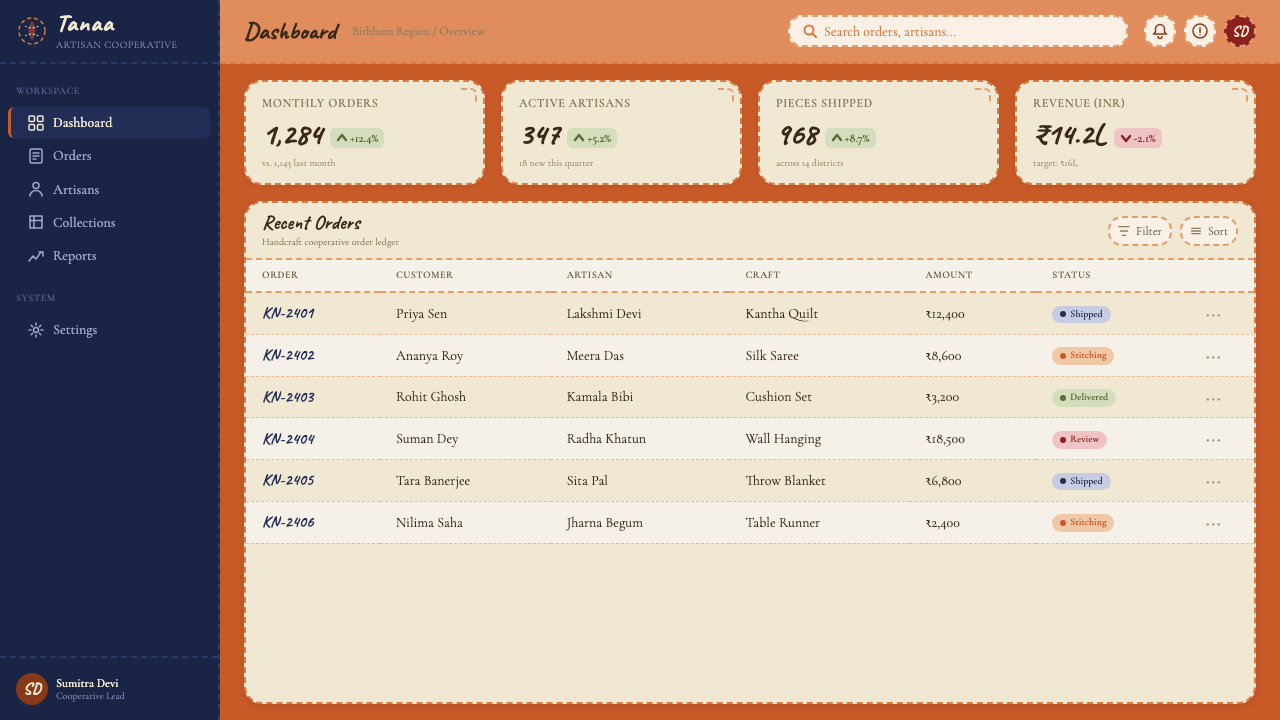
For web interfaces, kantha is most appropriate for contexts where warmth, cultural authenticity, and handmade quality are valued product attributes — artisan marketplaces, craft education platforms, cultural heritage organizations, wellness brands with a traditional rather than clinical orientation. A kantha-influenced dashboard might use warm off-white backgrounds, rust or terracotta as the primary interactive color, hand-drawn or semi-casual typography for headers, and card components with soft, irregular borders that suggest fabric rather than hard-edged screens. Navigation should feel unhurried and conversational. Iconography, if used at all, should be folk-style line drawings rather than geometric or system icons.
For editorial and marketing work, the kantha aesthetic supports rich, layered layouts that reward slow reading. A feature article layout might use a full-width textured header in warm tones, body text set in a comfortable measure with generous line height, and pull quotes or marginal notes rendered in a handwritten or irregular typeface. Marketing pages can use the kantha approach to visual abundance — repeating motifs at multiple scales, layering color and texture — but must manage the risk of visual clutter by maintaining clear reading hierarchy and ensuring that the hand-drawn warmth serves the message rather than competing with it. The tradition's dual register — sacred and domestic, formal and folk — makes it particularly effective for brands that want to communicate both quality and approachability.
The most common mistake when working with kantha-inspired design is substituting superficial textile texture — noise overlays, rough paper filters, scan effects — for genuine compositional and chromatic thinking. Applying a grain filter to an otherwise standard layout does not produce a kantha-informed design; it produces a standard layout with dirt on it. The tradition's authentic qualities — warmth, accumulation, hand-drawn energy, the sense that every mark is a deliberate act — must be built into the compositional logic from the start. A second frequent error is overextending the palette: kantha's warmth comes from the discipline of a few saturated accent tones against a neutral ground, not from attempting to include all possible warm hues simultaneously.
A common mistake specific to digital kantha applications is treating the aesthetic as exclusively suitable for ethnic or heritage branding contexts. The tradition's core qualities — narrative warmth, layered depth, visible human craft — are applicable across a much wider range of product categories: children's educational software, independent publishing platforms, small-scale food and hospitality brands, personal portfolio sites, and any context where the product proposition depends on human connection rather than technological authority. The limitation is symmetrical: kantha does not work well in contexts requiring clinical precision, corporate authority, or the suggestion of industrial scale.
Bengali Kantha Running Stitch — FAQ
What is the difference between kantha and quilting?
Both kantha and quilting involve stitching multiple layers of cloth together, but they differ fundamentally in technique, visual effect, and cultural origin. Western quilting typically involves cutting fabric into geometric pieces, reassembling them into planned patterns, and then quilting the top layer to a batting and backing. The visible stitch in quilting is usually a finishing element rather than the primary design tool. In kantha, the running stitch is the sole technique: it simultaneously holds layers together and draws the image. There is no batting, no piecing, and no pattern transfer. The visual surface of kantha is a continuous embroidered field rather than a mosaic of fabric patches. The kinship between the two traditions lies in the spirit of textile recycling and domestic practice rather than in technical method.
Is kantha exclusively a Hindu tradition?
No. Kantha developed in a region — Bengal — where Hindu and Muslim communities have lived in close proximity for centuries, and the textile tradition has always been practiced across religious lines. While some kantha iconography draws on Hindu mythology — depictions of Krishna, the goddess Durga, or scenes from the epics — other kanthas are entirely secular in their imagery, depicting local life, nature, and everyday scenes. In Bangladesh, where the majority population is Muslim, kantha has remained a vibrant living tradition, with makers adapting the iconographic vocabulary to emphasize geometric and floral motifs rather than figurative religious imagery. The tradition is better understood as a Bengali cultural practice than as a specifically religious one.
How does contemporary commercial kantha relate to the historical tradition?
The relationship is complex and contested. Commercial kantha — produced for export markets, often in workshops with multiple workers and standardized designs — has diverged significantly from the personal, idiosyncratic kantha made by individual women for household use or gift-giving. Commercial pieces often use purchased thread rather than thread from the recycled sari, feature designs that have been market-tested rather than invented by the maker, and are produced under time and cost constraints that limit the density and creativity of the stitching. At the same time, commercial production has provided economic livelihoods for thousands of women who might otherwise have had no income, and some workshop production has found ways to preserve creative latitude for individual makers. The historical and the commercial coexist, and pieces exist across a spectrum from purely handmade-personal to purely market-standardized.
Why is the running stitch so central — why not more complex embroidery techniques?
The running stitch is central to kantha precisely because of its simplicity and universality. It requires no specialized tools, no advanced training, and no materials beyond a needle and thread. This accessibility meant that kantha could be practiced by women across a wide range of economic circumstances and skill levels, and that the tradition could spread and sustain itself without institutional support or formal apprenticeship. The artistic achievement in kantha is not technical virtuosity in the conventional sense — it is the expressive depth that a master practitioner can achieve with the most elementary of stitches. The constraint is generative: because the same stitch must serve every purpose, the tradition developed extraordinary resourcefulness in varying stitch direction, density, and color to achieve a wide range of visual effects.
Can the kantha aesthetic work for technology products or fintech?
Generally no, and the reasons are structural rather than superficial. The kantha aesthetic communicates warmth, personal narrative, organic imprecision, and handmade intimacy — values that are in direct tension with what most technology and financial products need to project: precision, reliability, systemic control, and institutional trust. A banking interface that signals handmade quality raises questions about the reliability of its backend systems; a data dashboard that uses folk-art illustration raises questions about the accuracy of its numbers. There are exceptions: fintech products targeting artisan economies or small-scale cultural producers might find kantha's vocabulary genuinely aligned with their user community. Educational technology for young children is another area where the warmth of the aesthetic serves the product. But for mainstream technology contexts, the aesthetic is better used as an accent — in illustration, in loading states, in onboarding flows — than as the dominant visual system.
Related design styles
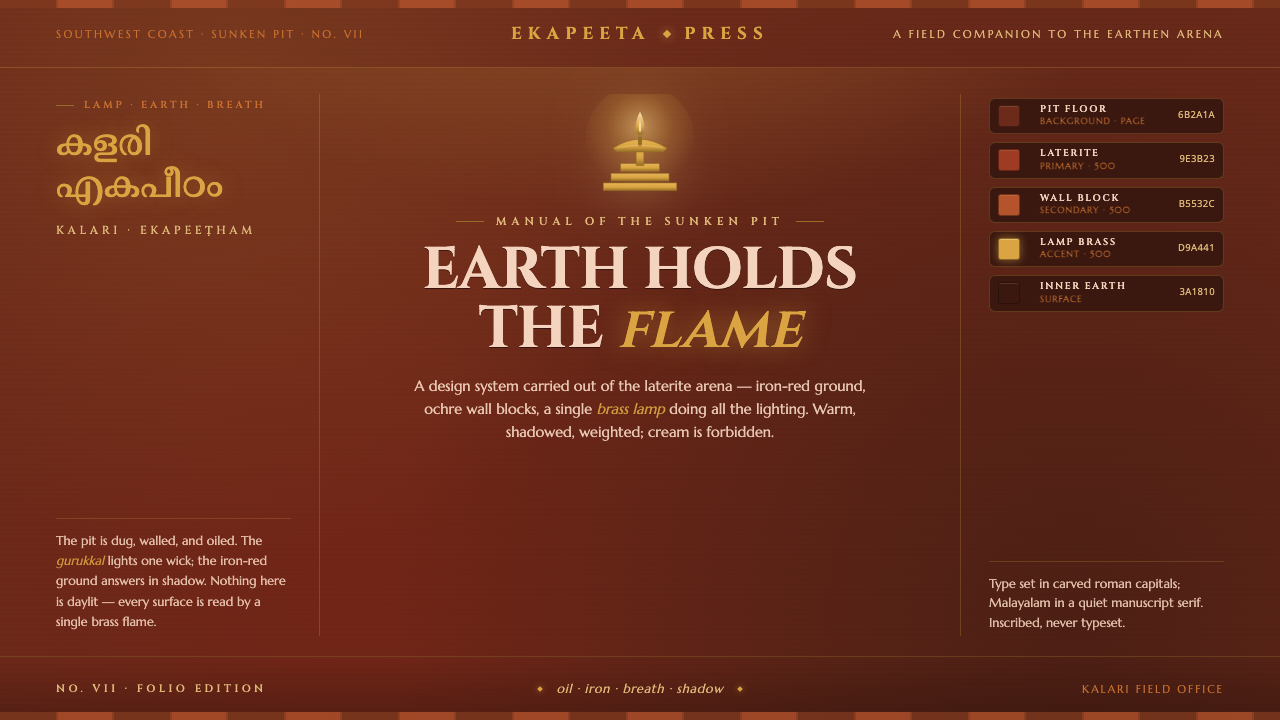 Kalaripayattu Kalari ArenaEarth holds the flame. Iron-red laterite, ochre wall blocks, a single brass l…
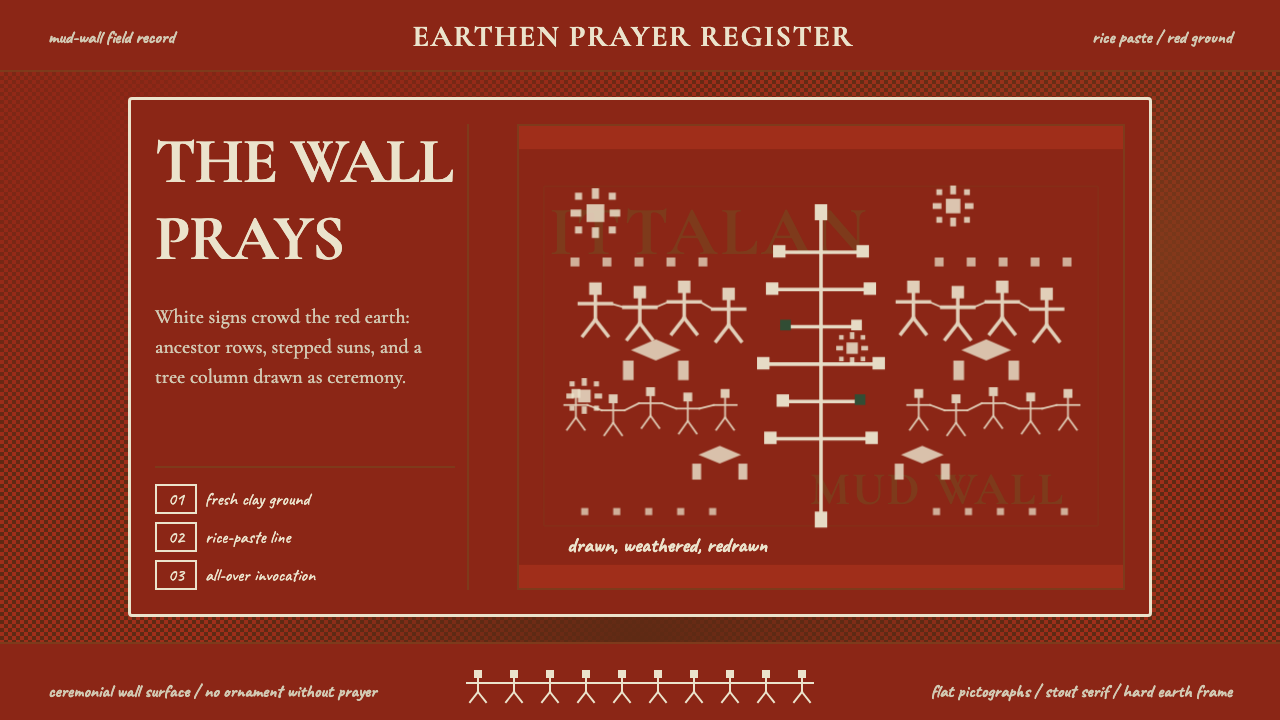 Odisha Saura Tribal MuralSacred density. Rice-white pictographs crowd a red-earth wall in ritual rhyth…
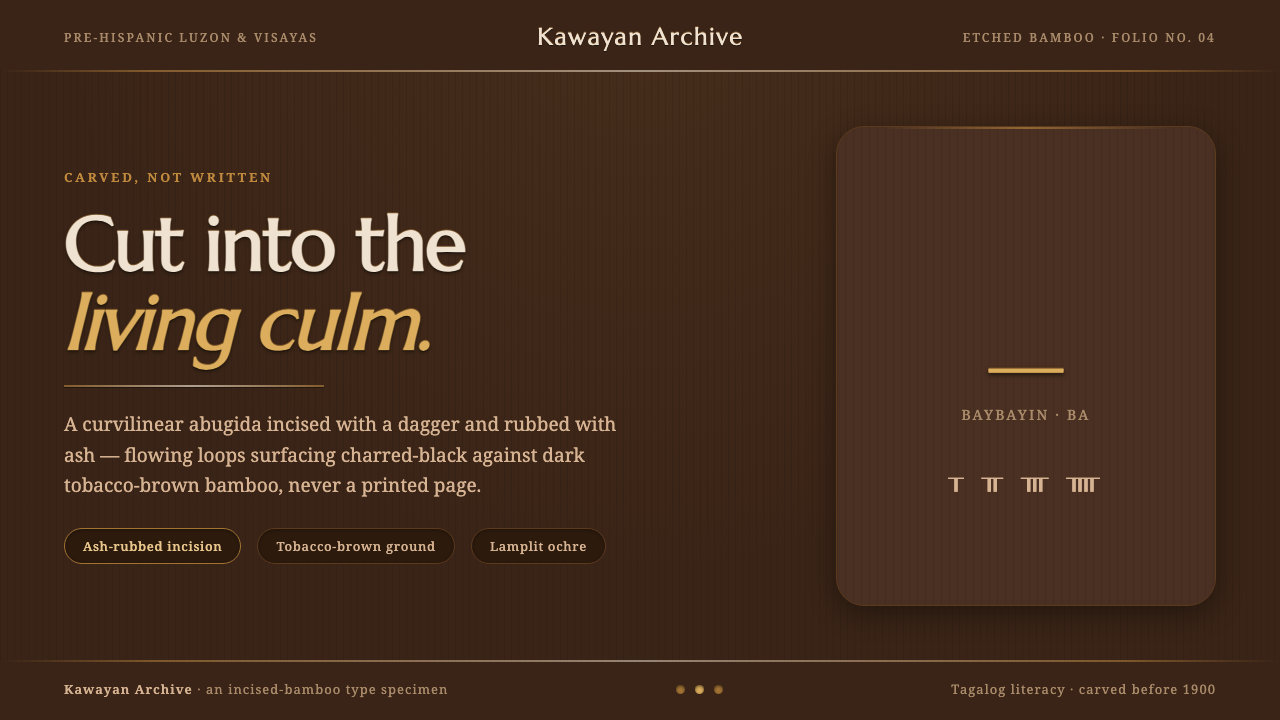 Baybayin ScriptCarved, not written. Curvilinear baybayin ash-rubbed into tobacco-brown bambo…
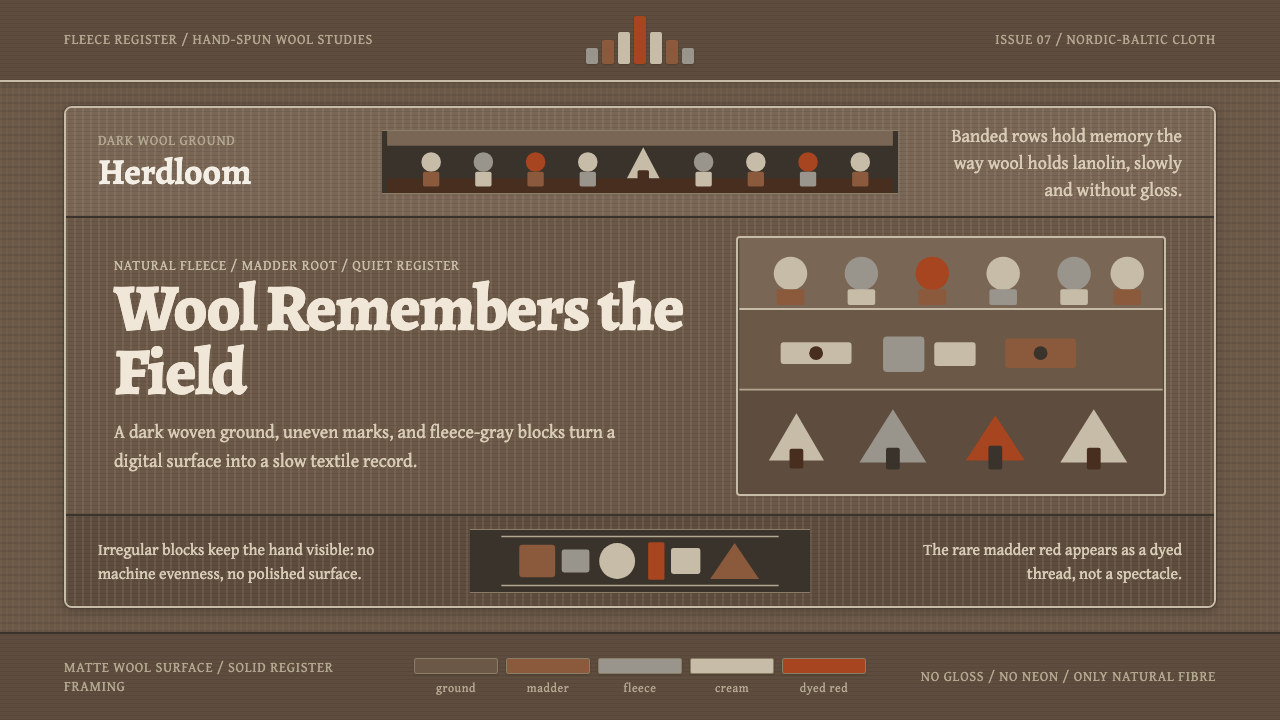 Estonian Folk Tapestry (Anu Raud)Quiet wool carries memory. Banded fleece browns and Alegreya type move like a…
 Georgian Qvevri Supra FeastHospitality made earthen. Terracotta ground, amber wine, Georgian serif curve…
 Himba Otjize Ochre NamibiaDense and ritual-warm. Oxblood ground, butterfat sheen, and sparse brass coil…