What is Iraqi Marsh Arab Mudhif Reed?
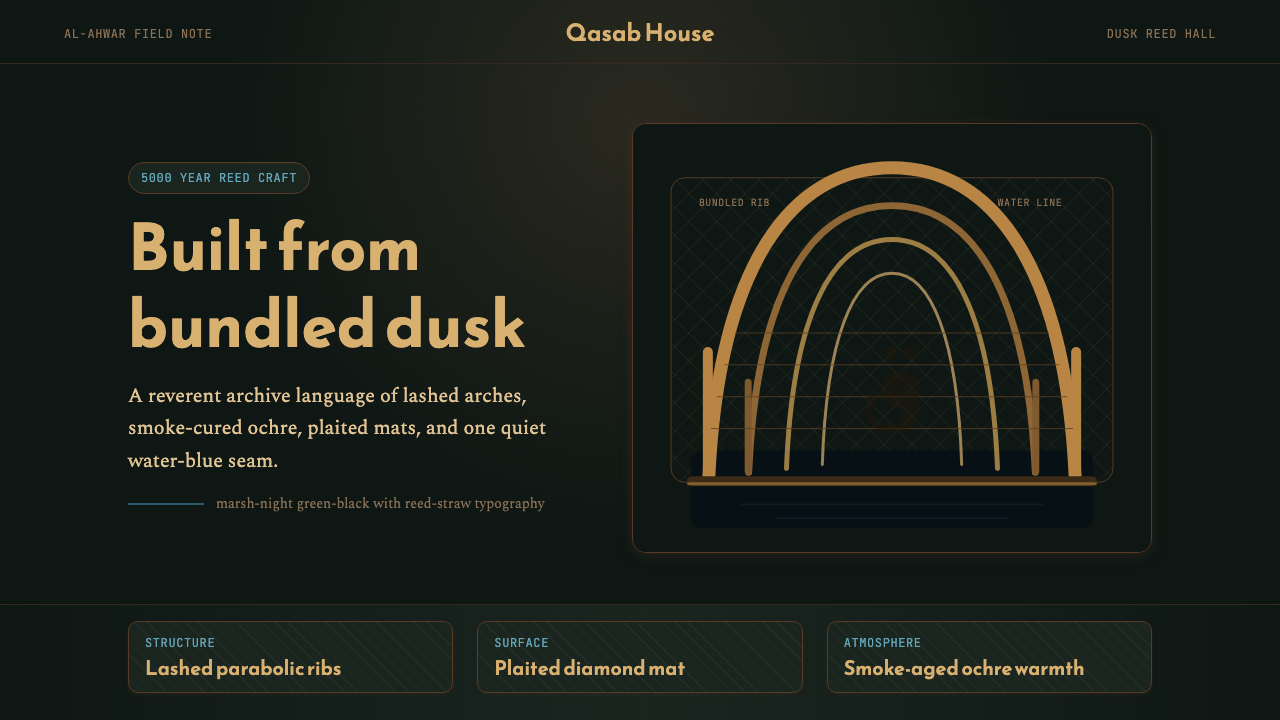
The mudhif is a cathedral built from reeds — an arching, smoke-darkened hall that has sheltered Mesopotamian life for five thousand years, and whose woven geometry still speaks a living visual language.
Iraqi Marsh Arab Mudhif Reed in brief
Iraqi Marsh Arab Mudhif Reed is a design language rooted in the vernacular architecture of the Ma'dan — the Marsh Arabs of southern Iraq — who have built monumental guest halls from the towering reeds of the Mesopotamian marshes since at least the third millennium BCE. The mudhif itself is a structure of extraordinary elegance: bundles of giant reeds are bent into soaring pointed arches, lashed together at their crowns, and infilled with woven reed matting to create a vaulted interior that filters light like a forest canopy. The resulting aesthetic is organic, structural, and deeply material.
The visual character of this system emerges from the interior of a sheikhly mudhif at dusk. Overhead, the repeated reed-bundle arches create a rhythmic, compressed barrel vault — deep ochre and smoke-cured brown tones graduating into near-black at the apex. The walls and floor are layered with plaited diamond-lattice mats whose geometric precision contrasts with the organic irregularity of the bundled columns. Beyond the open ends of the hall, the Hammar or Central Marsh stretches away in a blue-black stillness that appears as a single cool horizontal accent against the warm interior.
As a design system, Mudhif Reed translates these architectural and material qualities into a contemporary visual vocabulary: vaulted arch forms as structural dividers, woven diamond-lattice textures as surface pattern, a palette anchored in marsh-night greens and reed ochres with a single water-blue accent, and a compositional logic that emphasizes verticality, compression, and the quiet reverence of a sheltered interior space.
Where does Iraqi Marsh Arab Mudhif Reed come from?
The architectural tradition embodied in the mudhif is among the oldest continuous building practices on earth. Clay tablets and cylinder seals from Sumerian Uruk — dating to roughly 3200–3000 BCE — depict the same bundled-reed facade that Ma'dan builders construct today. The Sumerians called the marsh people Anki, and the reed structures they inhabited appear in the earliest Mesopotamian cosmological imagery. The continuity is not merely symbolic: the techniques of splitting, soaking, bending, and lashing giant reeds (Phragmites australis) have been transmitted from builder to builder, community to community, with almost no deviation for five millennia.
The Ma'dan people developed a civilization adapted entirely to a floating world. Their islands (dibbin) were constructed from reeds and mud, their boats were of bundled reed, and their houses ranged from the simple arched sarifa dwelling to the monumental mudhif reserved for the sheikh and used for community gatherings, judicial hearings, and the reception of guests. A mudhif is not a private home but a public institution — its interior is kept in permanent readiness to receive travelers, and the obligation of hospitality it embodies (diyafa) is among the most stringent in Arab culture. The space is designed to communicate welcome, dignity, and permanence simultaneously.
The twentieth century brought catastrophe to the marshes. The British mandate period and successive Iraqi governments imposed land-use restrictions, and the large-scale drainage schemes of the 1950s reduced the marshes significantly. But the decisive destruction came between 1991 and 2003, when Saddam Hussein's regime, following the failed Shia uprising after the Gulf War, drained approximately ninety percent of the marshes in a campaign of deliberate ecological destruction. The Ma'dan population, estimated at around half a million before 1990, was reduced by displacement and violence to a fraction of that number. The mudhif tradition — dependent on living communities with access to giant-reed stands — was brought to the edge of extinction.
The post-2003 period brought partial restoration. With the fall of Saddam Hussein, drainage structures were breached and water began returning to the marshes. Environmental scientist Azzam Alwash and his organization Nature Iraq led an internationally supported effort to restore the hydrological systems and document the returning ecology. By the 2010s, roughly sixty percent of the original marsh area had been recovered. In 2016, UNESCO inscribed the Ahwar of Southern Iraq — including the marshes and associated archaeological sites — as a World Heritage Site, recognizing both the ecological uniqueness and the living cultural heritage. The mudhif continues to be built, though the communities that sustain it are smaller and the giant reed less abundant than before 1990. The tradition's survival is an act of cultural resilience as much as architectural continuity.
Western documentation of the mudhif tradition began in earnest with the British explorer and writer Wilfred Thesiger, who lived among the Ma'dan for several extended periods in the late 1940s and 1950s and whose photographs — published in his 1964 book The Marsh Arabs — gave global audiences their first detailed visual access to the tradition. Norwegian photographer Tor Eigeland documented the marshes in the 1970s. These records became crucial after 1991, when the built heritage was largely destroyed, providing reference material for post-2003 reconstruction efforts.
What defines the Iraqi Marsh Arab Mudhif Reed look?
Palette — Marsh Night
The dominant tones are derived from the mudhif's smoke-cured interior at dusk: deep greens shading into near-black that recall the marsh at nightfall, warm ochre and amber tones that correspond to sun-dried and fire-cured reed, and a brown-black that appears in the shadowed depths of the arched ceiling. Against this warm, dark ground, a single water-blue accent — the color of the marsh surface glimpsed through the open hall ends — provides the system's only cool note. The palette reads simultaneously as earthy and nocturnal, reverent and intimate.
Arch and Vault Rhythm
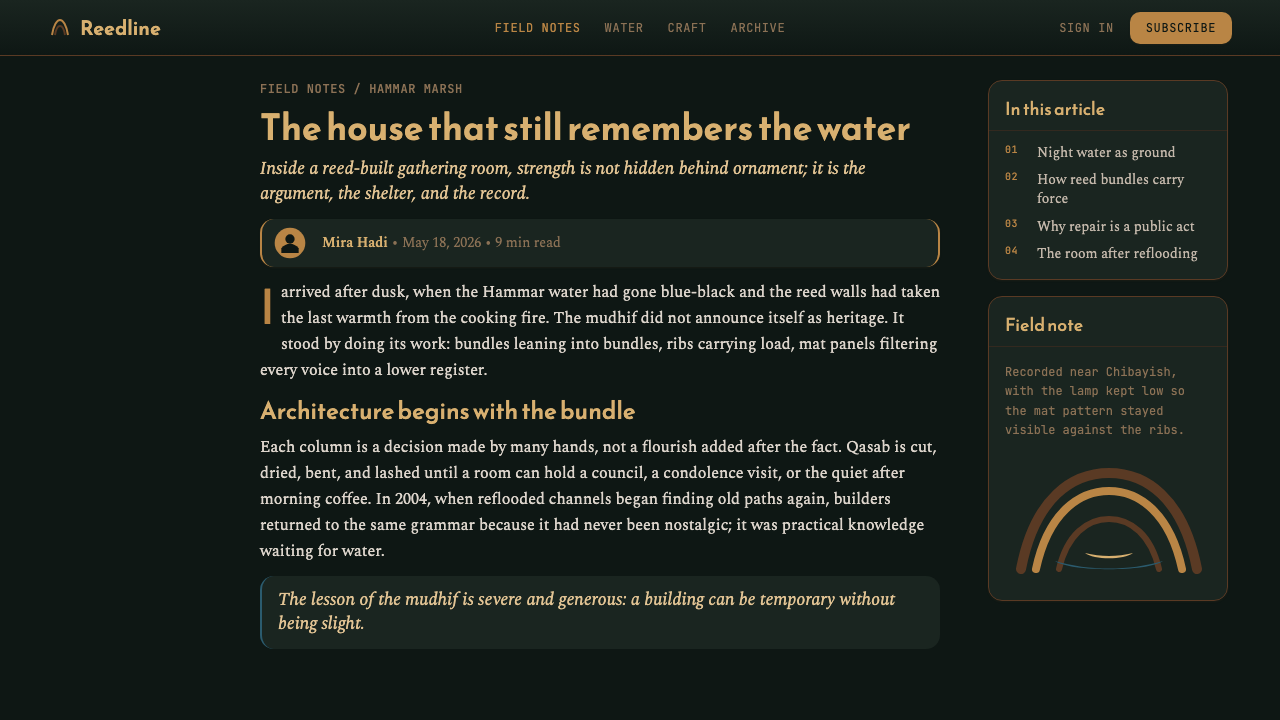
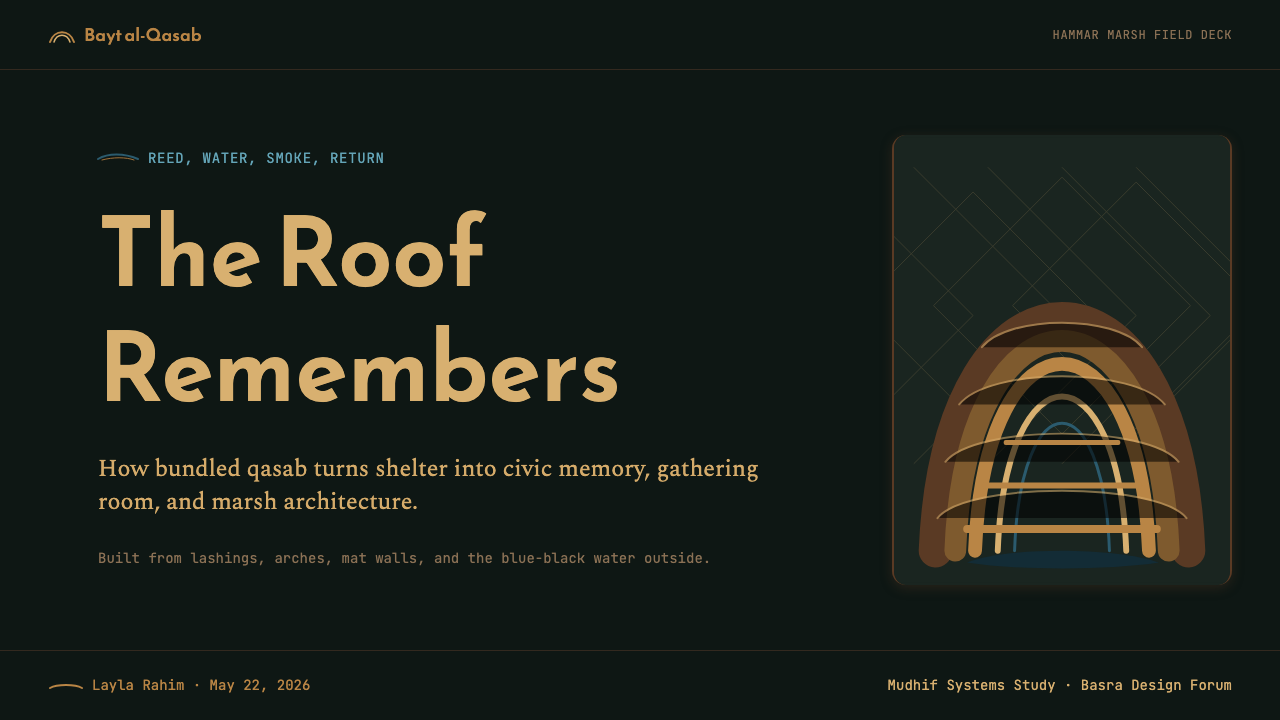
The defining structural form is the pointed arch created by two bent reed bundles meeting at their crowns. In the mudhif, these arches repeat at regular intervals down the length of the hall, creating a compressed barrel vault effect. As a compositional motif, the arch form functions as a framing device, a section divider, and a symbol of sheltered space. The rhythm of repeated arches — each slightly irregular due to hand construction — gives the system an organic quality that distinguishes it from mechanical repetition: there is consistency without rigidity.
Woven Diamond Lattice
The woven reed mats that line the mudhif's walls and floor are constructed in a diagonal over-under plaiting technique that produces a diamond or lozenge pattern. This lattice is one of the most ancient geometric forms in human visual culture — it appears on Ubaid-period pottery from the fifth millennium BCE in the same region — and in the mudhif context it carries the visual signature of careful, practiced handwork. The diamond grid operates across multiple scales: as a large-format wall texture, as a repeat tile in flooring, and as a micro-pattern in mat edging. Its regularity provides visual stability while its slight material variation (each reed is unique) prevents monotony.
Bundled Column Verticality
The columns of the mudhif are not single structural members but bundles of multiple reed stems lashed together with fiber cord, their base spread slightly and their upper ends pulled together toward the arch crown. The visual effect is one of gathered, upward-straining energy — like a handful of rushes held at the waist and raised overhead. This bundled column form communicates solidity through multiplication: the structure appears to hold its load through collective effort rather than monolithic strength. Translated into design, this principle expresses itself as grouped vertical elements, thin strokes consolidated into deliberate clusters, and an overall compositional preference for height over width.
Smoke, Warmth, and Age
A mudhif that has been in use for years is deeply marked by smoke from the fire kept burning near its entrance: the reed surfaces graduate from tawny ochre near the ground to a rich, almost black depth near the ceiling apex. This tonal gradation — warm at the base, dark at the crown — is the opposite of the typical light-from-above convention and gives the interior a particularly enveloping quality. The smoke also unifies disparate materials: individual reed bundles, mat panels, and rope lashings all acquire the same amber-to-charcoal patina. The design system carries this quality as a preference for graduated tonal depth over flat uniform color fields, and for warmth as the default temperature of any neutral tone.
The Single Cool Accent
In the mudhif at dusk, the warm interior is bracketed at both ends by open views across the marsh — a pale, luminous blue-grey water-surface that registers as a sudden horizon. This visual contrast between warm enclosure and cool opening is one of the most emotionally charged moments in the experience of the building. The design system preserves this quality by restricting cool tones to a single carefully placed accent. The accent reads as relief, as distance, as sky glimpsed through reed columns — and its power depends entirely on its restraint. Used generously, the water-blue becomes decorative; used sparingly, it functions as a window.
Materiality and Imperfection
Every element of a mudhif is hand-made from a single natural material. No two reed bundles are identical in diameter; no two mat panels are exactly the same density; no two arch crowns meet at precisely the same angle. The building's aesthetic authority does not come despite these variations but through them — the slight irregularities signal authentic craft, accumulated skill, and responsive making. As a design principle, this translates to an aesthetic tolerance for organic texture and natural variation: surfaces that breathe slightly, patterns that flex at their edges, and an overall quality that reads as made rather than generated.

Who shaped Iraqi Marsh Arab Mudhif Reed?
A contemporary mudhif builder and keeper of the tradition in the revived post-2003 marshes, Sheikh Khlaif represents the continuity of the living practice. His family's mudhif in the Chibayish area of the Central Marshes is among the most documented of the surviving structures and was featured in international coverage of the UNESCO inscription process. His work demonstrates that the technical knowledge of giant-reed construction — including the sequences of bending, lashing, and tightening that give the arches their load-bearing integrity — has been retained in living memory and continues to be transmitted to a new generation of builders.
An Iraqi-American environmental engineer who grew up in the marshes and returned after 2003 to lead the restoration effort. Through his organization Nature Iraq and in collaboration with international conservation bodies, Alwash coordinated the breaching of drainage embankments, the monitoring of water quality, and the documentation of recovering wildlife. He received the Goldman Environmental Prize in 2013 for this work. His broader contribution to the mudhif tradition is indirect but foundational: without the physical return of water to the marshes, the reed-building communities could not revive. Alwash's restoration work created the ecological precondition for cultural continuity.
The British explorer and writer Wilfred Thesiger spent several extended periods living among the Ma'dan between 1947 and 1958, traveling by mashuf (a narrow reed canoe) through the waterways and sleeping in the homes of marsh families. His photographs — taken with a simple handheld camera and reproduced in his 1964 book The Marsh Arabs — gave global audiences their first sustained visual documentation of the mudhif and the material culture surrounding it. Thesiger had reservations about modernization and was drawn to what he perceived as an unchanging ancient way of life, which gives his account a somewhat elegiac quality. Nevertheless, his photographic record became an irreplaceable reference after 1991, when the communities and structures he documented were largely destroyed.
Norwegian photographer Tor Eigeland documented the Iraqi marshes and their inhabitants in the 1970s for National Geographic and other international publications. His color photographs, shot during a period when the marsh civilization was still largely intact, provide a complementary record to Thesiger's black-and-white work — capturing the color quality of the reed surfaces, the play of light through the vault, and the textures of woven mats with documentary precision. Eigeland's imagery contributed to an international awareness of the marshes' cultural significance at a time when they faced growing developmental pressure.
No single individual name can be attached to the five-thousand-year tradition of reed architecture in Mesopotamia, but the Sumerian culture of Uruk deserves recognition as the tradition's most ancient documented source. Cylinder seals, clay tablets, and the facade of the so-called White Temple at Uruk show bundled-reed columns and recessed-panel wall textures that are unmistakably continuous with the mudhif as built today. The Sumerian deity Enki — god of water, wisdom, and the deep — was associated with the marshes, and the Abzu (the underground freshwater ocean) was imagined as a reed-filled space. The aesthetic language of the mudhif is therefore not only vernacular craft but a thread connecting contemporary Ma'dan builders to the very origin of literate civilization.
How do you use Iraqi Marsh Arab Mudhif Reed today?
Mudhif Reed is a design system that rewards careful atmospheric commitment. Its power depends on maintaining a consistent dark-ground orientation — the warm, smoke-cured interior of the mudhif is the emotional center of the system, and departing from it too freely loses the distinctive sense of sheltered depth that separates this vocabulary from generic dark-mode conventions. When applied well, the style communicates reverence, material authenticity, and a kind of living antiquity that is highly distinctive in contemporary digital contexts.
For presentation slides, the system's dark palette and arch motifs make it particularly well-suited to cover and section-divider pages where establishing atmosphere matters more than information density. A cover built within this language might use a deep marsh-green or ochre-to-black gradient field as the primary ground, with the title set in a wide, considered typeface at relatively generous scale, and a single water-blue horizontal accent bar placed low — echoing the marsh horizon visible through the hall ends. Content slides should pull back from the atmospheric depth: a near-black or very deep ground with light-ochre text and minimal graphic elements — a single arch-form divider, a discreet woven texture in the margin — maintains coherence without competing with content. Data visualization benefits from the system's color logic: dark grounds with warm tonal bars and a single water-blue highlight for the most significant data point.
For web interfaces, Mudhif Reed suits contexts that benefit from a sense of depth, enclosure, and unhurried authority — documentation sites, cultural institution pages, premium product landing pages, and portfolios in the cultural or architectural sectors. The lattice texture, used at low contrast as a background or section separator, provides visual richness without visual noise. Navigation and header elements work well in deep marsh-green or near-black with ochre labels; the water-blue accent is reserved for primary calls to action or focus states. Card components carry the system's shadow logic: a slight warm-toned elevation shadow rather than a cold grey one, consistent with the interior's ambient lighting quality.
For editorial and marketing work, the style's greatest strength is in conveying cultural weight and material seriousness. An editorial layout in this register uses generous margins, deliberate text hierarchy, and section breaks marked by a thin horizontal rule in the ochre tone rather than a decorative ornament. Pull-quotes might be set in the water-blue accent — the only moment of color against an otherwise warm-dark page. Marketing pages benefit from alternating between a rich dark-ground section and a near-neutral mid-tone section, with the arch form used as a full-bleed photographic frame or a section transition motif.
A common mistake when applying Mudhif Reed is treating the water-blue accent as a secondary color rather than a punctuation mark. The system's emotional logic depends on that accent being genuinely rare — one blue element per screen or slide communicates the marsh horizon; three or four of them turn a carefully controlled atmosphere into an unfocused composition. A related mistake is softening the warmth of the ochre tones toward neutral beige: the system's intimacy comes from the specific amber-to-dark-ochre range that reads as sun-dried and smoke-cured, not as conventional craft-market warmth. Neutralizing those tones strips the system of its most distinctive quality.
Iraqi Marsh Arab Mudhif Reed — FAQ
What makes the mudhif tradition visually distinctive from other reed or thatch building traditions?
Most reed and thatch traditions around the world produce low-pitched roofs or conical forms. The mudhif is distinguished by its use of the pointed arch — a form created by bending entire bundles of giant reeds into a catenary curve and lashing them at the crown. This produces a monumental vaulted hall rather than a domestic shelter, and it gives the interior an extraordinary vertical quality for a structure built without any rigid members. The arch form also allows the mudhif to be considerably larger in span and height than comparable vernacular structures, which reinforces its social function as a public gathering hall. The combination of pointed arch, bundled column, and woven lattice panel is unique to this tradition.
Is this a dark design system, and how should contrast be managed?
Yes, Mudhif Reed is fundamentally a dark-ground system rooted in the smoke-cured interior of the mudhif at dusk. Managing contrast requires distinguishing between two registers: the warm-against-warm relationships within the primary palette (deep greens, ochres, and browns that share similar luminance) and the single cool-against-warm accent (the water-blue appearing against the dark field). Legibility within the warm register is achieved through tonal separation rather than hue contrast — light ochre text on a deep brown ground rather than introducing new colors. The water-blue accent must be reserved for the highest-priority elements, because it is the only point where true chromatic contrast appears. Accessibility checks on text contrast are essential, as some of the richest tonal combinations within the warm palette will fall short of minimum contrast ratios for body text.
How does the lattice texture work across different output media?
The diamond lattice derived from woven reed mats works well as a surface element but requires calibration for each medium. In digital screen contexts, the lattice is most effective at low contrast — as a barely-perceptible surface variation on a background rather than a dominant graphic element. The pattern should be fine-grained enough that individual intersections are not conspicuous on standard screen resolutions. In print, the lattice can carry more visual weight and can be used at higher contrast on section backgrounds or covers. In presentation contexts, use the lattice sparingly — as a margin texture or a small panel element — rather than as a full-slide background, where it can compete with text readability. The key in all media is that the lattice should read as surface memory of woven material rather than as a geometric decoration imposed on top of the design.
Can Mudhif Reed work for a contemporary brand that has no connection to Iraq or the Arab world?
Yes, but the appropriateness depends heavily on context and intention. The visual vocabulary of Mudhif Reed — arched forms, woven geometry, dark warm palette, single cool accent — is a distinct aesthetic with a specific cultural origin, and using it without any acknowledgment of that origin can feel hollow. The most successful applications tend to be those where the brand's own values — longevity, craftsmanship, ecological sensitivity, the dignity of the handmade — genuinely resonate with what the mudhif represents. Contexts that call for dark, warm, materially rich, and reverently serious atmospheres are where the system is likely to work with integrity. Using it purely as a visual novelty, without engagement with what the forms mean, typically produces work that feels decorative rather than resonant.
How does Mudhif Reed relate to other Middle Eastern or Islamic design traditions?
The mudhif tradition predates Islam by several thousand years and is rooted in Mesopotamian vernacular architecture rather than in the courtly or religious design traditions most commonly associated with the Islamic world. The pointed arch form appears in both traditions, but in the mudhif it arises purely from structural necessity — the catenary curve formed by a bent reed bundle — rather than from the geometric and theological elaboration found in mosque architecture. Similarly, the diamond lattice derives from weaving technique rather than from the mathematically derived geometric tiling patterns of classical Islamic art. The Ma'dan are Muslim, and the mudhif is embedded in an Islamic social context, but its aesthetic logic is pre-Islamic in origin and derives from material constraints rather than from religious symbolism. This distinction matters for designers: Mudhif Reed should not be conflated with Islamic geometric style or Arabic calligraphy traditions, which are separate and far more widely recognized visual systems.
Related design styles
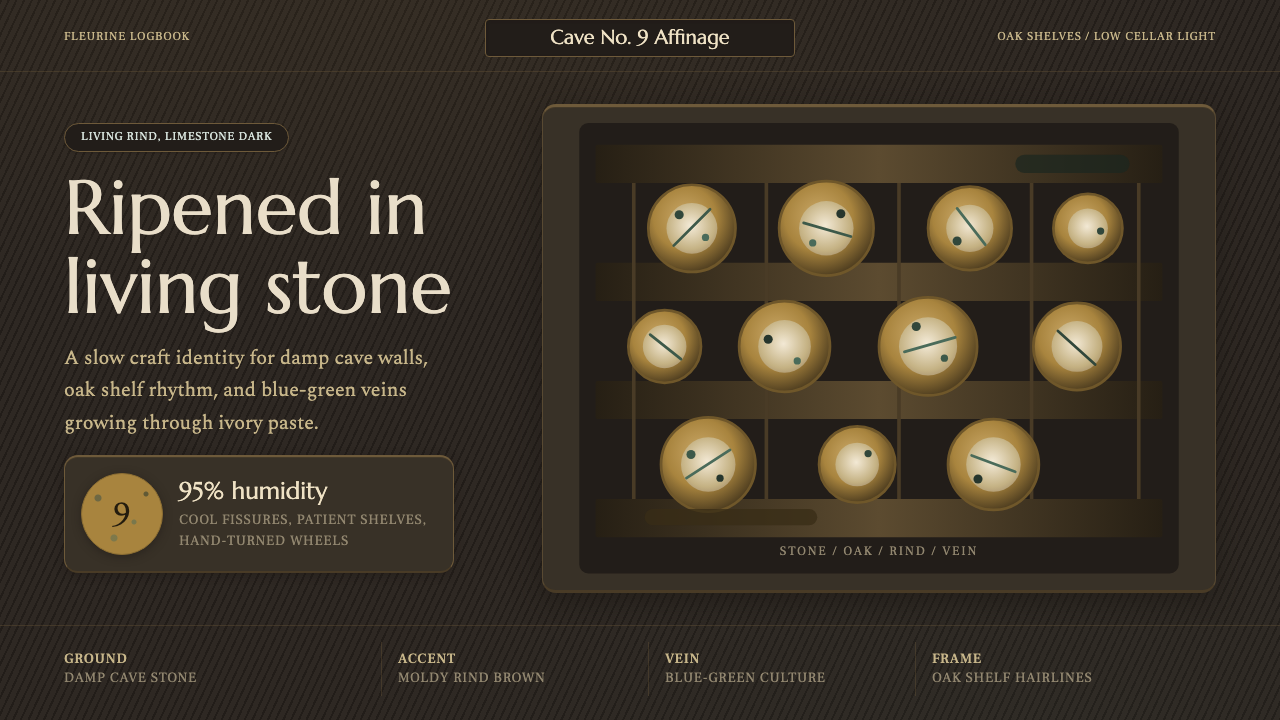 Cheese Affinage CavePatience reads as stone. Rind brown, mold green, and oak shelf grids glow in…
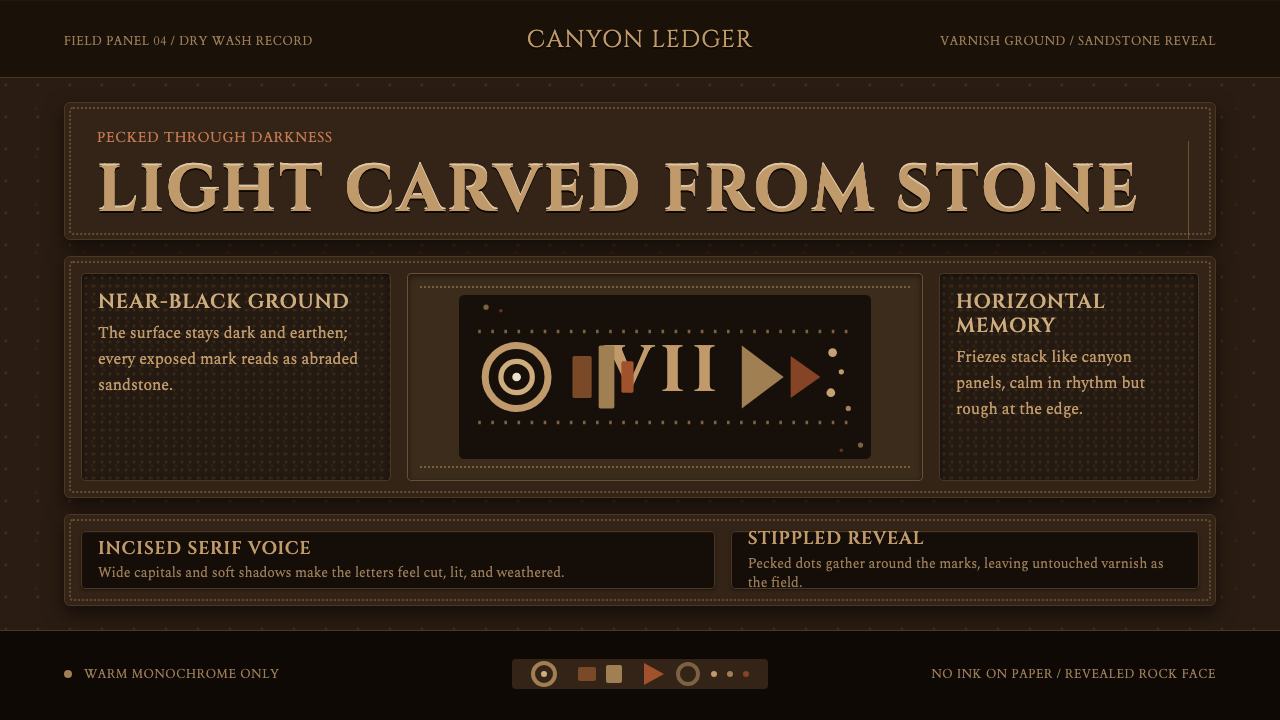 Desert VarnishStone remembers. Sandstone glyphs cut through near-black varnish in stacked f…
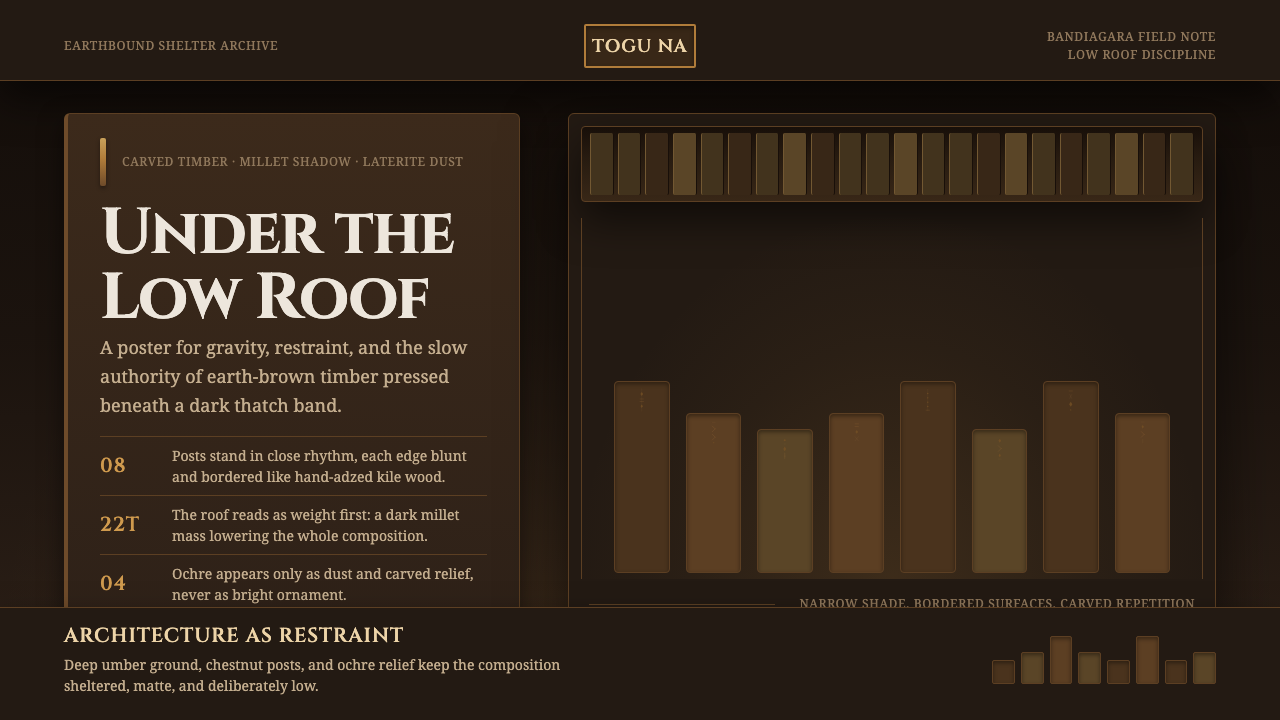 Dogon Toguna Shelter MaliGravity made visible. Deep umber ground, low roof band, chestnut posts in sha…
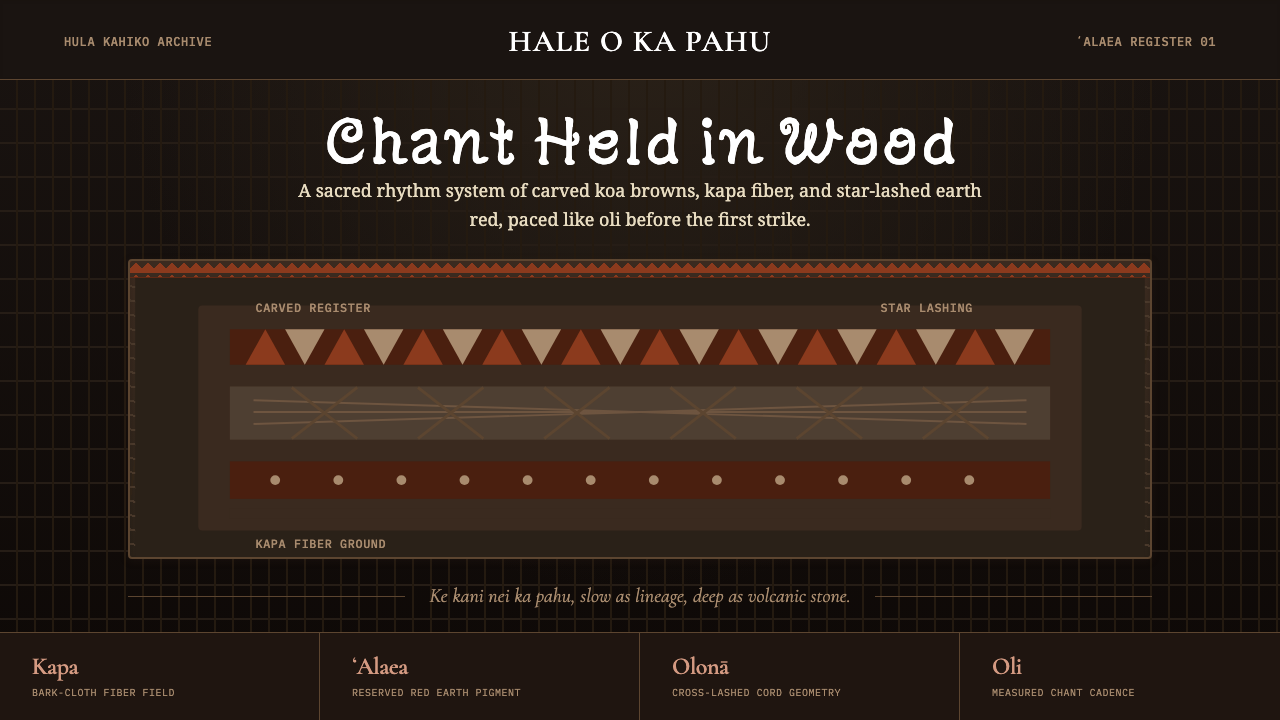 Hawaiian Hula Pahu DrumSacred weight, hand-marked. ʻAlaea red, kapa texture, and stacked carved regi…
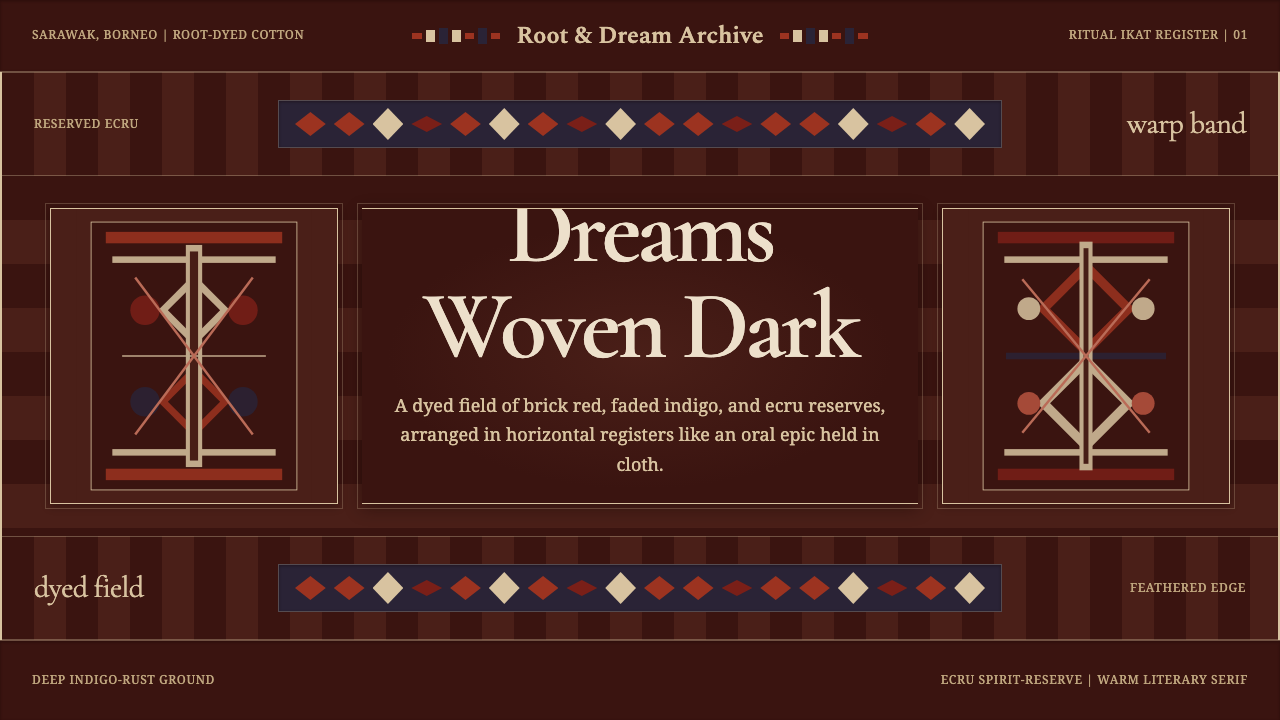 Iban Pua KumbuSacred cloth logic. Indigo-rust bands, ecru reserves, and blurred ikat edges…
 Nok Terracotta NigeriaAncient clay holds the dark. Russet grain, Cinzel labels, and pierced triangl…