What is Ecuadorian Otavalo Cochineal Loom?
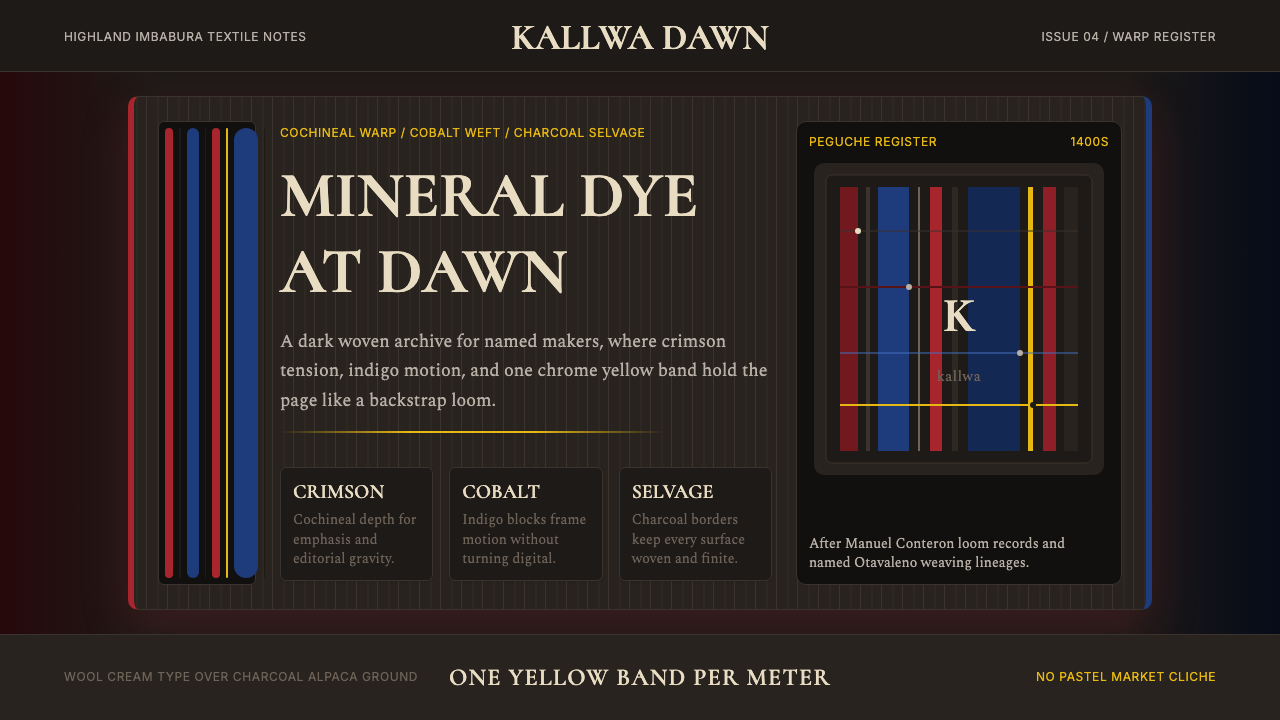
From the highland looms of Imbabura, a weaving tradition older than the Inca empire transforms mineral-dye saturation and precise stripe geometry into one of the Americas' most enduring and visually powerful design systems.
Ecuadorian Otavalo Cochineal Loom in brief
Ecuadorian Otavalo Cochineal Loom is a design system rooted in the living textile practice of the Kichwa-Otavaleño weavers of Imbabura province in the northern Andes. It draws directly from the visual vocabulary of the backstrap loom — the tensions of the warp, the rhythmic interlocking of the weft, the mineral richness of dyes derived from cochineal insects, indigo plants, and volcanic earth pigments — and translates those properties into a digital aesthetic language.
The system is built around a core contrast: deep, saturated chromatic bands — cochineal crimson, indigo cobalt, chrome yellow — pressed against a charcoal ground made from undyed dark alpaca or llama fiber. This is not a palette assembled for contemporary taste; it is the direct visual record of what those dyes do to those fibers under highland light. The stripe is the fundamental unit of composition, carrying the weight of both decoration and structure simultaneously.
What distinguishes this tradition from other Andean textile systems is its particular economy: one accent color per meter of cloth. Each chamarra or anaco is disciplined by this rule. The cochineal-dyed warp threads carry the primary chromatic statement; the cobalt weft crosses and ties; the charcoal selvage frames the whole; and a single band of chrome yellow appears once, like a signature, to close the composition. That restraint — abundance of craft meeting austerity of layout — gives the Otavaleño textile its characteristic visual authority.
Where does Ecuadorian Otavalo Cochineal Loom come from?
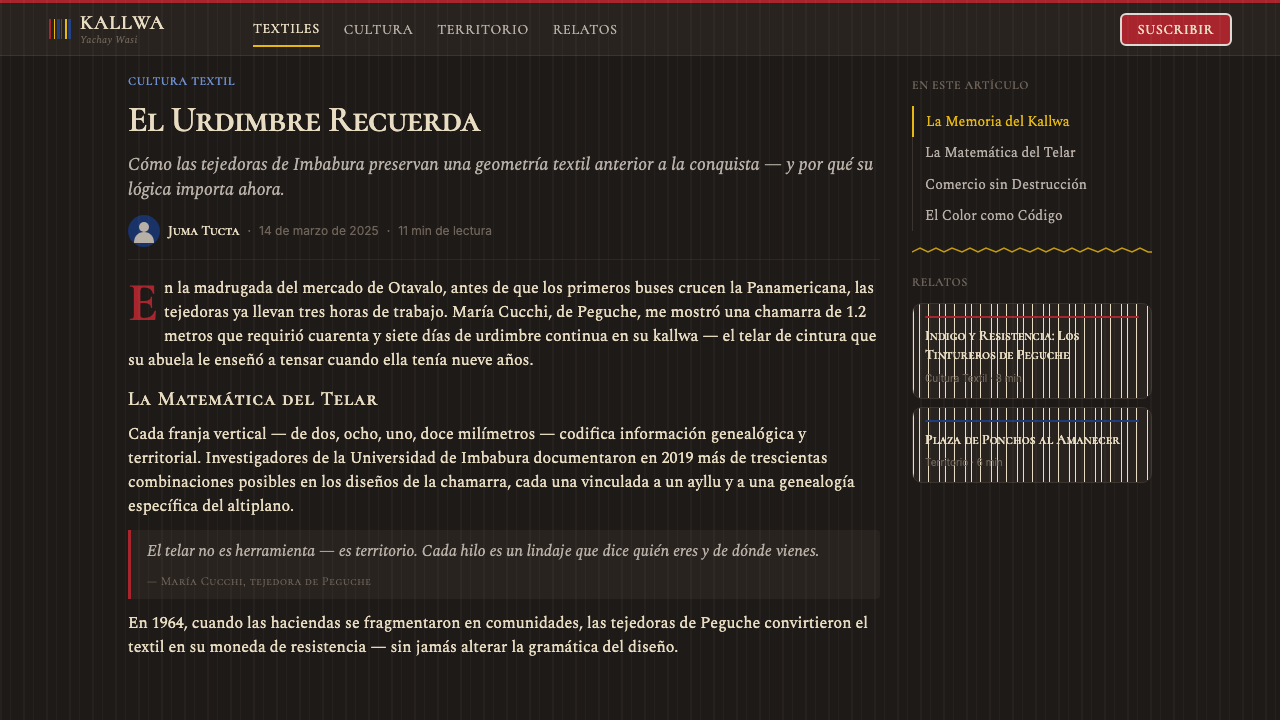
The Otavaleño weaving tradition predates the Inca empire's expansion into what is now northern Ecuador in the late fifteenth century. Kichwa-speaking peoples of the Imbabura highlands had already developed sophisticated backstrap-loom textile production, using locally grown cotton and wool from the camelids that grazed on the páramo grasslands. When the Inca administration incorporated the region, they recognized the textile skill of Imbabura's weavers and organized them into mit'a labor arrangements — rotating tribute obligations that required communities to produce cloth for state redistribution. This formalized what was already a region of high weaving density and deep specialist knowledge.
Cochineal entered the highland palette through contact with Mesoamerican trade networks, although the parasite that produces the dye — Dactylopius coccus, a scale insect living on Opuntia cacti — was also native to the drier Andean valleys. The crimson produced by cochineal is among the most intense natural reds known, and its adoption transformed the visual character of highland Andean textiles. Unlike the organic ochres and earthy madders common before, cochineal red has a luminous, almost electric presence that does not fade easily under highland ultraviolet. Spanish colonizers recognized the commercial value of cochineal immediately and made it one of the most traded commodities in the colonial Andean economy, second only to silver.
The Plaza de Ponchos in Otavalo, formalized as a market space in 1964, became the principal node for the Otavaleño textile economy. But the market's consolidation accelerated something deeper: the standardization and refinement of a textile aesthetic that had been evolving across centuries. Weavers competing in a visible market had incentive to develop the most recognizable and transportable forms of the tradition. The chamarra — a woven shawl or poncho — and the anaco — a wraparound skirt woven in warp-stripe patterns — became the iconic objects through which the tradition communicated itself to outside audiences.
The contemporary boom from the nineteen-nineties onward brought Otavaleño weavers into global circuits. Families established shops in European capitals, North American cities, and across Latin America. This diaspora created a feedback loop: the textile aesthetic traveled, encountered other design systems, and returned to Otavalo carrying new influences — but the core vocabulary of cochineal warp, cobalt weft, charcoal ground, and single accent band proved durable. The movements of Kichwa-Otavalo cultural revival, Pachakutik political design, and the consolidation of the Plaza de Ponchos as a cultural institution collectively reinforced rather than diluted the tradition's visual coherence.
What defines the Ecuadorian Otavalo Cochineal Loom look?
Color System
The palette is built on a fundamental opposition between mineral-dye saturation and deep, unsaturated ground. Cochineal crimson — a luminous, slightly warm red with extraordinary depth — serves as the primary chromatic agent. Indigo cobalt, cooler and more recessive, crosses the crimson as a structural counterweight. Chrome yellow, used sparingly as the single accent element, carries a sharp energetic charge that activates the darker tones around it. The charcoal ground — derived from the natural dark pigmentation of alpaca and llama fiber — is not neutral but carries its own warm animal undertone that prevents the palette from reading as cold or graphic. These colors do not blend; they contrast.
Stripe as Structure
The warp stripe is not decoration — it is the grammar of the system. Vertical bands of color arise directly from the mechanical logic of the loom: the warp threads, tensioned by the weaver's body and fixed in their positions, determine where each color will fall. The stripe is thus structurally honest; it cannot be repositioned arbitrarily without changing the weaving process itself. In digital translation, this principle becomes a commitment to columnar organization and the refusal of decorative mark-making that floats free of the underlying grid. Spacing between stripes is as meaningful as the stripes themselves.
The Single Accent Rule
Traditional Otavaleño textiles operate under a strict economy: one chromatic accent per composition. The chrome yellow band appears once within the field of crimson and cobalt stripes — not as a repeated motif, but as a structural event, a punctuation mark that resolves the composition. This rule emerges not from aesthetic theory but from material practice: extra accent colors require extra dye baths, extra warping sequences, extra weaving complexity. Scarcity of means produced a design principle. In contemporary application, this translates to a rigorous single-accent discipline: one color reserved exclusively for the most critical interactive or structural element, with everything else drawn from the primary palette.
Textile Weight and Surface Quality
Otavaleño cloth is not delicate. It is dense, heavy, durable — the properties of a fabric made to withstand the cold and wet of the highland páramo at altitude. The weave itself is visible as surface texture: the crossing of warp and weft creates a subtle relief that catches light differently from the face and from the edge. This physical quality translates aesthetically into a preference for elements that read as substantial rather than airy, grounded rather than floating. Visual weight should feel earned and intentional, not decorative. Backgrounds carry presence; text should be set with enough density that it holds its position in the composition.
Bilateral Symmetry and Vertical Flow
Unlike the asymmetric dynamism of many modernist design systems, the Otavaleño textile tradition is fundamentally symmetrical along the vertical axis. A chamarra is a mirror image of itself: the left warp and the right warp carry the same sequence of colors, and the composition reads as balanced when laid flat or worn. This bilateral symmetry creates a composed, ceremonial quality — not static, because the horizontal weft crossings introduce a secondary rhythm, but ordered. Vertical flow dominates: the eye moves from top to bottom along the stripe columns, not diagonally across the field.
Darkness as Ground
The charcoal base of the Otavaleño textile is not a neutral backdrop but a positive element that shapes how the saturated color bands read. Against a very dark ground, cochineal crimson appears almost luminous — the contrast is greater than it would be on a light ground, and the dye's inherent warmth is amplified rather than diluted. This means the system is fundamentally dark-first: the dark ground is the primary surface, and the colored bands emerge from it rather than being placed onto a neutral field. This is the opposite of the light-ground tradition common in European decorative textiles of the same period.
Geometric Precision Without Measurement
Otavaleño stripe geometry is precise, but its precision is bodily rather than mathematical. The weaver counts threads by feel and by sight, maintaining consistent stripe widths through trained muscle memory and rhythmic counting rather than a ruler or measuring device. The result has the qualities of handmade precision: perfectly regular enough to read as intentional, with a sub-perceptible variation that distinguishes it from machine output. Stripe widths repeat exactly enough to signal control, but the slight irregularity of natural fiber and hand tension gives the surface life. In digital application, this quality suggests tolerating and even introducing subtle variation rather than demanding mechanical perfection.

Who shaped Ecuadorian Otavalo Cochineal Loom?
Miguel Andrango is among the most recognized contemporary Otavaleño master weavers, credited with maintaining and transmitting the technical knowledge of the backstrap loom in its most demanding traditional forms during a period when commercial pressure was pushing many weavers toward faster treadle-loom production. His work has been documented by ethnographic researchers and has served as a reference point for discussions about the continuity of textile tradition as a form of cultural memory rather than simply an economic activity.
Lynn Meisch is an anthropologist whose decades of fieldwork in Otavalo produced some of the most detailed documentary records of the textile tradition in its market and social context. Her ethnographic work — particularly on the relationship between the Plaza de Ponchos economy and the maintenance of cultural identity — provided the academic framework that helped international audiences understand Otavaleño weaving not as folk craft but as a sophisticated, self-aware visual culture capable of global circulation while maintaining local coherence.
Ariruma Kowii is a Kichwa-Otavaleño poet, academic, and cultural advocate whose work has been central to the articulation of Otavaleño identity as something simultaneously rooted in pre-Inca textile and linguistic traditions and capable of engaging with contemporary global cultural politics. His advocacy for Kichwa language preservation and his writing on the relationship between Andean material culture and cosmology have contributed to the framing of the textile tradition not merely as aesthetic heritage but as an embodied philosophical system.
José Cotacachi represents the generation of Otavaleño weavers who expanded the tradition's reach through market entrepreneurship during the global boom of the nineteen-nineties and two-thousands. His family's establishment of retail networks outside Ecuador — across Latin America and into Europe — exemplifies the diaspora dynamic that carried the Otavaleño textile aesthetic into international design consciousness while maintaining the core vocabulary of cochineal, cobalt, and charcoal ground. This generation demonstrated that a tradition could travel without dissolving.
How do you use Ecuadorian Otavalo Cochineal Loom today?
Ecuadorian Otavalo Cochineal Loom translates most successfully into digital contexts that benefit from strong chromatic authority, clear vertical organization, and a sense of material presence. The key to application is understanding the system's underlying logic — darkness as primary surface, saturated color emerging from that darkness, single accent used with ceremony — rather than simply reproducing the stripe pattern as a visual motif.
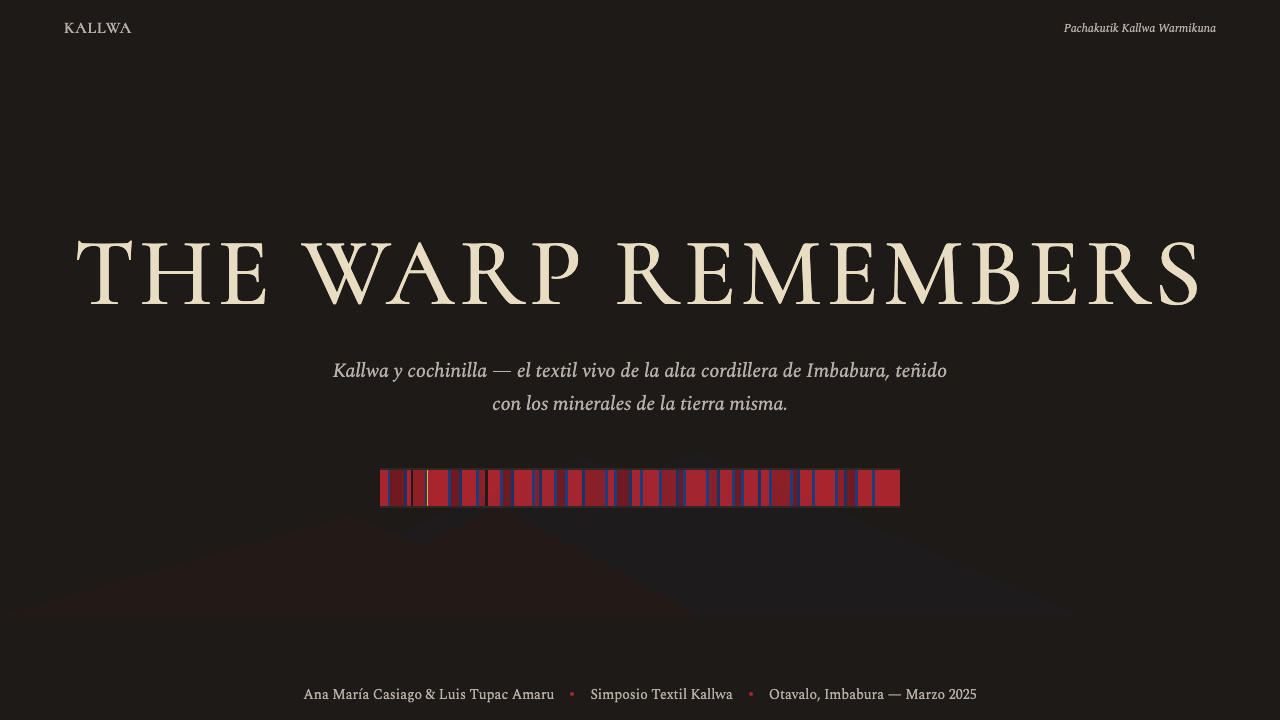
For presentation slides, the system works best with a dark base as the primary surface. Cover slides benefit from full-field cochineal crimson or deep charcoal, with the title set in a light, weighty letterform that reads against the saturated ground. Content slides should organize information into clear vertical bands — a primary content column flanked by a narrower metadata column — echoing the warp-stripe structure. Use the single accent color (bright yellow or a secondary saturated hue) exclusively for the one element that needs the audience's attention in each slide. Data visualizations become stripe diagrams: bars and segments should be colored with the same restraint as warp threads, with the accent color marking only the most significant data point.
For web interfaces, this system suits platforms where cultural richness, authority, and considered craft are desired values: editorial publications, cultural institutions, artisan marketplaces, and premium product sites. The approach: build on a dark base, define a strict columnar grid that reflects the warp structure, and reserve the single accent color for primary interactive elements — the call to action, the active navigation state, the key status indicator. Navigation should be typographically clear, with no decorative flourishes. Cards and panels should sit with visual weight against the dark ground, not float with soft shadows.
For editorial and marketing work, the style supports immersive, bold visual storytelling. Full-bleed dark sections with saturated-color typography can alternate with lighter passages — but the accent color should appear in the light sections with the same discipline as in the dark ones, never multiplying. Marketing materials benefit from the tradition's ceremonial quality: treat the accent element as a single significant gesture per composition, not as a repeated highlight pattern. The stripe structure translates well into section dividers, progress indicators, and any element that needs to communicate sequence or rhythm.
A common mistake is treating the three primary colors of the palette as equal players to be distributed evenly. In the Otavaleño tradition, cochineal red is the dominant warp, cobalt is the structural weft, and yellow is the single accent. Inverting this hierarchy — or distributing all three in equal quantities — produces noise rather than composition. Similarly, placing the stripe pattern over a light ground inverts the system's logic: this is fundamentally a dark-ground tradition, and lightening the base reduces the luminous intensity that makes the saturated colors read as powerful rather than merely colorful.
Ecuadorian Otavalo Cochineal Loom — FAQ
How does this system differ from other Andean textile traditions like Peruvian or Bolivian weaving?
While all Andean highland textile traditions share certain technical foundations — the backstrap loom, camelid wool, natural mineral dyes — the Otavaleño system is distinguished by several specific choices. The dominant use of cochineal crimson as the primary warp color against a charcoal ground is characteristic; many Peruvian and Bolivian traditions use a wider range of dye colors simultaneously and often on lighter grounds. The Otavaleño single-accent discipline is also distinctive — other Andean traditions frequently layer multiple accent colors and complex pictographic or symbolic motifs into the textile field. The Otavaleño aesthetic tends toward bold, abstract stripe geometry over narrative or symbolic imagery, which makes it more directly translatable to contemporary design systems.
Is the dark background essential, or can the system work on a light ground?
The dark ground is fundamental to the system's visual logic, not a stylistic option. The Otavaleño textile produces its characteristic luminosity by placing highly saturated mineral-dye colors against a very dark field — the contrast is what makes cochineal crimson appear to glow rather than simply appear red. On a light ground, the same colors read entirely differently: the crimson becomes a flat, warm tone rather than a luminous force; the cobalt loses its recessive structural quality; and the chrome yellow accent, which gains its power from being surrounded by darkness, becomes merely another light element. A light-ground version would require a fundamental redesign of the color relationships, and would be better understood as a different system inspired by the tradition rather than a translation of it.
How strictly should the single accent rule be followed in a complex digital interface?
The spirit of the rule — that the accent color carries ceremonial weight and should not be depleted by overuse — is more important than mechanical application. In a complex interface, a single accent color can appear multiple times without violating the principle, provided it appears only on elements of equal functional significance. What the rule forbids is using the accent color for both primary calls to action and minor decorative elements simultaneously — that devalues the signal. A practical approach: define the single accent as the exclusive property of one functional category (primary interactive states, critical alerts, or active navigation), and use the primary palette for everything else. The accent should be the rarest color in the interface at any given moment.
Does the system work for brands that want to convey warmth and approachability rather than authority?
The Otavaleño system carries inherent warmth — the cochineal red has an organic, mineral quality that differs from the cool severity of many modernist design systems, and the charcoal ground has animal undertones from the natural fiber that prevent it from reading as cold or industrial. However, the system's overall character is ceremonial and weighty rather than casual or playful. It communicates dignity, craft, and cultural depth. Brands that want approachability in a light, friendly sense — pastel palettes, rounded forms, soft shadows — will find this system at odds with those values. But brands that want warmth in the sense of genuine cultural richness, material honesty, and considered gravity will find it well-suited.
How does this system handle typography, given that it originates in a pre-typographic textile tradition?
The textile origin means the system has no native typographic component — it must be constructed from principles rather than inherited from a historical practice. The translation logic is this: the warp stripe's qualities (strong vertical orientation, consistent weight, clear color assignment, bilaterally symmetrical) suggest a typographic approach that mirrors those structural properties. Heavy letterforms with clear vertical stress read as consistent with the warp structure. The single-accent principle applies to type hierarchy: the most critical typographic element should carry the accent color; all other levels of hierarchy should be drawn from the primary palette — light type on dark ground, or dark-ground reversal for emphasis. Avoid typefaces with strong horizontal stress or decorative features that would introduce visual noise into the stripe-governed composition.
Related design styles
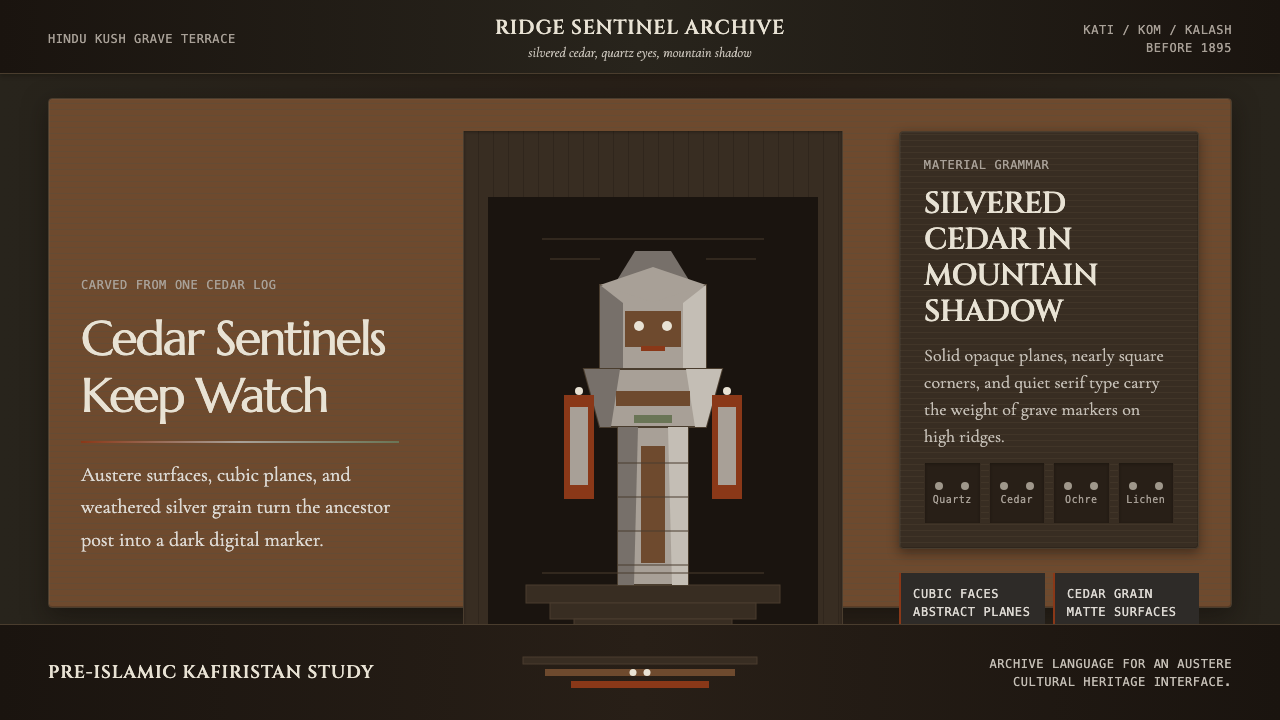 Nuristani Wooden Effigy (Pre-Islamic Kafiristan)Grave-marker serious. Silver cedar, quartz dots, and columnar stack hold the…
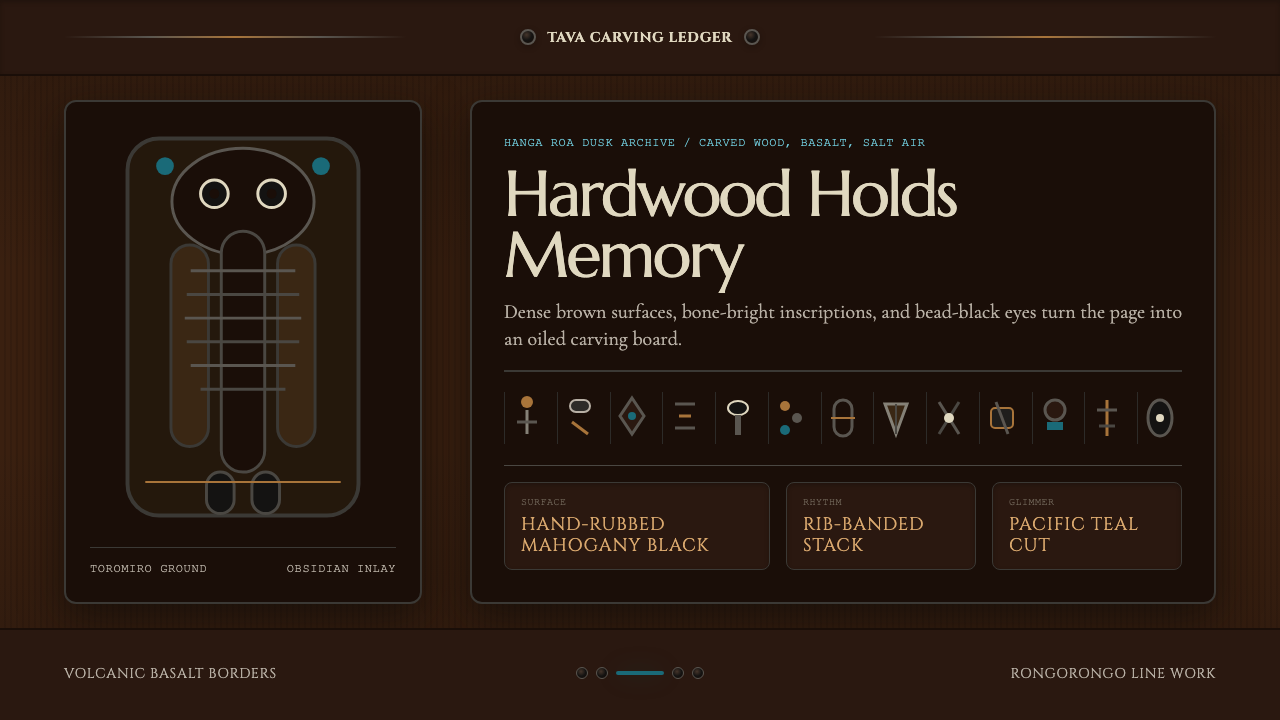 Chilean Rapa Nui Toromiro (Easter Island)Ancient weight, dusk-lit. Toromiro brown, Cinzel capitals, rib bands, obsidia…
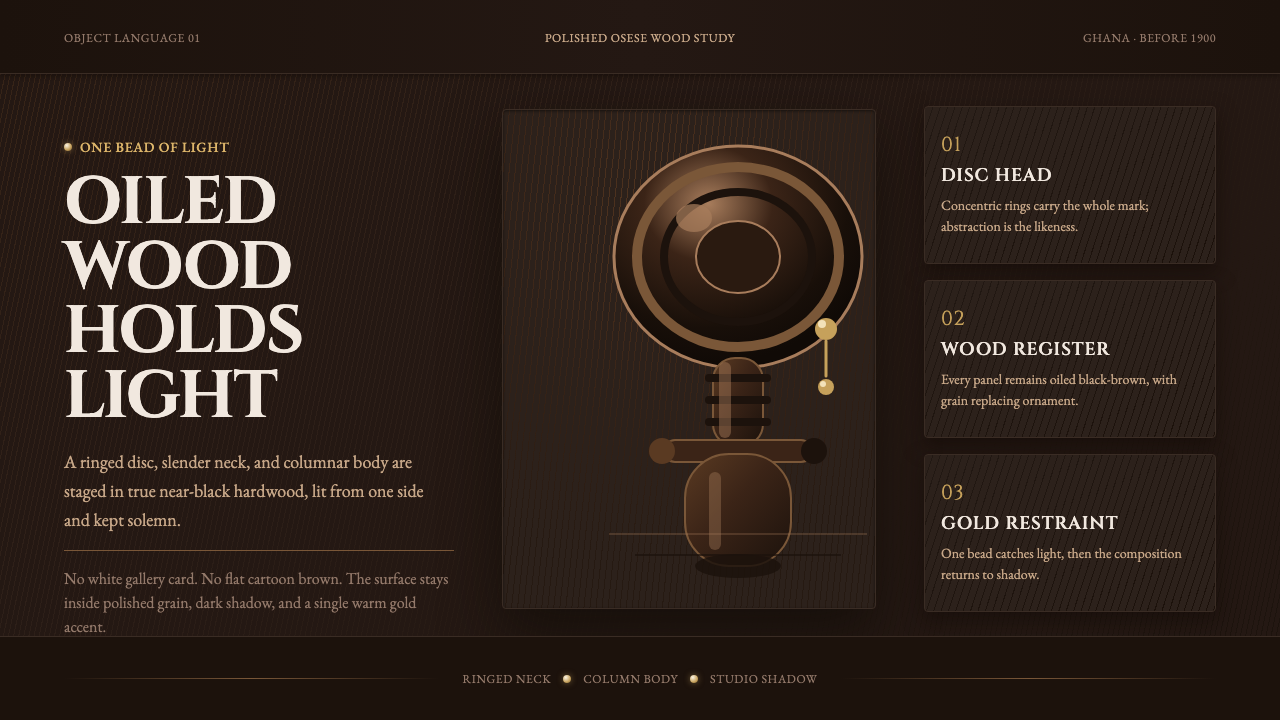 Akuaba Akan Fertility DollDarkness becomes sculpture. Near-black wood, ringed geometry, and one gold be…
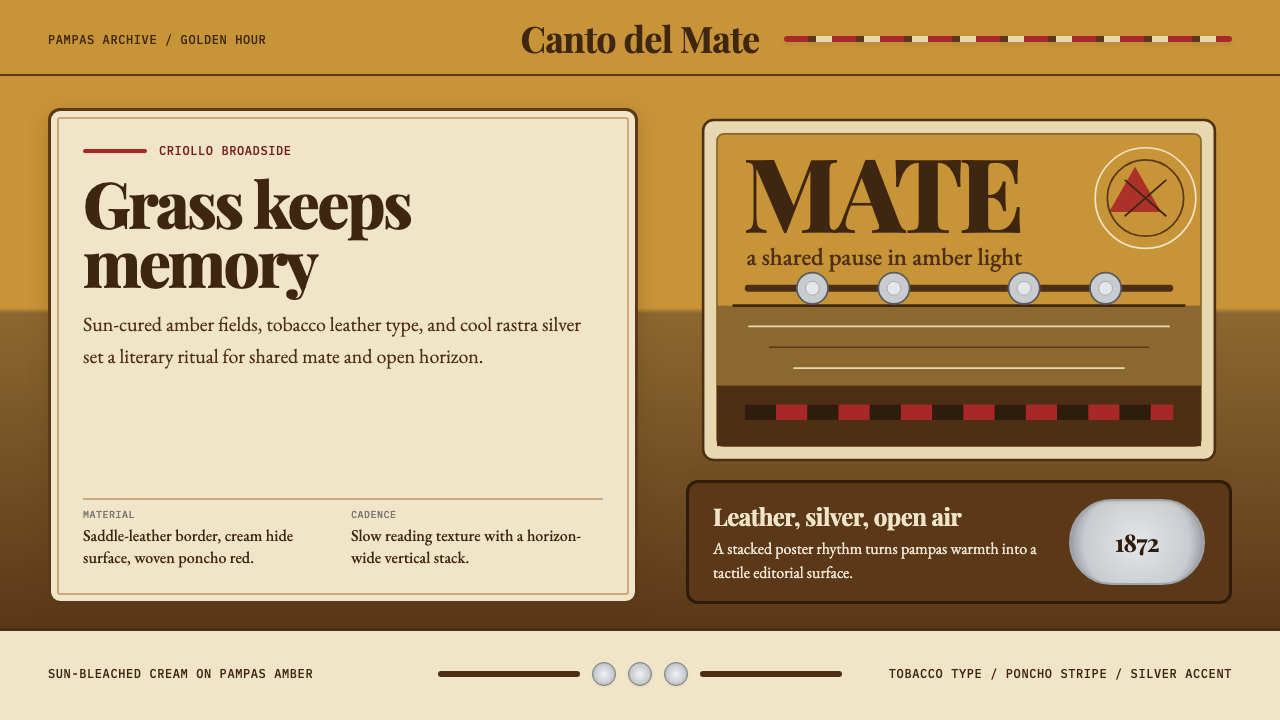 Argentine Gaucho (Pampas Mate Culture)Open grassland, printed warm. Amber fields, Playfair serif, and silver rastra…
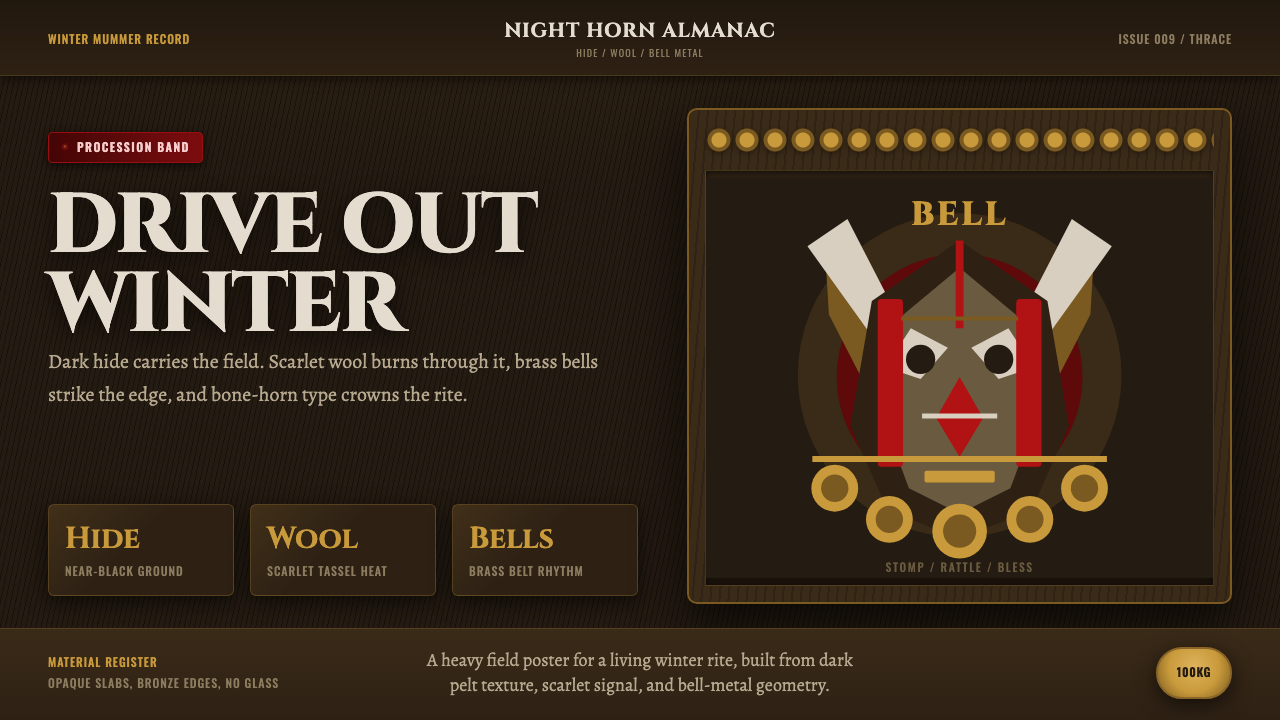 Bulgarian Kukeri MummersRitual darkness hits first. Scarlet wool, brass bells, and bone type stomp ac…
 Chancay Gauze TextileQuiet woven dignity. Tan silhouettes float through a dark open cotton mesh.