What is José Guadalupe Posada Calavera?
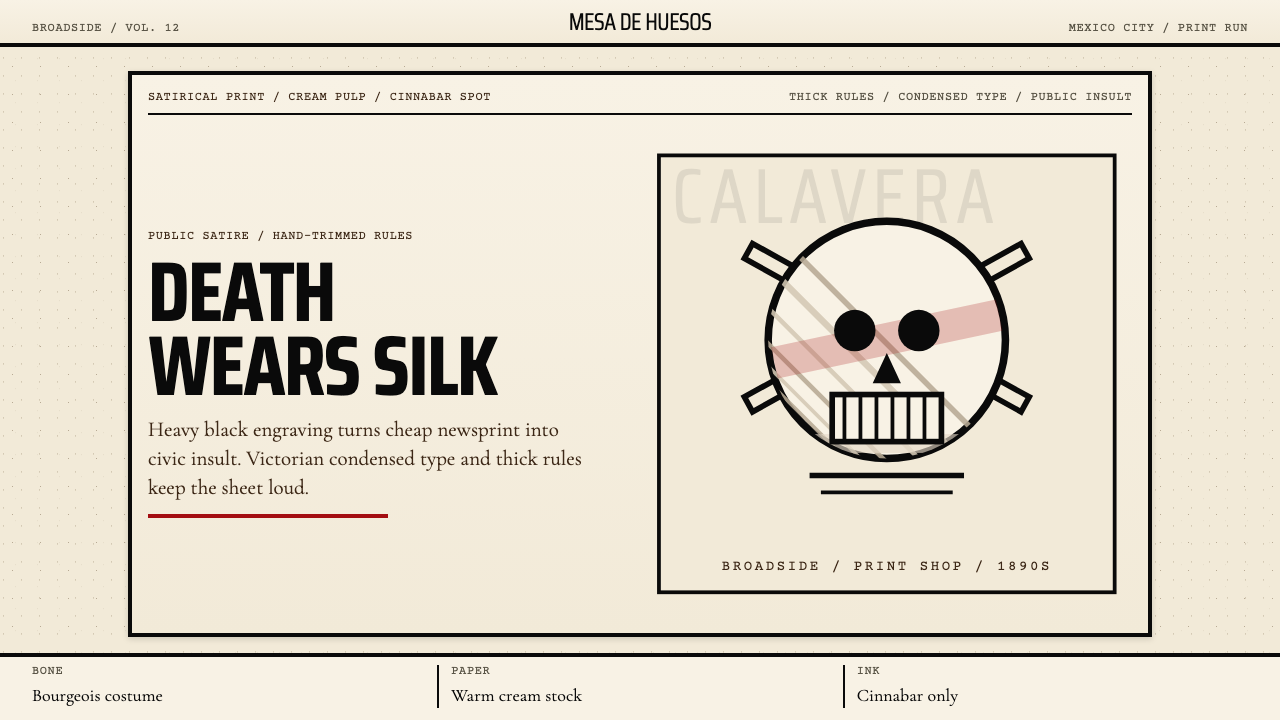
Posada turned death into democracy — skeleton figures in bourgeois finery, printed on cheap newsprint for the streets of Mexico City.
José Guadalupe Posada Calavera in brief
The José Guadalupe Posada Calavera style is a visual language rooted in the broadsides and penny-press prints that circulated in Mexico City from the 1880s through the early twentieth century. Its defining elements are heavy black engraving lines on warm, yellowed paper grounds, a cinnabar red deployed as a single dramatic accent, condensed Victorian display type, and thick rectilinear borders that echo the broadside format of the print shop. At its center is the calavera — the skeleton figure dressed in the costumes of the living — which became the vehicle for biting political and social commentary aimed at a largely illiterate urban public.
Posada worked as a relief engraver for the publisher Antonio Vanegas Arroyo, producing hundreds of prints that documented crimes, disasters, political scandals, and the annual celebrations of Día de los Muertos. His most enduring creation, the Calavera Garbancera — later renamed La Catrina by Diego Rivera — depicted a female skeleton in an elaborate European hat, mocking the social pretensions of Mexicans who aped European fashion while denying their indigenous heritage. The image condensed an entire social critique into a single iconic figure.
As a design system, the Posada aesthetic is one of deliberate tension: the macabre made festive, the high-culture form made popular, the grave subject made comic. It operates through contrast — the refinement of Victorian typography set against raw engraving marks, the ceremonial formality of a bordered broadside carrying a skeleton dancing in top hat and tails. This tension is the source of its power and its continued resonance in contemporary graphic design, editorial illustration, and cultural branding.

Where does José Guadalupe Posada Calavera come from?
José Guadalupe Posada was born in 1852 in Aguascalientes, a provincial city in central Mexico, where he apprenticed in a local print shop and learned the craft of ceramic decoration before moving to León to work as a lithographer. In 1888 he relocated to Mexico City, where he established a workshop directly across from the print house of Antonio Vanegas Arroyo, a publisher who had built a thriving business producing corridos (ballad broadsheets), crime pamphlets, religious prints, and Día de los Muertos calavera verses — short satirical poems naming public figures as the newly dead. The partnership between Posada and Vanegas Arroyo, which lasted until Posada's death in 1913, was the engine of the visual style that bears his name.
The broadside print tradition Posada inherited was already ancient — it traced back to sixteenth-century Spanish colonial printing and the Catholic Church's use of woodcut imagery in religious instruction. What Posada introduced was a shift from static devotional imagery toward dynamic satirical narrative. Working first in lead relief engraving and later in zinc etching — a faster, cheaper technique — he developed a mark-making vocabulary of extraordinary energy: thick, unmodulated contour lines; hatching that built up shadow through raw repetition rather than tonal graduation; and figures that compressed emotion into posture, gesture, and grotesque facial expression rather than subtle modeling.
The political context was decisive. Posada worked through the final decades of the Porfiriato — the long authoritarian rule of Porfirio Díaz, which lasted from 1876 to 1911 — and into the violent years of the Mexican Revolution. The broadside press occupied a precarious but essential position: too popular and too cheap to suppress entirely, it circulated images of hanged criminals, catastrophic floods, miraculous apparitions, and dancing skeletons that served as coded commentary on a society riven by inequality and ruled by a regime that performed civilization while tolerating mass poverty. The calavera form — using death as the leveling agent, reducing generals and grandees to bones — was the print tradition's most powerful political instrument.
Posada died in obscurity and poverty in 1913, and was buried in a common grave. His rehabilitation came in the 1920s, when the muralist Diego Rivera — newly returned from Paris and deeply engaged with the project of constructing a post-revolutionary Mexican national identity — discovered Posada's prints and recognized in them an authentic popular visual tradition. Rivera collected Posada's work, cited him in interviews, and incorporated calavera imagery into his own murals. The French artist Jean Charlot published the first serious critical essay on Posada in 1925. By the 1940s, Posada had been canonized as the father of Mexican graphic art, and La Catrina — a figure Posada created but Rivera named, elaborated, and placed in a mural landscape — had become one of the most recognizable images in the hemisphere.
What defines the José Guadalupe Posada Calavera look?
Engraving Line Weight
The foundational mark of the style is the heavy, unmodulated contour line — the direct trace of a relief engraving tool cut into lead or zinc. Unlike fine-art intaglio, which favors tonal variety and hairline detail, Posada's broadside engravings used thick, consistent strokes that read clearly at small scale on coarse newsprint. Outlines are bold and closed; interior detail is built through densely packed hatching rather than graduated shading. The result is a visual language that operates entirely through contrast: solid black shape against light ground, with no intermediate tone.
Warm Paper Ground
The authentic Posada broadside was printed on cream-pulp newsprint — a cheap, acid-containing paper that yellowed quickly with age and light exposure. This warm, slightly irregular ground is inseparable from the visual identity of the style. Contemporary applications channel this quality through off-white or aged-cream backgrounds that retain warmth and tactility rather than optical-white or cool-gray surfaces. The ground is never pure white, never neutral; it carries the sensory memory of the print shop and the street vendor's stack of papers.
Cinnabar Red Accent
Red in the Posada system is a single-color spot — a second pass of ink in a warm, slightly orange-leaning red that invokes the mineral pigment cinnabar used in traditional Mexican crafts and colonial-era religious painting. It is used sparingly: to highlight a headline, to fill a border element, to color a decorative skull, to mark a text block that demands immediate attention. It never serves as a background color; it is always figure against the cream ground. Its warmth distinguishes it from the cooler primaries of Northern European graphic traditions — this red is earthy and festive simultaneously.
Condensed Victorian Display Type
The typography of the Posada broadside draws from the condensed wood-type and metal-type display faces that filled nineteenth-century print shops across North America and Latin America — ultra-compressed letterforms with pronounced thick-thin stroke contrast, heavy serifs, and decorative details that gave each letter an almost architectural presence. Headlines are set tightly, often in all capitals, with the condensed width allowing multiple words to stack dramatically in a narrow column. This typographic style sits in deliberate and productive tension with the rawness of the engraved imagery beneath it.
Rectilinear Border System
Every Posada broadside is contained within a thick border of typographic rules — the horizontal and vertical lines that print shops assembled from foundry-cast rule material. These borders are not decorative in a floral or ornamental sense; they are structural, giving the broadside the authority of a posted notice or official document even when the content within is scandalous or satirical. Inner borders further divide the sheet into zones for illustration, headline, and verse text. The frame becomes part of the content: it signals that what is inside is public, official, worth stopping on the street to read.
Calavera Figure as Social Allegory
The defining iconographic element of the style is the calavera — skeleton figures that retain every social marker of their living identities: the general's epaulettes, the dandy's top hat, the widow's veil, the bourgeois matron's imported Parisian hat. The skeleton is not a symbol of horror but of equity: death strips rank and wealth from everyone equally, revealing the absurdity of social pretension. Visually, calavera figures operate through recognizable costume detail rendered in simplified silhouette — the body is schematic, but the hat, the uniform, the jewelry is specific and cutting.
Festive Macabre Tone
The Posada style is not gothic or melancholy — it is carnivalesque. Death in the broadside tradition is not a source of grief but of comedy and social leveling. Skeletons play guitar, ride bicycles, dance at balls, argue in congress. This festive quality permeates every element of the visual system: the energy of the hatching, the humor implied by juxtaposed costume and skeleton, the playfulness of the verse text that accompanied the images. A design that successfully channels this tradition carries both weight and wit, gravity and glee — it never collapses into mere spookiness.

Who shaped José Guadalupe Posada Calavera?
Posada produced an estimated two thousand or more broadside engravings during his Mexico City career, working at extraordinary speed to respond to current events — a criminal execution, a train derailment, a political scandal — often publishing within days of the events they depicted. His technical range extended from detailed zinc etchings to rapidly cut lead relief blocks, and his visual invention never settled into formula despite the pressures of commercial output. He died in 1913, was buried in a common grave when his rent went unpaid, and was disinterred and reburied in a mass grave six years later. His rehabilitation by the muralists of the 1920s rescued both the work and the reputation from oblivion.
Vanegas Arroyo was the publisher and entrepreneur who created the economic and editorial context in which Posada's visual style developed. A former schoolteacher from Puebla, he established his Mexico City print house in 1880 and built a popular press empire on broadside ballads, crime pamphlets, religious almanacs, and the annual Día de los Muertos calavera publications. He understood his audience precisely — literate enough to read verse, urban enough to recognize political caricature — and shaped the format constraints within which Posada worked: the single sheet, the dual column, the verse-image layout. Without Vanegas Arroyo's commercial acumen and popular instinct, Posada's imagery would have had neither the volume nor the distribution to become a visual tradition.
Manilla was Posada's immediate predecessor at the Vanegas Arroyo press, working for the publisher through the 1870s and 1880s before Posada's arrival displaced him as the primary engraver. His calavera figures — somewhat stiffer and less energetically composed than Posada's — established the visual conventions that Posada would inherit and dramatically intensify. The relationship between the two engravers was long obscured because early twentieth-century critics sometimes misattributed Manilla's work to Posada; disentangling their respective contributions required archival research conducted decades after both men's deaths.
Rivera did not create the Posada style but was responsible for its elevation into the canon of Mexican national art. Returning from fourteen years in Europe in 1921, Rivera discovered Posada's prints circulating as street ephemera and recognized them as the authentic popular visual voice that his own muralist project required as its popular-culture counterpart. He collected hundreds of Posada's prints, named the Calavera Garbancera figure 'La Catrina,' and incorporated her into his 1947 mural Dream of a Sunday Afternoon in Alameda Park — where she appears full-length between the young Rivera and the adult Rivera, as a figure of cultural memory and national irony. Rivera's championing transformed Posada from a forgotten commercial engraver into the founding father of Mexican graphic art.
Charlot was a French artist who arrived in Mexico in 1921 and became deeply embedded in the muralist movement. In 1925 he published the first serious critical essay on Posada, rescuing a body of work that was rapidly disappearing as the original broadside sheets deteriorated or were discarded. Charlot's essay established the critical vocabulary — popular print tradition, political satire, death as democratic leveler — that all subsequent Posada scholarship has drawn on. He also helped organize the first exhibitions of Posada's work and lobbied for the collection of surviving prints in Mexican public institutions.
How do you use José Guadalupe Posada Calavera today?
The Posada Calavera style transfers into contemporary design work through its structural logic rather than through literal skeleton imagery. A designer reaching for this vocabulary is choosing a specific relationship between visual weight, cultural gravitas, and wit — a combination that works best when the content itself carries some element of satire, critique, celebration, or the kind of direct public address that the broadside format was designed for. It does not suit corporate neutrality or minimalist restraint; it is a voice, not a frame.
For presentation slides, the style translates most effectively on cover and section-break pages that demand immediate visual impact. A cover built in this vocabulary uses the warm paper ground as the slide background, sets a large headline in condensed display type with maximum weight, reserves the cinnabar red for a single emphasized word or decorative element, and contains the composition within a thick ruled border. Content slides within the same deck should be treated more sparingly — the engraving energy of the style can overwhelm text-heavy pages. Consider alternating: one full-bleed illustrative slide in the complete vocabulary, followed by clean content slides that retain only the warm ground and display-type hierarchy.
For web interfaces, the style is most at home in editorial and cultural contexts: event pages for festivals and cultural organizations, Day of the Dead or Mexican heritage campaigns, food and beverage brands positioning themselves within Mexican craft traditions, and music or arts platforms that want to evoke populist energy and street-press credibility. In dashboard or product interfaces, the visual weight of the style requires careful management — thick borders and heavy type can overwhelm functional UI components. A practical approach is to apply the full vocabulary to hero sections, landing pages, and marketing surfaces, while using the warm ground and typographic hierarchy as the quieter connective tissue of content pages and data views.
For editorial and marketing work, the style offers strong tools for information hierarchy and emotional contrast. A Posada-inflected editorial layout treats pull quotes as broadside headlines — set in oversized condensed type with a cinnabar rule above and below — while body text runs in a readable weight and measure beneath. Marketing campaigns that draw on this vocabulary work best when they lean into the festive-macabre tension deliberately: the combination of warm, celebratory color and the gravity of skeleton imagery creates the cognitive contrast that makes the message memorable. Poster formats are the natural habitat of the style, and contemporary posters for cultural events, political campaigns, or social commentary can draw directly on the broadside structure — full border, dominant image, stacked headline, smaller verse or subtitle below.
A common mistake when applying this style is reducing it to decoration — adding skull motifs to an otherwise unrelated design system and calling it Posada. The authentic logic of the style is political and communicative: every element, including the border, the engraving texture, and the red accent, carries meaning that connects to the broadside tradition of public address. A second common error is importing the calavera figure without the social critique it embodies — using skeleton imagery purely for visual edge or seasonal theming without the leveling wit that gives the figure its cultural force. The style rewards designers who understand what the calavera is actually doing: not frightening the viewer, but inviting them to laugh at the pretensions of the powerful.

José Guadalupe Posada Calavera — FAQ
Is this style only suitable for Day of the Dead or Mexican holiday contexts?
No — and assuming otherwise is a significant creative limitation. The Posada style was created for political satire and social commentary that operated year-round, not as seasonal decoration. Its broadside format was the newspaper of the street, addressing crime, disaster, and injustice on any day of the year. Contemporary applications that have successfully used this vocabulary include political campaign graphics, labor rights materials, anti-corruption journalism, festival and concert promotion for any kind of music with populist energy, and food and craft brands grounded in artisan tradition. The calavera imagery works in any context where social leveling, the absurdity of pretension, or festive irreverence serves the message.
How does the cinnabar red function differently from accent colors in other design systems?
In most contemporary design systems, accent color signals interactivity, calls to action, or brand identity. In the Posada system, the cinnabar red carries historical and cultural weight that precedes its functional role. It evokes the spot-color printing of the broadside press, the red of colonial religious painting, and the warmth of traditional Mexican craft pigments. Applied correctly, it does not simply draw the eye — it invokes a tradition. This means it should be used even more sparingly than a typical accent: one headline, one border element, one critical image detail. When it appears in multiple places simultaneously, it loses the singularity that gives it cultural authority.
Can the style work with photography, or does it require flat illustration?
The original Posada style predates photography as a practical print medium and used hand-engraved illustration exclusively. Contemporary applications can incorporate photography, but the integration requires a specific treatment: high-contrast duotone or halftone reproduction that reduces the photograph to a near-graphic quality, consistent with the engraving mark of the surrounding imagery. A photographic portrait processed to emphasize strong contour and reduce midtone detail can sit comfortably within the broadside format. What does not work is naturalistic, full-color photography placed directly against the warm paper ground and engraving line vocabulary — the tonal and textural contrast is too jarring. The photograph must be stylized to meet the engraving on its own terms.
What is the difference between Posada's style and Day of the Dead folk art more broadly?
Day of the Dead folk art encompasses a wide range of material and visual traditions — painted sugar skulls, papier-mâché figures, marigold altars, embroidered textiles, painted pottery — that share a festive attitude toward death but differ significantly in medium, color vocabulary, and cultural origin. Posada's style is specifically a print tradition, rooted in the mass-reproduction technology of the broadside press. Its aesthetic is defined by the constraints of relief engraving: limited color, high contrast, strong contour, bold type. Day of the Dead folk art is generally more colorful, more materially rich, and more varied in its sources and regional expressions. Using Posada's vocabulary specifically invokes the print tradition and its political satire legacy; borrowing from Day of the Dead more broadly draws from a wider and more decorative vernacular. They are related but not interchangeable.
How do I avoid making the style feel like a costume rather than a genuine design decision?
The test is whether the formal choices — the heavy border, the condensed type, the engraving texture, the skeleton imagery — are doing communicative work specific to the content, or whether they are draped over the content regardless of fit. Posada's broadsides worked because every formal element amplified the subject: the border gave authority to scandalous content, the engraving line made the skeleton both urgent and vivid, the cinnabar red made the headline impossible to ignore on a crowded wall. When designers apply these same elements to, say, a tech startup's pricing page or a logistics company's annual report, the disconnect is legible — the form is contradicting the content rather than serving it. The style is genuine when its formal vocabulary and the content's communicative ambition are genuinely aligned: when you are actually speaking to a public, actually making a case, actually finding the absurdity in power.
Related design styles
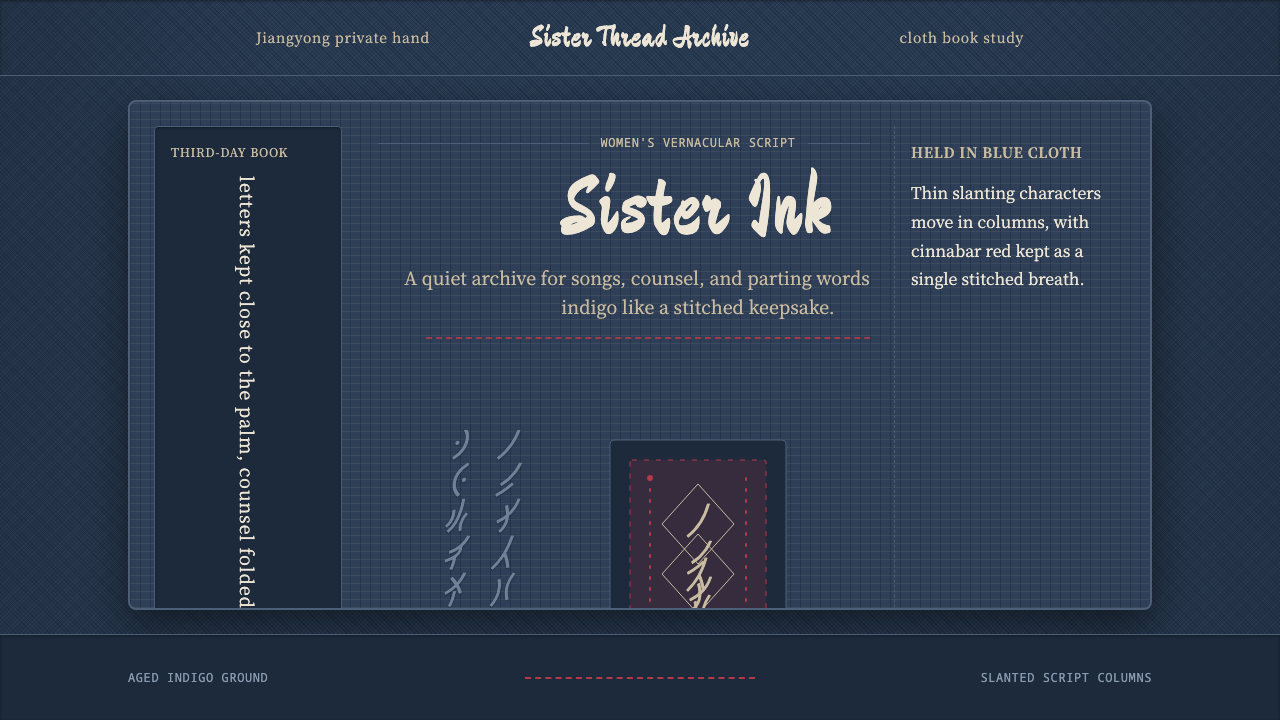 Nüshu 女书Private script, cloth-soft. Indigo weave, slanted columns, and one red thread…
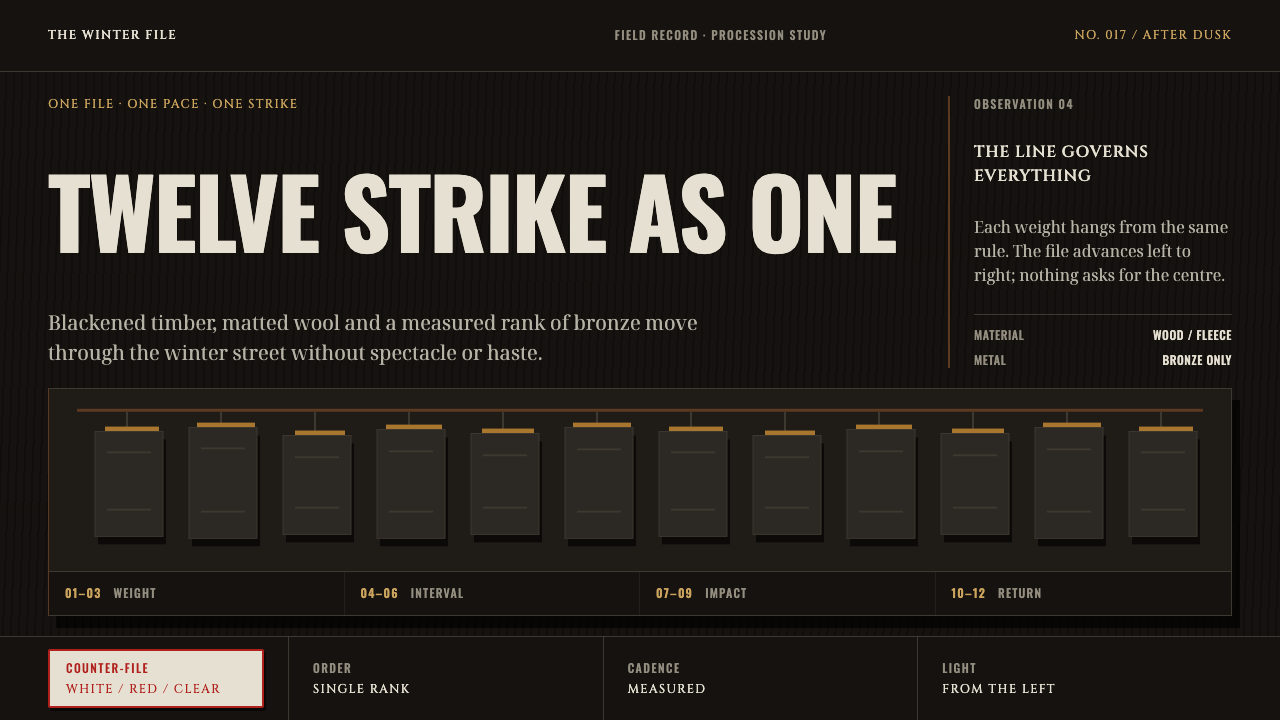 Sardinian MamuthonesRitual moves in one file. Soot-black planes and a rationed bronze rank set th…
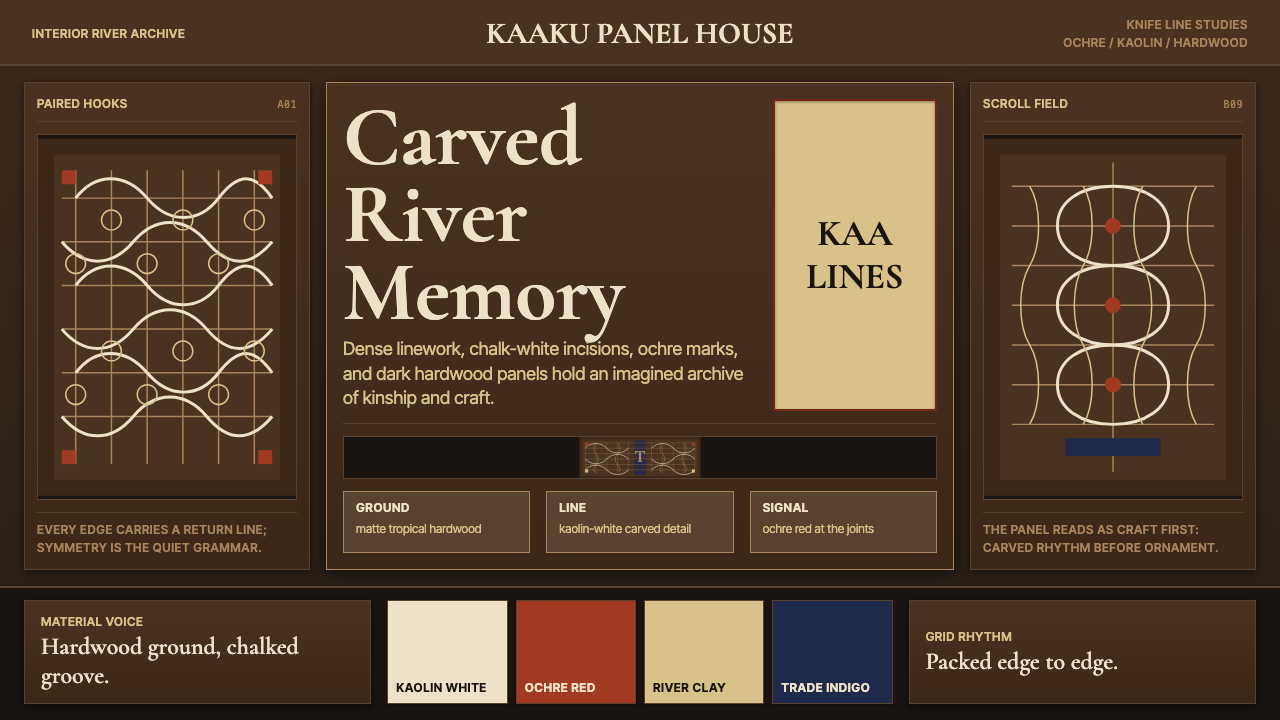 Suriname Maroon TembeDense memory, carved in rhythm. Kaolin lines cross hardwood brown in bilatera…
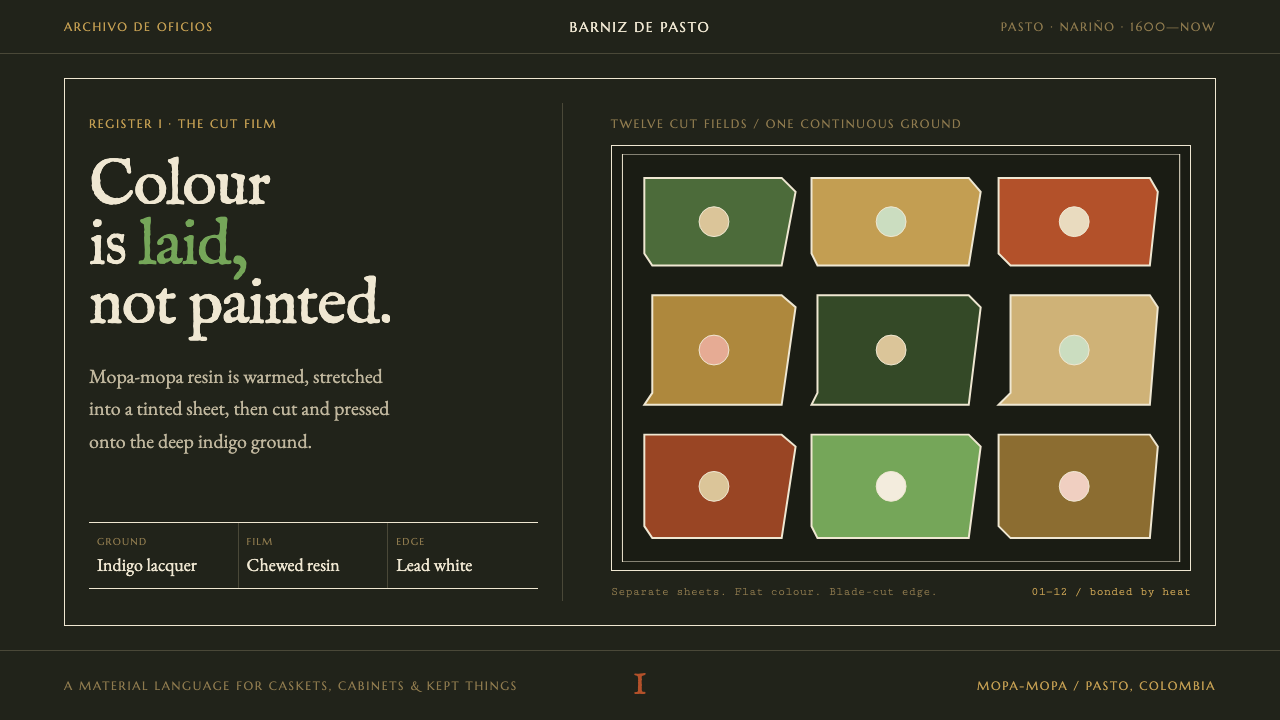 Barniz de PastoColour is laid, not painted. Cut green, gold, and red resin sheets glow on in…
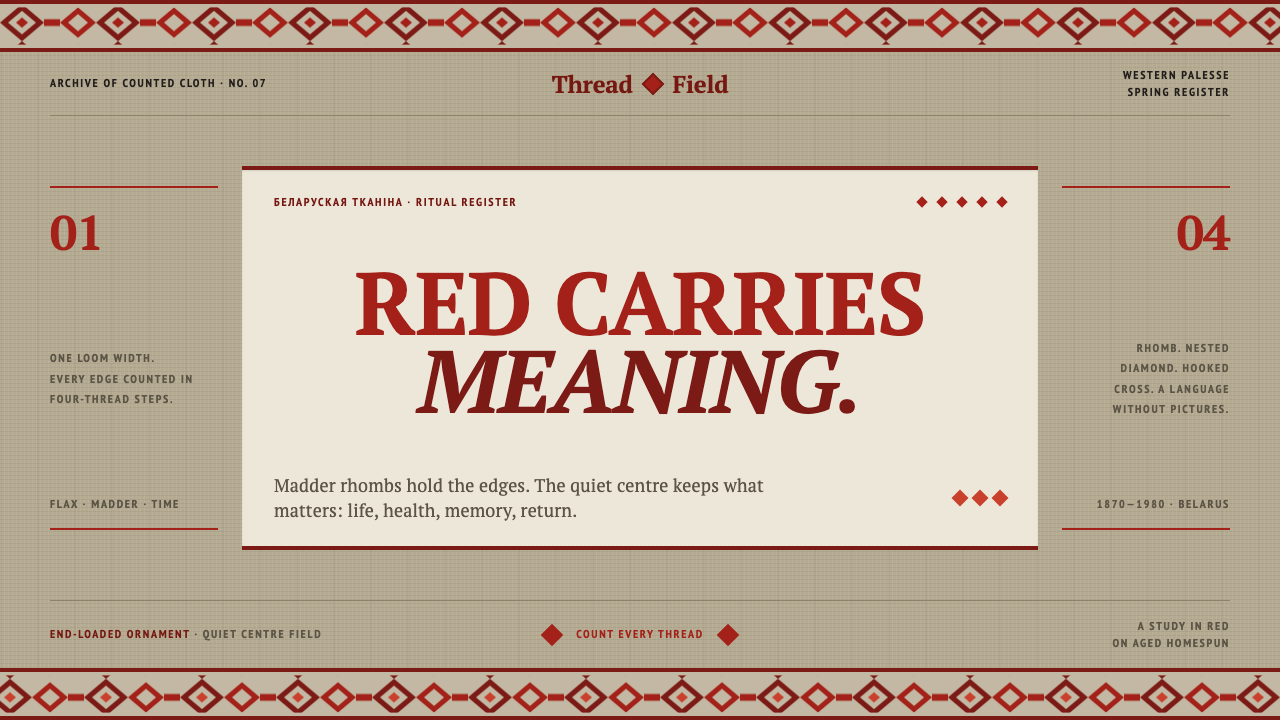 Belarusian RushnykRed carries meaning. Madder rhombs crowd aged flax edges while the woven cent…
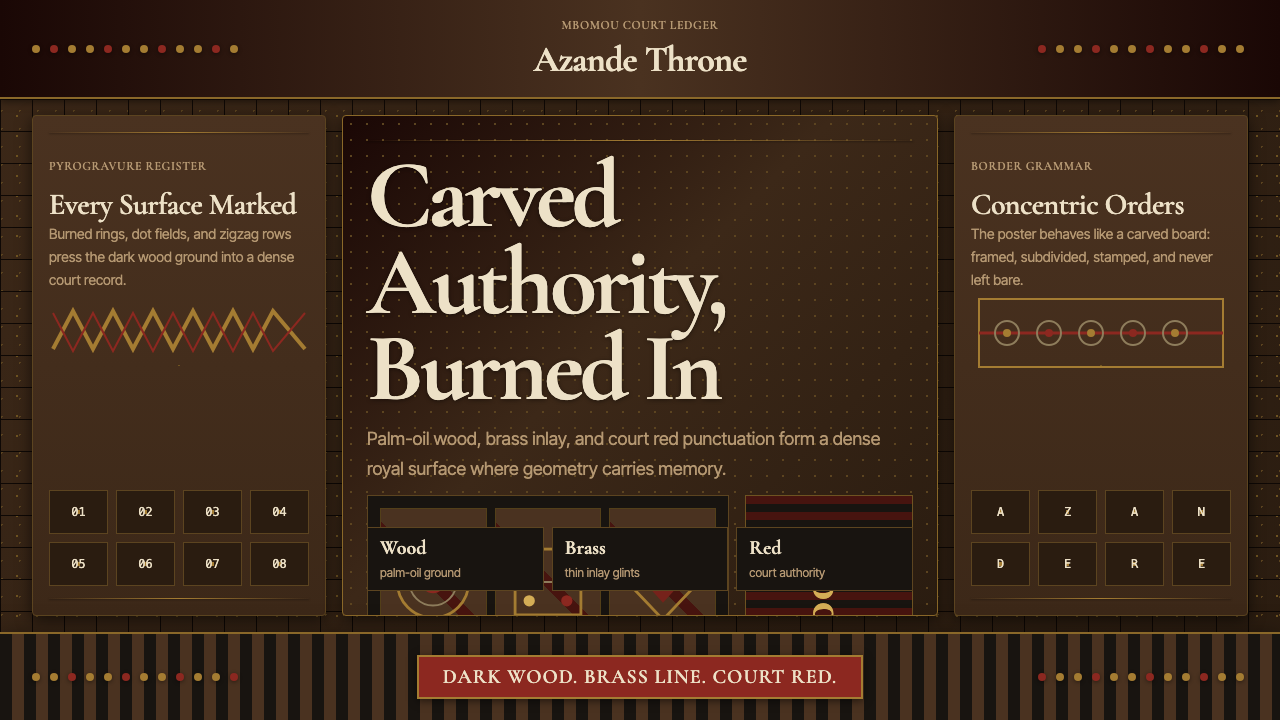 Central African Azande ThroneDense court gravity. Dark wood grids, brass dots, and court red cover every s…