What is Suriname Maroon Tembe?
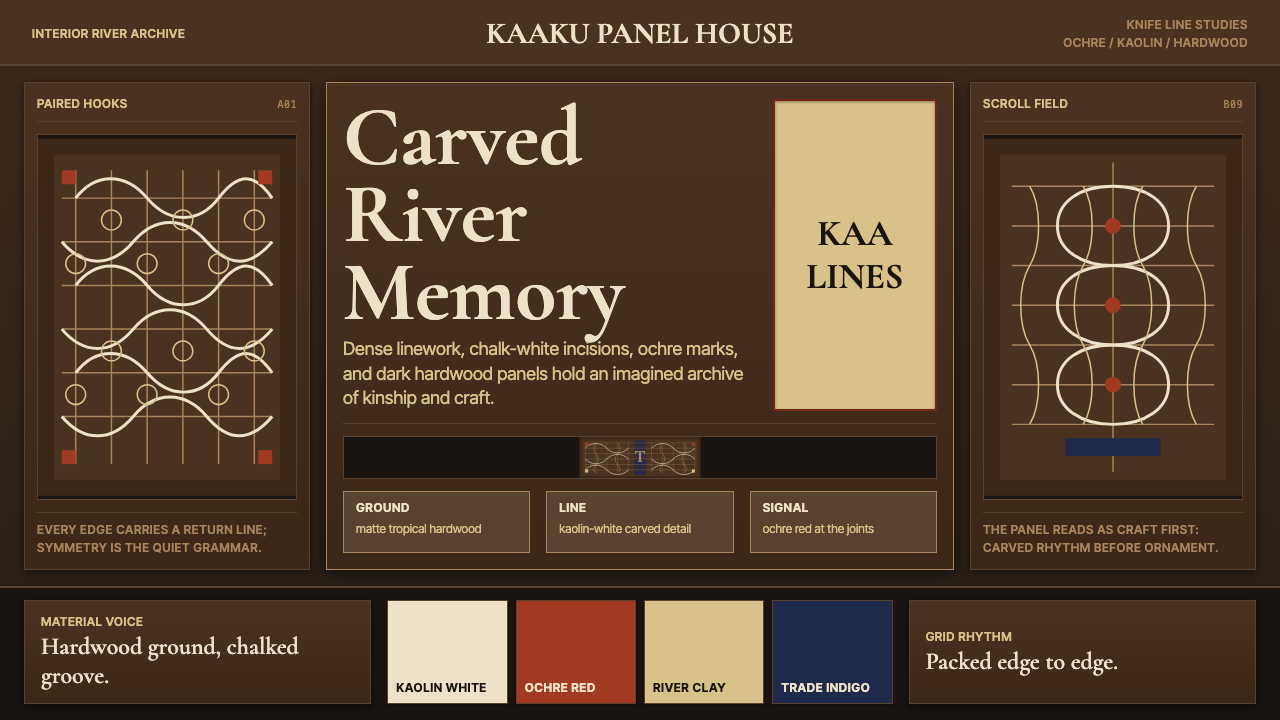
Carved into tropical hardwood by the descendants of self-liberated Africans, Suriname Maroon tembe is a dense, rhythmic geometry born from defiance and memory.
Suriname Maroon Tembe in brief
Tembe is the geometric line-carving tradition of the Maroon peoples of Suriname — principally the Saramaka and Ndyuka communities — who developed it in the forests of the South American interior over several centuries. The word refers both to the carved objects themselves and to the visual logic governing their surface treatment: every available face is packed edge-to-edge with interlocking S-curves, bilateral scrollwork, paired hooks, and radiating symmetrical motifs, incised with a knife into hardwood and then filled with kaolin chalk-white, red ochre, or black soot.
What distinguishes tembe from other geometric carving traditions is its commitment to total surface coverage and bilateral symmetry. No part of the carved face is left plain; negative space is itself a carved element, held in precise tension with the positive lines surrounding it. The palette is elemental: the deep warm brown of the hardwood ground, the stark chalk of kaolin, the earthen red of ochre, and the dense matte black of soot — materials drawn entirely from the Surinamese forest and riverbed. The result is a visual system of extraordinary density that reads simultaneously as pattern, map, and encoded memory.
In its contemporary design application, tembe translates this carved materiality into screen form. Deep hardwood browns anchor the background, kaolin white provides text contrast and fine line detail, ochre red marks primary interactive elements, and river-clay sienna warms secondary surfaces. The density and rhythm of a tembe panel — its insistence on filling every space with purposeful mark-making — becomes the governing principle of layout: nothing is left empty without intention, and every decorative element carries structural weight.
Where does Suriname Maroon Tembe come from?
The history of tembe begins with one of the most remarkable acts of collective resistance in the Atlantic world. Between roughly 1685 and 1762, tens of thousands of enslaved Africans escaped from Dutch colonial plantations on the Surinamese coast and fled into the dense rainforest interior, where they established autonomous societies in the river valleys of the upper Suriname, Tapanahony, and Marowijne. These communities — called Maroons, from the Spanish cimarrón meaning 'wild' or 'untamed' — successfully defended their freedom against repeated Dutch military campaigns and in 1760–1762 extracted formal peace treaties from the colonial government that recognized their territorial sovereignty. The Saramaka treaty of 1762 is among the oldest surviving treaty agreements between a European colonial power and a formerly enslaved community.
Cut off from the coast and building new societies in the forest, the Maroon communities synthesized a new material culture from African memories, Amazonian craft knowledge, and the limited tools and materials they could acquire or produce. Tembe emerged in this context as a prestige craft — objects carved for chiefs, elders, and community ceremonies — and became one of the most sophisticated visual art traditions in the Americas. Early ethnographic documentation of tembe dates to around 1900, though oral tradition and artifact evidence suggest continuous development throughout the eighteenth and nineteenth centuries. By the time anthropologists Richard Price and Sally Price began their fieldwork with the Saramaka in the 1960s, tembe had achieved a level of formal complexity comparable to the great weaving and textile traditions of West Africa.
The iconographic vocabulary of tembe is deliberately non-representational. Unlike many African visual traditions that encode spirits, cosmological diagrams, or narrative sequences, tembe patterns are abstract — their meaning is held in the formal relationships between elements rather than in any single motif's referent. Scholars including Kenneth Bilby have documented how individual carvers develop signature compositional styles that are recognizable within their communities while remaining within the shared formal vocabulary. Mastery is demonstrated not by inventing new shapes but by achieving unprecedented density and rhythmic precision with established ones.
Tembe objects traditionally served specific social functions: elaborately carved wooden trays, stools, paddles, combs, and food stirrers were gifted by men to women within systems of reciprocal exchange that governed Maroon social life. The quality of carving conveyed respect, affection, and status. This social grounding means that tembe is not merely decorative — it is relational, and its density is an index of care. When contemporary designers apply the tembe aesthetic, they inherit this logic: a surface packed with deliberate, precise mark-making signals effort and attention, never excess.
What defines the Suriname Maroon Tembe look?
Total Surface Coverage
The defining structural principle of tembe is that no face of a carved surface is left unworked. Motifs are arranged so that every zone — including the spaces between positive carved lines — becomes a deliberate element. In screen applications, this translates to layouts where negative space is actively managed: margins carry line-work or micro-patterns, section dividers function as ornamental bands, and even padding areas are conceived as part of the visual rhythm rather than empty rest.
Bilateral Symmetry
Every tembe composition is organized around one or more axes of bilateral symmetry, with motifs mirrored precisely left-to-right and often top-to-bottom. This is not casual reflection — pairs of hooks, S-curves, and scroll elements are calibrated so that each half is the exact mirror of the other, with the axis itself marked by a thin central line or a column of repeated dots. In layout terms, this suggests centered compositions with paired typographic or ornamental elements flanking a strong vertical axis.
Elemental Earth Palette
The tembe palette is drawn from materials found in the Surinamese forest and river: the deep warm brown of tropical hardwood, the bright chalky white of kaolin clay, the saturated burnt orange of red ochre, and the near-black of wood soot. These four tones — brown ground, white detail, ochre accent, black structure — are the entire system. Colors are not blended or softened; they appear as flat, opaque planes in sharp contrast with their neighbors. The warmth of the ochre against the cold kaolin is the system's primary visual tension.
Knife-Line Precision
Tembe lines are incised rather than painted, giving them a character distinct from brushwork: they are narrow, sharply edged, and completely consistent in weight along their length. The carver controls depth rather than pressure, producing lines that are architectural rather than expressive. In digital translation, this quality calls for strokes that are thin, uniform, and geometrically derived — lines whose precision signals the craft origin rather than spontaneous gesture.
S-Curve and Hook Vocabulary
The primary formal vocabulary of tembe consists of S-curves (which appear singly, mirrored, and nested in series) and paired hooks (J-shapes that face each other across the axis of symmetry). Secondary motifs include small diamond lozenges, repeating dot chains, and concentric arc bands used as field dividers. These elements are not combined arbitrarily — their pairing and sequencing follows compositional rules developed and transmitted across generations of carvers. Understanding the grammar means recognizing which elements terminate a composition and which ones create its interior rhythm.
Rhythmic Density
Experienced tembe carvers achieve a remarkable visual rhythm through repetition and modulation: similar motifs appear at regular intervals but are scaled, rotated, or nested differently at each appearance, creating a pulse that the eye can follow across the surface. This is closer to musical structure — theme and variation — than to the static repetition of a wallpaper tile. In layout design, this rhythmic quality is best achieved by using a small set of geometric elements repeatedly but at varying scales and orientations rather than through literal reproduction.
Material Honesty
Tembe never simulates a material it is not: the carved wood is visibly wood, the kaolin fill is visibly a dry chalk inlay, and the distinction between the two is part of the composition's visual logic. No illusions of depth, shadow, or three-dimensionality are introduced that do not arise from the actual carving. In screen design, this principle argues against decorative gradients, soft drop-shadows, or surface textures that imitate materials rather than acknowledging the flat digital ground. What tembe calls for is contrast between distinct flat materials, not simulation of light and depth.
Who shaped Suriname Maroon Tembe?
Richard Price is among the foremost scholars of Maroon history and visual culture. His decades of fieldwork with the Saramaka, beginning in the late 1960s, produced a body of documentation — undertaken jointly with Sally Price — that remains the principal scholarly record of tembe and its social context. His books on Saramaka history gave Maroon oral tradition its most rigorous written form in English, and his collaborative approach to research set a standard for ethical ethnographic practice in communities with histories of exploitation.
Sally Price's scholarship focuses specifically on the art objects of the Suriname Maroons, examined both as aesthetic achievements and as objects embedded in social exchange. Her work challenged the tendency of Western art history to treat non-Western geometric abstraction as mere craft or folk art — arguing instead that tembe carvers operate with aesthetic theories of comparable sophistication to any European tradition. Her book on Maroon arts remains the foundational art-historical treatment of tembe for a general audience.
Kenneth Bilby is an ethnomusicologist and anthropologist whose fieldwork spans multiple Maroon communities in Suriname and Jamaica. His research on Ndyuka material culture and ceremonial practice has illuminated the connections between tembe's formal vocabulary and the broader systems of spiritual and social communication in Maroon life. His documentation of individual carvers' styles has been particularly valuable in demonstrating that tembe is not an anonymous folk tradition but one in which named practitioners develop identifiable personal vocabularies within a shared formal system.
The hereditary chiefs — Granmen — of the Saramaka have historically been the primary commissioners and custodians of the most elaborately carved tembe objects. Granman households maintained the most accomplished carvers, and objects gifted by or to the Granman set the standard of technical excellence that younger carvers studied and aspired to match. The continuity of tembe through periods of colonial harassment, Surinamese civil conflict in the 1980s and 1990s, and the disruption of displacement has depended substantially on the cultural authority vested in these lineages.
How do you use Suriname Maroon Tembe today?
Applying tembe in contemporary design contexts requires understanding what the aesthetic is actually doing: it is not surface decoration added to a neutral layout but a complete spatial logic in which density, bilateral order, and material contrast are structural. Any correct application must commit to the system's core principles — total surface intentionality, a restricted earth-toned palette, and geometric line-work derived from the S-curve and hook vocabulary — rather than borrowing isolated motifs.
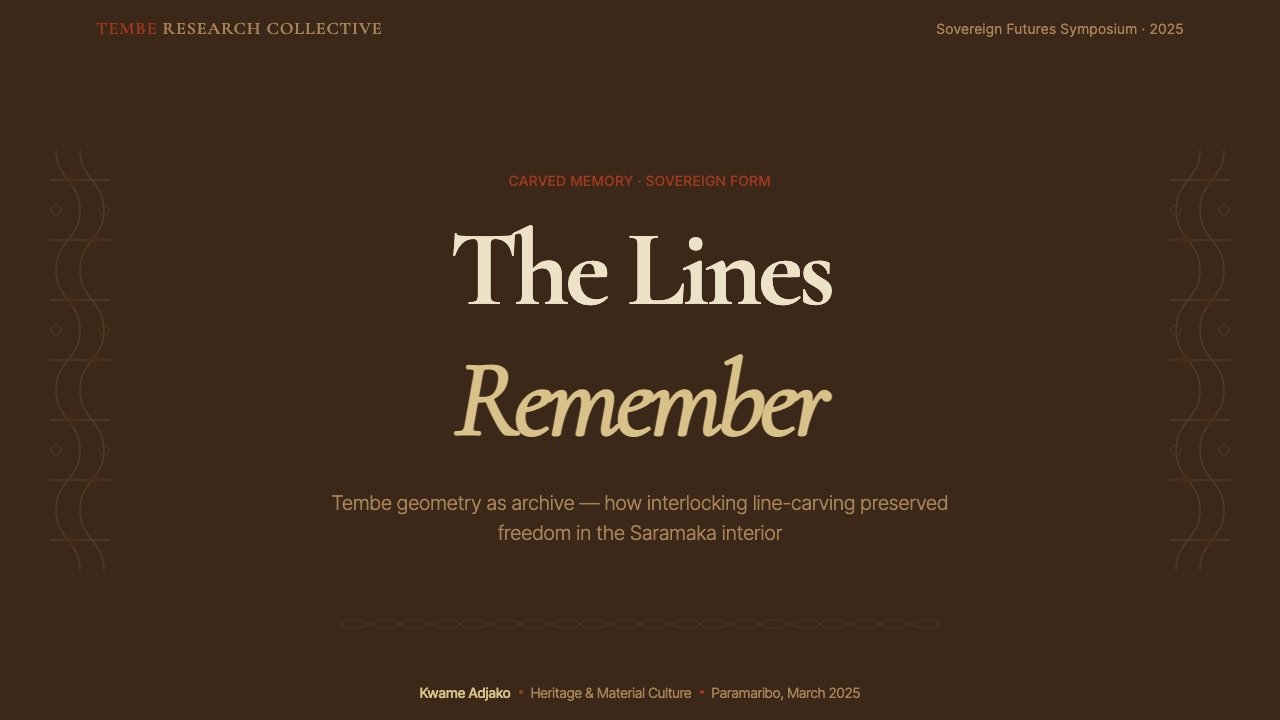
For presentation slides, tembe works most effectively when the cover page treats the full slide surface as a carved panel: a deep hardwood-brown field covered in fine white kaolin line patterns, with the title set in high-contrast white or chalk type against the patterned ground. Content slides should maintain the palette but reduce the pattern density, using tembe-derived border bands or axis lines to organize the grid rather than filling the full background. Data slides benefit from the palette's natural hierarchy — ochre red for primary data series, kaolin white for secondary, dark ground for the chart area — with bar and segment fills derived from the four-color earth system.
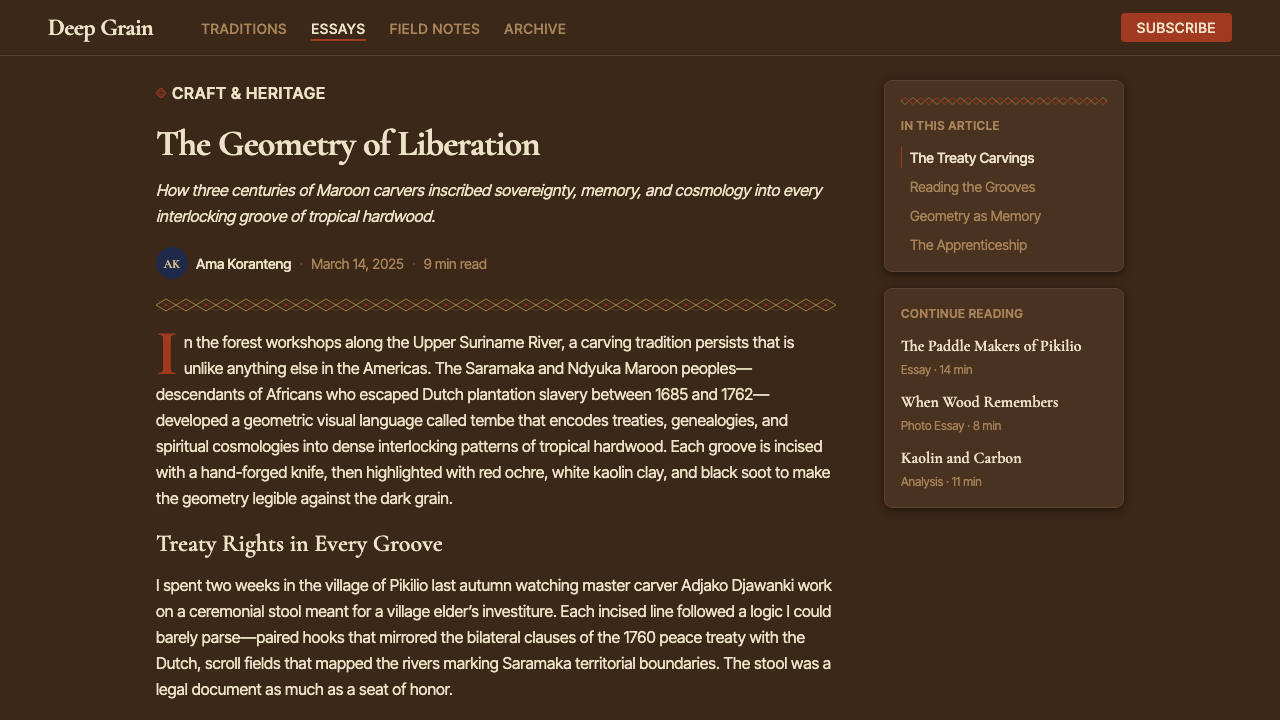
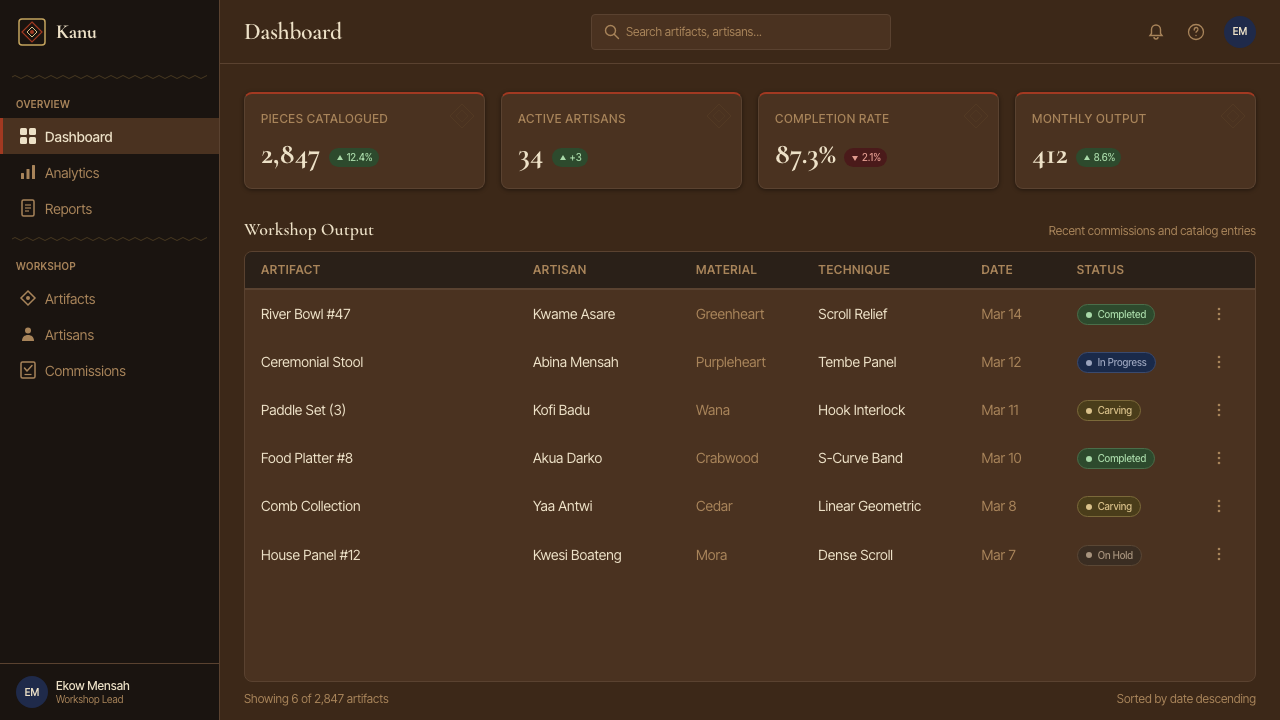
For web interfaces, the style is well-suited to dashboards and profile pages where the grid-based bilateral symmetry of tembe informs the component layout. Cards should have a warm hardwood-brown background with kaolin-white text, with ochre used exclusively for primary calls to action and alert states. Navigation patterns should be architectural — horizontal bands rather than floating menus — reinforcing the panel-like quality of the tembe surface. The tembe aesthetic works less well for light, airy product pages where the dense pattern and earth palette can overwhelm fine typographic hierarchy.
For editorial and marketing applications, tembe offers a distinctively bold surface for cover pages, section dividers, and hero areas where the full pattern can be deployed without overwhelming body text. An editorial spread using tembe might treat the article image zone as a tembe panel — the photograph or illustration surrounded by a dense line-work border, with the text column on a clean kaolin-white ground. Marketing pages can use tembe-derived pattern bands as section breaks, with the ochre red reserved for a single consistent call-to-action color across the entire layout.
A common mistake when applying tembe is treating the palette as a generic earth-tone scheme — adding terracotta, sage, or other trending muted tones alongside the kaolin, ochre, and soot. The tembe palette is not earthy in a general sense; it is specific to four materials with precise contrast relationships. Adding additional colors dilutes the system's visual logic and breaks the strong figure-ground relationships that give tembe its presence. Similarly, attempting tembe with gradients or blended transitions undermines its fundamental flatness — the chalk inlay sits cleanly in the carved groove; it does not fade at the edges.
Suriname Maroon Tembe — FAQ
Is tembe a living tradition or a historical one?
Tembe is very much a living tradition, though it has been severely disrupted by the Surinamese civil conflict of the 1980s and 1990s, during which tens of thousands of Maroons were displaced from their interior villages to coastal refugee camps or across the border into French Guiana. The disruption broke apprenticeship chains and separated many carvers from their communities. In the decades since, Maroon cultural organizations and diaspora communities in Paramaribo and Cayenne have worked to maintain the practice. Contemporary tembe carvers are active today, and the tradition has also attracted international attention through museum exhibitions in the Netherlands, France, and the United States.
How does tembe relate to other African diaspora visual traditions?
Tembe shares formal qualities with several West and Central African visual traditions — particularly the Akan adinkra symbol system, Kuba kingdom geometric textiles, and various Yoruba woodcarving traditions — but it is not a direct continuation of any of them. The Maroons' African ancestors came from multiple regions and ethnic groups, and tembe emerged from the synthesis of these varied heritages in a new Amazonian context, combined with indigenous South American formal influences absorbed through forest life and trade. The bilateral symmetry and total surface coverage are widely shared principles, but the specific vocabulary of S-curves, paired hooks, and the kaolin-ochre-soot palette is distinctly Surinamese Maroon.
Can tembe work in a light-background design system?
The canonical tembe surface is dark — the hardwood ground is naturally deep brown — and the kaolin white reads as a bright light-on-dark contrast. A light-ground inversion is possible, with the kaolin white becoming the field and the dark brown appearing as the line work, but this reverses the material logic in a way that requires care. In a light inversion, the ochre red tends to appear warmer and more dominant than in the dark-ground version, and the overall effect is closer to printed textile than carved wood. This variant works well for printed materials and certain editorial contexts but can feel softer and less authoritative than the canonical dark-ground presentation.
What distinguishes an authentic tembe application from a generic tribal pattern?
The critical distinctions are specificity and grammar. Generic tribal patterns borrow isolated geometric motifs — zigzags, diamonds, repeating chevrons — and tile them without regard for compositional structure. Authentic tembe application follows the formal rules of the tradition: bilateral symmetry organized around a central axis, S-curves and paired hooks used as primary vocabulary, ochre and kaolin as the two main tones against a brown or black ground, and the specific quality of total surface coverage where every element is in purposeful relationship with its neighbors. Beyond the formal, authentic application also requires acknowledgment: tembe is the living heritage of a specific community with a documented history, and design work that deploys it should not present it as generic exotic geometry.
How do you handle the high visual density of tembe in small-screen or mobile contexts?
Tembe's density is calibrated for viewing at arm's length on objects of a certain scale — a carved tray or paddle held in the hands. At very small sizes, the fine line-work can collapse into visual noise. The practical solution is to use pattern density selectively: full-density tembe panels are appropriate for large hero areas, cover pages, and section dividers, while content areas and individual components use a reduced pattern vocabulary — perhaps just border bands, axis lines, or the four-color palette without the pattern fill. The earth tones travel well at any scale; the detailed line-work requires sufficient space to breathe.
Related design styles
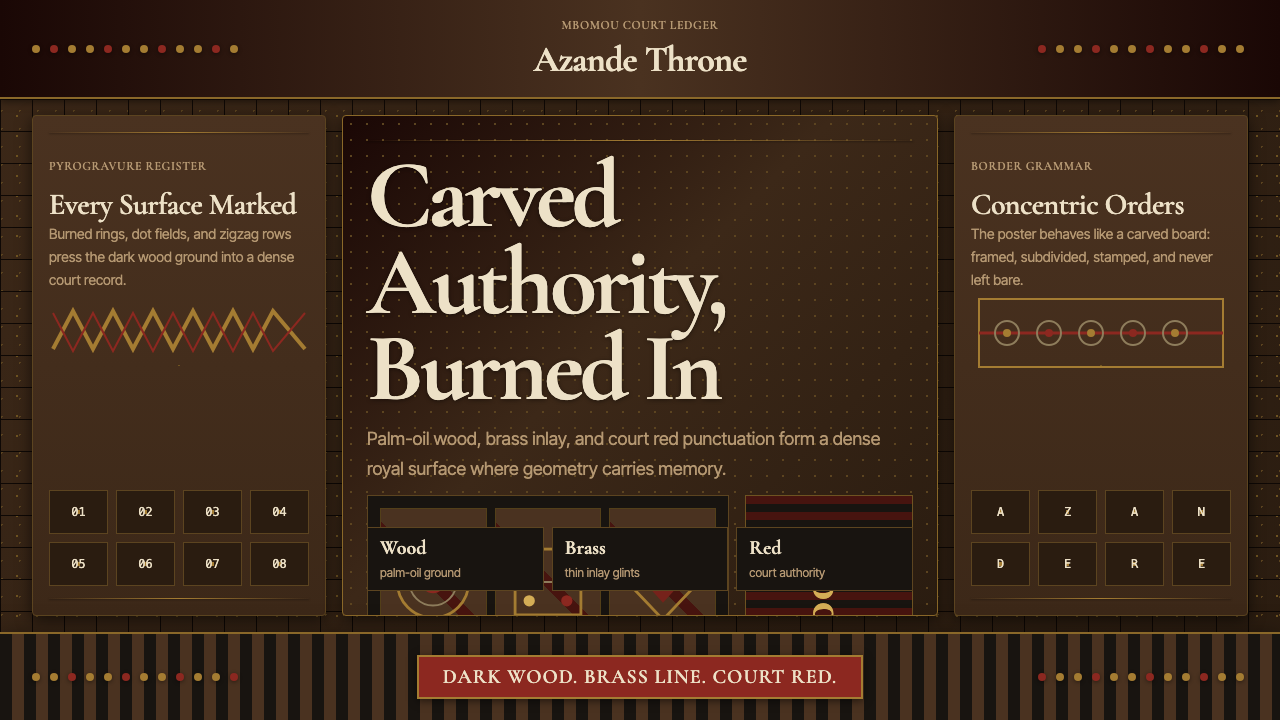 Central African Azande ThroneDense court gravity. Dark wood grids, brass dots, and court red cover every s…
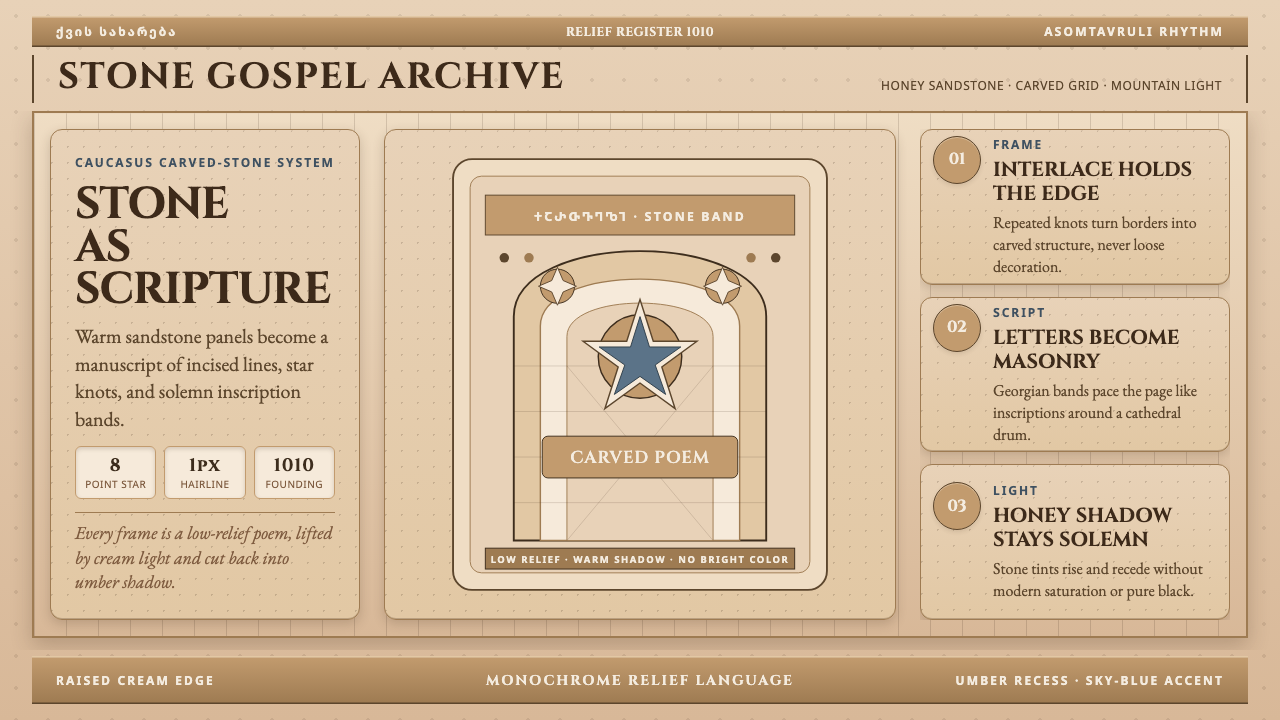 Georgian Nikortsminda Stone-CarvingStone becomes scripture. Cinzel caps and Georgian bands carve honey-sandstone…
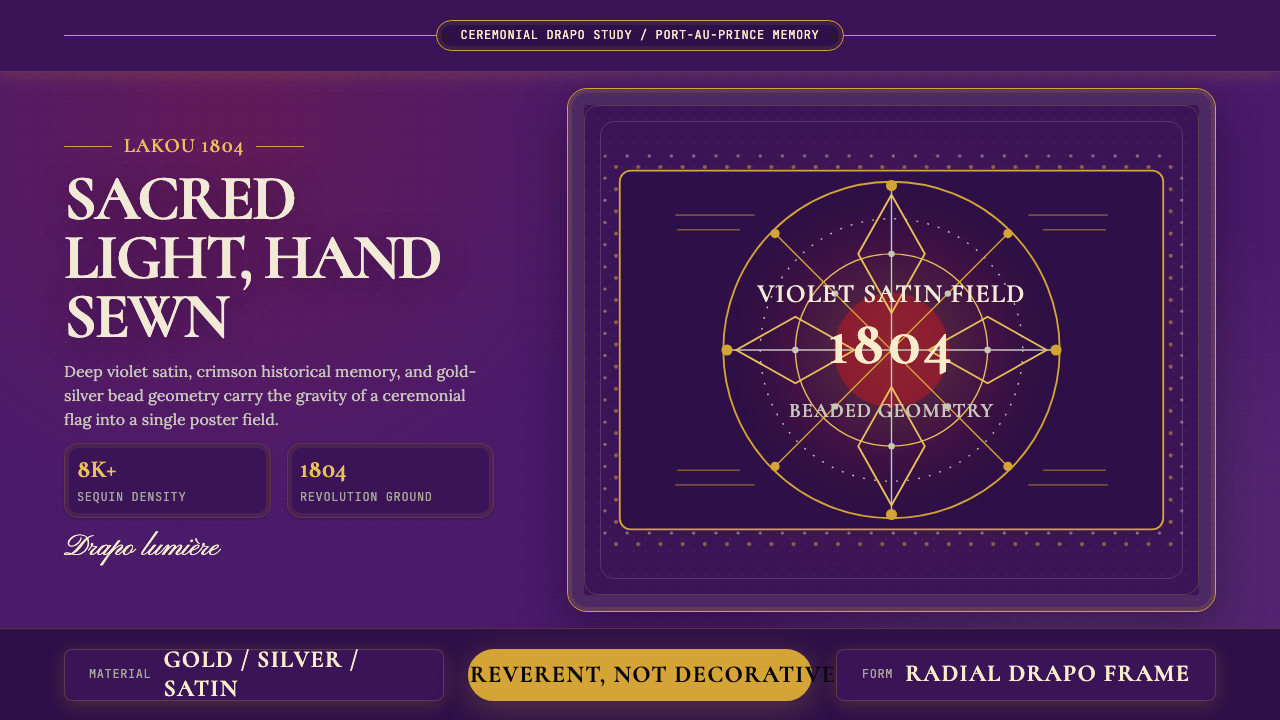 Haitian Vèvè Sequin Drapo 1804Sacred density. Violet satin, gold sequins, and radial geometry hold 1804 gra…
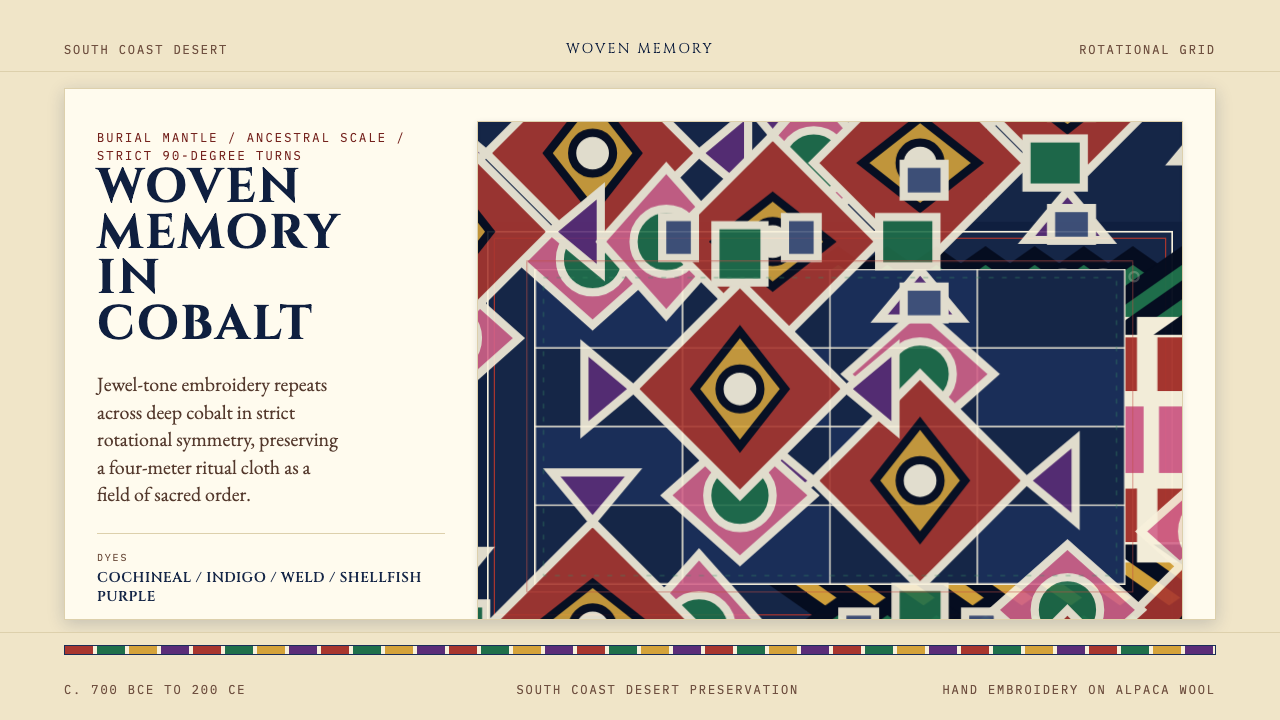 Paracas Andean TextileAncestral and exact. Jewel tones repeat on deep cobalt in strict 90° turns.
 Peruvian Quechua Keros (Andean Cup)Hidden cosmology glows. Crimson lacquer and saffron tocapu grids frame the st…
 Swahili Stone Town DoorTeak darkness remembers. Brass studs and Cormorant small caps frame a carved…