What is Paracas Andean Textile?
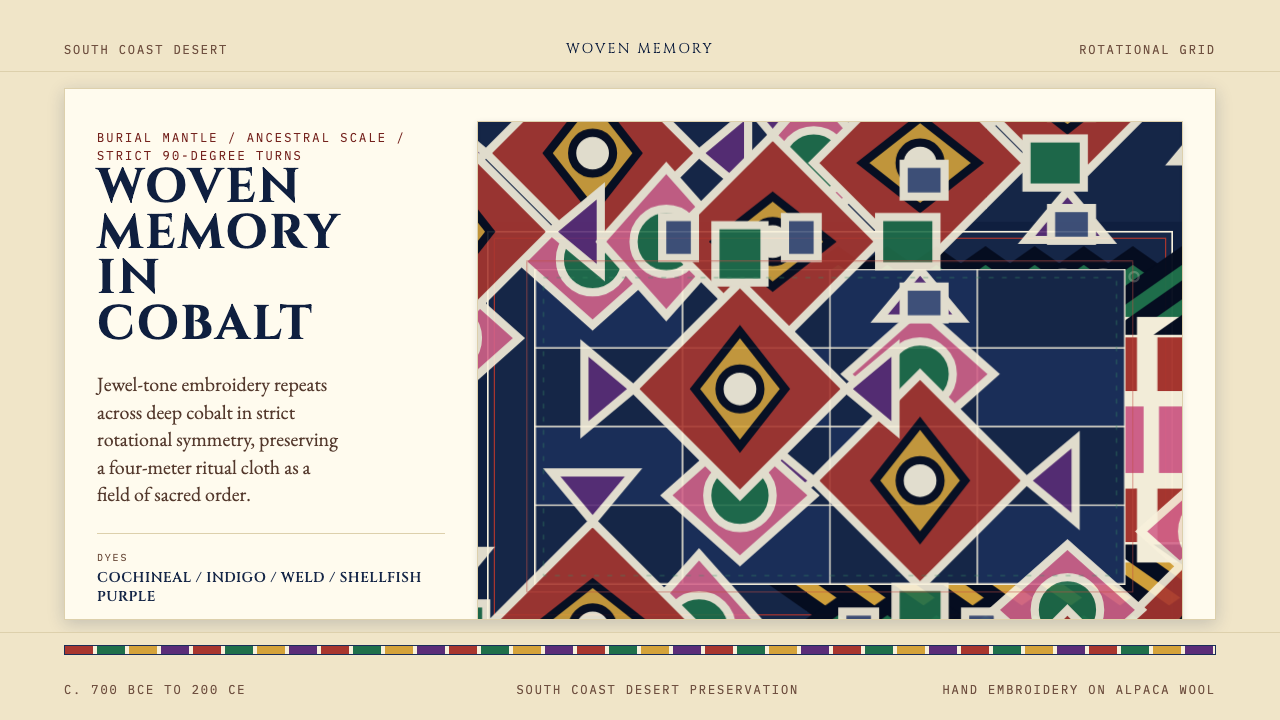
Two thousand years before pantone, Andean weavers mapped the cosmos in cochineal red and indigo blue — fifty identical shamans rotating in perfect lockstep across four meters of alpaca wool.
Paracas Andean Textile in brief
Paracas Andean Textile is a design language derived from the embroidered burial mantles of the Paracas culture on Peru's south coast, active roughly from 700 BCE to 200 CE. The visual system is built on three interlocking principles: saturated jewel-tone color on a deep cobalt ground, strict rotational symmetry enforced across the full width of a cloth, and a dense repertoire of recurring figures — flying shamans, jaguars, monkeys, and supernatural birds — each drawn with bold embroidered outlines and filled with contrasting hues.
What separates this tradition from decorative textile arts elsewhere is its systematic, almost algorithmic quality. A single mantle contains fifty to one hundred nearly identical figures, each rotated exactly ninety degrees from its neighbor, the sequence repeating in a four-directional grid across the full surface. The repetition is not laziness — it is cosmological argument. Each rotation embodies a cardinal direction, a season, a state of spiritual transformation. The aesthetic is simultaneously archaeological and monumental: ancient in its materials, rigorous in its geometry, and quietly sacred in its intent.
In its contemporary application as a design system, Paracas Andean Textile translates this visual intelligence into a vocabulary for digital and print work. The deep cobalt ground becomes a commanding background field. The jewel tones — ruby red, emerald green, saffron yellow, and shellfish purple — serve as the primary accent and hierarchy palette. Rotational grid logic governs layout and pattern. The result carries an authority that reads as neither Western modernist nor generically ethnic, but as the product of a fully realized, self-sufficient visual civilization.

Where does Paracas Andean Textile come from?
The Paracas peninsula, a windswept desert promontory on Peru's south coast, was home to a culture that flourished for nearly a millennium before being absorbed into the Nazca tradition around 200 CE. The region's extreme aridity — almost no rainfall for centuries on end — preserved objects in a state that would be impossible in wetter climates. When Peruvian archaeologist Julio C. Tello excavated the Paracas Necropolis in 1925, he uncovered more than four hundred mummy bundles, each wrapped in multiple layers of finely embroidered textiles. The colors were not faded. The figures were not blurred. Two thousand years in the sand had left them as vivid as the day they were made.
The dyes that produced these colors were among the most sophisticated in the pre-industrial world. Cochineal, a dye extracted from the dried bodies of scale insects that live on prickly pear cacti, yielded reds of extraordinary intensity and lightfastness — a range from pale rose through crimson to near-purple, depending on the mordant used and the acidity of the dye bath. Indigo, fermented from the leaves of several plant species native to the Andes, produced deep blue tones. Weld and other plant sources contributed yellows. Shellfish murex provided a rare and costly purple. The Paracas weavers understood mordanting, over-dyeing, and resist techniques well enough to produce color combinations that still carry visual weight across two millennia.
The figures themselves — the flying shamans with their elaborate headdresses and trophy heads, the feline creatures with split-staffs and serpent attributes — are not merely decorative motifs. Scholars including Anne Paul and Mary Frame have demonstrated that these figures encode a systematic visual language. Specific attribute combinations signal specific supernatural identities; the orientation of a figure relative to its neighbors encodes relational meaning; the four-directional rotational scheme maps onto Andean cosmological models of spatial and temporal organization. What looks to a modern eye like a bold repeating pattern is, for its makers, closer to a written text.
The textile tradition did not end with the Paracas culture. It passed through Nazca, through the Wari empire (roughly 600 to 1000 CE), through the Inca empire (roughly 1400 to 1532 CE), and continues in contemporary Andean weaving cooperatives throughout Peru, Bolivia, and Ecuador. In the twentieth century, scholars such as Anne Paul produced systematic catalogs of Paracas iconography, while artists like Maximo Laura — a contemporary Peruvian master weaver — have extended the visual language into large-format tapestries that hang in international museums and corporate collections. The Lima Larco Museum holds the most significant institutional collection, where the textiles are displayed in conditions that allow their scale and chromatic intensity to be fully apprehended.
What defines the Paracas Andean Textile look?
Color — Jewel Tones on Cobalt Ground
The defining chromatic decision is a deep, saturated cobalt blue as the dominant ground, against which jewel tones — ruby red, emerald green, saffron yellow, and shellfish purple — read with maximum intensity. The ground is not neutral; it is assertive. The accent colors do not decorate the background — they compete with it and win through saturation rather than lightness. This produces a visual temperature that is simultaneously warm and cool, ancient and immediate. In practice, no more than three accent hues appear prominently on any one surface, with one typically dominant and the others used for interior fill or outline contrast.
Rotational Symmetry — The Four-Direction Grid
The structural engine of the system is not bilateral symmetry but rotational symmetry, specifically the ninety-degree rotation of a complex figure across a grid. A single figure is drawn; it is then rotated and repeated such that every adjacent unit faces a different cardinal direction. Seen close up, the pattern appears to show figures in many orientations; seen at a distance, it resolves into a unified, hypnotically stable field. This logic — local variation, global order — gives layouts an energy that purely symmetrical patterns lack. It rewards slow looking and repays the eye at every scale.
Figure Drawing — Bold Outline and Interior Contrast
Each figure in the Paracas tradition is bounded by a thick, continuous embroidered outline in a hue that contrasts sharply with both the ground and the figure's interior fill. The interior is not monochromatic — limbs, headdress elements, and attribute objects are each filled in a different hue, producing a mosaic effect within the silhouette. This approach ensures that figures read at distance as bold unified shapes while rewarding close inspection with color complexity. In digital application, this translates to strong stroke weights on illustrative elements and deliberate multi-color fill strategies rather than flat single-color fills.
Iconographic Vocabulary — Specific, Recurring Figures
The motif vocabulary is not abstract — it is populated by identifiable beings: the flying shaman with fanged mouth and trophy head, the oculate being with radiating appendages, the feline creature with split-staff, the supernatural bird. Each figure carries a fixed set of attributes that identifies it within the iconographic system. This commitment to a specific, readable figure vocabulary rather than geometric abstraction gives the style a narrative weight that purely ornamental pattern systems lack. Applied to design, it suggests the use of a controlled set of illustrative icons or emblems rather than generic decorative pattern.
Texture — Embroidered Surface Quality
The original textiles are not flat — they are built up from thousands of individual embroidery stitches, each adding a tiny increment of raised, directional texture to the surface. The visual effect is a surface that shifts slightly as light changes, that has grain and directionality within each color field. In contemporary application, this quality is suggested rather than simulated: a subtle woven or fabric-grain texture applied to solid color fields, or illustrative linework that varies in weight to suggest the irregularity of hand-stitched outline. The texture should feel handmade and material, not digital and smooth.
Scale — Monumental Repetition
The original mantles are not small objects — they are four meters long and were designed to be seen as a whole from a distance as well as examined close up. The scale relationship between the individual figure and the total cloth is carefully calibrated: the figure is large enough to be read at arm's length, the total field is large enough to produce a visual rhythm when seen from across a room. In design application, this means that pattern elements should be sized for the actual viewing distance of the medium — generous on a printed cover, tighter on a phone screen — and that the total composition should read as a unified field before it reads as a collection of individual motifs.
Typography — Inscriptional Weight and Ceremonial Register
The original textiles have no letterforms, but the design language implies a typographic register: monumental, inscriptional, ceremonial. The appropriate typographic companion to Paracas Andean Textile is a large-uppercase serif with strong stroke contrast — a face in the tradition of classical Roman stone inscription, evoking permanence and cultural authority — used for display and headline purposes. Body text, where present, should be set in a legible serif at comfortable reading size, with generous leading that echoes the open intervals between figure rows in the original cloth. Avoid typefaces that feel casual, grotesque, or purely geometric; the typographic mood is reverent and deliberate.

Who shaped Paracas Andean Textile?
Tello (1880–1947) is the founding figure of Peruvian archaeology. Born in Huarochirí in the central Andes, he was the first indigenous Peruvian to earn an international academic degree (Harvard, 1909) and dedicated his career to demonstrating that Peru's pre-Columbian civilizations were independent, sophisticated achievements rather than diffusions from other cultures. His 1925 excavation of the Paracas Necropolis — which he conducted under difficult conditions, racing against looting — brought the Paracas textiles to international scholarly attention and established the framework within which they have been studied ever since. The Lima Larco Museum and the National Museum of Archaeology, Anthropology and History in Lima both hold significant Tello-era collections.
Anne Paul is the scholar most responsible for transforming the study of Paracas textiles from archaeological cataloging into iconographic analysis. Her landmark publication Paracas Ritual Attire: Symbols of Authority in Ancient Peru (1990) provided the first systematic analysis of the relationship between figure attributes and probable ritual or social function. Paul demonstrated that specific combinations of headdress, mouth-mask, and held object identify distinct supernatural figures in a coherent iconographic system — that the textiles are not merely beautiful but semantically structured. Her work established the interpretive foundations that scholars including Mary Frame have continued to build on.
Mary Frame is a textile scholar and weaver who has contributed the most technically detailed analyses of Paracas structure and figure construction. Her work focuses on how the embroiderers encoded meaning through the direction and sequence of stitches — not only in the visible imagery but in the underlying structural logic of the cloth itself. Frame's research has demonstrated that the textile tradition embeds spatial and directional information at multiple levels simultaneously: in the figure, in the figure's relationship to neighboring figures, and in the orientation of the stitching relative to the warp and weft. This layered encoding is what distinguishes Paracas textiles as a meaning-bearing system rather than a decorative one.
Maximo Laura is a contemporary Peruvian master weaver, born in 1955 in Ayacucho, who has extended the Paracas and broader Andean textile tradition into large-format fine-art tapestry. His works — some exceeding two meters in height — are held in the collections of the United Nations, the World Bank, and numerous international museums. Laura's practice demonstrates that the Paracas visual language is not a closed historical system but a living one: he maintains strict fidelity to the traditional color approach and figure vocabulary while extending scale, subject matter, and compositional complexity beyond what any pre-Columbian weaver could have produced. His work is the clearest contemporary evidence that Paracas Andean Textile is a viable aesthetic system for large-format, high-resolution visual communication.
Rebeca Carrión Cachot (1897–1960) worked alongside Tello and later directed the National Museum of Archaeology. Her 1931 study La Indumentaria en la Antigua Cultura Paracas provided the first detailed typological analysis of the figures and their costume attributes. She established the basic descriptive vocabulary — the naming and categorization of figure types — that subsequent scholars refined. Her work represents the transition from Tello's broad archaeological surveys to the more focused iconographic scholarship that Paul and Frame later developed. Together, these scholars form the interpretive lineage through which Paracas textiles have been understood as a coherent visual and cultural system.
How do you use Paracas Andean Textile today?
Paracas Andean Textile works best when the design brief calls for authority, cultural depth, and visual intensity — situations where the designed artifact is meant to feel like a primary document rather than a communication tool. The deep cobalt ground reads immediately as serious and commanding; the jewel-tone accents read as precious and deliberate. This makes the system well-suited to institutional presentations, premium product launches, cultural heritage brands, and any context where gravitas and distinctiveness are more important than approachability.
For presentation slides, the system divides naturally into two modes. Cover slides benefit from the full pattern treatment: the cobalt ground with one or two figures from the rotational grid overlaid at large scale, the title set in large-uppercase inscriptional serif, a single jewel-tone accent used for the brand or event name. The combination reads as a visual statement before it reads as a title card — which is appropriate for high-stakes keynotes and award presentations. Content slides should pull back to a simpler register: cobalt ground retained, body text in cream or near-white at a generous size, section headings in the accent color, no pattern overlay on text-heavy slides. Data slides work well when chart elements are colored from the jewel-tone palette — bars and segments in ruby, saffron, and emerald against a cobalt or deep-navy ground read as distinctly as traditional textile figures against their background.
For web interfaces and digital dashboards, the system requires some adaptation. A full cobalt ground works for hero sections and feature blocks but is too dominant for long-form reading interfaces. A practical approach: use the deep cobalt for navigation, sidebars, and high-emphasis components; use a very light warm neutral for the primary content area; reserve the jewel tones for data visualization, interactive states, and call-to-action elements. Pricing pages work particularly well with this treatment — tier differentiation through jewel-tone accent on card borders or headers, with the recommended tier marked by the full cobalt background, creates a visual hierarchy that is both legible and memorable.
For editorial and marketing work, the style supports bold, high-contrast treatments that photograph well and reproduce at any scale. A Paracas-inflected magazine spread or brochure cover works best when it commits fully to the cobalt ground with large-scale figure imagery — either original textile photography or contemporary illustration in the same vocabulary — and reserves all white or cream space for text. Marketing campaigns using this aesthetic read as culturally substantial rather than trendy, which makes them well-suited for brand positioning in premium, heritage, or global-institutional contexts. The rotational grid logic can be applied to multi-panel sequences: a series of social media cards or a folded brochure where each panel continues the pattern creates a satisfying sense of visual rhythm and system coherence.
The most common mistake when applying Paracas Andean Textile is treating the jewel-tone palette as decorative rather than structural — scattering red, green, and yellow accents across a layout without the underlying rotational logic that gives the original textile its order. A second common error is using the cobalt ground without committing to its intensity, producing a washed-out version that reads as generic dark blue rather than as a commanding field. The third is adding softness where the system demands hardness: soft shadows, blurred edges, and gradients are antithetical to a visual language built on flat dyed surfaces and crisp embroidered outlines. When in doubt, reduce the number of colors and increase the scale and boldness of the remaining elements — this system rewards decisiveness.

Paracas Andean Textile — FAQ
Is this style appropriate for brands outside of Peru or Andean culture?
The question of cultural context is genuine and worth considering carefully. The Paracas Andean Textile tradition belongs to a living cultural sphere — Andean communities continue to weave, and the iconographic tradition continues to carry meaning. Applying the style respectfully means engaging with it as a coherent visual civilization rather than as a decorative surface: understanding what the rotational logic, the color hierarchy, and the figure vocabulary are doing structurally, and deploying them with that understanding rather than as atmospheric texture. Brands outside the Andean sphere that use this style credibly tend to do so in contexts where cultural depth and global scope are explicit brand values — institutional, academic, and international organizations for whom the Andean visual tradition carries universal rather than regional associations.
Can Paracas Andean Textile work on light backgrounds, or is the cobalt ground mandatory?
The deep cobalt ground is historically canonical and produces the most authentic reading of the style, but it is not absolutely mandatory. A light-ground variant is possible — warm cream or natural linen tones echo the undyed alpaca wool ground that appears in some Paracas pieces — but it requires a significant shift in how the other colors function. On a light ground, the jewel tones must increase in visual weight to maintain the system's intensity, and the figure outlines should become heavier to preserve the bold legibility that characterizes the tradition. The risk on a light ground is that the style drifts toward generic folk-art or Southwest-textile pastiche. Staying close to the specific Paracas iconographic vocabulary — the systematic rotation, the specific figures — rather than relying on surface color alone is what prevents that drift.
How is this different from other pre-Columbian or indigenous Andean design styles?
Several distinct visual traditions coexist under the broad label of Andean textile art. Nazca (which directly followed Paracas) used a lighter ground and more elongated, more abstract figure forms. Wari textiles (roughly 600–1000 CE) used a stepped-fret and geometric abstraction that is more grid-like and less figural. Inca textiles used the tocapu — small geometric squares containing abstract glyphs — arranged in bands, producing a more restrained and heraldic effect. Contemporary Andean cooperative weaving varies enormously by region. Paracas is specifically characterized by the deep cobalt ground, the bold embroidered outline, the dense rotational repetition of complex figural scenes, and the specific iconographic vocabulary of shamanic transformation. Any application that retains these specific features reads as Paracas rather than as generically Andean.
Does the style work for digital data visualization?
Yes, with deliberate application. The Paracas palette — with its four to five clearly differentiated, high-saturation jewel tones against a deep dark ground — is actually well-suited to multi-series data visualization, where distinguishable categorical colors are essential. The cobalt ground functions like a dark-mode dashboard background, and the jewel tones provide naturally high contrast against it. The practical constraint is the number of distinct colors: the system works with four to five accent hues before it starts to feel inconsistent with its source material. For datasets requiring more than five categorical colors, the system requires extension through lightness variants of the existing hues rather than introduction of new colors outside the palette. Charts and graphs in this system should avoid drop shadows and soft glows; the data elements — bars, lines, arcs — should be rendered as flat, solid, crisp-edged shapes, consistent with the flat dyed surfaces of the original textiles.
How do I avoid making the style look like costume or theme-park Andean rather than serious design?
The distinction between authentic application and pastiche comes down to structural integrity versus surface borrowing. Pastiche takes the colors and perhaps a single recognizable motif — the stepped fret, the condor silhouette — and scatters them decoratively. Authentic application uses the underlying logic: the rotational grid, the specific figure vocabulary, the strict color hierarchy of dominant ground and subordinate accent, the flat embroidered quality of form. Concrete markers of serious application: the rotation sequence is systematic rather than random; color relationships are based on the original dye palette rather than approximations; typography is inscriptional and grave rather than folksy; the overall scale and proportion of the composition are monumental rather than cute. When a design reads as archaeological and monumental, it is working; when it reads as festive or decorative, the underlying structural logic has been lost.
Related design styles
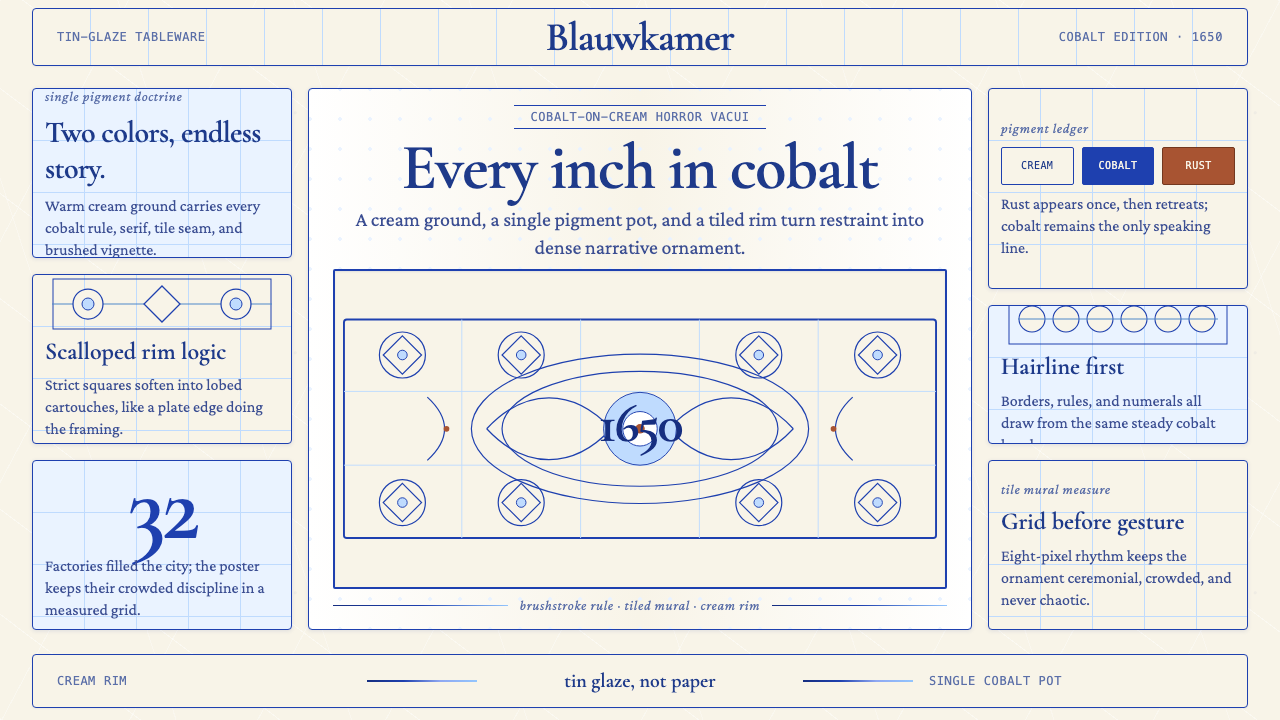 Delft Blue PotteryRestrained, yet every inch speaks. Cobalt hairlines crowd a cream tile grid.
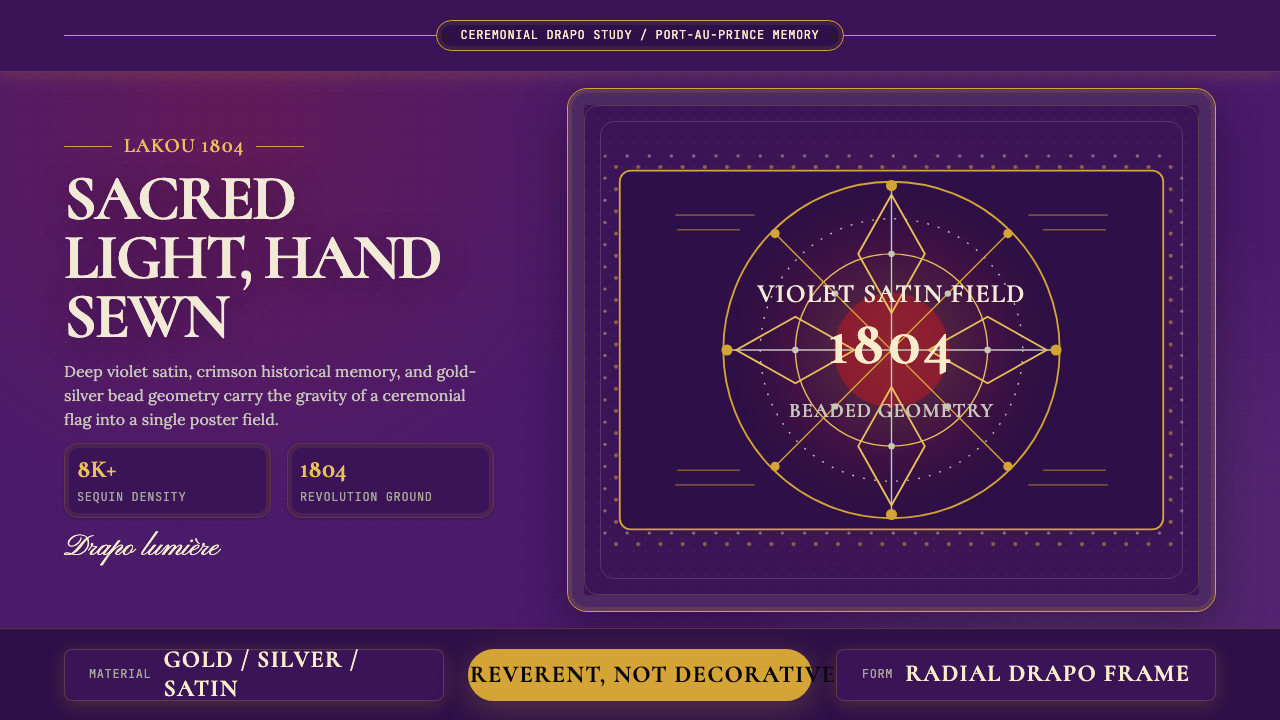 Haitian Vèvè Sequin Drapo 1804Sacred density. Violet satin, gold sequins, and radial geometry hold 1804 gra…
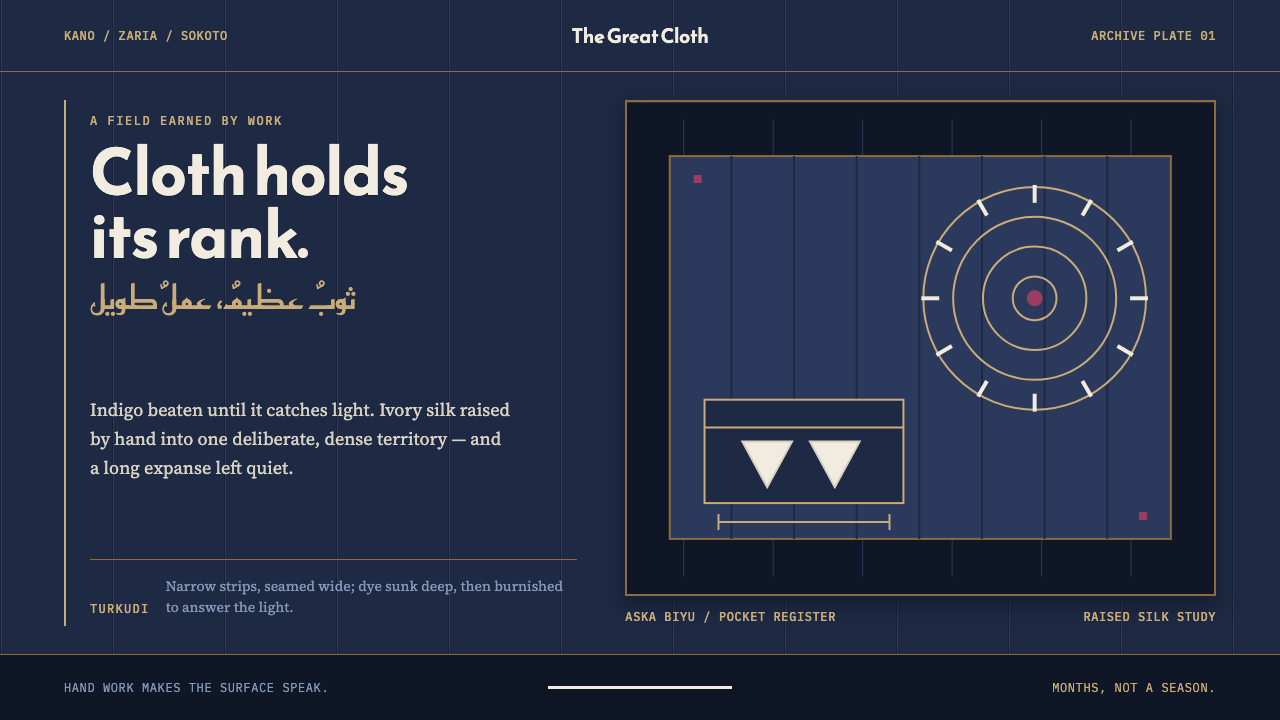 Hausa Babban RigaRank is worked, not announced. Burnished indigo holds raised ivory geometry i…
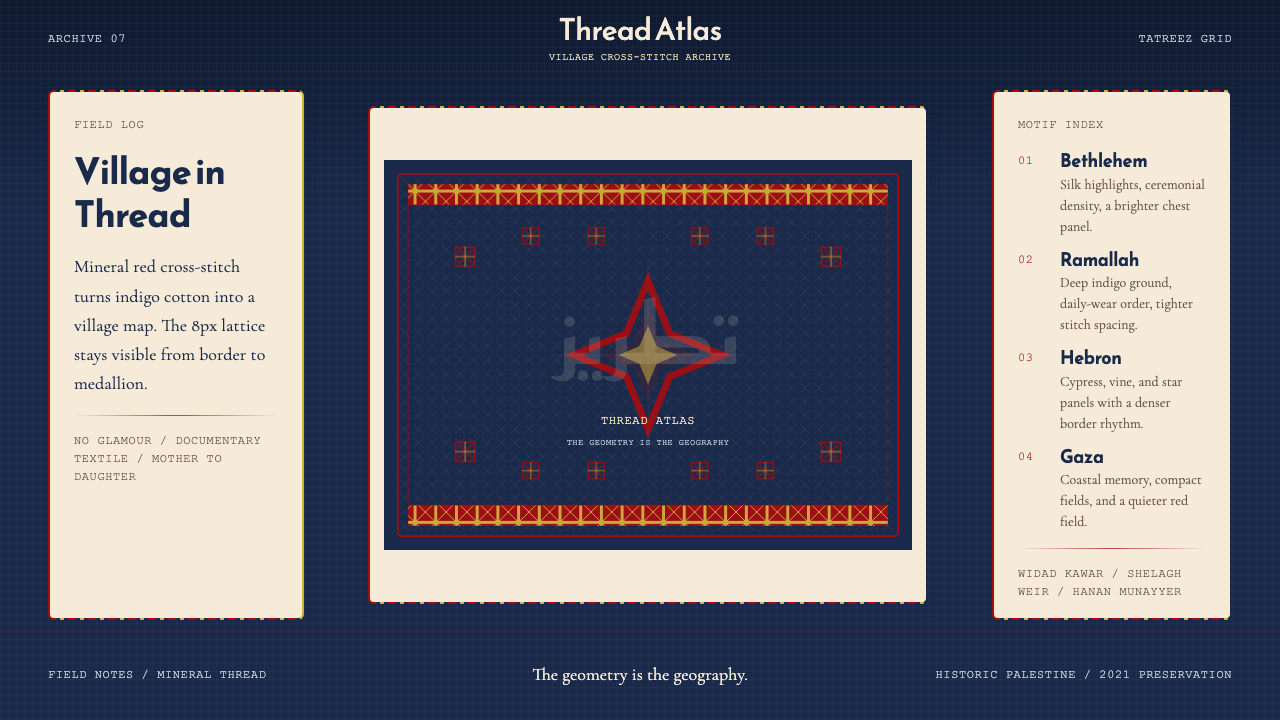 Palestinian Tatreez Cross-StitchMemory in thread. Red cross-stitch on indigo cotton, built on an 8px grid.
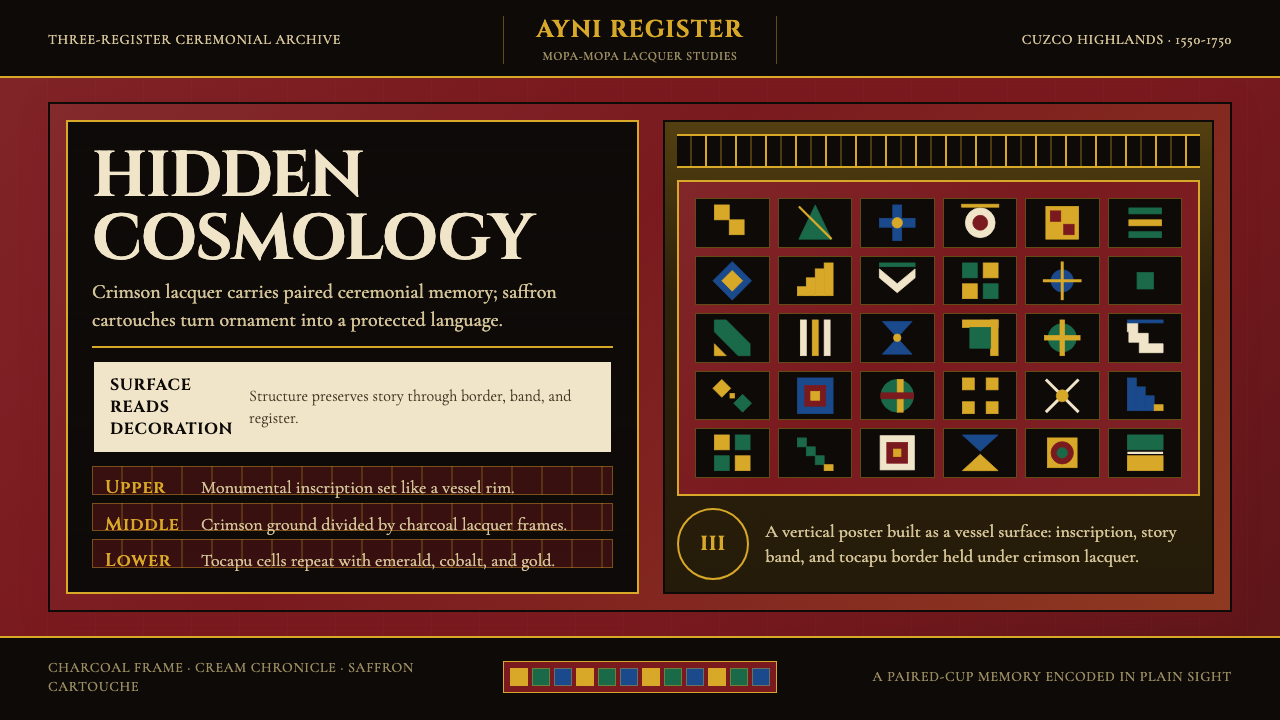 Peruvian Quechua Keros (Andean Cup)Hidden cosmology glows. Crimson lacquer and saffron tocapu grids frame the st…
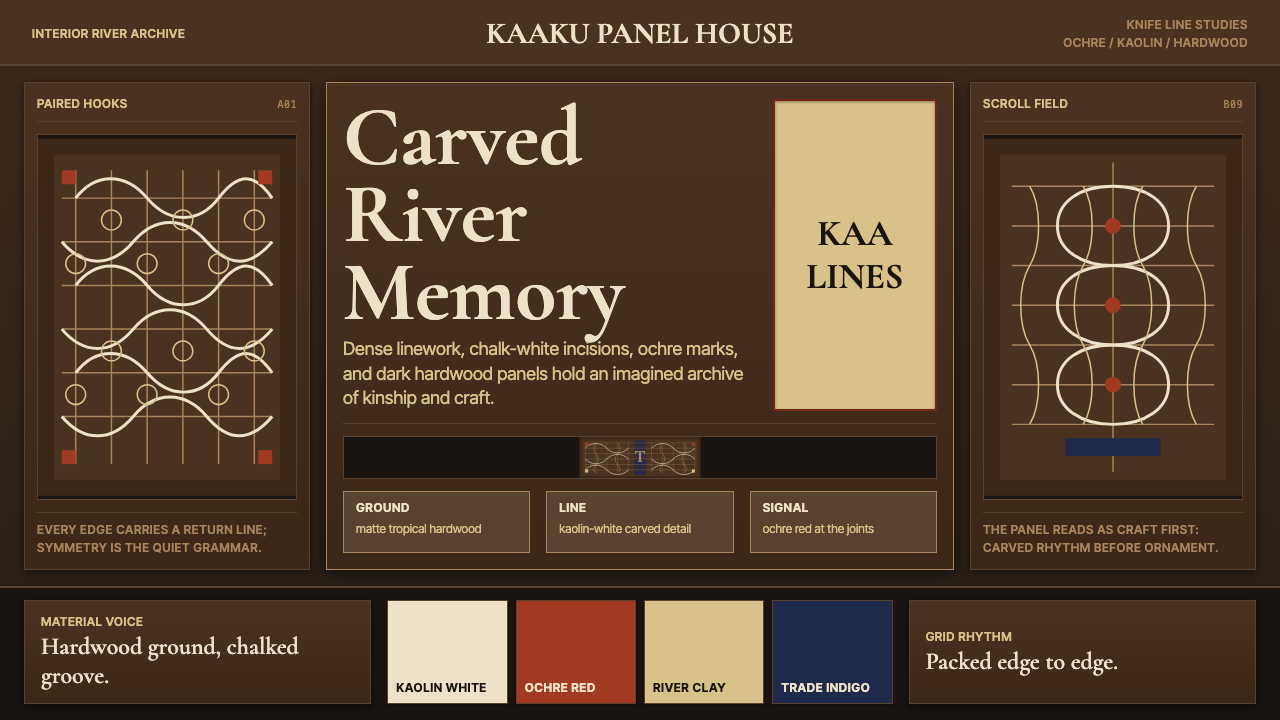 Suriname Maroon TembeDense memory, carved in rhythm. Kaolin lines cross hardwood brown in bilatera…