What is Palestinian Tatreez Cross-Stitch?
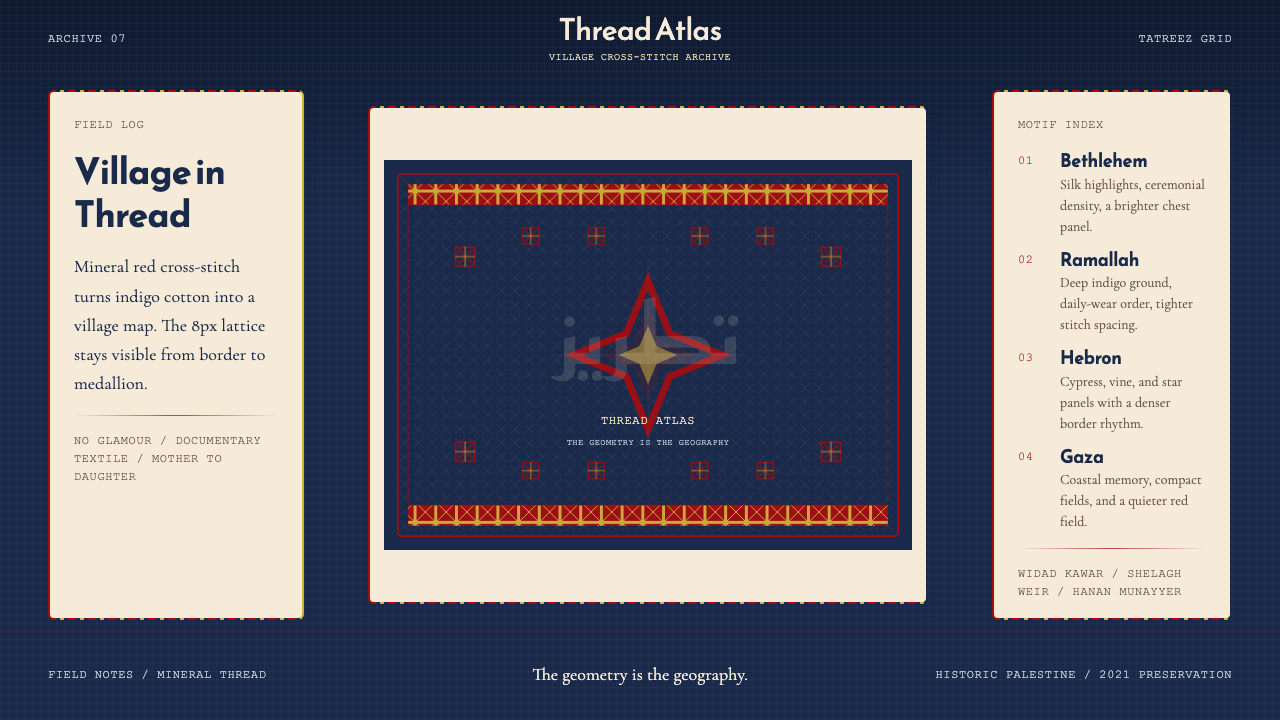
Tatreez transforms a counting grid of thread into a living archive — each village's geometry a distinct dialect of memory stitched in mineral red on indigo cotton.
Palestinian Tatreez Cross-Stitch in brief
Palestinian Tatreez is a cross-stitch embroidery tradition carried by rural women across historic Palestine for centuries. Its visual logic is inseparable from the material it inhabits: every stitch occupies a single unit of woven cotton grid, and every motif — cypress trees, eight-pointed stars, birds in flight, interlocking vines — is built from that grid upward. The geometry is not imposed on cloth; it emerges from cloth. The result is a textile aesthetic of supreme rectilinear precision: crisp diagonals, interlocked rhombuses, stepped zigzags, and branching tree forms, all governed by the same underlying lattice.
Each village and region developed a distinct visual vocabulary, making tatreez a form of geographic identity legible to those who know how to read it. The chest panels (qabbeh), sleeve bands, and hem borders of the traditional Palestinian thobe dress each carried specific arrangements of color and motif that announced the wearer's origin — Bethlehem's densely packed cross-fill patterns, Ramallah's fine red-on-white scrollwork, Hebron's bold geometric registers in deeper tones, the Gaza coast's wide satin-stitch accents. This geographic specificity is not decorative trivia; it is the system's core information-carrying function.
As a design language, tatreez offers something rare: an aesthetic of strict geometric constraint that is simultaneously warm, handmade, and culturally dense. Unlike modernist grid systems that arrive at geometry by subtracting ornament, tatreez arrives at the same grid by accumulating meaning stitch by stitch. The two results look structurally similar on the surface — both are rectilinear, both are systematic, both resist naturalistic illustration — but they carry opposite emotional valences. Where modernist geometry reads as universal and anonymous, tatreez geometry reads as specific and personal.

Where does Palestinian Tatreez Cross-Stitch come from?
The practice of cross-stitch embroidery in the Levant predates written documentation; textile fragments and historical accounts place geometric embroidery in this region well before the nineteenth century. What the nineteenth and early twentieth centuries provide, however, is the first systematic ethnographic record. European travelers, missionaries, and later anthropologists began collecting and describing Palestinian dress during this period, producing the first comparative accounts of regional variation. The Palestine Exploration Fund's late-nineteenth-century surveys noted the specificity of embroidery styles by village, and European museum collections began acquiring Palestinian textiles, preserving examples that would otherwise have been worn out and discarded.
The peak of classical tatreez production corresponds roughly with the late Ottoman period and the early decades of the British Mandate — the decades spanning the eighteen-eighties through the nineteen-thirties. During this time, the tradition was still fully embedded in everyday life: young women learned from mothers and grandmothers as part of preparation for marriage, and the wedding trousseau (jihaz) was a primary occasion for producing embroidered dress. The social function of the embroidery was inseparable from its visual function — time invested in fine needlework was legible as care, skill, and status. Collectors and scholars of this era, including ethnographer Shelagh Weir and textile historian Widad Kawar, later documented that specific stitch counts and motif arrangements were shared knowledge within village communities, a kind of distributed pattern library held in collective memory rather than in written form.
The displacement of 1948 — the Nakba — transformed the social and symbolic status of tatreez in ways that cannot be separated from any honest account of the tradition. Approximately seven hundred thousand Palestinians were expelled or fled during the founding of the Israeli state, and the material culture they carried with them — including embroidered dress — became some of the primary physical evidence of the villages and lives that had been lost. Embroidered garments acquired documentary weight that went beyond their original function as clothing. In the refugee camps of Jordan, Lebanon, Syria, and Gaza, women continued to embroider — both to maintain a practice that connected them to lost homes, and because the cooperative production and sale of embroidery provided income in contexts where other economic options were severely constrained.
The post-1948 period also produced the institutions and scholars who ensured that the tradition's regional diversity was preserved and studied rather than collapsed into a single generic form. Widad Kawar began collecting Palestinian dress in the nineteen-sixties and built one of the world's most significant private collections, eventually founding the Tiraz Centre in Jordan. Hanan Munayyer's collection in the United States, Shelagh Weir's scholarly work at the British Museum, and Wafa Ghnaim's more recent documentation and teaching through the Tatreez and Tea project each contributed to keeping the regional specificity of the tradition legible to new generations. In 2021, UNESCO inscribed Palestinian embroidery on the Representative List of the Intangible Cultural Heritage of Humanity, formalizing international recognition of what communities had already understood: that tatreez is not merely a craft technique but a living record.
What defines the Palestinian Tatreez Cross-Stitch look?
The Cross-Stitch Grid
Every visual decision in tatreez is constrained by the woven grid of the base cloth. A stitch is one unit; a motif is a count of units. This means all angles are expressed as diagonals through the lattice rather than as true curves, and all forms are ultimately composed of the same square building block. The grid is not a limitation — it is the system's grammar. Designers working from this aesthetic inherit a logic of modular, additive construction where complexity emerges from repetition and combination of simple units rather than from freehand elaboration.
Color as Regional Identity
The dominant palette of traditional tatreez is mineral red on indigo cotton — a combination that reads simultaneously as bold and grounded, warm against cool, saturated against deep. Regional variations introduced secondary colors in ways that created legible geographic dialects: some areas favored yellow-green accents, others introduced black outlining, and coastal regions sometimes incorporated blue thread alongside the standard red. The relationship between color and identity was functional, not merely decorative — knowing which colors appeared together in a given arrangement was knowing where the maker came from.
Motif Vocabulary
The core motifs of tatreez — cypress trees, eight-pointed stars, birds, interlocking branches, diamond chains, and stepped zigzag borders — are not purely abstract despite their geometric execution. Each carries accumulated cultural resonance: cypress trees appear at tomb markers and in garden traditions across the Levant; the eight-pointed star connects to a geometric vocabulary shared across Islamic architecture and textile traditions; birds carry meanings of freedom and messenger-ship. The geometric constraint of the grid means these motifs can never be naturalistic, but they retain figurative identity even at the level of a few dozen stitches.
Density and Register
Traditional tatreez garments organize their embroidery into distinct registers — horizontal bands of motifs separated by narrow geometric borders — and vary density deliberately between zones. Chest panels might be almost entirely covered with dense cross-stitch, creating a saturated field of pattern, while sleeve edges carry a single isolated running motif. This structural organization of density — maximum coverage in focal zones, sparse decoration in transitional zones, clear borders marking transitions — is directly transferable to digital layout: think hero sections versus supporting content versus navigation.
The Counting Logic
Because tatreez is built by counting stitches rather than drawing freehand, its visual system is inherently numerical and modular. A pattern that works at a count of sixteen stitches wide can be scaled to thirty-two or eight while preserving its essential character. This scalar flexibility — native to any grid-based system — is one reason the aesthetic translates readily to digital design contexts where responsive scaling across different screen sizes is a design requirement. The underlying module, not the fixed size, is the unit of design.
Surface Without Hierarchy
Traditional tatreez does not employ depth cues — there is no simulated shadow, no layering effect, no sense of elements floating above a surface. Thread sits in the weave, flat and immediate. The aesthetic is entirely surface: the ground and the stitched motifs occupy the same visual plane, with differentiation achieved purely through color contrast and pattern. This flatness is structurally different from modernist flatness, which is a principled rejection of illusionism; tatreez flatness is a material necessity that became an aesthetic virtue.
Repetition as Structure
Tatreez compositions achieve visual richness not through variety of motif types but through strategic repetition and mirroring of a small vocabulary. A border might repeat a single stepped diamond element dozens of times; a chest panel might tile two or three alternating motifs across its entire surface. This discipline of repetition with variation — introducing subtle color shifts or scale changes within a repeated module — creates visual patterns that reward sustained looking. For digital design, the lesson is that a restricted motif vocabulary applied with rigor is more powerful than a diverse vocabulary applied loosely.

Who shaped Palestinian Tatreez Cross-Stitch?
Jordanian collector and philanthropist who began acquiring Palestinian and broader Levantine dress in the nineteen-sixties and built what became one of the world's most significant collections of Palestinian embroidered textiles. Kawar's approach was explicitly preservationist: she understood that displacement and modernization were erasing regional variation faster than it could be documented, and that private collection was, at least temporarily, the most reliable means of preservation. Her collection eventually formed the foundation of the Tiraz Centre in Amman, which continues to function as a research and educational resource. Her work documented the regional specificity — village by village, motif by motif — that makes tatreez legible as a geographic system rather than a generic craft.
British anthropologist and curator at the British Museum whose fieldwork in Palestine and Jordan during the nineteen-sixties and seventies produced the most systematic scholarly account of Palestinian dress available in English. Her landmark publication on Palestinian costume, based on the British Museum's collection and her own field documentation, established the comparative framework — analyzing embroidery by region, period, and social function — that subsequent scholarship has built upon. Weir's work was significant not only for its depth but for its timing: the communities she documented were already in the midst of rapid change, and her fieldwork preserved information that could not have been reconstructed later.
Palestinian-American collector whose collection of Palestinian embroidery, assembled over decades in the United States, became one of the most significant holdings outside the Middle East. Munayyer's collecting was motivated by a sense of urgency about diaspora cultural preservation: each piece she acquired was a document of a specific place and time, and collectively the collection functioned as a distributed archive of regional diversity. Her collection has been shown at museums and cultural institutions in the United States and contributed to growing scholarly and public awareness of Palestinian textile heritage in contexts where it might otherwise have remained invisible.
Palestinian-American artist and educator who founded the Tatreez and Tea project, a contemporary platform for teaching traditional tatreez technique to diaspora communities and interested learners worldwide. Ghnaim's contribution is distinct from the collector-scholars who preceded her: where they focused on preservation and documentation, she focuses on transmission — keeping the practice alive as a practice, not merely as an object in a collection or a subject of scholarship. Her work has brought tatreez to new audiences through workshops, online platforms, and publications, and has contributed to a renewed global interest in the tradition that coincides with, and responds to, its UNESCO recognition.
How do you use Palestinian Tatreez Cross-Stitch today?
Applying the tatreez aesthetic to digital work requires understanding what makes it structurally coherent rather than simply borrowing its surface appearance. The system works because every element — color, form, spacing — derives from the same underlying grid logic. When that grid discipline is maintained in a digital context, the result reads as intentional and culturally resonant rather than decorative pastiche. When it is abandoned in favor of loosely geometric shapes with organic spacing, the result loses the defining quality of the tradition.
For presentation slides, the tatreez aesthetic is particularly effective for cover pages and section dividers, where a bold, full-surface pattern can serve as both visual anchor and cultural statement. A cover slide might use a deep indigo ground with a band of geometric motifs in warm red occupying one register — upper third or lower quarter — while the title sits in clean, high-contrast type in the remainder of the field. Content slides should treat any geometric ornamentation as a structural frame rather than background fill: a narrow border motif along one edge, a corner accent, or a horizontal dividing band can carry the aesthetic without competing with the content. Data slides benefit from applying the rectilinear grid logic to chart design — bar charts whose bars are organized on strict grid intervals, with the primary color palette used to encode category rather than applied as gradient or shadow.
For web interfaces, the tatreez vocabulary works well in contexts that call for cultural specificity, warmth, and visual richness alongside functional clarity. Dashboard layouts can use geometric border motifs as structural dividers between sections, replacing generic ruled lines with patterned equivalents drawn from the cross-stitch vocabulary. Pricing and feature comparison pages benefit from the tradition's density logic: use heavy pattern concentration in focal zones (the recommended plan, the primary call-to-action) and minimal ornamentation in supporting zones. Navigation and typographic elements should remain clean and undecorated — the geometric richness of the motif work is most effective when it contrasts with areas of typographic simplicity.
For editorial and marketing work, the tradition supports strong thematic applications wherever cultural heritage, craft, community, or resilience are part of the brand or editorial message. A full-width feature banner using a tatreez-derived pattern as background texture — rendered in the canonical indigo and red — immediately signals handmade precision and cultural depth without requiring any explanatory text. Marketing pages in this aesthetic use pattern registers as section-break devices: a narrow geometric band separates one content zone from the next, creating rhythm without requiring color-field changes. Editorial layouts can use isolated motif elements as decorative capitals, pull-quote markers, or section indicators, giving the page a textile-like quality where each element appears to have been placed with the deliberateness of a counted stitch.
A common mistake when applying this aesthetic is treating it as primarily about surface pattern — adding geometric cross-stitch elements over an otherwise conventional layout without adapting the underlying structure. Authentic tatreez logic requires that the grid govern spacing decisions, not just decorative ones: column gutters, section margins, and component proportions should feel derived from the same modular unit as the motifs themselves. Similarly, color application often goes wrong when designers introduce the indigo-and-red palette but supplement it freely with contemporary neutral tones or photographic backgrounds. The tradition's palette is bounded and opaque — it does not mix gracefully with translucent overlays or muted desaturated tones. The discipline is all or nothing: commit to the grid and the palette together, or the aesthetic reads as cultural borrowing without cultural understanding.

Palestinian Tatreez Cross-Stitch — FAQ
Is tatreez the same across all Palestinian regions, or does it vary?
It varies significantly by region and historically by village. Bethlehem embroidery is known for dense cross-fill patterns and a rich use of supplementary colors alongside the primary red. Ramallah work tends toward finer thread, more open spacing, and elaborate scrollwork. Hebron embroidery uses bolder geometric registers with a deeper, more restrained palette. The Gaza coastal tradition incorporates satin-stitch and couching techniques alongside cross-stitch in ways that give its textiles a more tactile, raised quality. These distinctions were so precise that knowledgeable observers could identify a garment's origin village from its embroidery alone — the regional vocabulary functioned as an identity marker as much as an aesthetic choice.
How did displacement after 1948 change the tradition?
The displacement transformed tatreez from an everyday domestic practice into a deliberate act of cultural preservation — and eventually into a symbol of political identity. In refugee camps, women continued to embroider partly to maintain connection with lost homes and partly because cooperative embroidery production provided economic income. The motifs and patterns associated with specific villages became more consciously maintained and documented precisely because those villages no longer existed as lived communities. Some scholars note a paradox: displacement, while devastating, also intensified the documentation and preservation of regional variation, because diaspora communities and sympathetic scholars recognized the urgency of recording what had been lost. The tradition did change: some regional distinctions blurred in camp settings where women from multiple villages worked together, and new motifs emerged that referenced the Palestinian flag and other contemporary political symbols.
Can the tatreez aesthetic be used respectfully outside Palestinian cultural contexts?
Yes, with genuine care and informed practice rather than superficial borrowing. The distinction matters: using tatreez's geometric vocabulary as a design system while understanding its origins, communicating that understanding to audiences, and crediting the tradition explicitly is substantively different from extracting the visual surface without acknowledgment. Designers working with this aesthetic should be able to articulate what they are drawing on and why — the specific grid logic, the regional palette, the historical context of the motifs — rather than treating it as interchangeable pattern texture. Engaging with the work of practitioners like Wafa Ghnaim and institutions like the Tiraz Centre, and directing audiences toward those resources, is part of using the tradition responsibly.
What is the relationship between tatreez and contemporary Palestinian design practice?
Contemporary Palestinian designers engage with tatreez across a spectrum of approaches — from direct formal incorporation of traditional motifs in graphic and textile work, to loose aesthetic inspiration that draws on the palette and grid logic without replicating specific patterns, to critical examination of how the tradition has been commodified or misrepresented. Some designers treat tatreez as a living vocabulary to be extended and reinterpreted; others are concerned with the conditions under which it is reproduced and whether commercial use adequately compensates the communities that maintain it. The tradition's UNESCO inscription in 2021 has both amplified international interest and intensified discussions within Palestinian cultural communities about stewardship, authenticity, and the politics of heritage recognition.
Does the tatreez aesthetic work for dark-background designs?
The tradition's canonical form is built on the deep indigo ground, which is itself a dark background — so dark-mode interpretations are historically grounded, not an inversion. The challenge in digital dark applications is maintaining the warmth and density that come from the contrast between indigo and red without the tradition's literal textile texture as support. Against a very dark near-black digital background, the standard red motifs retain their warmth, but the overall composition can read as isolated floating elements rather than as a field of woven pattern. The most effective approach is to use the dark ground with enough motif density that the patterned zone reads as a field rather than a collection of individual marks, and to reserve highly sparse decoration for transitional or secondary zones rather than using it as the primary approach throughout.
Related design styles
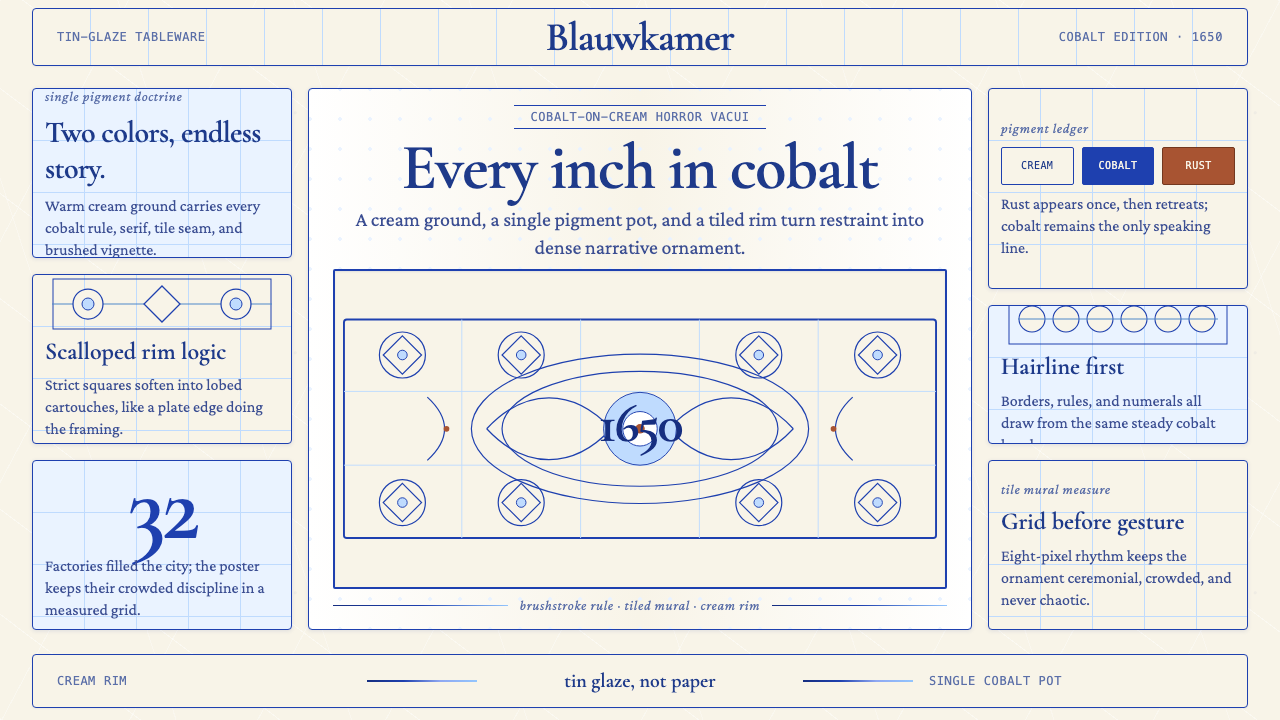 Delft Blue PotteryRestrained, yet every inch speaks. Cobalt hairlines crowd a cream tile grid.
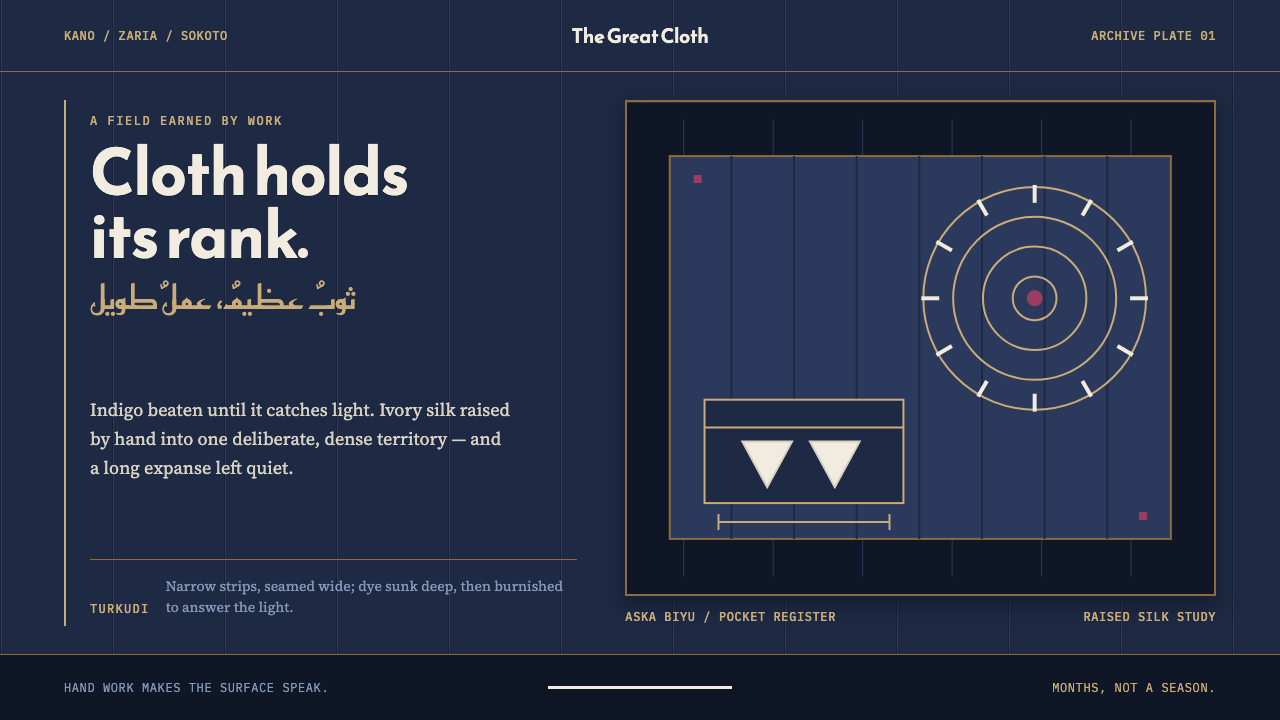 Hausa Babban RigaRank is worked, not announced. Burnished indigo holds raised ivory geometry i…
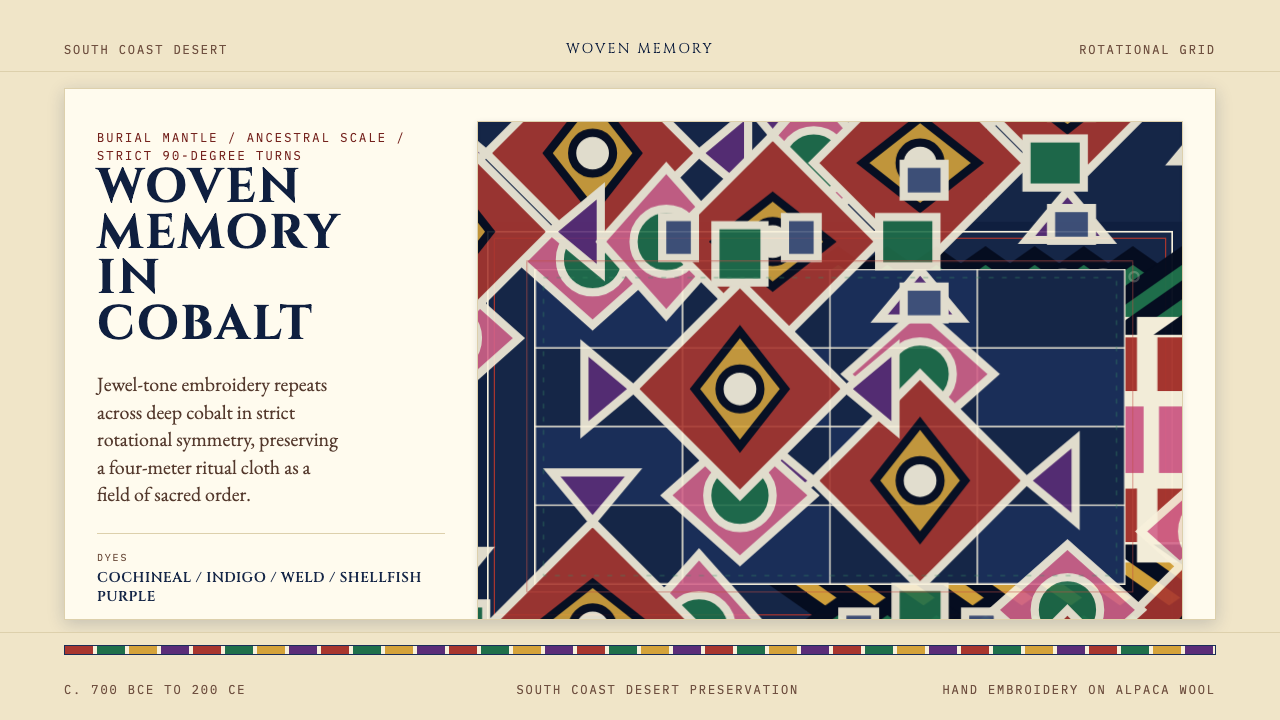 Paracas Andean TextileAncestral and exact. Jewel tones repeat on deep cobalt in strict 90° turns.
 Yemeni Sana'a Old City Tower-HouseVertical memory, densely framed. Brick orange, gypsum white, and blue rosette…
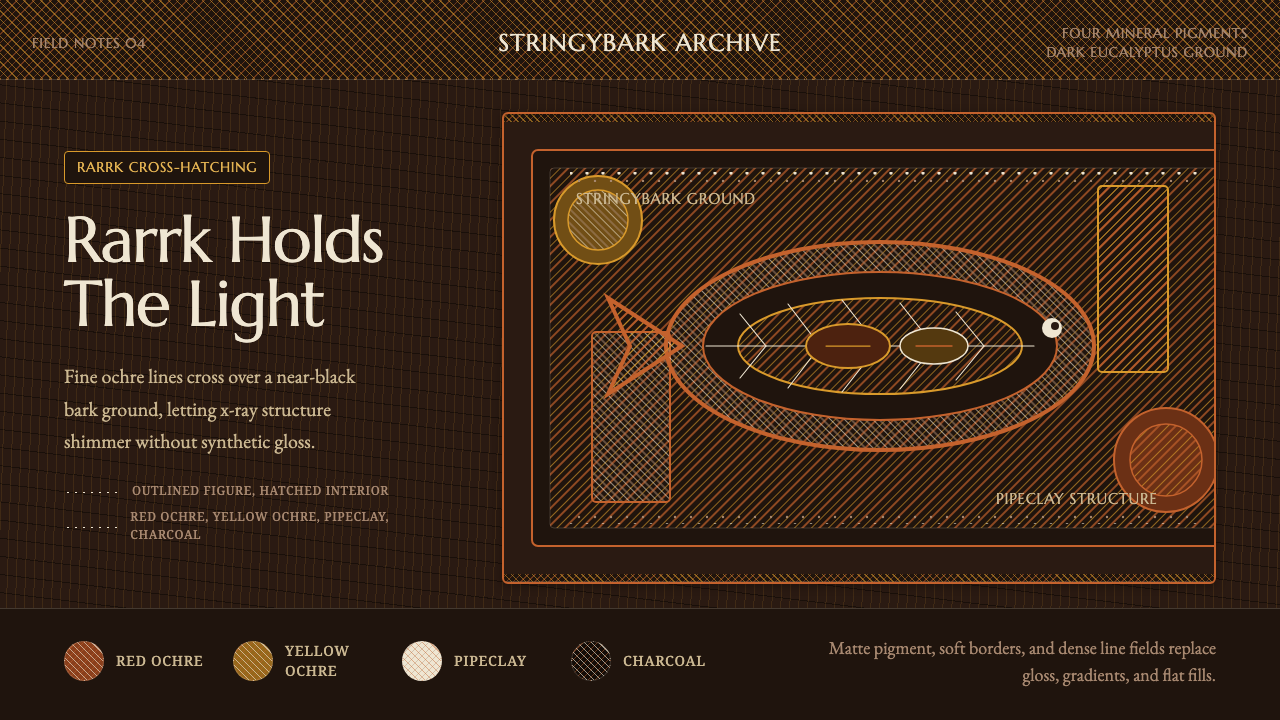 Arnhem X-Ray Bark PaintingShimmers without gloss. Ochre rarrk lines vibrate on dark stringybark.
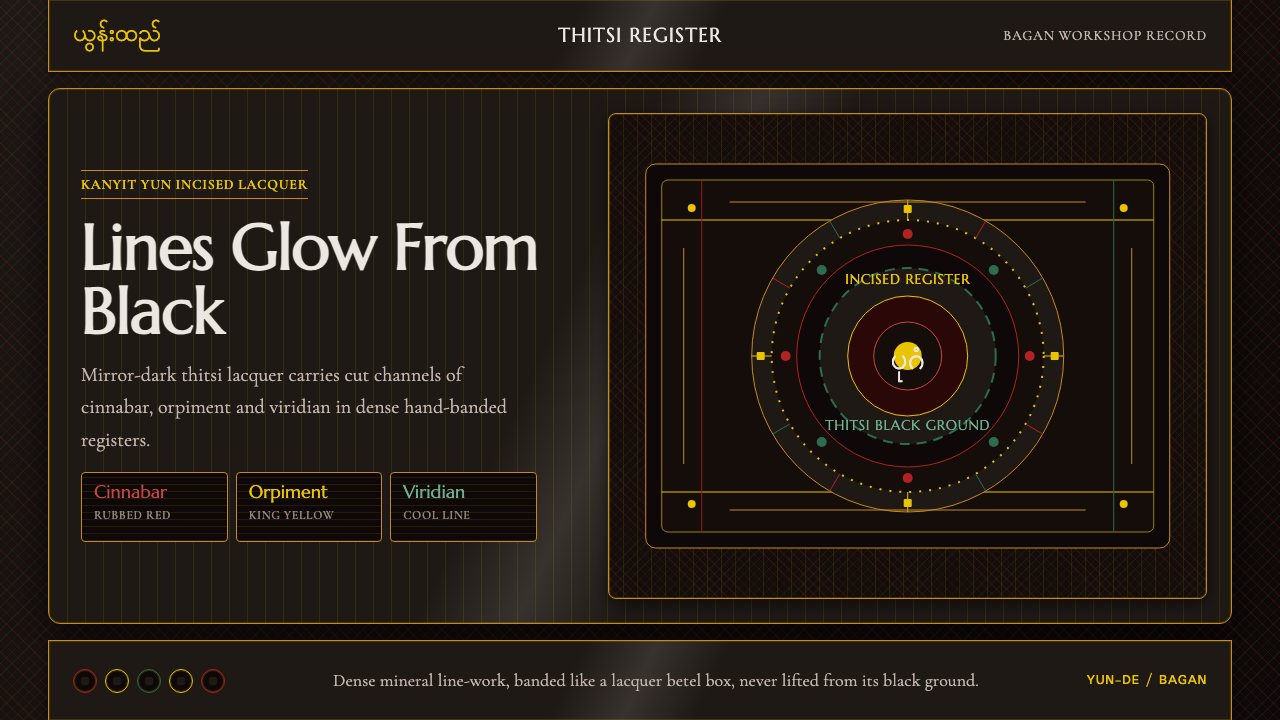 Burmese Yun LacquerwareLacquer glows in cut lines. Cinnabar, orpiment and viridian band a mirror-bla…