What is Delft Blue Pottery?
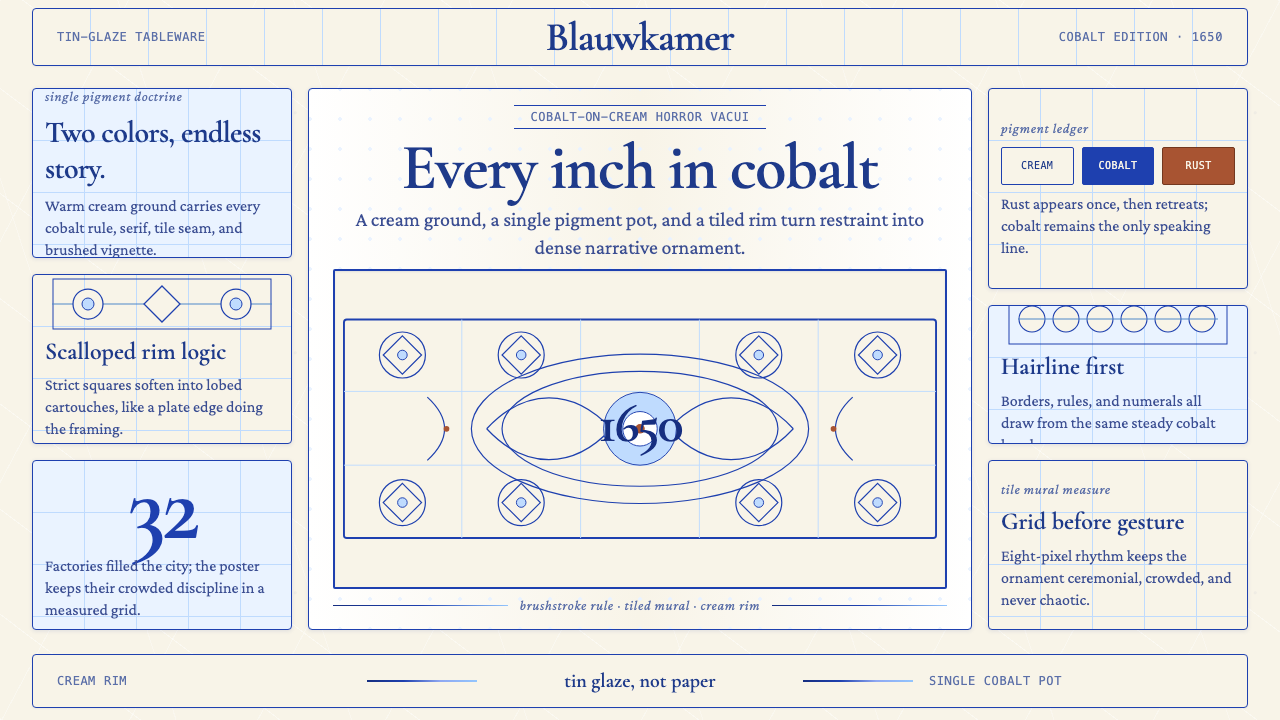
Delft Blue turned a trade emergency into an aesthetic empire — cobalt brushstrokes on cream tin-glaze that could pass for Ming porcelain by candlelight.
Delft Blue Pottery in brief
Delft Blue is the signature ceramic tradition of the Dutch Republic's Golden Age: hand-painted tin-glazed earthenware in deep cobalt on a warm cream-white ground. Born from the workshops of the city of Delft in the seventeenth century, the style mimicked Chinese porcelain so faithfully that it became a luxury in its own right — collected by European courts, exported worldwide, and eventually copied by every major European pottery center from Frankfurt to Faenza.
The visual system is built on a two-color discipline of striking purity. Deep cobalt — the only reliable high-temperature pigment available to Dutch potters — is applied over a tin-oxide glaze that fires to a dense, luminous off-white. Everything the style says, it says in these two tones: a single decisive brushstroke outlines a windmill sail; dense crosshatching builds the shadow under a tulip petal; fine stippling gives depth to a heron's wing. The restraint is structural, not minimal — every square centimeter of surface tends to carry detail, but detail organized into legible, balanced compositions.
Iconographically, Delft Blue speaks in a vocabulary immediately recognizable across centuries: windmills, canal houses, sailing ships, tulip bouquets, farm courtship scenes, herons among rushes, and — borrowed directly from Chinese blue-and-white — pavilions, cloud scrolls, and ornamental fences. Scalloped borders, tile-grid murals composed of individual painted squares, oval cartouches, and hand-lettered inscriptions in serif letterforms complete the system. Rare polychrome pieces add iron-rust orange, manganese purple, or antimony yellow as accent tones, but the two-color cobalt-and-cream version remains the canonical expression of the style.

Where does Delft Blue Pottery come from?
The story of Delft Blue begins with a supply-chain crisis. Through most of the early seventeenth century, the Dutch East India Company (VOC) imported enormous quantities of Chinese blue-and-white porcelain — Ming dynasty ware — which was the prestige tableware of European courts and wealthy merchants. Then, in the 1620s and 1630s, civil war and dynastic transition in China disrupted the Jingdezhen kilns. Shipments collapsed. The Dutch merchant class, accustomed to porcelain on their tables, suddenly faced a shortage, and the Delft potters — who had been producing tin-glazed earthenware (maiolica) in the Italian tradition since the mid-sixteenth century — saw their opportunity.
Delft was already a prosperous industrial city in South Holland with an established ceramics trade. After the decline of the Delft brewing industry in the mid-seventeenth century freed up large warehouse spaces, entrepreneurs converted breweries into pottery workshops almost overnight. By 1650, some thirty potteries operated in the city, competing fiercely on the quality of their Chinese-style decoration. The key technical advance was the double-firing process: a first bisque fire set the earthenware body, then the tin glaze was applied and the cobalt decoration painted over it, and a second glaze fire fused everything into the characteristic dense, slightly luminous surface. This surface, cooler and denser than Chinese porcelain, nonetheless captured the blue-and-white visual language with remarkable fidelity.
The peak years of Delft Blue production ran roughly from 1650 to 1750. During this century, the leading workshops — among them De Porceleyne Fles (The Porcelain Bottle, which survives today as Royal Delft), and those associated with master potters Aelbrecht de Keizer, Adrianus Kocx, and the painter-decorator Frederik van Frytom — developed a house vocabulary that layered Dutch landscape and genre motifs over the Chinese structural grammar. Van Frytom in particular became renowned for his large-format painted tiles and plaques depicting Dutch panoramas in a style that owed as much to Golden Age landscape painting as to Chinese blue-and-white. The workshops also produced tulip vases, apothecary jars, dinner services, wall tiles, and monumental decorative objects — all in the same two-color discipline.
By the early eighteenth century, several forces began to erode Delft's dominance. Chinese exports resumed and European demand for genuine porcelain intensified. More critically, the discovery of hard-paste porcelain manufacture at Meissen in 1708 gave European competitors a material advantage Delft's soft earthenware could not match. The invention of transfer printing in England in the 1750s further undercut the hand-painted tradition. Yet the style did not die — it calcified into an icon. De Porceleyne Fles, founded in 1653, carried the tradition through into the nineteenth and twentieth centuries, and Delft Blue became less a living ceramic practice than a cultural symbol: the visual shorthand for Dutch craft identity, widely reproduced, collected, and emulated worldwide.
What defines the Delft Blue Pottery look?
Two-Color Discipline
The defining constraint of Delft Blue is its palette: deep, saturated cobalt against a warm cream-white tin-glaze ground. No other hues are structurally necessary, and in canonical pieces none appear. The cobalt ranges in tone from a near-black concentrated outline to diluted washes that suggest sky or water, giving the painter a full tonal register within a single pigment. The warmth of the cream ground — subtly different from a pure optical white — keeps the overall effect inviting rather than clinical, a distinction that matters greatly when adapting the style to digital or print contexts.
Painterly Brushwork
Unlike transfer-printed or stenciled ceramics, Delft Blue is hand-painted, and the evidence of the brush is central to its identity. Outlines are drawn with a confident, slightly variable line weight that reveals the artist's speed and pressure. Interior areas are filled with stippling, crosshatching, or wash — techniques borrowed from Dutch Golden Age print and drawing practice. This handmade quality gives even mass-produced Delft pieces a warmth and slight irregularity that distinguishes them from mechanical reproduction. When adapting the aesthetic to digital work, deliberately imperfect strokes, variable line weights, and hand-drawn textures preserve this essential character.
Horror Vacui Ornament
Delft Blue is deeply suspicious of empty space. Compositions tend to fill their fields completely, layering central motifs with framing borders, background hatching, and secondary vignettes until the surface achieves a sense of productive density. This quality — sometimes described by the Latin term horror vacui, fear of the void — is borrowed partly from Chinese blue-and-white and partly from the Baroque sensibility of the Dutch Golden Age. The result is rich rather than cluttered: every element has compositional purpose, and the eye is given a clear hierarchy even within a dense field. Borders, whether scalloped, geometric, or foliate, organize the composition and contain its energy.
Iconographic Vocabulary
Delft Blue draws on two distinct iconographic traditions that it blends seamlessly. From the Chinese blue-and-white it imports: rock gardens, willow branches, pavilions, cloud bands, decorative fences, and figures in robes. From Dutch daily life and Golden Age landscape painting it draws: windmills, canal houses, sailing vessels, tulip arrangements, farm scenes, herons, and hunting vignettes. The genius of the Delft synthesis is that these two vocabularies coexist without contradiction — a Dutch windmill set within a Chinese rock-garden border feels natural rather than incongruous. This cultural blending is the style's most distinctive intellectual quality.
Tile-Grid Composition
One of Delft Blue's most architecturally ambitious formats is the painted tile mural: individual square tiles, each bearing a fragment of a larger image or a self-contained vignette, assembled into walls, fireplace surrounds, and staircase linings. This grid logic — modular units combining into a larger coherent composition — translates naturally to screen and slide layout. A grid of image tiles, each with its own cobalt-framed detail, creates an instantly recognizable Delft rhythm. Individual tiles often feature a small corner ornament — a stylized oxhead, a spider, or a fleur-de-lis — that visually connects adjacent tiles without requiring perfect alignment.
Serif Lettering and Cartouche Framing
Where text appears on Delft Blue objects — on apothecary jars, commemorative plates, and decorative tiles — it is typically rendered in a robust hand-lettered serif style that echoes the Dutch printing tradition of the seventeenth century. Text is often enclosed within a baroque cartouche: an oval or shield-shaped frame of scrollwork, foliage, or shell ornament that gives it visual prominence without competing with the figurative decoration. This framing principle is directly applicable to modern slide layouts and editorial design: a cobalt-outlined text block with a slightly baroque border reads as Delft-derived, even in a digital context.
Restrained Polychrome Accent
Although cobalt-on-cream is the canonical Delft expression, a distinct tradition of polychrome Delft ware exists, known as Delft Polychrome or Fayence Delft. In these pieces, iron-red, manganese purple, copper green, and antimony yellow are introduced as accent tones alongside the dominant cobalt. The key discipline is that polychrome is used sparingly — as a guest, not a co-host. A tulip rendered in rust-orange against a cobalt stem and leaf structure demonstrates the approach: the accent hue intensifies the composition without disrupting the blue-and-white foundation. In digital and print applications, a single warm accent tone introduced against the blue-and-cream base creates visual emphasis while preserving the style's essential character.

Who shaped Delft Blue Pottery?
Founded in 1653 and the only surviving original Delft pottery factory, De Porceleyne Fles — The Porcelain Bottle — is the institutional guardian of the tradition. Through the economic crises that shuttered every other Delft workshop by the late eighteenth century, it maintained continuous production. In the nineteenth century it was revitalized under the artistic leadership of Joost Thooft, who modernized the visual vocabulary while preserving the hand-painted cobalt technique. Today operating as Royal Delft, it functions simultaneously as a working pottery, a museum, and the primary authority on what authentic Delft Blue looks and feels like — its archives representing over three and a half centuries of continuous visual development.
Van Frytom (c. 1632–1702) is the most distinguished individual artist to emerge from the Delft tradition, celebrated for large painted plaques and dishes bearing expansive Dutch landscape panoramas — riverside towns, windmills on flat horizons, ships on broad waterways — executed in a style that bridges Golden Age landscape painting and the decorative ceramic tradition. His compositions abandoned the dense all-over ornament typical of Chinese-derived Delft in favor of spacious, atmosphere-conscious layouts that gave cobalt wash a nearly watercolor-like transparency. His work demonstrates that the Delft two-color discipline could achieve an almost painterly poetry while remaining formally within the ceramic tradition.
Kocx (died 1701) was the proprietor of De Grieksche A (The Greek A) factory and one of the most commercially ambitious Delft masters of the late seventeenth century. His workshop was among the first to produce the elaborate tulip vases — towering pyramidal or angular forms with multiple spouts — that became a defining luxury object of the Dutch court and the English monarchy. He supplied William III and Queen Mary II of England, whose patronage elevated Delft Blue from a prosperous trade good to an object of monarchical prestige. Kocx also pioneered the production of large-format tile panels depicting biblical and allegorical subjects for aristocratic interiors, establishing the form that would later define Delft's architectural legacy.
De Keizer was among the first generation of Delft masters to systematically adapt Chinese blue-and-white compositional principles to Dutch subject matter in the 1640s and 1650s, laying the visual grammar that later workshops would refine and codify. His approach to border design — organizing the rim of a plate or the shoulder of a vase into registers of alternating motifs separated by geometric bands — became a standard template. He also trained many of the painters and decorators who staffed the next generation of Delft workshops, making him as significant as a pedagogical figure as he was as a producer. His legacy is less in specific surviving objects than in the diffusion of technical and compositional knowledge through the Delft craft community.
Thooft (1817–1890) was the nineteenth-century industrialist who rescued De Porceleyne Fles from near-bankruptcy in 1876 and transformed it into a viable modern enterprise without abandoning its handcraft identity. His contribution was essentially curatorial and entrepreneurial: he commissioned thorough documentation of historical Delft forms, standardized production processes enough to ensure consistency at scale, and established the workshop's identity as an authentic survivor rather than a revival or imitation. The monogram TF (Thooft and Labouchere, his partner) became one of the most recognized pottery marks in Europe. Without Thooft's intervention, the living tradition of hand-painted Delft Blue would very likely have ended entirely in the nineteenth century.
How do you use Delft Blue Pottery today?
Delft Blue is one of the few historical styles that carries genuine narrative weight — it signals craft, heritage, and cultural depth rather than simply announcing a color preference. Applying it correctly requires understanding its core logic: two colors disciplined by handwork, dense ornament organized into clear hierarchy, and a vocabulary of specific motifs that function as cultural quotations. Reaching for a cobalt-on-cream palette without also applying the compositional grammar produces decoration without character — the visual equivalent of using a historical font without understanding the typographic system it belongs to.
For presentation slides, Delft Blue performs best when its tile-grid logic informs the layout system. A cover slide built around a central cobalt medallion on a cream ground, framed by a scalloped border, establishes the visual contract immediately. Supporting content slides work well with a narrow cobalt rule separating the header from the body, and with section breaks marked by a small tile-grid motif or a stylized tulip ornament. Data visualization adapts naturally to the style: bar charts rendered in cobalt on cream, with a single rust-orange accent series where emphasis is needed, read as part of the same visual world rather than as imported charts. Avoid placing photographic images directly on Delft-styled slides — if imagery is required, treat photographs as high-contrast duotone vignettes within an oval or cartouche frame.
For web interfaces — particularly dashboards, pricing pages, and cultural-sector platforms — Delft Blue offers a distinctive alternative to the dominant minimal-modern conventions. The approach: establish a cream or warm off-white page ground, use deep cobalt for primary interactive elements and navigation, and reserve body text for near-black rather than pure black. Card components take on the tile format — equal-sized, cobalt-bordered, arranged in a grid — with icons drawn in a hand-sketch style rather than geometric flat vectors. Hover states and focus indicators can use a slightly deeper cobalt wash rather than a colored highlight. The style is particularly well-suited to products in heritage, hospitality, food and drink, craft, and cultural institution contexts.
For editorial and marketing work, Delft Blue supports a narrative-rich approach where the visual system reinforces a sense of history, craft, and provenance. A magazine feature layout might use a large cobalt-tinted pull quote in a cartouche on the recto page, with body text in a sturdy serif that echoes the hand-lettered tradition, set against a cream stock or equivalent background tone. Marketing campaigns benefit from the iconographic vocabulary: windmills, tulips, and ships carry immediate cultural recognition and can anchor a visual identity that reads as both international and specifically Dutch. The style is equally effective on packaging — particularly for food, spirits, ceramics, and luxury goods — where the two-color cobalt-and-cream combination on a tactile matte surface produces a premium, handcrafted impression.
A common mistake when applying Delft Blue is treating it as a simple color-swap exercise: taking an existing layout, coloring it cobalt and cream, and assuming the result will read as Delft. The style's identity depends equally on its ornamental density, its specific motif vocabulary, and its handwork quality. A sparse, geometric layout in cobalt and cream reads as minimalism with a blue tint, not as Delft. The other frequent error is introducing too many additional hues alongside the cobalt and cream base. Delft's polychrome accent tradition is restrained — one warm guest color, used sparingly and with compositional purpose. Deploying four or five colors in the name of 'polychrome Delft' produces decoration that loses the discipline the style depends on for its authority.

Delft Blue Pottery — FAQ
How does Delft Blue differ from other blue-and-white ceramic traditions like Chinese blue-and-white or English Willow Pattern?
All three descend from the same Chinese blue-and-white tradition, but they diverge in important ways. Chinese blue-and-white, produced primarily at Jingdezhen, is true porcelain — harder, more translucent, with a brighter, cooler white and a more precise cobalt line achievable because the porcelain body does not absorb the pigment as readily. Delft Blue is earthenware with a tin glaze, which produces a warmer, denser surface; the brushwork has more visible texture and the white has a cream warmth that porcelain does not. English Willow Pattern (developed in Staffordshire in the 1780s) is transfer-printed rather than hand-painted, producing perfectly replicated imagery with no brushwork variation — the opposite of the handwork quality central to Delft's identity. Willow Pattern also uses a fixed, narrative scene composition, while Delft offers a much broader compositional vocabulary.
Can Delft Blue work in a modern digital product without looking like a heritage pastiche?
Yes, but the approach matters enormously. The designs that successfully modernize Delft Blue take its structural principles — cobalt-on-cream discipline, grid-based modularity, handwork texture — and apply them at the level of system design rather than surface decoration. This means designing the grid system as a tile-grid, using cobalt as the primary interaction color with cream as the base, and introducing hand-drawn or slightly imperfect line qualities in icons and dividers rather than machine-perfect geometry. The mistake is applying the motifs — windmills, tulips — without the underlying structural logic. Applied correctly, Delft Blue reads as a distinctive contemporary design decision that happens to have historical roots, not as a museum exhibit.
What makes something authentically Delft Blue versus a generic cobalt-and-white design?
Three distinguishing qualities: the warmth of the white (cream rather than optical white or pure cool white), the handwork quality of the cobalt marks (variable line weight, brush texture, stippling and wash rather than fills and strokes), and the compositional density (horror vacui organization with clear hierarchy rather than sparse minimalism). A design that uses a bright cold white background, perfectly uniform cobalt geometric shapes, and empty negative space is using the color but not the system. The motif vocabulary — tulips, windmills, cartouches — helps signal the reference, but the three structural qualities are what make a design feel genuinely Delft-derived rather than merely blue-and-white.
Is Delft Blue appropriate for luxury branding, or does it risk looking nostalgic or quaint?
Delft Blue is genuinely well-suited to luxury contexts — its historical association with royal patronage, costly imported materials, and handcraft expertise maps naturally onto luxury brand values. The risk of quaintness is real but avoidable. The style tips into nostalgic pastiche when it is used illustratively — when the windmills and tulips are the whole message — rather than structurally, when the underlying two-color discipline and handwork quality are doing compositional work. Luxury applications that succeed with Delft Blue tend to use the motifs sparingly as signature details (a tulip on a bottle neck label, a scallop border on a hang tag) while letting the cream-and-cobalt color discipline and material quality do the primary communicative work. In packaging especially, the combination of matte cream stock with deep cobalt printing reads as premium without requiring any figurative motifs at all.
How should Delft Blue handle typography — does it require a period-appropriate serif?
A sturdy serif typeface is strongly preferable and will always produce the most coherent result within the Delft Blue system. The historical reference point is the Dutch punchcutter tradition of the seventeenth century — letterforms with relatively high contrast between thick and thin strokes, moderate bracketed serifs, and a slight calligraphic axis. A contemporary typeface in this spirit will read as Delft-appropriate without requiring a literal historical revival. Sans-serif type is not impossible within a Delft-derived layout, but it creates a visible tension with the style's hand-drawn, ornamented identity — it tends to read as a deliberate modernization signal rather than as part of the system. If a sans-serif is required by a brand's broader identity, pairing it with cobalt rule lines, cartouche framing, and reduced ornament can preserve enough of the Delft character to hold the system together.
Related design styles
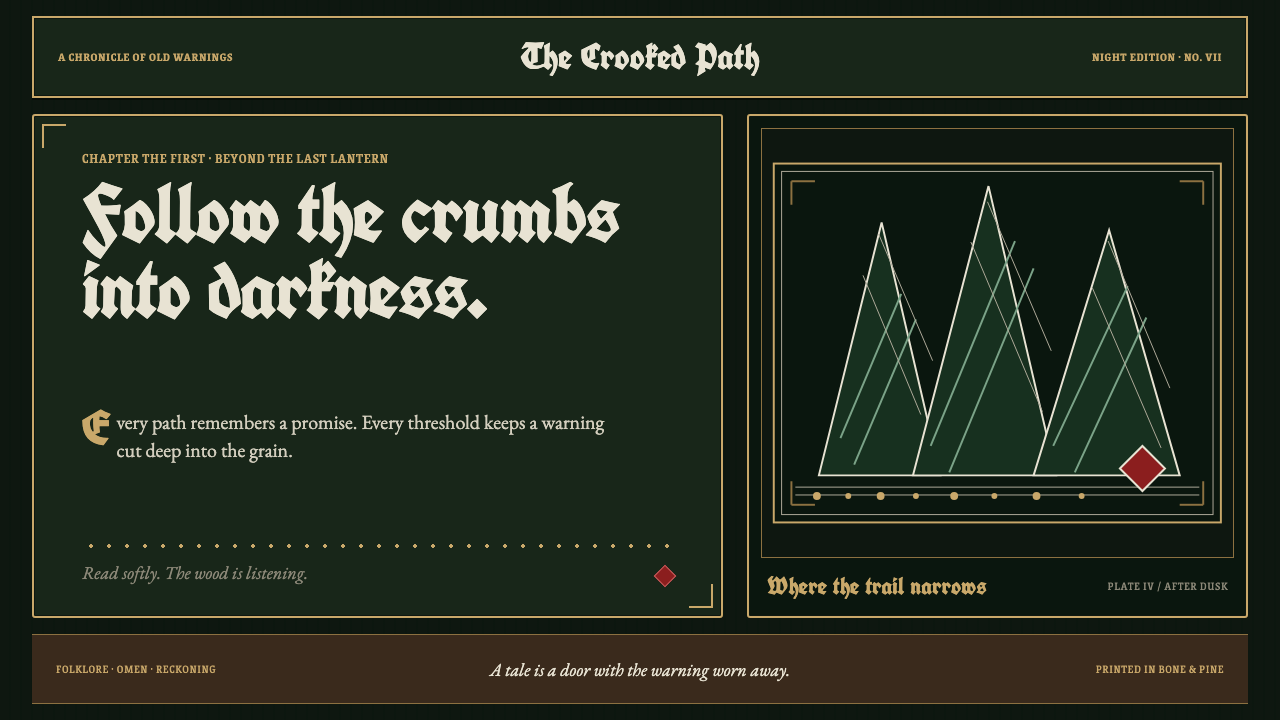 Grimm Fairy Tales (Black Forest Woodcut)The dark wood closes in. Bone-white cuts and aged-gold frames score a pine-bl…
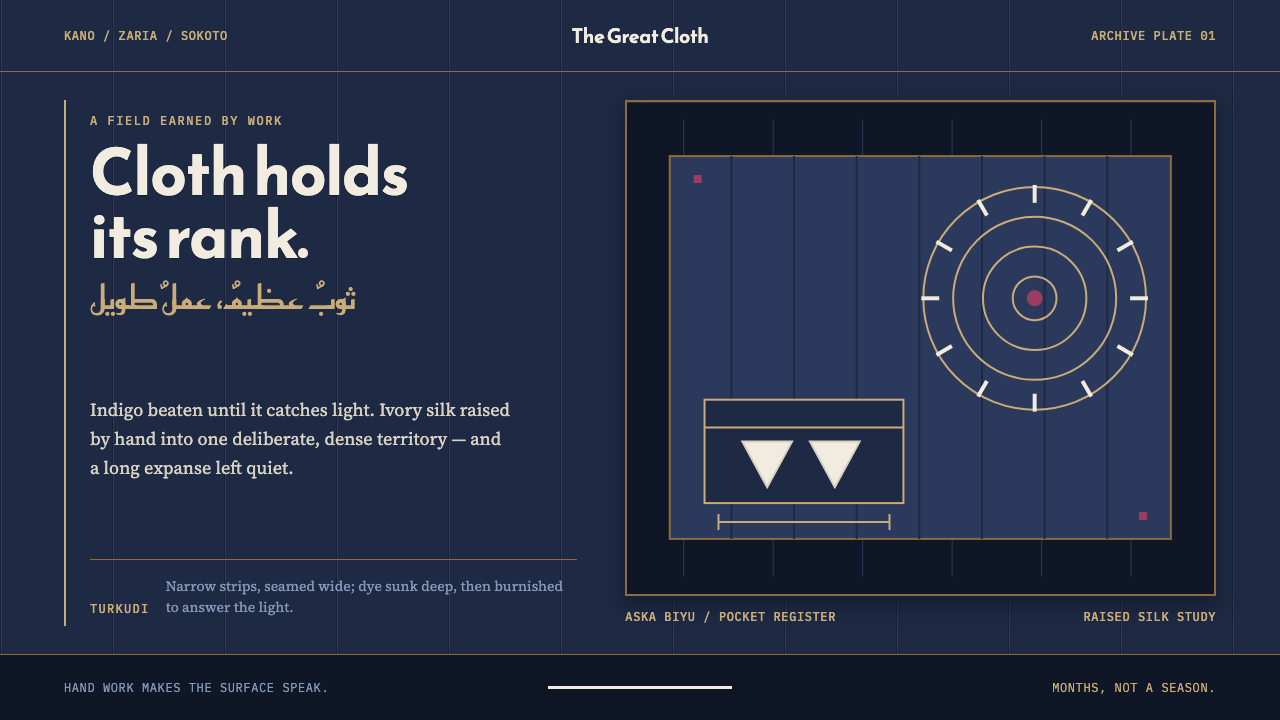 Hausa Babban RigaRank is worked, not announced. Burnished indigo holds raised ivory geometry i…
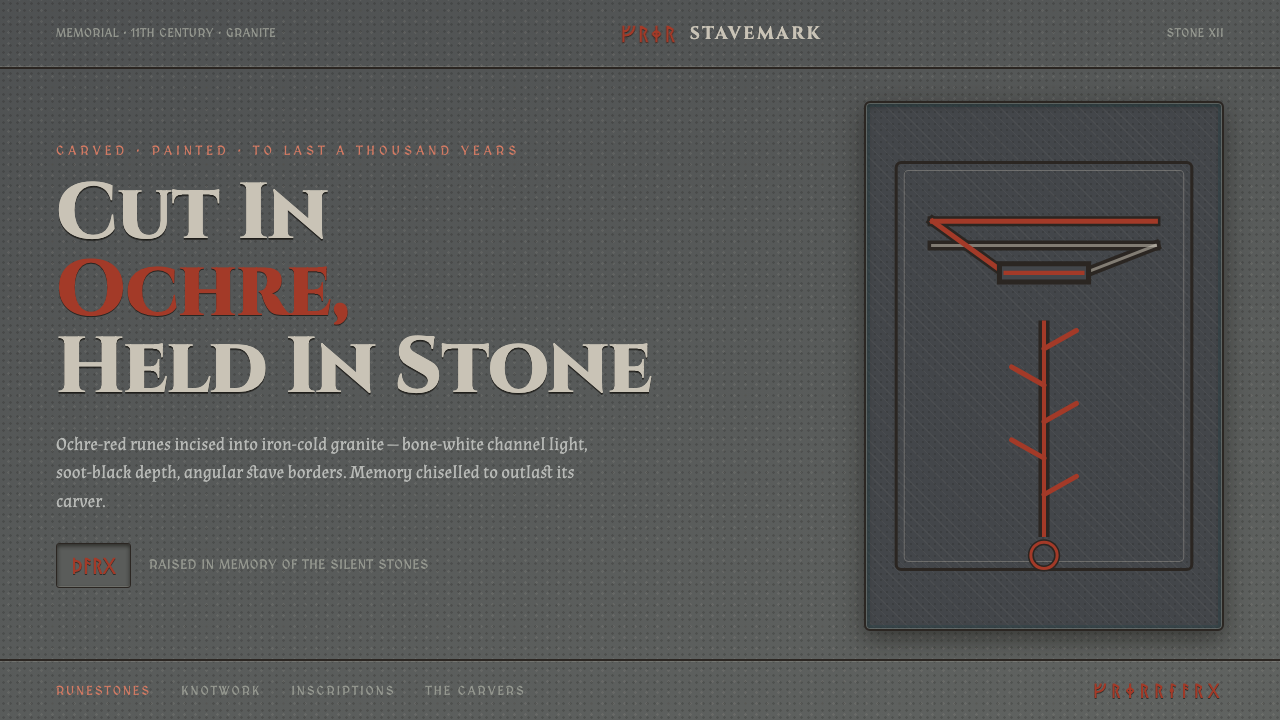 Norse Runic StaveCarved memory, painted to last. Ochre-red futhark runes incised into iron-col…
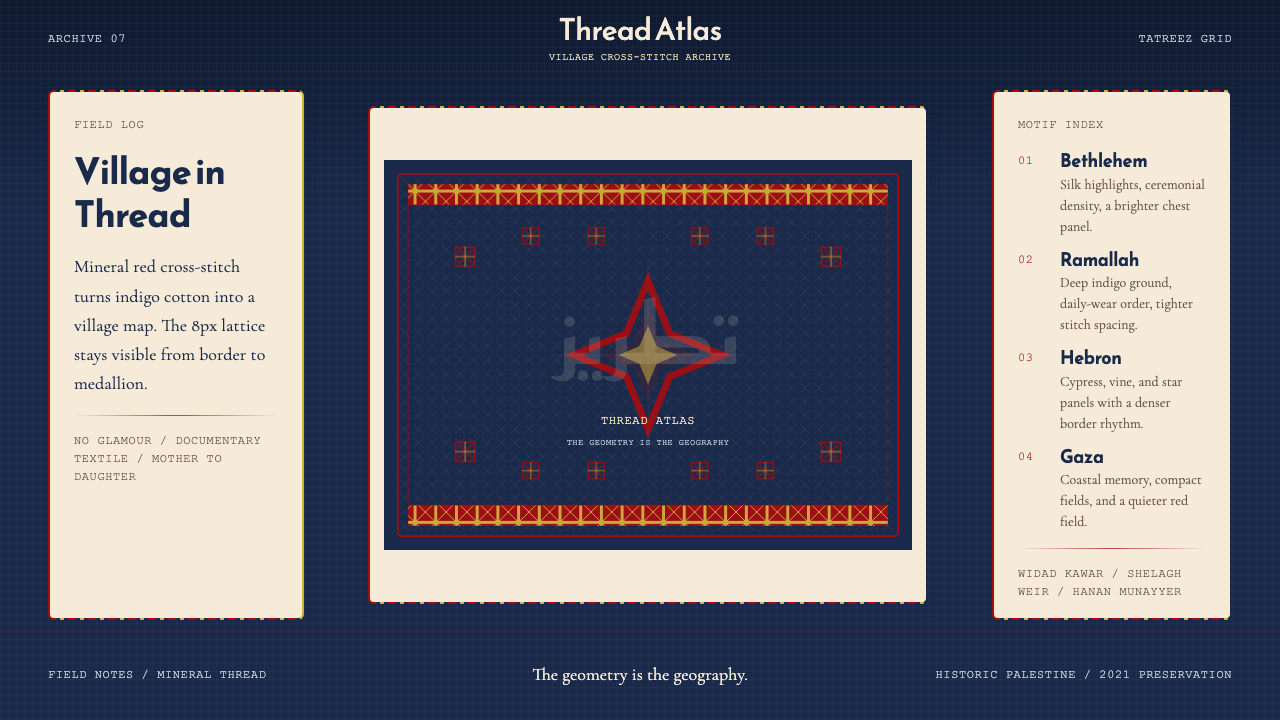 Palestinian Tatreez Cross-StitchMemory in thread. Red cross-stitch on indigo cotton, built on an 8px grid.
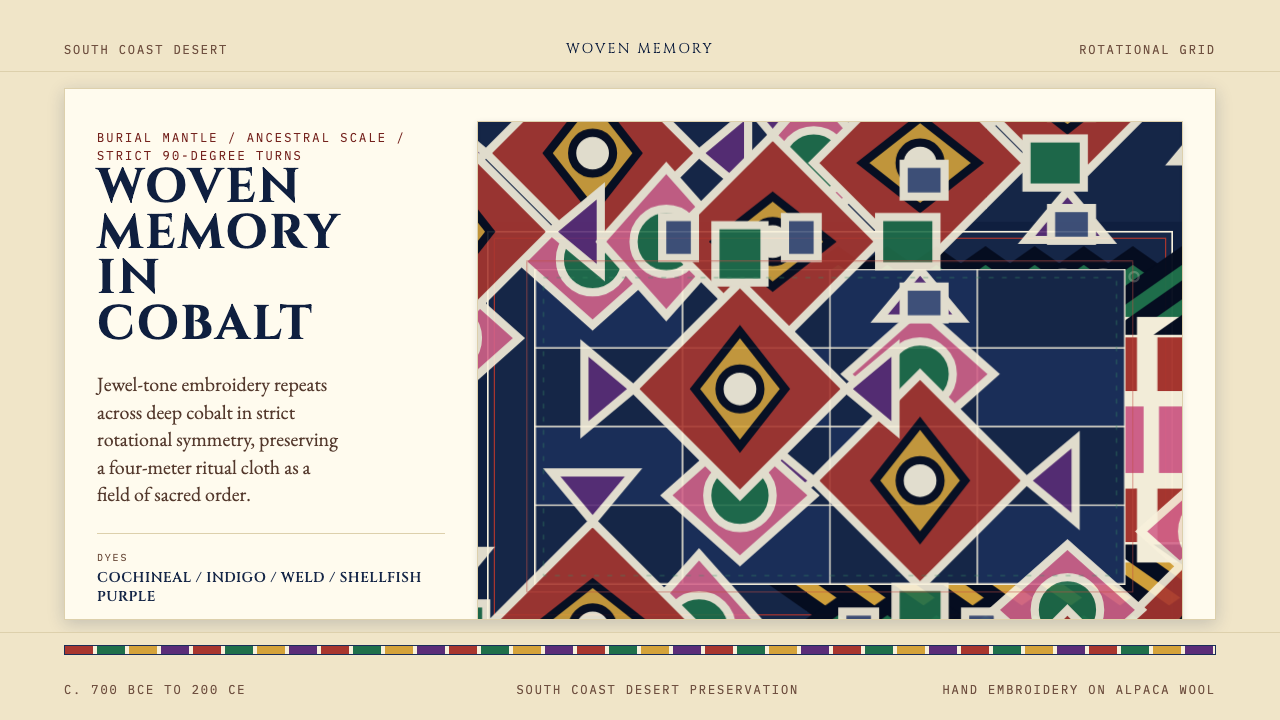 Paracas Andean TextileAncestral and exact. Jewel tones repeat on deep cobalt in strict 90° turns.
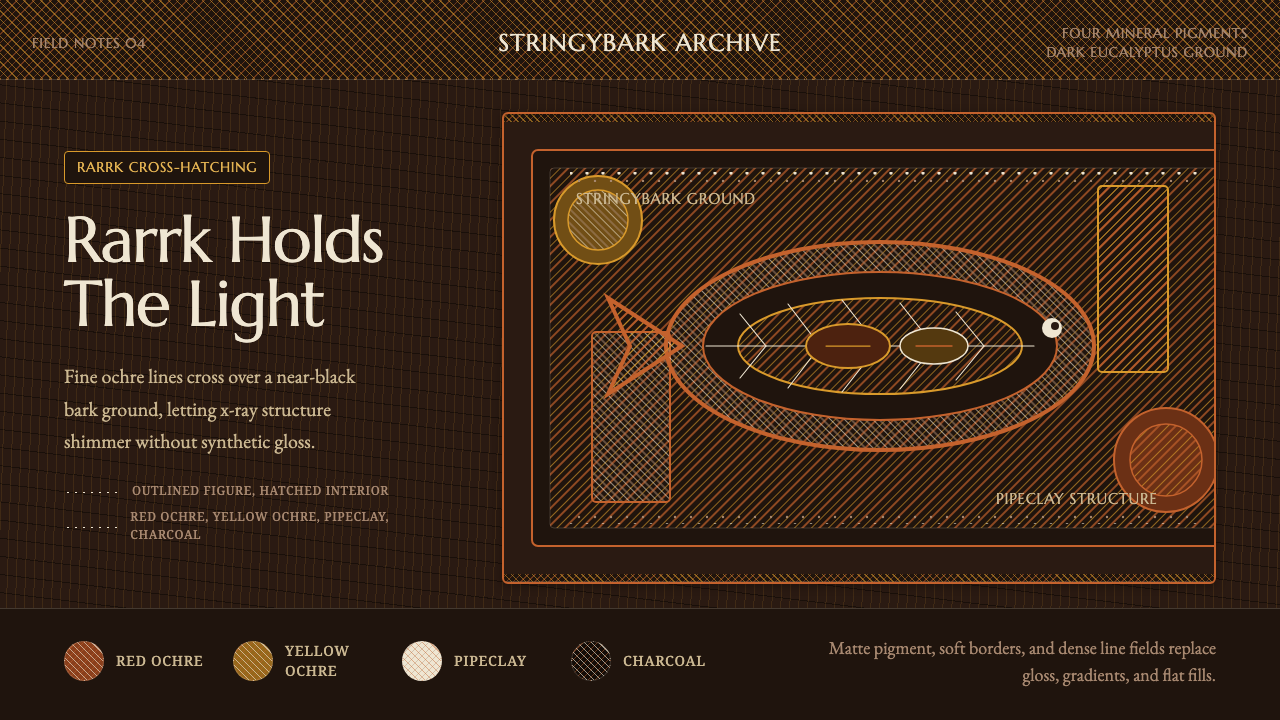 Arnhem X-Ray Bark PaintingShimmers without gloss. Ochre rarrk lines vibrate on dark stringybark.