What is Georgian Nikortsminda Stone-Carving?
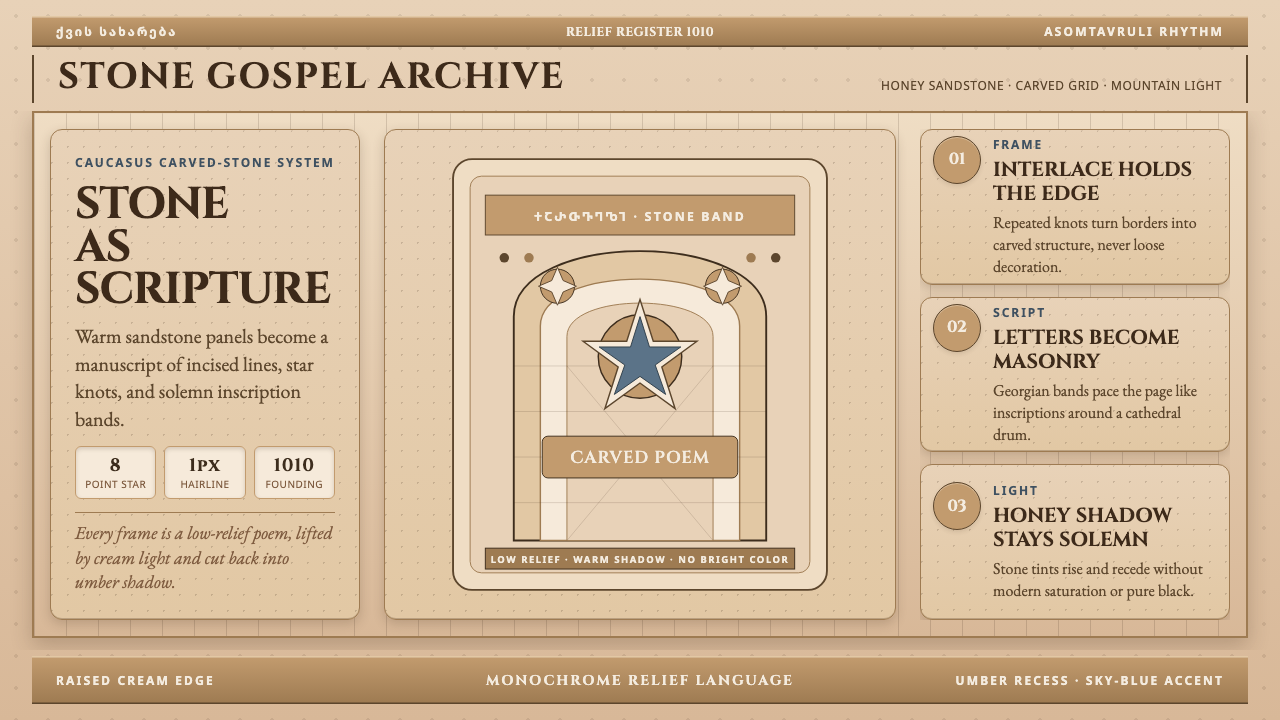
In the mountain light of the Caucasus, an entire cathedral becomes a manuscript — every surface carved with vine-scroll, geometric star, and sacred inscription.
Georgian Nikortsminda Stone-Carving in brief
Georgian Nikortsminda Stone-Carving is the visual and architectural tradition born from the 11th-century Georgian Orthodox cathedral-building programme, most fully realised at Nikortsminda Cathedral (consecrated 1010–1014 CE) in the Imereti region. Its defining character is the complete coverage of warm honey-coloured sandstone exteriors with dense, low-relief carving: interlaced vine-scrolls that never repeat exactly, geometric girih-derived star rosettes, figural panels of lions and bulls serving as corbels, and continuous bands of Asomtavruli — the ancient rounded script of the Georgian alphabet — running as inscriptional friezes around gables, window-frames, and tympana.
Unlike Byzantine icon art, which operates in a flattened and hieratic symbolic register, or Western Romanesque carving, which tends toward bold and somewhat coarse figural relief, Nikortsminda-tradition carving is fine-grained, allover, and deliberately text-like: every gable, arch-surround, and door-jamb is treated as a page to be filled with interlocking pattern. The stone surface is never left bare. The effect is simultaneously monumental and intimate — a building you can read, or at least feel compelled to read, as you move around its exterior.
The colour world of this tradition is imposed by material: the warm amber of freshly cut local sandstone deepening with centuries of weathering through mellow ochre into shadowed umber and moss-darkened brown. Carved channels sink into near-black shadow against the sunlit ground, producing a palette of extreme tonal contrast within a single hue family. The only relief from this warm stone register is the ash-grey of Caucasus mountain sky visible above the roofline — a colour that provides the tradition's sole cool counterpoint.

Where does Georgian Nikortsminda Stone-Carving come from?
The Nikortsminda tradition emerged during the Georgian Golden Age, that extraordinary century of political consolidation and cultural flowering that ran from roughly 975 to 1213 CE under the Bagrationi dynasty. King Bagrat III (ruled 975–1014), who unified the kingdoms of Abkhazia and Kartli and extended Georgian sovereignty across most of the South Caucasus, sponsored an intensive programme of church construction that became both a statement of dynastic legitimacy and a vehicle for developing a distinctly Georgian visual identity. The Nikortsminda Cathedral, begun under his patronage in the final years of his reign, represents the most ambitious flowering of the carving style that would define the tradition.
The geographical and material conditions of the South Caucasus region were decisive in shaping the aesthetic. The Imereti, Shida Kartli, and Mtskheta regions sit at elevations where local sandstone — warm in colour, consistently fine-grained, and workable with iron chisels — was the primary available building material. Byzantine workshops used marble and mosaic; Seljuk builders in neighbouring territories used brick and plaster. Georgian builders in this tradition worked almost exclusively in stone, and the qualities of their local stone — its receptiveness to fine cutting, its warm tonality, its ability to hold intricate line-work over centuries — shaped every choice the carvers made.
The iconographic sources of Nikortsminda carving are richly syncretic. The vine-scroll and inhabited-scroll motifs derive ultimately from Hellenistic and early Byzantine ornamental traditions transmitted through the Christian East. The geometric star-rosettes and interlace patterns show clear affinities with Islamic geometric art as practised in the broader medieval Caucasus and Anatolia — a cultural porousness that reflects the region's position as a crossroads between Byzantine Christendom, the Islamic world, and the Iranian cultural sphere. The Asomtavruli inscriptional bands are uniquely Georgian: the script, used since at least the 5th century CE, was deployed in these buildings not merely as signage but as ornament in its own right, the letterforms becoming part of the visual rhythm of the carved surface.
The tradition reached its widest geographic expression in the century following Nikortsminda, with major works at Samtavisi Cathedral (1030), Svetitskhoveli Cathedral at Mtskheta (rebuilt 1010–1029, further elaborated across the 11th century), and Bagrati Cathedral in Kutaisi (consecrated 1003, though substantially damaged in later centuries). Queen Tamar, who ruled Georgia from 1184 to 1213 and presided over the kingdom's greatest territorial extent, continued to patronise church construction and manuscript production in the same tradition. Modern scholarship on the tradition was substantially shaped by the architectural historian Wachtang Beridze, whose meticulous documentation of Georgian medieval church fabric in the 20th century provided the foundational record, later extended by David Khoshtaria and others working on the archaeology and conservation of the buildings.
What defines the Georgian Nikortsminda Stone-Carving look?
Palette
The Nikortsminda palette is monochromatic by material necessity and philosophical choice. The ground is the warm amber of local honey-sandstone; the carved relief reads as a darker version of the same stone, its channels filled with deep brown shadow. Weathering introduces subtle variation — patches of silver-grey lichen, streaks of iron-red oxidation, zones of surface blackening — but all of this remains within a narrow warm-neutral range. The only external colour reference is the pale grey-blue of open sky. There are no polychrome accents, no applied pigments, no gilding. The visual richness is achieved entirely through the contrast of light striking relief against shadow pooling in incised line.
Surface Coverage
The governing principle of the style is horror vacui applied at architectural scale: no exterior stone surface should remain uncarved. Tympana, gable fields, window-jambs, blind arcading, corbel-courses, and the transitions between architectural elements are all treated as fields for carving. This total coverage does not produce visual chaos because the carving is organised into clearly bounded zones — each architectural member receives its own ornamental programme — and because the relief is uniformly shallow, keeping everything within a single visual plane. The density reads as richness, not noise.
Interlace and Vine-Scroll
The vine-scroll — a continuously flowing stem that branches, curls back on itself, and fills its field with leaf, tendril, and occasional inhabited forms — is the primary decorative vocabulary. In Nikortsminda carving it achieves a particular density and fineness: the stems are thin, the intervals between filled, and the logic of growth is followed with botanical consistency. Interlace, where strands pass over and under one another in a regular sequence, appears on framing bands and border zones, operating as a kind of visual punctuation between different ornamental fields. Both motifs were executed with iron chisels capable of cutting channels only a few millimetres wide.
Geometric Star-Rosettes
Set within the vine-scroll fields or occupying the centres of tympana as focal medallions, the geometric star-rosettes are constructed on the same compasses-and-straightedge logic as Islamic girih geometry, producing eight-pointed stars, twelve-pointed stars, and interlocking polygonal grids from a single generating angle. The stars function as visual anchors in the composition — the densest concentrations of formal energy, where the viewer's eye rests before being carried back into the surrounding vine-scroll. Their geometric precision contrasts with the organic growth logic of the vine, and this contrast — rule against growth, angle against curve — is one of the style's central visual tensions.
Asomtavruli Inscription Bands
Running as continuous horizontal friezes around window apertures, beneath gable-peaks, and along the transitions between stories, the Asomtavruli script bands serve a double function: they record dedications, donor names, and liturgical texts, and they operate as purely visual ornament within the carved field. The rounded, majuscule letterforms of Asomtavruli — the oldest of the three Georgian scripts — have a natural affinity with the curvilinear vocabulary of the vine-scroll, and skilled carvers integrated them seamlessly into the overall surface rhythm. To a viewer unable to read Georgian, the inscription band reads as another register of dense, flowing ornament.
Figural Corbels
At the junctions between walls and rooflines, and at the corners of apses and drums, carved corbels in the forms of lion heads, bull heads, and occasionally human faces project from the stone surface. These are not mere surface relief but fully three-dimensional sculptural elements, cut deep enough to cast strong shadow. The lion and bull forms carry ancient Caucasian symbolic associations — sovereignty, strength, the sacred — and place this Christian tradition in a longer pre-Christian regional visual history. They also interrupt the all-over flatness of the vine-scroll field with sudden volumetric incident, marking the structural logic of the building beneath the ornamental surface.
Low Relief and Shadow Drawing
The carving throughout the tradition is low relief — the projection rarely exceeds what the eye reads as a few centimetres at most, often far shallower. This shallowness is a technical decision as much as an aesthetic one: deep undercutting in fine-grained sandstone risks fracture, and the buildings were designed to stand for centuries. The consequence is that the visual effect of the carved surface changes dramatically with the angle and quality of light. In the low, raking light of morning or evening the carving reads as a dense field of shadow-drawing; at midday, much of the relief flattens. The tradition assumes outdoor mountain light, and designs to work hardest at the hours when that light is most directional.

Who shaped Georgian Nikortsminda Stone-Carving?
Bagrat III (ruled 975–1014) was the first king of a unified Georgia, having consolidated the kingdoms of Abkhazia, Kartli, Kakheti, and Rani under a single crown. His patronage of the Nikortsminda Cathedral and several contemporary churches established the visual programme that would define Georgian sacred architecture for the next two centuries. The building campaign he sponsored was understood not merely as piety but as political act — the visual assertion, in carved stone, of a coherent Georgian Christian civilisation.
Tamar (ruled 1184–1213), the first woman to rule Georgia in her own right and celebrated in Georgian tradition as 'King of Kings', presided over the kingdom's greatest territorial extent and cultural efflorescence. Though the Nikortsminda Cathedral predates her reign by nearly two centuries, she is the paradigmatic royal patron of the broader Georgian Golden Age aesthetic — commissioning church construction, manuscript illumination, and the monumental poem The Knight in the Panther's Skin (Vepkhistkaosani) by Shota Rustaveli, which was itself dedicated to her.
Beridze (1902–1985) was the most significant Georgian architectural historian of the 20th century, whose systematic fieldwork and publications documented the medieval church fabric of Georgia with a rigour and completeness that had not existed before. His work on Nikortsminda and the other Golden Age churches established the scholarly framework through which the tradition is understood — identifying typological sequences, recording iconographic programmes, and situating Georgian carving within the broader history of medieval Christian art.
Khoshtaria is a contemporary Georgian archaeologist and architectural historian whose fieldwork has substantially extended the record of Georgian medieval building, particularly through excavation and close documentation of fabric at sites including Nikortsminda. His work has clarified the construction sequence of key buildings, identified phases of repair and modification, and brought the technical understanding of medieval Georgian stone-carving craft — the tools used, the workshop organisation, the sequence of execution — to a higher level of precision.
How do you use Georgian Nikortsminda Stone-Carving today?
Nikortsminda Stone-Carving is a high-specificity historical style — it carries strong cultural and geographic associations — so applying it requires a clear thematic fit. It works best for projects in the domains of heritage, cultural tourism, luxury goods with artisanal positioning, documentary and archival publishing, sacred or contemplative institutions, and any design context where densely crafted surface detail is a value rather than a liability. The style signals antiquity, craftsmanship, and the weight of a specific place and tradition.
For presentation slides, the style is well-suited to cover pages and section dividers rather than dense content pages. A cover treatment might use the warm sandstone tone as the ground, with a panel of extracted geometric rosette or vine-scroll line-work — rendered as fine pale line on the warm amber background — occupying a full third to half of the frame, with the title set in a serif face recalling inscriptional letterforms. Content slides work best with the texture vocabulary used sparingly: a narrow band of interlace ornament at the top or bottom margin, substantial white space (or warm parchment tone) for text, and the stone palette restricted to accent elements. Data slides in this style gain character from using the warm amber and deep shadow-brown as the two tones of a bar chart or proportional diagram, avoiding any colour that does not belong to the stone register.
For web interfaces and dashboards, the style is best deployed in heritage portals, museum collection browsers, cultural-institution homepages, and luxury product presentation pages. The approach: use a warm near-white or parchment tone for the primary background, stone-brown for all body text, and the deeper shadow-umber as a hover and active state indicator. Surface decoration should be used architecturally — as border treatments, section-header motifs, or loading-screen ornamentation — rather than scattered across every component. Navigation benefits from an inscription-like quality: generous letter-spacing, measured weight, a serif or lapidary typeface. Interactive elements should be calm and deliberate rather than animated, reflecting the stillness of carved stone rather than the dynamism of digital motion.
For editorial and marketing work — book covers, exhibition catalogues, cultural-institution annual reports, heritage tourism campaigns — the style's density and warmth are direct assets. A double-page spread can set body text in a measured serif column against a warm ground, with a full-bleed reproduction of carved stone detail as the facing page. Marketing materials gain authority from treating the ornamental vocabulary as a signature system: consistent use of the same extracted vine-scroll or star-rosette motif across touchpoints reads as brand identity rooted in cultural depth. Packaging for heritage food, wine, or craft products benefits from the association between the warm stone palette and the idea of age, provenance, and handwork.
The most common mistake when applying this style is attempting to replicate its surface density digitally without understanding its spatial logic. Scattering tile-pattern fragments across a background produces visual noise, not richness — because in the original buildings the carving is organised by architectural structure, with each panel bounded by its own frame and the overall programme unified by material consistency. The digital equivalent is to use ornamental elements as deliberate zone-markers — bordering a specific content block, heading a specific section — rather than as background fill. A second common mistake is pairing the warm stone palette with cool, saturated accent colours. This tradition has no bright blues, no acid greens, no vivid purples: the only permissible cool note is a grey that recalls stone in overcast light.
A note on typography: no exact script or font family is prescribed here, but the tradition's inscriptional character calls for letterforms with lapidary quality — a slight squareness in the proportions, a readability derived from carved rather than drawn construction. All-caps or small-caps settings suit the style's monumental register. Body text should be set generously spaced, in a weight that reads as substantial without heaviness, with a line-length that creates a text-column proportioned like a manuscript page rather than a newspaper column.

Georgian Nikortsminda Stone-Carving — FAQ
How is Nikortsminda Stone-Carving different from Byzantine church decoration?
Byzantine sacred decoration is primarily flat, additive, and light-emitting: mosaic tesserae on gold grounds, icon panels with gilded haloes, frescoes that represent figures in a hierarchical frontal register. The imagery is figurative and theological — Christ Pantocrator, the Virgin, saints, narrative scenes. Nikortsminda carving, by contrast, is primarily abstract, subtractive, and shadow-drawing: the carver removes stone rather than applying colour, produces pattern rather than figure, and works in the tonal range of a single material rather than across a full chromatic palette. Both traditions are Eastern Christian and share some iconographic sources, but their means are fundamentally different — mosaic versus relief, light versus shadow, figure versus pattern.
Can this style work in a digital or screen context, given that it originated in carved stone?
Yes, but the translation requires deliberate adaptation rather than direct reproduction. On screen, you cannot replicate the tactile depth of shallow stone relief, the tonal shift as light moves across a wall, or the monumental scale of a cathedral exterior. What you can translate is the compositional logic: the total coverage of a defined field, the organisation of ornament into architecturally bounded zones, the use of a narrow warm palette, the combination of geometric and organic motifs within a single visual register, and the inscription-like quality of text set against a carved-surface ground. The most successful digital applications treat the ornamental vocabulary as a structural system — borders, headers, dividers — rather than attempting to simulate carved stone literally.
What typefaces and typographic approaches suit this style?
The style does not prescribe specific font families, but it calls for letterforms with lapidary or inscriptional qualities — slightly squared proportions, a construction logic that recalls cutting rather than drawing, clear contrast between stroke weights. Display type works well at large scale in all-capitals, recalling the monumental register of the Asomtavruli inscription bands. Body text benefits from a generous set — wider than usual tracking, a comfortable leading — to echo the spacious distribution of carved line across the stone ground. Condensed display faces and anything with a highly expressive or calligraphic character would undercut the style's monumental restraint.
Is this style appropriate for contemporary brands, or does it read as too historical?
The style is well-suited to brands where historical depth, geographic specificity, and artisanal quality are genuine positioning values — wine, spirits, heritage tourism, luxury leather goods, cultural institutions, fine publishing. For brands that need to communicate forward-looking innovation, technological dynamism, or playful accessibility, it is a poor fit. The key is whether the specific associations the style carries — the Caucasus, medieval Christian culture, carved stone, antiquity — align with what the brand actually offers and wants to claim. Used authentically, it provides an unusually specific cultural signature that distinguishes from the generic historicism of faux-classical or generic medieval references. Used without contextual justification, it reads as arbitrary costume.
What are the most important things to avoid when working in this style?
Four things above all. First, cool or saturated colour: the tradition is monochromatic in warm stone tones, and introducing vivid blues, greens, or purples breaks the material logic entirely. Second, gradient fills: the style operates in hard contrasts between lit surface and shadowed incision — gradients import a photographic naturalism that is alien to the tradition. Third, scattered ornament: the vine-scroll and rosette motifs only work when organised within architecturally defined zones, not when tiled as background texture or applied randomly. Fourth, overcrowding at small scale: the original carving was designed for architectural surfaces read at a distance of several metres; at thumbnail or small-screen scale, the density becomes illegible, and the decorative vocabulary needs to be simplified or isolated to a single motif.
Related design styles
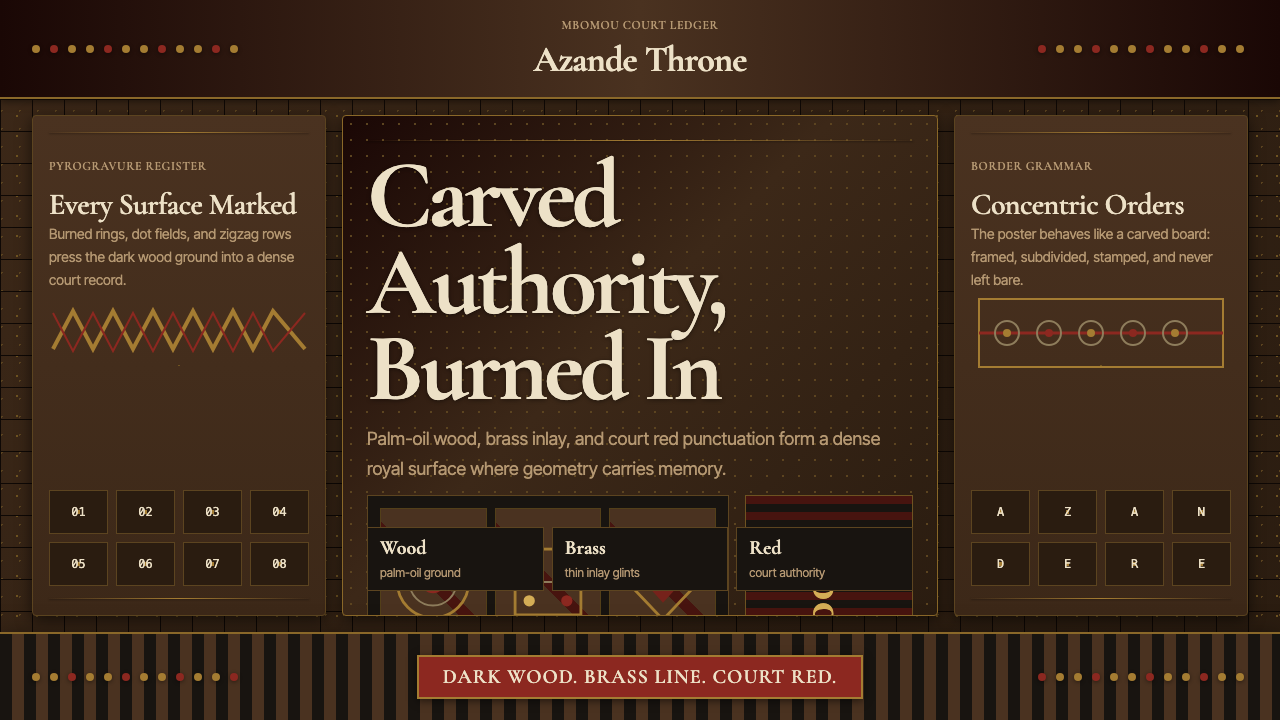 Central African Azande ThroneDense court gravity. Dark wood grids, brass dots, and court red cover every s…
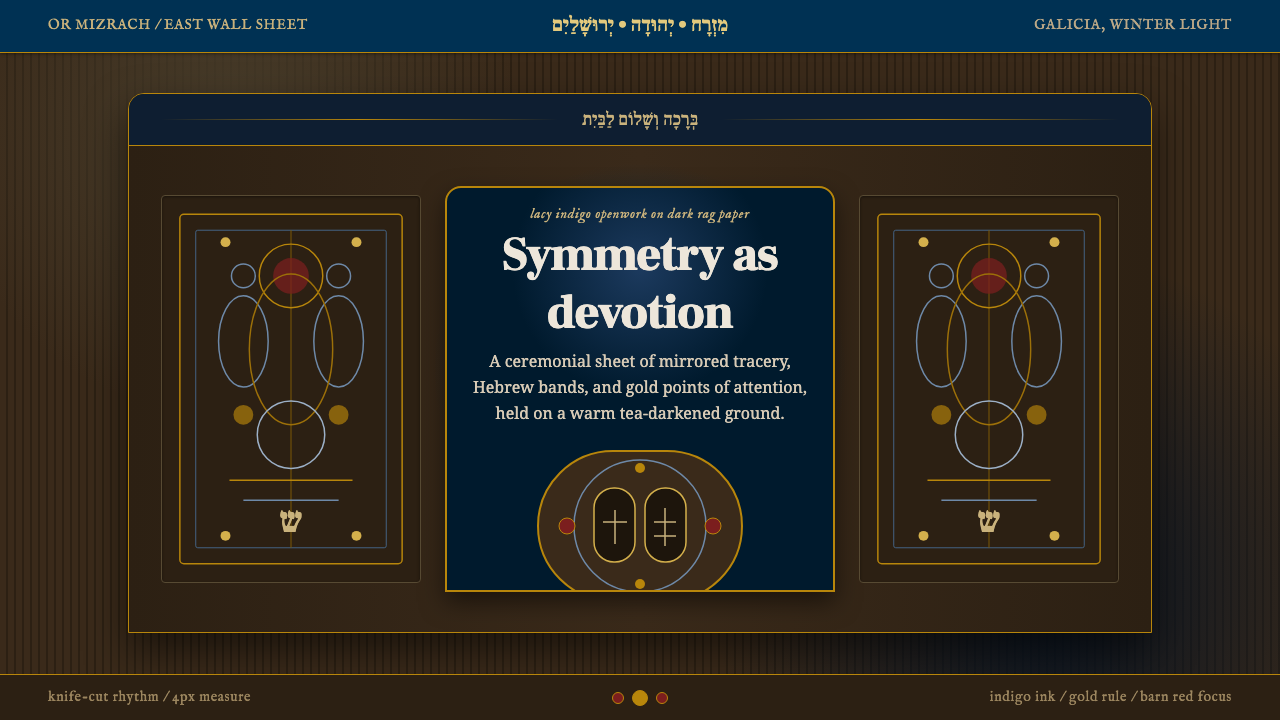 Jewish Papercut MizrahDevotion as openwork. Indigo filigree and Hebrew bands glow on dark rag paper.
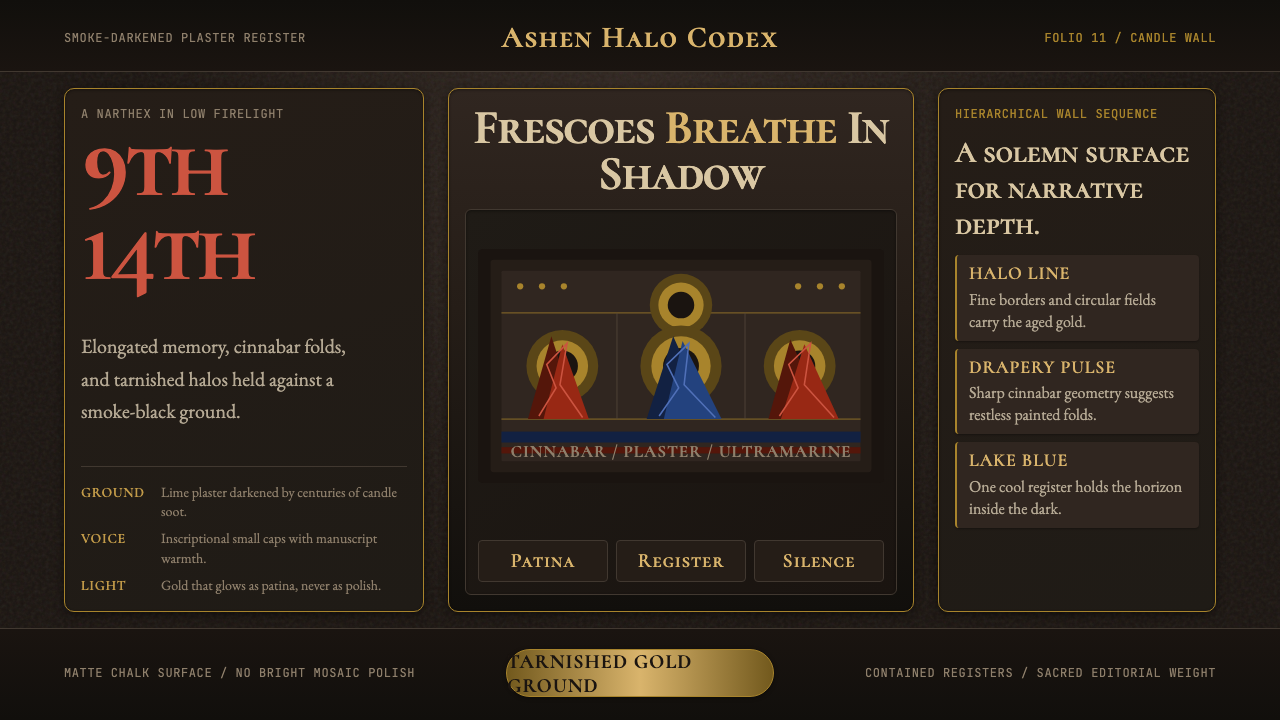 Macedonian Ohrid Fresco (Byzantine)Sacred darkness breathes. Tarnished gold rings, cinnabar folds, and plaster g…
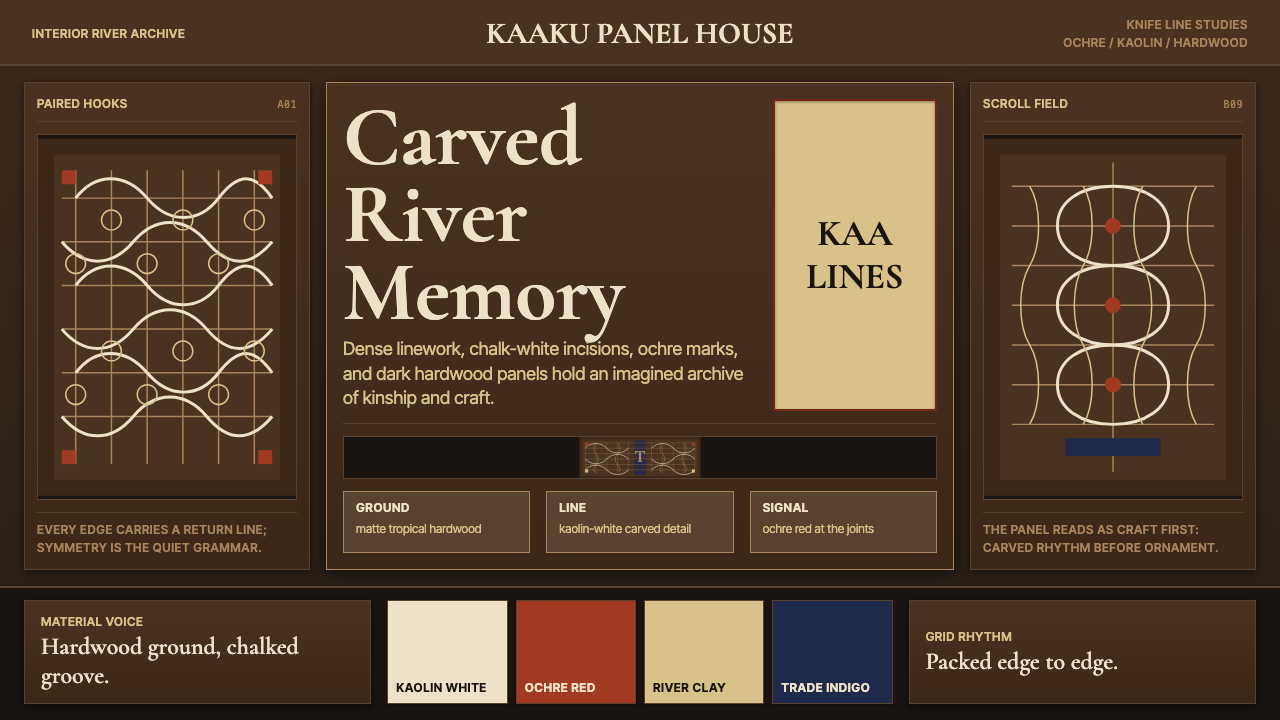 Suriname Maroon TembeDense memory, carved in rhythm. Kaolin lines cross hardwood brown in bilatera…
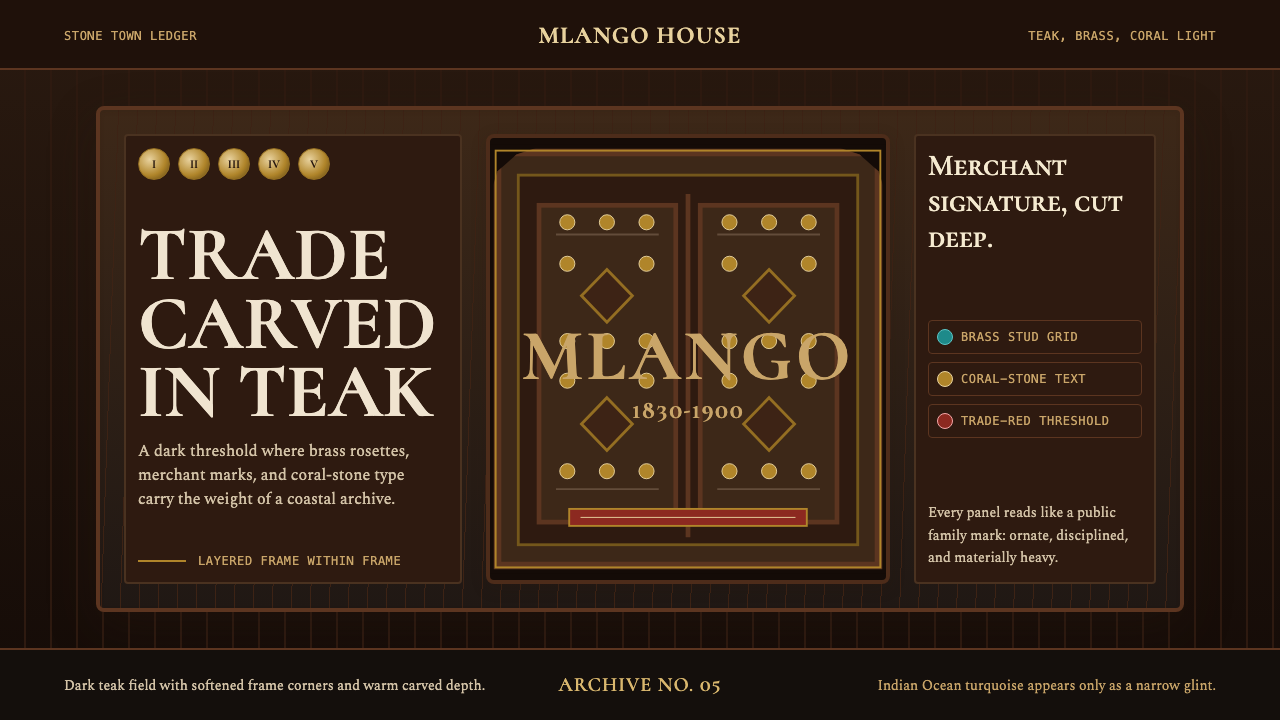 Swahili Stone Town DoorTeak darkness remembers. Brass studs and Cormorant small caps frame a carved…
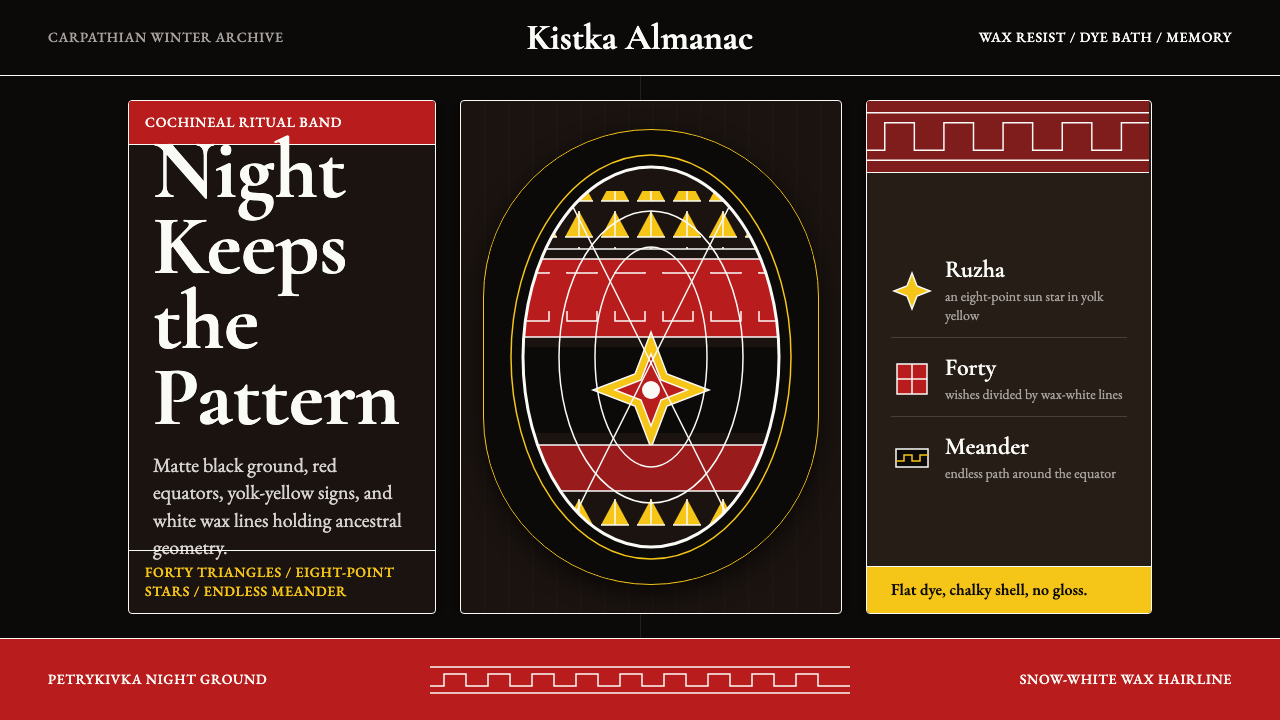 Ukrainian Pysanky (wax-resist egg)Night holds memory. Red bands, yolk geometry, and white wax lines cut matte b…