What is Macedonian Ohrid Fresco (Byzantine)?
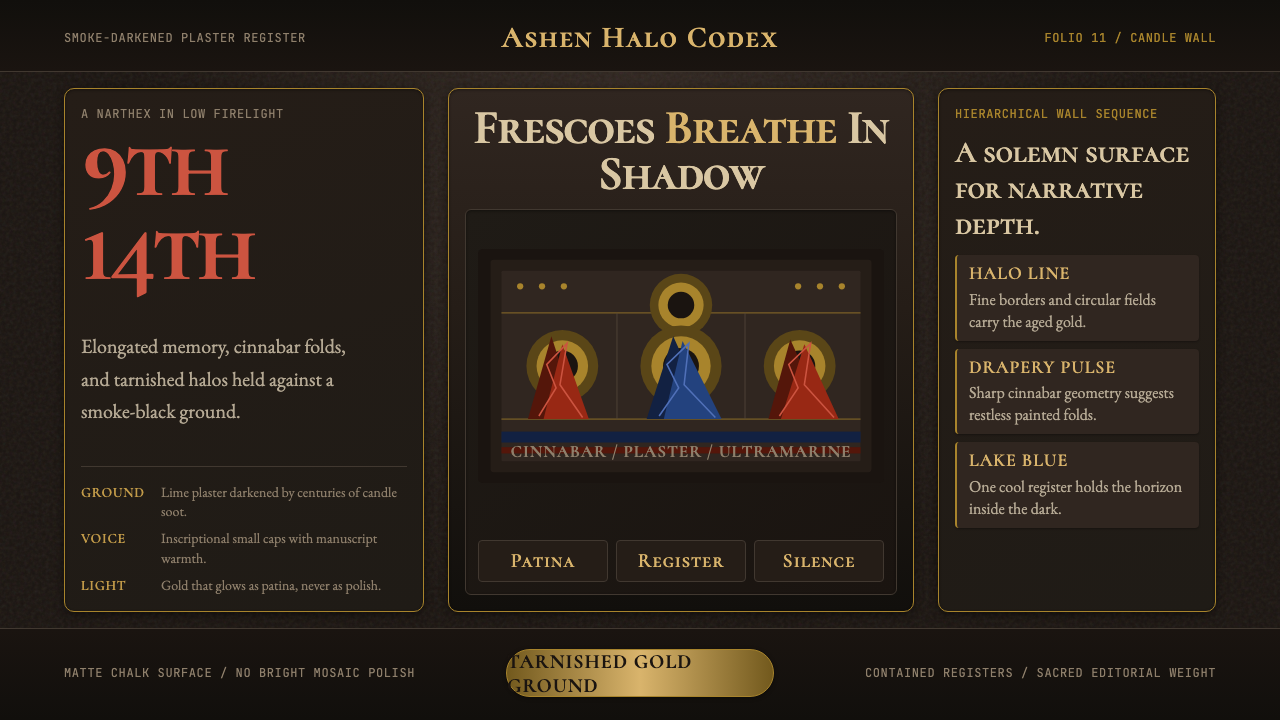
On the smoke-darkened walls of Lake Ohrid's ancient churches, Byzantine fresco painters forged a devotional visual language of tarnished gold, deep cinnabar, and elongated figures charged with a spiritual urgency that still resonates across nine centuries.
Macedonian Ohrid Fresco (Byzantine) in brief
The Macedonian Ohrid Fresco style is a distinct regional branch of Byzantine sacred painting, developed over four centuries on the shores of Lake Ohrid in what is today North Macedonia. It diverges sharply from the imperial formality of Constantinople and the mosaic grandeur of Ravenna, instead cultivating an intensely expressive register: figures are elongated and weightless, faces carry visible inner turmoil, and drapery moves with an agitated energy that suggests spiritual disturbance rather than courtly composure.
Visually, the style is defined by its atmospheric darkness. Plaster grounds are warm and dim, sometimes literally blackened by centuries of candle smoke, creating a depth that pulls figures forward rather than pressing them against a flat background. Gold is tarnished and organically applied — it does not blaze like the rigid gold leaf of Venetian mosaics but glows with an uneven, breathing luminosity. The color relationships throughout are deep and saturated: cinnabar reds, ochre skin tones, and a distinctive ultramarine drawn from the quality of light reflecting off Lake Ohrid itself all operate together in calculated harmony.
The system's emotional authority comes from its treatment of the human face. Byzantine convention generally prescribed serene, iconic physiognomies; the Ohrid School painters allowed sorrow, anguish, and concentrated devotion to mark the features of saints and sacred figures with a psychological specificity unprecedented in their tradition. Combined with drapery folds that twist and fold with almost baroque restlessness, this gives the style a drama that distinguishes it immediately from its more composed regional contemporaries.

Where does Macedonian Ohrid Fresco (Byzantine) come from?
The Ohrid School emerged on the spiritual and administrative foundations laid by Saint Clement of Ohrid, a disciple of Saints Cyril and Methodius who arrived at Lake Ohrid in 886 CE after being expelled from the Moravian mission. Clement established a monastery and school that became the first Slavic university, training clergy and artists who gave Byzantine sacred art a Slavic inflection that distinguished it permanently from its Greek and Latin contemporaries. The 9th and 10th centuries saw the initial formation of this regional character, as painters working in the newly completed Church of Saint Sophia developed conventions that centered local devotional needs rather than Constantinopolitan prestige.
The style reached its first major peak in the 11th century, when Saint Sophia Ohrid — built on the site of an earlier basilica under Archbishop Leo around 1040 CE — received an extensive fresco program. These paintings, particularly the extraordinary Deesis composition in the apse and the portraits of archbishops in the nave, established the hallmarks of the school: the warm plaster ground, the restrained but emotionally charged palette, and above all the expressive individualization of faces. This was not the standardized physiognomy of a copying workshop but the product of painters who understood that each sacred figure carried a distinct spiritual identity.
The 13th and 14th centuries represent the school's highest achievement, centered on the prolific workshop of Mihailo Astrapas and Eutychios. This painter-duo — whose signatures appear in multiple churches across what is now North Macedonia, Kosovo, and Serbia — were among the most technically accomplished fresco masters of the medieval world. Their work at the Church of Saint George in Staro Nagoričane (1317–1318) and at Saint Clement's Cathedral in Ohrid demonstrates the mature Ohrid style: figures whose drapery writhes with intentional agitation, compositional arrangements that use architectural framing to create spatial drama, and a narrative confidence that treats biblical scenes as charged human dramas rather than devotional diagrams.
The broader context for this flourishing was the Palaiologan revival, a cultural renaissance in the Byzantine world following the restoration of Constantinople from Latin Crusader rule in 1261. Under the Palaiologan emperors, Byzantine art became more naturalistic, more emotionally expressive, and more interested in the drama of the individual human figure — tendencies already present in the Ohrid School that the Palaiologan movement amplified across the wider Orthodox world. The scholar Cvetan Grozdanov, who devoted much of his career to documenting and analyzing the Ohrid frescoes in the 20th century, demonstrated how the regional school anticipated and in some cases independently developed these qualities before the Palaiologan court painters brought them to Byzantium's imperial center.
What defines the Macedonian Ohrid Fresco (Byzantine) look?
Ground and Atmosphere
The foundational layer in Ohrid fresco work is an earthen plaster ground — warm, granular, and often visibly textured by the trowel marks of the master's hand. This is not a neutral background but an active visual element. Its warmth counterpoints the cool blues and reduces the harshness of strong contrasts; its texture catches raking light and gives even flat color areas a luminous depth. Where centuries of candle smoke have darkened the plaster to near-black, the effect is of figures emerging from sacred darkness rather than being placed against a surface.
Color and Its Symbolic Weight
The Ohrid palette is deliberately restricted and symbolically loaded. Cinnabar red — dense, earthy, and warm — dominates garments associated with martyrdom, divine authority, and sacred intensity. Against it, a deep ultramarine derived from the cool luminosity of the mountain lake horizon anchors the compositions and creates spatial recession. Ochre tones model flesh with warmth and specificity. Gold, whether tarnished or softly luminous, denotes the divine realm and the uncreated light of Orthodox theology. These are not decorative color choices but a coded visual theology: every hue carries doctrinal meaning legible to the congregation.
Agitated Drapery
Perhaps the most recognizable signature of the Ohrid School is the treatment of fabric. Drapery in Ohrid frescoes does not drape with physical logic — it twists, bunches, and fractures into angular ridges that respond to internal spiritual energy rather than gravity. Highlight strokes run counter to the fold direction, creating a shimmering restlessness that sets the figures in perpetual internal motion. This is a deliberate theological statement: the sacred body transcends physical law, and the movement of clothing around it demonstrates a different kind of energy.
Expressive Faces
Byzantine art conventionally idealized the sacred face into composed, unchanging serenity — the icon as window to the eternal. The Ohrid School masters broke consistently with this convention. Saints in their compositions show furrowed brows, deeply shadowed eye sockets, and mouths set with tension or sorrow. The modeling of flesh is bold and sculptural, carving light and shadow into volumes that read as psychologically inhabited rather than transcendently blank. This individuation was not irreverence but a different theological emphasis: the saints became human precisely because they chose the divine, and their struggle was worthy of visible commemoration.
Architectural Framing
Ohrid fresco painters were skilled at using the actual architecture of the church — arched niches, pilasters, pendentives, and the curve of the apse — as compositional infrastructure. Figures are placed in dialogue with these structural elements: a saint in a shallow niche becomes a fully three-dimensional presence through the fresco's modeling of depth against the curved stone surface. Narrative cycles on horizontal registers use architectural moldings as frame elements, creating rhythm and separating scenes with the same economy that a manuscript illuminator would use column divisions. The fresco and the building are conceived as a unified devotional environment.
Gold and Uncreated Light
In the Ohrid School, gold is not a luxury finish but a theological material. Applied to halos, to garment edging, and to the backgrounds of icon panels, gold represents the uncreated light of divine energy — a concept central to Orthodox hesychast theology that was being systematized by thinkers like Gregory Palamas in the very period when Astrapas and Eutychios were most active. The tarnished quality of aged gold in these frescoes is not decline but transformation: like the saints themselves, the material has been changed by time into something deeper and more complex than its original brightness.
Spatial Depth Without Perspective
Byzantine fresco painting did not use linear perspective, which would not be systematized until 15th-century Italian workshops. Instead, the Ohrid painters created spatial depth through overlapping figure planes, the recession implied by the plaster ground's warm darkness, and what scholars call 'inverse perspective' — the deliberate widening of architectural elements toward the viewer rather than toward a vanishing point. This creates a paradoxical sense of space that surrounds and includes the viewer rather than positioning them as an external observer. The devotional function was precisely this: to place the worshipper inside the sacred space rather than outside it looking in.

Who shaped Macedonian Ohrid Fresco (Byzantine)?
Mihailo Astrapas (active approximately 1295–1318) is the most documented painter of the Ohrid School, known from inscriptions and colophons in at least seven Macedonian and Serbian church programs. Working in close collaboration with his partner Eutychios, Astrapas developed the school's most technically ambitious phase: complex multi-figure narrative compositions, architecturally sophisticated spatial frameworks, and a psychological depth in facial modeling that set a standard for Balkan fresco painting that endured for two centuries. The inscription at Saint George in Staro Nagoričane — one of the best-preserved examples of their mature collaboration — shows Astrapas as the senior partner responsible for the overall compositional program.
Eutychios worked inseparably with Mihailo Astrapas throughout his documented career, and the two names appear together in nearly every inscription that credits the Ohrid School's most ambitious projects. While it is difficult to attribute individual passages to one or the other with certainty, art historians have proposed that Eutychios specialized in the figure and drapery work — the areas of most distinctive Ohrid invention — while Astrapas supervised the architectural framing and compositional planning. Their combined output represents the fullest realization of Palaiologan expressionism in the Macedonian regional context.
Saint Clement (c. 840–916 CE) was not a painter but the institutional founder whose work made the Ohrid School possible. A bishop, scholar, and missionary disciple of Saints Cyril and Methodius, he established at Ohrid the first institution in the Slavic world that combined theological education with scriptural translation and liturgical art production. By training local clergy and artists in a single program, he created the conditions for a sustained regional tradition — one that would not simply copy Byzantine models from Constantinople but would adapt them to the needs of a Slavic devotional community, producing the emotional and linguistic adjustments that ultimately became the Ohrid style's defining character.
Cvetan Grozdanov (1936–2013) was the most important modern scholar of the Ohrid fresco tradition, a Macedonian art historian whose decades of fieldwork, archival research, and technical analysis produced the definitive documentation of the school's surviving work. His monographs on the paintings of Saint Sophia Ohrid and on the Astrapas-Eutychios workshop established the attributional framework still used by scholars today. Beyond documentation, Grozdanov argued consistently that the Ohrid School represented a genuinely independent creative tradition — not a provincial derivative of Byzantine art but a regional school with its own innovations, priorities, and expressive logic.
Gregory Palamas (c. 1296–1359) was not a painter but the theologian whose hesychast doctrine of uncreated divine light provides the most important intellectual framework for understanding what the Ohrid frescoes were trying to do visually. Palamas argued that God's energies — including his light — are genuinely present in the world and directly accessible to human experience through contemplative practice. The gold-saturated visual theology of Ohrid fresco painting, with its glowing halos and luminous grounds, was making a parallel argument in pigment: the sacred is not a symbol or metaphor but an immediate presence, apprehensible by trained devotional attention. Palamas was formally canonized by the Eastern Orthodox Church in 1368.
How do you use Macedonian Ohrid Fresco (Byzantine) today?
The Macedonian Ohrid Fresco style is a challenging but deeply rewarding aesthetic to translate into contemporary design contexts. It does not transfer through surface borrowing — adding gold tones and textured backgrounds is not enough. The style works when the designer understands its underlying logic: that darkness is a material, that warm tarnished surfaces create depth that pure black cannot, and that emotional charge in imagery comes from specific formal choices about proportion, movement, and the play of light against textured grounds.
For presentation slides, the Ohrid fresco aesthetic is best suited to cultural, historical, spiritual, and educational contexts rather than product or corporate settings. A cover slide benefits from a dark plaster-toned background against which a key image or typographic element glows with uneven, candlelit warmth — not a flood-lit highlight but a selective luminosity that draws the eye without explaining itself. Content slides should honor the style's ratio of darkness to light: heavy, grounded backgrounds with sparse but precisely weighted elements floating in the upper register. Data-driven slides are a poor fit unless the data itself has a meditative quality; force a pie chart into this palette and the sacred darkness becomes mere gloom.
For web and digital interfaces, the style is most effective in editorial and cultural contexts: museum collection pages, digital humanities projects, religious heritage platforms, or any interface where immersive depth and historical gravitas are the desired emotional registers. The key technical translation is the background: avoid pure black and instead build the dark ground from warm ochres and deep earthen tones that create the plaster-ground effect digitally. Interactive elements — buttons, hover states, selected items — benefit from the style's gold language, using a desaturated, warm metallic tone rather than a saturated yellow, signaling significance through material suggestion rather than brightness.
For editorial and marketing design, the Ohrid fresco aesthetic is powerful for heritage brand communications, religious and spiritual publishing, cultural event promotion, and any context that benefits from invoking a deep historical gravitas. The photographic treatment should match the fresco aesthetic: high-contrast, slightly warm in tone, with backgrounds allowed to fall toward deep shadow rather than being lit to even exposure. Typography placed over dark grounds should avoid pure white and instead use warm off-white or parchment tones that suggest the illuminated manuscript tradition without literally citing it.
A common mistake is treating the Ohrid aesthetic as interchangeable with any generic 'Byzantine' or 'medieval' visual vocabulary. The style's specific qualities — the agitated drapery, the psychologically individuated faces, the tarnished rather than blazing gold, the warm plaster ground — are precise and historically specific. Reducing the style to dark backgrounds with gold accents and arch-shaped frames produces a generically religious atmosphere but misses what makes the Ohrid School distinctive: its commitment to spiritual drama through controlled formal tension, not through decorative historical quotation.
Macedonian Ohrid Fresco (Byzantine) — FAQ
How does the Ohrid School differ from mainstream Byzantine art?
The most significant difference is emotional and psychological. Mainstream Byzantine art, particularly the imperial court style of Constantinople, prized serene, iconic faces and rigid compositional hierarchies that communicated divine authority through composure and timelessness. The Ohrid School, working at the cultural periphery of the Byzantine world but with direct access to Slavic devotional sensibilities, developed a more emotionally expressive register: anguished faces, restless drapery, and a warmth in the treatment of sacred narrative that brought biblical and hagiographic events closer to lived human experience. The school also worked directly in fresco — a medium that rewards speed and confidence — rather than in the slower, more controlled medium of panel icon painting, which may have encouraged its more fluid, expressive line.
What is the Palaiologan revival and why does it matter for Ohrid?
The Palaiologan revival refers to the cultural renaissance that followed the restoration of Constantinople from Latin Crusader rule in 1261, under the Palaiologos dynasty. Byzantine art during this period became significantly more naturalistic and emotionally expressive — more interested in depicting human bodies with volume and movement, sacred faces with psychological specificity, and narrative scenes with spatial depth. The Ohrid School is historically important in part because scholars have identified Palaiologan-style innovations in Ohrid paintings — particularly the work of Astrapas and Eutychios — that appear to predate or develop independently of the Constantinople workshops. This suggests the school was not merely a recipient of imperial fashion but an active participant in the broader transformation of Byzantine visual culture.
Can this style work for secular or commercial design projects?
It can, but with significant care about context. The style's visual language carries such deep devotional associations that it creates a strong gravitational pull toward the sacred, the historical, and the contemplative. It works well for heritage luxury brands, cultural institutions, publishing projects about history or spirituality, architectural and interior design for hospitality spaces with a historical Mediterranean or Slavic identity, and editorial work where depth and gravitas are the goal. It works poorly for high-energy consumer products, technology companies, food and beverage brands, and any context where warmth and accessibility are more important than historical weight. The darkened plaster palette can also present accessibility challenges in digital contexts where text legibility over dark grounds must meet specific standards.
Why is Lake Ohrid specifically important to this style?
Lake Ohrid is one of the oldest and deepest lakes in Europe, with a quality of light unique to its geographic context — a high mountain basin lake in a region of strong contrasts between limestone-pale shores and deep blue water, between alpine brightness at the rim and dense shadow in the valleys below. The ultramarine tone that characterizes Ohrid fresco painting is specifically associated with this lake-and-sky quality: a deep, slightly desaturated blue that is neither the pure ultramarine of lapis lazuli nor the warm cobalt of Mediterranean sea paintings, but something cooler and more specific to the Macedonian highland atmosphere. Beyond the color, the lake created the geographic isolation that allowed a regional school to develop over centuries with relative consistency, less subject to the fashion cycles of the Byzantine capitals.
Is the Ohrid style the same as Serbian or Greek Byzantine painting?
They are related traditions within the broader Byzantine family but are meaningfully distinct. Serbian medieval frescoes, particularly those in the Nemanjić dynastic commissions of the 12th and 13th centuries, share the Ohrid aesthetic's expressive tendencies and were sometimes executed by the same Macedonian workshops — Astrapas and Eutychios worked in Serbia as well as Macedonia. But Serbian patronage introduced its own dynastic iconographic programs and tended toward larger, more spectacular cycles. Greek Byzantine painting, particularly from the Meteora monasteries and the Cretan School, maintained a closer fidelity to the serene Constantinopolitan tradition with more refined and regularized figure modeling. The Ohrid School's specific contribution is its combination of Slavic emotional directness, the warmth of its plaster-ground palette, and the agitated drapery convention that reflects a local theological tradition of engaging the sacred as physically present rather than transcendently remote.
Related design styles
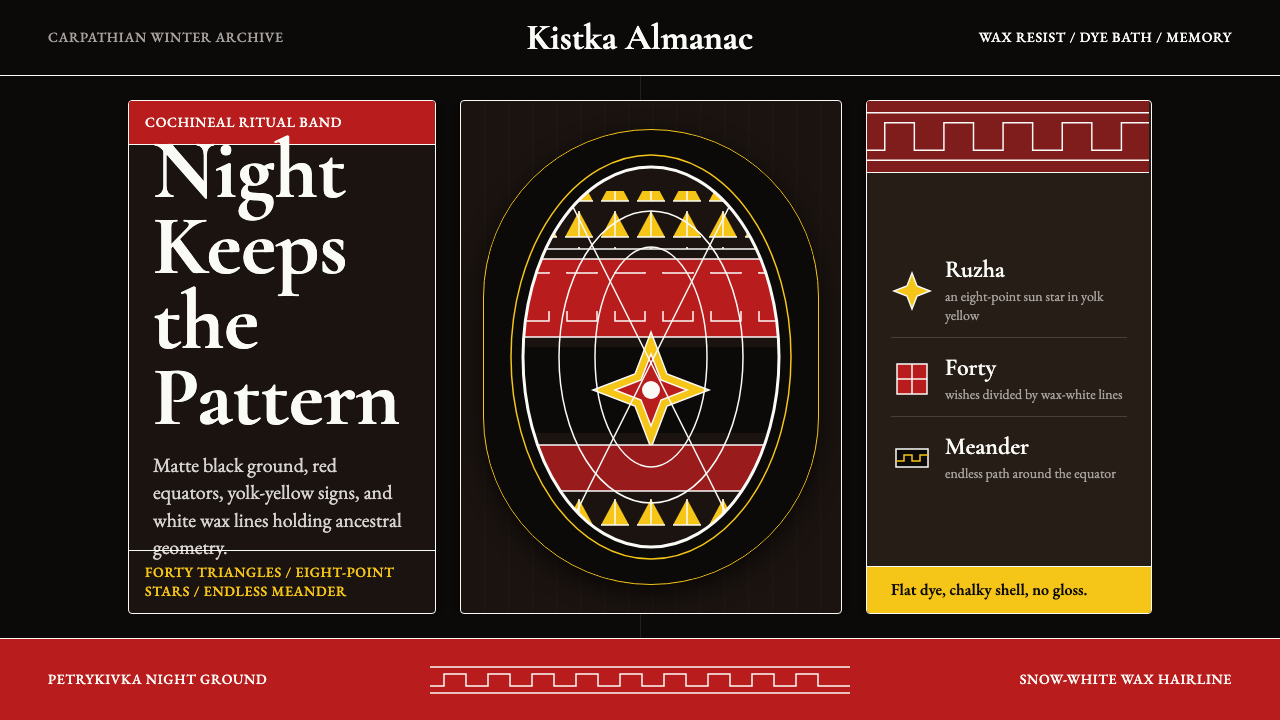 Ukrainian Pysanky (wax-resist egg)Night holds memory. Red bands, yolk geometry, and white wax lines cut matte b…
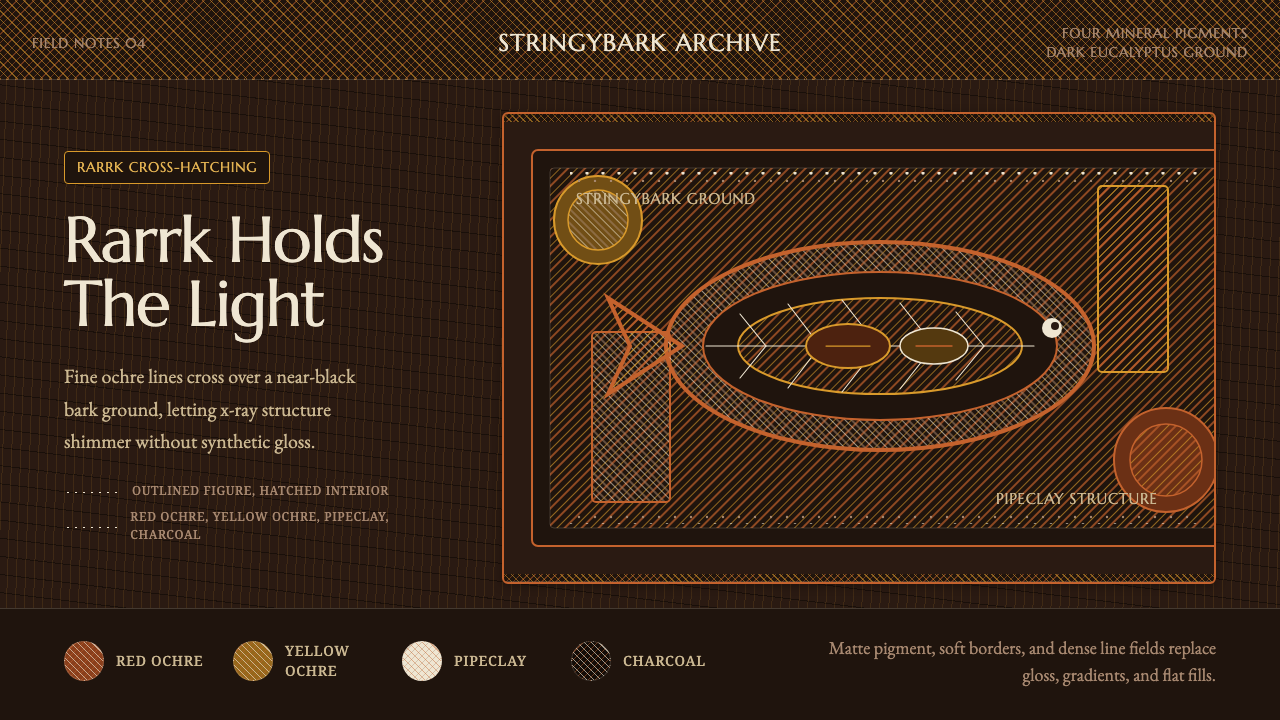 Arnhem X-Ray Bark PaintingShimmers without gloss. Ochre rarrk lines vibrate on dark stringybark.
 Burmese Yun LacquerwareLacquer glows in cut lines. Cinnabar, orpiment and viridian band a mirror-bla…
 Georgian Nikortsminda Stone-CarvingStone becomes scripture. Cinzel caps and Georgian bands carve honey-sandstone…
 Grimm Fairy Tales (Black Forest Woodcut)The dark wood closes in. Bone-white cuts and aged-gold frames score a pine-bl…
 Malagan CarvingCarved for the dead feast. Ochre, lime and charcoal pierced into dark wood, e…