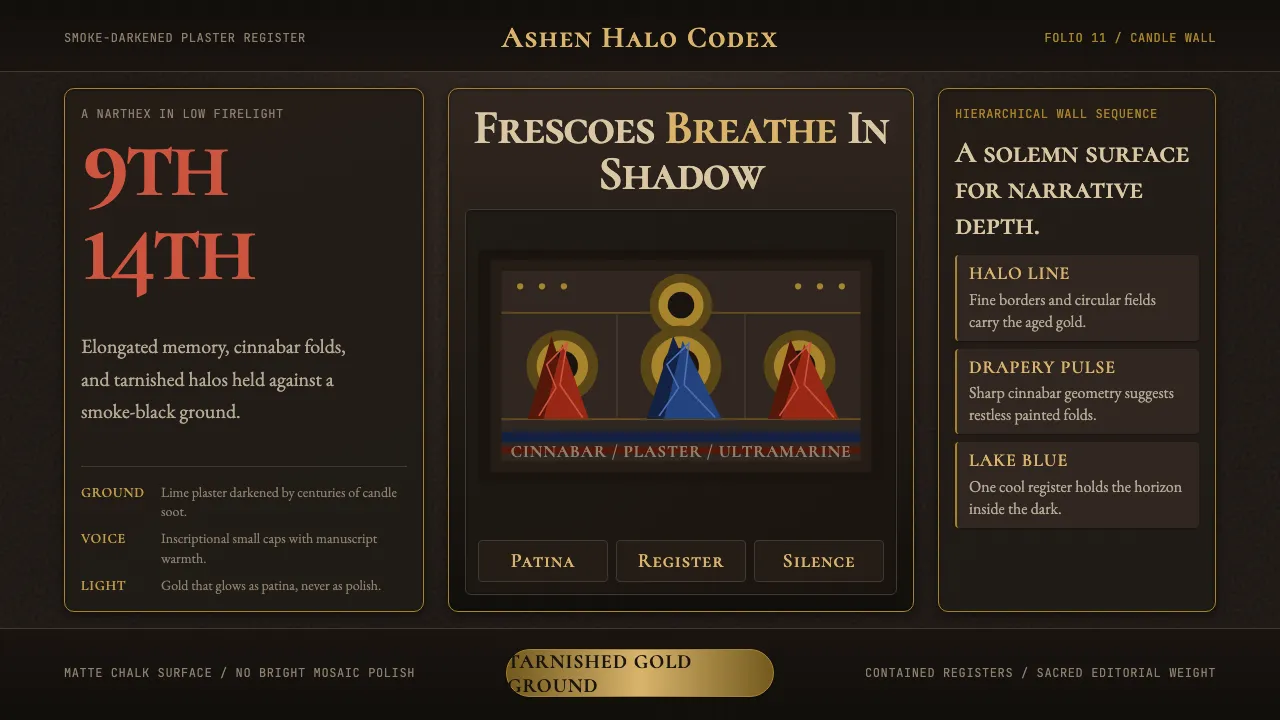
About Macedonian Ohrid Fresco (Byzantine)
The Ohrid School represents a distinct Macedonian branch of Byzantine fresco painting, characterized by elongated figures, emotionally charged faces, and agitated drapery folds unlike anything from Constantinople or Ravenna. Flourishing between the 9th and 14th centuries on the shores of Lake Ohrid, master painters like Mihailo Astrapas and Eutychios spread this style across the Balkans.
This design system captures the candlelit narthex atmosphere of St. Sophia Ohrid — smoke-blackened plaster grounds, tarnished gold halos, deep cinnabar reds, and the distinctive ultramarine drawn from the lake-sky horizon.
Learn more about the Macedonian Ohrid Fresco (Byzantine) style
- Origin
- North Macedonia — Ohrid, Lake Ohrid, Nerezi; reach into Serbia and Kosovo
- Era
- 9th–14th century; peak 11th-c. St. Sophia frescoes, 13th–14th-c. Astrapas commissions
- Key figures
- Mihailo Astrapas · Eutychios · St. Clement of Ohrid · Cvetan Grozdanov
- Movements
- Ohrid School of fresco painting · Macedonian School · Palaiologan revival
Macedonian Ohrid Fresco (Byzantine) design spec
Colors
Typography
The other 11 sections — buttons, cards, spacing, motion, techniques and more — open once you unlock. Download the DESIGN.md or send it to your AI in one click. Unlock once, yours forever.
Sign up nowStyles similar to Macedonian Ohrid Fresco (Byzantine)
Also inspired by art & artists, with a close feel.
 Dunhuang Mogao MuralsTime lives in the wall. Mineral green and azurite endure on oxidised brown plaster.
 Raw Umber SketchbookMiddle tone becomes drama. Tobacco paper, Garamond type, sanguine marks, chalk hatching.
 Georgian Pirosmani 1910Oilcloth black turns memory ceremonial. Ochre panels and Cormorant type hold the glow.
 Jewad Selim Baghdad ModernCast in bronze, read right to left. Aged-bronze grounds, incised Kufi line, verdigris accents.