What is Kerala Mural Temple?
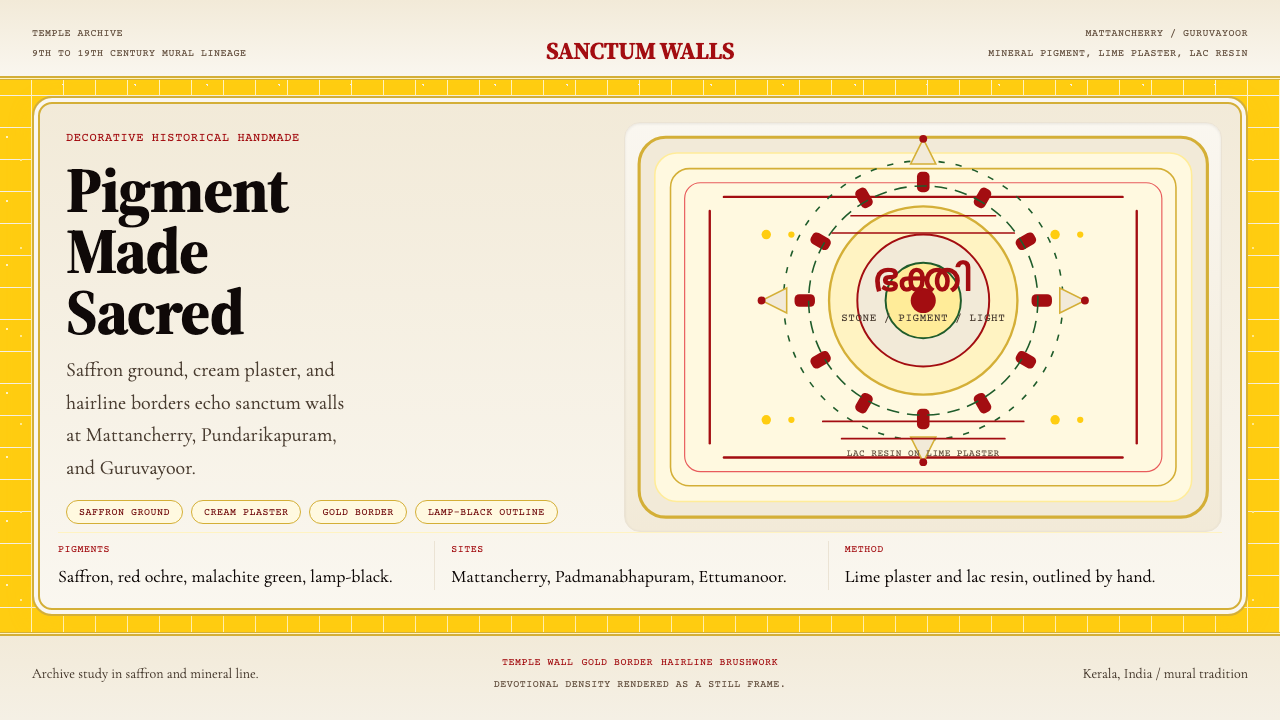
Kerala Mural Temple translates the devotional density of ancient Hindu sanctum walls — saffron grounds, mineral-pigment warmth, and hairline brushwork borders — into a digital visual system where every surface earns its ornament.
Kerala Mural Temple in brief
Kerala Mural Temple is a design system rooted in the sacred wall-painting tradition of Hindu temples in Kerala, India. Its visual language draws from compositions where saffron-yellow grounds anchor cream lime-plaster panels, mineral-derived colors carry deep symbolic weight, and every surface is filled with dense, purposeful ornament — the aesthetic inversion of minimalism, where richness is not excess but devotion made visible.
The style is defined by its warmth and density: deep ochre and saffron tones dominate the page ground, while cream and off-white panels hold the primary content as though framing a sanctum inscription. Borders are treated as active elements — thin, precise, and layered in the manner of temple frieze bands — rather than passive dividers. Classical serif typography echoes the monumental stone inscriptions of Kerala's great temples, giving text a ceremonial gravity.
Where Bauhaus removes ornament to reveal structure, Kerala Mural Temple adds ornament to consecrate it. The underlying grid is still disciplined and hierarchical, but it is expressed through patterned borders, layered framing, and a palette drawn from natural mineral pigments rather than industrial primaries. The result is a system that feels simultaneously ancient and precise — authoritative without being cold, ornate without being chaotic.

Where does Kerala Mural Temple come from?
Kerala mural painting traces its documented origins to at least the 9th century, when the region's distinctive temple architecture — characterized by sloped wooden roofs, enclosed ambulatories, and small, intensely decorated inner sanctums — created the particular wall surfaces that the tradition would come to fill. The earliest surviving examples appear in sites such as the Thirunandikkara Cave Temple and the Thrissur Vadakkunnathan Temple complex, where panels depict episodes from the Ramayana and Mahabharata in a style already recognizable for its confident, sinuous line and strong mineral palette.
The tradition reached its zenith between the 16th and 19th centuries, coinciding with a period of relative political stability and substantial temple patronage in Kerala. The Vijayanagara Empire and its successor kingdoms, along with local Nair chieftains and temple trusts, commissioned extensive cycles of mural painting across the region. Mattancherry Palace in Kochi — built by the Portuguese in 1555 and gifted to the Cochin royal family — houses some of the finest surviving examples: densely packed mythological scenes where figures are rendered in red ochre, lamp-black, yellow derived from orpiment, green from malachite, and white from lime, with no space left void between them.
The technical process was as demanding as the theological program it served. Master artists — working within hereditary guilds whose knowledge passed from generation to generation — first prepared lime-plastered walls with multiple layers, allowing each to cure fully before applying the next. Pigments were ground from raw minerals: yellow from orpiment or turmeric, red from red ochre or vermilion, green from erinite or malachite, black from lamp soot, white from shell lime. Each pigment was bound with coconut water or plant-based fixing agents and applied to the still-damp plaster so that the color fused with the wall rather than sitting atop it. This fresco-like technique, combined with Kerala's humid climate, means that the most durable murals are those on sheltered interior walls where the lime could carbonate slowly over centuries.
The 20th century brought both decline and revival. Colonial-era temple renovation projects, changes in building materials, and shifting patronage patterns threatened the continuity of the hereditary guilds. The Kerala Lalithakala Akademi and a network of individual scholar-practitioners worked from the mid-20th century onward to document surviving murals, train new practitioners, and reintroduce the tradition into contemporary temple construction and public architecture. Artists such as Mammiyoor Krishnankutty Nair became central figures in this revival, combining scholarly research into historical techniques with active mural practice. Today the tradition is recognized as a living art form — practiced in newly commissioned temple murals, taught in art schools, and documented in academic archives — while also functioning as a source vocabulary for contemporary design and visual communication.
What defines the Kerala Mural Temple look?
Color
The palette is drawn from mineral pigments found in the historical tradition: saffron-yellow as the dominant ground, deep red ochre for figure outlines and emphasis, malachite green as a secondary accent, lamp-black for structural line and fine detail, and cream or shell-white for highlight and panel surfaces. These colors carry devotional and cosmological associations — the saffron ground evoking sacred fire and auspiciousness, the deep reds signifying divine energy. Secondary and tertiary hues from outside this mineral vocabulary rarely appear; the warmth of the palette comes from the natural impurity of each pigment rather than from brightness.
Ornamental Density
Unlike Western classical traditions that use negative space to isolate and elevate individual figures, Kerala mural composition treats the entire surface as a field to be consecrated. Every background is patterned, every border is layered, every figure is surrounded by iconographic attributes and decorative framing. In a digital application of this principle, the goal is not to fill space arbitrarily but to ensure that every zone of the composition carries visual intention — empty white space would be a theological error, a surface left unsanctified.
Line and Contour
The defining mark of Kerala mural work is its confident, unbroken contour line. Historical painters used a single-hair brush — a technique called 'lekhana' — to draw figures and borders with a line that is simultaneously precise and alive, never mechanical. The line varies subtly in weight to model volume without recourse to tonal shading: thicker where a form turns away from the viewer, thinner where it faces forward. In digital application, this principle manifests as hairline borders, fine rule lines, and typographic letterforms with subtle stroke contrast — never the homogeneous line weight of geometric minimalism.
Typography
Classical serif typefaces are the natural companions of Kerala mural compositions, evoking the monumental inscriptions carved into the granite facades of Kerala's great temples. The serif detail echoes the quality of a master's brushstroke — purposeful, unhurried, slightly weighted at the terminal. Type is set with generous leading to allow each line to breathe within its ornamental frame, and size hierarchies are established through weight and measure rather than through color variation. Display text benefits from letterforms with high contrast between thick and thin strokes, reinforcing the visual rhythm of the surrounding mural line work.
Framing and Borders
Temple murals are never presented without their architectural frame: carved stone surrounds, painted frieze bands, and threshold markings that signal the boundary between sacred and profane space. In design application, this principle becomes a system of layered borders — a fine outer rule, a slightly wider mid-band, and an innermost content frame — that contain and elevate the material within. These borders are not decorative afterthoughts but structural members of the composition, establishing hierarchy and marking transitions between sections as firmly as a temple doorway marks a transition between spaces.
Iconographic Systematization
Kerala temple murals operate within a codified iconographic grammar: each deity has prescribed attributes, colors, gestures, and spatial positions. This is not arbitrariness dressed in tradition but a legibility system — a viewer who knows the grammar can read a composition as fluently as a text. In design terms, this corresponds to a strict component system where each element type has a defined role, fixed visual properties, and a predictable position in the hierarchy. Variation within the system is permitted; violation of the system's grammar undermines its readability.
Surface Warmth
The mineral pigments of the Kerala tradition produce colors with a warmth and depth that synthetic equivalents rarely match. Saffron ground has a golden undertone; red ochre leans slightly brown; malachite green carries a grey-green complexity. In digital surfaces, this warmth is preserved by choosing tones with warm undertones — no cool-white backgrounds, no blue-shifted neutrals, no pure saturated hues. The warmth of the palette is what distinguishes the style from other high-density ornamental traditions and what makes it feel materially grounded rather than decoratively arbitrary.

Who shaped Kerala Mural Temple?
Krishnankutty Nair is among the most celebrated practitioners of the Kerala mural revival in the 20th century, combining deep scholarship into historical technique with active production of new temple murals. His work at sites across Kerala helped establish the standards for what authentic revival practice looked like — how historical pigments could be approximated with durable modern materials, how traditional iconographic programs could be extended into newly constructed sanctum spaces, and how the master-apprentice transmission could be formalized into teachable curricula without losing the gestural immediacy of the tradition.
Saji T.K. represents the contemporary generation of Kerala mural artists working across both traditional temple commissions and public and gallery contexts. His practice demonstrates the tradition's adaptability: the same technical vocabulary — mineral-derived palette, confident contour line, layered iconographic density — translates from sacred sanctum walls to secular public murals and contemporary art exhibitions without losing its essential character. His engagement with the tradition as a living practice rather than a historical reconstruction has been influential in framing how Kerala mural painting is understood and taught in contemporary art education.
The great mural cycles of Mattancherry Palace, Guruvayoor Temple, and the Krishnapuram Palace were produced by masters whose names were not recorded — not because their skill was unrecognized, but because the tradition understood the work as offering rather than authorship. These anonymous painters developed the canonical compositional programs, the precise iconographic grammar, and the technical standards of lime preparation and pigment binding that the revival tradition would later study and reconstruct. Their anonymity is part of the tradition's theological orientation: the artist's ego is dissolved into the act of devotional making.
The Vijayanagara Empire (1336–1646) and its regional successor courts provided the institutional patronage that enabled the most ambitious mural cycles of the 16th and 17th centuries. Temple construction and decoration were understood as acts of royal devotion and political legitimacy simultaneously — a king who commissioned a great mural cycle was fulfilling both his spiritual obligations and his role as protector and amplifier of Hindu culture. The aesthetic choices that define what we now recognize as classical Kerala mural style — the particular balance of iconographic density, the warmth of the mineral palette, the monumental scale of individual figures — were shaped in part by the theological and political priorities of this patronage context.
How do you use Kerala Mural Temple today?
Kerala Mural Temple is one of the more architecturally specific styles available in contemporary design work — it brings a strong cultural and aesthetic proposition that works powerfully when matched to the right context, and can feel incongruous when misapplied. The style is appropriate wherever warmth, ceremonial authority, visual richness, and depth of craft signal the right values: luxury and heritage brands, cultural institutions, spiritual or wellness platforms with a South Asian or broadly Eastern aesthetic register, editorial design for subjects involving history, mythology, or material culture, and presentation contexts that need to communicate gravitas and refinement rather than modernity and speed.
For presentation slides, the style rewards a deliberate structural approach. Cover slides work best with the saffron ground as the dominant surface, a cream panel inset as the title field, and fine border rules framing the composition — no photography, no geometric minimalism, the visual weight coming entirely from color, typography, and ornamental border detail. Content slides should maintain the warm ground across all pages for visual consistency, with cream panels defining the primary content zone. Data slides can deploy the mineral palette as a symbolic language: the deep red for primary metrics and critical thresholds, the malachite accent for secondary data series, black for axis lines and labels. The overall composition should feel like an illuminated manuscript page — densely organized but never random.
For web interfaces, the style is particularly well-suited to contexts where the visual experience is itself part of the product's value proposition — cultural heritage platforms, luxury e-commerce, editorial publications with a strong design identity, and pricing pages for products positioning themselves in the premium or artisanal tier. The implementation approach: use the saffron or deep ochre as the page ground, cream panels for card and content containers, layered border systems for component framing, and classical serif typography for all primary text. Dashboard applications can use the mineral palette for state differentiation — alert states in ochre-red, stable states in cream-white, active states with a malachite accent — with hairline borders defining component boundaries. Navigation should carry the same ceremonial weight as a temple threshold, clearly marking zones of transition.
For editorial and marketing applications, the style's richness translates naturally into high-impact layout work. A Kerala Mural Temple editorial spread pairs a warm saffron or ochre dominant field with tightly leaded classical serif text, ornamental border bands between sections, and pull-quotes set in enlarged letterforms against the cream panel tone. Marketing pages benefit from the style's poster-quality authority: full-width section blocks alternate between saffron-ground and cream-ground, with the deep red reserved for calls to action and emphasis. The style works particularly well for content involving craft, provenance, heritage, and ritual — any context where the visual communication needs to signal that what is being offered has depth and history, not just immediate utility.
A common mistake when applying Kerala Mural Temple is mistaking decorative density for visual noise. The style's power depends on the decoration being systematic and legible: borders at consistent weights, palette colors used with iconographic intention rather than for variety, and ornamental elements confined to designated structural roles such as framing, dividing, and thresholding. Adding pattern arbitrarily, mixing warm and cool tones, or using the saffron ground inconsistently across a composition breaks the devotional logic of the system. Similarly, pairing the style with sans-serif or geometric typefaces undermines the visual coherence — the ceremonial quality of Kerala Mural Temple depends on typography that carries the same crafted, stroke-varied quality as the mural line itself.

Kerala Mural Temple — FAQ
Is Kerala Mural Temple appropriate for products without any South Asian cultural connection?
The style can be applied outside its originating cultural context, but doing so well requires understanding what the visual system is communicating beyond surface appearance. The Kerala mural aesthetic signals depth, craft, devotion, warmth, and heritage — values that can be relevant to products in luxury, wellness, cultural, and editorial contexts regardless of geographic specificity. Where it becomes problematic is when the surface iconography (specific deity representations, sacred symbols) is applied without understanding or respect for what those symbols mean. The design system abstracted from the style — mineral palette, ornamental density, layered borders, classical type — is fully transferable; specific sacred iconographic content should be handled with cultural awareness.
How does Kerala Mural Temple differ from other South Asian ornamental design traditions?
Several features distinguish it from neighboring traditions. The mineral palette — with saffron-yellow as the dominant ground — is specific to Kerala's tradition and differs from the more jewel-toned palette of Rajasthani miniature painting or the cooler, blue-and-white emphasis of certain Mughal decorative work. The thick, confident contour line that defines Kerala mural figures has a boldness and directness that Tanjore painting, for example, replaces with gold-leaf inlay and gem-encrusted surfaces. The iconographic program draws specifically from Dravidian traditions of the South — the Ramayana, Puranas, and Kerala's own regional mythology — rather than from the Persianate or Central Asian influences visible in northern Indian court art. The style's combination of warm ground, strong outline, and controlled mineral palette is distinctive and specific.
Can the style work in a light or minimal composition, or does it require high ornamental density?
The style can be calibrated along a density axis, but reducing it too far produces something that no longer reads as Kerala Mural Temple — it becomes a warm-toned, serif-heavy design with border details, which might be pleasant but loses the specific character. A useful minimum threshold: at least two levels of border framing on major compositional elements, the warm ground color maintained consistently, and serif typography with visible stroke contrast. Below this threshold, consider whether a different warm, heritage-inflected style might be more appropriate for the content density the project requires. The style does not need to be maximally dense to work, but it does need to be more dense than most contemporary digital defaults.
How should photography and real images be handled within this style?
Photography is the most challenging element to integrate with Kerala Mural Temple, because the style's visual logic is built around flat, line-defined, mineral-colored surfaces — the naturalistic depth of photography is in some tension with this. When photography must be used, the most coherent approach is to treat it as an inset panel: framed within the border system, given a warm-toned overlay or duotone treatment that brings it into the mineral palette's register, and positioned as a contained element within the composition rather than as a full-bleed background. Full-bleed photography backgrounds are generally incompatible with the style — they undermine the warm-ground logic that the entire system depends on. Illustrated or stylized imagery that shares the palette and line quality of the tradition integrates far more naturally than photographic realism.
Does Kerala Mural Temple suit dark-mode or dark-background layouts?
Dark-mode is more problematic for this style than for many others. The core logic of Kerala Mural Temple depends on the saffron or warm-ochre page ground — a color that is fundamentally a warm medium value, not a dark one. Inverting to a near-black background loses the distinctive warmth that makes the style legible as itself rather than as generic ornate design. A partial adaptation is possible: deep terracotta or very dark warm brown can serve as a ground that preserves some of the warmth while reducing overall luminosity — closer to the interior light of a lamp-lit sanctum than to a digital dark mode. On such grounds, cream and saffron swap roles: cream becomes the dominant panel and text tone, saffron the accent. The malachite green and red ochre continue to function as accents. This adaptation works best in contexts where atmospheric immersion is the goal — full-screen editorial or experience design — rather than in utility interfaces where readability across diverse ambient conditions is required.
Related design styles
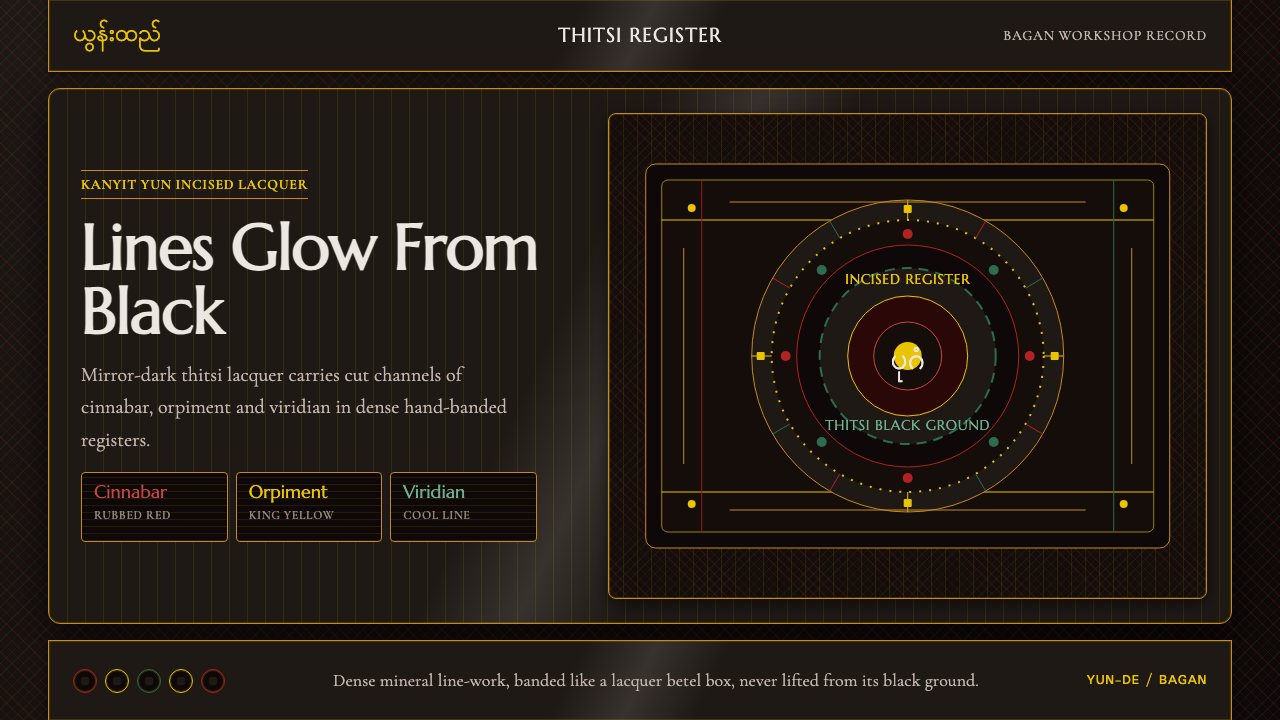 Burmese Yun LacquerwareLacquer glows in cut lines. Cinnabar, orpiment and viridian band a mirror-bla…
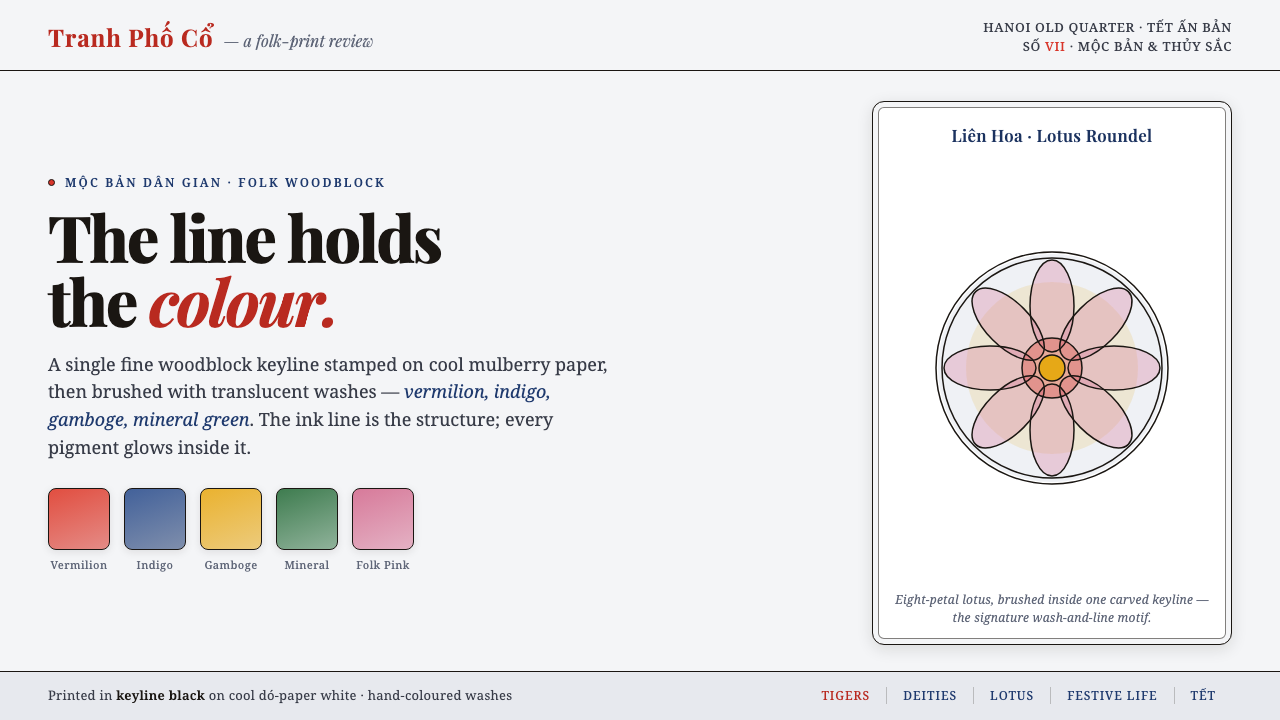 Hàng Trống Folk PrintBright folk colour, never loud. Translucent vermilion-indigo washes held insi…
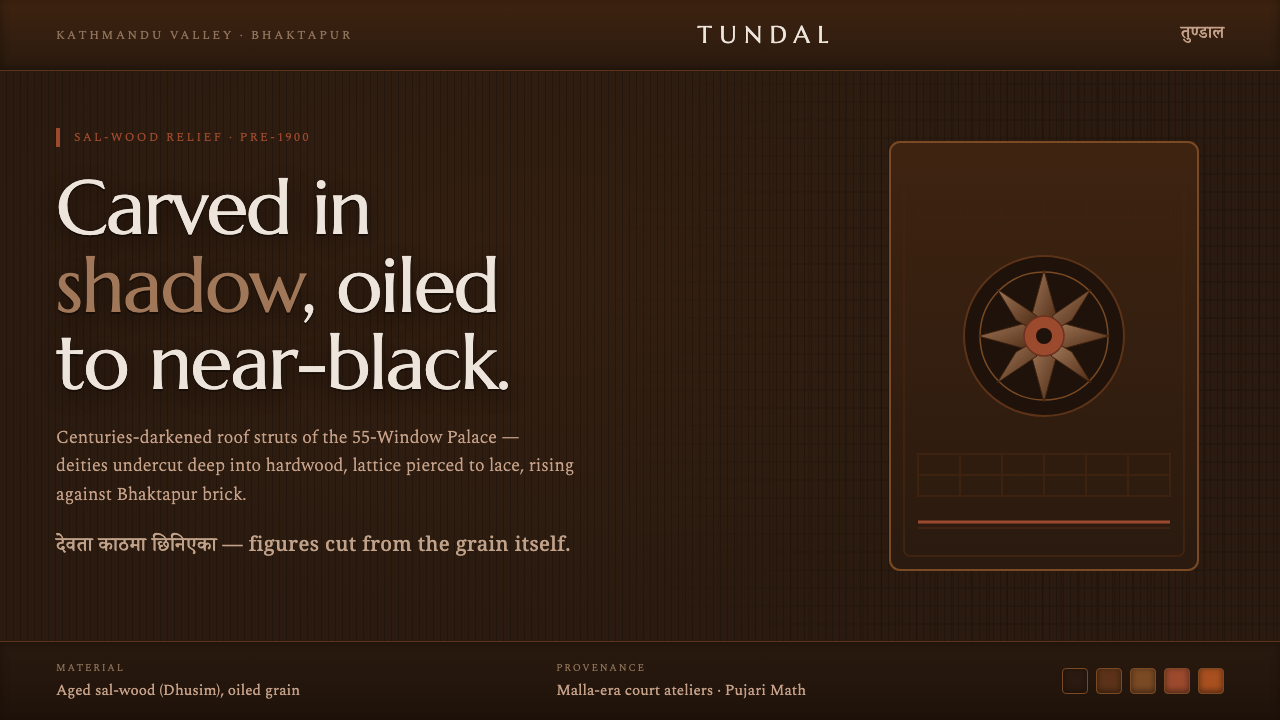 Newar Tundal Strut CarvingCenturies-darkened sal-wood. Carved deities and pierced lattice in mid-brown…
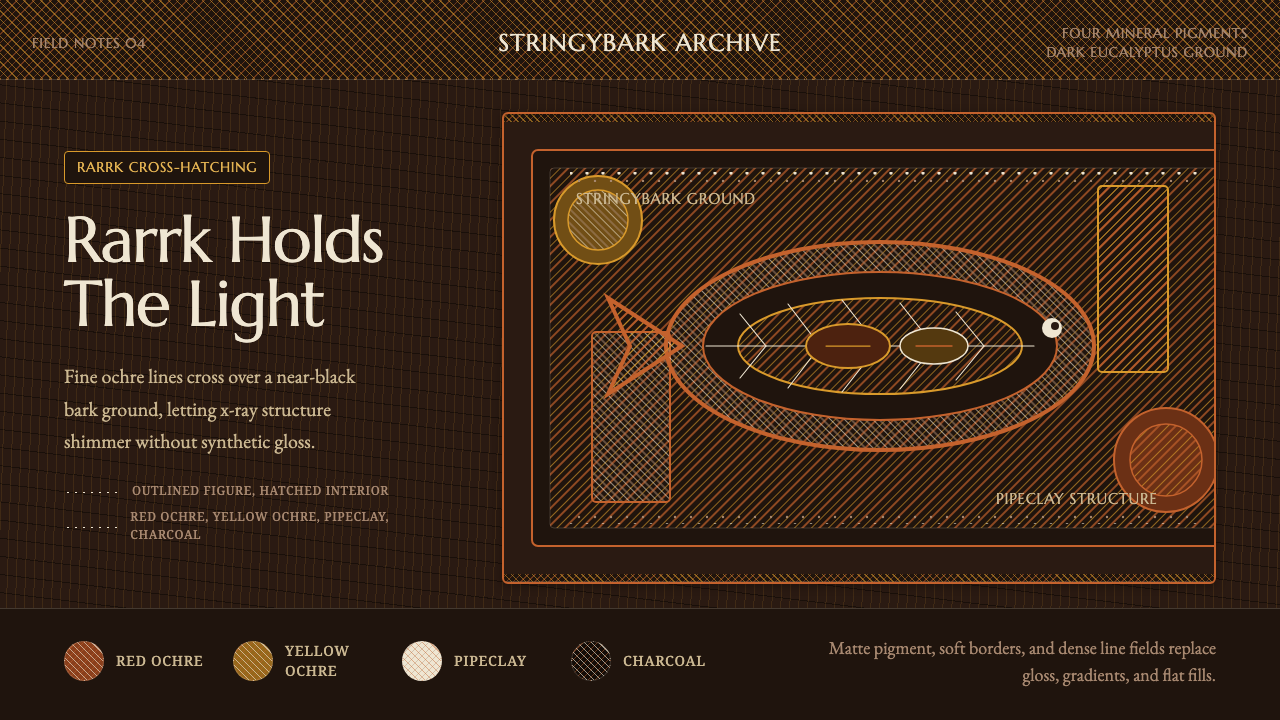 Arnhem X-Ray Bark PaintingShimmers without gloss. Ochre rarrk lines vibrate on dark stringybark.
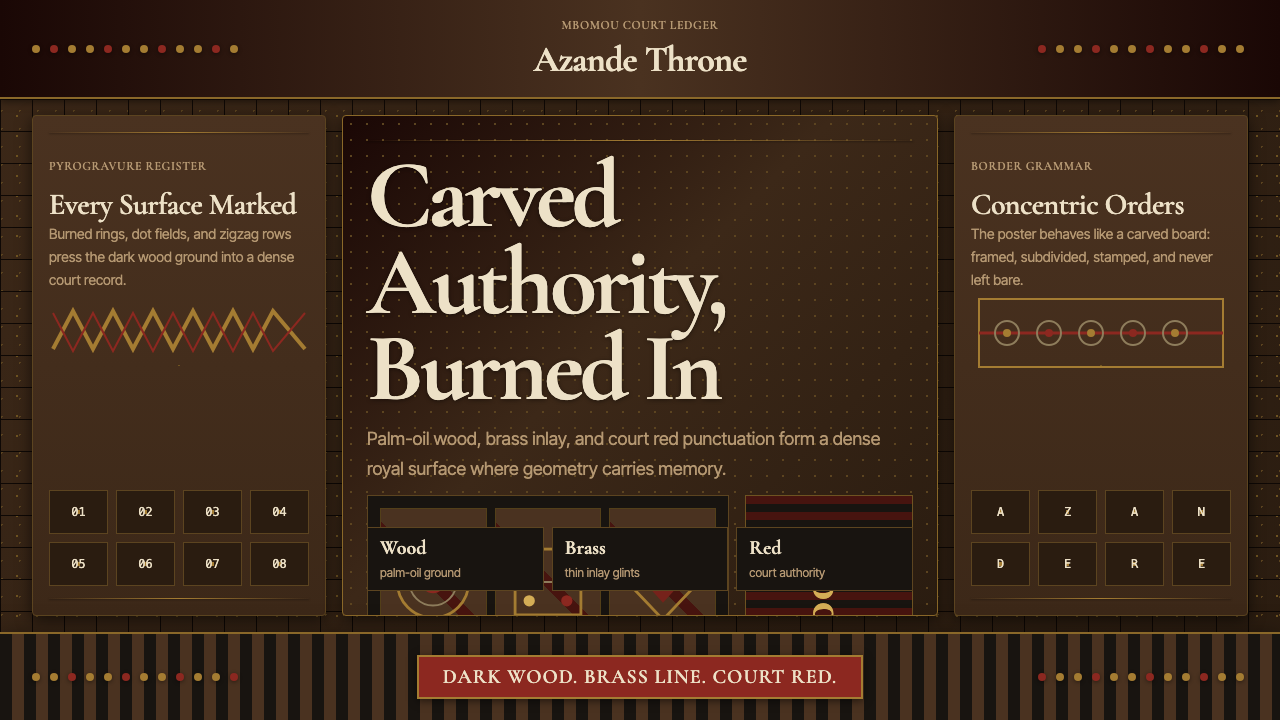 Central African Azande ThroneDense court gravity. Dark wood grids, brass dots, and court red cover every s…
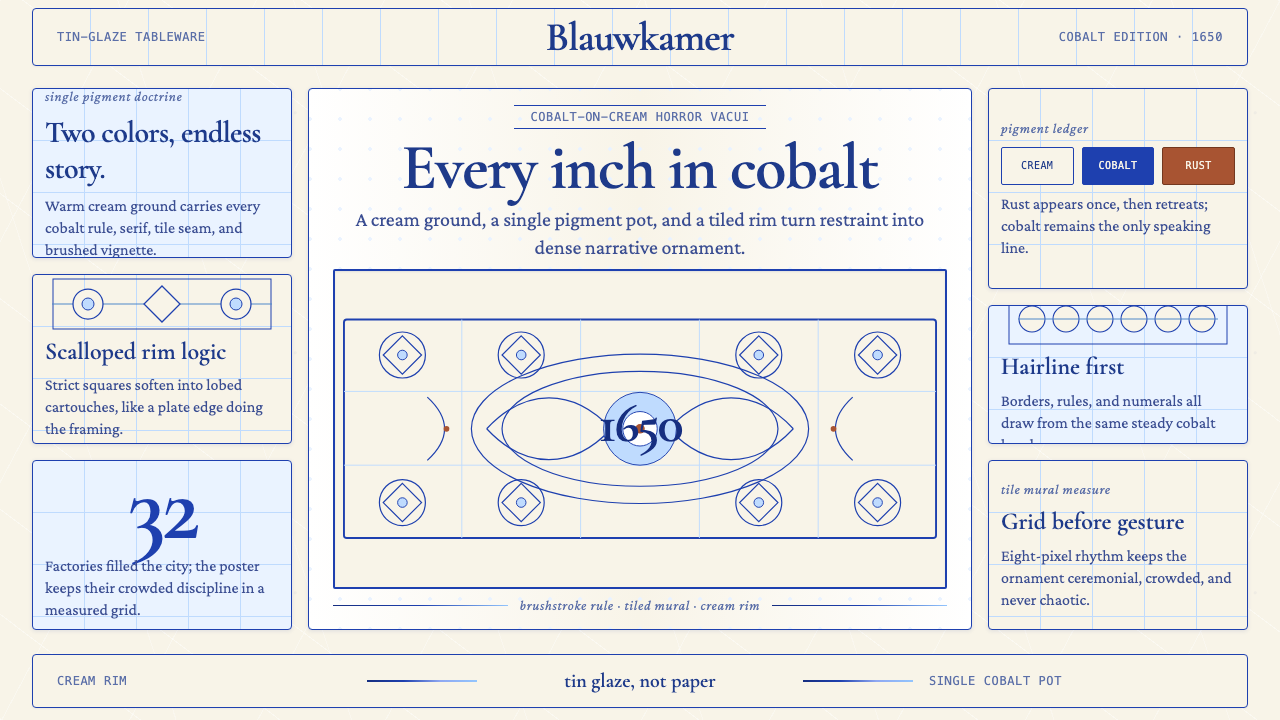 Delft Blue PotteryRestrained, yet every inch speaks. Cobalt hairlines crowd a cream tile grid.