What is Haitian Vèvè Sequin Drapo 1804?
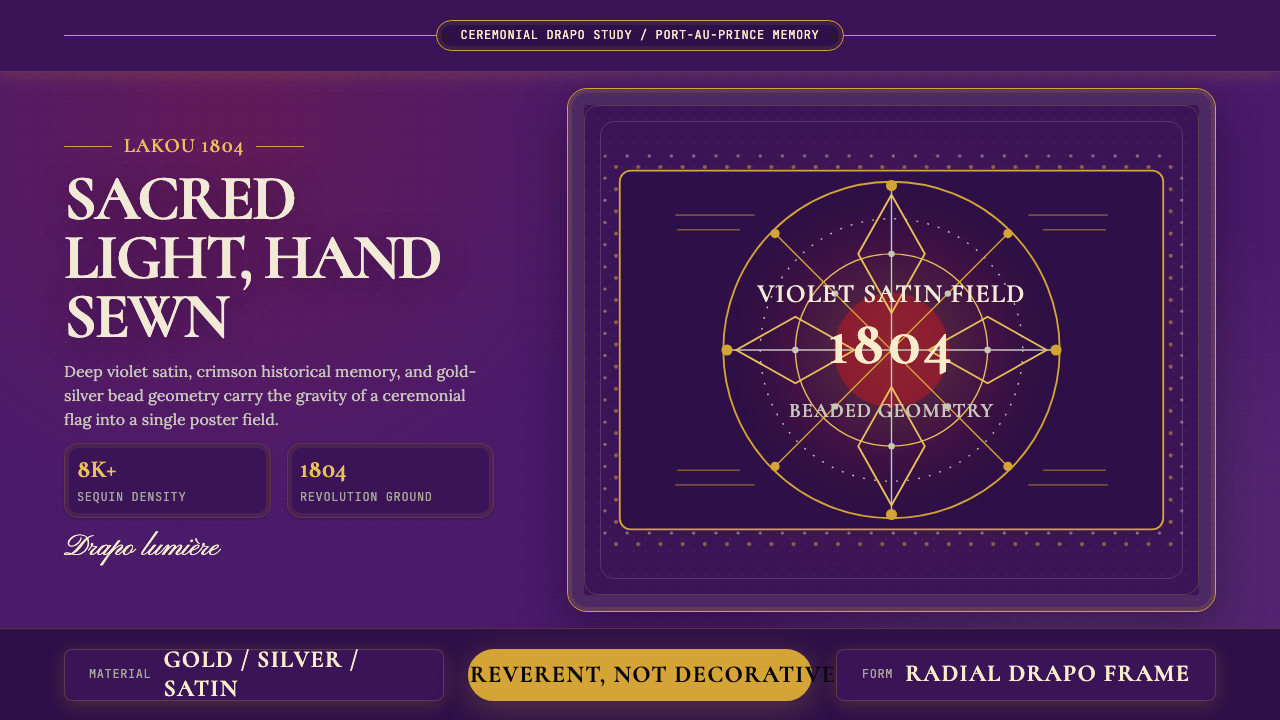
Born from the only successful slave revolution in modern history, Haitian Vèvè Sequin Drapo 1804 channels the sacred geometry of Vodou ceremony into a design language of radical, reverent density.
Haitian Vèvè Sequin Drapo 1804 in brief
Haitian Vèvè Sequin Drapo 1804 is a visual system rooted in two sacred objects: the vèvè, a ritual sigil traced in cornmeal on the ground to invoke a specific lwa (spirit), and the drapo, a ceremonial sequined flag hand-sewn from thousands of glass beads and metallic discs that serves as the material throne of a lwa during Vodou ceremony. Together, these two forms — the drawn sigil and the beaded standard — constitute a grammar of sacred composition unlike any other in the Atlantic world.
The aesthetic operates at the boundary between heraldry and devotion. Where European heraldry codified noble lineage into flat, symbolic fields of color and form, the Haitian drapo encodes spiritual authority into layered, luminous density. A single drapo flag can consume thousands of hours of labor by a skilled asesounder (beadwork artist), its surface so dense with sequins and seed beads that no ground fabric remains visible. The resulting object vibrates with light: silver shifts toward white in direct sun, gold deepens toward amber at dusk, and the whole surface moves as the flag is carried in procession.
The design language that emerges from this tradition is characterized by deep, saturated grounds — violet, crimson, and midnight — against which radial and bilateral compositions unfold in gold and silver. Sigil geometry is strict and symbolic: certain spirals belong to Ogou, the warrior spirit; heart-and-anchor configurations belong to Erzulie Freda, the spirit of love; serpentine double-spirals belong to Danbala, the serpent sky-deity. Every geometric element carries a referent. There is no purely decorative mark.
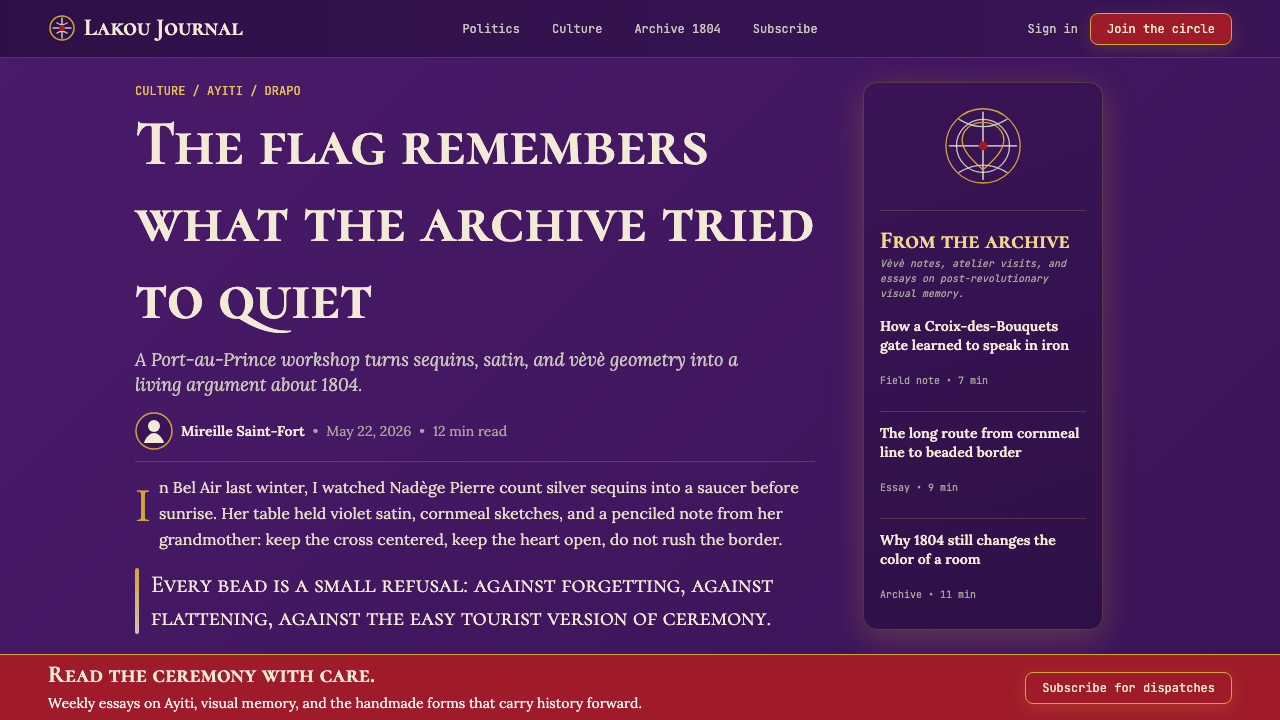
Where does Haitian Vèvè Sequin Drapo 1804 come from?
The roots of this visual system reach back to West and Central African religious traditions brought to Saint-Domingue by enslaved Fon, Ewe, Yoruba, and Kongo peoples from the seventeenth century onward. The vèvè itself is most closely related to the Kongo cosmogram — the dikenga dia Kongo, a cross within a circle that maps the cycle of the soul across the threshold between the living and the dead. Under the brutal conditions of plantation slavery, these practices were suppressed, driven underground, and eventually fused with Catholic iconography in a process of strategic syncretism. Erzulie Freda absorbed attributes of the Virgin Mary; Ogou merged with Saint James the apostle; the calendar of lwa aligned with the Catholic liturgical year.
The Haitian Revolution, which began with the Bwa Kayiman ceremony of August 1791 and ended with the declaration of independence on January 1, 1804, was itself understood by its participants as a spiritual as well as a political event. The ceremony at Bwa Kayiman was led by the Vodou priest Dutty Boukman and the mambo Cécile Fatiman; the revolution was understood not merely as a military uprising but as the action of the lwa themselves acting through human agents. The year 1804 — unique in Atlantic history as the founding of the first Black republic and the first state born from an enslaved-person revolution — thus became fused with the aesthetic vocabulary of Vodou sacred practice.
The drapo tradition was codified over the nineteenth century as Vodou ceremony became more formalized after independence. By the late nineteenth century, the sequined flag had become an essential element of Vodou peristyle ceremony across Haiti, particularly in Port-au-Prince and the southern city of Jacmel, which developed its own regional variation in bead palette and sigil elaboration. The flags served as processional objects, carried by flag societies (sosyete drapo) who bore them before the sacred drums at the opening of ceremony.
International recognition came through the Centre d'Art, founded in Port-au-Prince in 1944 by the American DeWitt Peters as a venue for Haitian visual art. The Centre gave a platform to painters such as Hector Hyppolite — himself an ordained Vodou priest — whose work brought Vodou cosmography into the register of fine art and attracted the attention of André Breton and the Surrealist movement. Later, the contemporary beadwork artist Myrlande Constant, working from the 1990s onward, transformed the drapo from a ceremonial object into a fine-art medium, creating massive sequined tableaux that retell Vodou mythology and Haitian revolutionary history, bringing the tradition to museum collections across Europe and North America.
What defines the Haitian Vèvè Sequin Drapo 1804 look?
Ground and Field
The tonal ground is deep, saturated, and unwavering: rich violet, burgundy crimson, and deepest midnight carry the primary field. These are not background colors in the decorative sense but sacred grounds — the darkness from which luminous form emerges. The ground is never neutral or softened; it must carry weight, so that the sequin-bright geometry placed upon it seems to float rather than sit. The effect is ecclesiastical rather than ornamental: the darkness is itself a presence.
Sequin Light and Material Shimmer
The defining surface quality of this system is not flatness but luminous density. Gold and silver are the primary accents, and they are never rendered as flat color — they exist as the combined effect of thousands of individually faceted reflective discs. In a digital context, this quality is best evoked through subtle gradations within gold and silver fields, through layered micro-textures that suggest faceted depth, and through a sense that surfaces are active rather than inert. The light should seem to move, as it does on a drapo flag carried through a candlelit peristyle.
Sigil Geometry
The compositional vocabulary is drawn from Vodou sigil tradition: radial layouts centered on a single axial point, bilateral symmetries that mirror across a vertical spine, interlocking spirals, looping continuous lines that return to their own origin, and cross-within-circle configurations that map cardinal directions. These are not abstract geometric choices — each configuration carries a specific spiritual referent. The design language therefore achieves a rare quality: it is simultaneously highly decorative and semantically dense. Every mark means something.
Heart-Lwa and Devotional Motifs
Alongside the abstract sigil geometry, specific figurative motifs recur with fixed symbolic meaning: the heart pierced by a sword belongs to Erzulie Freda and signals love, loss, and beauty; the crossed swords and flags signal Ogou the warrior; the serpent coiled around an egg or tree signals Danbala and Ayida Wedo. These motifs are never purely illustrative — they function as icons in the theological sense, images whose power resides not in artistic invention but in the accuracy of their devotional reproduction. In a design context, they introduce a quality of sacred iconography into what might otherwise read as pattern.
Processional Scale and Density
The drapo tradition is a processional art — flags are designed to be seen in motion, carried at the head of a column, and read at a distance in varying light. This origin shapes the scale logic of the design system: forms are bold and large enough to read across a crowd, negative space is minimal (the field is always full), and contrast between ground and figure is maximized. There is no subtlety for its own sake; the aesthetic reward is achieved through accumulation and intensity rather than restraint and reduction.
Chromatic Hierarchy: Violet, Crimson, Gold
The color hierarchy is consistent and spiritually assigned. Deep violet is the ground of transformation and mystery, associated with Baron Samedi and the Gede spirits of death and renewal. Crimson red carries the heat of Ogou's warrior fire and Erzulie's passionate love. Gold and silver shimmer are the manifestation of lwa presence — the light that breaks through the dark ground when the spirit arrives. White appears only in specific contexts, marking Danbala's purity and the elevated spiritual states of possession. This is not a palette selected for aesthetic taste but for cosmological accuracy.
Bilateral Symmetry and the Ceremonial Axis
Unlike the asymmetric, dynamic compositions of modernist design movements, Haitian Vèvè Sequin Drapo 1804 is fundamentally symmetrical — or rather, axialy organized. The vèvè sigil is centered on the poteau mitan, the central post of the peristyle through which the lwa descend. The drapo flag is composed to be read frontally, its bilateral symmetry acknowledging the viewer as a ceremonial participant facing the altar. This frontal, centered composition communicates authority, completeness, and spiritual presence — it does not invite the eye to wander but commands it to acknowledge.

Who shaped Haitian Vèvè Sequin Drapo 1804?
The most prominent living artist working in the sequined drapo tradition, Constant began her practice in Port-au-Prince in the 1990s. Working with a team of assistants over months or years per piece, she creates massive beaded tableaux — sometimes measuring several meters across — that retell Vodou mythology, the Haitian Revolution, and contemporary Haitian life in sequins, seed beads, and metallic thread. Her work has entered the collections of major museums including the Brooklyn Museum and the Fowler Museum at UCLA, transforming the drapo from a ceremonial object understood primarily within Haitian religious practice into a recognized form of contemporary fine art. Constant insists that her work remains devotional, not merely aesthetic.
A painter and ordained Vodou Houngan (priest) from Saint-Marc, Hyppolite came to prominence through the Centre d'Art in Port-au-Prince in the mid-1940s. His oil paintings — made with house paint and chicken feathers as brushes when formal materials were unavailable — depicted Vodou spirits and cosmological scenes with a directness and authority that distinguished them from outsider art and demanded engagement on their own terms. André Breton visited Haiti in 1945 and was profoundly struck by Hyppolite's work, promoting it to Surrealist circles in Europe. Hyppolite's practice established a permanent bridge between the sacred visual logic of Vodou and the register of internationally recognized fine art.
One of the significant sequin flag makers of the twentieth century, Oleyant worked primarily in Port-au-Prince and is credited with developing formal innovations in the composition of drapo flags — particularly in the elaboration of central lwa portraits surrounded by dense radiating fields of sequin work. His flags were acquired by collectors and entered ethnographic and art museum collections in North America and Europe during the 1970s and 1980s, at a moment when Haitian Vodou material culture was beginning to receive sustained scholarly and curatorial attention outside Haiti.
The general and political architect of the Haitian Revolution, Louverture led the insurgent forces through the 1790s and early 1800s before his capture and imprisonment by Napoleon in 1802 — he died in a French prison in 1803, one year before the independence he fought for was declared. In Vodou iconography and in the drapo tradition, Louverture is often depicted alongside Ogou Feray, the warrior lwa, collapsing the boundary between historical and spiritual figure. The 1804 date embedded in this design system's name references both the political declaration of independence and the spiritual understanding of that year as a moment of collective lwa intervention in human history.
A mambo (Vodou priestess) who co-officiated the Bwa Kayiman ceremony of August 1791, which is understood as the spiritual inauguration of the Haitian Revolution, Fatiman's role marks the central position of women in Vodou ceremonial authority. In the drapo tradition, the mambo holds equal standing with the Houngan as a commissioning figure — many of the most important ceremonial flags were made for, and are associated with, female spiritual leaders. Fatiman's historical presence is a reminder that this design system emerges not from a single male genius but from a collective ceremonial practice in which gender parity was structurally built in.
How do you use Haitian Vèvè Sequin Drapo 1804 today?
Applying Haitian Vèvè Sequin Drapo 1804 to contemporary design requires understanding that its power comes from sacred density and luminous contrast, not from surface decoration. The central challenge is honoring the weight of the source tradition — one born from revolution, spiritual survival, and collective devotion — while adapting it to secular design contexts without reducing it to pattern or appropriating its symbols as mere ornament. The most successful applications treat the visual language with the same respect one would bring to any source with deep devotional and historical roots.
For presentation slides, this system works with exceptional force on cover pages and section dividers. A cover built around this vocabulary places a single large sigil-derived radial composition at center, rendered in gold or silver against a deep violet or midnight ground. The title type sits within or below the composition in a clean, high-contrast face — the system tolerates type that is formal and weighty, not playful or condensed. Section dividers benefit from a single dominant motif and a tight color discipline: deep ground, one metallic accent, no color noise. Content slides should step back from the full intensity: dark ground with gold rule lines, headings in near-white, body text in warm off-white to avoid harsh contrast. Reserve the full sequin-density visual for moments of ceremony — openings, transitions, endings.
For web interfaces, the system is suited to contexts that require gravity and cultural authority: cultural institution websites, music platforms with Afro-Caribbean content, fashion brands with Haitian or Caribbean creative direction, or any context where spiritual depth and material richness are the intended emotional register. Dashboard and data contexts are a harder fit — the high visual density and non-neutral chromatic ground compete with functional legibility. If used in a data context, treat the dark ground as a canvas and limit active visual elements to header regions, letting the content area adopt a more neutral palette that maintains the tonal spirit without overwhelming quantitative information.
For editorial and marketing work, the style produces commanding full-page compositions. An editorial spread built around this vocabulary uses the deep ground as a full-bleed field, brings photography into near-silhouette treatment against it, and uses gold or silver rule lines and pull quotes to organize the reading field. Marketing pages can alternate between full-immersion spreads (dark ground, metallic text, sigil-derived graphic element) and lighter content sections that maintain the material richness through textural detail rather than full chromatic saturation. The system is particularly effective for event identity — ceremony, celebration, memorial — where visual weight and luminous intensity carry appropriate cultural meaning.
A common mistake when applying this vocabulary is to treat the deep grounds as merely atmospheric or to import only the color palette without the structural logic. The result is decoration without authority: violet backgrounds with gold text that look opulent rather than sacred. The system works because the geometric vocabulary is compositional, not cosmetic — sigil geometry structures the layout, not merely fills it. Similarly, using the metallic accents at low contrast against the ground defeats the essential dynamic of the tradition, which is darkness opened by light, not darkness softened into mood.
Haitian Vèvè Sequin Drapo 1804 — FAQ
What is a vèvè, and how does it differ from other sacred symbols?
A vèvè is a ritual design specific to Vodou practice, traced in cornmeal, ashes, or other powdered materials on the floor of the peristyle (ceremonial space) to invoke a particular lwa. Unlike a mandala, which is meditative and generalized, or a yantra, which encodes metaphysical geometry without a specific spirit addressee, the vèvè is precise and personal: each configuration belongs to one specific lwa and no other. The heart-and-mirror configuration belongs exclusively to Erzulie Freda; the anchor-and-heart configuration to Erzulie Dantor. This one-to-one correspondence between visual form and spiritual entity gives the design language its semantic density — every element is overdetermined with meaning.
Is this design system appropriate for brands with no direct connection to Haiti or Vodou?
This question requires honest consideration rather than a simple yes or no. The visual tradition encoded here comes from a specific community whose history includes centuries of persecution, forced labor, and cultural suppression — a context in which the preservation of this visual language was itself an act of resistance and survival. Using elements of this tradition without acknowledgment of that history, and without some meaningful connection to the communities that created it, risks the kind of flattening that turns a sacred tradition into an aesthetic trend. That said, design history is full of traditions that have traveled and transformed beyond their original context. The most defensible approach is transparent attribution, intentional rather than incidental use, and where possible, some form of collaboration with or support for Haitian and Haitian-diaspora artists and communities.
How does this style handle typography, given that it originates in a non-typographic tradition?
The drapo and vèvè traditions are not typographic — they do not incorporate letterforms as compositional elements. When this visual system is brought into contexts that require text, the translation requires care. Type that is formal, serifed, and carries visual weight works better than sans-serif minimalism, which reads as culturally dissonant against the ceremonial density of the ground and figure. High-contrast between type and ground is essential; type should seem to emerge from the field rather than float neutrally above it. Calligraphic or hand-drawn letterforms can be appropriate in cultural or editorial contexts, maintaining the handmade quality of the beadwork tradition. The overriding principle is that type should feel like an element of ceremony, not a navigation system.
What distinguishes an authentic application of this style from a superficial one?
The distinction lies in whether the compositional logic is honored or only the surface palette. A superficial application borrows the deep violet and gold color combination and applies it to a standard layout — card grids, hero banners, navigation bars — without any engagement with the sigil-based geometry, the processional scale, or the semantic weight of individual motifs. An authentic application works outward from the compositional system: it builds layouts around radial or axialy centered structures, it treats decorative elements as semantically loaded rather than arbitrary, and it matches the visual density of the source tradition rather than diluting it into a merely luxurious mood. The test is whether the design would remain coherent and powerful if someone with knowledge of the Vodou visual tradition looked at it — or whether it would read as a surface borrowing.
How does this style relate to other Afro-diasporic design traditions in the Americas?
Haitian Vèvè Sequin Drapo 1804 shares family resemblances with several other Afro-diasporic visual traditions: the beaded costuming of Yoruba Gelede masquerade in West Africa and Brazil, the sequined and embroidered clothing of carnival traditions in Trinidad and New Orleans, and the Candomblé ceremonial visual culture of Bahia, Brazil, which similarly maps specific orixás to specific colors, geometric forms, and heraldic emblems. All of these traditions share a common root in West and Central African cosmological and ceremonial practice, and all developed under conditions of suppression that required adaptation, strategic syncretism, and the encoding of sacred knowledge in material form. What distinguishes the Haitian tradition specifically is the tight fusion of this visual culture with a singular historical event — the 1804 revolution — that gave it an explicitly political as well as spiritual dimension that no other Afro-diasporic tradition carries in quite the same way.
Related design styles
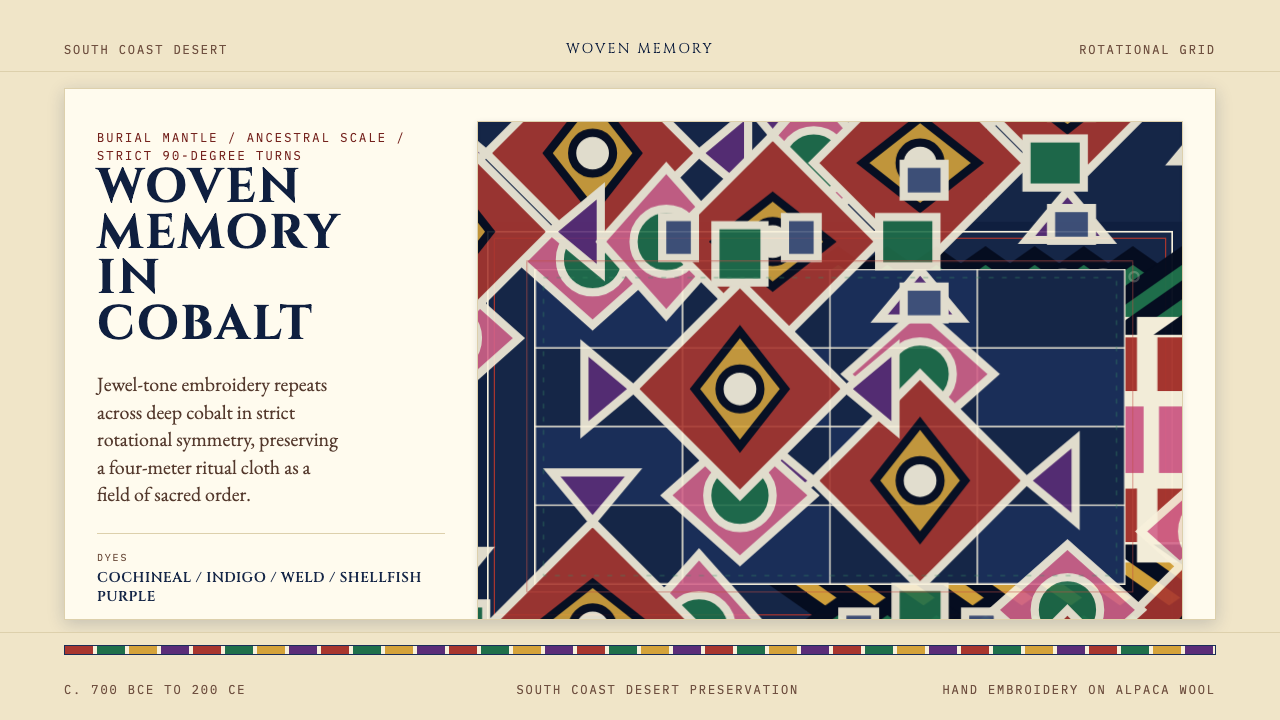 Paracas Andean TextileAncestral and exact. Jewel tones repeat on deep cobalt in strict 90° turns.
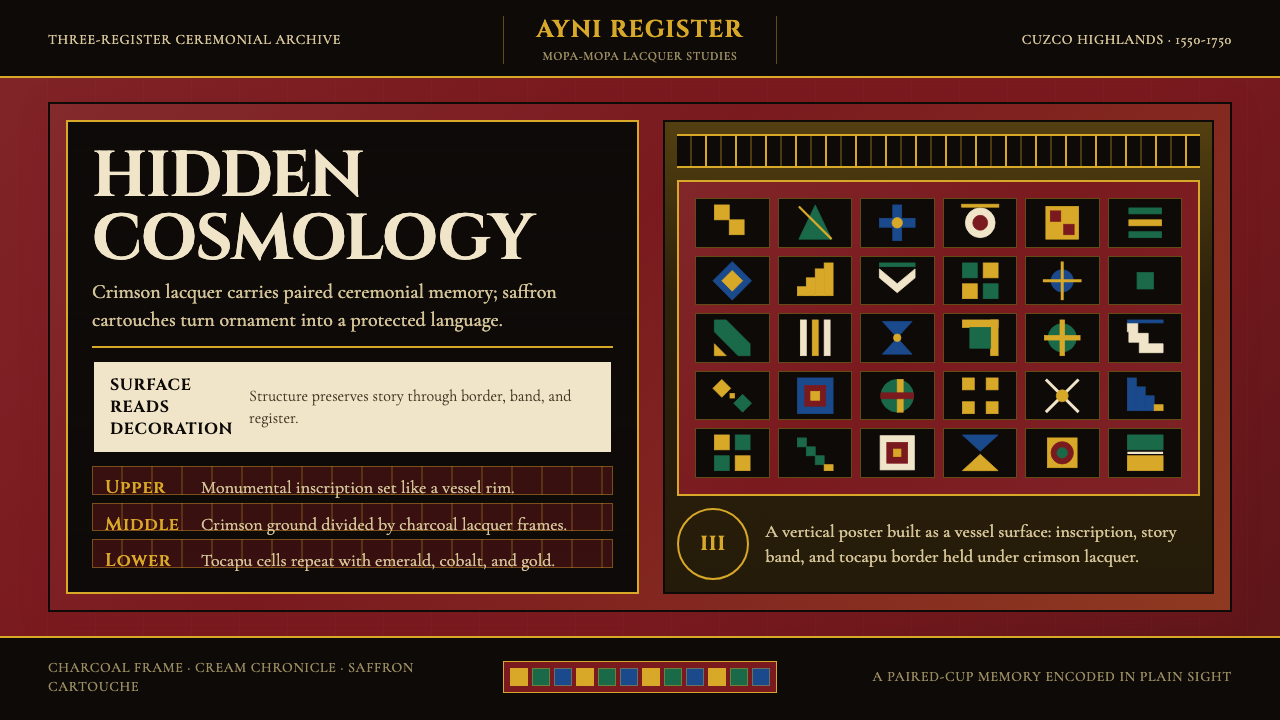 Peruvian Quechua Keros (Andean Cup)Hidden cosmology glows. Crimson lacquer and saffron tocapu grids frame the st…
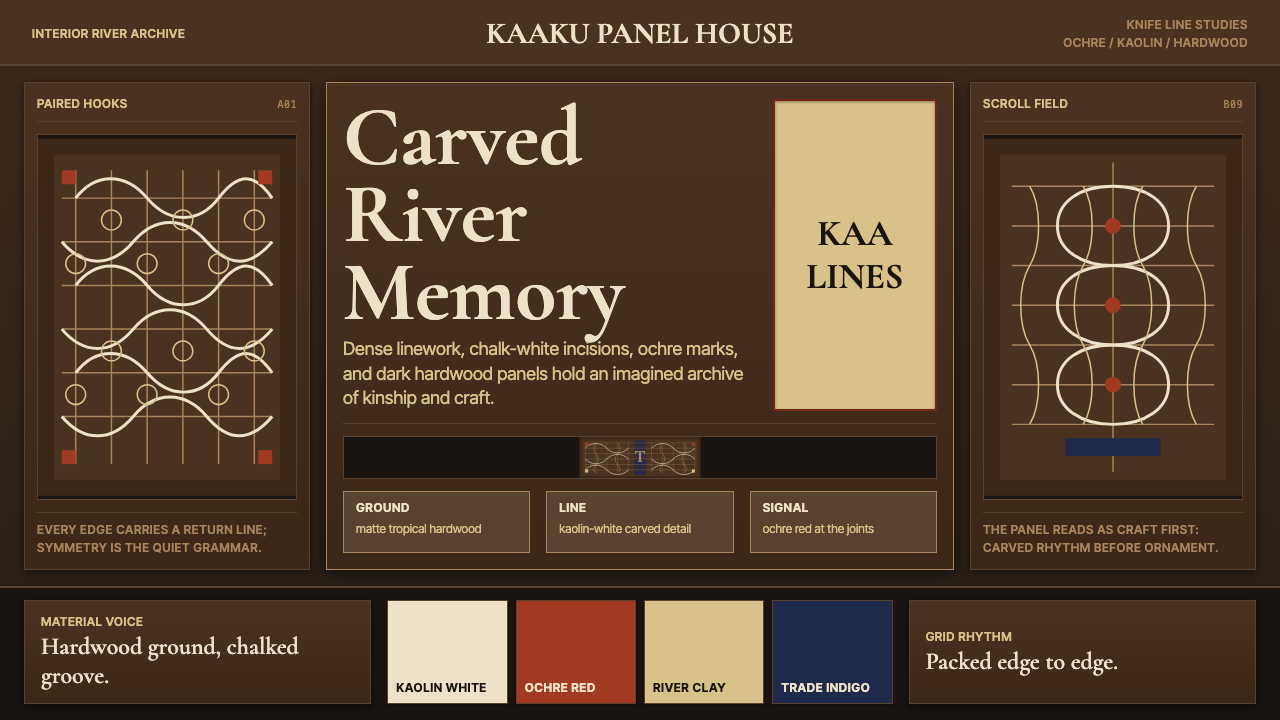 Suriname Maroon TembeDense memory, carved in rhythm. Kaolin lines cross hardwood brown in bilatera…
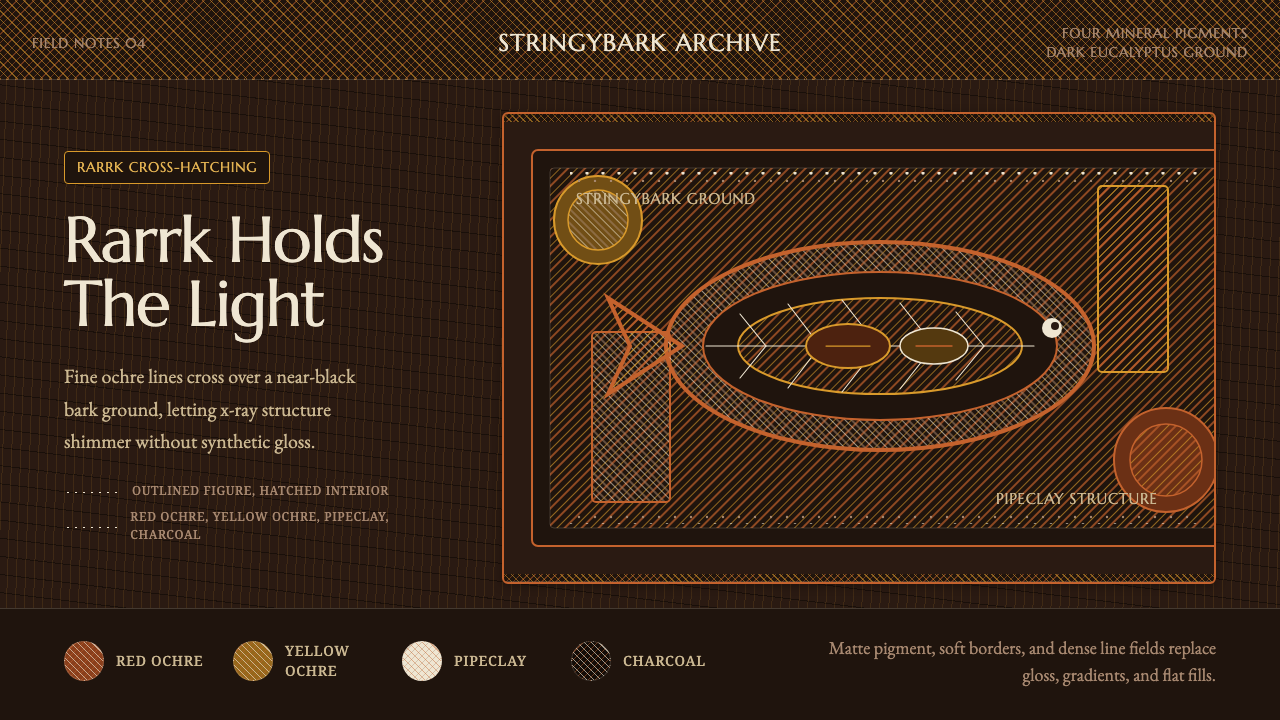 Arnhem X-Ray Bark PaintingShimmers without gloss. Ochre rarrk lines vibrate on dark stringybark.
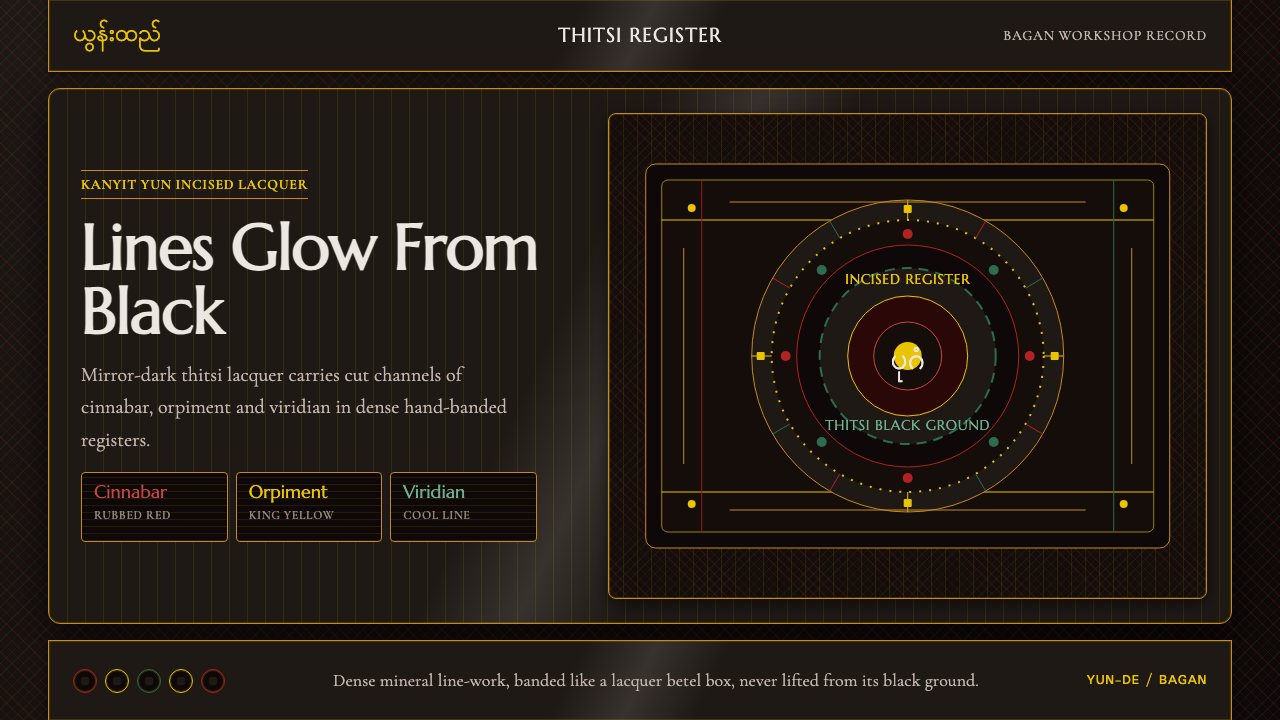 Burmese Yun LacquerwareLacquer glows in cut lines. Cinnabar, orpiment and viridian band a mirror-bla…
 Central African Azande ThroneDense court gravity. Dark wood grids, brass dots, and court red cover every s…