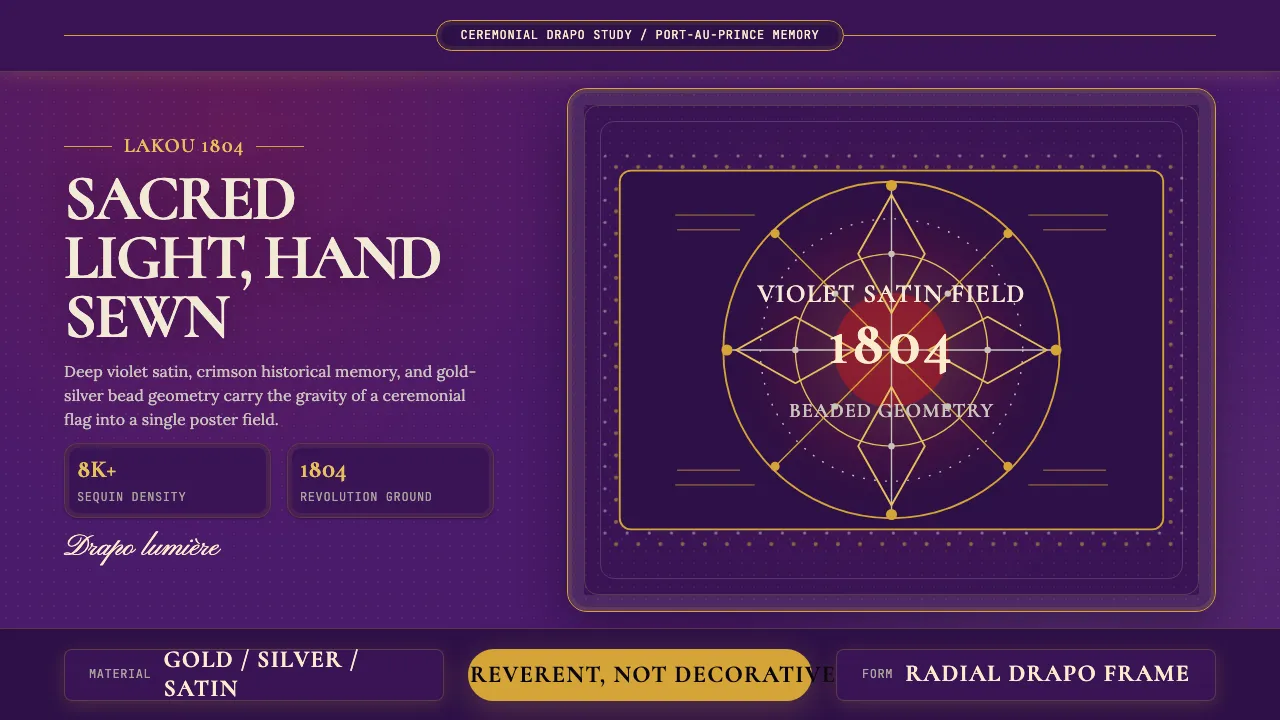
About Haitian Vèvè Sequin Drapo 1804
Born from the 1804 Haitian Revolution — the only successful enslaved-person revolt in modern history — this design system channels the sacred visual culture of Vodou ceremony. Vèvè sigils traced in cornmeal and sequinned drapo flags hand-sewn with thousands of beads become the compositional grammar.
Deep violet satin grounds, crimson heart-lwa accents, and gold-silver sequin flash create an ecclesiastical intensity that is reverent, not decorative. Every element references the heraldic geometry of lwa sigils and the material density of beaded ceremonial flags.
- Origin
- Port-au-Prince, Jacmel, Les Cayes, Haiti; diaspora New Orleans, Miami, Brooklyn
- Era
- 1791–1804 Revolution origin; drapo tradition codified 19th c.; Centre d'Art (1944) modern recognition; contemporary
- Key figures
- Hector Hyppolite · Myrlande Constant · Antoine Oleyant · Toussaint Louverture
- Movements
- Vodou drapo tradition · Centre d'Art Haitian school · Saint Soleil naïf school
Haitian Vèvè Sequin Drapo 1804 design spec
Colors
Typography
The other 11 sections — buttons, cards, spacing, motion, techniques and more — open once you unlock. Download the DESIGN.md or send it to your AI in one click. Unlock once, yours forever.
Sign up nowStyles similar to Haitian Vèvè Sequin Drapo 1804
Also inspired by crafts & folk art, with a close feel.
 Wau Bulan Moon KiteKelantan moon-kite craft. Purple tissue, emerald piping, symmetric gold-and-pink cut-paper foliage.
 Basotho Seanamarena BlanketRank made visible. Cobalt wool, gold maize diamonds, and chestnut borders read like a crest.
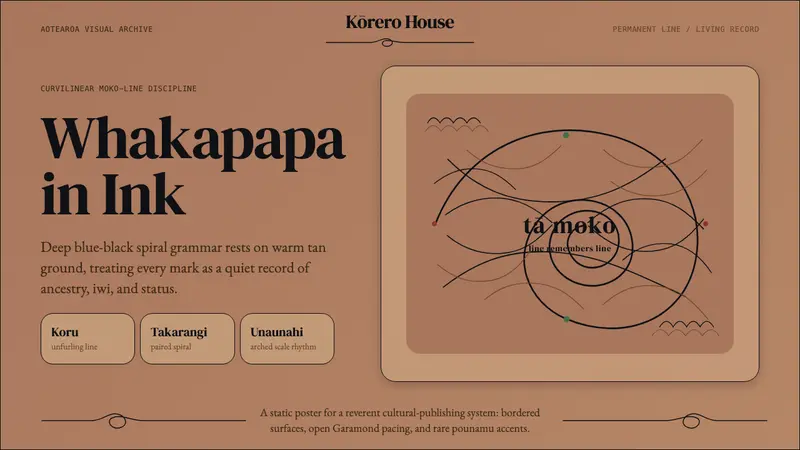 Māori Tā Moko (Facial Tattoo)Ancestry feels carved. Blue-black spirals on tan ground carry a restrained Garamond voice.
 Tibetan Butter SculptureDevotion made dense. Cinnabar, lapis, and gold relief glow from altar black.