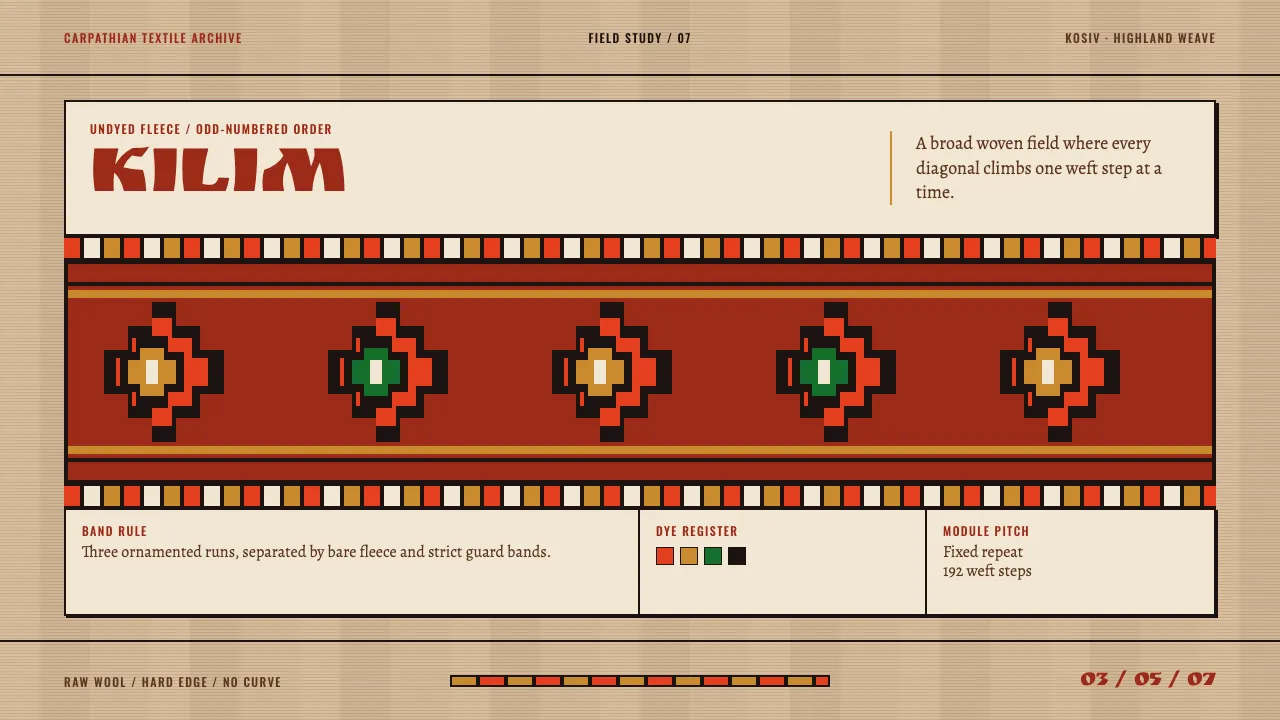
About Hutsul Kilim
Hutsul kilims are woven flat, on upright looms, in shepherd households across the Ukrainian Carpathians. The ground is raw sheep fleece left undyed; the design is a stack of cross-striped bands, three or five or seven of them, never an even count.
Inside each band sit concentric stepped rhombs with serrated edges, rectangles pushing out of their points, hooks curling at the corners. Nothing curves, because slit-tapestry weaving cannot make a curve — every diagonal climbs as a staircase of weft steps.
- Origin
- Hutsul highlands of the Ukrainian Carpathians — Kosiv, Kosmach, Kolomyia, Ivano-Frankivsk oblast
- Era
- pre-1900 — 18th and 19th century highland weaving, continuous through the 20th century
- Key figures
- Oleksa Bakhmatiuk · Yosafat Kobrynskyi
- Movements
- Ukrainian kylymarstvo · Hutsul folk applied art · Kosiv school of applied and decorative arts
Hutsul Kilim design spec
Colors
Background
Surface
Primary
Secondary
Accent
Text
Typography
Ruslan DisplayHeadings
AlegreyaBody
Noto Sans MonoMono
Unlock for 1 credit
The other 11 sections — buttons, cards, spacing, motion, techniques and more — open once you unlock. Download the DESIGN.md or send it to your AI in one click. Unlock once, yours forever.
Sign up nowHave an account? Sign in
Styles similar to Hutsul Kilim
Also inspired by crafts & folk art, with a close feel.
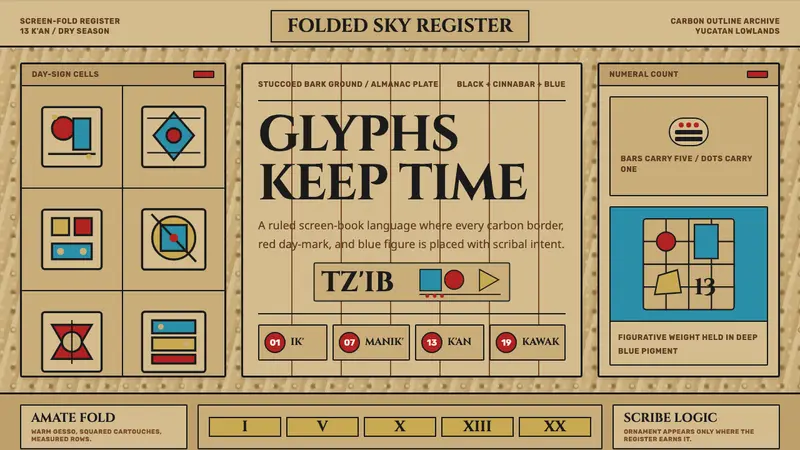 Maya Glyph CodexScribal authority on bark. Cinnabar, Maya Blue, and carbon rules lock into almanac panels.
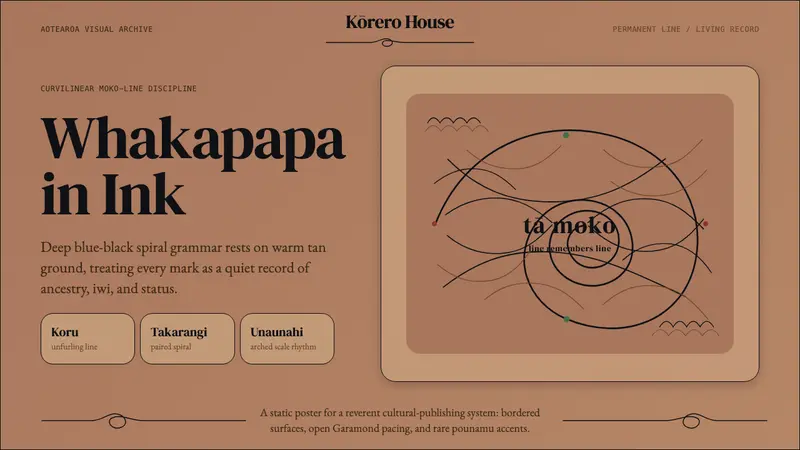 Māori Tā Moko (Facial Tattoo)Ancestry feels carved. Blue-black spirals on tan ground carry a restrained Garamond voice.
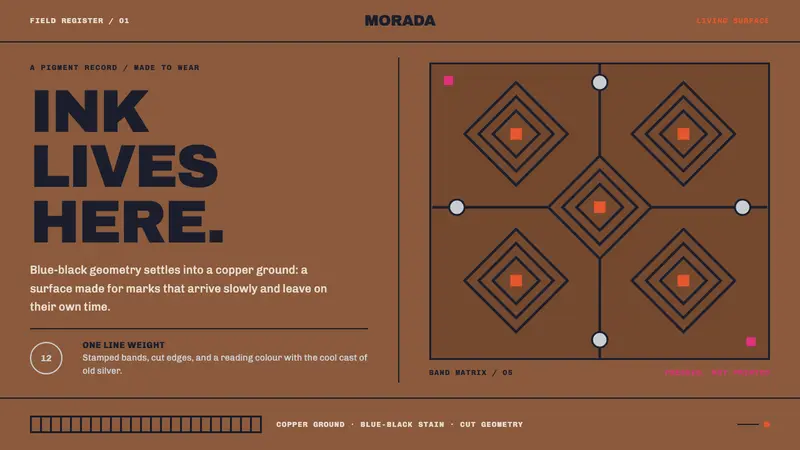 Emberá JaguaA living stain, never a print. Blue-black diamond bands press across copper skin.
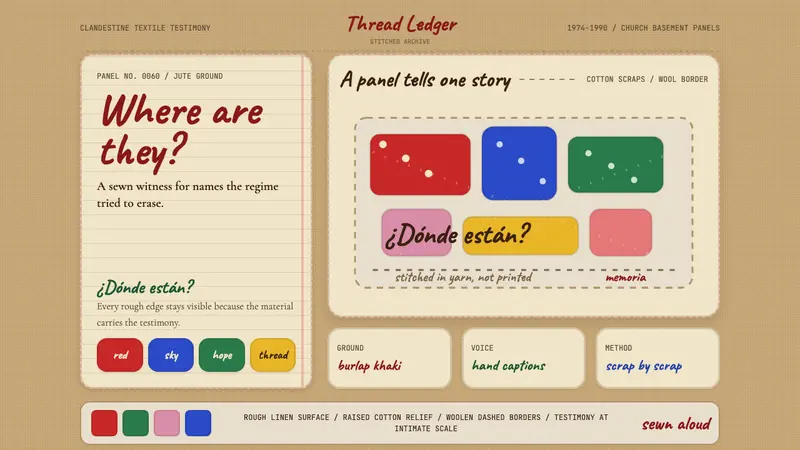 Chilean Arpillera (Pinochet Resistance)Witness sewn, not spoken. Burlap khaki, Caveat captions, and red cotton blocks carry testimony.