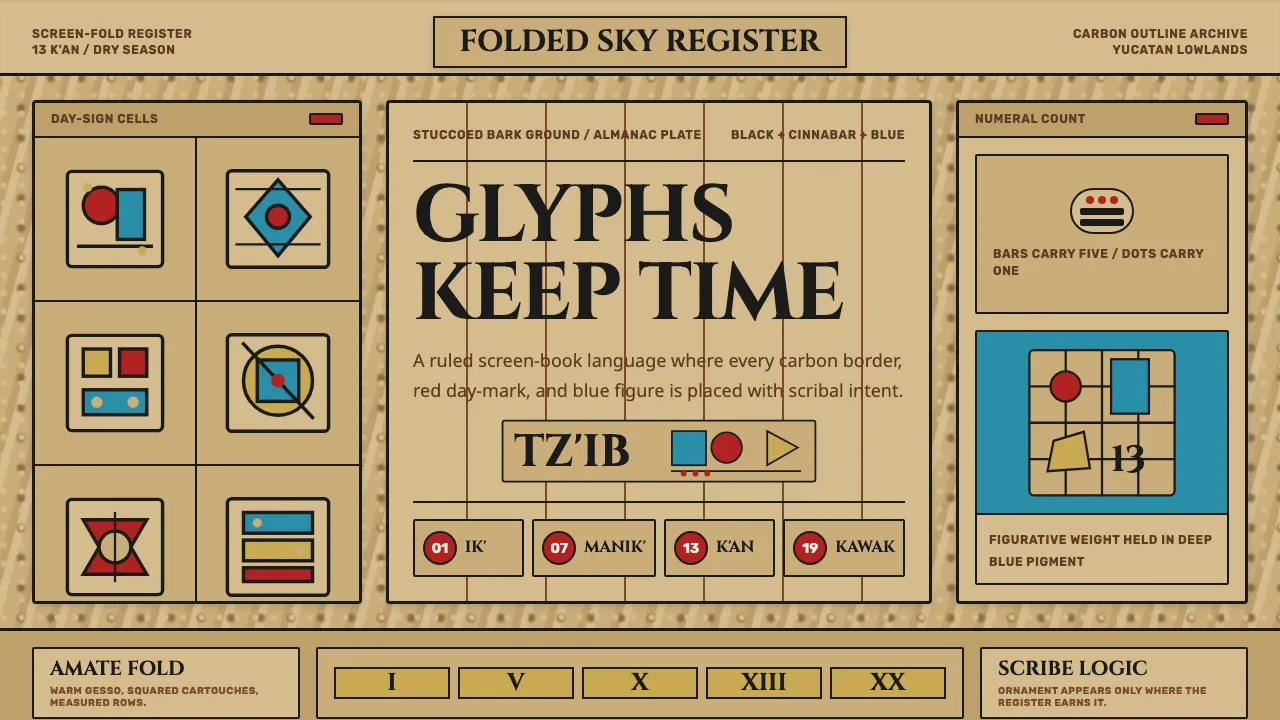
About Maya Glyph Codex
The surviving Maya codices — Dresden, Madrid and Paris — are folded screen-books of amate fig-bark paper, sized with thin lime gesso and aged to a warm buff-tan. Across their registers, block-head deity glyphs sit in carbon-black outline beside bar-and-dot numerals, with red reserved for day-signs and emphasis and deep turquoise Maya Blue carrying the figurative passages.
This system rebuilds that scribal logic for the screen: a stuccoed bark ground, thick confident outlines, and a disciplined palette of black, cinnabar red and Maya Blue. Type is blocky and inscriptional, layout is gridded into almanac panels, and ornament stays earned — every mark reads like it was painted by an aj tz'ib who knew exactly where it belonged.
- Origin
- Maya lowlands (Yucatán), Mesoamerica
- Era
- Postclassic Maya, c.1200–1500s CE (surviving manuscripts)
- Key figures
- Anonymous Maya scribes (aj tz'ib) · Yuri Knorozov
- Movements
- Maya hieroglyphic writing · Almanac & astronomical manuscripts
Maya Glyph Codex design spec
Colors
Typography
The other 11 sections — buttons, cards, spacing, motion, techniques and more — open once you unlock. Download the DESIGN.md or send it to your AI in one click. Unlock once, yours forever.
Sign up nowStyles similar to Maya Glyph Codex
Also inspired by crafts & folk art, with a close feel.
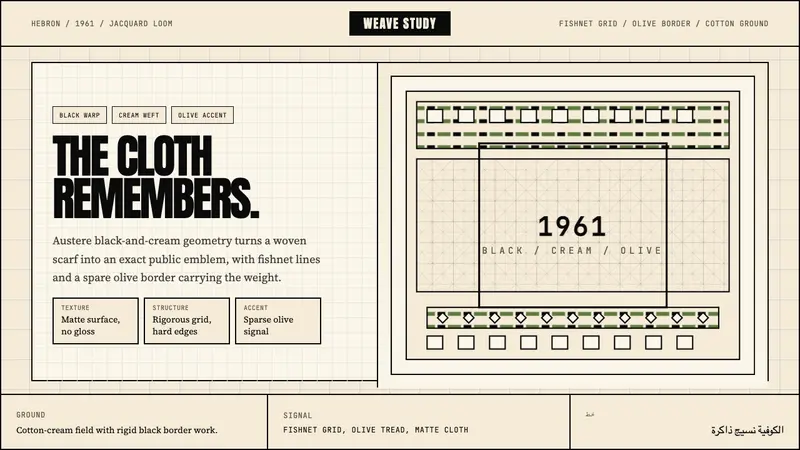 Palestinian Keffiyeh GridMemory in black and cream. Fishnet grid, olive border, and austere Anton type.
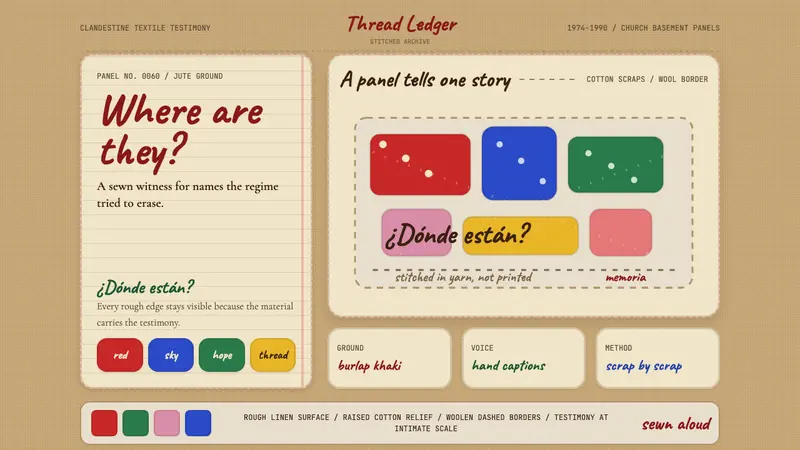 Chilean Arpillera (Pinochet Resistance)Witness sewn, not spoken. Burlap khaki, Caveat captions, and red cotton blocks carry testimony.
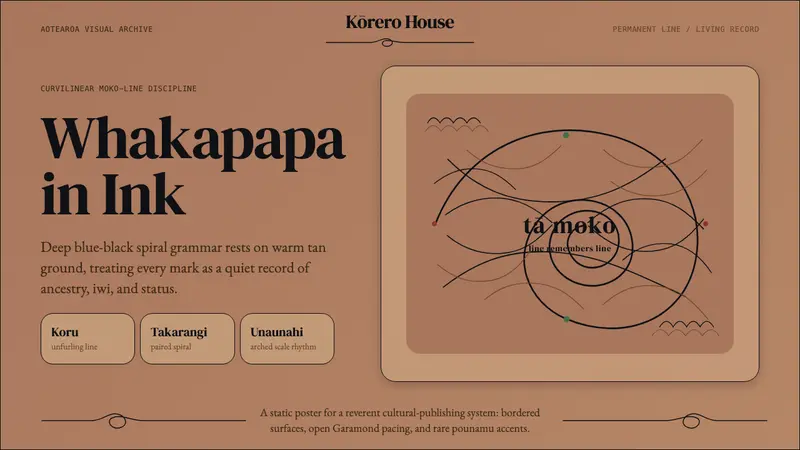 Māori Tā Moko (Facial Tattoo)Ancestry feels carved. Blue-black spirals on tan ground carry a restrained Garamond voice.
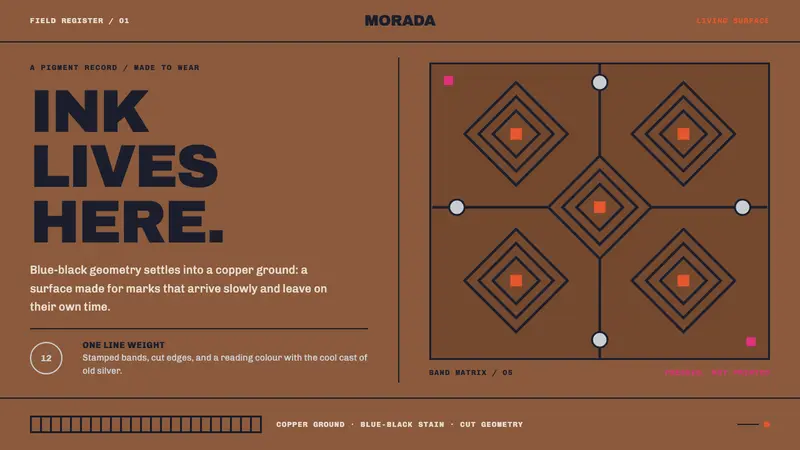 Emberá JaguaA living stain, never a print. Blue-black diamond bands press across copper skin.