What is Hutsul Kilim?
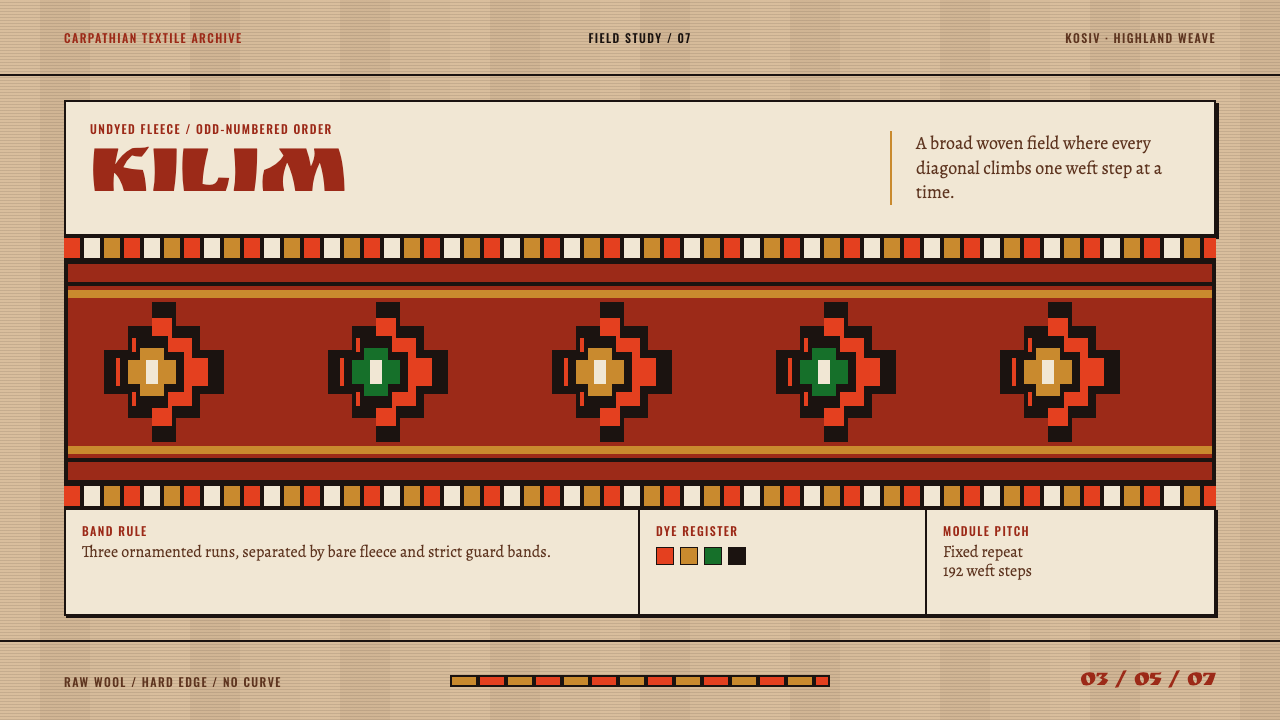
A Hutsul kilim is geometry made by the loom itself: stepped rhombs in hot red marching across bands of raw, undyed fleece, with not a single curve in sight.
Hutsul Kilim in brief
Hutsul kilims are flat-woven rugs made on upright looms in shepherd households across the Ukrainian Carpathians. The ground is raw sheep fleece left undyed, warm and faintly yellow, the colour the wool had when it was spun. The design is a stack of cross-striped bands, three or five or seven of them, never an even count. Inside each band sit concentric stepped rhombs with serrated edges, rectangles pushing out of their points, and hooks curling at the corners.
As a design style it is defined by what the loom can and cannot do. Slit-tapestry weaving cannot make a curve, so nothing in a Hutsul kilim is curved. Every diagonal climbs as a staircase of weft steps. This is not a simplification of some more fluent drawing; it is the true form of the craft. The geometry is the technique made visible, which is why the style feels so inevitable and so unfussy.
Visually the result is warm, rhythmic and strongly structured. A leading hot orange-red sets the temperature, a deeper madder red sits beneath it, and white, black and green are used to edge things. The undyed fleece between the bands is not unfilled space but part of the structure. The style rewards repetition, odd counts and honest edges, and it turns away from gradient, shadow and anything that pretends to be smooth.
Where does Hutsul Kilim come from?
The Hutsul kilim comes from the Hutsul highlands of the Ukrainian Carpathians, in what is now Ivano-Frankivsk oblast, with the weaving centres of Kosiv, Kosmach and Kolomyia as its best-known names. The Hutsuls are a mountain people whose economy has long rested on sheep, pasture and wool, so it is no accident that a pastoral household would turn its own fleece into floor coverings and bedding. The style is rooted in the eighteenth- and nineteenth-century highland weaving, and the tradition has stayed continuous through the twentieth century, which is why it reads as a living craft rather than a revival.
The weaving itself explains the aesthetics. A kilim is woven flat, the weft packed down so that it covers the warp completely, and in slit-tapestry technique each patch of colour is built from its own short run of weft that turns back at the edge of its area. Where two colours meet along a vertical line, a small slit can open. Curves are impossible to make cleanly, so weavers built diagonals as steps and let them become the vocabulary of the pattern. The stepped rhomb, the serrated edge and the hooked corner are therefore not decorations added to a rug; they are what a loom of this kind naturally draws.
Colour in the tradition is deliberately limited. A hot orange-red leads, and beneath it comes a red of madder depth, with white, black and green used to set off edges. Kosiv weaving adds a family of warmer earth tones, namely warm brown, ochre-gold and terracotta, which gives its work a slightly different temperature from neighbouring centres. Local variation of this kind is typical of highland craft: the same grammar spoken with village accents.
The Ukrainian term for the craft, kylymarstvo, places it in a larger story of carpet weaving, while the phrases Hutsul folk applied art and the Kosiv school of applied and decorative arts mark its place in the modern life of the region. These point to teaching, collecting and exhibiting: a tradition that is not only made at home but also studied, preserved and shown. That layered history is what the design system draws on, taking the household object seriously as a body of design knowledge.
What defines the Hutsul Kilim look?
Ground: raw fleece
The ground is undyed sheep fleece, warm and faintly yellow, and it is treated as a colour in its own right rather than as an absence of colour. It plays the role that white paper plays in other styles, but warmer and slightly rougher. Everything else on the surface is set against this natural tone, which is why the style feels grounded and tactile even on a flat screen.
Bands in odd counts
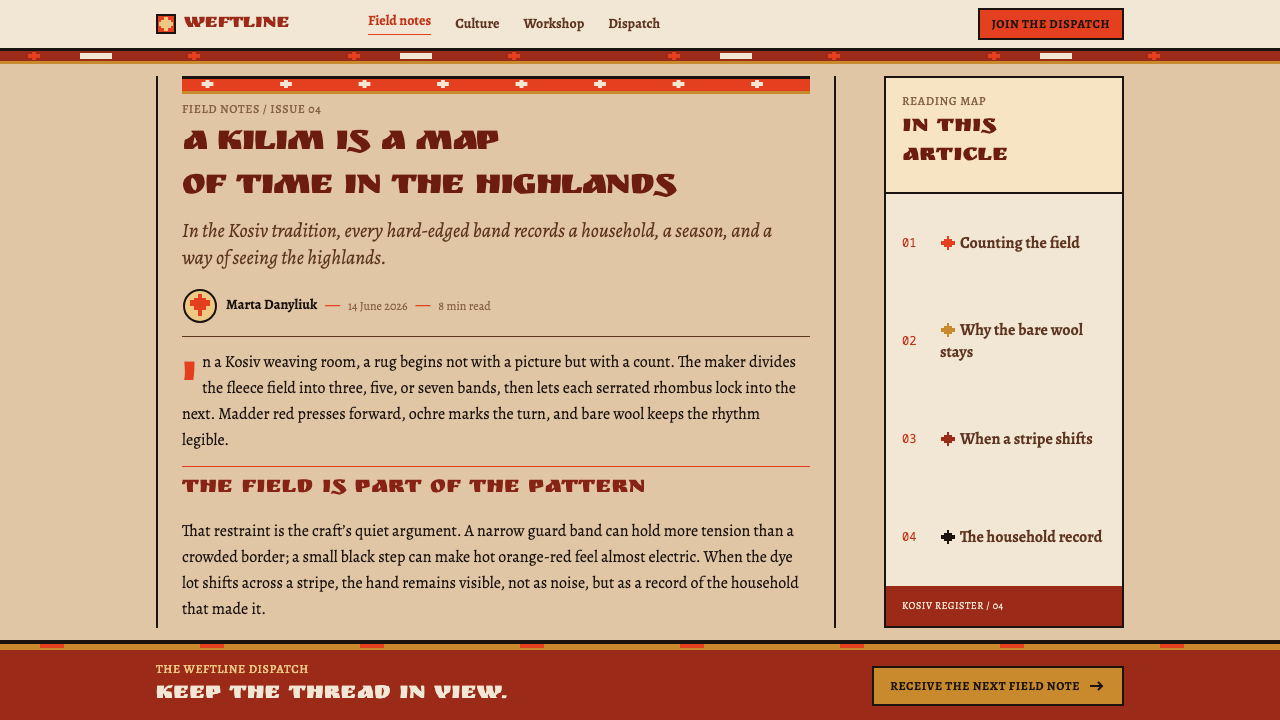
The composition is a stack of cross-striped bands, three, five or seven, never an even number. An odd count gives the pattern a centre, so the middle band can be the strongest while the others balance around it. The bands run across the full width, and each is a separate field of repeating motifs. This is the style's basic layout unit, a horizontal strip that can be repeated, resized or reordered without losing coherence.
Motif: the stepped rhomb
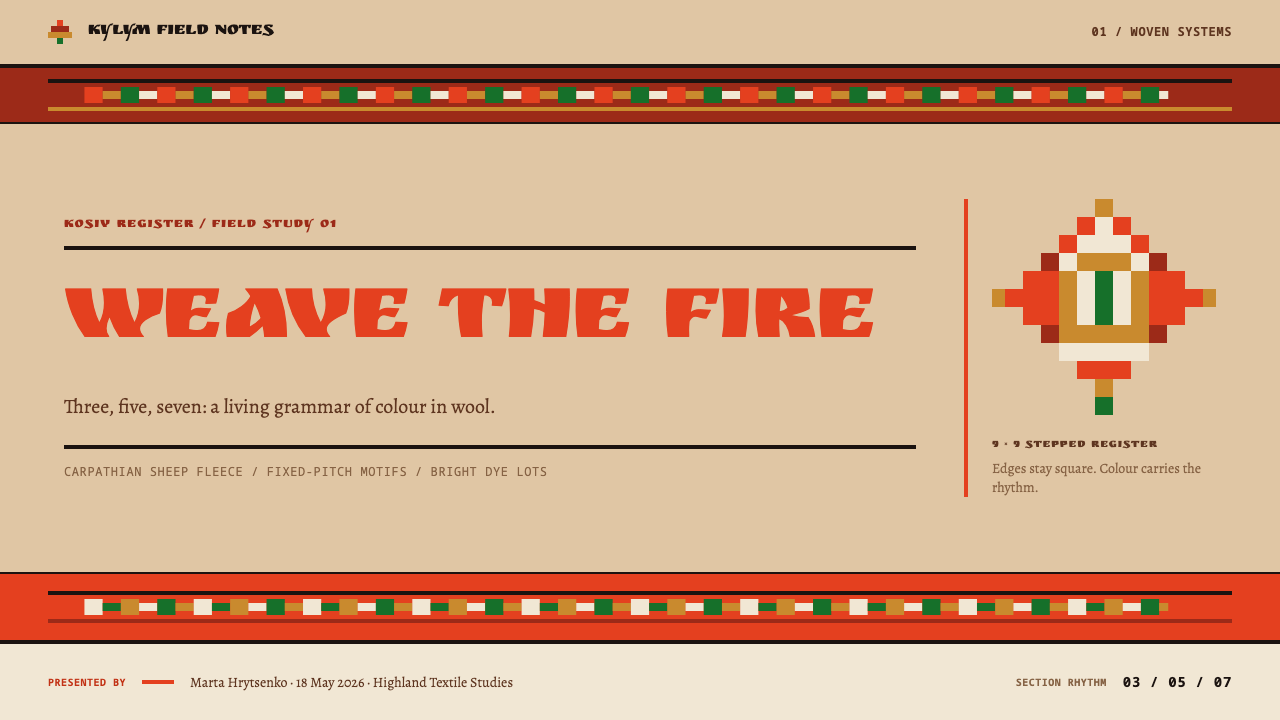
Inside each band sit concentric stepped rhombs with serrated edges, like diamonds nested within diamonds. Rectangles push out of their points, and hooks curl at the corners. The motif is dense yet legible because it is built from only a few kinds of move, repeated: step, notch, hook. It can be scaled up to a hero shape or reduced to a border without losing identity.
Geometry from the loom
Nothing curves, because slit-tapestry weaving cannot make a curve. Every diagonal is a staircase of weft steps, and every edge is a decision rather than a smooth line. For design, this implies angular corners, stepped edges and hard transitions. Rounded shapes and soft gradients would contradict the logic of the object, as they are things the loom would never produce.
Colour: hot red leads
A hot orange-red leads the palette and carries the main figures. Beneath it sits a deeper madder red, while white, black and green are used for edging and fine contrast. Kosiv work adds warm brown, ochre-gold and terracotta, shifting the temperature toward earth. The palette is small and warm, and it relies on a strong lead colour rather than on many accents.
Unfilled fleece as structure
The bare wool left between bands is part of the structure, not a gap that failed to get filled. It gives the eye somewhere to rest, separates one field from the next and lets the colourful bands breathe. In layout terms this is deliberate negative space with a texture and a warmth of its own, and removing it, to pack in more pattern, would flatten the rhythm that makes the style work.
Who shaped Hutsul Kilim?
Oleksa Bakhmatiuk is one of the two individuals named as key figures for this style, placed in the same circle of makers, teachers and keepers of Hutsul applied art around Kosiv and Kolomyia. A name in a style library is a pointer into a tradition rather than a full biography, and what it signals here is that Hutsul weaving has authors and custodians in the modern sense. Readers who want his story should look to Ukrainian sources on Hutsul folk art.
Yosafat Kobrynskyi is associated with the gathering and preservation of Hutsul and Pokuttia folk art in Kolomyia, one of the named weaving and collecting centres of the region, and the folk-art museum there carries his name. For a design tradition this kind of figure matters because collecting is how household objects become a visible, studied canon. Many of the patterns now cited as authentically Hutsul survive in part because someone decided they were worth keeping.
The real authors of the style are the anonymous weavers of highland households, who worked on upright looms with wool from their own flocks. They fixed the odd count of bands, the stepped rhomb and the logic of the bare fleece over generations of repetition and small variation. Their craft carried the grammar from one household to the next, and it explains why the same motifs recur across villages, each with its own accent.
The Kosiv school is named as a movement rather than a person, and it represents the institutional side of the tradition: teaching, workshops and exhibition. Its significance for this style is that it carried Hutsul applied art from household practice into a taught discipline, which is part of why the kilim vocabulary can be described, taught and, in the case of this design system, translated into a coherent visual language.
How do you use Hutsul Kilim today?
The Hutsul kilim system suits subjects that want warmth, rhythm and craft: anything where hand-made structure is the story. It works because its rules are explicit: bands in odd counts, a limited warm palette with one strong lead, stepped rather than curved geometry, and bare ground used as structure. Keeping to those rules matters more than copying any single motif.
For presentation slides, a cover can be a few broad horizontal bands of repeating rhombs in the lead red, laid across a warm fleece-toned ground, with a short title set in a sturdy, plain type. Content slides can borrow the band logic directly: three or five horizontal fields, each carrying one idea, with bare ground between them. Data slides suit stepped charts, since a staircase is the style's native diagonal, and a bar or area drawn in steps reads as belonging to the system.
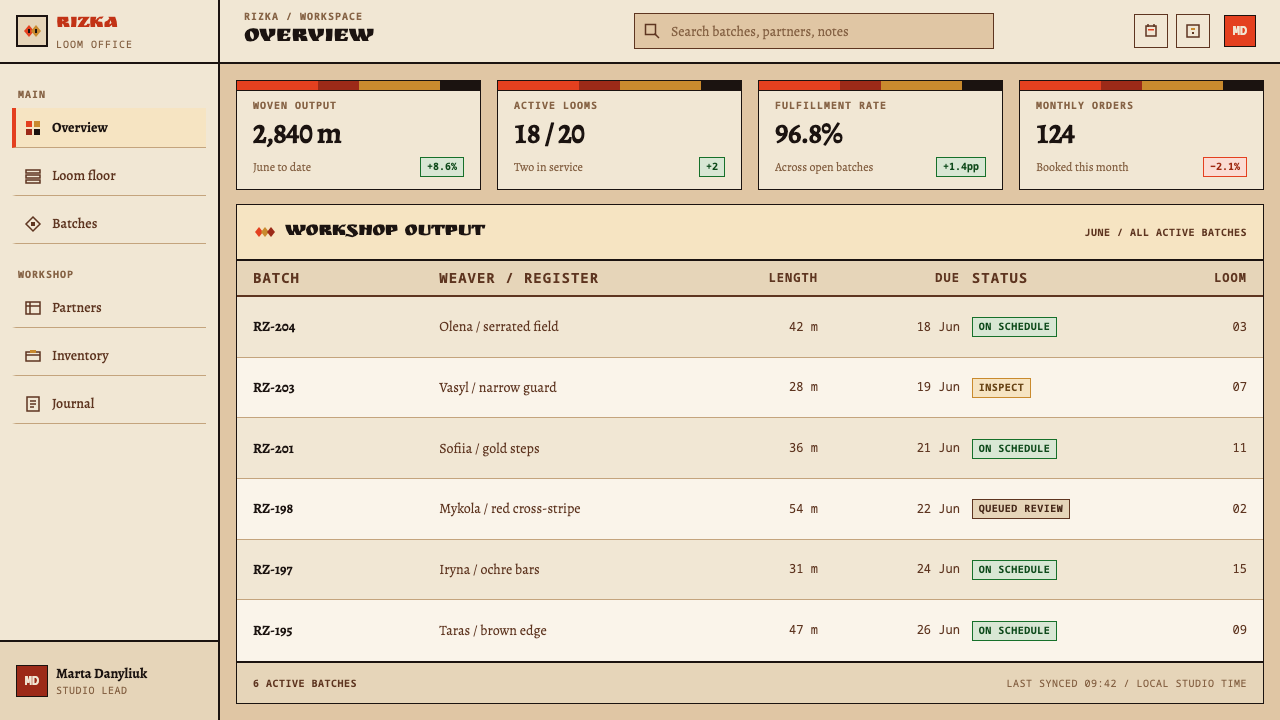
For web interfaces, the style fits product pages for handmade goods, cultural organisations, travel and regional food, and any dashboard where a calm, warm and highly structured look is wanted. Use horizontal bands as section dividers, keep corners sharp, and let the bare ground separate regions instead of heavy borders. Pricing and feature lists can sit in three or five repeating rows. Hover and active states should be flat colour shifts, not glows or soft elevation.
For editorial and marketing work, the style is good at heritage storytelling, craft brands, textile and interior content, and long features about mountain cultures. Border strips of repeated stepped motifs make excellent page rules and chapter openers. A single strong red used consistently for calls to action is more faithful to the loom than a scatter of accents. Photography of real wool, loom and landscape pairs well because it shares the style's warm, matte texture.
A common mistake is to soften the geometry: rounding the corners, adding a gradient to the red, or putting a soft shadow under a card. The loom cannot make those things, so the style looks wrong the moment they appear. Others are filling every inch with pattern, using an even number of bands, or dyeing the ground a bright flat white. Finally, avoid treating the kilim as a generic ‘tribal’ texture. It belongs to a specific highland people and a specific technique, so name the Hutsul tradition and its centres wherever you can.
Hutsul Kilim — FAQ
What is a Hutsul kilim?
It is a flat-woven wool rug made on an upright loom in a shepherd household in the Hutsul highlands of the Ukrainian Carpathians. The ground is raw, undyed fleece, and the design is a stack of cross-striped bands in an odd count, each filled with stepped, serrated rhombs in a warm palette led by orange-red. Its geometry is the geometry of the weaving technique itself.
Why does the style never use curves?
Because slit-tapestry weaving cannot make a curve. A weaver builds each diagonal as a staircase of weft steps, so stepped edges are the true form of the craft rather than a simplification. In a digital system, this translates into angular corners and stepped shapes, with no rounded buttons, soft gradients or blurred shadows. Adding them would contradict the logic of the object.
Why is the number of bands always odd?
Tradition holds that the bands come in threes, fives or sevens, never an even count. Compositionally, an odd number gives the pattern a centre line, so one band can lead while the others balance around it. In a layout, it means choosing three or five sections rather than two, four or six, and letting the middle one carry the most weight.
Can the style be used on a dark background?
It is conceived as a light, warm system whose ground is the colour of raw fleece, so a dark background changes its character. If you try it, keep the same structure and make the hot red the clear lead, and treat the bare ground as a deep wool-brown rather than black. The risk is that the quiet, tactile quality is lost, because the unfilled fleece is part of the style's logic.
How is Hutsul kilim different from other kilim styles?
Kilim is a broad family of flat-woven rugs, and many regions share the stepped geometry that the weaving technique encourages. The Hutsul version is recognised by its undyed fleece ground, its stack of odd-numbered cross-striped bands, its concentric serrated rhombs with rectangles at the points and hooks at the corners, and its hot orange-red lead. Centres such as Kosiv add their own earth tones, so there is variation within the tradition too.
Related design styles
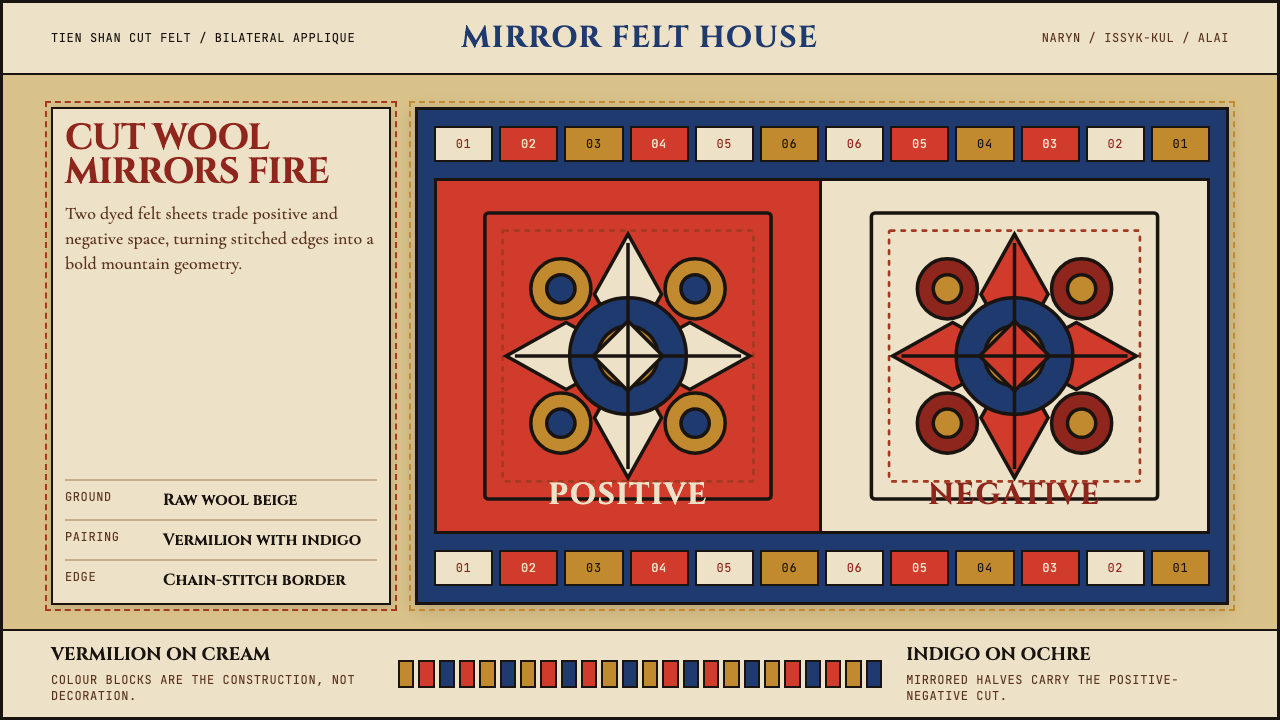 Kyrgyz Shyrdak Felt RugCut felt becomes structure. Vermilion-indigo mirror blocks stitch positive to…
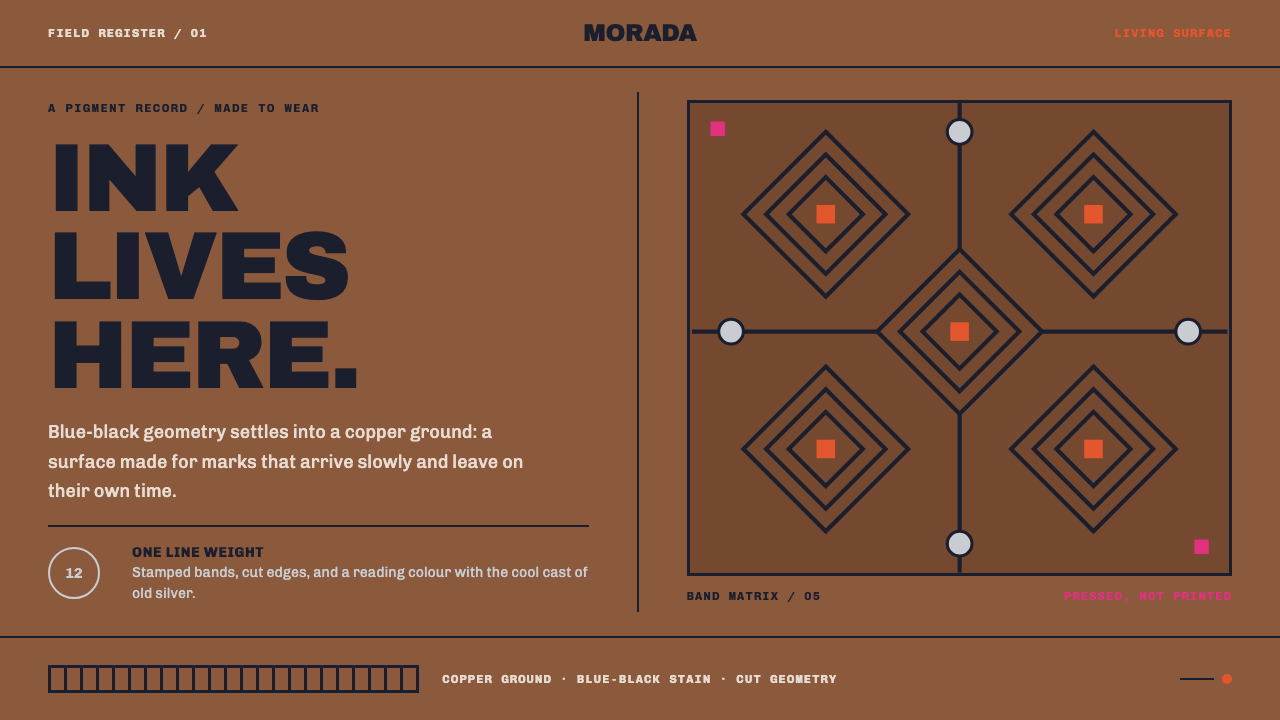 Emberá JaguaA living stain, never a print. Blue-black diamond bands press across copper s…
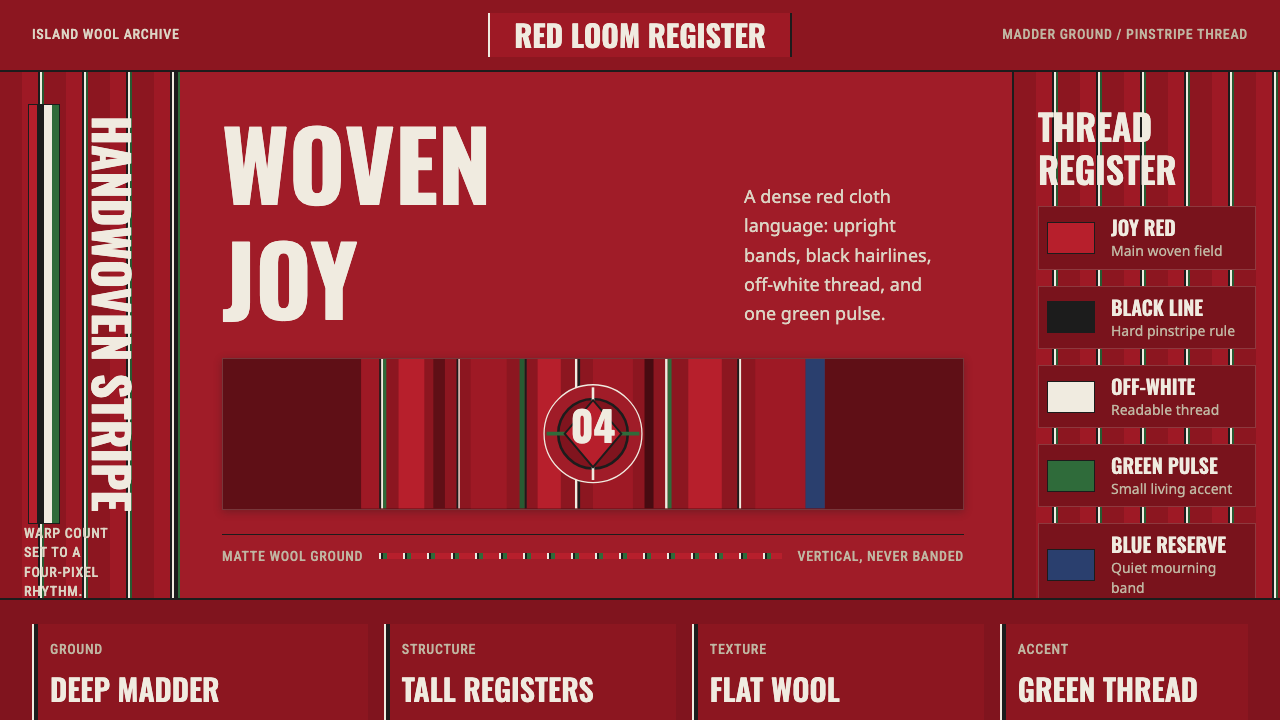 Estonian Kihnu Island SkirtJoy is woven vertical. Madder red ground, Oswald stripes, black and green pin…
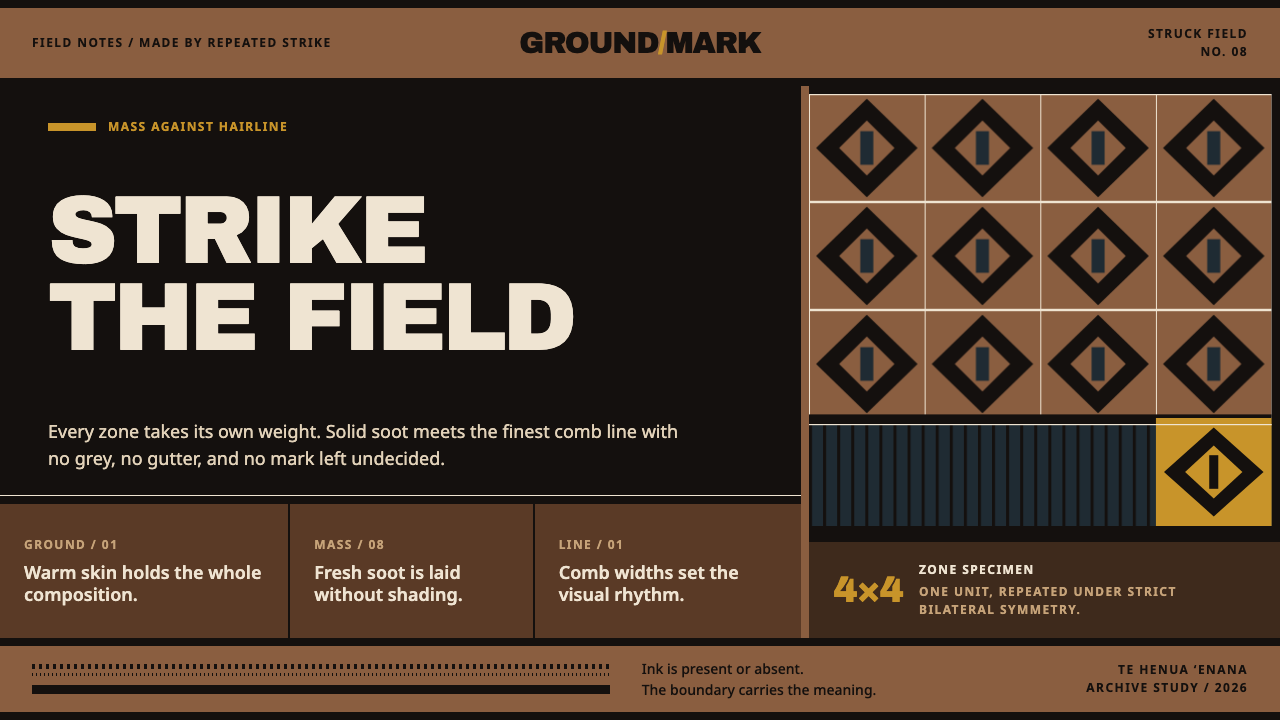 Marquesan PatutikiSoot meets skin without compromise. Solid black zones collide with comb-struc…
 Tongan Kupesi TapaRubbed, never painted. Koka red and tongo black soak into beaten tan bark as…
 Andean ChulloOrnament carries a code. Cochineal red stacks strict stitch bands with bead-w…