What is Kyrgyz Shyrdak Felt Rug?
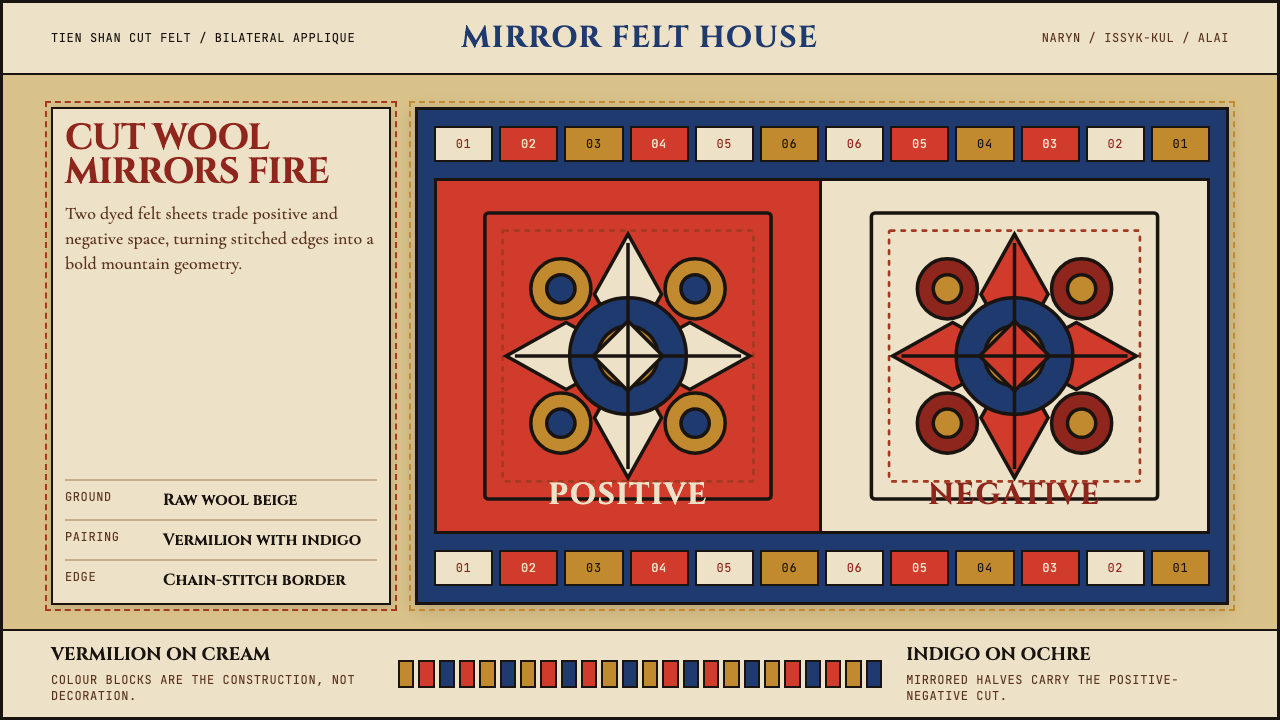
The shyrdak turns a single cut into two patterns at once — the wool you remove becomes the decoration you keep.
Kyrgyz Shyrdak Felt Rug in brief
Shyrdak is a Kyrgyz mosaic felt rug made by cutting two contrasting sheets of dyed wool felt into matching mirrored shapes and stitching the halves together in reverse — the positive silhouette of one colour becomes the negative ground of the other. The result is a seamless interlocking composition where no shape exists without its complement. Every panel is simultaneously figure and ground, foreground and frame.
The visual language is bold and unambiguous: strong two-tone palettes anchored in vermilion-on-cream, indigo-on-ochre, or deep crimson-on-black; motifs derived from the mountain landscape and nomadic life — ram-horn spirals called kochkor müiz, butterfly silhouettes, four-petal flowers, and angular fret borders; surfaces that are dense with pattern yet structurally ordered through strict bilateral symmetry. Nothing about shyrdak is accidental. Even the thick woollen ground carries meaning: the warmth and weight of pressed felt connects every object to the yurt floor it was made to cover.
As a design system, shyrdak channels that cut-and-stitch clarity into a set of rules: colour blocks are the entire design, not a coating applied over it; geometry is always bilateral and mirrored rather than free-form; every edge is defined by the stitched join between two contrasting fields rather than by a drawn line. The chain-stitch embroidery that reinforces those seams adds a secondary texture without softening the graphic force of the main shapes.
Where does Kyrgyz Shyrdak Felt Rug come from?
The shyrdak belongs to the broader Central Asian felt-rug family — a textile tradition stretching from the Kazakh steppe to the Pamir highlands — but it is most precisely associated with the mountain women of Kyrgyzstan's Naryn, Issyk-Kul, and Alai regions, where the Tien Shan range provided both the harsh winters that made felt essential and the flocks of fat-tailed sheep whose wool is particularly suited to dense felting. The technique of cutting and interlocking contrasting felts is old enough that its origins cannot be precisely dated, but the craft is documented in historical accounts from the eighteenth century and likely predates them substantially.
Shyrdaks were made for specific purposes within nomadic life: as floor coverings for yurts, as gifts at weddings and births, and as markers of household status. A bride's trousseau customarily included several shyrdaks she and her female relatives had made over years. The colour combinations and motif repertoire varied by region and family, giving rugs a local and sometimes personal signature without departing from the shared visual grammar. The kochkor müiz motif — the ram-horn spiral — was among the most widespread, carrying associations with strength, fertility, and the vitality of the herds on which nomadic life depended.
The Soviet era transformed shyrdak production in complex ways. Collectivisation disrupted the pastoral economy and the domestic craft context, but Soviet craft promotion simultaneously institutionalised shyrdak-making as a recognised Kyrgyz national folk art, channelling production into workshops and cooperatives and exposing the rugs to wider audiences through exhibitions and export. After independence in 1991, the collapse of Soviet-era support structures threatened many traditional crafts, but shyrdak experienced a revival through women's cooperatives — organisations like the Altyn Kol Women's Handicraft Cooperative in Naryn — that rebuilt production networks and connected rural craftswomen directly with international buyers.
UNESCO's inscription of shyrdak-making on the List of Intangible Cultural Heritage in Need of Urgent Safeguarding in 2012 marked international recognition of both the craft's cultural significance and the precarity of its transmission. Researchers including ethnographer Stephanie Bunn, who conducted sustained fieldwork with Kyrgyz felt-makers, documented the technical and symbolic dimensions of the tradition in detail, contributing to both preservation efforts and the wider scholarly understanding of Central Asian textile culture. The Kyrgyz Felt Centre in Bishkek has become a hub for training young practitioners and promoting the craft to designers and collectors outside the region.
What defines the Kyrgyz Shyrdak Felt Rug look?
Cut-and-Inlay Color
Color in shyrdak is not painted or printed — it is the felt itself. Two contrasting sheets of dyed wool are cut simultaneously into complementary shapes, then each half is swapped into the other's ground, producing a composition where both hues cover exactly equal area. The classic pairings are vermilion against cream, indigo against ochre, and deep crimson against black, chosen for their maximum contrast rather than tonal harmony. Because the colors are structural rather than applied, they never fade or bleed at the edges; the boundary between fields is always a sharp, physical seam.
Bilateral Mirror Symmetry
Shyrdak compositions are almost always bilaterally symmetrical along one or two axes. A motif that spirals left on one half of a panel is answered by an identical spiral turning right on the other. This mirroring is not merely decorative — it is a structural consequence of the cut-and-swap technique itself: when you cut two layers together and redistribute the pieces, perfect symmetry is the natural result. The visual effect is one of disciplined inevitability, as though the pattern could not have been any other way.
Ram-Horn and Geometric Motifs
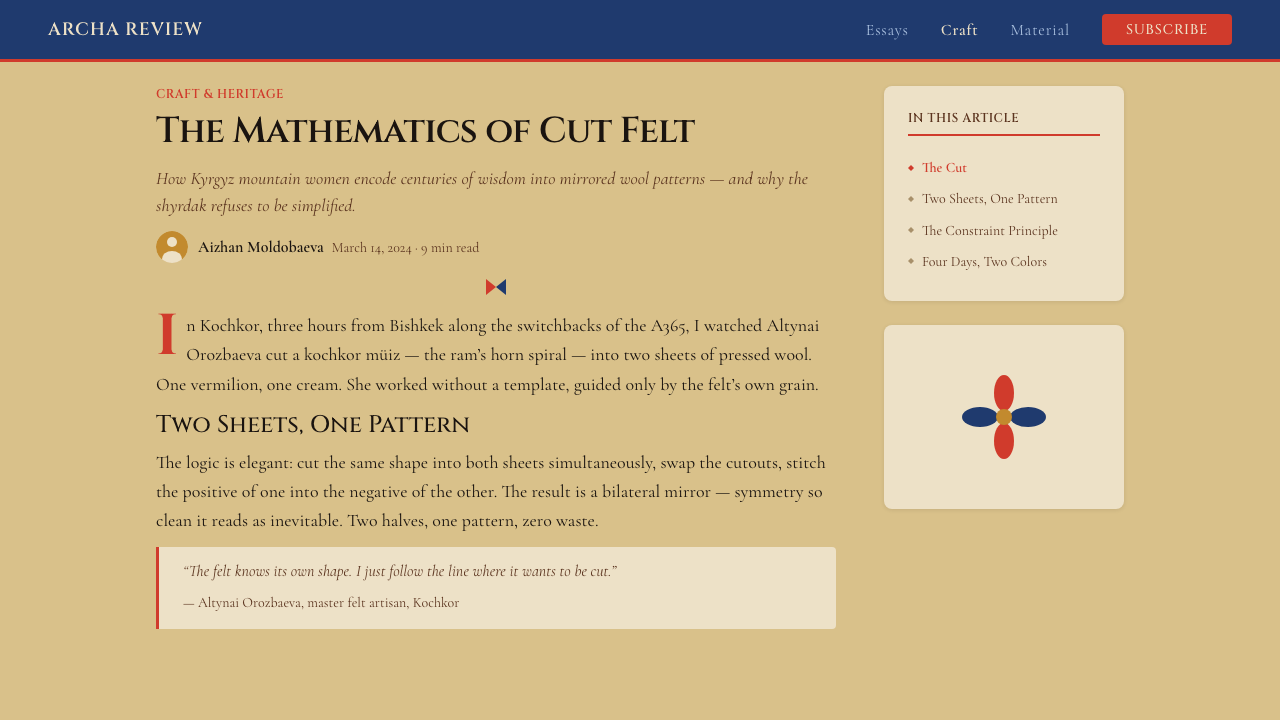
The motif vocabulary draws on the nomadic environment rather than botanical or figurative traditions. The kochkor müiz — a spiral that echoes the curve of a ram's horn — is the most iconic, appearing as a primary centerpiece or a repeated border element. Related forms include the butterfly silhouette, the four-petal flower (derived from the top opening of the yurt), and angular step-fret patterns that echo mountain ridgelines. All motifs are geometrised to the point where their natural origins recede: the ram's horn becomes an abstract double spiral, the butterfly becomes a symmetrical lozenge.
Chain-Stitch Seam Embroidery
The join between the two contrasting felt fields is reinforced with a line of chain-stitch embroidery in a third color — typically a warm mustard, a vivid grass green, or a bright white — that runs precisely along the boundary. This embroidered seam serves a structural function, binding the pieces securely, and a visual one: it introduces a fine linear element that articulates every edge without interrupting the bold color-block reading. The stitch line is never heavy enough to dominate, but its presence gives the composition a hand-crafted intimacy that raw seams alone could not provide.
Tactile Wool Ground
Unlike woven textiles or printed media, shyrdak is built from pressed and compressed wool — a material with visible surface texture, a slight nap, and a warmth that reads even in photographs. The background tone is typically the natural off-white of undyed wool rather than a stark white, which gives the palette an inherent earthiness. This material warmth differentiates shyrdak from other geometric or high-contrast traditions: even at its most graphic, the style retains the soft-edged quality of a handmade object, never achieving the cold precision of machine-reproduced geometry.
Dense Surface with Ordered Structure
A finished shyrdak panel leaves almost no empty ground visible — motifs fill the field from edge to edge, with borders and interior blocks arranged in a strict hierarchy. Yet the composition never reads as chaotic because the bilateral symmetry and the two-color constraint impose an underlying order. The density is a feature rather than a failing: in a yurt interior, where walls, floor, and furnishings were all textile, a pattern that held visual weight at close range was more effective than one that required distance to resolve.
Two-Palette Discipline
Each shyrdak panel is built on exactly two dominant hues — one warm and one cool, or one saturated and one neutral — plus the narrow embroidery accent. This constraint is not timidity but structural logic: the cut-and-swap method produces two equal halves of the same shape, so introducing a third major color would require a separate panel or a fundamentally different technique. The discipline forces every design decision into the question of which motif shape best serves the two tones available, producing compositions of concentrated visual intensity.
Who shaped Kyrgyz Shyrdak Felt Rug?
A master shyrdak-maker from the Naryn region whose work has been exhibited internationally and documented by researchers studying the living transmission of Kyrgyz felt craft. Chytyrbaeva represents the generation of craftswomen who maintained production through the post-Soviet transition period and whose expertise became foundational to the cooperative revival movement, training younger practitioners in both the technical process and the symbolic grammar of traditional motifs.
A British ethnographer and textile scholar who conducted sustained fieldwork among Kyrgyz felt-makers over many years, producing some of the most detailed English-language documentation of shyrdak technique, symbolism, and social context. Bunn's research — collected in her book on Kyrgyz felt — bridges the gap between technical craft analysis and anthropological understanding of the objects' roles in nomadic social life, and has been instrumental in bringing the tradition to the attention of the international design and heritage communities.
Founded after Kyrgyzstan's independence, the Altyn Kol (Golden Hand) cooperative in Naryn became one of the most significant organisations in the post-Soviet revival of shyrdak production. By connecting rural craftswomen directly with fair-trade markets in Europe and North America, the cooperative made shyrdak economically viable as a livelihood for the first time since the collapse of Soviet export structures. Its model — community-owned, skill-training-focused, and market-linked — was later replicated by other cooperatives across the region.
A Bishkek-based institution that functions as a training centre, exhibition space, and commercial outlet for Kyrgyz felt crafts including shyrdak. The Centre has played a key role in connecting traditional rural practitioners with urban and international audiences, fostering dialogue between heritage craft and contemporary design practice. It serves as a point of contact for designers and researchers interested in engaging with shyrdak aesthetics, and has supported efforts to document and standardise the technical vocabulary of the craft for educational purposes.
How do you use Kyrgyz Shyrdak Felt Rug today?
Shyrdak is a high-contrast, pattern-dense style with a strong cultural specificity, which means it transfers well when its structural logic is understood and followed, but poorly when it is treated as a surface texture to be layered onto an otherwise unrelated layout. The core transferable logic is: two dominant tones, bilateral symmetry, motifs defined by their silhouette rather than by internal detail, and a ground that is warm and material rather than stark or clinical.
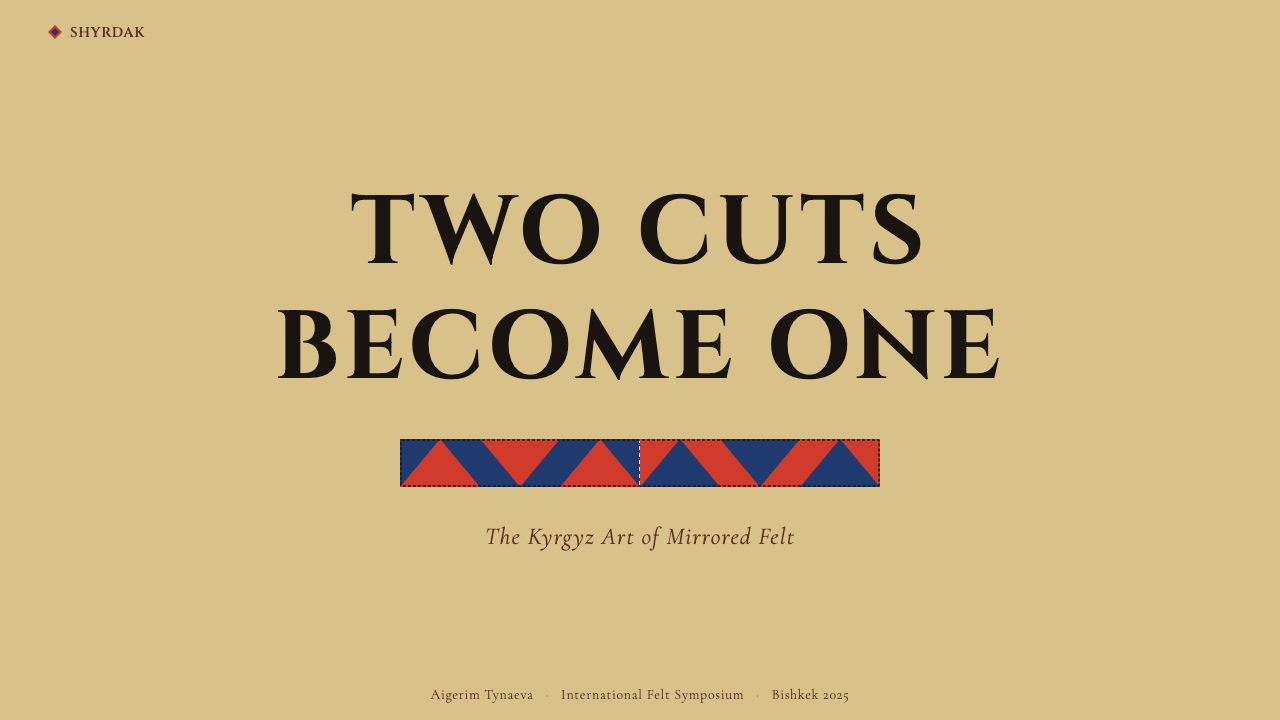
For presentation slides, shyrdak works most powerfully on cover and section-divider pages where a single strong image can carry the full visual weight. A cover built in this style uses one of the classic two-tone pairings — vermilion against off-white, or deep indigo against warm ochre — with a single large centered motif drawn from the geometric vocabulary: a ram-horn spiral, a four-petal flower, or an angular border grid. The motif should fill most of the field, leaving only a structured margin. Content slides benefit from the style's border tradition: a narrow geometric frame around each slide creates visual containment without competing with the information inside. Data slides work well when chart elements — bars, segments, areas — are rendered in the two dominant tones only, with no intermediate shades.
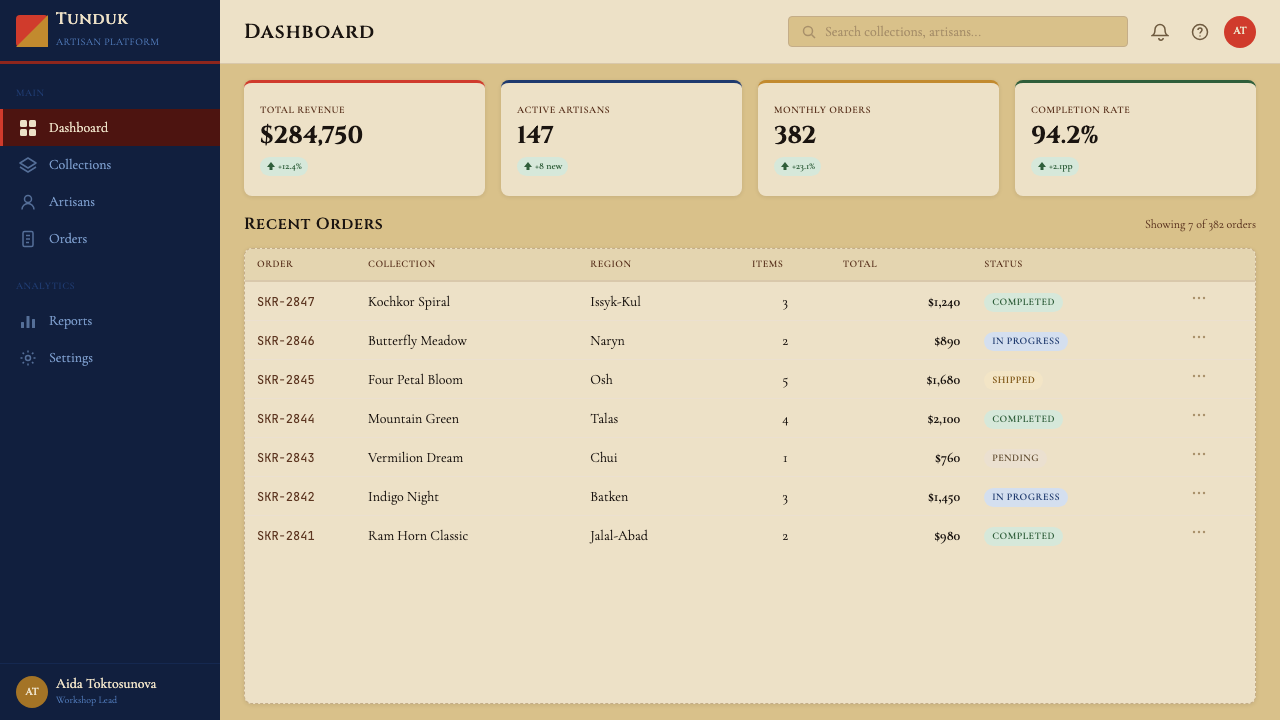
For web interfaces, shyrdak is best suited to editorial contexts, landing pages, and marketing sections where visual impact and cultural distinctiveness are valued over interface efficiency. The approach requires discipline: commit to two background-level tones, use the embroidery-accent color sparingly for interactive elements and highlights, and resist the temptation to introduce photographic imagery or gradient fills, which will immediately undercut the flat, tactile quality the style depends on. Pricing pages and dashboards can adopt shyrdak border motifs as structural dividers — a repeating angular step-fret pattern as a section separator, for instance — without committing the entire interface to the full two-tone density.
For editorial and marketing work, the style supports ambitious full-bleed feature sections and campaign headers. A marketing page built around this aesthetic uses the two dominant tones to alternate between sections — one section rendered with the warm color as ground, the next reversing to the cool — while the motif vocabulary provides recurring graphic elements that create visual continuity across the page. Physical and printed applications — event programs, packaging, textile-adjacent product branding — suit the style particularly well because the warm, material quality of the original craft reads more naturally in printed ink on uncoated stock than on a backlit screen.
A common mistake is treating shyrdak as a general-purpose geometric or ethnic pattern resource, pulling isolated motifs out of context and scattering them decoratively over an otherwise unrelated design. This produces pastiche rather than coherent style application. The two-color constraint is not optional — introducing multiple accent colors simultaneously dissolves the structural logic that makes shyrdak compositions readable. Similarly, softening the palette with gradients or tints, or reducing the motifs to a small-scale repeat on a white ground, strips away the density and visual weight that distinguish the style. When the contrast ratio drops, so does the identity.
Kyrgyz Shyrdak Felt Rug — FAQ
How does shyrdak differ from other Central Asian rug traditions?
The defining feature of shyrdak is its cut-and-inlay construction: two sheets of contrasting felt are cut together and reassembled with the pieces swapped, so that every shape is simultaneously present in both colors. This is different from woven rugs like Azerbaijani kilims or Turkmen carpets, which build pattern through the interlacing of different-colored threads, and from printed or painted felt traditions, where color is applied to a pre-existing ground. The result is a flat, graphic, structurally symmetric composition that has no direct equivalent in other Central Asian textile families. The related Kazakh syrmak uses a similar cut-and-appliqué logic but typically features more complex layering and different regional motifs.
Can shyrdak aesthetics work in dark-mode interfaces?
Yes, and the tradition itself supplies the precedent: deep crimson-on-black and indigo-on-near-black are authentic shyrdak palette pairings used when the ground felt is dark-dyed rather than natural. Adapting shyrdak to a dark interface is a matter of selecting one of these historically grounded pairings rather than inverting a light scheme arbitrarily. The warm tones — crimson, ochre, mustard — read well against dark grounds at the saturations traditional rugs use. What does not work is replicating the vermilion-on-cream palette with its values inverted to cream-on-vermilion — the two colors change perceptual weight dramatically when switched, and the structural balance the motifs depend on breaks.
Is the shyrdak style too culturally specific to use in unrelated design contexts?
The question is less about permission than about execution. Shyrdak's structural principles — two-tone interlocking geometry, bilateral symmetry, edge-defined by the boundary between fields — are transferable formal properties, not cultural content. When applied as a visual system with those properties intact, the result is coherent and distinct without requiring the viewer to recognise the source tradition. The difficulty arises when shyrdak elements are applied as exotic surface decoration without understanding the rules they follow: isolated motifs floating on unrelated grounds, palette borrowed but symmetry abandoned, or a thin sprinkling of ram-horn shapes on an otherwise generic layout. The style works when its logic is honoured; it reads as pastiche when only its appearance is borrowed.
Why does shyrdak always use exactly two dominant colors rather than a broader palette?
The two-color constraint is not a stylistic preference but a technical consequence of the cut-and-swap construction method. When you cut two felt layers simultaneously and redistribute the pieces, you get exactly two sets of shapes — one from each original sheet — and no more. Introducing a third color requires either a third sheet and a more complex reassembly, or a separate appliqué technique that changes the nature of the object. Traditional shyrdak-makers worked within this constraint not because it was the only way to make felt rugs, but because the interlocking symmetry it produces — and the visual intensity of a palette reduced to exactly two competing tones — was understood to be the point. The constraint is the style's engine, not its limitation.
How should shyrdak motifs be adapted for a digital interface without losing their character?
The key is to retain what makes the motifs structurally distinctive: bilateral symmetry along at least one axis, silhouette-based definition with no internal detail or gradient, hard edges with no anti-aliasing softening, and scale bold enough to read at the resolution of the interface. The ram-horn spiral and four-petal flower translate well to vector paths and SVG, where they can be redrawn at any size without loss of fidelity. What degrades the character fastest is adding drop shadows, corner rounding, or inner glow effects to individual motif elements — these introduce a dimensionality that conflicts with the craft's flat, fabric-flush aesthetic. Motifs used as structural elements — borders, dividers, corner treatments — maintain their integrity better than motifs used as standalone icons, because they preserve the edge-defining function they serve in the original rugs.
Related design styles
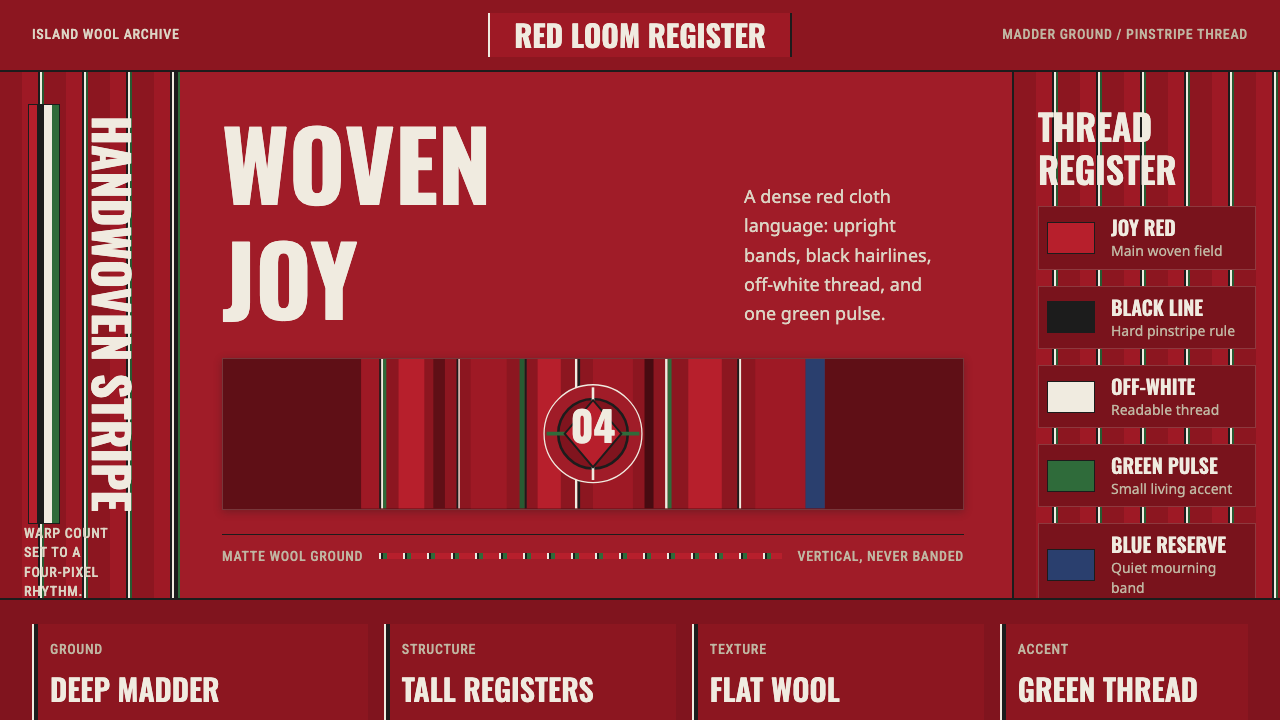 Estonian Kihnu Island SkirtJoy is woven vertical. Madder red ground, Oswald stripes, black and green pin…
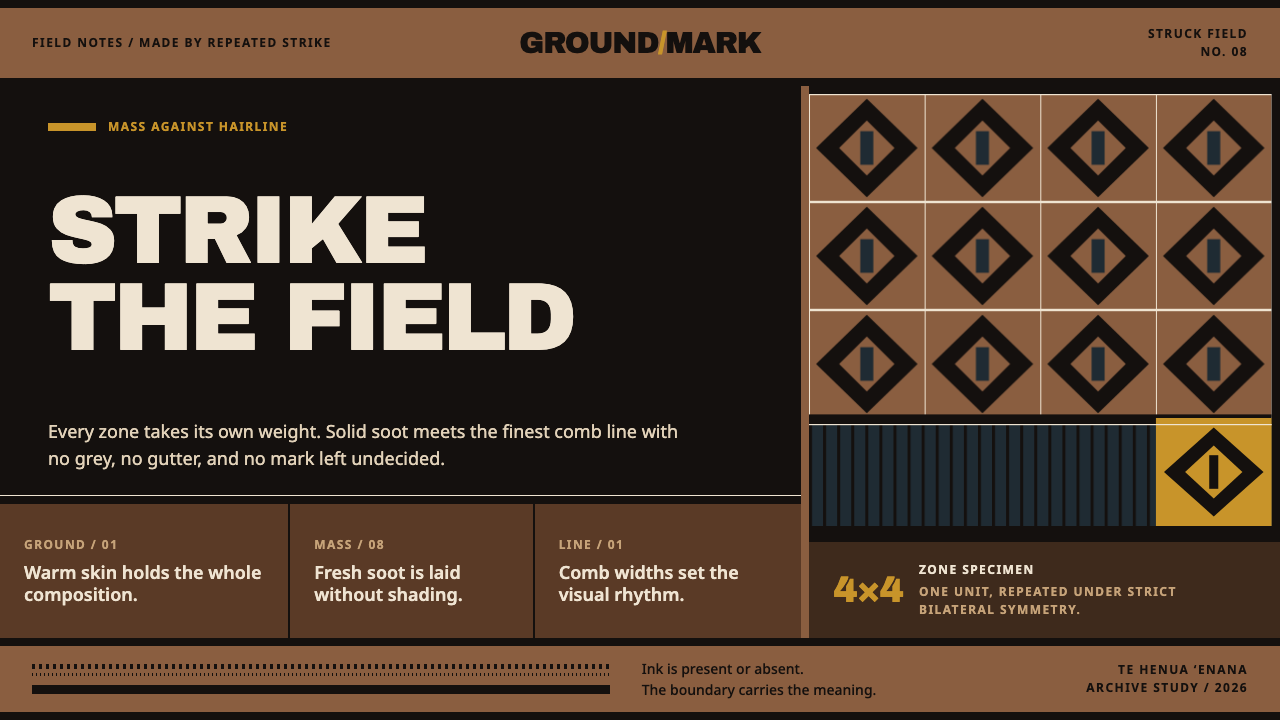 Marquesan PatutikiSoot meets skin without compromise. Solid black zones collide with comb-struc…
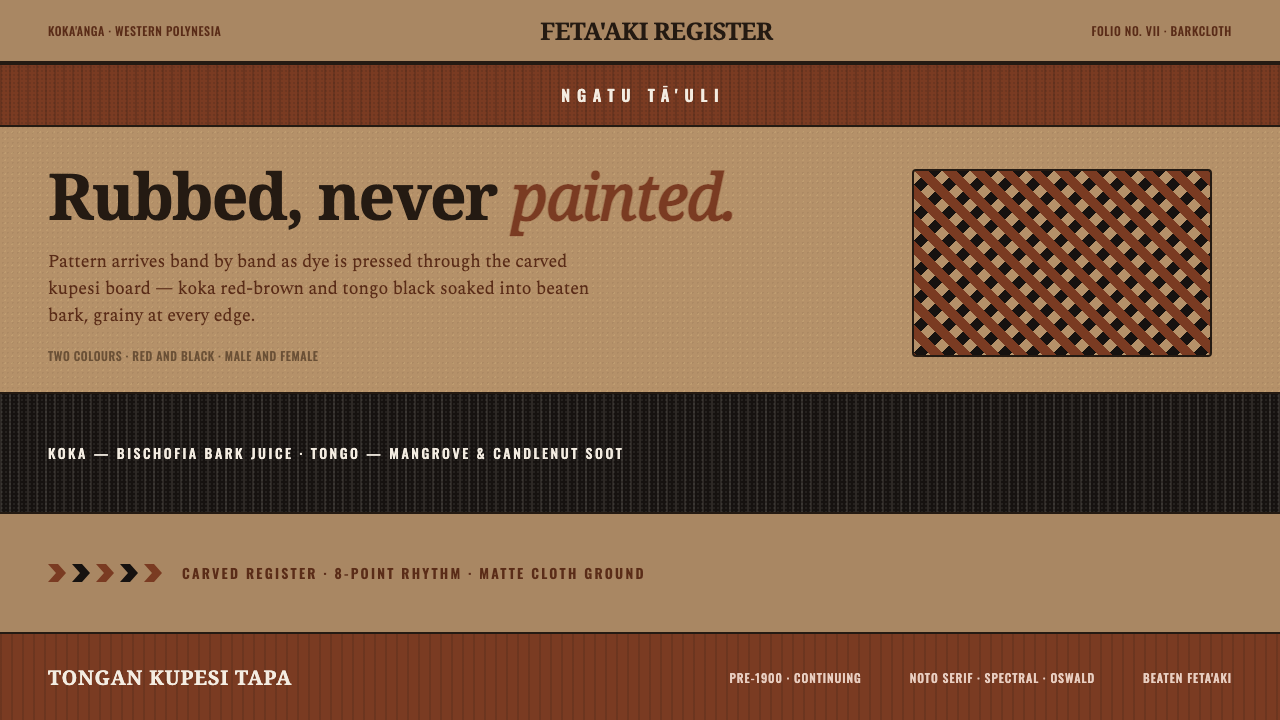 Tongan Kupesi TapaRubbed, never painted. Koka red and tongo black soak into beaten tan bark as…
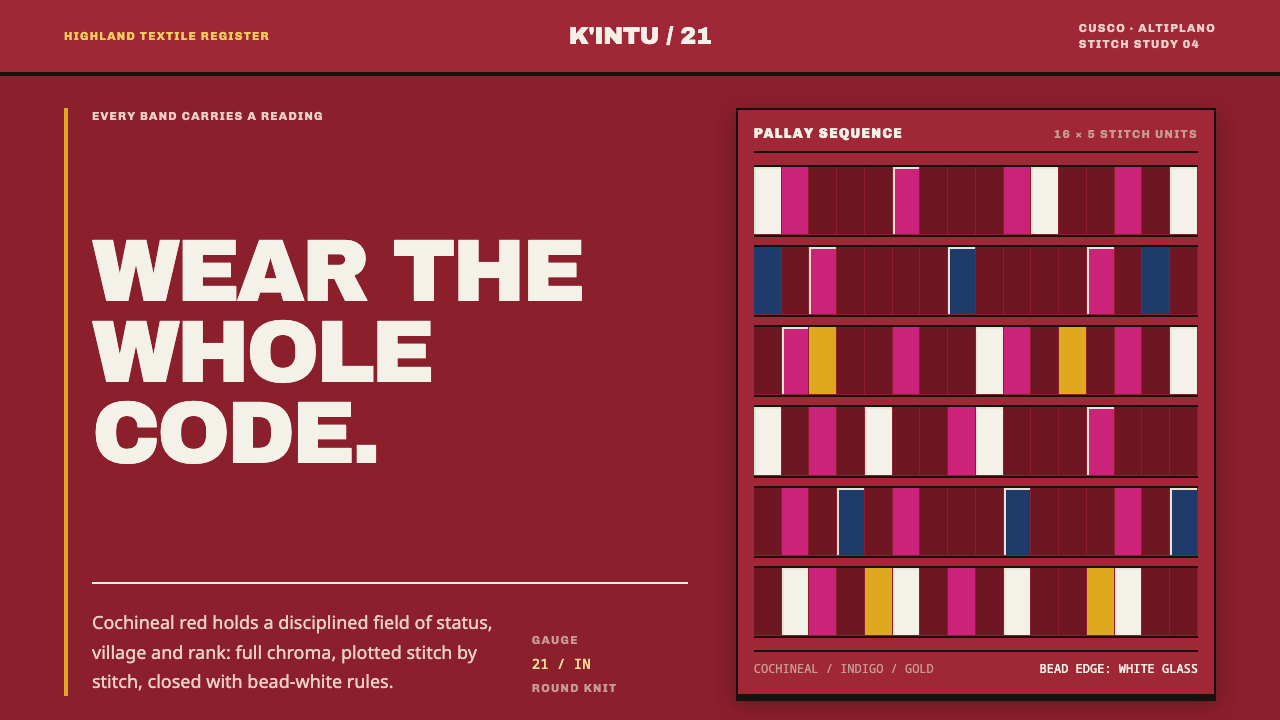 Andean ChulloOrnament carries a code. Cochineal red stacks strict stitch bands with bead-w…
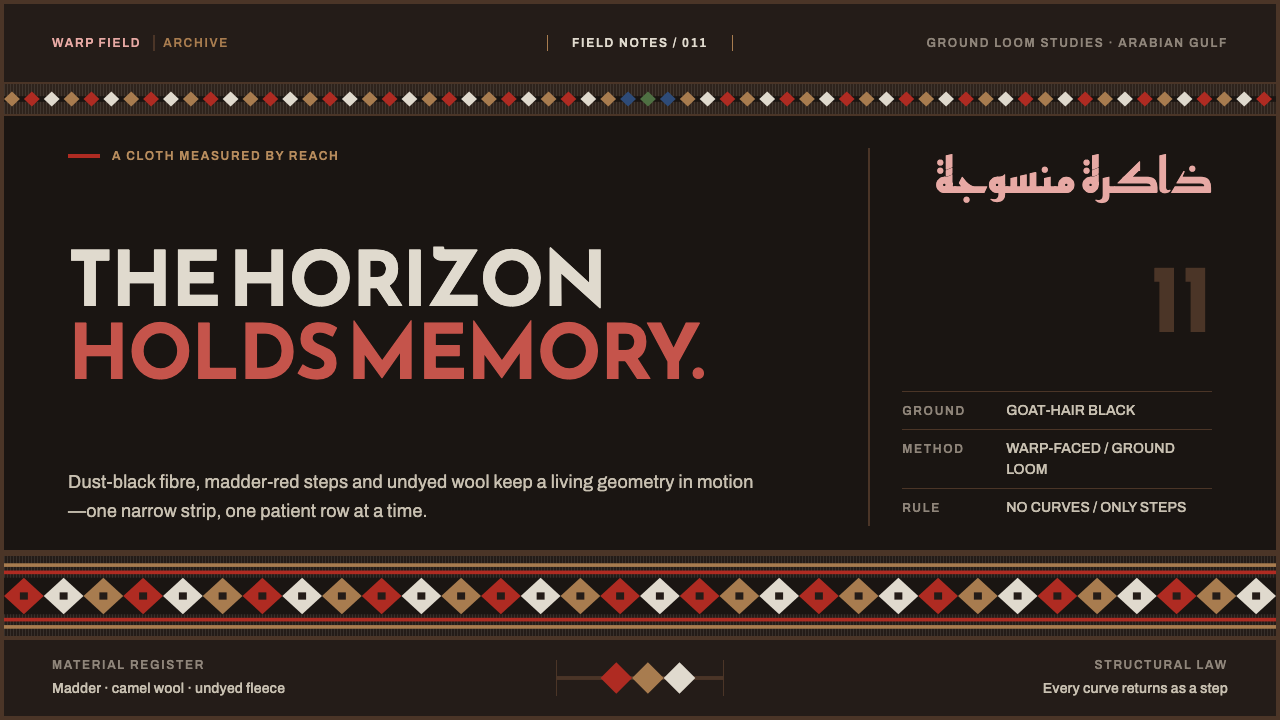 Emirati Sadu WeavingMemory runs in bands. Madder steps cross dusty goat-hair black with no curve…
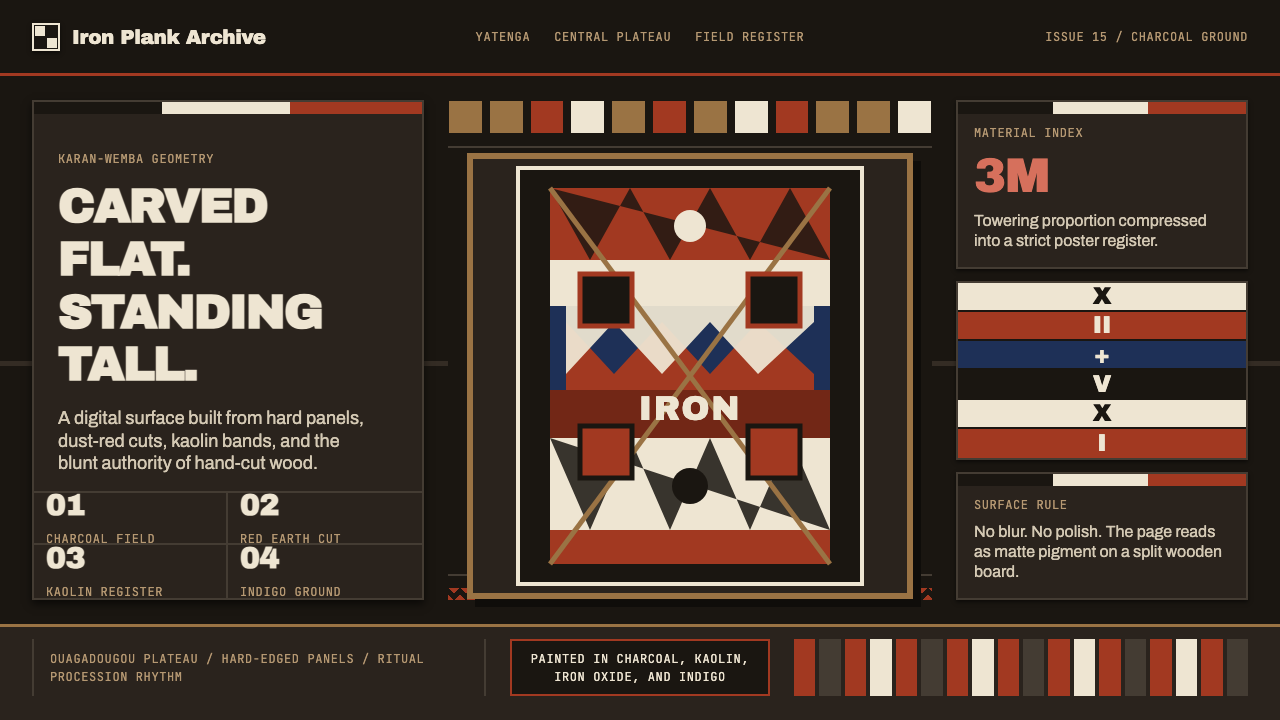 Mossi Burkina Plank MaskCarved, not rendered. Charcoal fields, dust-red cuts, and kaolin bands stack…