What is Sindhi Ralli Quilt?
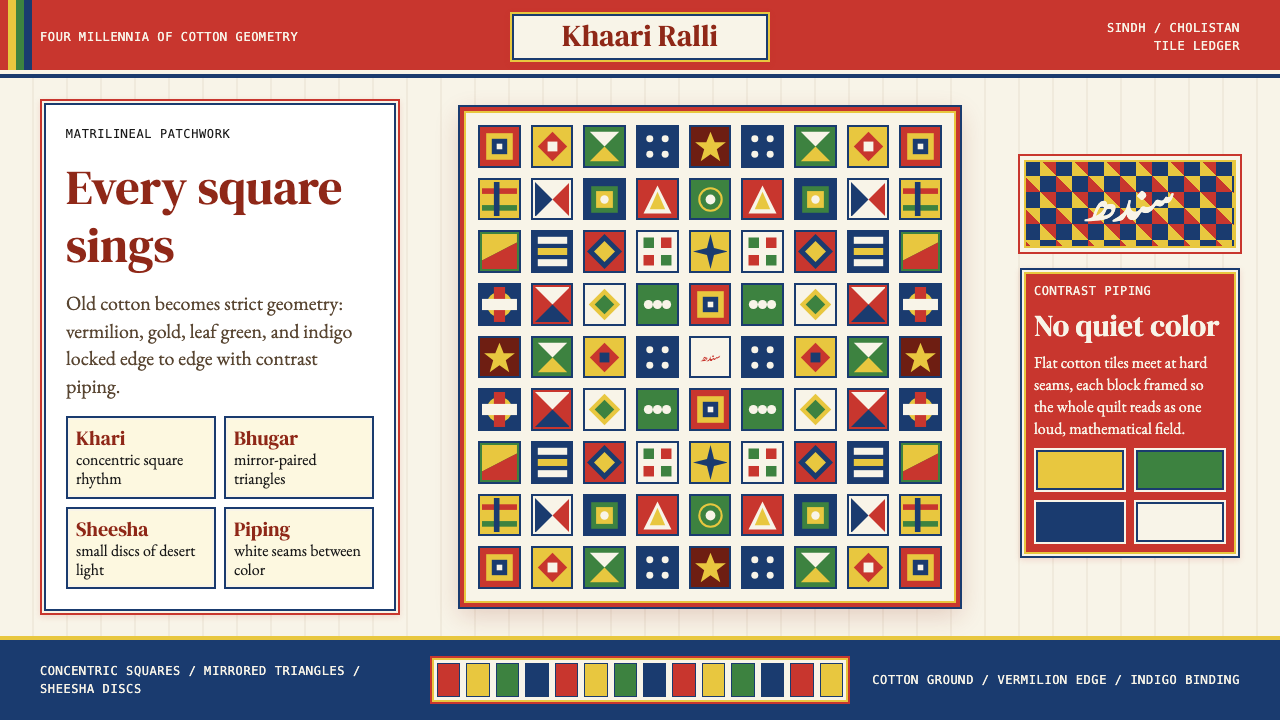
Ralli quilts from Pakistan's Sindh and Cholistan deserts are four-thousand-year-old geometric mosaics stitched from salvaged cloth — bold, loud, and mathematically exacting.
Sindhi Ralli Quilt in brief
Ralli is the traditional quilting art of women in Pakistan's Sindh province and the Cholistan Desert. The word 'ralli' derives from the Sindhi verb meaning 'to mix' or 'to join' — a literal description of the technique: worn saris, shalwar-kameez, and domestic fabric scraps are cut into geometric patches and joined with careful stitching into three-layer cotton bedding. The top layer carries the pattern, a cotton batt provides warmth in the middle, and a plain backing cloth closes the underside. Every completed Ralli is simultaneously a functional bedcover and a record of a household's textile life.
The visual logic of Ralli is uncompromising. Patterns are built from concentric squares, mirror-paired triangles, chevron bands, radiating diamond mandalas, and interlocking pinwheel blocks — all governed by strict bilateral or four-fold symmetry repeated across the entire surface. There is no empty ground, no ambiguous space. Color is deployed at maximum saturation: vermilion red, golden yellow, leaf green, indigo, rose pink, and orange appear together in five-to-seven-color combinations, each patch separated from its neighbor by a narrow border of white or cream cotton that functions like a musical rest — defining the beat so the colors can sing.
Small circular mirrors called shisha are sometimes stitched into the field, catching and scattering sunlight. This detail is not decorative whimsy; in the desert context where Ralli originated, reflected light carried protective and auspicious meaning. The overall effect — saturated geometry, white piping, mirror sparks — produces a visual intensity that reads equally well at the scale of a folded market stall and an unrolled twelve-foot bedspread.

Where does Sindhi Ralli Quilt come from?
The lineage of Ralli extends to the Indus Valley Civilization. Textile fragments recovered from Mohenjo-daro and Harappa — sites active around 2500 BCE — show evidence of cotton spinning and geometric fabric patterning consistent with the modular tile logic that defines Ralli today. While no direct documentary chain links those fragments to contemporary practice, the continuity of the geometric vocabulary in the same geographic region over four millennia is regarded by textile scholars as meaningful evidence of an unbroken matrilineal craft tradition.
Within recorded history, Ralli developed as a domestic art transmitted from mother to daughter across generations of rural Sindhi and Cholistani households. Quilts were made for personal use, as dowry gifts, and as community bonds — women gathered to share cloth and stitch together in sessions that functioned as both social occasions and skill exchanges. Because the raw material was salvaged clothing, each quilt encoded the family's economic history. A particularly vivid Ralli might incorporate cloth from a wedding garment, a festival outfit, and daily-wear kurtas spanning decades of family life.
The nineteenth and early twentieth centuries saw Ralli production intensify and diversify as trade expanded access to commercially dyed cloth, introducing brighter synthetic colors alongside traditional vegetable-dyed fabrics. Different sub-regions developed recognizable local styles: the tilework-inspired square grids of lower Sindh, the elongated triangle bands of upper Sindh, the densely mirrored versions from the Thar Desert borderlands. These regional distinctions meant that an experienced eye could read a Ralli's approximate provenance from its pattern vocabulary and color balance.
Academic documentation of Ralli began seriously in the 1980s and 1990s. American textile scholar Patricia Stoddard produced foundational research classifying Ralli types and tracing their geographic distribution across Sindh, Cholistan, and across the border into Kutch and Rajasthan in India. Pakistan's Lok Virsa Museum (National Institute of Folk and Traditional Heritage) built collections and organized exhibitions that brought Ralli to urban and international audiences. The Aga Khan Trust for Culture and the Behbud Association both funded cooperative programs connecting rural Ralli makers with export markets and design institutions, creating economic pathways that helped sustain the craft while also professionalizing its production.
What defines the Sindhi Ralli Quilt look?
Saturated Jewel-Tone Palette
The Ralli palette is built on five to seven simultaneously active colors — vermilion, golden yellow, leaf green, indigo, rose pink, and orange — all deployed at their maximum intensity with no muting or tonal reduction. Unlike traditions that use a dominant hue with supporting neutrals, Ralli treats each color as an equal voice in a chord. The overall effect is described by practitioners as 'singing' — a visual loudness that registers as joy rather than discord because the colors are separated by white piping that prevents simultaneous contrast from becoming cacophony.
White-Piped Grid Structure
Every color patch in a Ralli is separated from its neighbor by a narrow band of white or cream-colored cotton piping. This structural feature is not optional or decorative — it is the load-bearing visual device that makes the intense palette legible. The white border functions like a musical rest or a typographic leading: it defines the rhythm, prevents visual collision between adjacent high-saturation colors, and gives the eye a moment of pause before the next block of color. In modern digital applications, this principle translates to strong outlines or generous gap spacing between saturated color fields.
Strict Geometric Symmetry
Ralli patterns are governed by bilateral symmetry, four-fold symmetry, or radial repetition — never informal or organic arrangement. The primary motifs are concentric squares (tilted forty-five degrees into diamond orientation), mirror-paired triangles forming hourglass or pinwheel blocks, chevron bands, and radiating mandala forms. These shapes are not selected for symbolic meaning in isolation but for their capacity to lock together into a continuous, gap-free surface covering. The mathematics is exact: a patch that is slightly off-square will disrupt the entire repeat, so skilled Ralli makers develop an acute geometric precision that functions as a form of spatial intelligence.
Shisha Mirror Inlays
Small circular convex mirrors called shisha are stitched into Ralli surfaces using a specialized embroidery technique in which threads form a cage that holds each mirror in place without adhesive. In their original desert context, these mirrors served an auspicious function — reflecting evil spirits outward — as well as a practical one: catching sunlight and announcing presence from a distance. In visual terms, the shisha dots introduce a third texture to the composition of matte cloth and solid color. They scatter light unpredictably across an otherwise flat, gridded surface, introducing the only element of randomness in a system that is otherwise rigorously ordered.
Salvage-and-Mosaic Construction
Ralli is structurally a mosaic of salvaged cloth — the raw material is recycled domestic textile, primarily worn saris and shalwar-kameez that have passed their useful life as garments. The constraint of working from irregular salvage pieces is resolved by cutting everything into regular geometric shapes (most commonly squares or triangles) before any design work begins. This process — converting irregular material into regular modules — is the foundational act of Ralli making. It means the aesthetic is not imposed from the outside but arises from the logic of the material itself, a principle that resonates with contemporary sustainable design thinking.
Dense, Unrelieved Surface Coverage
Ralli compositions fill the entire surface without any neutral resting zone or negative-space composition. This is the opposite of minimalist design logic: rather than using empty space as an organizing element, Ralli resolves the compositional problem through pattern locks — each geometric unit interlocks with its neighbors so tightly that the eye reads the whole as a field rather than as discrete objects on a ground. This approach creates what designers call an 'all-over pattern' — a surface with no clear focal point, no hierarchy of figure and ground, only continuous, equal-weighted rhythm.
Mathematical Modular Scalability
The geometric logic of Ralli is modular and scalable in both directions: the same pattern unit can be repeated across a small lap quilt or a king-size bedspread without any compositional adjustment. This scalability is intrinsic to the grid-and-tile structure — the pattern has no 'correct' size, only correct proportions. For contemporary designers, this translates into an aesthetic that tiles naturally across responsive screen layouts, repeating backgrounds, and variable-format presentations without losing coherence. The pattern neither stretches nor strains; it simply gains or loses repetitions.

Who shaped Sindhi Ralli Quilt?
Patricia Stoddard is the American textile scholar most responsible for bringing systematic academic attention to Ralli quilts. Working from the 1980s onward, she documented regional Ralli types across Sindh and Cholistan, classifying patterns by their geometric vocabulary and tracing the cross-border presence of closely related quilting traditions in Kutch and Rajasthan. Her research established a taxonomic framework — distinguishing patchwork Ralli, appliqué Ralli, and embroidered Ralli as primary categories — that subsequent scholars and curators have built upon. Without her fieldwork, much of the geographic and typological diversity of the tradition would have remained undocumented.
Pakistan's Lok Virsa Museum in Islamabad has been the primary institutional custodian of Ralli documentation and display. The museum's collections include significant holdings of historical and contemporary quilts from across Sindh and Cholistan, and its exhibition programs have brought Ralli before urban Pakistani audiences and international visitors who would otherwise have no access to the tradition. Lok Virsa also maintains audiovisual archives of Ralli makers at work, preserving records of technique, song, and communal practice that accompany the quilting process. Its role as both collector and broadcaster has been central to the craft's transition from purely rural practice to nationally recognized cultural heritage.
The Aga Khan Trust for Culture, operating through its Historic Cities Programme and broader cultural development initiatives, funded cooperative programs in Sindh and Cholistan that connected rural Ralli makers with national and international markets. These programs addressed a structural vulnerability of the craft: its raw material (salvaged cloth) is abundant but its market reach was historically limited to local exchange. By facilitating export linkages, design collaborations, and quality standards without imposing external aesthetics, the Trust helped sustain economic incentives for Ralli production at a time when synthetic machine-made bedding was undercutting the handmade tradition on cost. Their approach modeled how heritage craft interventions can strengthen economic viability while preserving visual integrity.
The Behbud Association is a Pakistani non-governmental organization that has worked directly with women artisans in Sindh and Punjab to develop craft production as a livelihood program. For Ralli, Behbud's contribution has been at the supply-chain and training level: creating women's cooperatives, providing stable income to makers, and connecting cottage production to retail and wholesale channels. Their work has helped professionalize Ralli production without removing it from the communities where the knowledge lives. As a model, Behbud represents the kind of socially embedded craft organization that can sustain a matrilineal tradition through economic disruption without converting it into an export commodity detached from its origins.
How do you use Sindhi Ralli Quilt today?
Ralli's visual system is fully transferable to digital and print work, but it requires genuine commitment to its core logic: every color must be present at full strength, white or near-white borders must separate color fields, and the geometric structure must be mathematically consistent. Applying Ralli correctly means adopting its boldness deliberately — this is not a style that permits half-measures. Desaturating the colors, substituting gradients for flat patches, or softening the white borders will produce something that superficially resembles Ralli while losing its entire visual argument.
For presentation slides, Ralli offers an exceptional approach to both cover pages and content dividers. A cover slide built on Ralli logic uses a full-bleed field of interlocking geometric color blocks — concentric squares or a triangle grid — with the title dropped over a white or cream panel that functions exactly as the piping does in the original quilt: a legibility zone amid saturated color. Section divider slides benefit from the same approach, with the color combination shifted to signal the new chapter. Data slides can adopt Ralli's color vocabulary for charts and infographics: each category is assigned one of the jewel tones at full saturation, separated by white gap spacing in bar and pie formats.
For web dashboards and pricing pages, Ralli translates most effectively as an accent and border system rather than a full-surface treatment. Set the main content area on white or very light cream, then use the jewel-tone palette for status indicators, category tags, tier-differentiation cards, and hover states. The white-piping principle maps directly to bordered card components — a visible rule or gap between each card panel prevents visual collision between adjacent saturated elements. Navigation elements and iconography should be kept in a single neutral tone, reserving the full color vocabulary for data-carrying elements only.
For editorial and marketing work, Ralli's poster-like density is best deployed in hero sections, section breaks, and call-to-action blocks rather than body layout. A full-width hero built from a Ralli-derived tile pattern makes an immediate impression without any photographic content. Marketing pages can use alternating sections of solid jewel-tone backgrounds — each section a different color from the Ralli palette — with white text and white-bordered content modules maintaining the piping principle throughout. For print editorial, the tile pattern works well as a large pull-quote background or an end-matter decorative element, with body columns remaining on white for readability.
The most common mistake when applying Ralli is reducing the palette to two or three colors in the name of 'restraint.' Ralli's visual power is specifically a product of its chromatic fullness — the five-to-seven-color chord is the aesthetic, not an excess of it. A two-color version loses the mosaic quality and simply reads as a generic geometric pattern. The second common mistake is omitting the white border between color blocks, which causes adjacent saturated colors to vibrate uncomfortably. If your application genuinely cannot support five-plus full-saturation colors simultaneously, this style is probably not the right fit; choose a palette-reduced derivative rather than a degraded Ralli.

Sindhi Ralli Quilt — FAQ
What distinguishes Ralli from other South Asian patchwork traditions?
Ralli is distinguished from related traditions — such as Rajasthani gudri or Bengali kantha — primarily by its commitment to strictly geometric forms, its piped-border construction method, and its specific palette logic of maximum-saturation jewel tones separated by white. Kantha quilts from Bengal, for example, are worked with running-stitch embroidery over layered saris and frequently incorporate figurative and narrative imagery alongside geometric motifs. Gudri from Rajasthan uses a similar salvage-cloth base but tends toward more varied pattern scales and softer color combinations. Ralli's defining characteristics — the lock-tight geometric mosaic, the mandatory white piping, and the full-chord color deployment — constitute a visually distinct vocabulary even within the broader South Asian patchwork family.
Is Ralli always geometric, or are there figurative versions?
The dominant tradition is strictly geometric — concentric squares, triangle pairs, chevrons, and mandala forms. However, some regional variants, particularly embroidered Ralli from specific Sindhi sub-districts, incorporate stylized floral and leaf motifs alongside or woven into geometric frameworks. These hybrid forms are technically Ralli but visually distinct from the classic mosaic type. In contemporary production for export markets, some makers have introduced animal or landscape silhouettes to appeal to buyers seeking more illustrative imagery; purists and scholars tend to classify these as commercial adaptations rather than authentic examples of the tradition's geometric heritage.
How does the Ralli palette differ from other bold, saturated design styles like Memphis or Vaporwave?
All three use high-saturation color, but their underlying logic is fundamentally different. Memphis (1980s Italian design) deploys saturated color as part of a postmodern game with historical references — the colors are chosen to feel deliberately awkward, clashing, or kitsch-adjacent. Vaporwave uses saturated pink and cyan in a way that evokes nostalgia and digital-era unreality — the palette is mood-specific and culturally coded to a particular era. Ralli's color logic, by contrast, has no ironic or nostalgic dimension: it is simply the most direct and efficient way to produce visible beauty from salvaged cloth. Each color is chosen for maximum optical vibrancy, the combination is resolved by the white piping, and the result is joy without commentary. This absence of irony makes Ralli palettes feel warmer and more universal than Memphis, and more grounded and physical than Vaporwave.
Can Ralli work in a dark-background layout?
Traditional Ralli is always light-ground — the white or cream piping against cotton batting is canonical, and the jewel tones were selected to perform against a light base. A dark inversion is technically possible but requires significant adjustments. On a near-black ground, the white piping must increase in visual weight to maintain its separating function; the golden-yellow tones that anchor Ralli's warmth can become too dominant or too glowing against darkness; and the composition loses the clean legibility that the light ground provides. Dark-background Ralli derivatives work best when the palette is simplified to two or three of the jewel tones — typically indigo, vermilion, and gold — with the piping converted to a light cream or off-white gap rather than pure white. The result is richer and moodier than the original but also lower in the graphic intensity that defines the tradition.
Is Ralli suitable for brands aiming for a minimal or luxury feel?
Ralli is not naturally aligned with minimalist aesthetics, and the fit with conventional luxury branding is specific rather than general. Minimalism depends on negative space, restraint, and tonal reduction — all of which Ralli deliberately refuses. However, Ralli's full chromatic intensity is not incompatible with cultural luxury: in South Asian contexts, rich color saturation and dense pattern have historically signified celebration, prosperity, and social generosity rather than the austerity that Western luxury codes sometimes favor. A brand anchored in South Asian heritage, festival goods, artisan craft, or warm cultural expressiveness can deploy Ralli-derived aesthetics with genuine luxury connotations. For Western-default minimal-luxury positioning — clean white packaging, muted palettes, wide margins — Ralli would require significant attenuation, at which point the core aesthetic has usually been lost.
Related design styles
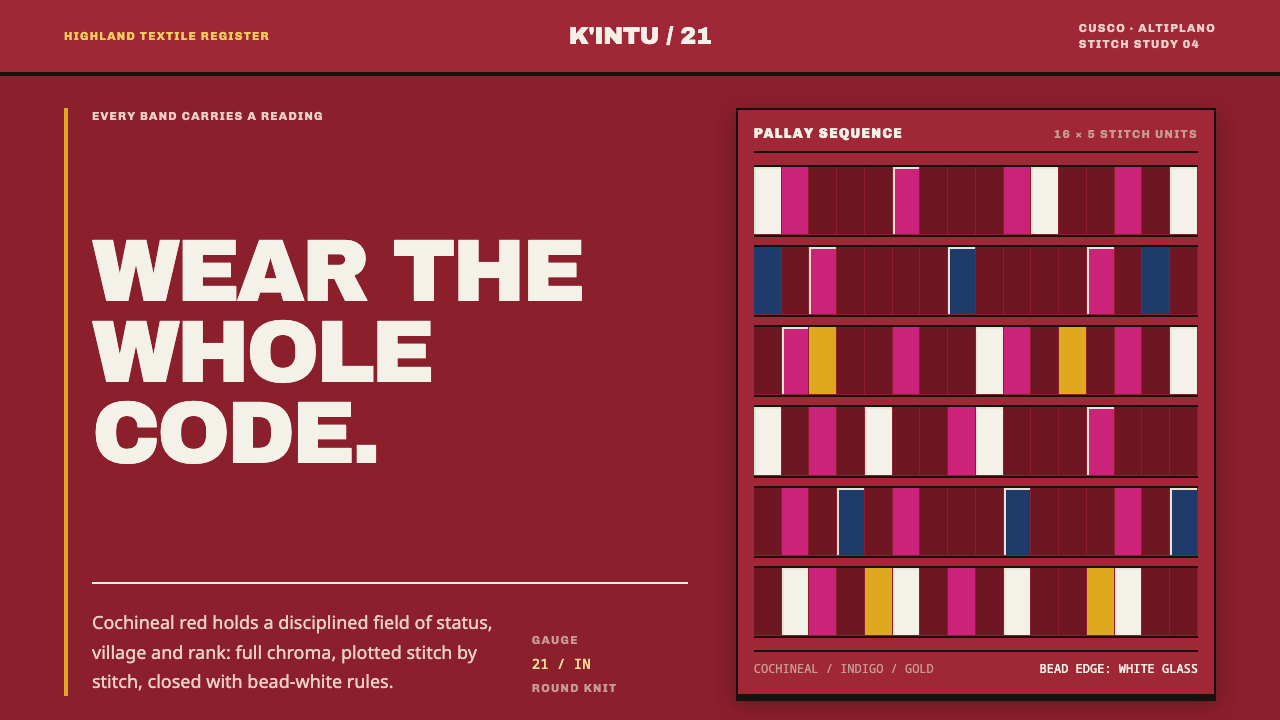 Andean ChulloOrnament carries a code. Cochineal red stacks strict stitch bands with bead-w…
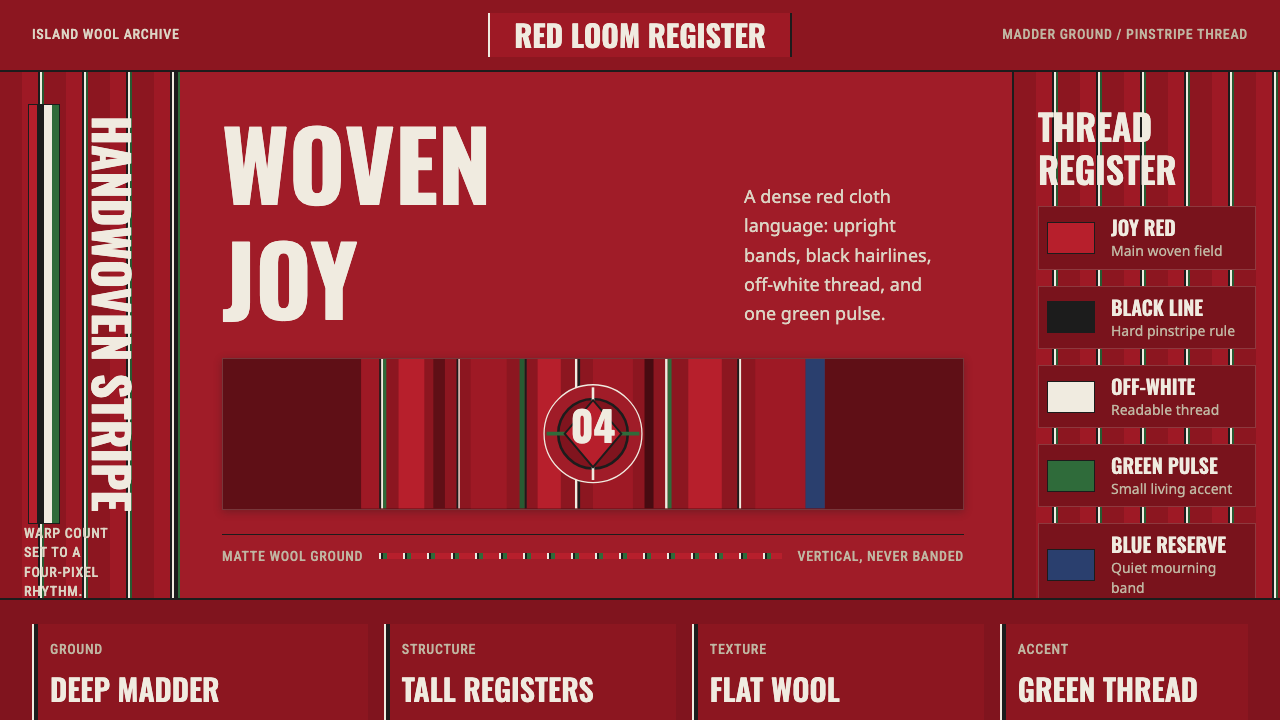 Estonian Kihnu Island SkirtJoy is woven vertical. Madder red ground, Oswald stripes, black and green pin…
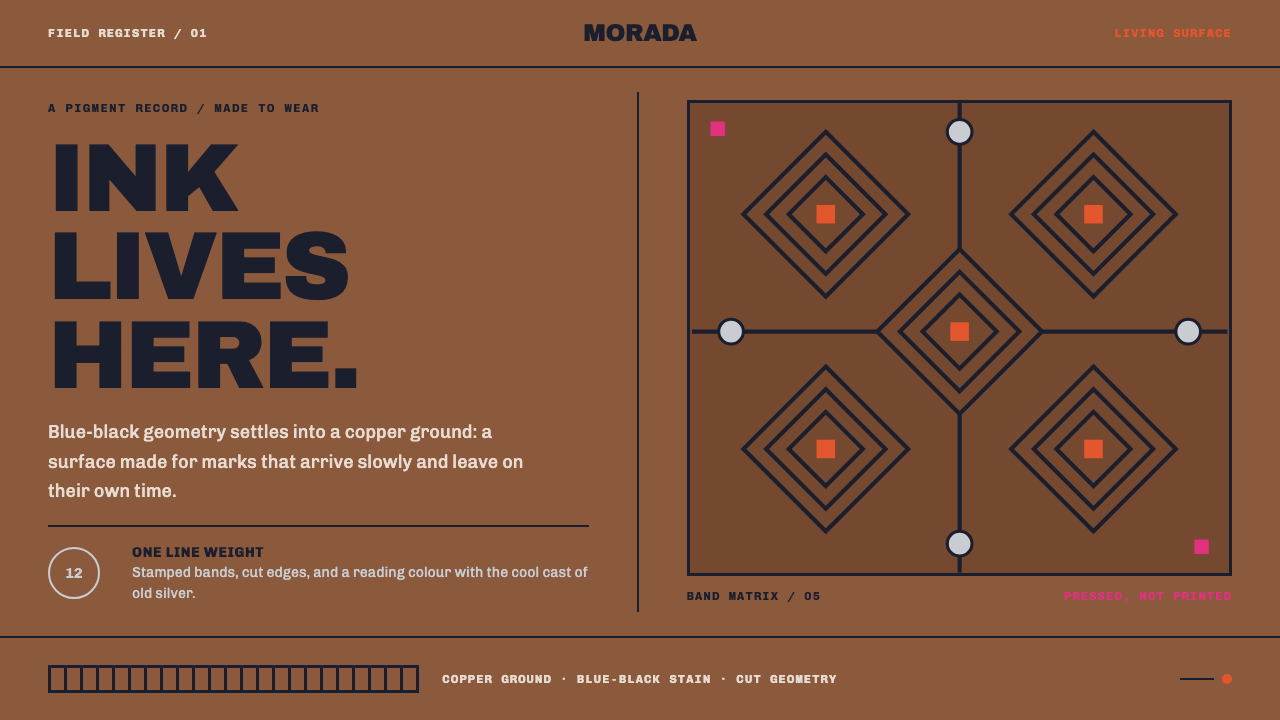 Emberá JaguaA living stain, never a print. Blue-black diamond bands press across copper s…
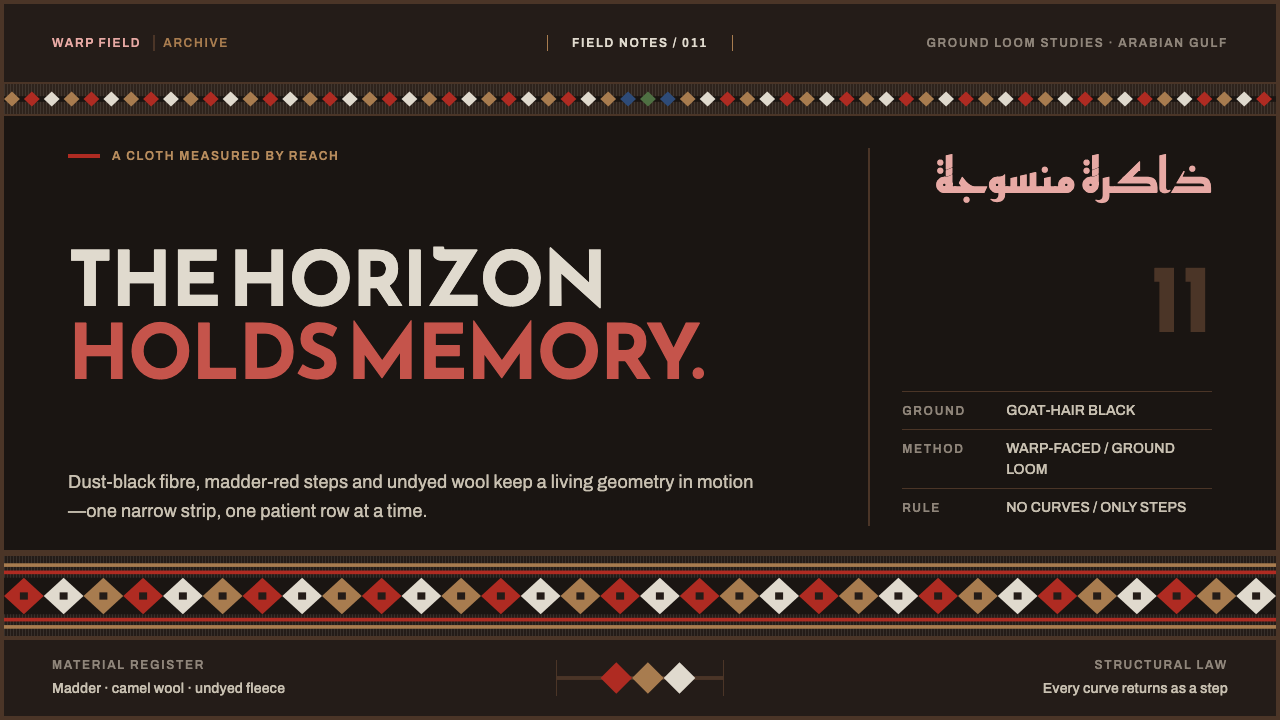 Emirati Sadu WeavingMemory runs in bands. Madder steps cross dusty goat-hair black with no curve…
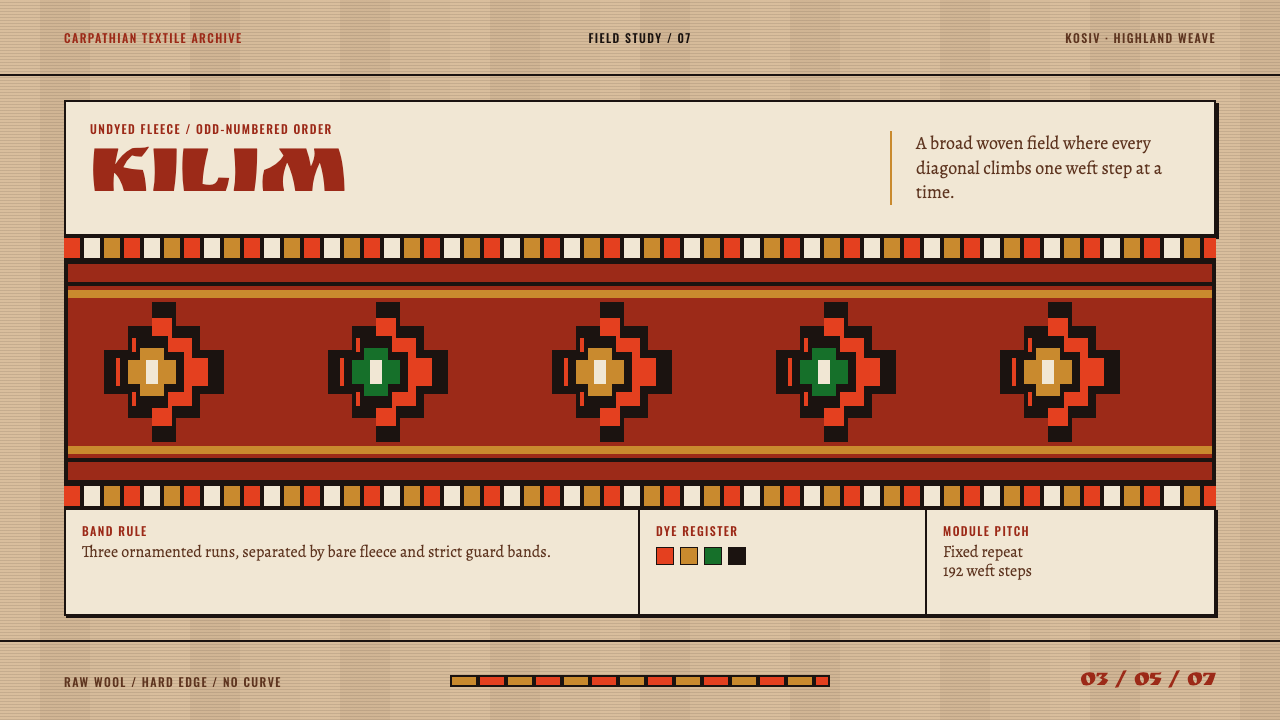 Hutsul KilimGeometry is the craft. Hot red stepped rhombs repeat across raw fleece bands.
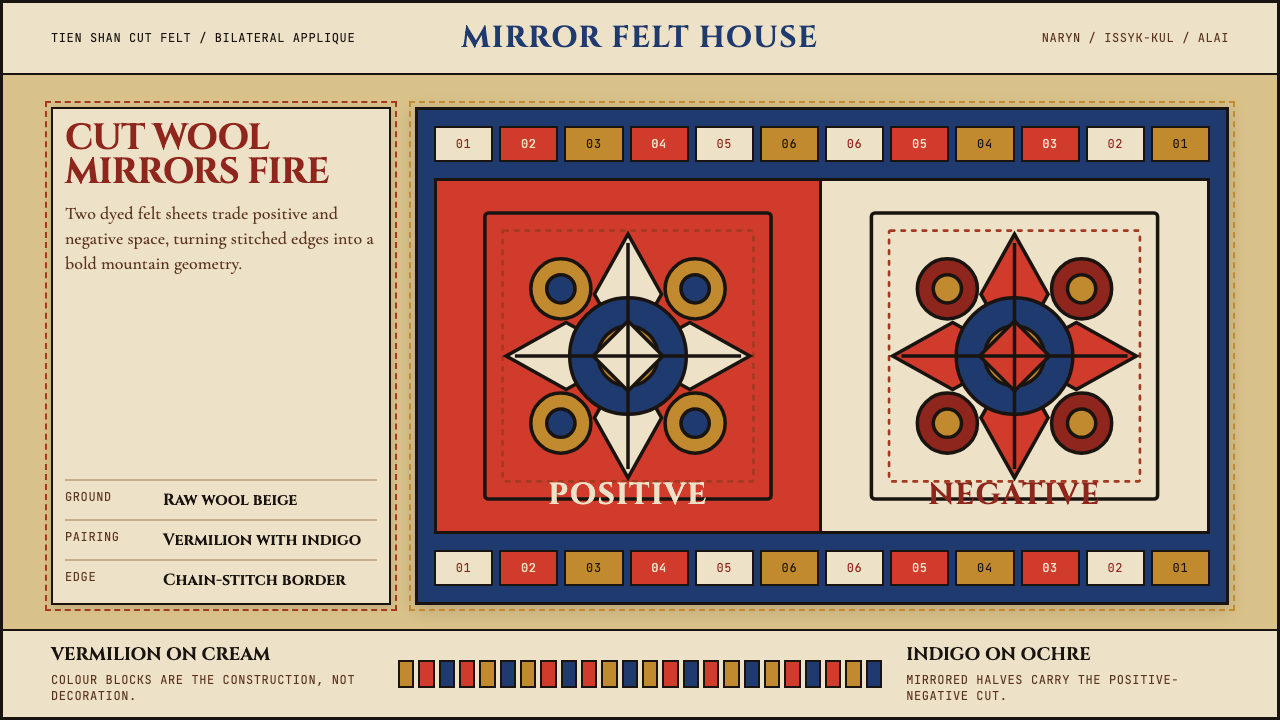 Kyrgyz Shyrdak Felt RugCut felt becomes structure. Vermilion-indigo mirror blocks stitch positive to…