What is Akan Adinkra (Ghana)?
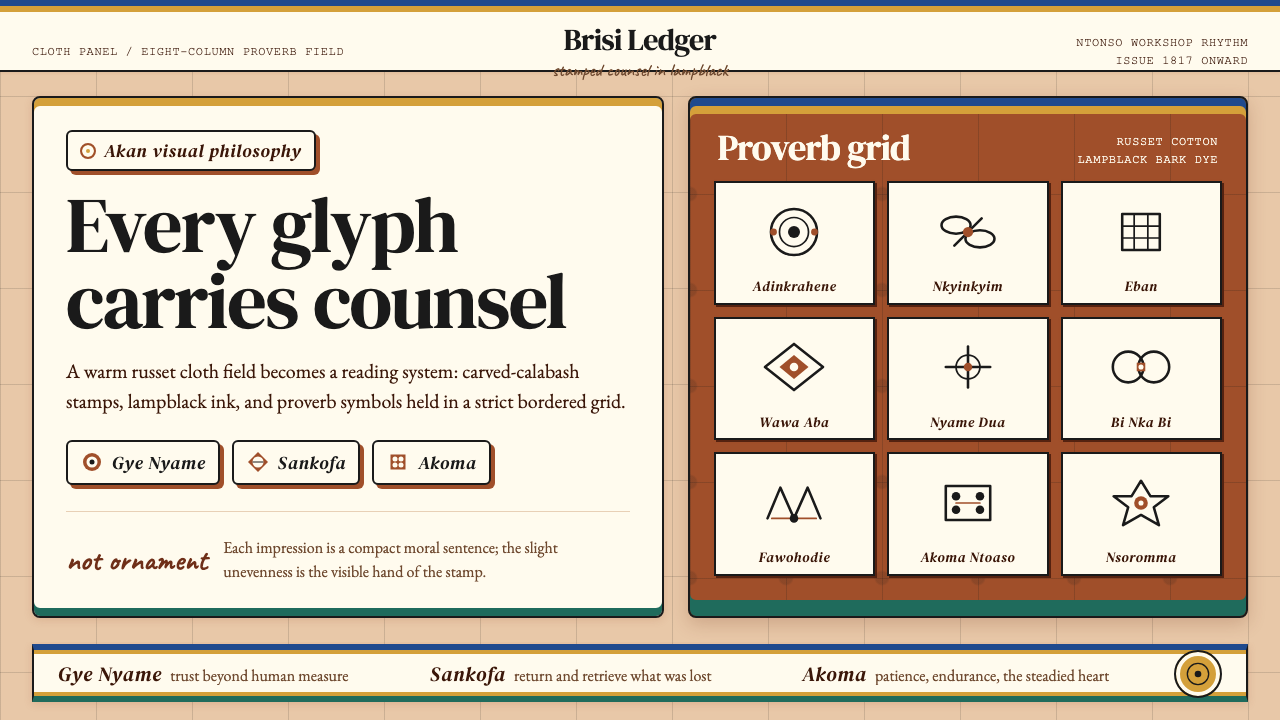
Akan Adinkra turns proverbs into cloth — each carved-calabash stamp a moral argument pressed in lampblack onto warm russet-orange cotton.
Akan Adinkra (Ghana) in brief
Akan Adinkra is a visual-philosophy symbol system originating from the Akan ethnic group of Ghana and the broader West African region. More than one hundred codified pictogram-symbols form the core vocabulary, each encoding a proverb, a moral concept, or an ancestral teaching. This is not illustration — it is writing that thinks in pictures. Gye Nyame proclaims that nothing is mightier than God; Sankofa commands you to return and retrieve what was left behind; Akoma, shaped like a heart, speaks of patience and endurance.
The traditional aesthetic is built from three interlocking elements: a warm russet-orange base cloth hand-woven from cotton, the dense lampblack ink derived from boiled tree bark, and the carved calabash gourd stamps that transfer symbol to textile. Glyphs are arranged in an orderly grid across the cloth surface, with narrow border strips in indigo, gold, or deep green framing the field. Each stamped impression carries a slight irregularity — the inevitable human signature of a hand-pressed tool — and it is this quality of controlled imperfection that distinguishes authentic Adinkra from mechanical reproduction.
The Adinkra system operates simultaneously as language and as cloth. A person wearing or gifting an Adinkra garment is making a statement in a shared vocabulary that every member of the community can read. The symbols are not decorative accessories to the cloth; the cloth exists to carry the symbols. This philosophical inversion — textile as text — is what separates Adinkra from purely ornamental textile traditions and makes it one of the most sophisticated information-carrying design systems ever developed outside the Roman alphabet.

Where does Akan Adinkra (Ghana) come from?
The oldest surviving Adinkra cloth with a confirmed date is housed in the British Museum and dates to 1817, when the British explorer Thomas Edward Bowdich documented the tradition during his mission to the Ashanti kingdom. But the symbols themselves — and the philosophical infrastructure they encode — are rooted in Akan cultural practice stretching back to the Akan kingdoms of the fifteenth and sixteenth centuries. Adinkra was not invented on a particular day; it crystallized over generations as the Akan people developed a systematic visual language for expressing the ethical and spiritual values that governed community life.
The name Adinkra derives from the Twi word for 'farewell' or 'goodbye,' and the cloth was traditionally associated with funeral and mourning rites. A chief, elder, or bereaved family would wear Adinkra cloth as a visible public statement: the specific symbols selected communicated who the deceased was, what virtues they embodied, and what messages the living wished to send across the boundary between worlds. This funerary context gave the symbols their gravity — they were never frivolous marks but weighted communications addressed to both the living and the ancestral dead.
The center of Adinkra production has long been Ntonso village, located near Kumasi in the Ashanti Region of Ghana. Here, specialist craftsmen — most notably the Boakye and Frempong family lineages — have maintained the tradition of carving calabash stamps, preparing bark-dye ink, and stamping cloth across generations. The scholar Robert Sutherland Rattray produced the first systematic English-language catalog of Adinkra symbols in the early twentieth century, an effort that contributed to preserving and transmitting the vocabulary to later researchers and designers worldwide.
In the twentieth century, Adinkra made a decisive transition from a regional funerary tradition to a global visual language of Pan-African identity. The independence movements across sub-Saharan Africa in the 1950s and 1960s drew on Adinkra symbols as legible, dignified expressions of African philosophical and aesthetic autonomy — a counterweight to the erasure of precolonial visual cultures under European rule. Today, Adinkra symbols appear in the architecture of public buildings in Accra, in the diplomatic gifts of Ghanaian heads of state, in academic scholarship on African semiotics, and in the work of designers, typographers, and visual artists across the African diaspora. The tradition remains alive in Ntonso, where artisan families continue to produce cloth using the original methods alongside contemporary adaptations.
What defines the Akan Adinkra (Ghana) look?
Color Field
The Adinkra palette is built on saturated earth tones — the warm russet-orange of undyed and naturally dyed cotton cloth provides the dominant ground, a color that reads simultaneously as soil, ochre, and sunset. Against this field, the stamp ink is a deep lampblack: not a neutral black but one with a slightly organic, matte quality that absorbs light rather than reflecting it. Accent colors — indigo, gold, and deep emerald — appear as narrow border strips along the cloth's edges, creating a sense of ceremonial framing without competing with the stamped symbols. The palette reads as warm, weighty, and rooted in the natural material world.
Symbol Geometry
Adinkra symbols are highly geometric, built from combinations of curves, spirals, interlocking forms, radial structures, and bold outlines. Most glyphs fit within an implied square or circle boundary, allowing them to tile predictably across a grid. The geometry is not mechanical — the forms carry biological and cosmological references (hearts, birds, crocodiles, celestial bodies) distilled into their geometric essences — but the visual result is systematic and scalable. Line weight tends toward the bold: symbols are meant to register at a glance, stamped in one action, readable from a distance.
Grid Rhythm
The organization of symbols across cloth follows a grid logic rooted in the physical stamp-and-repeat process. Glyphs are arranged in even rows and columns, with consistent gutters of unpainted ground between each impression. This regularity is not sterile: because each stamp is hand-pressed, the registration drifts slightly, giving the grid a breathing, living quality. The overall pattern reads as orderly from a distance and handmade up close — a productive tension between system and craft.
Semantic Density
Unlike purely decorative pattern systems, every Adinkra symbol is a compressed argument. A single glyph can encode a full proverb, a cosmological belief, and a social norm simultaneously. This semantic density means that an Adinkra composition can be read at two levels: as a visual pattern by the uninitiated, and as a layered philosophical text by those who know the vocabulary. The design challenge — and its power — lies in the fact that the visual form is beautiful regardless of whether the viewer can decode it.
Craft Imperfection
The slight unevenness of hand-stamped impression is not a defect to be corrected but an essential quality of the system. Over-regularized, digitally perfect Adinkra reproductions lose something fundamental: the evidence of human engagement, the breath between identical marks, the trace of a practice sustained over generations. Authentic Adinkra textile carries the weight of its making. In contemporary design applications, this quality of controlled imperfection — pattern with variation, system with humanity — is one of the most valuable aspects of the tradition to consciously honor.
Border Framing
Traditional Adinkra cloth is bounded by one or more narrow strips of contrasting color — typically indigo, gold, or emerald — that run along the woven edges. These borders function as a frame that separates the symbolic field from the body that wears it, marking the cloth as a distinct communicative space rather than simple fabric. In contemporary design applications, this border logic translates into the use of strong edge lines or accent strips that contain and elevate the symbolic content within a composition.
Communal Legibility
Adinkra symbols were designed to be read by a community that shares the code — not as private marks but as public speech. The visual system assumes a viewer who is also a participant in the culture that produced it. This communal dimension shapes the aesthetics: symbols are bold enough to be seen across a gathering, specific enough to be individually parsed, and varied enough that a single cloth can carry a nuanced argument through symbol selection. The aesthetic is social before it is individual.

Who shaped Akan Adinkra (Ghana)?
The Boakye family represents one of the oldest lineages of Adinkra master craftsmen in Ntonso village, the historic center of Adinkra cloth production near Kumasi in Ghana's Ashanti Region. Across generations, Boakye artisans have maintained the full production chain: harvesting and boiling the Badie tree bark to produce the black stamp ink, carving new stamps from dried calabash gourds, preparing the hand-woven base cloth, and executing the stamping process itself. Their continuation of the craft is not nostalgic preservation but an active, living practice that simultaneously maintains ancient symbol vocabularies and responds to contemporary demands from Ghanaian markets and international designers.
Thomas Edward Bowdich was a British explorer and writer whose 1817 mission to the Ashanti court in Kumasi produced the first substantial European documentation of Adinkra cloth. His book, Mission from Cape Coast Castle to Ashantee (1819), included visual records of Adinkra symbols that gave Western scholarship its first systematic window into the tradition. While Bowdich's account reflects the assumptions and limitations of its colonial era, the documentation he produced has proved indispensable to later researchers tracing the historical development of the symbol system. The 1817 cloth he recorded in the British Museum remains one of the most important dated reference objects in Adinkra study.
Robert Sutherland Rattray was a British colonial officer and anthropologist who served in the Gold Coast (present-day Ghana) and produced foundational scholarly work on Akan culture in the early twentieth century. His 1927 book Religion and Art in Ashanti remains a landmark reference, containing the most comprehensive early catalog of Adinkra symbols with their names, proverb associations, and visual forms. Rattray's documentation — whatever its political context — preserved knowledge of dozens of symbols and their meanings at a moment when rapid social change threatened transmission of oral and material cultural knowledge. His catalog has been the baseline from which all subsequent Adinkra scholarship has worked.
Like the Boakye family, the Frempong lineage of Ntonso village represents a continuous multigenerational tradition of Adinkra production. The Frempong craftsmen have been particularly associated with the formal transmission of stamping technique and symbol carving to apprentices, maintaining the educational dimension of the craft alongside its productive practice. Their work demonstrates that Adinkra is not a museum artifact but an ongoing craft economy: cloth produced in Ntonso today travels to markets in Accra, Kumasi, and Abidjan, as well as to international buyers seeking authentic material for design, fashion, and ceremonial use.
While not a single individual, the Pan-African visual reclamation movement of the twentieth century collectively transformed Adinkra from a regional Akan tradition into a globally recognized symbol of African intellectual and aesthetic heritage. Designers, scholars, and cultural activists across Ghana, Nigeria, Senegal, and the African diaspora in the Americas and Europe drew on Adinkra symbols as a counter-narrative to colonial erasure, citing them as evidence that pre-colonial Africa possessed sophisticated, literate visual systems. This collective movement has been responsible for Adinkra's presence in contemporary architecture, graphic design, postage stamps, academic heraldry, and digital iconography worldwide.
How do you use Akan Adinkra (Ghana) today?
Applying Adinkra in contemporary design work is an exercise in understanding what the system actually does — a visual language organized around semantic symbols, warm earth tones, grid rhythm, and the tension between system and craft — rather than superficially borrowing its most visible features. Done well, Adinkra-influenced design communicates rootedness, depth of meaning, and respect for accumulated communal wisdom. Done carelessly, it flattens a rich philosophical tradition into surface pattern.
For presentation slides, the Adinkra visual system offers a compelling approach to both cover and content pages. A cover slide benefits from centering a single bold symbol — selected for its meaning, not merely its visual appeal — against the warm russet ground, with a title set in strong, legible type beneath or beside it. The symbol should be large enough to command the slide's visual weight. Content slides work well with a restrained grid: one or two Adinkra symbols used as section markers or ornamental anchors in the margin, a consistent warm ground, and text organized in clear hierarchies without decorative clutter. Data slides can take on a diagrammatic warmth if chart elements are toned with the earth palette — russet bars, lampblack axes, gold or indigo accent highlights — giving analytical content a grounded, material quality.
For web interfaces and dashboards, the Adinkra tradition's grid-and-symbol logic translates effectively into component design. Navigation icons or section identifiers drawn from or inspired by Adinkra glyphs carry immediate visual distinctiveness and implicit depth. Backgrounds should stay warm and muted — not pure white, but a slightly toasted cream — to allow lampblack-toned text and symbol-weight interface elements to read clearly. Pricing pages and feature comparison tables benefit from the tradition's strong border logic: clear ruled lines in deep indigo or gold separate rows and columns, creating a sense of ceremonial structure that elevates the content beyond a generic grid.
For editorial design and marketing materials, the Adinkra vocabulary is especially powerful when used to establish thematic identity across a series. A report or editorial publication can adopt a different Adinkra symbol for each chapter or section, with the symbol's meaning directly reflecting the section's content — building a symbolic architecture that rewards attentive readers. Marketing materials benefit from the tradition's poster-like boldness: large, centered symbols against saturated russet grounds function as memorable visual anchors, while the border strip motif can be adapted into consistent design elements — horizontal rules, callout boxes, divider lines — that create visual coherence across a campaign.
A common mistake when working with Adinkra aesthetics is treating the symbols as purely decorative motifs divorced from their meanings, or applying so many symbols simultaneously that the composition loses the focus and intentionality that makes the tradition powerful. Another frequent error is digitizing Adinkra-inspired marks with such mechanical precision that the craft quality — the slight variation, the matte texture, the warmth of hand-pressed ink — is entirely eliminated. Contemporary design applications should find ways to retain or evoke that quality of controlled imperfection, whether through texture overlays, slightly irregular stroke weights, or restrained use of single symbols as focal points rather than tiling the entire surface. The tradition is most compelling when its depth of meaning is honored, not when it is reduced to a palette and a pattern.

Akan Adinkra (Ghana) — FAQ
Are Adinkra symbols protected intellectual property, or can any designer use them?
Adinkra symbols exist as a form of traditional cultural expression that predates modern intellectual property frameworks, and there is no single entity that holds legal copyright over the core symbol vocabulary. However, this legal fact does not resolve the ethical question. Using Adinkra symbols in commercial design work without understanding their meanings, without attribution to the Akan cultural tradition, or in contexts that trivialize their significance is widely considered appropriative and disrespectful. Designers working with Adinkra are strongly encouraged to research the specific meanings of the symbols they select, to credit the Akan and Ghanaian origins of the tradition explicitly, and where possible to commission or source authentic cloth and motifs from Ntonso artisans directly.
Does every Adinkra symbol have a single fixed meaning, or can meanings vary?
Adinkra symbols do not have single, fixed, universally agreed-upon meanings. The core vocabulary is relatively stable — Gye Nyame universally refers to God's supremacy, Sankofa to the importance of learning from the past — but many symbols carry layered or contextually variable meanings, and different scholars, artisan families, and regional communities sometimes assign slightly different proverb associations to the same glyph. Additionally, the oral tradition that carries Adinkra knowledge has evolved over centuries, and some meanings recorded by Rattray in the 1920s are interpreted differently today. Designers should treat published symbol lists as starting points for research, not authoritative finales, and should be humble about the likelihood that their sources are incomplete.
How do I distinguish between authentic Adinkra cloth and mass-produced imitations?
Authentic Adinkra cloth from Ntonso village is hand-stamped using carved calabash gourds and bark-derived lampblack ink on hand-woven or hand-selected cotton. The resulting cloth shows slight impression irregularity — no two stamps are perfectly identical — has a matte, slightly textured ink surface that differs from the uniform sheen of screen-printed or digitally printed versions, and typically features the characteristic warm russet ground with narrow indigo, gold, or emerald border strips. Mass-produced imitations tend toward mechanical regularity, glossy or fully saturated ink, and simplified or incorrectly drawn symbol forms. When in doubt, sourcing directly from Ntonso artisans or established Ghanaian craft exporters is the most reliable approach.
Can Adinkra aesthetics work in a predominantly dark or monochrome color scheme?
The canonical Adinkra palette is warm-ground and earth-toned — the russet cloth and lampblack ink are the traditional anchors. A dark inversion is possible and has contemporary precedent in Pan-African design contexts, but it requires careful handling. On a dark ground, the symbol weight becomes the primary organizing element, and the warm earth tones that give traditional Adinkra its distinctive presence must be reintroduced as accents — warm gold or russet highlights against deep charcoal or near-black. A fully desaturated or cool monochrome application loses the tradition's essential warmth and risks reading as generic geometric pattern rather than culturally grounded symbol system. The most successful dark applications retain a warmth in the ground tone and use accent colors derived directly from the traditional palette.
Which Adinkra symbols are most widely recognized, and which are better avoided in casual design contexts?
The most widely recognized Adinkra symbols internationally are Gye Nyame (supreme power of God, depicted as a complex bilateral symmetrical form), Sankofa (the importance of learning from the past, depicted as a bird looking backward or a heart-shaped spiral), and Adinkrahene (chieftaincy and greatness, depicted as concentric circles). These three appear most frequently in Pan-African design and diaspora contexts and are the best-documented in accessible English-language sources. Symbols with specific funerary associations — such as those traditionally reserved for mourning contexts — are better approached with care and ideally with consultation from Akan cultural practitioners, particularly when the design context is celebratory or commercial. As a general principle, the more a design context diverges from the original communal and ceremonial functions of the tradition, the more important it becomes to engage deeply with the meanings of the specific symbols selected.
Related design styles
 Akan Carved StoolMatte wood carries memory. Honey amber, Marcellus type, and crescent-column r…
 Mauritian Sega Creole (1810)Rhythm made visible. Coral stripes, cream sleeve type, and ravanne circles ca…
 Andhra Cheriyal Scroll PaintingSaturated oral memory. Mineral red registers, mustard diamonds, and serif son…
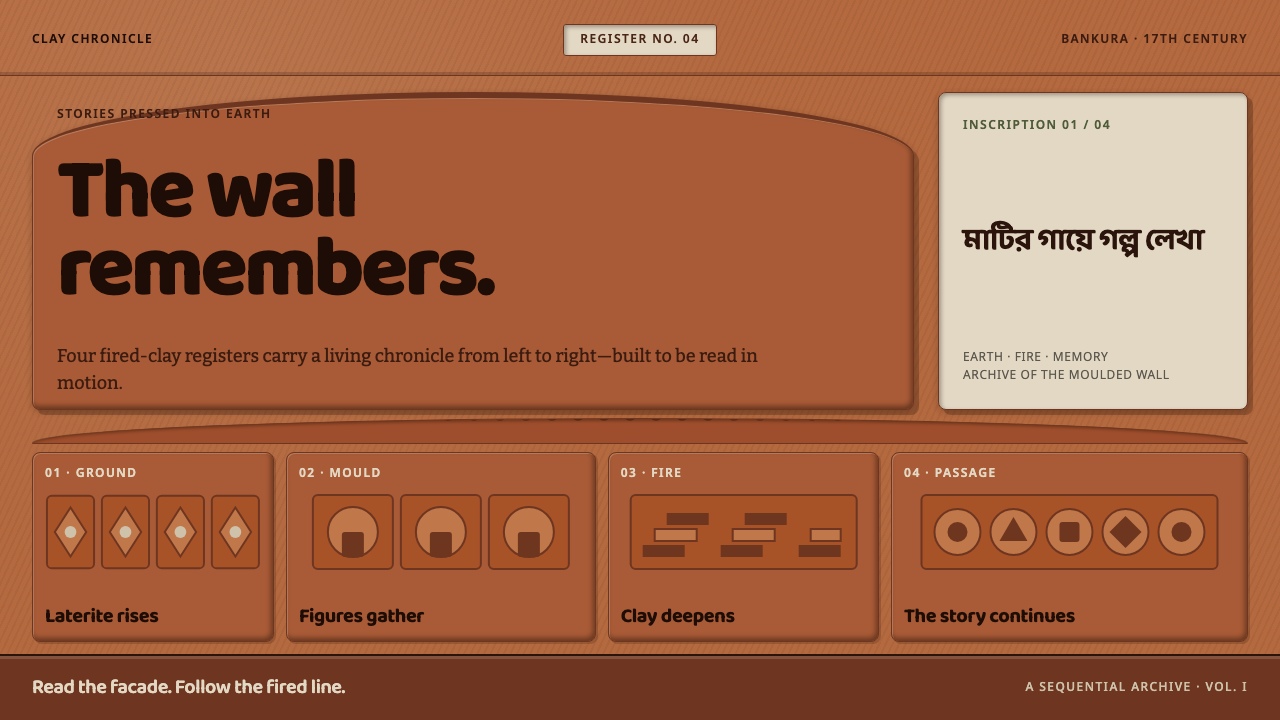 Bishnupur Terracotta TemplesThe wall tells the story. Fired-clay relief panels unfold in warm horizontal…
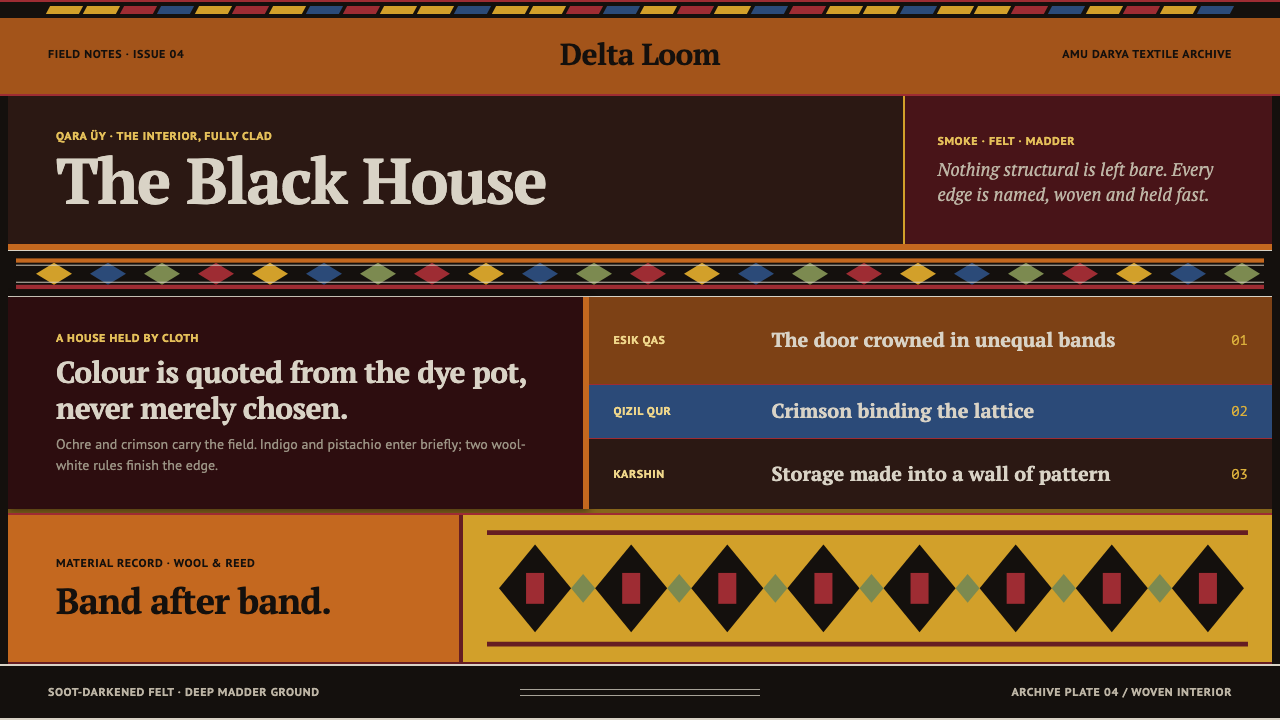 Karakalpak Yurt InteriorNo surface is left bare. Ochre, crimson and indigo bands wrap a smoke-darkene…
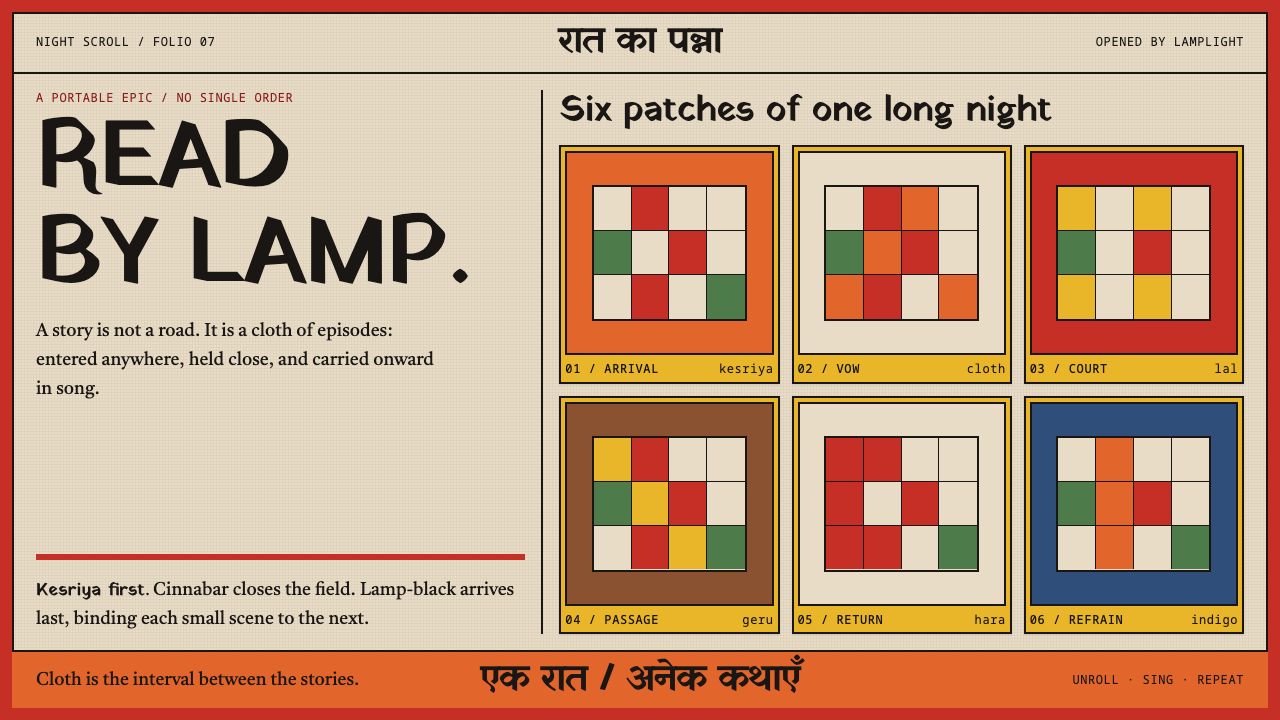 Phad Scroll PaintingAn epic refuses a single order. Kesriya cells and cinnabar rules open by lamp…