What is Chinese Spring Festival Red Couplet?
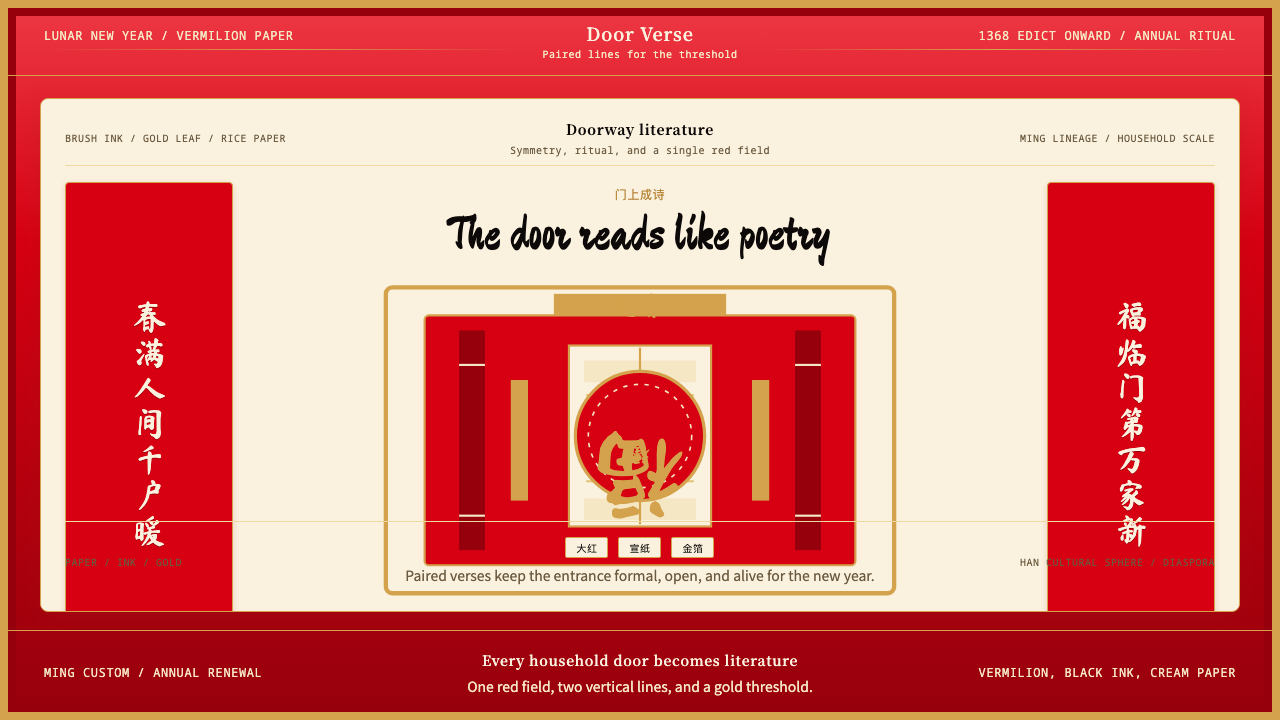
Vermilion paper, paired brushstrokes, and six hundred years of doorway poetry — the spring couplet is China's most democratic design system.
Chinese Spring Festival Red Couplet in brief
The Chinese Spring Festival red couplet — known as chunlian (春联) — is a visual tradition practiced by hundreds of millions of households each Lunar New Year. Two vertical strips of saturated vermilion paper, each bearing a line of brush-written auspicious verse, are pasted on the left and right door frames of a home or business, with a shorter horizontal strip across the lintel completing the composition. The entire arrangement is governed by a strict bilateral symmetry: the right strip leads, the left responds, and every character on one side is answered by a corresponding character on the other in meter, tone, and meaning.
The visual language is spare and absolute. Deep red dominates as the ground — not a decorative choice but a cultural one, red being the color of luck, vitality, and the warding of evil in Han cultural belief. Against this ground, characters are rendered in mineral-black ink or gold, both of which achieve maximum legibility and visual weight. No other colors appear. No illustrative imagery competes with the text. The calligraphy itself — typically in one of the classical scripts, from the formal kaishu to the fluid xingshu — is the sole ornament and the sole message. Content and form are indistinguishable.
Translated into interface design, this system becomes a discipline of constraint and ceremony. The palette reduces to three elements: a saturated warm red ground, a near-white or cream content surface evoking the texture of unbleached paper, and a deep ink tone for all typographic work. Composition inherits the couplet's bilateral logic — paired vertical columns, mirror-balanced layouts, the sense that every element on the left has a counterpart on the right. Calligraphic heading type carries the ritual weight of the brushstroke, while the overall effect projects the warmth, festivity, and ceremonial gravity that the tradition embodies.

Where does Chinese Spring Festival Red Couplet come from?
The spring couplet traces its roots to the peachwood charms (桃符, táofú) of the Five Dynasties period, roughly the tenth century. These were rectangular boards of peachwood hung at the entrance of homes during the new year, inscribed with the names of the door gods Shenshu (神荼) and Yulü (郁垒) to ward off evil spirits. The practice was ancient and widespread, but the form was still that of an amulet rather than a literary composition. The transformation from charm to couplet — from protective symbol to paired verse — began when literati began replacing the divine names with original lines of poetry, retaining the bilateral structure while filling it with literary content.
The decisive historical moment came in 1368, when Zhu Yuanzhang (朱元璋), the founding emperor of the Ming dynasty, issued an edict mandating that every household in the capital Nanjing affix a pair of couplets on red paper to their door frames before the new year. This act accomplished two things simultaneously: it democratized a practice previously associated with the educated class by making it universal, and it fixed the material — red paper — as canonical. The emperor is said to have personally toured the city on New Year's Eve to verify compliance and to compose impromptu couplets for households that had none. Whether the stories are precisely accurate matters less than what they reveal: the spring couplet was already understood as a civic and cultural obligation, not merely a personal custom.
Over the subsequent five centuries of Ming and Qing rule, the couplet tradition ramified into an elaborate folk art with its own craft economy. Papermakers in regions like Jiajiang in Sichuan and Fuyang in Zhejiang developed specialized production of the deep red paper used exclusively for couplets, achieving saturations and surface textures suited to absorbing brush ink without bleed. Inkmakers compounded formulas that would remain legible across the months between one new year and the next. Itinerant calligraphers set up stalls at markets to write couplets for households without a skilled brush hand — a practice still visible in contemporary China each January. The form's strict prosodic requirements (tonal antithesis, semantic parallelism, equal character count on both strips) meant that skill in couplet composition became a recognized literary accomplishment, with competitions and anthologies dedicated to the form.
In the modern period, the tradition survived political turbulence with remarkable resilience. The Cultural Revolution (1966–1976) suppressed many traditional observances, but the spring couplet returned with force when restrictions eased, and it was formally integrated into the national cultural heritage framework in 2006, when the custom of writing and posting spring couplets was included in China's first National Intangible Cultural Heritage List. Today, the couplet is practiced across the entire Han cultural sphere — mainland China, Taiwan, Hong Kong, Singapore, and Chinese diaspora communities worldwide — and has been adopted in some form by other East Asian cultures that absorbed Confucian ceremonial practice. Mass-produced printed couplets exist alongside hand-brushed ones, and digital versions appear on screens and social media, but the fundamental visual grammar — red ground, black or gold verticals, bilateral pair — remains unchanged across six centuries.
What defines the Chinese Spring Festival Red Couplet look?
Color Ground
The dominant ground is a deep, fully saturated vermilion red — not the orange-leaning red of warning systems nor the blue-shifted crimson of Western formal contexts, but a warm, dense red with cultural specificity. This red is never softened into a pastel and never darkened toward maroon; it is always at full chromatic intensity. Against it, content surfaces appear in a near-white or unbleached cream tone that reads as unpigmented paper rather than a designed neutral. The contrast between the two is deliberate and maximal.
Calligraphic Typography
Heading text draws from the brush-calligraphy tradition. The appropriate register ranges from the formal upright strokes of regular script (kaishu) to the fluid, slightly compressed energy of running script (xingshu) — both are acceptable; cursive grass script (caoshu) is too abbreviated for design headlines and should be avoided. What matters is that the letterforms carry visible evidence of the brush: varying stroke weight within each character, the slight flare at stroke terminals, the organic variation between characters that no digital geometric type can replicate. Body text may use a clean Ming-style or Song-style typeface for legibility, with the calligraphic heading type providing the ceremonial register.
Bilateral Symmetry
The couplet form demands perfect structural pairing: every element on the right has a counterpart on the left, and the two sides hold each other in balance. In design, this translates into layout structures built around a vertical central axis, with paired columns, mirrored section blocks, and visual weight distributed equally between the two halves. This is not the asymmetric tension of Bauhaus composition but its opposite — a deliberate mirror logic that communicates completeness, harmony, and ceremonial order. Layouts need not be robotically identical on both sides; tonal variation within a shared structure is correct and expected.
Vertical Orientation
Classical Chinese text runs from top to bottom, right to left, and the couplet reinforces this directionality absolutely. In design adapted from this tradition, vertical text blocks, tall narrow containers, and portrait-oriented compositional logic all carry cultural resonance. Even when horizontal text is necessary for interface legibility, structural elements — dividers, accent bars, iconographic columns — should be oriented vertically wherever possible, reinforcing the sense of upright stature that the couplet embodies. The vertical emphasis also conveys elevation and formality, qualities historically associated with classical Chinese architectural and calligraphic proportion.
Gold and Ink as Accent
Against the red ground, two accent options define the tradition: mineral-black ink for everyday couplets and gold leaf or gold-pigment ink for auspicious and formal contexts. In design, both work as high-contrast typographic options on red backgrounds, with black carrying a grounded, scholarly gravity and gold projecting celebration and prestige. The two should not be used simultaneously as competing typographic voices on the same surface; choose one as the primary text treatment and reserve the other for hierarchy differentiation — gold for a single headline tier, black for supporting text, for instance, or vice versa.
Auspicious Iconography
Beyond the couplet strips themselves, the broader Spring Festival visual vocabulary includes a set of recurring symbolic motifs: the character for luck or fortune (福) displayed prominently — often inverted to mean luck has arrived; the plum blossom signaling resilience through winter; the red lantern as the definitive festival marker; stylized cloud and wave scrollwork derived from classical textile and ceramic patterns. In design work, these elements function as accent graphics rather than compositional anchors — a single repeated motif in a border or background, a horizontally stretched cloud pattern as a divider. They should be used with selective restraint: one or two per composition, never as wallpaper.
Festive Warmth Without Frivolity
The spring couplet is celebratory in intent but solemn in execution. The calligraphy is careful, the verse is literary, the ritual is civic. This combination of warmth and gravity distinguishes the aesthetic from generic festive design, which tends toward high-energy chaos and visual competition. In interface terms, this means the festive feeling is carried by color temperature and compositional order rather than by animation, confetti, or visual noise. The red ground is warm; the typography is controlled; the white space within compositions is generous. The result should feel like a ceremony, not a party.

Who shaped Chinese Spring Festival Red Couplet?
The founding emperor of the Ming dynasty, Zhu Yuanzhang issued the 1368 edict that transformed the spring couplet from an elite literary practice into a universal civic obligation. By mandating red paper and doorframe placement for every household in Nanjing, he fixed the material and compositional grammar of the form for the six centuries that followed. His reported habit of personally touring neighborhoods on New Year's Eve to inspect couplets — and to write them for households that had none — made him the tradition's most consequential patron. The Ming dynasty's administrative reach also spread the practice across the empire, converting a regional literati custom into a pan-Chinese annual ritual.
Wang Xizhi, the fourth-century calligrapher revered as the Sage of Calligraphy (书圣), did not write spring couplets — the form did not yet exist in his era — but his aesthetic legacy shaped every brushstroke that followed. His Orchid Pavilion Preface (兰亭序) established ideals of balance, rhythm, and organic variation in letterforms that Chinese calligraphers have studied and emulated for seventeen centuries. The stylistic criteria applied to couplet calligraphy — the quality of the brushstroke, the distribution of ink within each character, the spatial relationship between characters — are ultimately Wang's criteria. Any appreciation of the spring couplet's typographic dimension is an appreciation, at some remove, of his influence.
Qi Gong (1912–2005) was the twentieth century's most celebrated Chinese calligrapher and an Imperial Palace Museum curator whose work on classical calligraphy scholarship bridged the traditional and modern eras. His distinctive style — a refined, airy regular script with exceptional internal balance — became one of the most influential calligraphic models of the late twentieth century, appearing on institutional plaques, book covers, and commemorative couplets throughout China. His scholarship on the history and aesthetics of Chinese calligraphy helped preserve the theoretical framework within which spring couplet practice is understood, ensuring that the tradition's literary and formal standards survived into the digital age.
The unsung practitioners of the couplet tradition are the itinerant brush calligraphers who set up seasonal stalls at new year markets across China — and who have done so in an unbroken line from at least the Song dynasty. These anonymous craftspeople are the tradition's transmission mechanism: they make the form accessible to households without a skilled brush hand, they carry regional stylistic variations from one location to another, and they maintain live calligraphic practice in an era of digital typography. Their stalls, with red paper rolls and ink-blackened brushes spread across folding tables, remain one of the most visible signs that the Spring Festival visual tradition is alive rather than archival.
How do you use Chinese Spring Festival Red Couplet today?
The Chinese Spring Festival red couplet style is best applied in contexts where warmth, cultural resonance, and a sense of occasion are desired alongside structural legibility. Unlike more austere historical styles, this system is inherently celebratory — the red ground signals good fortune, the bilateral composition implies completeness, and the calligraphic type carries ceremonial weight. These qualities make it well suited to Lunar New Year campaigns, culturally specific brand identities, festival-season product launches, and any context in which Chinese or broader East Asian cultural affiliation is a meaningful dimension of the design brief.
For presentation slides, the system works at two distinct levels. Cover slides benefit from a full red ground with paired vertical title treatment — the main title running in one large calligraphic block on one side and a subtitle or date in a smaller, answering block on the other, with generous white space between them. Content slides should shift to the cream or near-white ground, reserving the red for accent bars, section headers, or horizontal marker lines. Data slides in this style take a diagrammatic approach: charts should read as clean, high-contrast figures on light grounds, with the red used selectively to highlight the key data series rather than applied to all elements uniformly. The overall deck should feel like a beautifully printed ceremonial document rather than a generic business presentation.
For web interfaces, this style suits landing pages, campaign microsites, and culturally specific product pages more naturally than it suits utility dashboards or complex SaaS interfaces. A landing page applying this system would use the red ground for the hero section and major call-to-action areas, with content sections dropping to cream or white grounds for extended reading. Navigation and interactive elements should use the deep ink tone rather than the red, reserving red for primary actions only. Pricing pages can apply the bilateral layout logic effectively: two or three tiers displayed as paired vertical columns with symmetric spacing, allowing the form itself to communicate the comparison. Avoid applying the full red ground to dense information environments — the chromatic intensity that works for a festival cover overwhelms a feature matrix.
For editorial and marketing work, the spring couplet style provides a strong framework for Lunar New Year editorial packages, cultural features, and brand campaigns targeting Chinese-speaking audiences during the festival season. A magazine spread in this style would use a red ground for the opening spread with large calligraphic display type, transitioning to a cream ground for the body of the article with a consistent red rule marking section divisions. Marketing materials — social cards, email headers, outdoor posters — benefit from the style's inherent boldness: the red-and-gold or red-and-black contrast reads across distances and in small formats, and the auspicious iconography (the inverted Fu character, the lantern, the plum blossom) provides a recognizable seasonal signal that works even when the calligraphic type is absent.
A common mistake when applying this style is conflating it with generic Chinese or Asian festive design, which tends to add dragons, excessive gold gradients, cartoon-style illustrations, and cluttered pattern work. The spring couplet aesthetic is distinguished by its restraint: two colors (red and either black or gold), bilateral structure, calligraphic type, and selective use of traditional motifs. Designers who feel the urge to add more visual elements are almost certainly adding noise rather than meaning. The tradition's six-hundred-year survival depends precisely on its refusal to accumulate decoration — every household door, every year, the same red paper and the same bilateral form, with only the verse changing. That discipline is the design lesson.

Chinese Spring Festival Red Couplet — FAQ
Is this style appropriate for non-Chinese-New-Year contexts, or does it always read as seasonal?
The deep red ground and bilateral paired layout do carry strong Lunar New Year associations in most audiences who recognize the tradition. However, the association is not inescapable — it depends on how many of the tradition's specific signals appear simultaneously. A design that uses the red ground but replaces calligraphic type with a modern sans-serif, omits auspicious iconography, and uses a single-column layout rather than a bilateral pair will read as culturally warm and Chinese-influenced without triggering an exclusively festival reading. The key signals that make the seasonal reading unavoidable are: calligraphic paired verticals plus red-and-gold palette plus explicit auspicious motifs. Remove one or two of these and the cultural reference remains while the seasonal specificity softens.
How does this style differ from other Chinese aesthetics like ink-wash painting or Tang dynasty patterns?
The spring couplet style is specifically a folk and civic art form — it belongs to the vernacular tradition rather than the elite court or scholar-artist tradition. Ink-wash painting (水墨画) belongs to the literati painting tradition and operates through suggestion, misty gradation, negative space as atmosphere, and the representation of nature. Tang dynasty textile and ceramic patterns are ornamental and dense, built on repeating geometric or floral motifs. The couplet aesthetic, by contrast, is typographic at its core — its primary material is language rendered in calligraphy, not image. The red ground is bold and populist rather than subtle and refined. The bilateral structure is civic and symmetrical rather than dynamic and asymmetric. These distinctions matter for application: mistaking the spring couplet style for a general Chinese aesthetic and adding ink-wash texture or Tang scrollwork will produce an incoherent hybrid.
Can the red-and-gold palette work in dark mode or low-light interfaces?
Red-and-gold on a dark ground is historically attested — festival lanterns and ceremonial objects often use exactly this combination — and it can work in digital contexts, but it requires care. The challenge is that a very dark background shifts the red toward appearing more intense and almost alarming rather than festive. A dark adaptation works best when the ground is not pure black but a deep warm brown or near-black with a slight warm cast, evoking lacquerware rather than a blank screen. On this ground, gold reads as genuinely luminous and celebratory, while red can be used sparingly for accent only. The cream paper surface should not appear in a dark-mode version — it breaks the environmental coherence. This dark variant suits ceremonial overlays, loading screens, and special occasion UI states rather than extended content interfaces.
How should auspicious text like the Fu character be handled — always literal, or can it be abstracted?
The Fu character (福, meaning luck or fortune) is one of the most culturally loaded single characters in the Chinese visual tradition, and its use in design requires some care. Used literally and correctly — large, centered or prominently placed, optionally inverted (倒福) to signal luck arriving — it is immediately understood and carries its full cultural resonance. Abstracted as a geometric motif or reduced to a pattern element, it can work as surface texture or border detail without the full cultural weight, though designers should be aware that many Chinese audiences will still recognize the character and its meaning even in stylized form. The pitfall to avoid is using it as a purely decorative pattern without cultural awareness — the character has specific meaning and specific occasions for use, and treating it as arbitrary decoration can read as culturally obtuse.
Does the style work for brands that are not Chinese-owned or Chinese-targeted?
It can, but the context and intent must be considered carefully. The spring couplet tradition is specific and culturally significant — it is not generic East Asian decor. When a non-Chinese brand applies this style thoughtfully, in a clearly defined seasonal or cultural celebration context, with genuine engagement with the tradition's meaning rather than surface borrowing, the result can be respectful and effective. The relevant questions are: Is there a genuine occasion (Lunar New Year campaign, a culturally specific partnership, a market where Chinese cultural resonance is directly relevant)? Is the specific tradition being engaged with rather than a vague gesture toward Chinese-ness? Is the calligraphic and compositional work done with craft rather than approximation? Affirmative answers to all three support use; negative answers suggest the style is being deployed as cultural shorthand rather than cultural engagement.
Related design styles
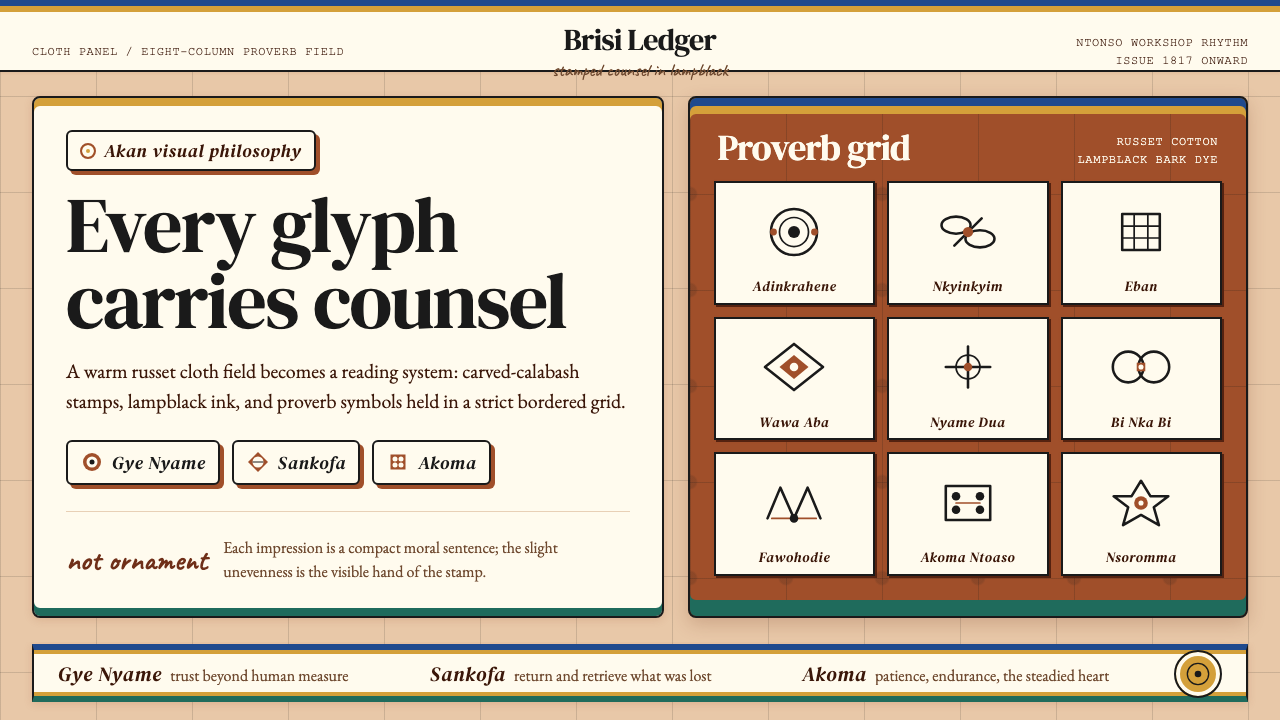 Akan Adinkra (Ghana)Proverbs become cloth. Russet grids, lampblack serif marks, and gold-edge ban…
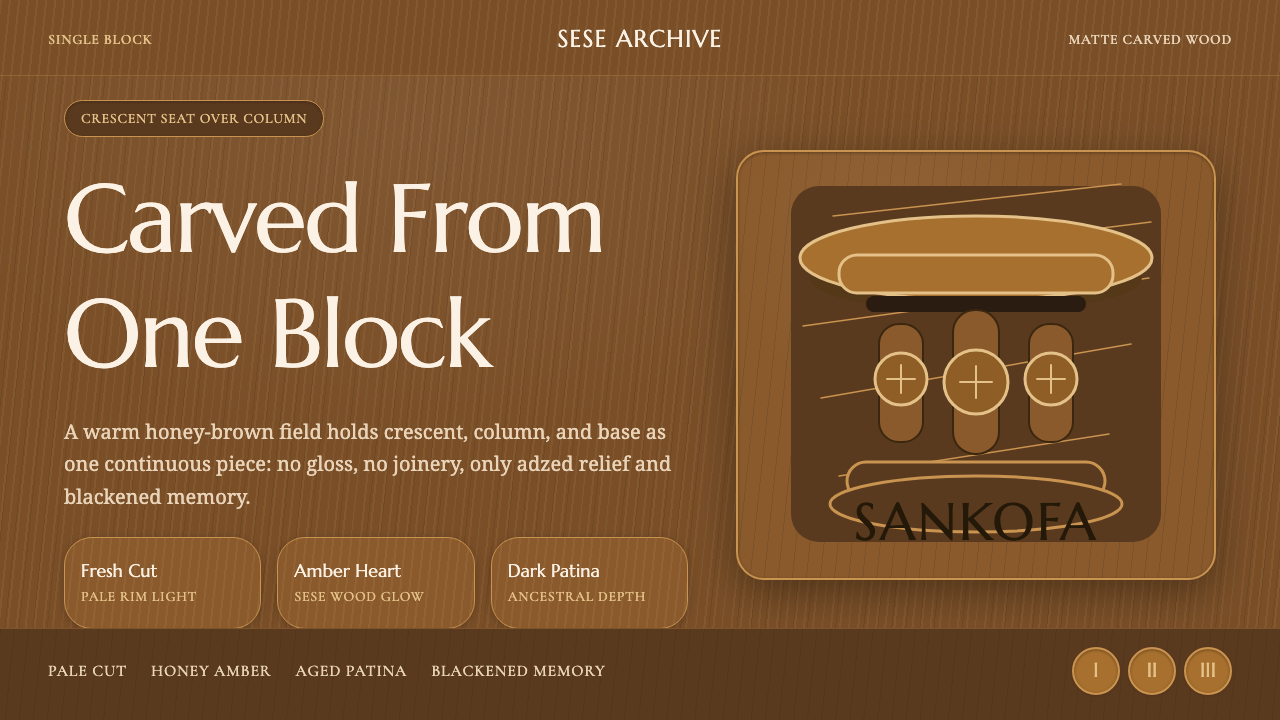 Akan Carved StoolMatte wood carries memory. Honey amber, Marcellus type, and crescent-column r…
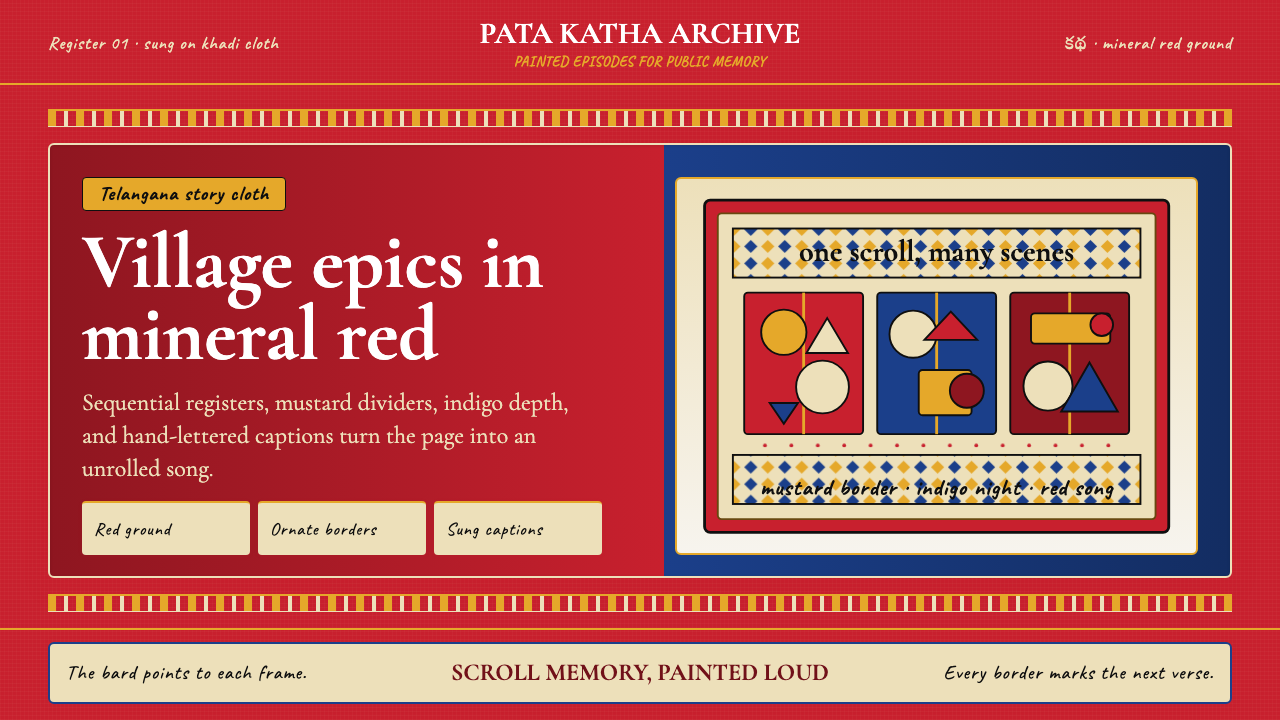 Andhra Cheriyal Scroll PaintingSaturated oral memory. Mineral red registers, mustard diamonds, and serif son…
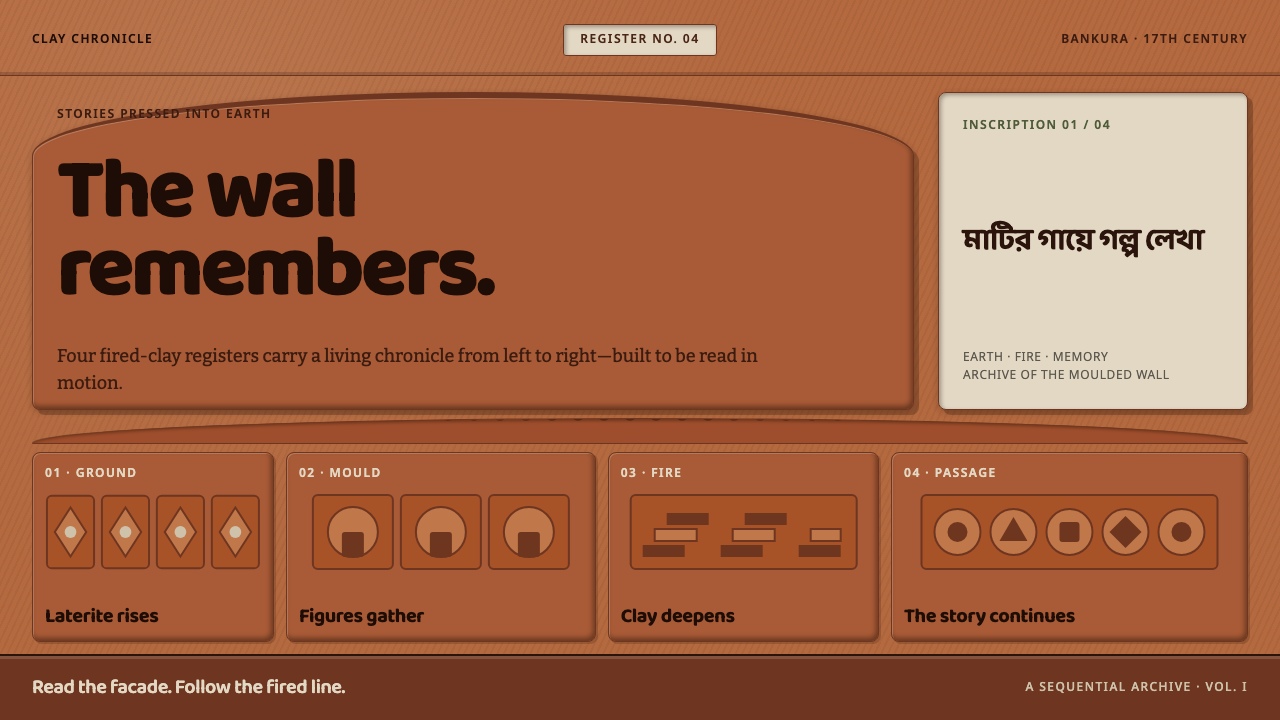 Bishnupur Terracotta TemplesThe wall tells the story. Fired-clay relief panels unfold in warm horizontal…
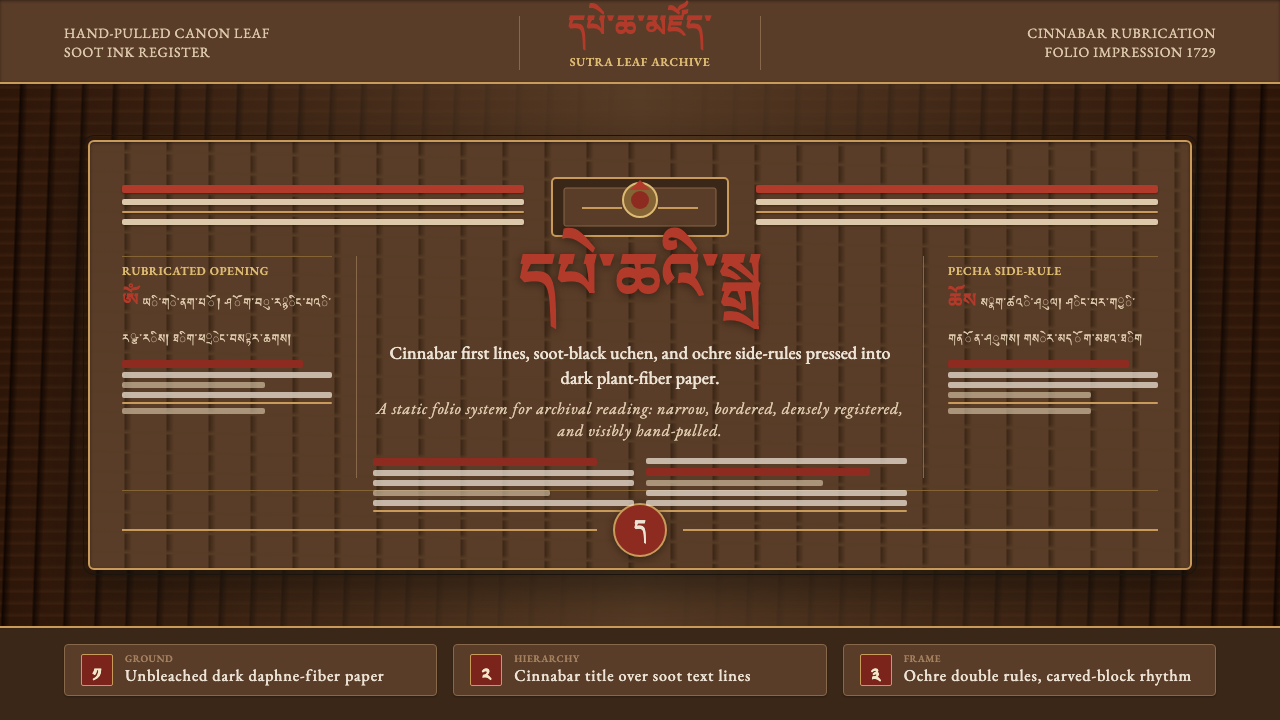 Derge Woodblock Sutra PrintHand-pulled scripture gravity. Cinnabar uchen and ochre rules press into dark…
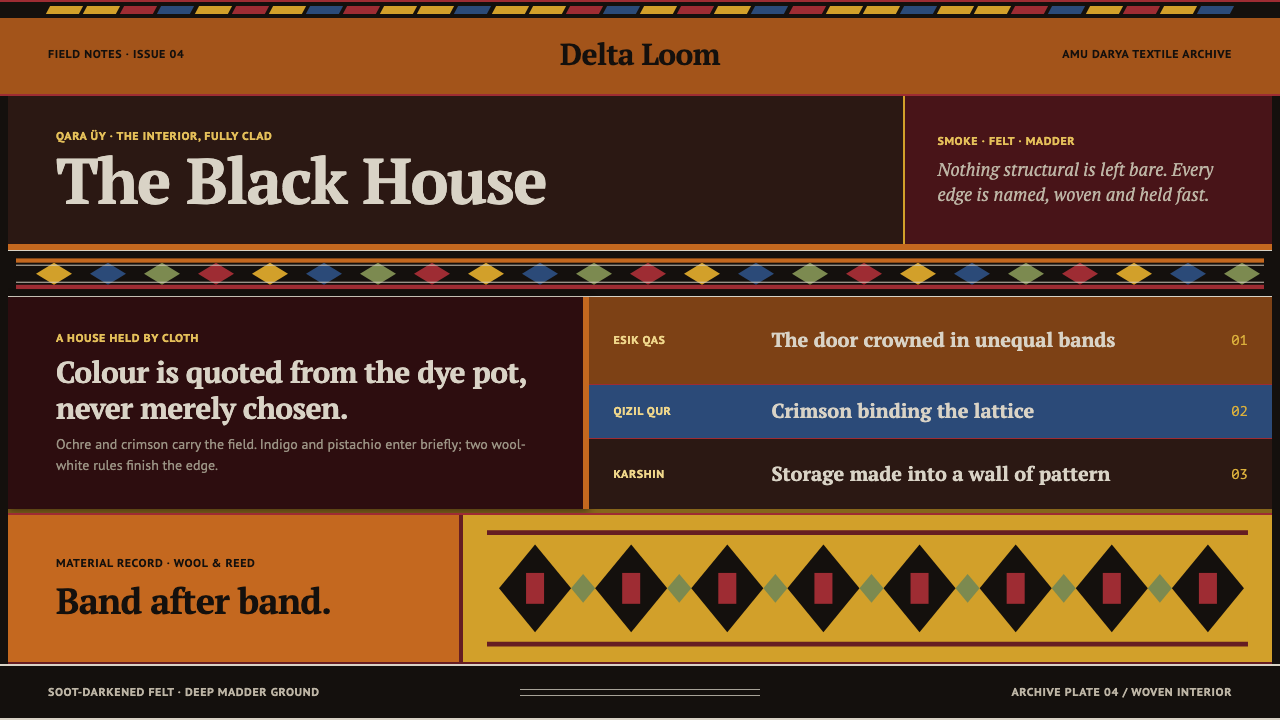 Karakalpak Yurt InteriorNo surface is left bare. Ochre, crimson and indigo bands wrap a smoke-darkene…