What is Serbian Pirot Kilim?
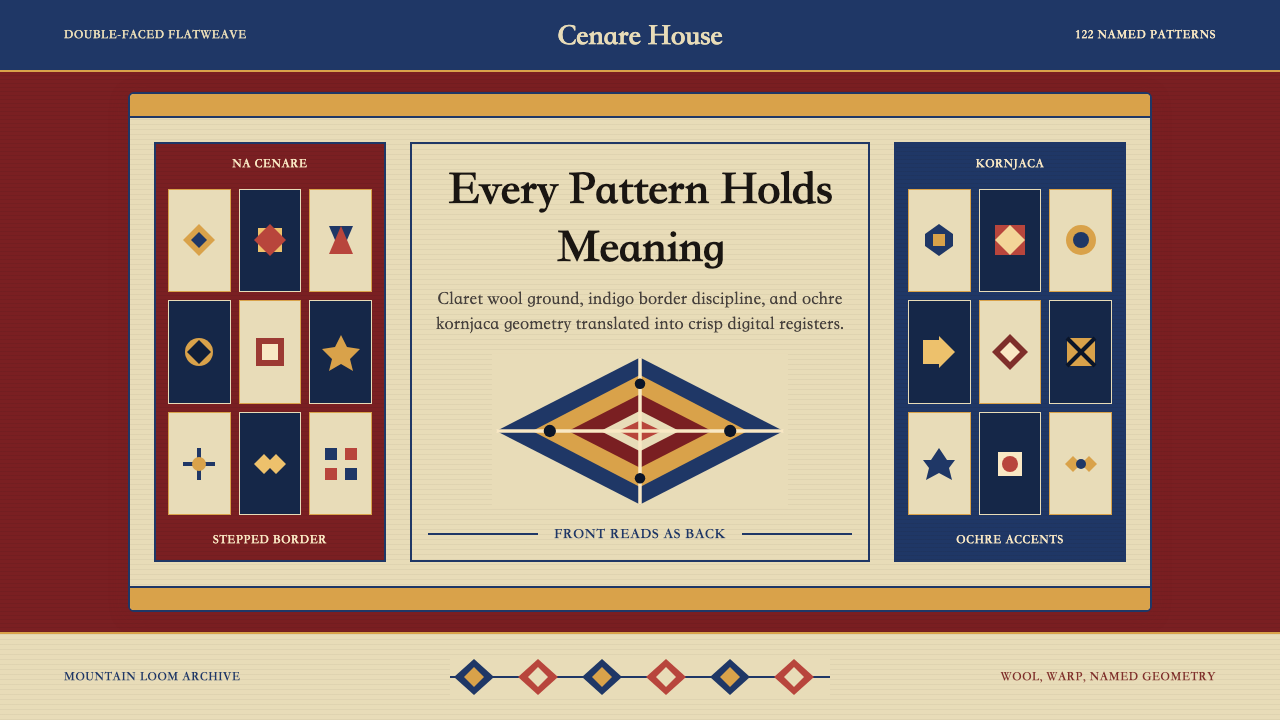
For six centuries, Serbian women in the mountain town of Pirot have woven a visual language so precise it reads the same from both sides of the cloth.
Serbian Pirot Kilim in brief
The Serbian Pirot kilim is a double-faced slit-tapestry flatweave whose visual identity is defined by deep claret grounds, indigo border bands, and ochre stepped diamonds. Unlike pile carpets, which build up a soft three-dimensional surface, the kilim is a flat interlocking weave where warp and weft produce the pattern simultaneously on both faces of the fabric. Every geometric decision is a structural decision: there is no underlayer to hide a mistake, and no pile to soften an imprecise edge.
The kilim's vocabulary consists of 122 named geometric motifs catalogued over centuries of practice. The kornjaca (tortoise) motif arranges stepped diamond lozenges in a symmetrical shell pattern. The bombe (bomb) concentrates concentric stepped shapes into an explosive focal point. The na cenare (frame-within-frame) border system creates nested rectangular borders that give each composition a formal architectural quality. These names are not decorative labels — they are a shared professional language passed from mother to daughter across generations, encoding weaving decisions as precisely as a musical score encodes notes.
The system as a whole reads as bold, warm, and architecturally resolved. The ground color — a deep brick or claret drawn from natural dyes — reads as a warm neutral rather than a vibrant accent, letting the geometric figures sit against it with high contrast. The indigo border bands create containment and formality, while ochre or golden-yellow accents energize the stepped motif edges. The overall effect is not folk-primitive but rigorously systematic: the same visual intelligence that governs Pirot kilim geometry could govern a dashboard, a poster, or a typographic grid.
Where does Serbian Pirot Kilim come from?
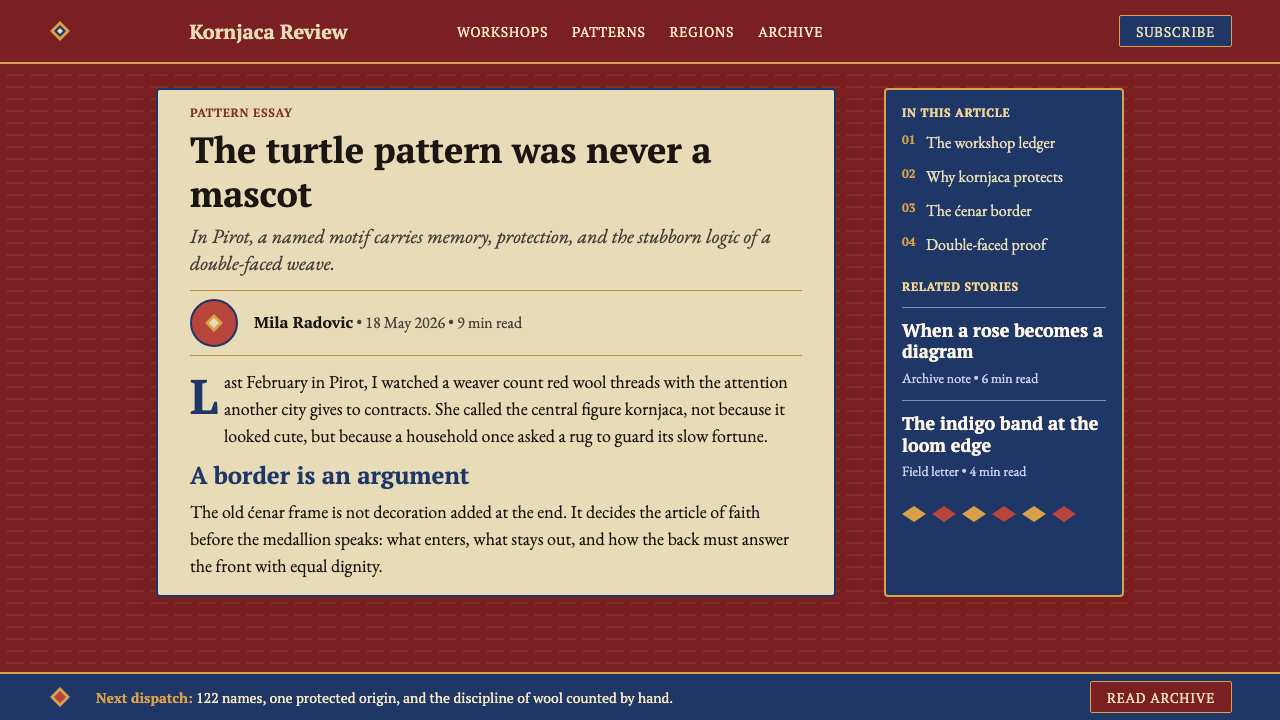
Pirot kilim weaving dates to at least the seventeenth century, though the town of Pirot itself — situated in the Nišava river valley at the foot of the Stara Planina mountains in southeastern Serbia — has been a textile crossroads for far longer. During the Ottoman period, Pirot sat on a major trade route connecting Constantinople to central Europe, and kilim production became the town's primary industry. By the nineteenth century, Pirot kilims were being exported through Belgrade merchants to buyers across Europe and the Ottoman lands, their bold geometry recognizable as a regional signature.
The craft is organized around a body of communally held pattern knowledge transmitted exclusively through practice and apprenticeship. Designs were never written down in the Western sense; instead, patterns were memorized by name, woven as samples, and corrected by master weavers in a living oral tradition. The 122 named motifs that survive today represent a fraction of what once existed — names and patterns tied to specific family lineages or villages were lost when those communities dispersed or died out. What remained was codified, protected, and kept alive by weaving cooperatives, the most significant of which is the Damsko Srce Pirota (Women's Heart of Pirot) cooperative.
The kilim's formal properties — bilateral symmetry, stepped diagonals, interlocking fills — are not arbitrary aesthetic preferences. They are direct consequences of the slit-tapestry flatweave technique. A true diagonal line cannot exist in this weave structure: every slanted edge must be expressed as a staircase of horizontal color steps, producing the characteristic stepped geometry that defines the style. The visual language of Pirot kilim is, in this sense, literally woven into the loom's constraints.
In 2002, the Pirot kilim received Geographic Origin protection from the Serbian government, recognizing it as a product inseparably tied to its place of origin. This legal designation, analogous to a European Protected Designation of Origin, requires that kilims sold under the Pirot name be produced in the Pirot region using traditional techniques. The protection has helped sustain the craft against cheaper machine-made imitations and has supported efforts to document the full vocabulary of named motifs before the knowledge is lost entirely. Today, a small number of master weavers continue producing kilims using centuries-old methods, working alongside younger practitioners who have taken up the craft through formal training programs.
What defines the Serbian Pirot Kilim look?
Color Ground
The dominant ground is a deep claret or brick red drawn from natural wool dyes — warmer and more complex than a pure red, suggesting aged leather or dark wine rather than a primary-color hue. This ground reads as a strong neutral that unifies the composition rather than competing with the geometric figures placed upon it. Against this ground, indigo and ochre accents register with immediate visual clarity without requiring the eye to reconcile competing warm tones.
Stepped Geometry
All diagonal lines in the Pirot kilim appear as staircases of horizontal color steps — a direct consequence of the flatweave technique, which cannot produce true diagonals. This stepped quality gives every diamond, chevron, or border a characteristic pixelated precision that reads as simultaneously ancient and thoroughly modern. The steps themselves become a visual rhythm, creating a secondary texture within each large geometric field.
Border Architecture
Pirot kilim compositions are organized by nested rectangular borders — the na cenare (frame-within-frame) system — that divide the surface into a central field surrounded by progressively narrower border bands. Each border band carries its own distinct pattern, typically in a contrasting color, creating a layered visual hierarchy that moves from the bold central motif outward to fine geometric trim. This architectural containment gives kilim-derived layouts a natural sense of edge, margin, and visual closure.
Bilateral Symmetry
Individual motifs in Pirot kilim are almost universally bilaterally symmetrical — reflecting across both vertical and horizontal axes — while the overall composition achieves balance through repetition rather than mirroring. A field of repeating diamond lozenges creates a tessellation that feels both orderly and infinite, with no single element dominating. This quality of structured repetition makes the visual system scalable: it works equally well at the scale of a small textile panel and a full-room floor covering.
Double-Faced Precision
Because Pirot kilim is a double-faced weave, the pattern appears identically on both surfaces of the textile — there is no right side and wrong side, no hidden back. This structural constraint enforces a quality of total commitment: every color change, every geometric decision, is permanent and visible from all directions. The design discipline this demands translates into a visual aesthetic of unflinching clarity, where every element is fully resolved and nothing is provisional.
Named Motif Vocabulary
The 122 named motifs of the Pirot kilim — the kornjaca, the bombe, the cukur, the krstac — constitute a shared symbolic language rather than a collection of decorative patterns. Each name encodes the motif's construction logic, making it learnable and reproducible. Digitally, this quality translates into a system of reusable components: like named motifs in kilim weaving, named components in a design system carry both visual identity and construction logic in the same package.
Warm-Cool Balance
The Pirot kilim achieves chromatic tension through a consistent warm-cool opposition: the deep claret ground and ochre accents supply warmth, while the indigo borders and secondary geometric fills supply cool contrast. This is not a clash but a calibrated counterpoint — the same principle that governs many of the world's most enduring color systems, from traditional Japanese textiles to mid-century Scandinavian design. The warm-cool balance keeps compositions energized without becoming agitated.

Who shaped Serbian Pirot Kilim?
Mile Mihajlovic was one of the most important twentieth-century documenters of the Pirot kilim tradition. His systematic work cataloguing the named motifs and their weaving specifications helped transform an oral tradition into a documented body of knowledge that could be taught, studied, and protected. Without this documentation effort, many pattern names and their associated weaving instructions would have been lost as the older generation of master weavers declined.
Slavica Krstic is among the contemporary master weavers who have worked to preserve and transmit Pirot kilim technique to younger generations. Her weaving demonstrates the highest standards of the double-faced slit-tapestry method, with the precision of motif execution and border alignment that defines the style at its most accomplished. Master weavers of her caliber serve as living references for what the tradition looks like when it is performed correctly.
Dobrivoje Milinkovic contributed to the academic and institutional documentation of Pirot kilim as a Serbian cultural heritage item. His research helped build the evidentiary case for Geographic Origin protection, which was granted in 2002, and contributed to broader scholarly understanding of the kilim as a cultural artifact with a specific regional identity rather than a generic Balkan folk textile.
The Women's Heart of Pirot cooperative is the institutional backbone of the contemporary Pirot kilim tradition. The cooperative organizes production, maintains quality standards, preserves the pattern vocabulary, and markets kilims domestically and internationally. As both a craft organization and a cultural preservation body, it has been central to the tradition's survival through political upheaval, industrialization, and the competition of cheaper machine-made alternatives.
How do you use Serbian Pirot Kilim today?
Serbian Pirot kilim geometry translates into digital design work through three core properties: a warm, richly saturated ground color that anchors without overwhelming; a vocabulary of stepped geometric motifs that carry cultural authority without feeling archaic; and a nested border system that naturally creates visual hierarchy and containment. Applying the style well means working with these structural properties, not just borrowing the color palette.
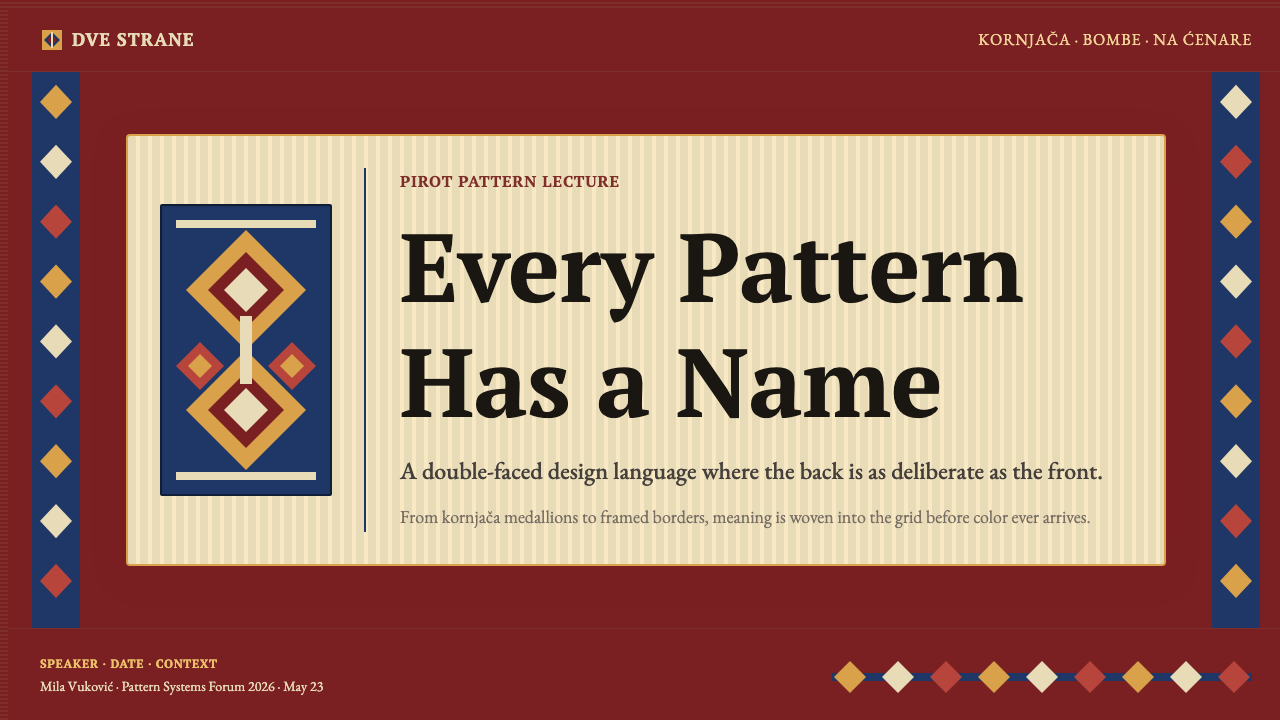
For presentation slides, Pirot kilim works best when the kilim's own compositional logic is followed. Cover slides benefit from a full claret or deep warm ground with a large stepped diamond or chevron motif occupying the center or a bold corner — the geometric figure should be rendered in ochre or indigo against the ground, following the kilim's own warm-cool opposition. Content slides should adopt the border-within-border principle: a contained text field surrounded by a thin geometric rule or stepped ornamental band, establishing clear margins the way kilim borders establish the edge of a composition. Data slides can use the stepped geometry directly — stacked bar charts, in particular, can be rendered as kilim-like horizontal banded fields, with each segment color drawn from the three-color system.
For web interfaces, the style is particularly well suited to heritage-positioned products, cultural institutions, craft marketplaces, or any brand seeking warmth and structural depth without slipping into generic earthiness. Dashboards can adopt the nested-border principle to create naturally hierarchical card layouts: a warm ground, cards with stepped-corner details, section dividers using the indigo-on-claret contrast. Pricing pages work well with tier differentiation expressed through the three core colors — claret for the dominant tier, indigo for an alternative, ochre for premium or limited offerings. Navigation should be typographic and spare, allowing the geometric ornament to carry the visual identity.
For editorial layouts and marketing materials, the Pirot kilim style supports both gravitas and visual interest. An editorial feature using this system might open with a full-bleed warm ground and a large central diamond motif, then shift to a two-column text layout with thin geometric border rules marking section transitions. Marketing posters or social cards benefit from the kilim's natural poster-like boldness: a strong geometric figure centered on a deep ground, the message set in high-contrast letterforms, no photographic imagery competing with the geometric field. The style rewards restraint — one central motif per composition is more powerful than a field crowded with competing patterns.
A common mistake when applying Pirot kilim geometry digitally is using all three colors at equal weight simultaneously, which produces visual chaos rather than the calibrated tension of the source material. Authentic kilim compositions lead with one dominant color (almost always the warm claret ground), use a second color (indigo) for structure and borders, and deploy the third (ochre) sparingly as an accent at motif edges. A second common error is attempting smooth gradients or curved forms — every element in this system should have a hard, stepped, or straight edge. Introducing soft curves or gradients immediately breaks the visual logic and reads as an inconsistency rather than a creative interpretation.
Serbian Pirot Kilim — FAQ
What makes a Pirot kilim different from other Balkan flatweave textiles?
The Pirot kilim is distinguished by its double-faced construction — the pattern appears identically on both sides — which is a technically demanding achievement that many other Balkan flatweaves do not attempt. It is also distinguished by its precisely catalogued vocabulary of 122 named motifs, its specific three-color palette anchored by the deep claret ground, and its formal nested-border compositional system. These properties together give Pirot kilim a specificity and visual consistency that sets it apart from the broader category of regional Balkan flatweave, which encompasses a wide range of techniques, palettes, and compositional approaches.
Why does the kilim's geometry look pixelated or digital even though it predates computers by centuries?
The stepped, grid-like quality of Pirot kilim geometry is not a stylistic choice — it is a direct consequence of the slit-tapestry flatweave technique. In this weave structure, true diagonal lines cannot be produced; every slanted edge must be approximated as a staircase of horizontal color steps. The result is geometrically identical to what happens when a diagonal line is rendered on a pixel grid: the same constraint of discrete units produces the same stepped approximation. The kilim predates digital imaging by centuries but discovered the same visual solution to the same structural problem.
How should I handle the kilim's symmetrical motifs in asymmetric digital layouts?
The Pirot kilim achieves overall balance through repetition of bilaterally symmetrical motifs, not through globally symmetrical layouts. You can apply the same principle digitally: use individually symmetrical geometric components — stepped diamonds, nested frames, chevron bands — and distribute them asymmetrically across a layout to create visual balance through weight and position rather than mirroring. A single large central diamond on a full-bleed ground is as faithful to the kilim's logic as a repeating field of smaller diamonds. The motif's internal symmetry does the work of visual stability; the layout's asymmetry provides dynamism and reading direction.
Can this style work in a light-background digital context, or does it require a dark ground?
The canonical Pirot kilim uses a deep warm ground — claret, terracotta, or brick — as its dominant field. A light-background inversion is possible but changes the visual character significantly. On a cream or off-white ground, indigo motifs and ochre accents take on a more decorative, less immersive quality; the sense of depth and warmth that defines the authentic tradition is reduced. If a light background is required by context, the most faithful approach is to confine the kilim geometry to contained panels or borders — a full-width kilim-patterned header band, an ornamented sidebar rule — rather than using it as a ground-level field. This preserves the visual logic while accommodating lighter interface conventions.
Is this style appropriate for modern brands, or does it read as too folklorically specific?
Pirot kilim geometry works as a contemporary brand system when the geometric properties — stepped edges, nested borders, the warm-cool three-color opposition — are foregrounded and the folkloric associations are allowed to recede. The style's strongest digital applications are for brands where warmth, craft quality, cultural depth, and structural precision are all desired together: artisan marketplaces, heritage food and beverage, cultural tourism, textile or fashion brands, and editorial platforms covering design history or global craft traditions. It struggles in contexts where a clean, culturally neutral aesthetic is required — technology products positioning for a global mass market, financial services, or medical applications. The decisive factor is whether the brand's story benefits from the associations the style carries: regionalism, handcraft, geometric rigour, and centuries of sustained practice.
Related design styles
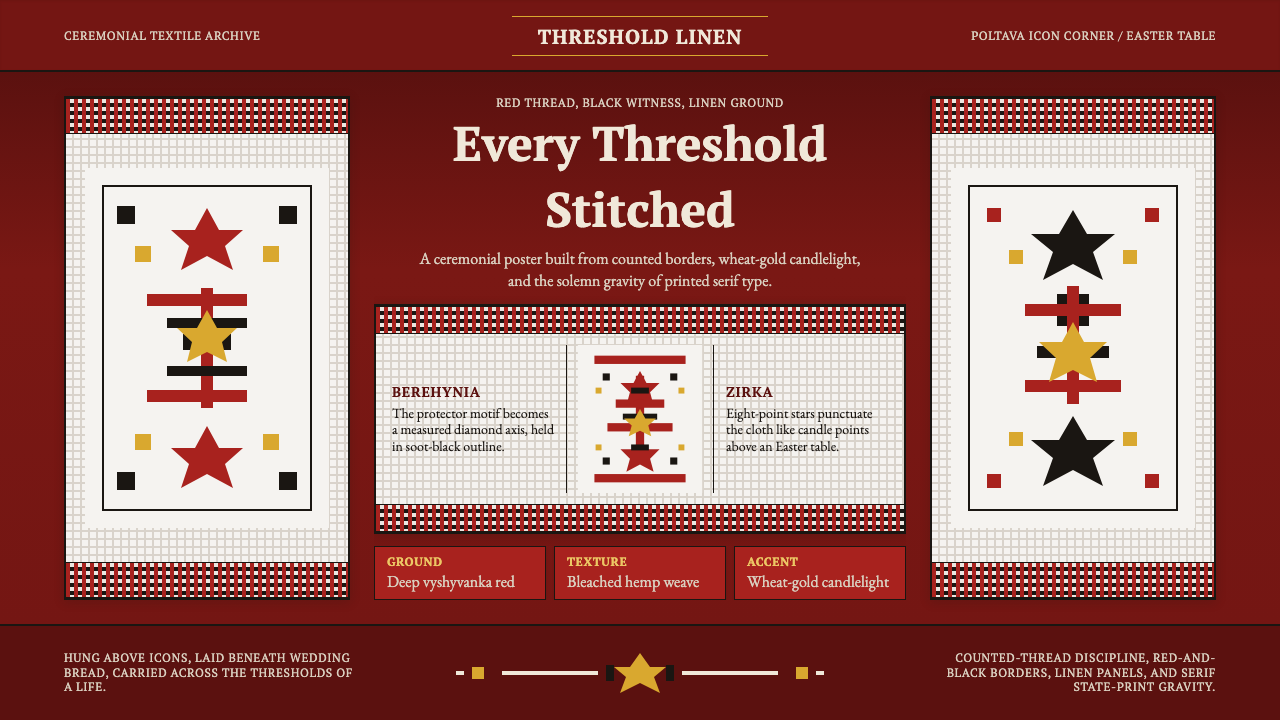 Ukrainian Rushnyk Ceremonial TowelCeremony stitched in red. Linen panels, soot-black crosses, and wheat-gold st…
 Akan Adinkra (Ghana)Proverbs become cloth. Russet grids, lampblack serif marks, and gold-edge ban…
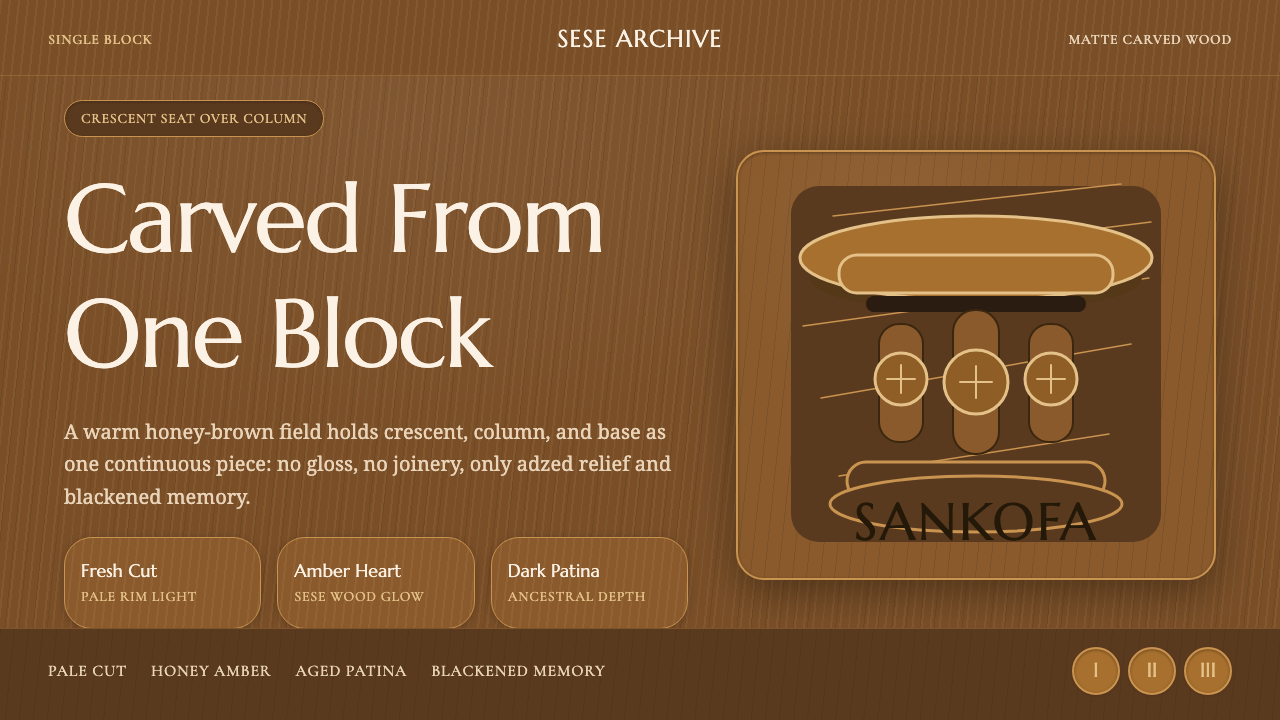 Akan Carved StoolMatte wood carries memory. Honey amber, Marcellus type, and crescent-column r…
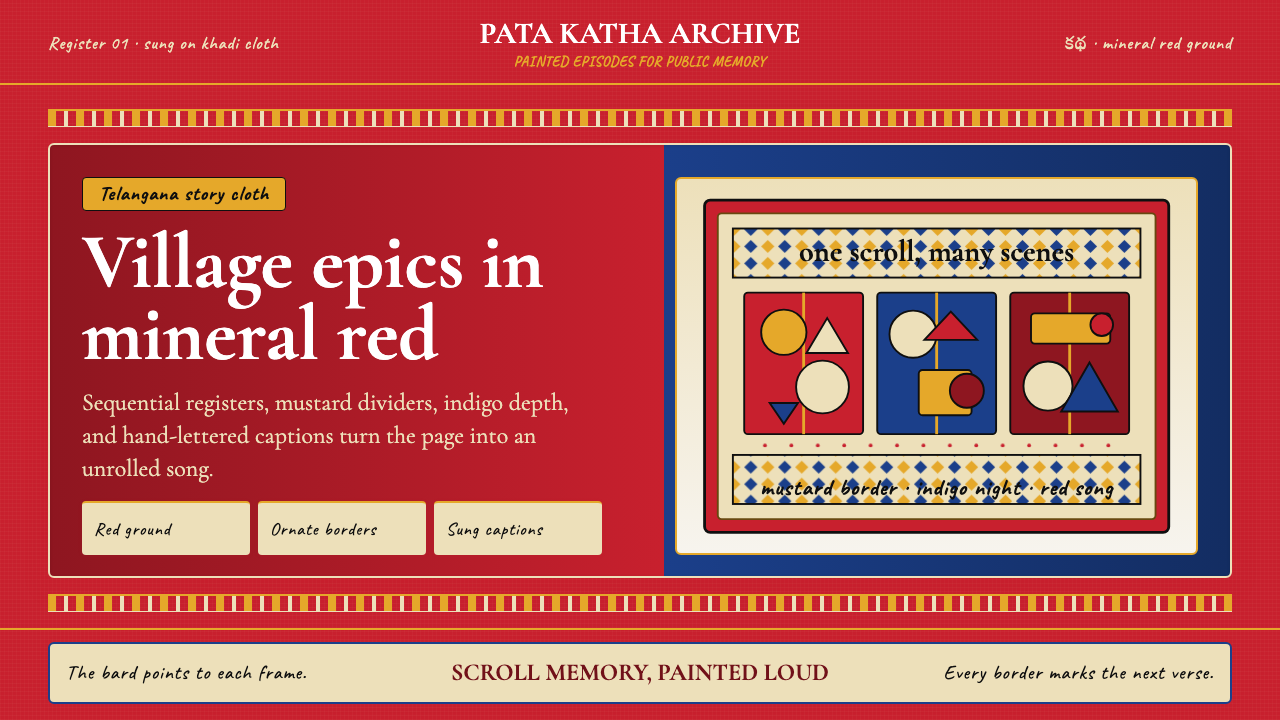 Andhra Cheriyal Scroll PaintingSaturated oral memory. Mineral red registers, mustard diamonds, and serif son…
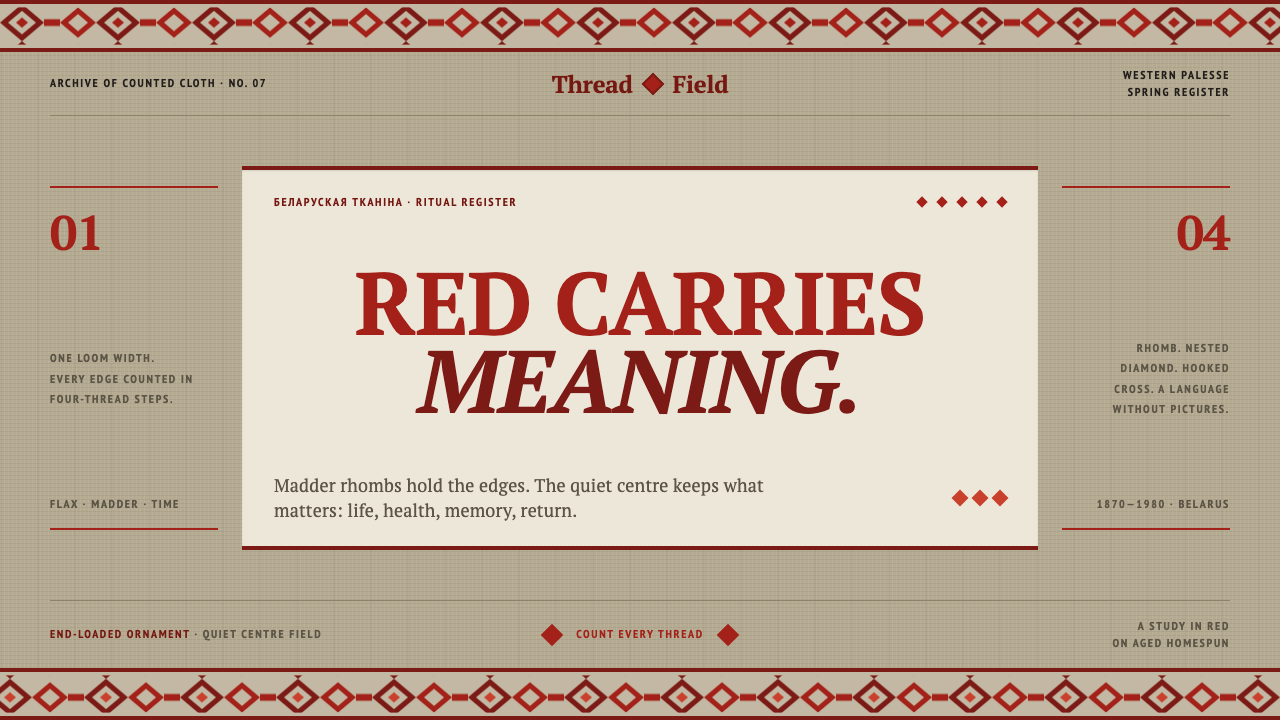 Belarusian RushnykRed carries meaning. Madder rhombs crowd aged flax edges while the woven cent…
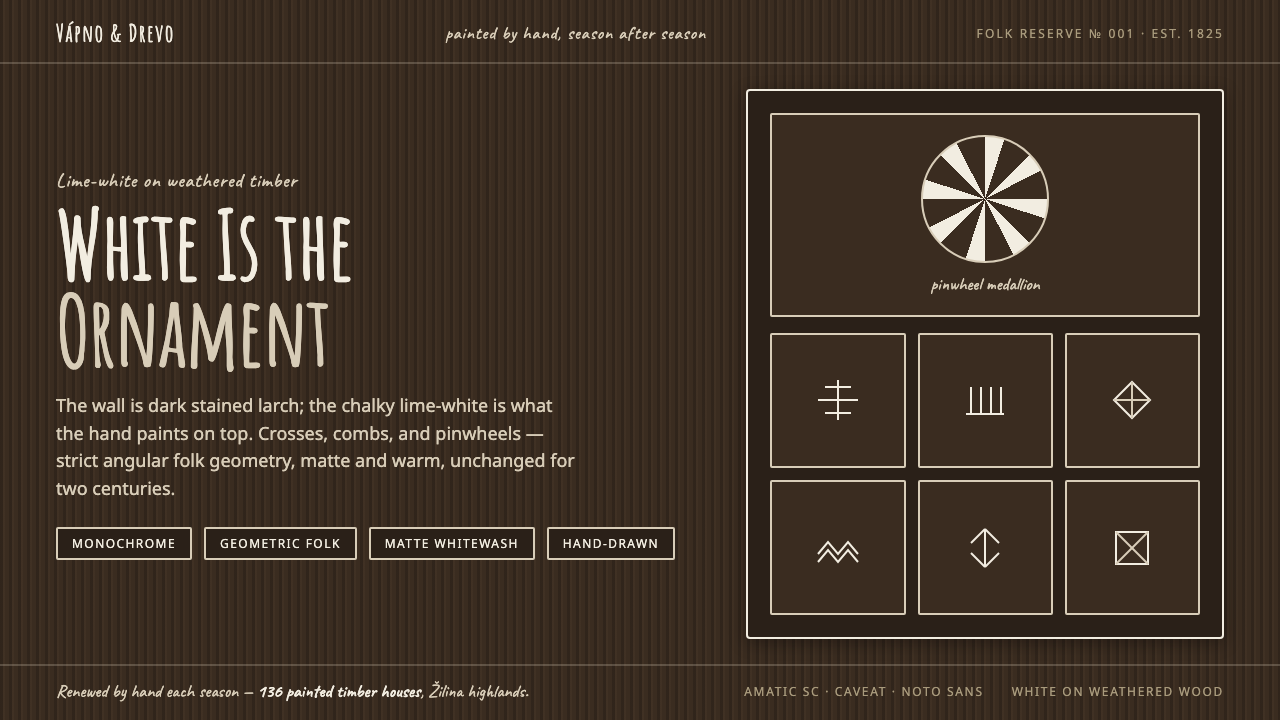 Čičmany Painted House OrnamentWhite is the ornament, not the page. Lime-white folk geometry on dark weather…