What is Latvian Knitted Mittens?
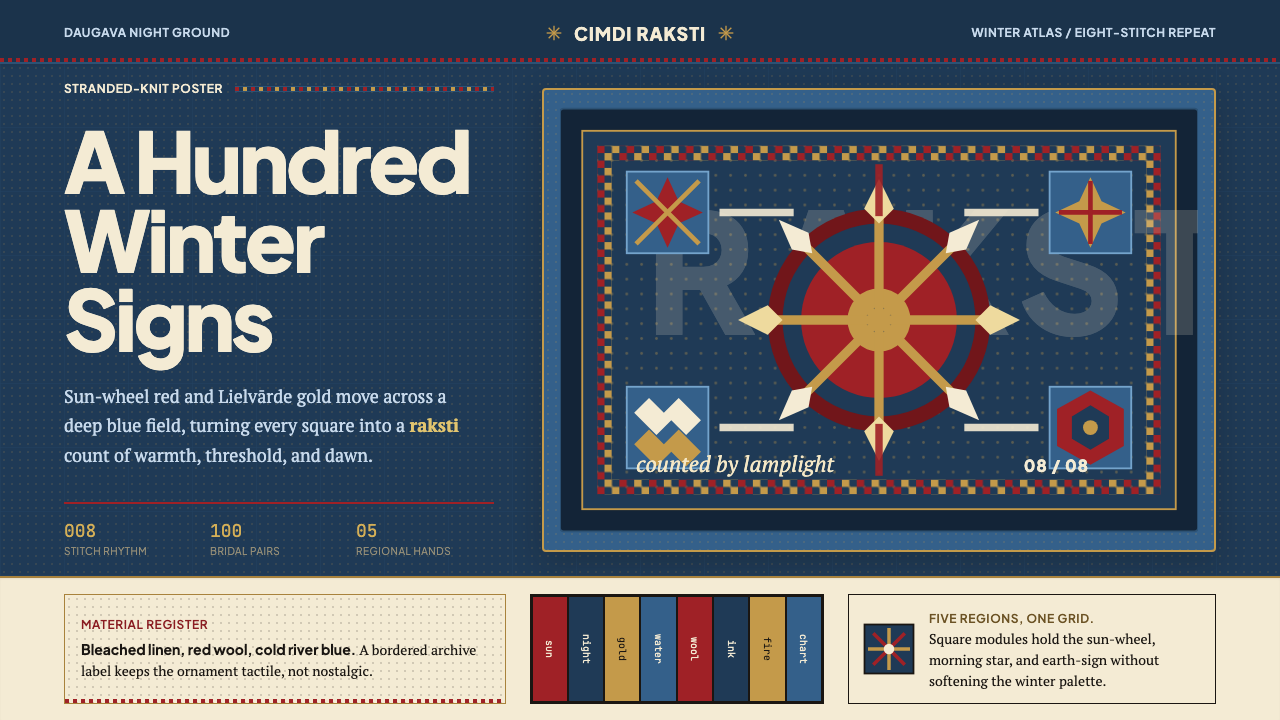
Latvian knitted mittens encode centuries of pagan cosmology into a dense, two-color stranded textile — a visual system where sun-wheels, morning-star crosses, and zigzag earth-signs still speak as clearly as any modern icon.
Latvian Knitted Mittens in brief
Latvian Knitted Mittens is a design style rooted in the Baltic folk-textile tradition of raksti — a word meaning both 'signs' and 'writing' in Latvian — which organized geometric symbols into repeating two-color patterns across hand-knitted woolen objects. The visual system is built on strict eight-stitch and eight-row repeat modules, producing a grid of extraordinary regularity that nonetheless carries enormous symbolic variety: sun-wheels for cosmic order, morning-star diamonds for protection, interlocking keys for continuity, and zigzag lines for the earth's surface and the cycle of seasons.
What distinguishes this tradition from other European folk textiles is its dual nature as both ornament and communication. A bride's mitten collection was read by wedding guests as a record of her skill, regional identity, and family lineage. The five ethnographic regions of Latvia — Lielvārde, Kurzeme, Latgale, Vidzeme, and Zemgale — each developed recognizable motif dialects, with Lielvārde known for its densest geometric complexity and Kurzeme for its bold contrast between saturated fields and white grounds. This regional specificity means the tradition offers not one but several distinct visual languages sharing a common structural grammar.
As a contemporary design style, Latvian Knitted Mittens draws on this vocabulary to produce work that feels simultaneously ancient and precisely geometric — the textile grid becomes an underlying compositional order, the raksti signs function as decorative marks with symbolic weight, and the palette of deep Baltic night-blue, sun-wheel red, and Lielvārde gold against bleached linen creates a distinctive warmth that no purely abstract geometric style can match.
Where does Latvian Knitted Mittens come from?
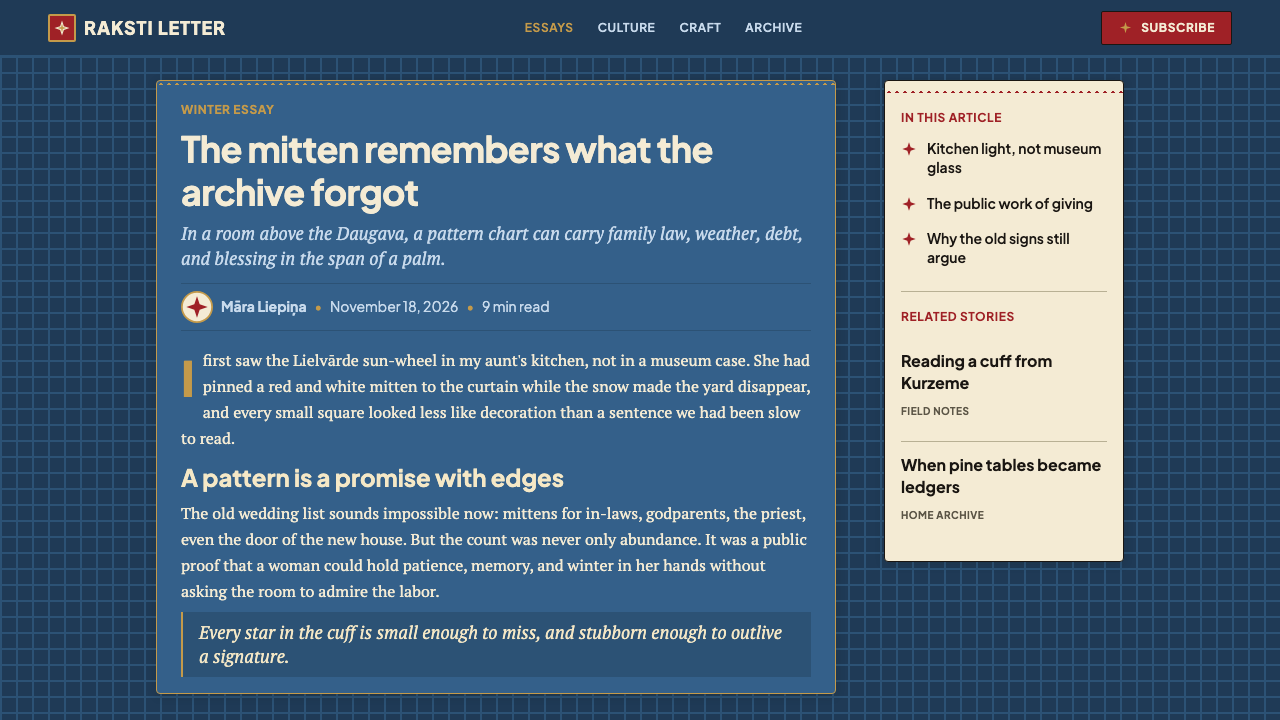
The signs woven into Latvian mittens predate the garments themselves. Raksti symbols have been found on Baltic bronze ornaments, carved wooden objects, and linen embroideries dating back to at least the early medieval period, and some scholars trace the solar motifs to the pre-Christian Baltic religion centered on Saule, the sun goddess, and Māra, the earth mother. This cosmological substrate is what gives the mitten tradition its unusual density of meaning: the decorative pattern and the religious sign were never fully separated. To knit a sun-wheel was also to invoke the sun's protection for the hands wearing the mitten through winter fieldwork.
The practice of producing elaborate knitted mittens as betrothal and wedding gifts crystallized in the eighteenth and nineteenth centuries, when the genre reached its most systematic and codified form. Latvian ethnographers and collectors of the late nineteenth century, working in parallel with the national awakening movement known as Jaunlatvieši (the Young Latvians), documented mitten patterns from across the five regions and preserved them in illustrated atlases. The poet and folklorist Krišjānis Barons, best known for compiling the monumental Dainas collection of Latvian folk songs, was part of the same cultural moment that recognized textile patterns as carriers of national identity — a visual counterpart to the oral literary tradition.
The Soviet period (1940–1941, 1944–1991) suppressed the explicit religious meanings of raksti signs while paradoxically preserving and institutionalizing the craft as a marker of Latvian folk culture, distinct from Russian traditions. State craft organizations documented patterns, trained knitters, and sold mittens as tourist objects, inadvertently creating a network of practitioners and a standardized canon of regional designs. Scholars like Mirdza Slava and Maruta Grasmane produced the reference atlases that contemporary designers still consult, cataloguing hundreds of distinct motifs by region and period.
The restoration of Latvian independence in 1991 triggered a revival that was as much symbolic as practical. The wearing and gifting of hand-knitted mittens in traditional patterns became an act of cultural assertion. Organizations like Sena Klēts worked to reconnect contemporary Latvian textile practice with its ethnographic sources, training a new generation of knitters in the regional pattern dialects that Soviet standardization had partially flattened. This post-independence revival is the direct context for the raksti tradition's emergence as a design style: the same energy that put hand-knitted mittens on the hands of politicians at independence ceremonies eventually found its way into digital interfaces, brand identities, and editorial graphics.
What defines the Latvian Knitted Mittens look?
Palette
The palette is Baltic winter rendered as dyestuff: a deep Daugava-river night blue anchors every composition as the dominant ground, with sun-wheel red providing active warmth and Lielvārde gold marking accent and hierarchy. Stranded-knit black defines structural outlines and lettering, while bleached linen white creates the high-contrast field that makes the geometric motifs legible at the scale of a thumb. The overall effect is simultaneously saturated and cold — the warmth comes from hue, not from light, as if the colors are seen by lamplight inside a Baltic farmhouse in November.
Geometric Modularity
Every motif in the tradition obeys the eight-stitch grid — the physical constraint of stranded knitting translated into a compositional principle. Diagonal lines resolve into staircase steps; curves become faceted approximations; the sun-wheel's spokes land exactly on grid intersections. This constraint produces a visual grammar of extraordinary consistency: no element can exist at less than one stitch of width, which means every form has a minimum weight and every composition shares the same underlying beat. In digital contexts, the grid becomes a modular tile system where decorative elements snap to invisible rules.
Symbol Vocabulary
The raksti lexicon is specific and documented: the eight-spoke sun-wheel (Saules zīme) for cosmic protection, the morning-star cross (Auseklis) for guidance and new beginnings, the interlocking key pattern (atslēdziņa) for security and continuity, the zigzag earth-sign (zeme) for grounding and seasonal cycle, and the diamond (rūtiņa) for wholeness and enclosure. These are not decorative choices — each carried legible meaning within its original community. In contemporary use, they function as a symbolic register that elevates geometric decoration to something with cultural weight, even for audiences who cannot read the specific sign.
Dense Two-Color Contrast
Stranded knitting is by definition a two-color technique: one color is always active in the foreground while the other forms the ground. This structural constraint produces compositions of stark, high-contrast figure-ground relationships without gradients, shadows, or blending. The visual weight is almost entirely carried by the relationship between the two colors — shift the ground from night-blue to white and the entire emotional register changes, even if every motif remains identical. This binary logic translates directly into digital design as a system that works cleanly in single-color reproduction and at small sizes.
Repetition and Border Logic
The mitten's compositional structure is always striped horizontally: bands of plain knitting separate bands of motif repetition, with narrower separator bands at wrist and cuff edges. This layered-border logic — wide motif band, narrow separator, wide motif band — creates a rhythm that is both deeply orderly and visually generous. In contemporary layouts, this logic maps to section dividers, full-width decorative bands, and the treatment of headers and footers as banded zones rather than floating elements. The separator's thinness makes the motif bands feel expansive by contrast.
Regional Texture and Variation
Unlike a single-designer style system, the raksti tradition encompasses at least five regional dialects of meaningful visual difference. Lielvārde patterns are characterized by maximum motif density and complex interlocking; Kurzeme favors broader grounds and stronger contrast; Latgale introduces vertical symmetry alongside horizontal banding; Vidzeme and Zemgale tend toward more open compositions with larger dominant motifs. This internal variation means the style has genuine range — it is not a single look but a family of related looks, and a designer working within it can signal different registers of formality, density, or warmth by drawing on different regional models.
Night-Field Luminosity
The dominant compositional mode places warm, saturated motifs on a dark night-blue ground rather than on white. This inversion of the typical folk-textile convention — where light grounds are more common — produces a distinctive luminosity: the red and gold signs appear to glow from within, the way lamplight catches embroidery in a dim room. This dark-field quality sets Latvian Knitted Mittens apart from most other European geometric folk styles and gives it a visual mood that contemporary designers associate with quality, warmth, and intimacy rather than clinical precision.

Who shaped Latvian Knitted Mittens?
The nineteenth-century poet and folklorist Krišjānis Barons is best known for compiling the Dainas, the monumental collection of Latvian folk songs that became a cornerstone of Latvian national identity. His work belongs to the same cultural moment that recognized textile patterns, song, and oral tradition as the repositories of a national consciousness that centuries of German and Russian overlordship had not extinguished. Without the national awakening movement he helped shape, the systematic documentation of mitten patterns might have been delayed by decades, and the regional atlases that contemporary designers consult might not exist.
Mirdza Slava was among the most important twentieth-century scholars of Latvian textile tradition, producing reference documentation of raksti patterns that organized the enormous regional variety of the mitten tradition into a form designers and craftspeople could navigate. Her atlases catalogued motifs by region, period, and symbolic function, creating the scholarly infrastructure that allowed the tradition to survive the Soviet period with its internal differentiation intact. Contemporary designers working with raksti signs draw on her documented corpus more often than they realize.
Maruta Grasmane continued and extended the documentation tradition begun by earlier ethnographers, producing illustrated references that made the regional mitten pattern dialects accessible to the generation of Latvian designers who came of age after independence. Her work represents the bridge between Soviet-era institutional preservation — which kept the craft alive but sometimes standardized it — and the post-independence revival that sought to reconnect practice with its ethnographic sources. Craft organizations like Sena Klēts built their revival programs on the scholarly record that Grasmane and her predecessors had maintained.
The Latvian visual artist Daina Tabaka worked at the intersection of folk tradition and contemporary fine art, exploring how Baltic sign cultures could speak in a modern idiom without being diluted into folklore pastiche. Her engagement with the symbolic language of Baltic material culture — including raksti-related motifs — contributed to a discourse in which traditional signs were treated as a living visual resource rather than a museum object. This critical framing influenced how Latvian designers subsequently approached the mitten tradition: as a formal language to inhabit rather than an artifact to quote.
How do you use Latvian Knitted Mittens today?
Latvian Knitted Mittens translates most naturally into contexts where cultural depth, handcraft warmth, and geometric precision need to coexist — it is not a clinical minimalism but a structured richness. The visual system works best when designers commit to its underlying logic rather than extracting only the surface motifs: the dark-field inversion, the eight-unit grid, the two-color discipline, and the banded compositional structure all need to be present together for the style to cohere. Dropping the night-blue ground in favor of a white background, for instance, radically changes the style's emotional register toward something that reads more like Nordic folk craft than Baltic winter.
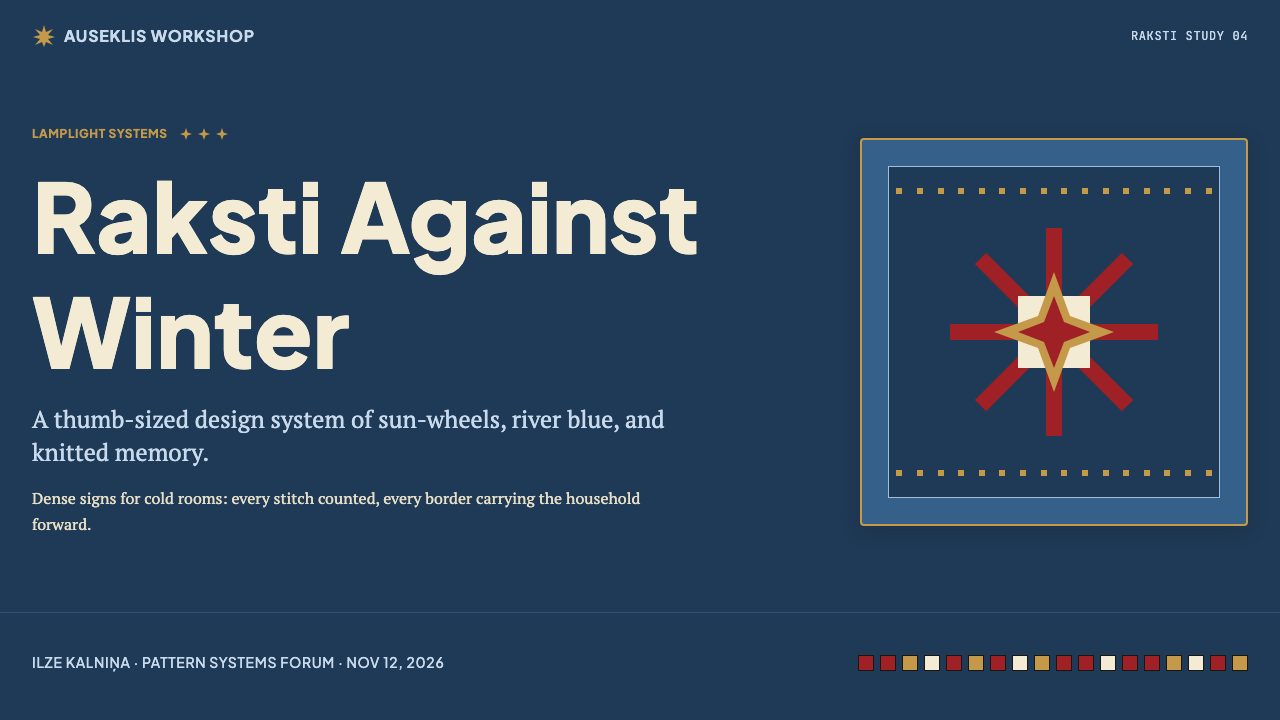
For presentation slides, the tradition offers a distinctive approach on both cover and content pages. A cover in this style uses the night-blue field as its ground, with a central sun-wheel or morning-star motif rendered in red or gold at large scale — the raksti sign functions as a focal emblem, not merely as pattern fill. The title appears in clean, upright display type against the dark ground; no gradient background or photographic imagery competes with the textile logic. Content slides work best as banded structures: a narrow decorative header band in the motif vocabulary, a generous content field in a muted ground, and a thin separator band at the foot. Data visualizations gain warmth when bars and segments are colored in the palette's red, gold, and white against the blue, rather than in generic corporate hues.
For web and digital interfaces, the style suits brand identity pages, cultural organization sites, editorial headers, and seasonal campaign microsites where warmth and distinctiveness matter more than corporate neutrality. Dashboard applications can use the grid logic without the figurative motifs — the eight-unit tile system translates into a consistent modular layout, and the palette's night-blue, red, and gold can define component states (default, active, alert) without importing the full textile vocabulary. E-commerce product pages in this style benefit from the decorative border logic: product images sit within banded frame compositions that recall the wrist and cuff borders of the mitten, giving each item a sense of ceremonial presentation.
For editorial and marketing design, the style supports rich, full-bleed layouts where visual distinction is a primary goal. A magazine spread or digital article header using this vocabulary places a large-scale raksti motif — rendered clean and flat, not as a scan of actual textile — behind or alongside the headline type, with the dark-field ground unifying the composition. Marketing materials for craft, heritage, winter, or cultural tourism contexts gain immediate legibility from the tradition's strong regional associations. The banded structure also lends itself to editorial timelines, section headers, and infographic frames, where the horizontal-stripe logic of the mitten creates natural divisions between content zones.
The most common mistake when applying this style is treating it as surface pattern — extracting the sun-wheel or morning-star motif and dropping it onto an otherwise conventional layout as a decorative flourish. This produces a pastiche rather than a coherent style application, because the raksti sign loses its structural role and becomes a logo-like emblem floating free of any compositional logic. A related error is mixing the palette with warm beige or terracotta grounds instead of maintaining the night-blue dark field; this softens the contrast that makes the motifs legible and imports a different cultural register entirely. The style also struggles when stretched across contexts that require extensive neutral typography: long-form body text and detailed data tables are difficult to reconcile with the boldness and decorative density of the visual system, and forcing the pairing usually means the typography suffers rather than the decoration being reined in.
Latvian Knitted Mittens — FAQ
How does Latvian Knitted Mittens differ from other Nordic or Scandinavian folk-textile styles?
The most significant differences are the dark-field compositional mode and the symbolic density. Scandinavian folk-textile styles — Norwegian Selbu, Swedish Dala, Finnish geometric weaves — most commonly use white or light grounds with dark or colored motifs. Latvian mittens invert this: the night-blue ground is dominant, and warm motifs glow against it. The symbolic dimension is also more systematic in the Latvian tradition: raksti signs have documented meanings within a pre-Christian cosmological framework, whereas most Scandinavian folk motifs are primarily ornamental. This gives Latvian Knitted Mittens a visual weight and cultural seriousness that distinguishes it from the more decorative register of its Nordic neighbors.
Can the raksti signs be used without the full two-color textile palette?
Yes, but with significant trade-offs. The sun-wheel, morning-star, and earth-sign motifs are legible as isolated graphic elements — they function as icons, stamps, or watermarks in monochrome or brand-color contexts. What is lost is the visual logic that gives them structural weight: without the night-blue field and the high-contrast two-color relationship, they read as decorative marks rather than as part of a coherent design system. If the full palette cannot be maintained, the strongest approach is to use a single primary color (the red or gold) against a neutral dark ground rather than floating the motif on white, which loses almost all of the tradition's characteristic luminosity.
Is this style appropriate for contexts outside Baltic or Eastern European cultural subjects?
The style is broadly usable outside its cultural origin, but the designer's relationship to the source material matters. The raksti tradition is a living cultural practice, not a historical artifact, and the signs carry specific meanings within Latvian communities. Using the visual system for unrelated commercial contexts — particularly in ways that reduce the signs to exotic decoration — risks the same kind of surface-level appropriation that flattens any living tradition. The more defensible approach is to engage the formal logic of the style (the grid, the palette, the banded structure, the two-color discipline) with genuine attention to what makes it distinctive, while being transparent about the source. The style is strong enough to carry this weight — its formal qualities are genuinely transferable, and its warmth and geometric precision fill a gap that many Western design systems leave open.
How does the eight-stitch grid translate into screen design and layout systems?
In textile terms, the eight-stitch unit means every motif element — diagonal step, sun-wheel spoke, diamond corner — is precisely positioned on a regular lattice. In digital layout, this translates naturally into a modular grid where a base unit (say, a comfortable spacing increment) is used as the module, and all layout decisions — column widths, spacing between components, icon sizes, border widths — are multiples of that unit. The eight-unit rhythm also maps well onto standard grid systems (eight columns, sixteen columns) that many contemporary design tools use as defaults. The practical effect is a layout with the same underlying regularity as the textile: elements feel placed rather than merely positioned, and the composition has a tightness that rewards close inspection.
What is the difference between this style and generic 'folk pattern' or 'ethnic textile' aesthetics?
Generic folk-pattern aesthetics borrow the surface appearance of traditional textiles — repeating geometric motifs, high-saturation color, decorative borders — without the underlying structural logic or cultural specificity. The result is often a visual shorthand for 'handmade' or 'heritage' that could plausibly come from any of a dozen traditions. Latvian Knitted Mittens is specific: the eight-stitch grid, the documented raksti sign vocabulary, the five regional dialects, the dark-field inversion, and the Baltic winter palette are particular rather than generic. Working with genuine specificity means the style can carry meaning and communicate cultural location, rather than merely signaling a vague ethnic warmth. The discipline required is to resist the temptation to generalize — to use the actual sun-wheel, the actual morning-star, the actual Daugava blue, rather than a generic starred pattern or a pleasant folk-inspired color story.
Related design styles
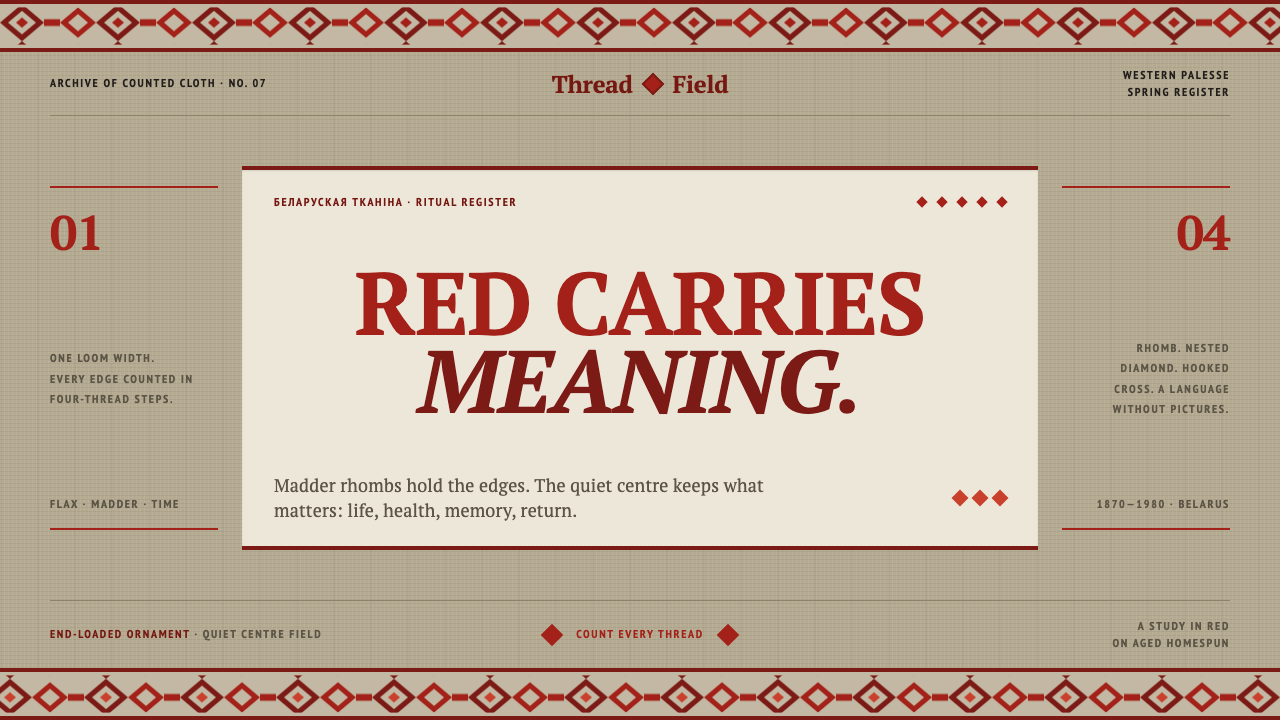 Belarusian RushnykRed carries meaning. Madder rhombs crowd aged flax edges while the woven cent…
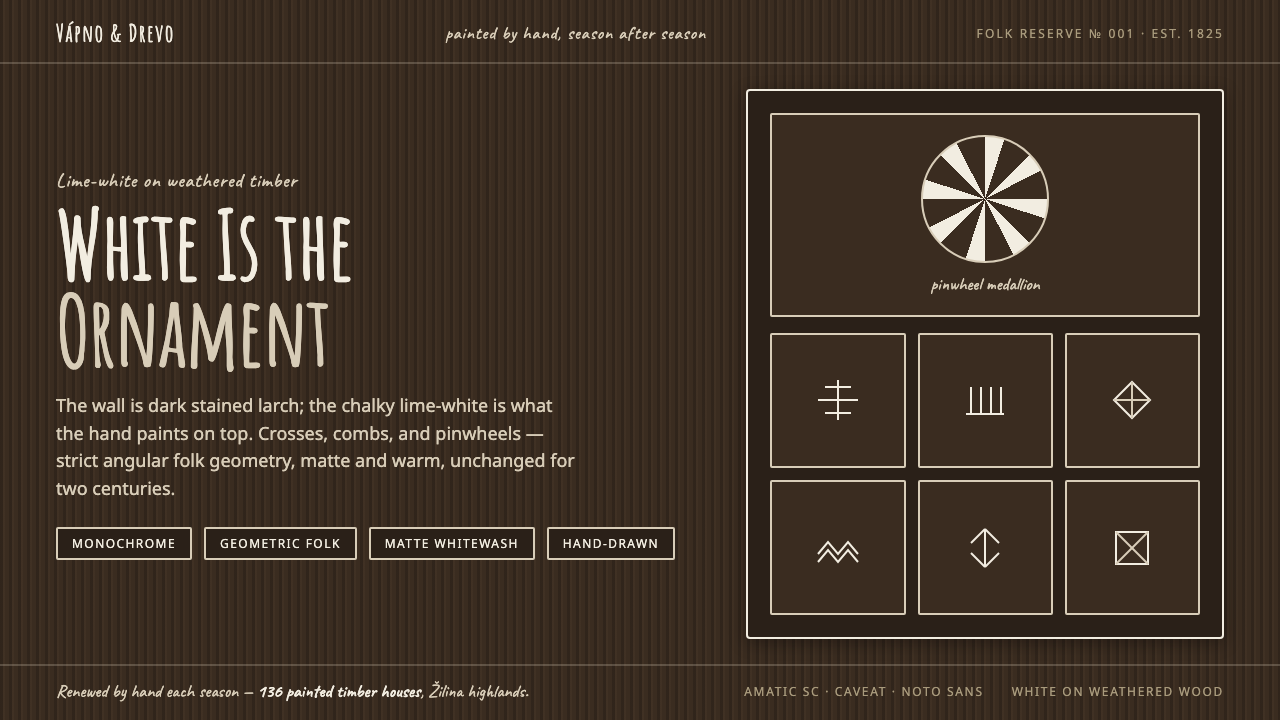 Čičmany Painted House OrnamentWhite is the ornament, not the page. Lime-white folk geometry on dark weather…
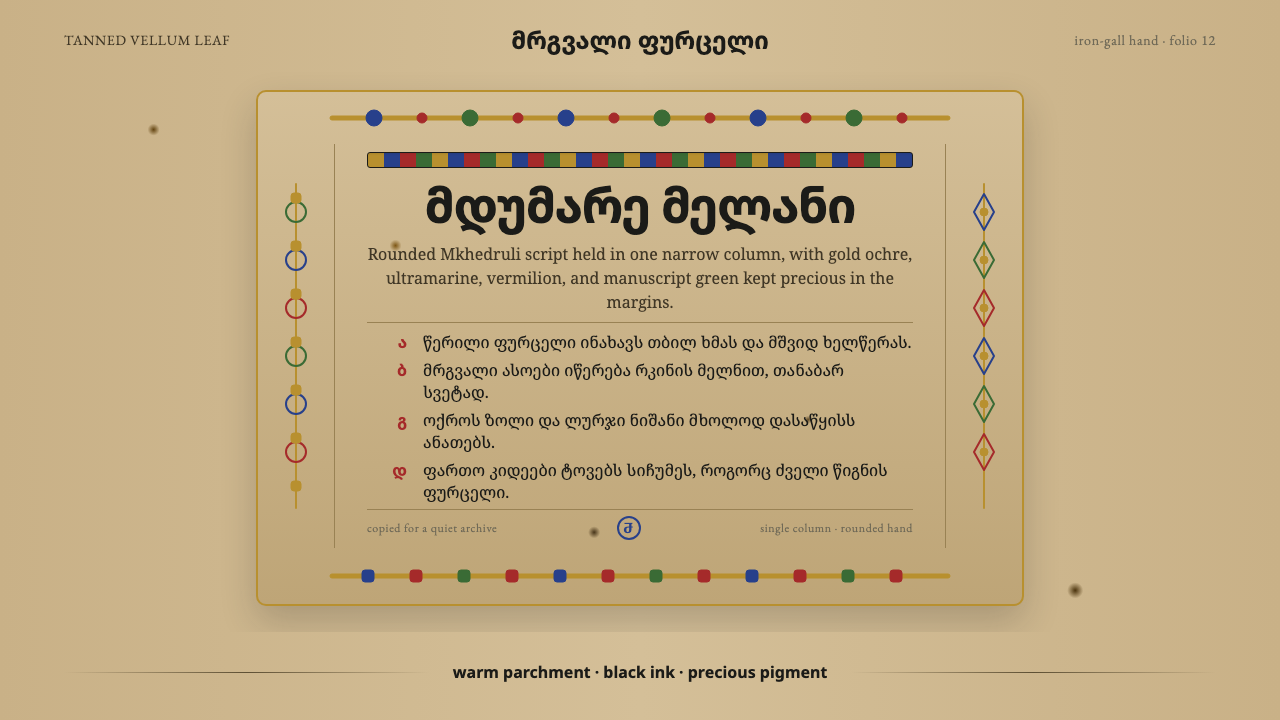 Georgian MkhedruliA manuscript breathes slowly. Tanned vellum, round Mkhedruli ink, ochre and u…
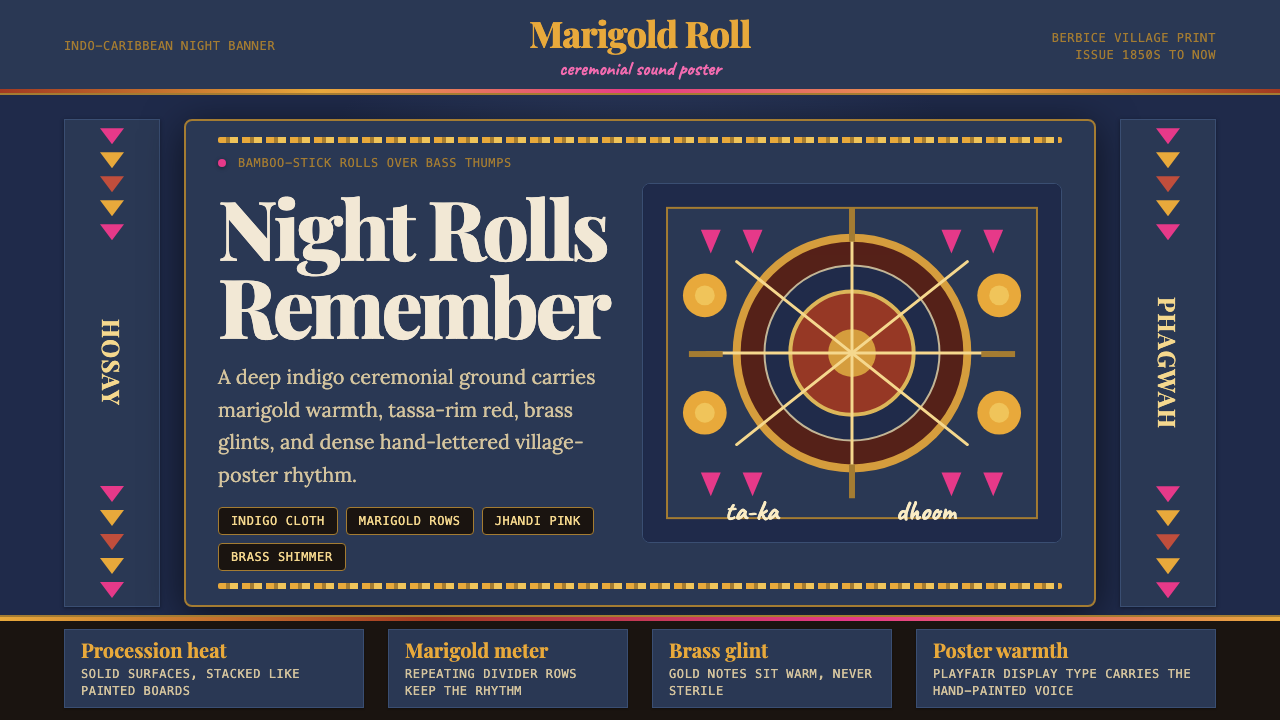 Guyanese Tassa DrumCeremony carries the beat. Indigo banners, Playfair type, and marigold rows g…
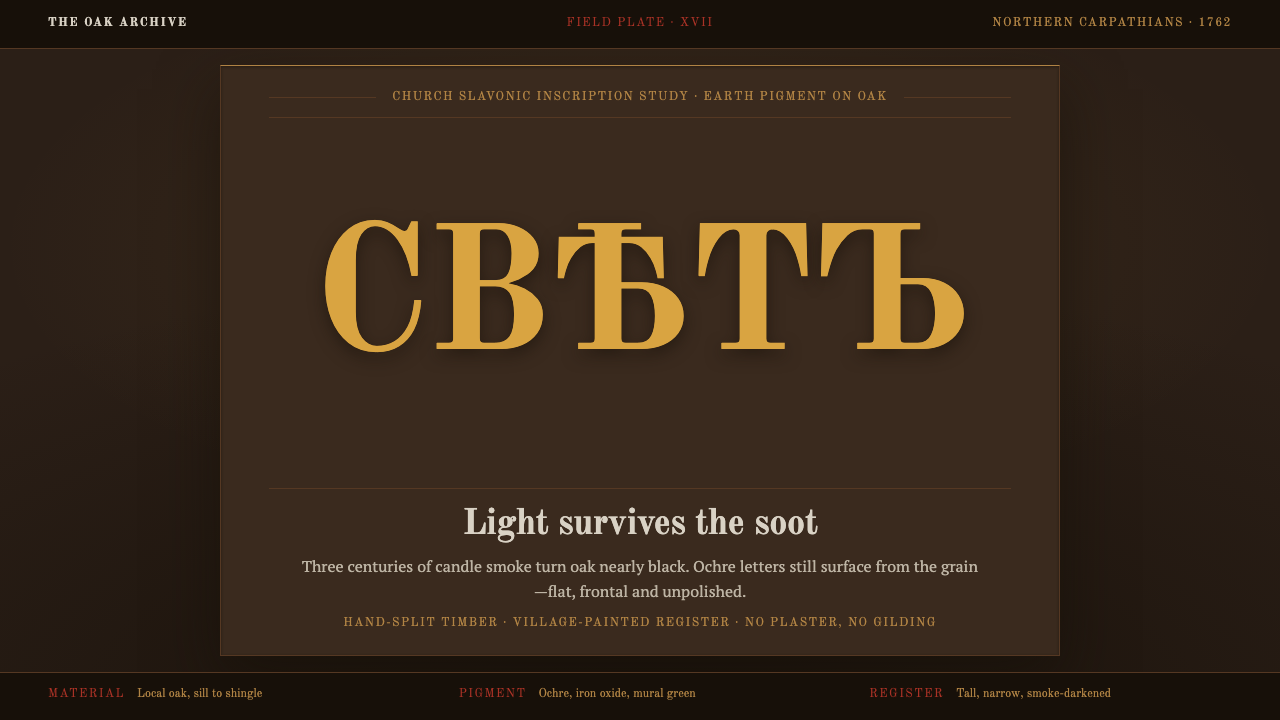 Maramureș Wooden ChurchLight survives the soot. Ochre type and earth-red geometry rise through smoke…
 Serbian Pirot KilimWoven memory, sharply framed. Claret ground, indigo borders, ochre stepped di…