What is Mauritian Sega Creole (1810)?
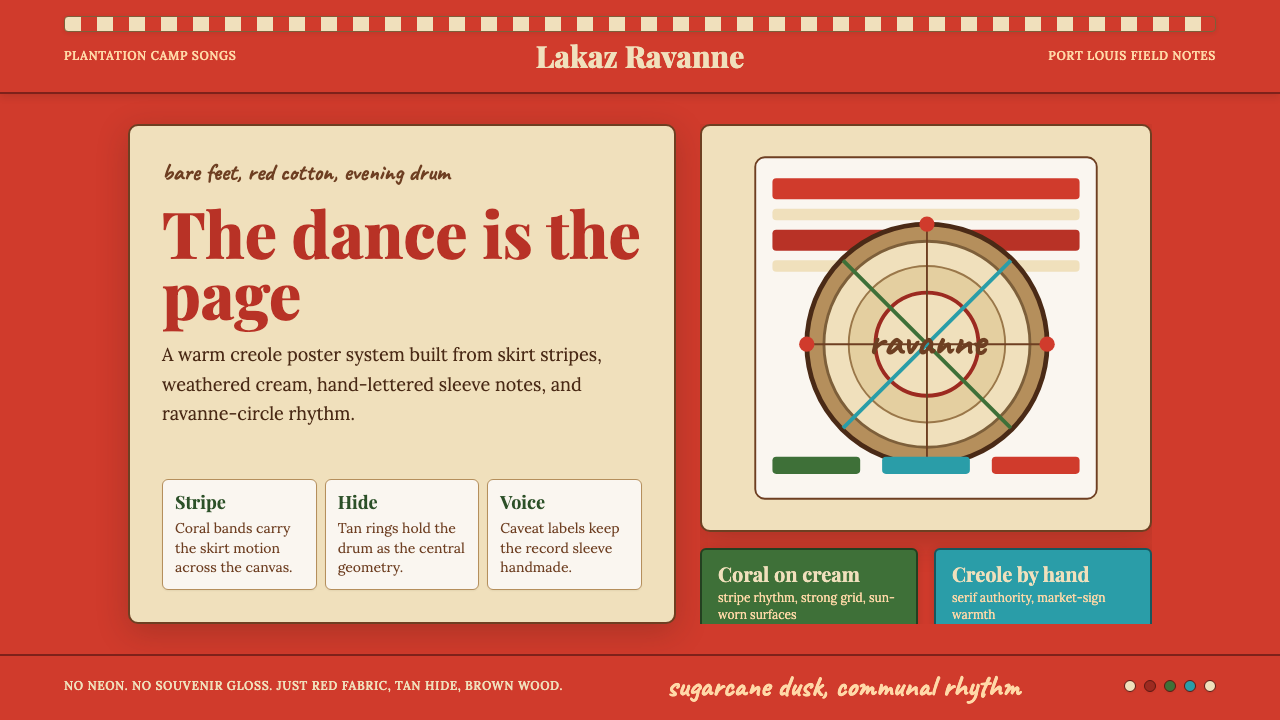
Sega is the rhythm of survival — born on Mauritian sugar plantations and beaten into visibility through coral stripes, ravanne circles, and the warm grain of weathered colonial wood.
Mauritian Sega Creole (1810) in brief
Mauritian Sega Creole (1810) is a design language rooted in the island's most important cultural tradition — the sega, a song and dance form that emerged among enslaved Africans, Malagasy people, and Mozambicans on the sugar plantations of Mauritius in the late eighteenth century. Recognized by UNESCO as an Intangible Cultural Heritage of Humanity in 2014, sega is not merely entertainment but an act of memory, carrying the grief and resilience of people who were denied almost every other form of cultural expression.
Visually, the system translates the sega's sensory world into graphic form: bold red-and-cream stripe bands that echo the rhythmic stripes of traditional dance skirts, the circular geometry of the ravanne — a goatskin frame drum beaten low to the ground — and lettering drawn in the hand-pressed tradition of mid-century record sleeves and plantation-era signage. Textures are warm and imperfect, evoking weathered wood, rough-spun cotton, and sun-bleached pigment. Nothing is clinical or digitally cold.
The aesthetic sits at the crossroads of African percussion culture, Malagasy textile tradition, French colonial typography, and Indian Ocean trade-port signage. It is unapologetically handmade in spirit, warm in palette, and rhythmic in its compositional logic — stripes, circles, and hand-lettered text pulse together the way the ravanne, maravanne rattle, and voice pulse in a sega circle.
Where does Mauritian Sega Creole (1810) come from?
Sega's roots lie in the catastrophic history of the Indian Ocean slave trade. Mauritius — then called Île de France — passed through Dutch, French, and British hands between the seventeenth and early nineteenth centuries. Under French rule from 1715 onward, the island's economy was built on sugar cultivation worked by enslaved people transported primarily from Madagascar, Mozambique, and the East African coast. Cut off from their home languages, religions, and social structures, enslaved communities forged a new Creole culture from the fragments available to them — African rhythmic traditions, scraps of European melody, improvised instruments made from gourds, animal skins, and cane stalks.
The ravanne drum — a shallow goatskin frame drum played close to the earth — became the heartbeat of this emerging culture. It was accompanied by the maravanne, a long rattle filled with seeds, and the triangle or bobre. Dancers moved low to the ground in sinuous, circular patterns, their bodies close to the earth from which they labored. The British takeover of Mauritius in 1810 — the date that anchors this design system's name — brought formal abolition of the slave trade, though slavery itself persisted until 1835 and was followed by decades of indentured labor from India. The cultural synthesis that had formed in the plantation era continued to evolve, absorbing Indian melodic influences and the French Creole language that became the lingua franca of all communities.
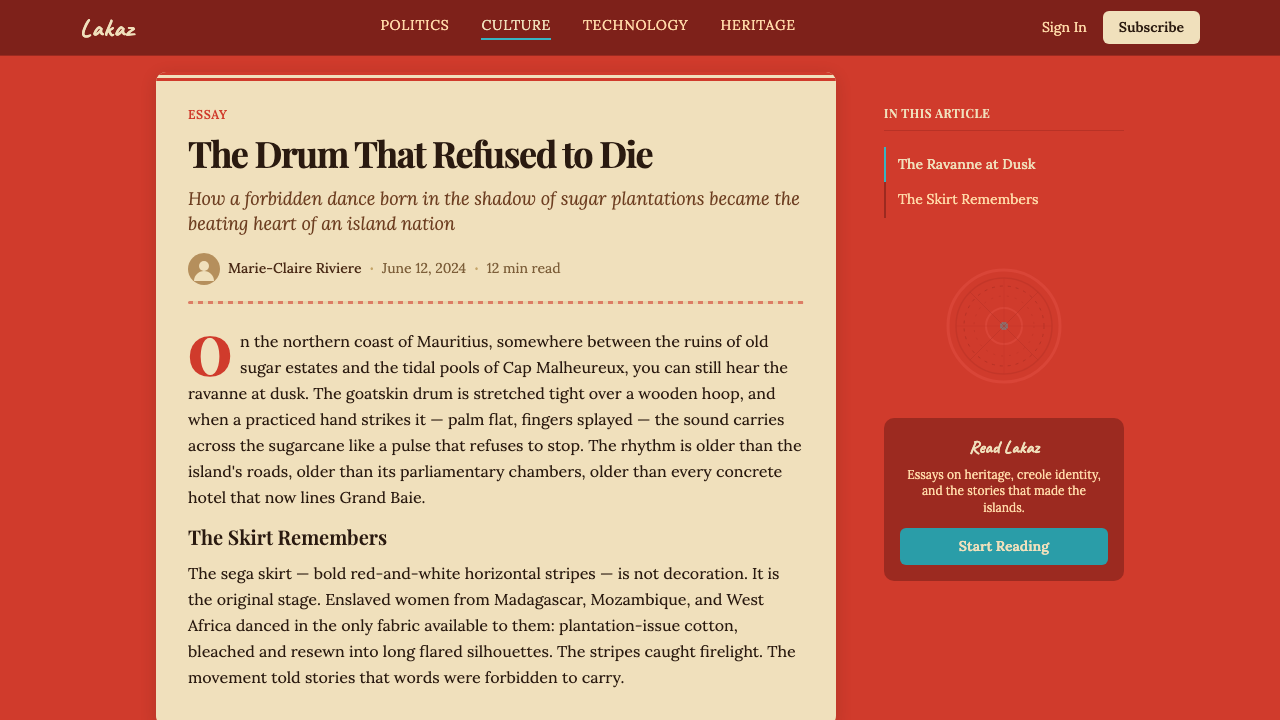
In the mid-twentieth century, as Mauritius moved toward independence (achieved in 1968), sega underwent a formal revival and began to be documented, recorded, and celebrated as a marker of national identity. Artists like Ti Frère — Jean Alphonse Ravaton — became beloved figures who carried the tradition's raw plantation energy into popular music recordings. The record sleeve designs of that era, with their hand-lettered type, coral and cream color schemes, and circular label iconography, became the visual grammar that this design system draws on most directly.
The UNESCO inscription of 2014 specifically recognized sega tipik — the traditional form as practiced in Mauritius — alongside sega tambour from Rodrigues Island, distinguishing the living tradition from its later commercial variants. This recognition confirmed what Mauritian communities had always known: sega was not folk nostalgia but a living cultural archive, encoded in rhythm, dress, and movement, of an experience that formal history had largely suppressed. The design system named for this moment draws on that archival depth — not as nostalgia, but as a visual language that has survived and accumulated meaning across more than two centuries.
What defines the Mauritian Sega Creole (1810) look?
Color
The palette is anchored by a warm coral red — the color of the traditional sega dance skirt — set against cream or off-white grounds that evoke bleached cotton and sun-warmed plantation plaster. Deep earth browns and natural wood tones provide a grounding secondary range, occasionally joined by faded saffron yellows or dusty indigos drawn from Indian Ocean textile traditions. The overall impression is warm, saturated without being harsh, and visually reminiscent of objects that have been handled and aged in tropical sun.
Stripe and Rhythm
Horizontal and diagonal stripe bands are the system's most immediately recognizable motif, echoing the striped skirts worn by sega dancers. These stripes are not mechanical or perfectly even — they carry a slight handmade variation in weight and spacing that suggests they were printed from a woodblock or drawn by hand. Used as dividers, backgrounds, or compositional anchors, they give every layout an underlying pulse, the way the ravanne gives a sega performance its rhythmic backbone.
Circular Geometry
The circle appears repeatedly as a structural and symbolic form, derived from the shape of the ravanne drum head and from the circular formations that sega dancers form around the musicians. In this design system, circles function as focal containers — for portraits, for decorative labels, for data visualizations — and as decorative elements that imply gathering, community, and cyclical rhythm. They balance the linear energy of the stripe motifs with a sense of centripetal warmth.
Typography
Lettering follows the hand-pressed tradition of mid-century Mauritian record sleeves and market signage — letterforms with slight irregularities, generous ink spread, and a warmth that distinguishes them from both rigid geometric sans-serifs and classical serifs. Display type feels as though it was composed by a sign painter who had learned from French colonial printing but adapted it for a tropical context. Body text, by contrast, uses more upright, readable forms to ensure clarity at smaller scales. The overall typographic register is expressive and human rather than institutional.
Texture and Material
Surface textures are integral, not decorative afterthoughts. Wood grain — the kind found in bleached plantation shutters and market stalls — appears as background texture, lending warmth and a sense of physical presence. Paper grain, rough-woven fabric, and the faint foxing of aged printed matter all contribute to a material vocabulary that insists these designs have been touched, used, and lived with. Digital applications translate this through deliberate noise layers and slightly uneven tonal fields rather than perfectly flat fills.
Warmth and Imperfection
Unlike design systems that prize mechanical precision, Mauritian Sega Creole embraces controlled imperfection as a carrier of authenticity. Edges may be slightly rough; registration between color layers may be fractionally off; textures may be uneven. These qualities are not errors to be corrected but signals of handmade origin — they connect the visual output to the tradition of the sega circle, where perfection was never the point. The point was presence, rhythm, and collective feeling.
Compositional Rhythm
Layouts are organized around repeating rhythmic units — stripe intervals, circular motifs at regular cadences, typographic lines that echo one another in weight and spacing. This repetition is not monotony but pulse: it gives the eye a beat to follow across a composition, the same way a repeating drum pattern gives dancers a ground on which to improvise. Negative space is used generously between these units, allowing each rhythmic element to breathe and register before the next arrives.
Who shaped Mauritian Sega Creole (1810)?
Born in 1900 in the Plaines Wilhems district of Mauritius, Ti Frère became the most beloved figure in sega history, recording prolifically from the 1950s through the 1970s. His songs in Mauritian Creole — personal, irreverent, and rooted in plantation-era memory — defined what sega tipik sounded like for generations of Mauritians. The visual culture of his record releases, with their hand-lettered sleeves, circular label designs, and coral-and-cream color palette, provides the most direct visual precedent for this design system.
A prolific composer and performer active from the 1950s onward, Serge Lebrasse helped bring sega to broader audiences through radio broadcasts and commercial recordings. His work sits at the intersection of the traditional plantation form and more melodically accessible arrangements, and his visual presence on album covers of the 1960s and 1970s — warm photographic portraits set against striped and patterned backgrounds — contributed to the mid-century visual grammar that this system draws on.
One of the first women to achieve prominence in sega performance, Marclaine Antoine helped establish the visual iconography of the sega dancer — the coral-striped skirt, the bare-footed movement, the physicality of dancing close to the earth — that became central to both the UNESCO recognition and the visual language of this design system. Her performances of the 1960s and 1970s crystallized the aesthetic of the sega circle into a form that could be represented and transmitted.
A Mauritian historian specializing in the history of slavery and indentured labor, Vijaya Teelock has been instrumental in documenting the plantation-era origins of sega and connecting the music to the broader context of the Indian Ocean slave trade. Her scholarly work provides the historical grounding for understanding sega not as simple folk entertainment but as a form of cultural memory and resistance — a dimension that gives this design system its depth beyond surface aesthetics.
How do you use Mauritian Sega Creole (1810) today?
Mauritian Sega Creole is one of the warmer, more texturally rich historical styles in contemporary design work. Applying it well requires understanding what the visual system is actually doing — using stripe rhythm to create movement, using circular geometry to anchor gathering and focus, using warm and imperfect surfaces to signal authenticity and human presence — rather than simply applying coral and cream to a standard layout.
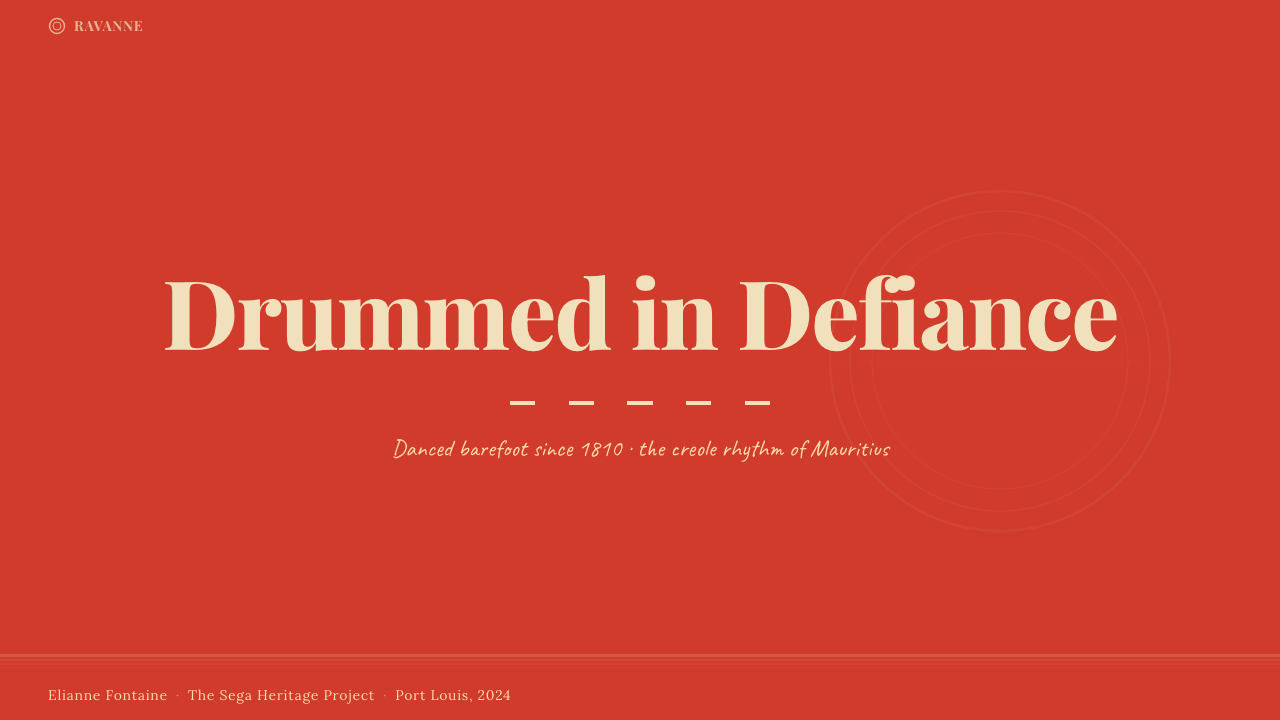
For presentation slides, the system works exceptionally well on cover pages where a strong cultural statement is appropriate. A sega-derived cover benefits from a full-bleed stripe band in coral running across the lower third, with a circular container holding a keynote image and hand-influenced lettering sitting at generous scale above. Content slides should preserve the stripe rhythm in a single horizontal accent line and use warm off-white grounds rather than pure white. Data slides work well when chart elements adopt the circular geometry — donut charts, radial progress indicators, and bubble charts are more at home in this system than bar charts, which fight the system's organic warmth with their geometric rigidity.
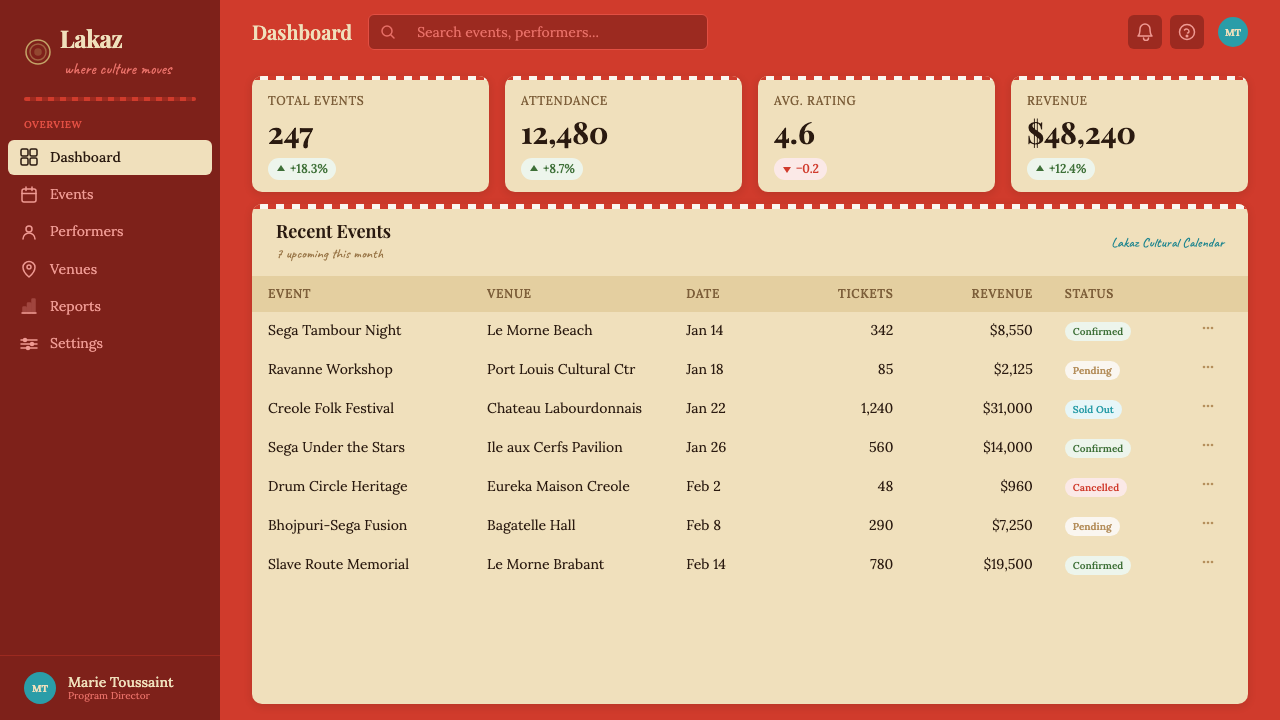
For web interfaces, the style is best suited to cultural platforms, creative portfolios, music and event sites, and any context where warmth and cultural identity are primary values. A dashboard built in this system should use the warm cream background as its base, reserve the coral red for primary actions and key data highlights, and introduce wood-grain or paper-grain texture subtly in card backgrounds and sidebar panels. Navigation should be typographically expressive, leaning into the hand-lettered register for brand-level labels while maintaining clean legibility for utility items.
For editorial and marketing work, the system supports rich, layered compositions. A sega-derived editorial spread uses stripe bands as section dividers, places circular portrait cutouts against warm-toned backgrounds, and allows generous margin space — the negative space between elements is as important as the elements themselves, giving the composition the breathing room that a sega circle gives each performer. Marketing pages work well with the system's inherent warmth: feature blocks alternate between coral-on-cream and cream-on-earth-brown, with the stripe motif providing horizontal rhythm across the full page width.
A common mistake when applying this system is over-smoothing its inherent roughness in pursuit of a polished digital finish. The system's power comes precisely from its textural warmth and controlled imperfection. Using perfectly flat fills, sharp-edged geometric shapes, and mechanically precise stripe widths produces a pastiche that borrows the palette but loses the soul. Similarly, treating the coral red as the only active color and leaving cream and brown as purely neutral fields underuses the system — the cream and earth tones carry as much visual weight as the red when applied with confidence.
Mauritian Sega Creole (1810) — FAQ
Is this style appropriate for non-Mauritian contexts, or does it read as cultural appropriation?
The distinction lies in intention and transparency. Using the Mauritian Sega Creole system for a product that has a genuine connection to Mauritius, Indian Ocean culture, or the African diaspora is straightforwardly appropriate. Using it for a project with no thematic connection but simply because the palette is appealing requires more care. The best practice is to treat the style as what it is — a named tradition with specific historical origins — and to name those origins in any context where the cultural reference is meaningful. Erasing the source while using the aesthetic is the problematic move; acknowledging and celebrating it is not.
How does the warm palette work on digital screens, where coral red can look very different across devices?
This is a real technical consideration. The coral red at the heart of this system is warm and slightly desaturated compared to pure signal red — it should read as the color of terracotta or faded paprika rather than a fire-engine red or a digital alert color. On screens with wider color gamuts, it can become more vivid than intended. The solution is to test across a range of displays and accept a degree of variation as a natural property of the style, much as the physical ravanne drum would sound differently in different acoustics. The warmth should survive even on cool-cast displays; if it looks neon, pull the saturation back. The cream and earth tones are more stable and will anchor the palette even when the coral drifts.
Can this system work for a dark-mode or dark-background layout?
A dark inversion is possible but requires rethinking the palette hierarchy. The canonical light version places coral on cream with earth brown as depth; a dark version works best by using a deep warm brown or near-black as the ground, coral as the primary accent, and cream or pale saffron for text. The stripe motif survives well in inversion — stripes of coral and pale yellow on dark brown read as authentic to the tradition while serving the dark context. What to avoid: using a cold or blue-toned dark background, which immediately fights the style's warm character and produces a result that feels like a mismatched skin rather than a coherent design decision.
How does the hand-lettered typographic register work alongside modern UI type requirements?
The practical approach is to use the hand-influenced style for display-level type — headlines, section labels, key calls to action — and to switch to a clean, readable typeface family for body text, navigation, and data labels. The display type carries the cultural register; the body type ensures usability. This split is historically authentic too: mid-century Mauritius record sleeves routinely combined hand-painted headline lettering with more mechanical body type set from available type. The system does not require that every character be hand-drawn — it requires that the spirit of expressive lettering is present at the visual focal points.
What kinds of projects are most and least suited to this style?
Mauritian Sega Creole is most naturally suited to projects where warmth, cultural rootedness, and handmade authenticity are genuine values: music and festival platforms, cultural heritage organizations, travel and hospitality brands with Indian Ocean or African connections, creative studios and independent makers who want to distance themselves from slick corporate aesthetics. It also works well for social impact organizations working on themes of diaspora, memory, and community. It is least suited to contexts that require clinical precision, cool authority, or the appearance of machine-made perfection: financial platforms, analytical tools, enterprise software, or any context where the user's trust depends on signals of technological rigor rather than human warmth.
Related design styles
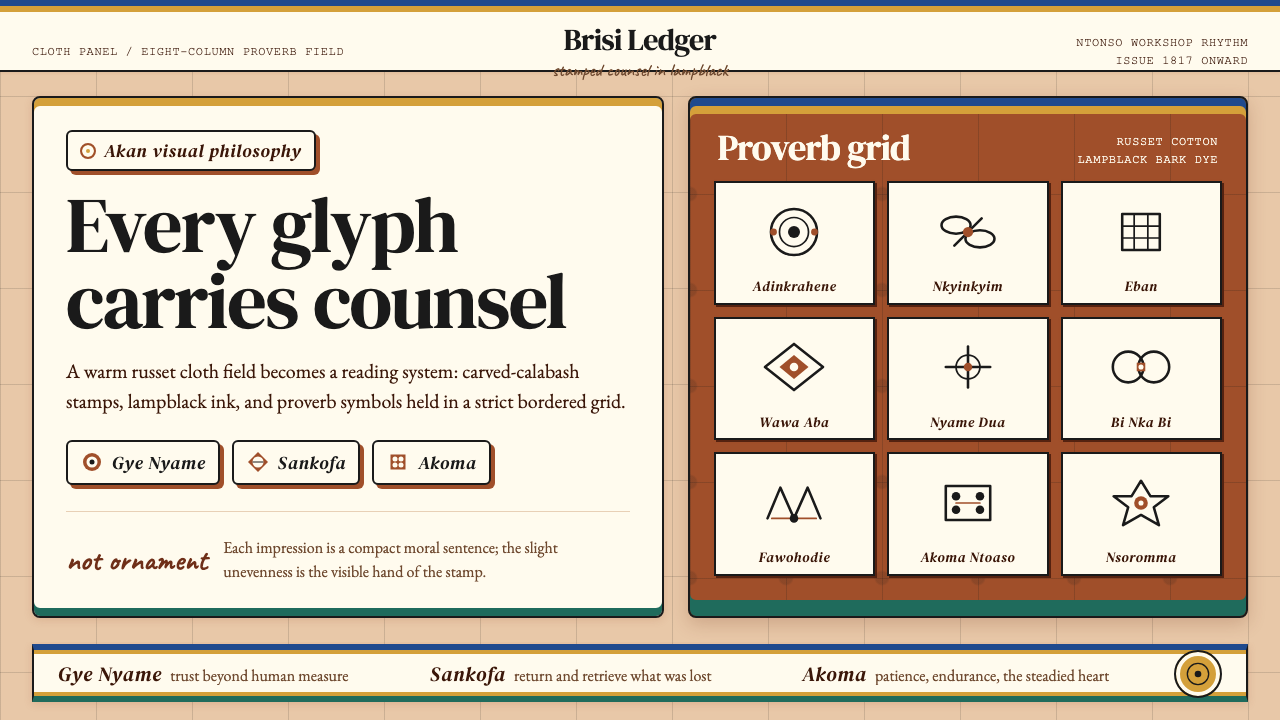 Akan Adinkra (Ghana)Proverbs become cloth. Russet grids, lampblack serif marks, and gold-edge ban…
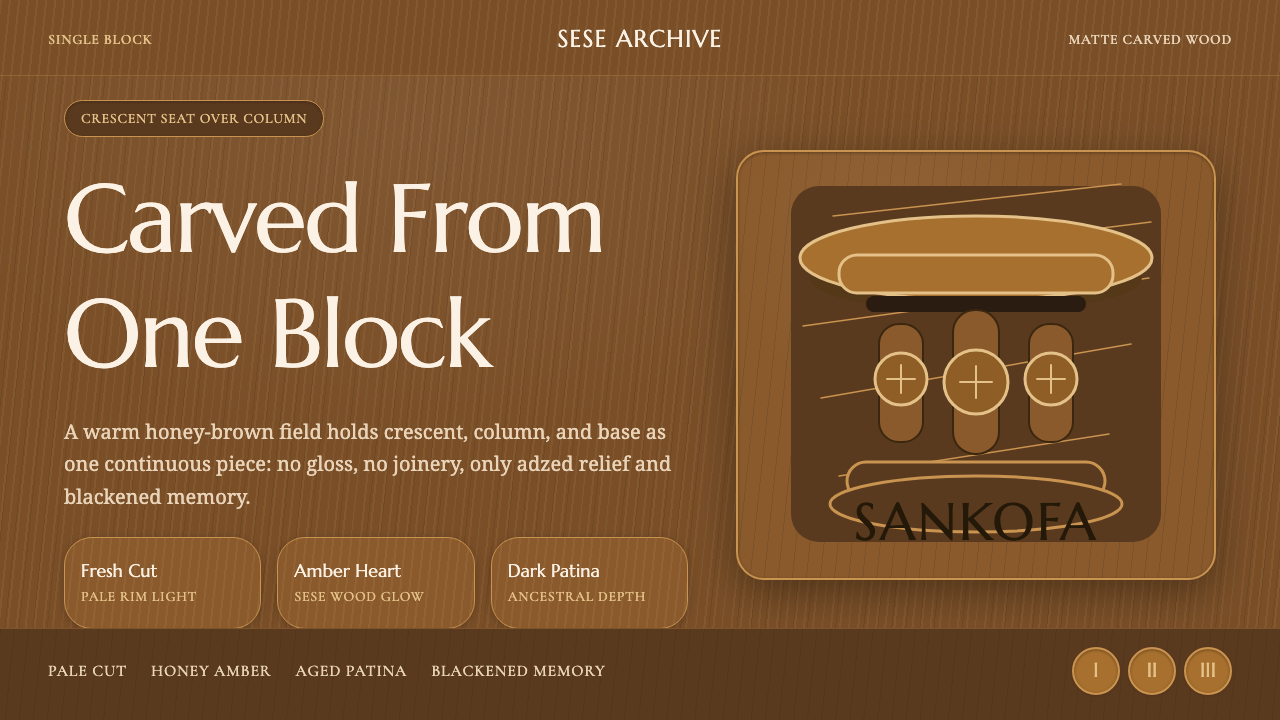 Akan Carved StoolMatte wood carries memory. Honey amber, Marcellus type, and crescent-column r…
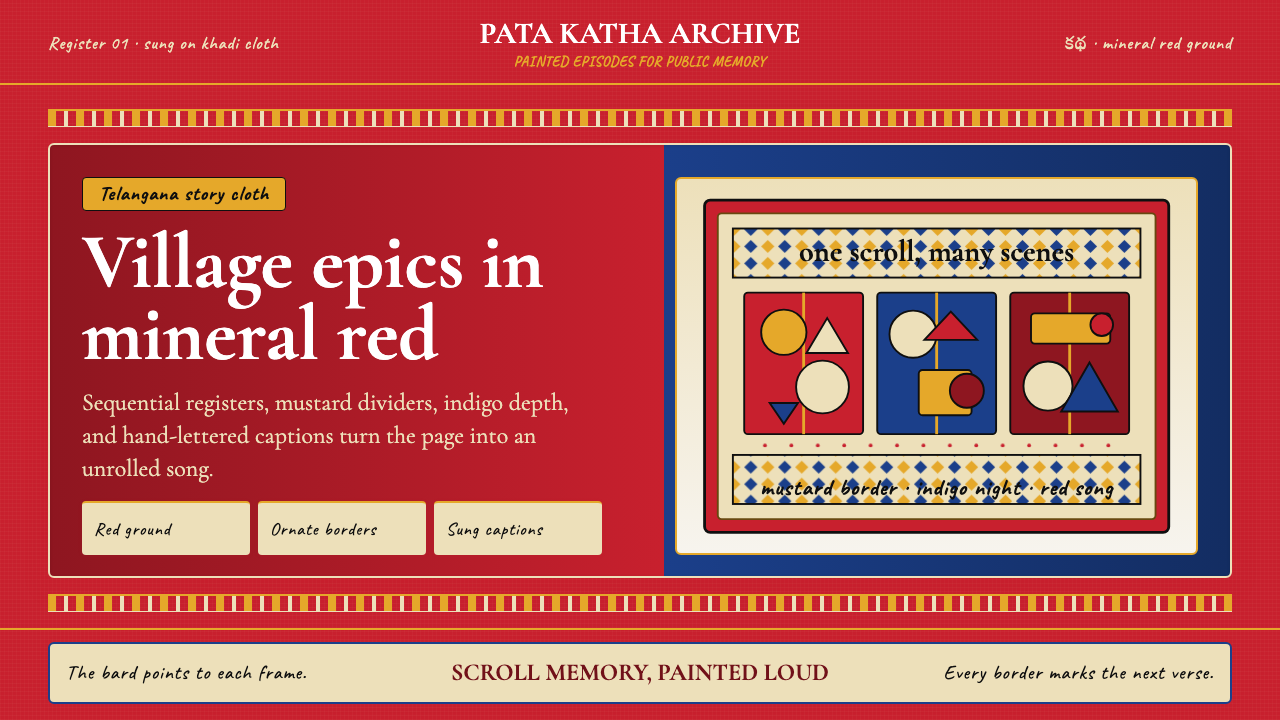 Andhra Cheriyal Scroll PaintingSaturated oral memory. Mineral red registers, mustard diamonds, and serif son…
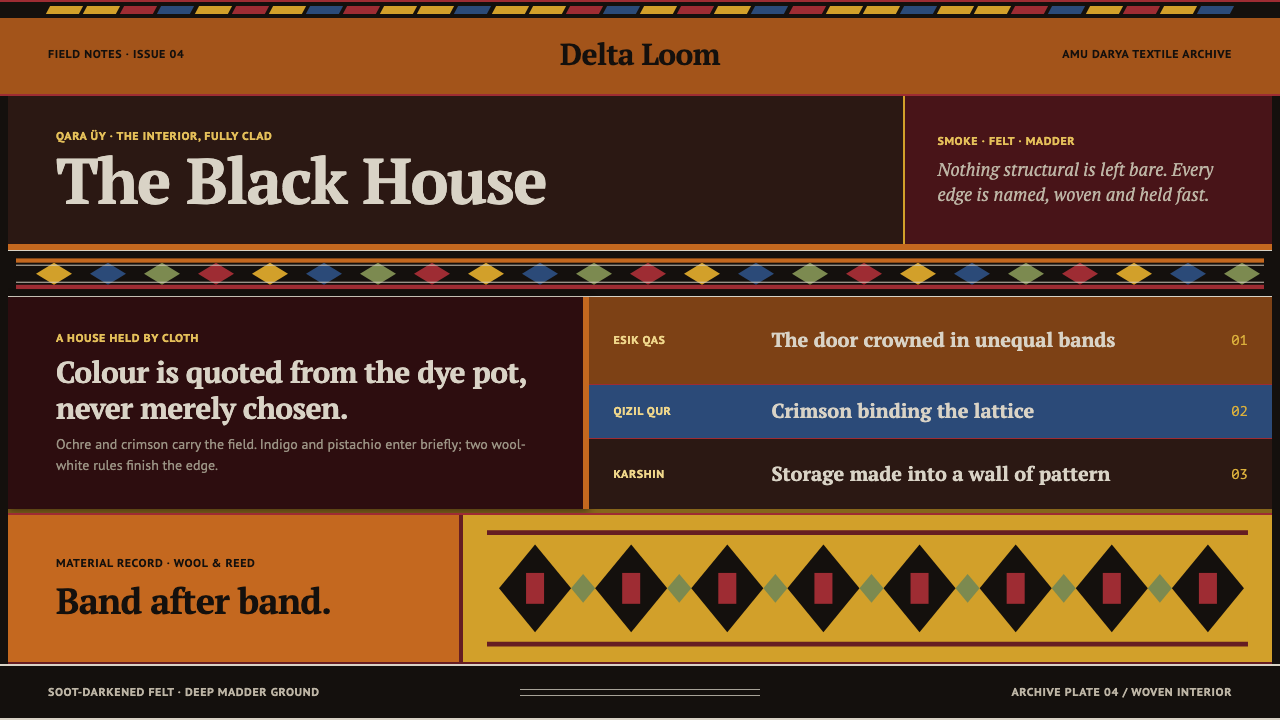 Karakalpak Yurt InteriorNo surface is left bare. Ochre, crimson and indigo bands wrap a smoke-darkene…
 Serbian Pirot KilimWoven memory, sharply framed. Claret ground, indigo borders, ochre stepped di…
 Ukrainian Rushnyk Ceremonial TowelCeremony stitched in red. Linen panels, soot-black crosses, and wheat-gold st…