What is Ukrainian Rushnyk Ceremonial Towel?
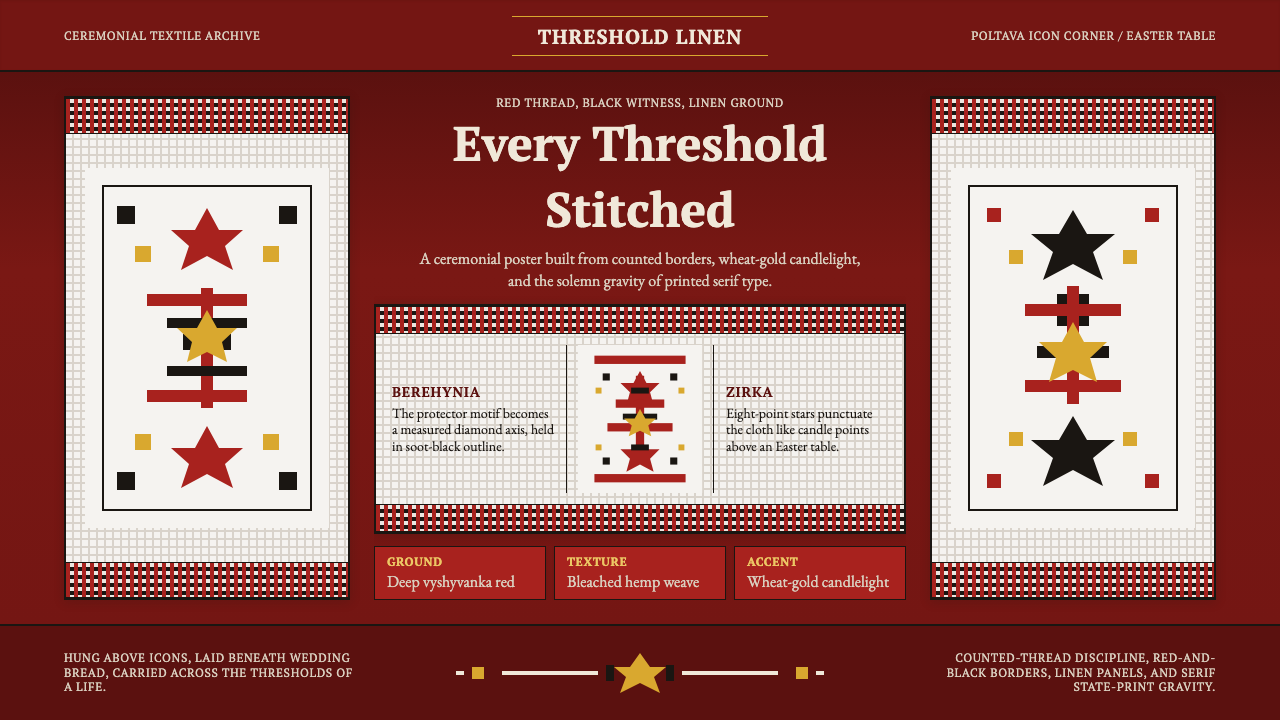
The rushnyk is Ukraine's embroidered ceremonial linen towel — stitched in red and black on bleached hemp, it has marked every threshold of Ukrainian life for over a thousand years.
Ukrainian Rushnyk Ceremonial Towel in brief
The rushnyk is Ukraine's most sacred textile form — a long, narrow strip of bleached hemp or linen cloth embroidered in disciplined geometric patterns using red and black cross-stitch. It is not merely decorative; it is a threshold object, used at every liminal moment of Ukrainian life: births, weddings, funerals, harvests, and the welcoming of honored guests. To step onto a rushnyk or to receive one is to enter into a symbolic covenant with family, community, and continuity.
The visual grammar of the rushnyk is a codified system refined over centuries. Its core motifs — the berehynia (a protective female figure with raised arms), the vazon (the tree of life sprouting from a vessel), and the zirka (an eight-pointed star) — repeat and vary along the cloth's length, contained within strict horizontal borders. The counting discipline of cross-stitch on a woven grid means every element is geometrically precise: diagonals are always at forty-five degrees, curves are approximated by stairstepped pixel logic, and the negative space between motifs is as considered as the motifs themselves.
What distinguishes the rushnyk from other European folk embroidery traditions is the weight of meaning compressed into its formal vocabulary. The choice of motif, the direction of border progression, and even the proportion of red to black carry regional, familial, and ritual significance. A Poltava-region rushnyk reads differently from a Hutsul one; a wedding rushnyk differs structurally from one hung above an icon corner. The system is, in the truest sense, a visual language — with grammar, dialect, and occasion-specific registers.
Where does Ukrainian Rushnyk Ceremonial Towel come from?
The rushnyk's roots reach into pre-Christian Slavic ritual life, where woven and embroidered cloth served as a medium for communicating with ancestral spirits and protective deities. The berehynia figure — a stylized goddess with arms raised in the orant posture — appears on Ukrainian embroideries that archaeologists have dated to the early medieval period, and her lineage extends further into the Bronze Age goddess imagery of the Cucuteni-Trypillia culture, which flourished on the territory of modern Ukraine between roughly 5500 and 2750 BCE. When Christianity arrived in Kyivan Rus in 988, it absorbed rather than erased this symbolic vocabulary, and the rushnyk became a bridge between the old protective magic and the new icon-corner devotion.
The golden age of rushnyk production ran from approximately the eighteenth century through the early twentieth, as regional traditions crystallized into identifiable schools. The Poltava region became associated with flowing geometric forms in deep red against a spare white ground, with motifs that left generous breathing space between elements — a visual austerity that gives Poltava rushnyky an almost architectural clarity. Polissia in northern Ukraine developed denser, more archaic forms in which black dominated and red served as accent, producing compositions that feel compressed and incantatory. The Hutsul Carpathian tradition combined embroidery with weaving, introducing wool alongside linen and using saturated warm colors absent from the central-Ukrainian palette. Podillia and Volhynia each developed their own signature border geometries and berehynia variants, creating a map of regional visual identity that ethnographers spent the nineteenth century systematically documenting.
Key figures in preserving and elevating the rushnyk tradition include Olena Pchilka, the folklorist and mother of the poet Lesya Ukrainka, who in the 1870s and 1880s made systematic records of regional embroidery patterns at a moment when industrialization was beginning to displace hand embroidery. Lesya Ukrainka herself incorporated rushnyk symbolism into her literary work, cementing the textile's status as a marker of national cultural identity. In the Soviet period, rushnyk production was simultaneously preserved as approved folk craft and politically co-opted — collective embroidery workshops produced rushnyky for state occasions, and the most accomplished practitioners were designated as National Artists. This institutional support preserved technique while sometimes flattening regional variation.
The post-2022 period has seen an extraordinary revival of rushnyk practice, as Ukrainians inside and outside the country have turned to traditional embroidery as an act of cultural affirmation under conditions of war. Contemporary embroiderers including Vira Rojko and writers including Halyna Lutsyshyna have articulated the rushnyk not as nostalgic folklore but as a living system — one whose formal discipline and accumulated meaning make it a vehicle for expressing both grief and resistance. This revival is not a folklorized reproduction; it is characterized by serious attention to regional historical sources and a refusal to reduce the tradition to a tourist-facing surface.
What defines the Ukrainian Rushnyk Ceremonial Towel look?
Color
The canonical rushnyk palette is binary and stark: deep ceremonial red for the embroidered motifs and pure black for outlining and shadow elements, worked against the natural off-white of undyed bleached hemp or linen. Red carries the weight of life, vitality, and protective energy in Ukrainian folk symbolism; black marks boundaries, mourning, and the earth. The proportion of red to black varies by region — Poltava compositions are red-dominant with black used sparingly for emphasis, while Polissia pieces tip toward black with red as a warm counter-accent. Wheat-gold occasionally appears as a tertiary note, particularly in harvest-season rushnyky, where it suggests candlelight and ripe grain. This severe restraint — two colors plus ground — is not poverty of means but disciplined articulation.
Grid and Geometry
Every element in a rushnyk is governed by the counting grid of the woven cloth. Cross-stitch on an even-weave fabric means that the smallest unit is one thread intersection — a single counted cell — and all forms are constructed by aggregating these cells. Diagonals run at strict forty-five-degree angles; curves are rendered as stairstepped approximations; symmetry is enforced by mirror-counting. This is not freehand embroidery: it is a pixel-grid system worked in thread, producing forms that are simultaneously rigorous and warm, mathematical and handmade. The discipline is visible in the spacing between motifs, which is always a counted multiple of the base unit.
Motif Vocabulary
The rushnyk's symbolic vocabulary is finite and codified. The berehynia — a frontal female figure with upraised arms, often flanked by birds — is the primary protective symbol, her posture unchanged from ancient votive figurines. The vazon presents the tree of life growing from a decorated vessel or base, its branches populated by birds, flowers, and geometric fruit. The zirka (eight-pointed star) functions as a solar and celestial symbol, appearing in border repeats and as field ornaments. Additional motifs include stylized birds (particularly doves and roosters), grape clusters, and endless-knot meanders. Each motif carries established meaning within the tradition, and their combination on a single rushnyk produces a composite symbolic program specific to the occasion.
Border Structure
The horizontal border is the organizing principle of rushnyk composition. Most rushnyky consist of multiple distinct border bands running the width of the cloth, stacked vertically with precisely counted intervals of bare ground between them. Each border band may carry a different motif or a variation of the same motif at different scales, creating a rhythmic progression from the cloth's center outward to its ends. The ends are the most densely worked areas — this is where the primary symbolic content concentrates, and where a rushnyk hung above an icon would draw the eye. The long unembroidered middle section is not emptiness but counted interval, a visual breath essential to the composition's rhythm.
Symmetry and Reflection
Rushnyk motifs are bilaterally symmetrical as a near-absolute rule — the berehynia's outstretched arms are mirror images, the vazon's branches balance left and right, the zirka reflects across both horizontal and vertical axes. This strict bilateral symmetry is enforced by the counting grid and carries symbolic weight: symmetry signals wholeness, protection, and completion. Asymmetric elements, when they appear, are significant departures — a mourning rushnyk might introduce deliberate imbalance to signal disruption and loss. Understanding that symmetry is the default and asymmetry is marked makes the tradition's visual logic fully legible.
Textile Ground
The ground cloth itself is an active visual element, not neutral background. Bleached hemp or linen carries a slightly warm off-white tone — neither the cold white of cotton nor the cream of aged paper, but something closer to the color of morning light on plaster. The visible weave structure shows through even where embroidery is dense, giving the cloth's surface a consistent fine texture that unifies embroidered and bare areas. In rushnyk aesthetics, the bare ground is never "empty" — it is part of the counted composition, and its proportion to embroidered area is as calibrated as the motif selection.
Ritual Function and Material Memory
A rushnyk is not a wall hanging that happens to be functional; it is a functional object whose repeated use accumulates meaning. Wedding rushnyky are kept for generations; a rushnyk that has witnessed a marriage becomes a family document, its embroidered surface a record of the hands that made it and the occasion it marked. This accumulation of meaning through use distinguishes rushnyk aesthetics from decorative folk art: the visual system is calibrated to carry weight — literal and symbolic — across time. The same formal properties that make a rushnyk readable as embroidery (geometric clarity, high contrast, bilateral symmetry) also make it readable as memory.
Who shaped Ukrainian Rushnyk Ceremonial Towel?
Folklorist, writer, and mother of the poet Lesya Ukrainka, Olena Pchilka (1849–1930) undertook systematic field documentation of Ukrainian embroidery patterns during the 1870s and 1880s, at a critical moment when industrialization and urbanization were beginning to displace hand embroidery from everyday use. Her ethnographic records preserved regional rushnyk designs — particularly from Poltava and surrounding areas — that might otherwise have been lost. Pchilka understood embroidery not merely as craft but as a visual language encoding Ukrainian cultural identity, and her writings framed the rushnyk as an object of serious scholarly and national significance.
Ukraine's most celebrated poet (1871–1913), Lesya Ukrainka was the daughter of Olena Pchilka and grew up immersed in her mother's ethnographic work with embroidery and folk tradition. Ukrainka incorporated rushnyk symbolism — the berehynia's protective gesture, the threshold crossing, the embroidered border as boundary between worlds — into her literary mythology. Her work cemented the rushnyk's position not as domestic craft but as a carrier of Ukrainian philosophical and spiritual thought, a reframing that gave the tradition intellectual dignity and made it central to Ukrainian cultural nationalism in the early twentieth century.
A contemporary Ukrainian embroidery practitioner and educator, Vira Rojko has been central to the post-2022 revival of rushnyk practice as a living tradition rather than a museum artifact. Rojko's work combines rigorous study of historical regional patterns — sourcing directly from ethnographic archives and museum collections — with contemporary applications that demonstrate the tradition's vitality for present-day practitioners. She has been instrumental in transmitting regional embroidery literacy to a new generation of Ukrainians who are turning to traditional textile work as an act of cultural resistance and affirmation during the ongoing war.
Ukrainian writer and academic Halyna Lutsyshyna has written extensively on the rushnyk as a site of Ukrainian cultural memory and feminine creative labor. Her critical and literary work contextualizes the rushnyk within broader frameworks of Ukrainian identity, resistance, and the politics of material culture. Lutsyshyna has been particularly attentive to the post-2022 embroidery revival, documenting how practitioners are using the tradition not as nostalgic preservation but as an active form of cultural survival — stitching continuity in conditions of existential threat.
How do you use Ukrainian Rushnyk Ceremonial Towel today?
The rushnyk's visual system is richly transferable to contemporary design contexts, but it requires careful extraction rather than wholesale transplantation. The tradition's power comes from the tension between strict formal discipline and accumulated symbolic meaning. When applying this aesthetic, the discipline is the transferable part — the grid logic, the bilateral symmetry, the high-contrast binary palette, the respect for ground as active element. The meaning must be built anew in context; lifting motifs without understanding their grammar produces decoration, not resonance.
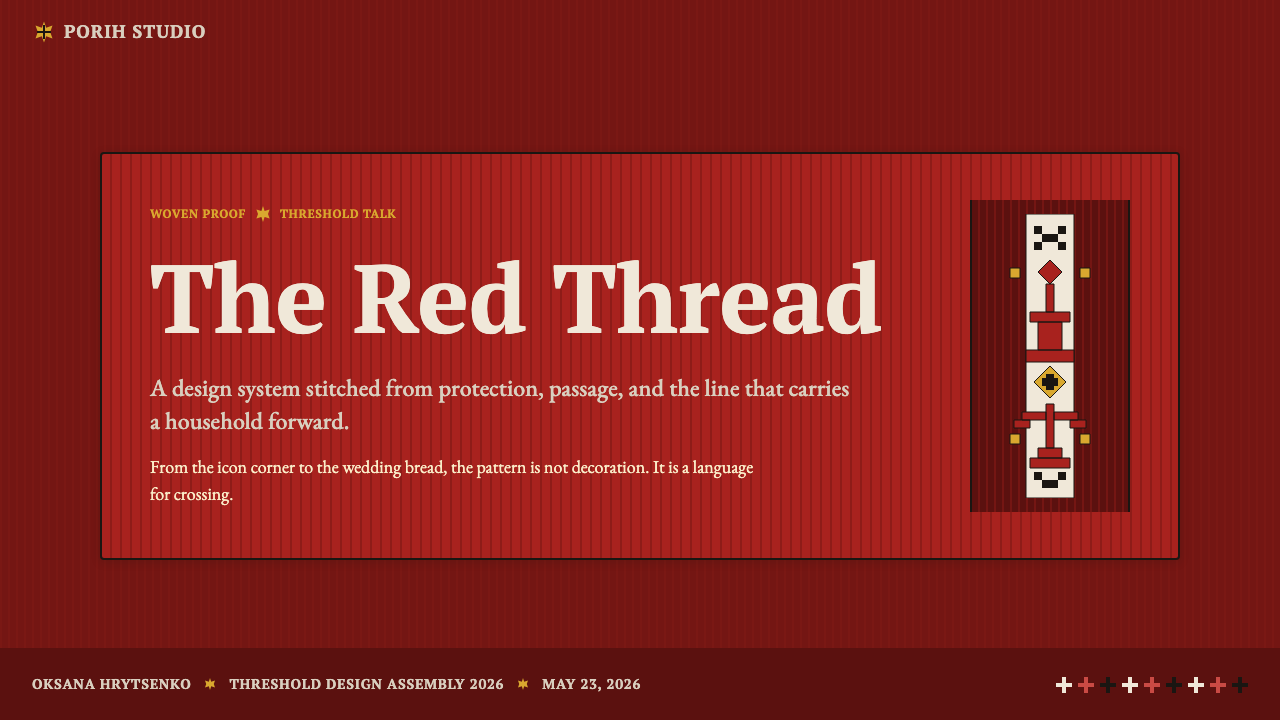
For presentation slides, the rushnyk aesthetic works exceptionally well as a ceremonial or commemorative register. A cover slide in this mode uses a deep red ground with a linen-white central panel bearing a geometric border pattern: the border runs horizontally across the upper and lower thirds, leaving the central field clear for title text in a weight that echoes the embroidery's visual density. Content slides adopt a simpler approach — a narrow horizontal border element (either a full rushnyk-style repeat or a single motif reduced to its geometric essence) anchors the top or bottom edge, while the body of the slide stays clean and undecorated. Data slides can use the binary palette to distinguish two data series with maximum clarity, treating bars or segments as counted threads rather than chart furniture.
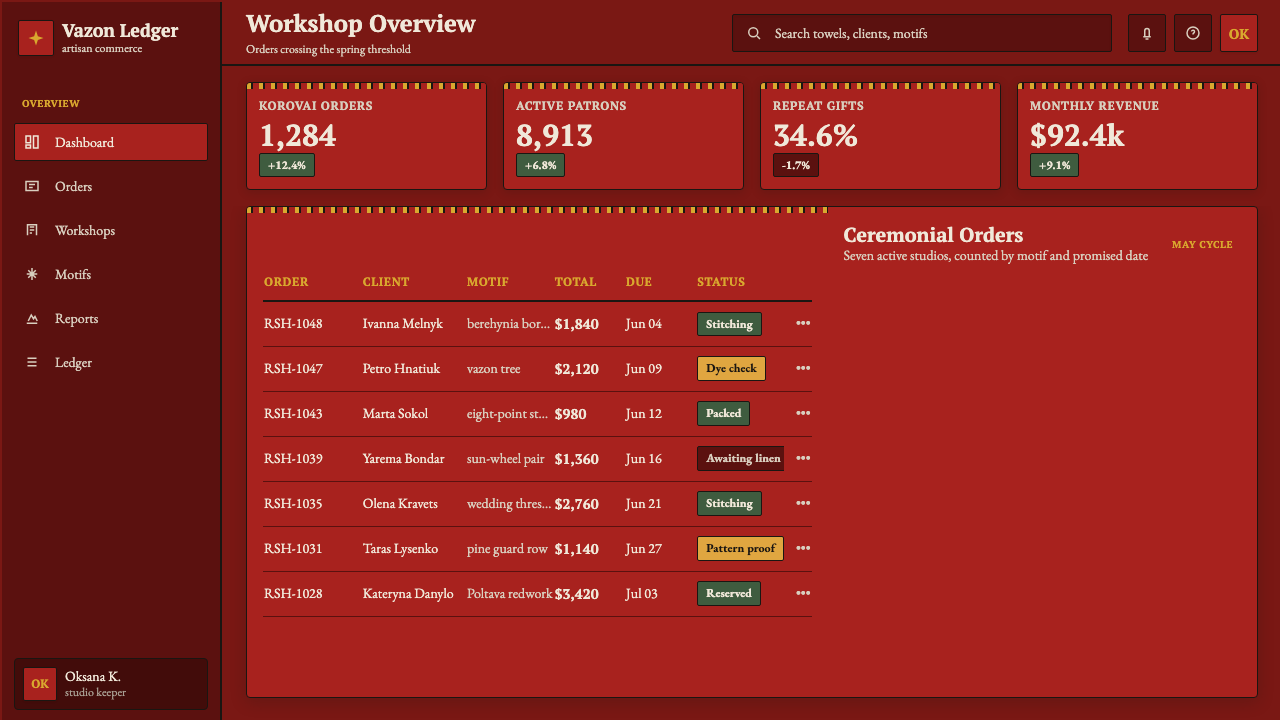
For web interfaces, the rushnyk visual vocabulary translates naturally into patterned background elements, section dividers, and decorative borders on dashboard panels or pricing cards. The key discipline is restraint: use the geometric border pattern as a frame or accent element, not as a primary surface. A pricing page in this register might feature a narrow rushnyk-style border running beneath the page header and above the tier comparison table, with the red-and-black palette used sparingly — red for the recommended tier highlight, black for primary type, linen-white for the card backgrounds. Icon sets can be built on the zirka and vazon geometries, using the same counting-grid logic that governs the embroidery.
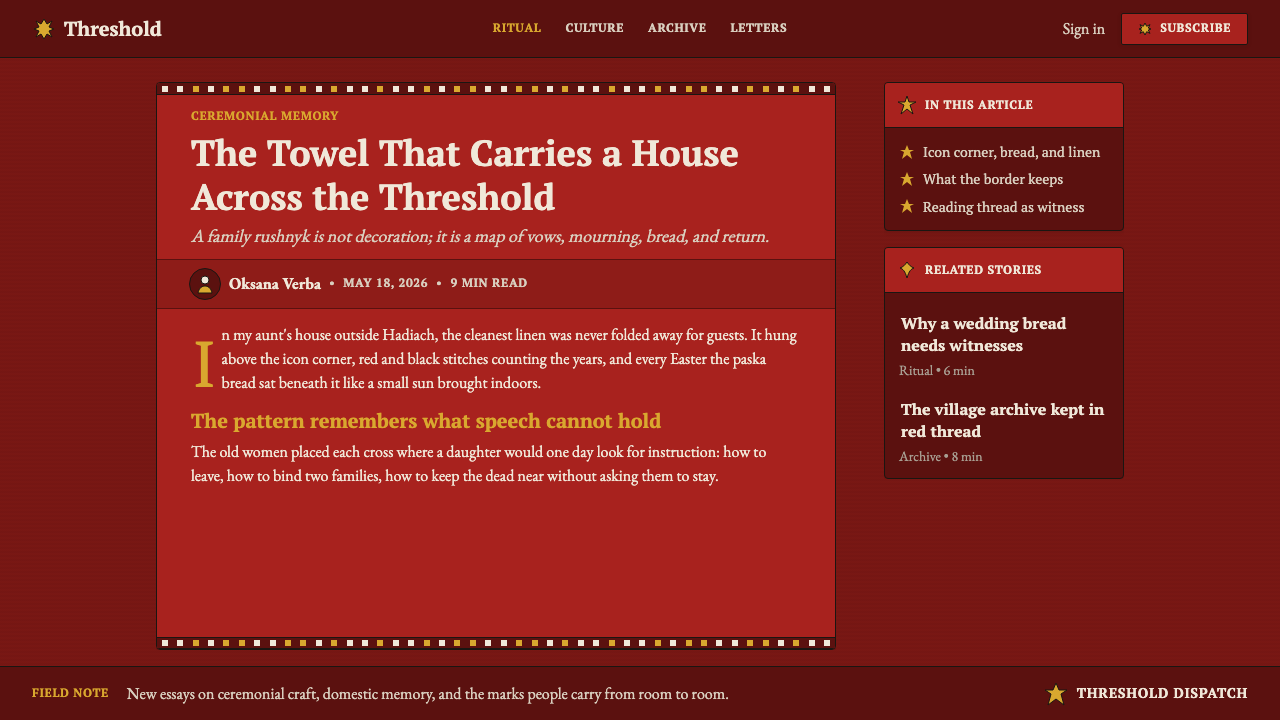
For editorial and marketing contexts, the rushnyk tradition provides one of the most distinctive ceremonial aesthetics available in the global design vocabulary. An article or campaign that draws on this language communicates weight, continuity, and handmade humanity — qualities increasingly rare in the landscape of digitally optimized content. A rushnyk-inspired editorial layout uses a warm off-white ground, sets body text in a weight that recalls the density of counted stitches, and reserves the deep red for pull quotes, chapter numbers, or structural markers. Marketing materials for cultural, craft, or heritage products can use the border patterns as framing devices for photography, placing images within rushnyk-style borders that function like decorative mats.
The most common mistake when borrowing from the rushnyk tradition is treating the motifs as clipart — isolating the berehynia or the vazon and using it as a standalone decorative element without the surrounding grid, the counted spacing, and the border structure that give it legibility. A second common error is softening the palette: adding intermediate tones or gradients to "modernize" the look destroys the high-contrast visual logic that makes the system readable. The rushnyk is a binary system — its discipline is its elegance. If warmth is needed, introduce it through the ground tone (a slightly warmer off-white rather than pure white) rather than through color mixing in the motifs themselves.
Ukrainian Rushnyk Ceremonial Towel — FAQ
What is the difference between a rushnyk and Ukrainian vyshyvanka embroidery?
Vyshyvanka refers broadly to Ukrainian embroidered clothing, particularly the traditional embroidered shirt worn as both everyday dress and national symbol. The rushnyk is a ceremonial textile object — a long, narrow towel — rather than a garment. While both traditions use cross-stitch on linen and share some regional motif vocabulary, they serve entirely different functions and are governed by different compositional conventions. Vyshyvanka embroidery wraps around a three-dimensional body and adapts to sleeves, collars, and cuffs; rushnyk embroidery is organized as a flat horizontal sequence of borders intended to be read as a unified composition from one end to the other. The rushnyk carries a heavier ritual weight — it appears at thresholds where vyshyvanka does not, including funerals and icon corners.
Why are most rushnyky red and black rather than multicolored?
The red-and-black palette reflects both symbolic and practical origins. Symbolically, red and black are the two colors most charged with meaning in Ukrainian folk tradition: red for life, vitality, love, and protective energy; black for the earth, mourning, boundaries, and the unknown. Their combination produces a complete cosmological statement — the living and the dead, the protective and the mourned — appropriate for an object used across the full span of human ritual. Practically, natural plant dyes in these two colors were among the most stable and lightfast available to village embroiderers, meaning the palette was also what would survive time and use. The chromatic restraint that results is not limitation but a deeply deliberate choice whose clarity has proven enduring.
How do regional rushnyk traditions differ from one another?
Regional variation in rushnyk practice is substantial and systematic. Poltava-region rushnyky are characterized by relatively spacious compositions, bold geometric motifs with significant bare-ground intervals, and a palette that strongly emphasizes red over black — producing pieces of visual elegance and austerity. Polissia (northern Ukraine, near the Belarusian border) developed denser, darker compositions in which black dominates and the archaic quality of the motifs — including some of the oldest berehynia forms — is particularly pronounced. Hutsul rushnyky from the Carpathian region incorporate wool alongside linen, use more saturated warm tones, and often blend embroidery with weaving in a single textile. Podillia is known for intricate geometric borders with a high density of small repeating units, while Volhynia traditions tend toward larger, more architecturally scaled motifs. An experienced eye can place a rushnyk's regional origin with considerable precision from these formal characteristics alone.
Is it appropriate to use rushnyk motifs in commercial or non-Ukrainian design contexts?
This question requires genuine care rather than a formulaic answer. The rushnyk is not merely a decorative tradition — it is a living symbolic system tied to Ukrainian cultural survival, and its motifs carry specific meanings within that system. Using rushnyk-derived geometric forms as structural design elements (borders, grid patterns, counting-logic compositions) is a form of informed aesthetic borrowing with a long history in design; using the berehynia or vazon as decorative clipart without acknowledgment or understanding is closer to appropriation. The distinction matters practically as well as ethically: designs that engage with the formal discipline of the tradition (geometry, symmetry, binary palette, border logic) will produce more coherent results than those that simply extract motifs. If using this tradition in a commercial context, crediting its Ukrainian origin and understanding the contemporary significance of that origin — given the ongoing cultural and military situation — is both respectful and contextually honest.
How has the meaning of the rushnyk changed since 2022?
The full-scale invasion of Ukraine in February 2022 catalyzed a profound transformation in how Ukrainians relate to the rushnyk. What had been, for many urban Ukrainians, a tradition associated primarily with rural grandmothers and museum collections became urgently present. Embroidery workshops filled; social media platforms became archives of newly made rushnyky; Ukrainian refugees carried needlework supplies across borders as both practical comfort and symbolic act. The berehynia's protective gesture acquired new literal weight; the threshold-marking function of the rushnyk resonated with the experience of exile and displacement. Contemporary practitioners have explicitly framed the act of embroidering a rushnyk as an act of cultural survival — stitching continuity when continuity is under attack. The tradition has not changed its formal vocabulary, but its symbolic charge has intensified markedly, and awareness of its meaning has expanded well beyond Ukraine's borders.
Related design styles
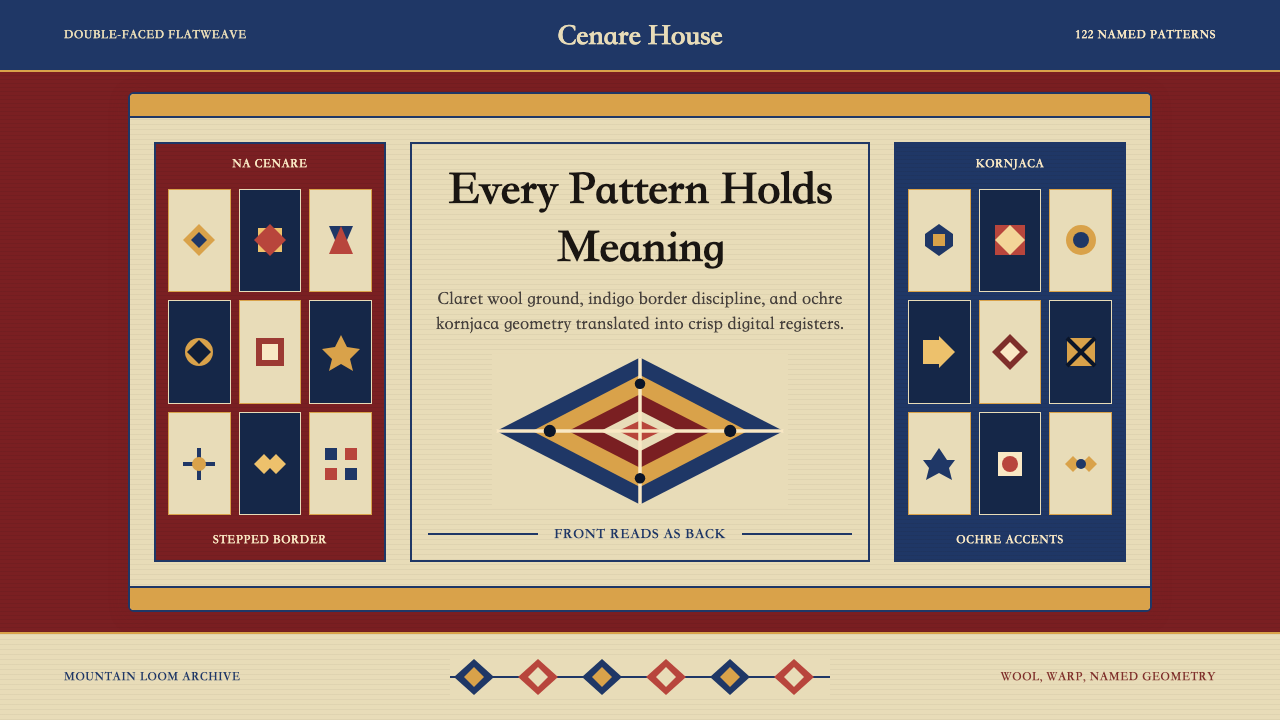 Serbian Pirot KilimWoven memory, sharply framed. Claret ground, indigo borders, ochre stepped di…
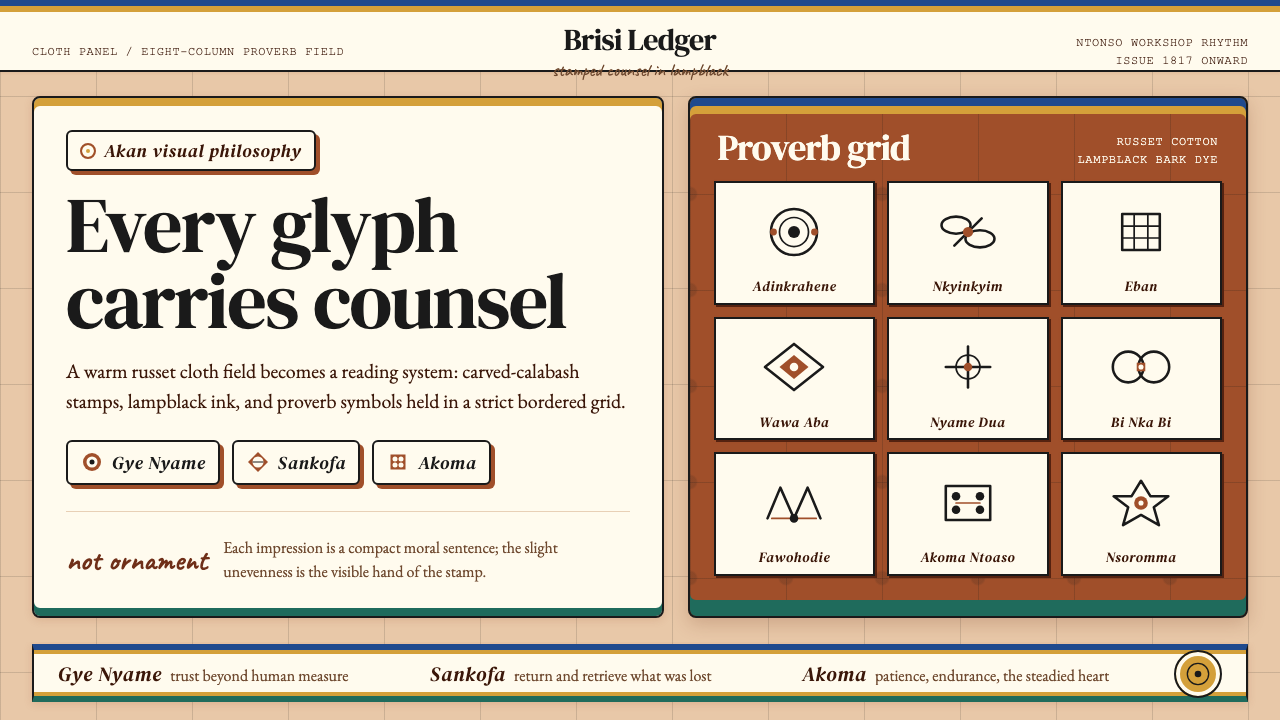 Akan Adinkra (Ghana)Proverbs become cloth. Russet grids, lampblack serif marks, and gold-edge ban…
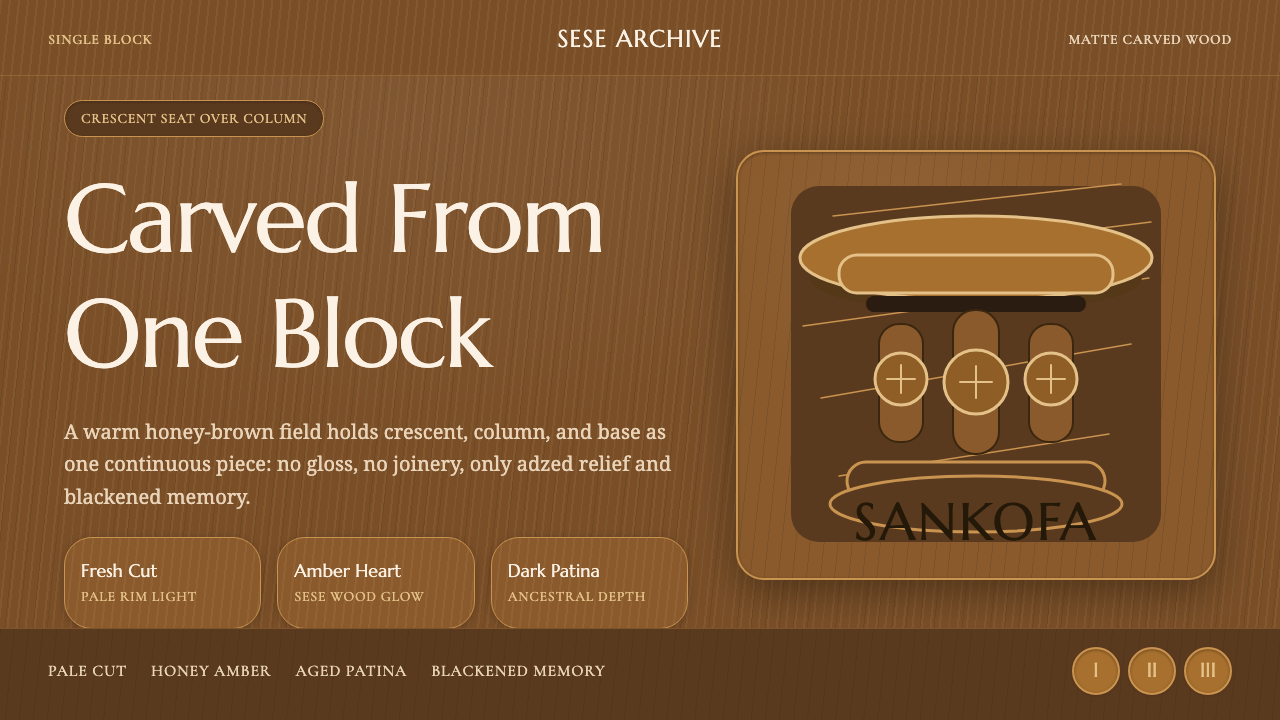 Akan Carved StoolMatte wood carries memory. Honey amber, Marcellus type, and crescent-column r…
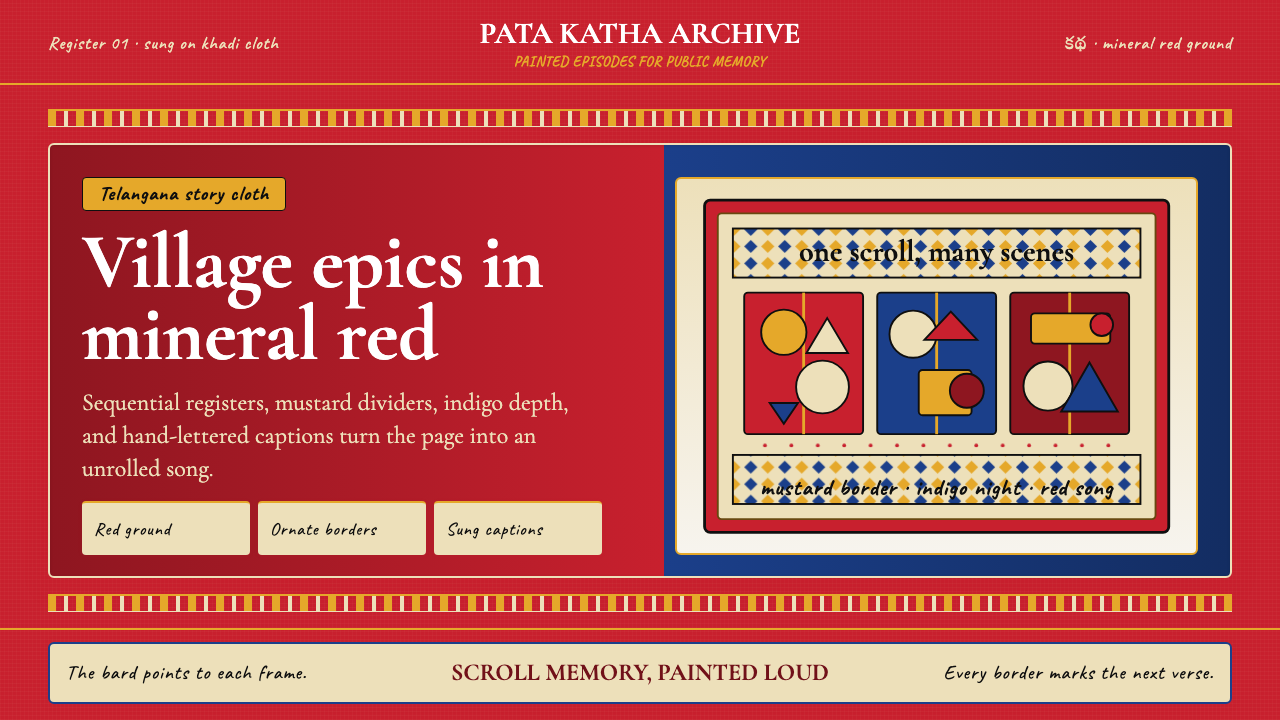 Andhra Cheriyal Scroll PaintingSaturated oral memory. Mineral red registers, mustard diamonds, and serif son…
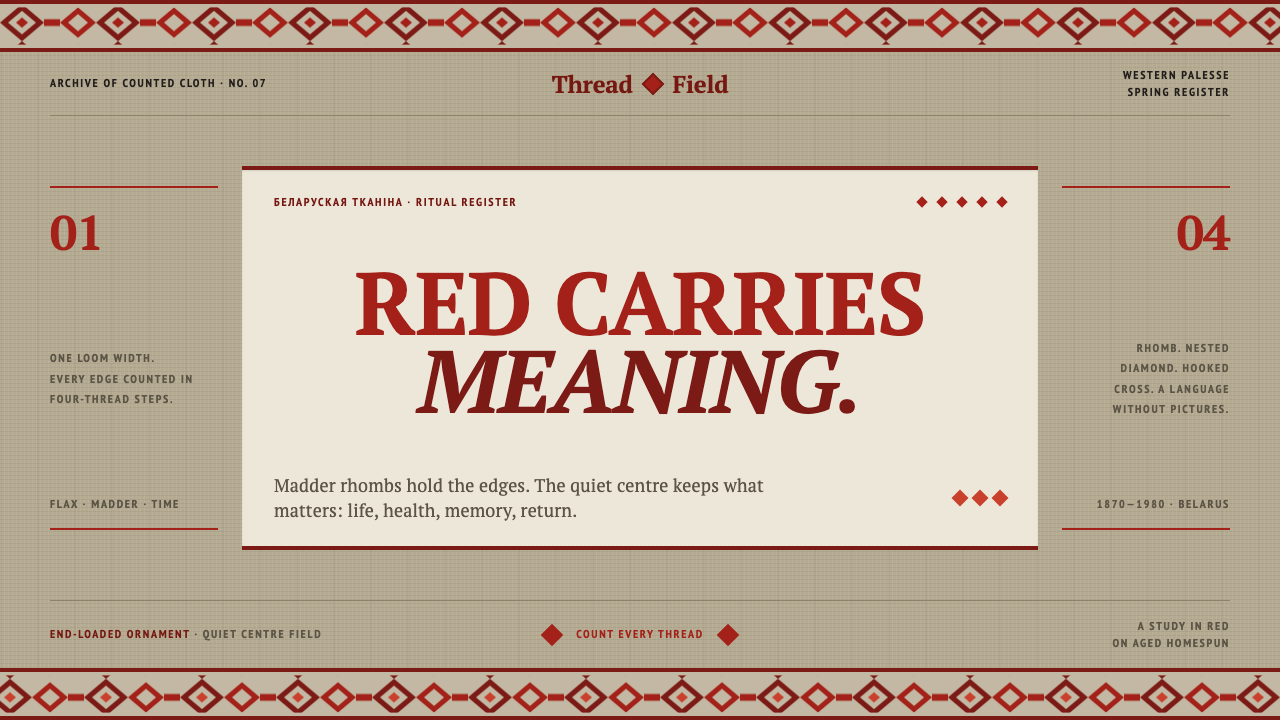 Belarusian RushnykRed carries meaning. Madder rhombs crowd aged flax edges while the woven cent…
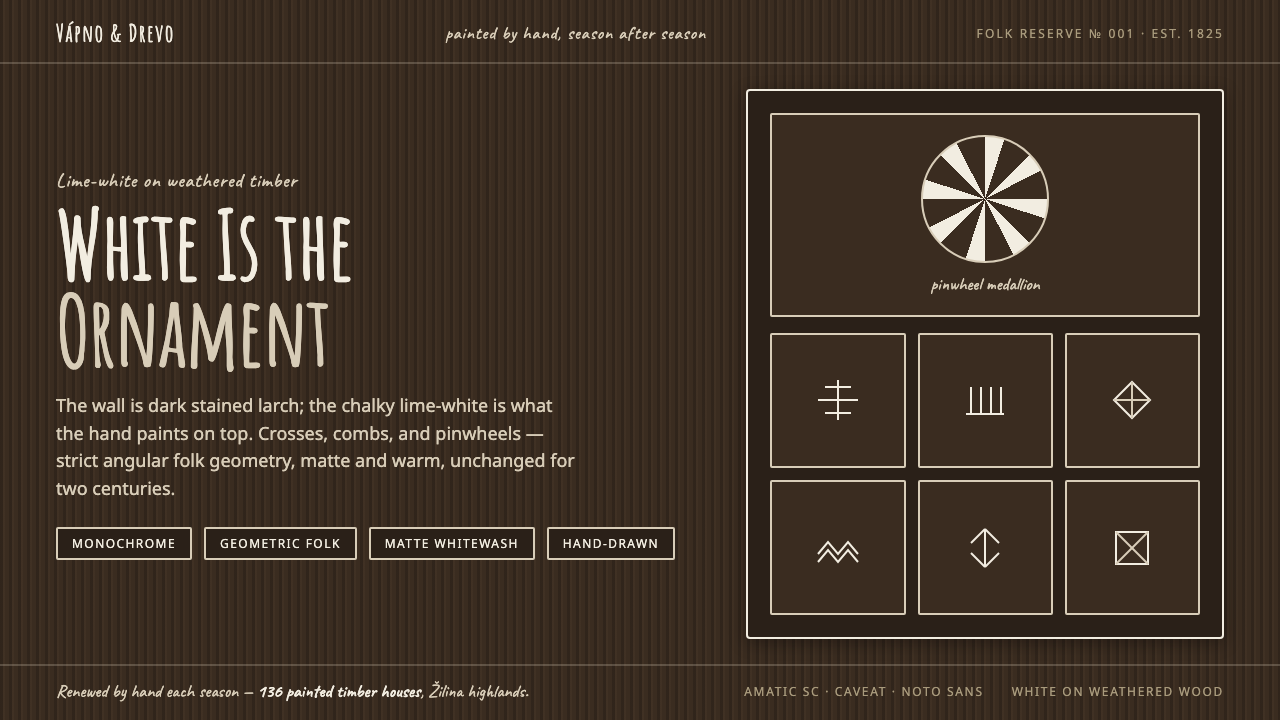 Čičmany Painted House OrnamentWhite is the ornament, not the page. Lime-white folk geometry on dark weather…