What is Andhra Cheriyal Scroll Painting?
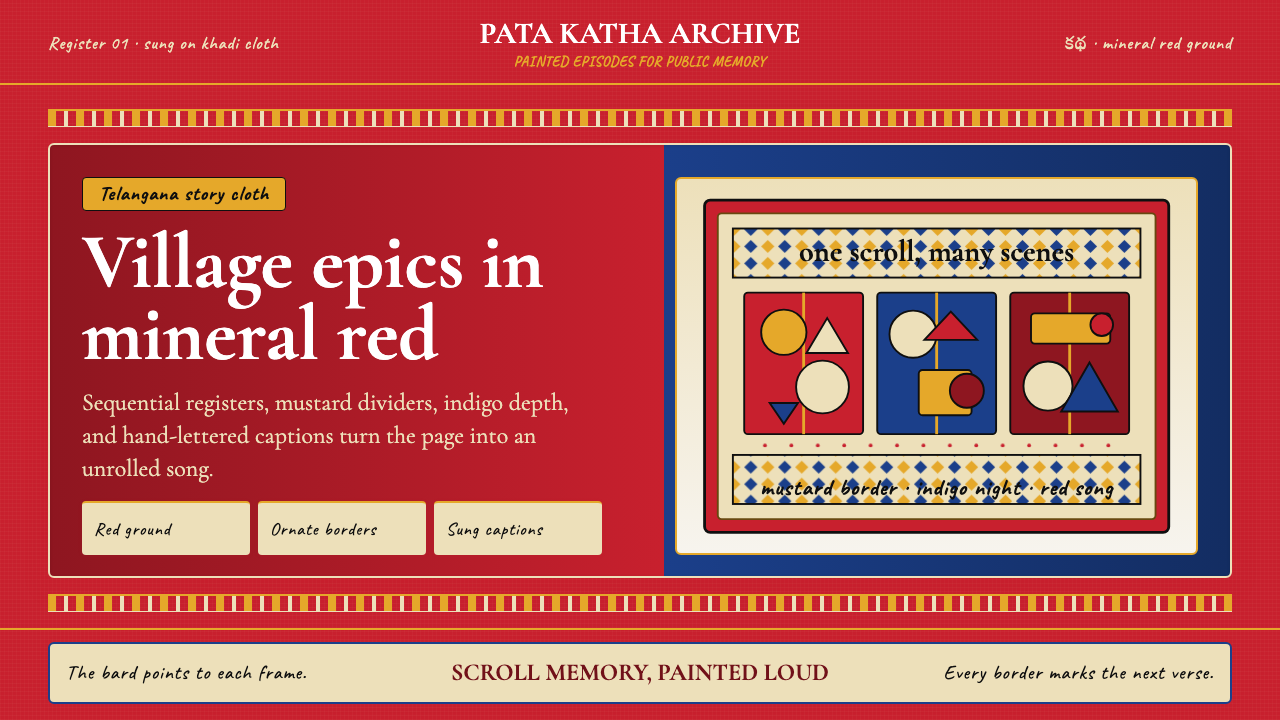
Cheriyal scroll painting turns narrative into architecture — blazing mineral-red registers, warm earth figures, and ornate borders stacked into a visual epic that has been sung and unrolled before village audiences for centuries.
Andhra Cheriyal Scroll Painting in brief
Cheriyal scroll painting is a sequential narrative art form originating among the Nakashi painter-clans of Telangana, in South India. Its defining physical form is the long khadi — hand-woven cotton cloth — scroll, which traveling bards called Kinneras unrolled before village gatherings while singing episodes from Hindu epics such as the Ramayana and the Mahabharata. Each painted register on the scroll corresponds to a stanza of the recitation, making the artwork function simultaneously as illustration, mnemonic, and performance prop. This fusion of visual and oral storytelling places Cheriyal painting in a category quite different from decorative folk art: it is, at its core, a communication system.
The visual language is immediately legible even to a viewer unfamiliar with the underlying stories. Figures are rendered in profile, faces characterized by strong Telugu physiognomy — broad, expressive eyes, firmly drawn noses, lips parted in speech or song. Each character occupies its own register within the scroll's horizontal band structure, and identity is established through iconographic code: color of garment, attribute held in hand, animal companion, or ornamental headdress. This codification allowed illiterate audiences to follow complex narrative threads across dozens of sequential panels without any written text.
What sets Cheriyal apart from other Indian scroll traditions — such as Bengali Patachitra or Rajasthani Phad — is the fiery intensity of its palette and the organization of space. The scroll is structured into discrete rectangular registers separated by highly decorative printed borders, giving the composition a grid-like architectural quality that feels remarkably modern. Within each panel, background space is filled rather than left empty; the ground itself is treated as a saturated surface that activates the entire picture plane, leaving no dead space between narrative elements.
Where does Andhra Cheriyal Scroll Painting come from?
The Cheriyal tradition takes its name from Cheriyal village in Warangal district, Telangana — once part of the broader Andhra Pradesh region, which is why the style is sometimes referred to as Andhra Cheriyal scroll painting. The Nakashi community, who are the hereditary custodians of this art form, trace their practice back at least to the sixteenth century, though some scholars place the tradition's conceptual roots in even earlier periods of the Kakatiya dynasty, when Warangal was a major center of Telugu cultural patronage. The Nakashis painted not only scrolls but also wooden toys, household articles, and ritual objects for temple use — the scroll format was only one expression of a broader pictorial vocabulary that the community developed over generations.
The practice was sustained by a symbiotic relationship between the Nakashi painters and the Kinnera bard communities. Painters produced the scrolls; bards performed them; village patrons provided both groups with grain, cloth, and small cash payments in an economy that operated largely outside the market. This communal patronage structure kept the tradition economically viable even as the content of the scrolls evolved — early scrolls focused primarily on the major Hindu epics, but by the eighteenth and nineteenth centuries, painters had incorporated stories from local Telangana folk traditions, regional deity cults, and historical events. The scroll became a living document of community memory rather than a fixed canonical text.
The visual system of Cheriyal was shaped by the practical constraints of the scroll's performance context. Scrolls needed to be read at a distance, by firelight or torchlight, by audiences who might be standing or seated on the ground. This demanded strong tonal contrast, bold silhouettes, and colors that held their legibility under variable illumination. The mineral-red ground was not merely an aesthetic choice — red earth-based pigments were locally available, durable, and held extraordinary visibility at low light levels. The systematic use of profile figures, repeated iconographic codes, and the horizontal band structure all reflect an art form designed for maximum communicative clarity in difficult conditions.
The twentieth century brought serious disruption to the tradition. The shift away from oral performance culture, the availability of printed religious images at low cost, and the erosion of traditional patronage networks caused the number of practicing Nakashi families to decline sharply. By the 1970s and 1980s, only a handful of families in Cheriyal village still maintained the art. Government intervention and cultural preservation efforts from the 1990s onward — including formal recognition and the award of Geographical Indication status in 2007 — have stabilized the community and created new markets through craft fairs, museum acquisitions, and export sales. Leading practitioners such as D. Vaikuntam, Nakash Vaikuntam, and Saichand Nakash have become internationally recognized artists, receiving national awards and demonstrating the style at cultural events worldwide.
What defines the Andhra Cheriyal Scroll Painting look?
Ground Color
The scroll ground is an intense, warm mineral red — the defining chromatic signature of the tradition. This is not a pastel or a muted terracotta but a fully saturated, almost aggressive warmth that makes every element placed on it immediately visible. The red derives from iron-oxide earth pigments mixed with tamarind paste binder, giving it a matte, slightly granular surface quality. All narrative figures and border decorations read as silhouettes against this blazing field, producing a visual effect that is dramatic rather than delicate.
Figure Style
All human and divine figures are painted in strict profile — a convention shared with Egyptian hieroglyphics, Greek vase painting, and other ancient narrative traditions, likely arrived at independently for the same practical reason: a profile face reads instantly and unambiguously at a distance. The Cheriyal profile is distinctive: eyes are drawn frontally within the profile head, a stylization that gives figures an alert, watchful quality. Bodies are shown in a relaxed three-quarter stance. Facial features — strong noses, rounded chins, elaborately detailed jewelry — signal the Telugu cultural milieu of the tradition.
Register Structure
The scroll is divided into discrete horizontal registers, each containing one scene or episode from the narrative. These registers are separated by boldly printed ornamental borders — typically floral or geometric bands — that function both as visual punctuation and as a rhythm device. The register structure is not merely organizational; it is the defining spatial logic of the form. Each panel is self-contained, with figures, attributes, and background elements arranged to tell a complete micro-story that connects upward and downward to adjacent panels.
Palette Range
Beyond the red ground, Cheriyal uses a warm, earthy palette: mustard yellow for highlights and garments, deep indigo or black for outlines and shadow areas, white or ivory for faces and ornamental highlights, and occasional greens derived from plant-based pigments. The palette is not naturalistic — skin tones are often deliberately warm yellow or ivory rather than attempting realistic flesh tones. Secondary colors relate to divine iconography: blue skin denotes Vishnu or Krishna, green often signals a forest or celestial setting.
Border Ornamentation
The printed borders between registers are among the most distinctive features of the Cheriyal style. Nakashi painters use carved wooden blocks to stamp repeating decorative patterns — lotus motifs, geometric interlace, stylized leaf forms — that frame each narrative panel. These borders do visual work beyond mere separation: they signal the pacing of the narrative (a more elaborate border might mark a climactic episode), they unify the scroll visually across many registers, and they demonstrate a level of craft complexity that distinguishes professional Nakashi work from amateur imitation.
Iconographic Coding
Cheriyal figures carry attributes that function as a visual shorthand — a system of symbols that allows a viewer to identify any character without reading a caption. Rama carries a bow; Hanuman holds a mace; Lakshmi sits on a lotus; the demon Ravana is depicted with ten heads. This coding is consistent across all traditional Cheriyal scrolls regardless of which painter produced them, reflecting the transmission of a shared visual vocabulary within the Nakashi community across generations. Modern practitioners sometimes introduce new narrative subjects, but the iconographic logic — identify through attribute, not through facial individuation — remains constant.
Filled Space
Unlike many painting traditions that use negative space as a compositional tool, Cheriyal scroll painting fills its panels densely. Background elements — stylized trees, cloud formations, architectural fragments — occupy every area not taken by figures or narrative props. This horror vacui approach is deliberate and functional: at the distances and lighting conditions of village performance, empty space reads as lost surface rather than breathing room. The density of detail also gives the scrolls their characteristic visual richness, which makes them compelling as objects even when viewed without knowledge of the underlying narrative.
Who shaped Andhra Cheriyal Scroll Painting?
D. Vaikuntam is widely regarded as the master who most decisively shaped the contemporary identity of Cheriyal painting. Working from Cheriyal village in Warangal district, he continued the hereditary Nakashi practice during the difficult decades when the tradition was most at risk, and became the primary conduit through which its techniques were transmitted to the next generation. He received the National Award for his work in traditional craft and has represented the tradition at exhibitions in India and abroad, introducing Cheriyal's visual language to international audiences who encountered it as both ethnographic artifact and living art.
Nakash Vaikuntam — the clan name Nakash itself signals hereditary membership in the painter caste — has been instrumental in adapting Cheriyal scroll conventions to new formats and audiences while preserving the essential visual vocabulary. His work demonstrates how the register structure, iconographic coding, and warm saturated palette of the traditional scroll can be applied to panel paintings, artistic prints, and objects intended for collector markets without losing the visual logic that defines the style. His practice represents the ongoing negotiation between cultural preservation and creative evolution that characterizes the healthiest living craft traditions.
Saichand Nakash represents a younger generation of Cheriyal practitioners who have engaged with the tradition's revival through both artistic practice and public cultural advocacy. His work in extending the subject matter of Cheriyal scrolls to include contemporary social themes — alongside the traditional epic narratives — demonstrates how the visual system's fundamental architecture can absorb new content without disrupting the formal conventions that make the tradition recognizable. Saichand has participated in national and international craft exhibitions, contributing to the wider recognition of Cheriyal as a living art form rather than a museum artifact.
The Kinnera performance community is not a single named individual but a social role without which Cheriyal scroll painting cannot be fully understood. The Kinneras — hereditary bards who specialized in narrative musical performance — were the performers who gave the scrolls their context and their audiences. Without the Kinnera performance tradition, the scroll is a visual artifact; with it, the scroll is a living multimedia event. The decline of the Kinnera performing tradition in the twentieth century was one of the main factors that isolated the Nakashi painters from their original audience, and understanding this severed partnership is essential to grasping why the revival of Cheriyal has been culturally complex rather than simply a matter of keeping the painting techniques alive.
How do you use Andhra Cheriyal Scroll Painting today?
Cheriyal scroll painting offers a design vocabulary that is simultaneously ancient and visually striking to contemporary eyes. Its core strengths — high-saturation warm palette, strong silhouette figures, register-based composition, and dense ornamental borders — translate well into digital applications precisely because the original tradition was designed for instant readability at a distance. The style is best suited to work that needs to communicate warmth, cultural depth, narrative richness, and visual exuberance without sacrificing legibility.
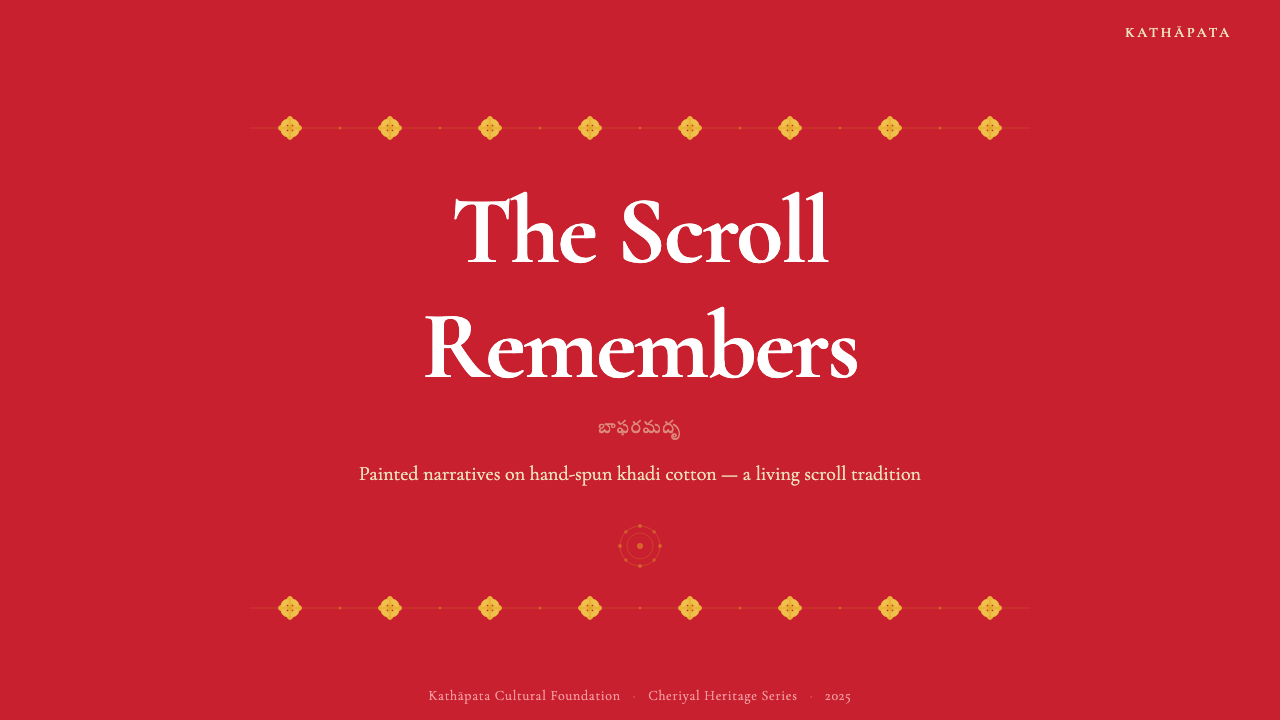
For presentation slides, the register structure of the Cheriyal scroll is directly applicable. A cover slide built around a central framed composition — a single large figure or scene element set against a saturated warm ground, bordered by decorative band elements — carries the tradition's most immediate visual impact. Content slides can adopt the horizontal-band logic: use clear visual dividers between content zones, keep each zone self-contained with its headline and supporting visual, and let the warm color palette unify the deck rather than relying on a cold neutral background. Data slides benefit from treating charts and diagrams as iconographic elements — bold, outlined, placed against a warm ground — rather than defaulting to the pale corporate chart aesthetic.
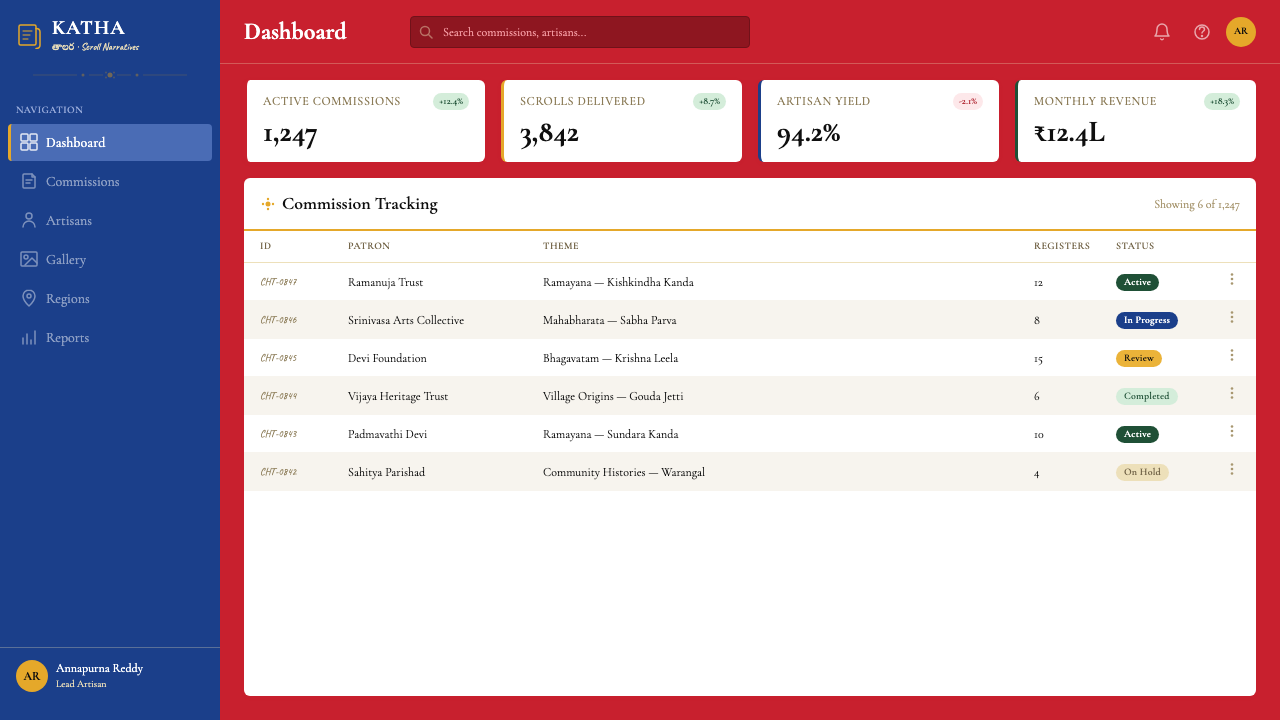
For web interfaces, Cheriyal is most effective in contexts that benefit from warmth and visual richness: cultural platforms, arts and education sites, craft and artisan marketplaces, and heritage tourism brands. Dashboards and pricing pages can adopt the register logic — clear horizontal band divisions, warm background fields, strong typographic hierarchy within each band — without necessarily importing the iconographic figure vocabulary. The palette translates well to dark-mode interfaces: a deep warm near-black ground with mineral-red accents and warm ivory type carries the spirit of the tradition while fitting contemporary screen expectations.
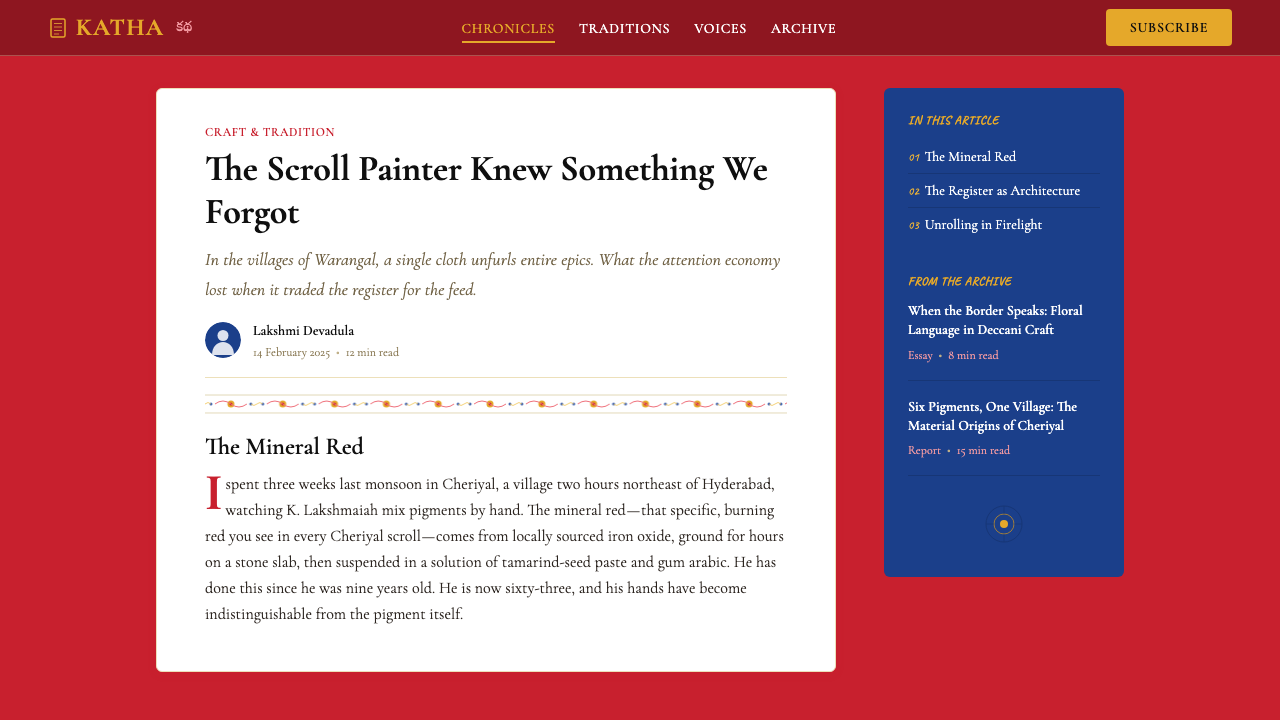
For editorial and marketing work, Cheriyal's most powerful application is storytelling-first layouts. Long-form editorial features benefit enormously from section breaks marked by decorative border elements inspired by the scroll's printed bands — it signals the reader to pause between narrative episodes the same way the original border functioned for a performance audience. Marketing pages and campaign materials that need to communicate cultural authenticity, artisanal quality, or narrative depth find in Cheriyal a visual register that feels genuinely rooted rather than generically exotic. Campaign imagery that uses the profile-figure approach — characters facing the same direction, silhouetted against a warm ground — immediately evokes the scroll tradition without literal quotation.
A common mistake when applying Cheriyal-inspired aesthetics is to treat the red ground as optional or to replace it with a more neutral background in search of a contemporary finish. The saturated warm ground is not a stylistic decoration — it is the load-bearing element that makes the silhouette figures readable and gives the palette its coherence. Desaturating the ground collapses the visual hierarchy the entire system depends on. A second common error is to use the ornamental border elements as mere decoration applied to an otherwise conventional layout; borders in Cheriyal function structurally, marking genuine narrative transitions. If a layout has no real compositional register changes to mark, the borders become noise rather than signal.
Andhra Cheriyal Scroll Painting — FAQ
What makes Cheriyal scroll painting different from other Indian folk painting traditions?
The most distinctive features are the blazing mineral-red ground, the sequential register structure with printed ornamental borders, and the tradition's inseparable connection to oral performance. Most Indian folk painting traditions — Madhubani, Pattachitra, Phad, Warli — are designed primarily as visual objects to be studied close-up. Cheriyal was designed for performance: to be unrolled before an audience while a bard sang the narrative. This performance origin shaped every aspect of the visual system, from the scale of the figures to the intensity of the palette to the strict separation of narrative episodes into self-contained panels. The iconographic coding system is also unusually rigorous compared to many regional traditions, allowing a viewer who knows the code to navigate any scroll regardless of which story it tells.
What does the GI protection awarded in 2007 mean for the tradition?
Geographical Indication status legally ties the name 'Cheriyal scroll painting' to the craft community in Cheriyal village, Warangal district, Telangana. In practical terms, it means that products claiming this name must be produced by recognized Nakashi practitioners using traditional methods; mass-produced imitations cannot legally use the designation. This creates an economic floor for the community by protecting the premium value of authentic work. It also functions as cultural recognition — placing Cheriyal in the same category as other GI-protected Indian crafts such as Darjeeling tea, Kancheepuram silk, and Phulkari embroidery — which has opened doors to government craft promotion programs, museum collaborations, and export market development. GI protection does not freeze the tradition in time; practitioners can still innovate with subject matter and format, but the core visual vocabulary and production methods must be maintained for a work to carry the official designation.
Can the Cheriyal visual system work for purely abstract or non-narrative design?
The style can be partially abstracted, but doing so honestly requires acknowledging which elements carry the tradition's identity. The saturated warm ground, the warm-earth figure palette, and the ornamental border vocabulary can all function in non-narrative contexts — as a background texture system, a framing device for data visualizations, or a color architecture for a brand identity. What cannot be easily abstracted is the sequential narrative register structure, because without episodes to separate, borders become decoration rather than punctuation. A design that uses Cheriyal's palette and border vocabulary but abandons the register logic risks appearing to borrow the surface aesthetic while discarding the structural intelligence that created it. Partial abstraction works best when it is conscious — when the designer can articulate what they kept and why.
Is Cheriyal an appropriate reference for brands or products with no connection to India or Hindu culture?
This is worth thinking about carefully. Cheriyal is a living, GI-protected craft tradition produced by a specific hereditary community in Telangana; it is not an anonymous historical style without contemporary custodians. Using the visual system respectfully and in full awareness of its origins is different from extracting surface elements while erasing the context. Best practice involves transparency: if a design is explicitly informed by Cheriyal scroll painting, naming the tradition and linking to its contemporary practitioners respects the original community and educates the audience. The visual vocabulary — saturated warm grounds, register structures, ornamental borders — has formal characteristics that exist independently of its specific iconographic content; working with those formal characteristics thoughtfully is a different act from reproducing sacred iconography without understanding.
How does the dark background of the Cheriyal style affect its use in digital design compared to light-ground alternatives?
The Cheriyal tradition is classified as a dark-background style because the mineral-red ground is deep and chromatic rather than light and neutral. This has important practical implications for digital applications. On screens, a saturated warm-red background reads as high-contrast and attention-commanding — it works well for full-screen hero sections, cover images, and feature blocks, but can create visual fatigue if used as the dominant background across an entire long-form page. The approach that preserves the tradition's spirit while respecting digital reading conditions is to use the deep warm red as an accent ground for key compositional moments — section covers, pull quotes, featured panels — while allowing a lighter warm neutral to carry the main reading surface. This mirrors how exhibition designers work with high-intensity historical palettes: maximum impact at key moments, relief between them.
Related design styles
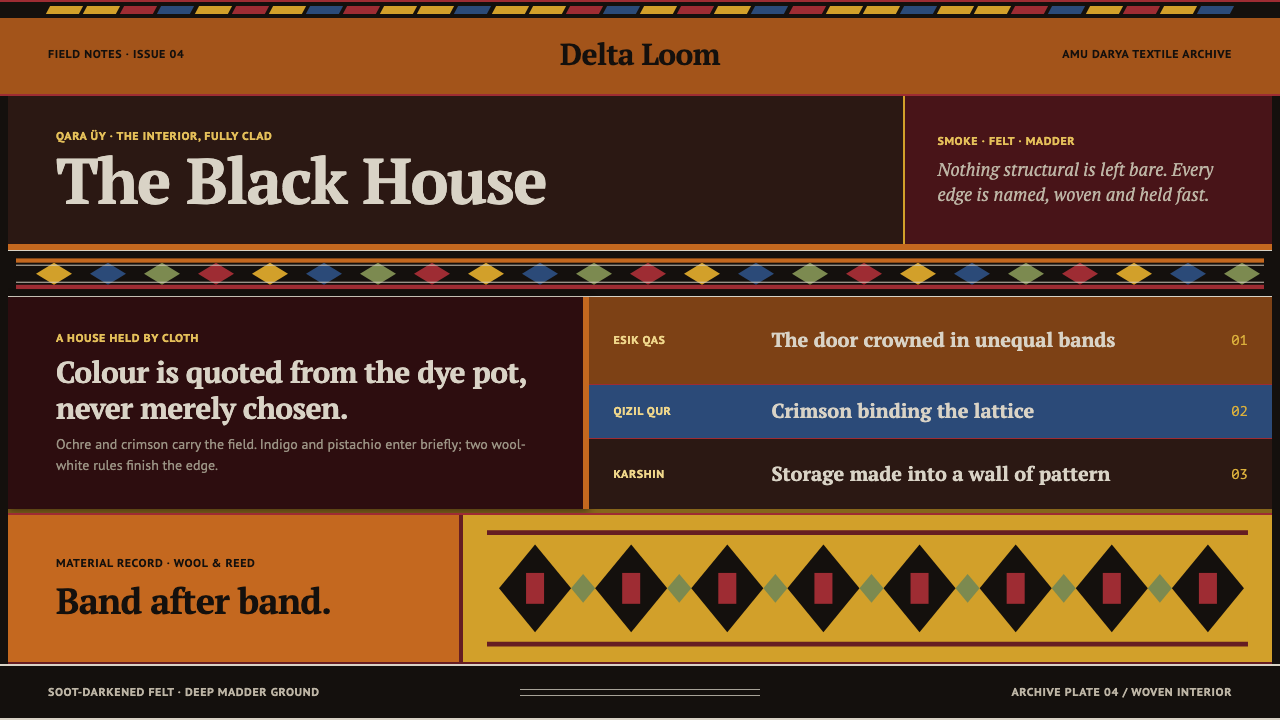 Karakalpak Yurt InteriorNo surface is left bare. Ochre, crimson and indigo bands wrap a smoke-darkene…
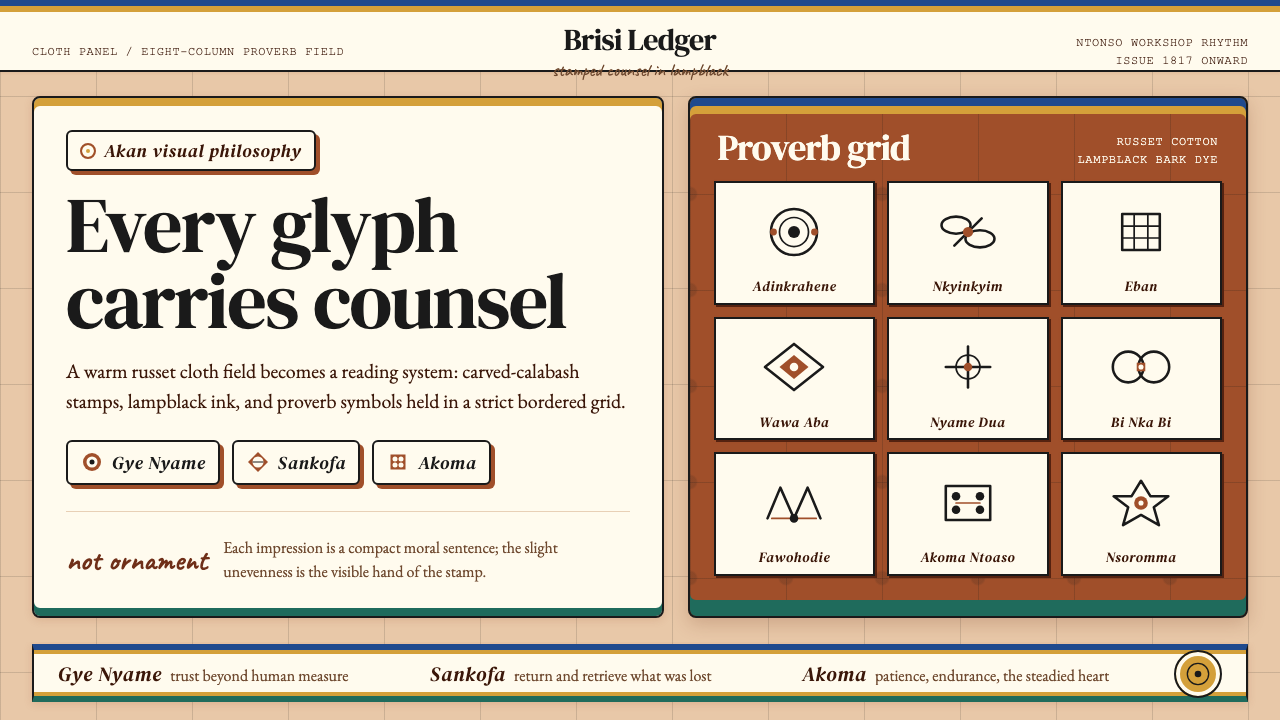 Akan Adinkra (Ghana)Proverbs become cloth. Russet grids, lampblack serif marks, and gold-edge ban…
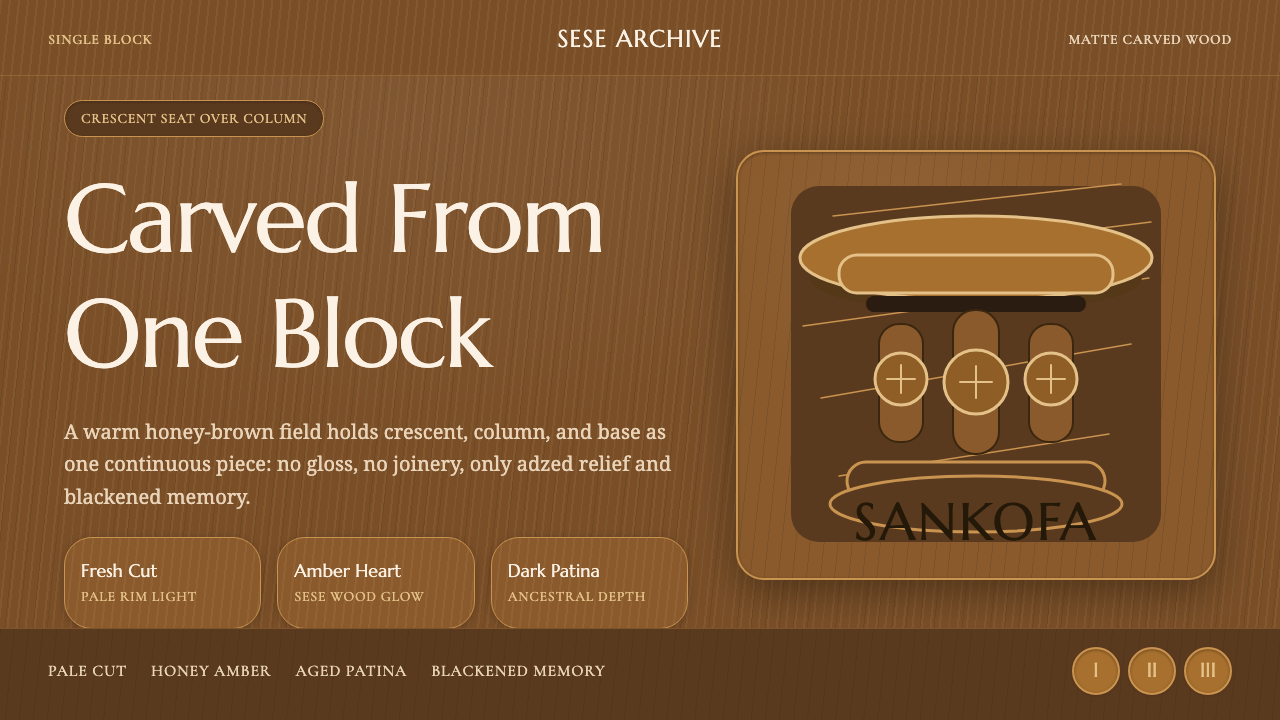 Akan Carved StoolMatte wood carries memory. Honey amber, Marcellus type, and crescent-column r…
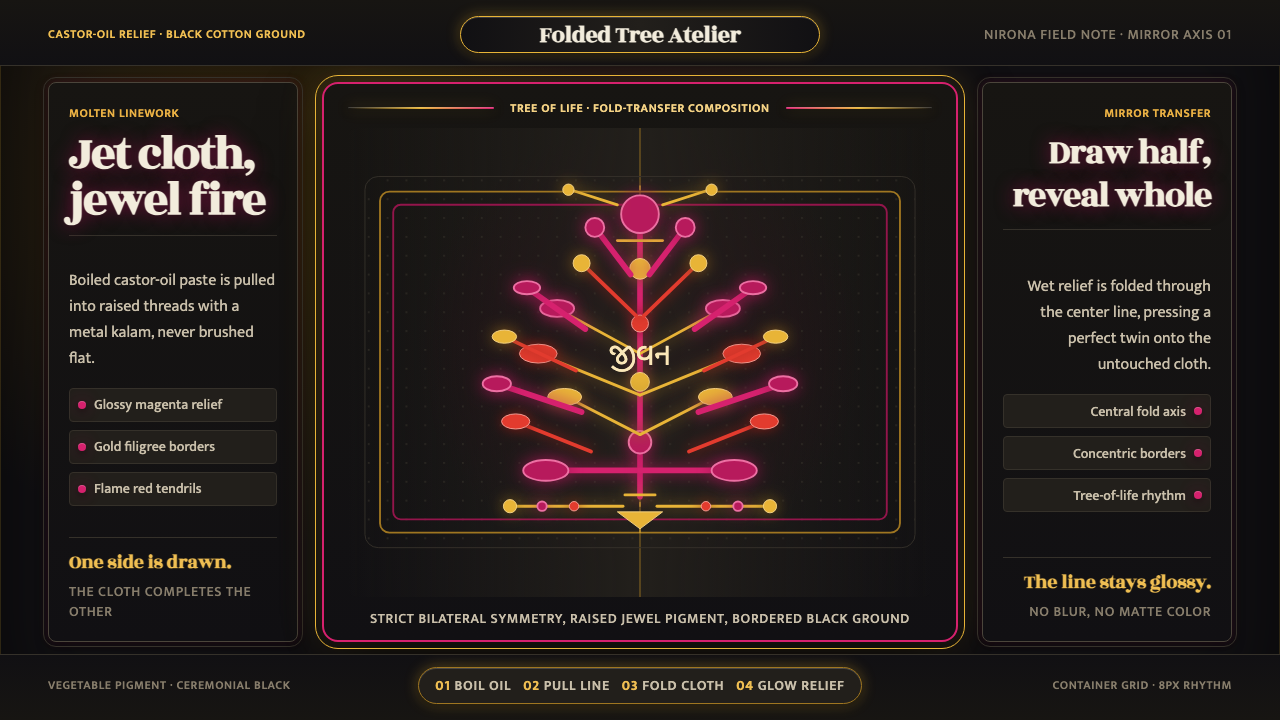 Kutch Rogan Castor-Oil PaintingGlossy symmetry holds the dark. Magenta castor-oil lines mirror across black…
 Lepakshi Vijayanagara CeilingEarth remembers in registers. Ochre gold, red underdrawing and black rules ma…
 Mauritian Sega Creole (1810)Rhythm made visible. Coral stripes, cream sleeve type, and ravanne circles ca…