What is Guyanese Tassa Drum?
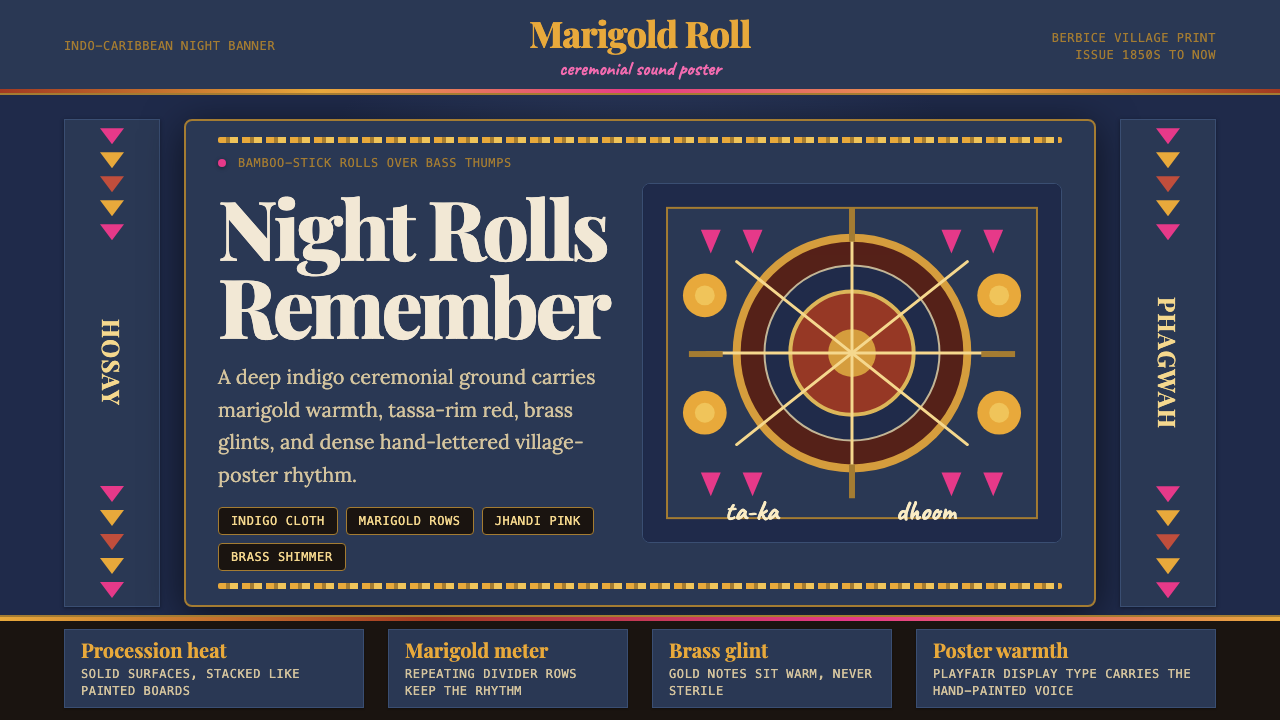
From the cane fields of colonial Guiana to Caribbean street processions, the tassa drum carried a whole civilization's color, ceremony, and resilience in its skin-stretched beat.
Guyanese Tassa Drum in brief
Guyanese Tassa Drum is a design aesthetic rooted in the ceremonial visual culture of Indo-Caribbean communities — the deep indigo banners carried in Hosay processions, the marigold garlands strung at Hindu weddings, the brass-bright flash of cymbals, and the dense, warmly saturated hand-painted posters that announced Phagwah celebrations across Berbice villages. It is a system built from layered warmth: dark grounds glowing under golden and orange accents, with bold display type that carries the weight of festival announcement.
At its heart the style is about ceremony made visible. Everything in it echoes the physical experience of attending a tassa performance — the deep resonant boom of the bass drum (the larger dhantal-reinforced kettledrum called the 'tassa'), the rapid, rolling bamboo-stick strikes that dance above it, the crowd pressing close under indigo fabric, the air thick with marigold and incense. Translated into graphic and interface terms, this means rich darkness as a ground, warm saturated color as signal, and a typographic presence that feels like a proclamation rather than a label.
The system sits in deliberate contrast to minimalist or neutral design languages. Where many contemporary systems seek to disappear, Tassa Drum asserts. It is festival-weight design — meant to be seen at distance, felt immediately, remembered.
Where does Guyanese Tassa Drum come from?
The tassa drum's journey to Guyana begins with the indenture system. Between 1838 and 1917, after the abolition of slavery in the British Caribbean, the British colonial government recruited approximately 238,000 indentured labourers from the Indian subcontinent — primarily from the Bhojpuri-speaking regions of Bihar and eastern Uttar Pradesh — to work on sugar plantations in British Guiana, Trinidad, and other colonies. They arrived carrying languages, religions, musical instruments, and visual traditions that would take root in alien soil and evolve into something entirely their own.
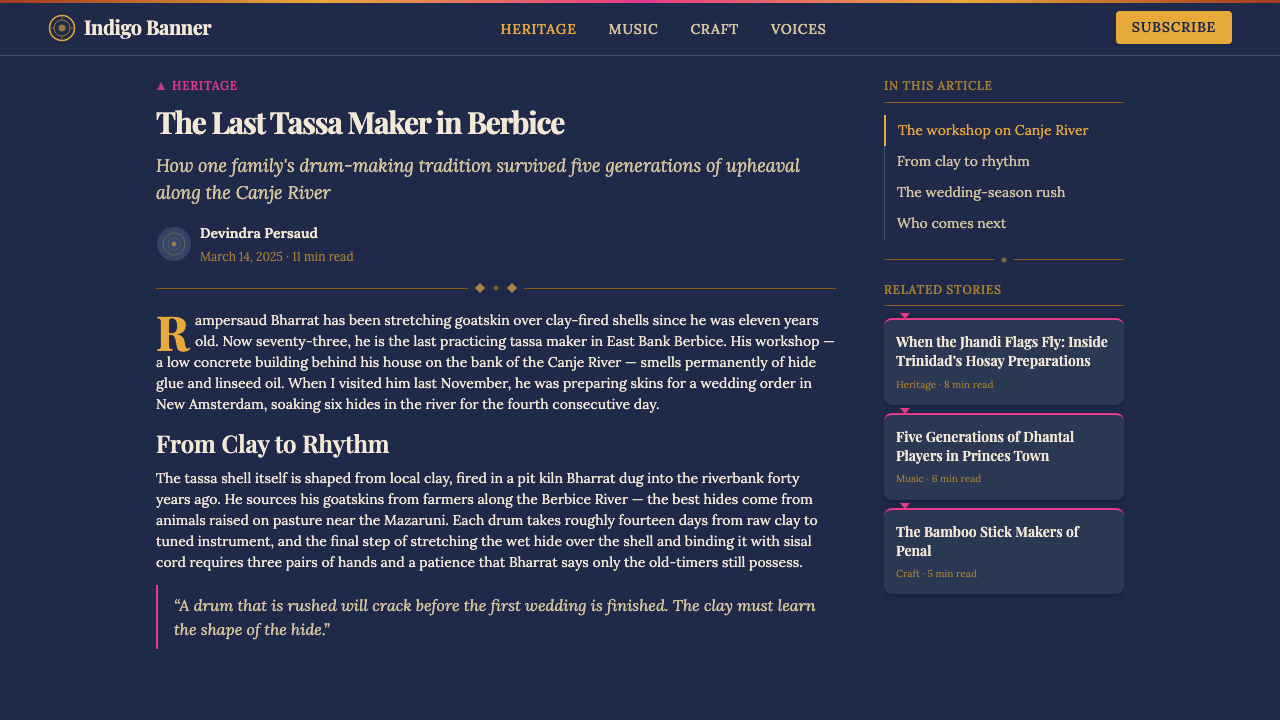
Among the instruments carried was the tassa, a small goatskin-headed kettledrum struck with a curved bamboo stick. In north India, tassa drums were already associated with Muharram observances — the Hosay festival, in which effigies of the tombs of the Imam Hussein and his brother Hassan are paraded through streets in mourning processions. In the Caribbean, Hosay became one of the central ceremonial events of the Indo-Caribbean calendar, and tassa playing became its sonic identity. The visual world surrounding Hosay — deep indigo and crimson fabric, elaborately decorated taziya structures, dense floral offerings — formed the color memory that this design system draws upon.
Beyond Hosay, tassa became indispensable at Hindu weddings throughout the Guyanese interior. Village wedding posters, hand-lettered and hand-painted, advertised these celebrations with an exuberant density that had no interest in restraint: multiple typefaces, layered color, marigold yellow and vermillion red against dark grounds, ornamental borders inspired by both Indian folk painting and colonial print conventions. Scholars of Indo-Caribbean music and culture — Peter Manuel, who documented chutney-soca musical fusion; Frank Korom, whose fieldwork traced the Hosay festival from South Asia to the Caribbean; Helen Myers, who recorded the musical cultures of rural Trinidad — have traced how these visual and sonic traditions survived, transformed, and became markers of a distinct diaspora identity.
Mungal Patasar, the Trinidadian musician and cultural advocate who brought Indo-Caribbean classical and folk music into wider public awareness, represents the generation that began to frame these traditions explicitly as heritage worthy of formal recognition. The visual vocabulary of tassa ceremony — deep grounds, warm ceremonial color, bold proclamatory type — is not folk naivety; it is a sophisticated aesthetic that developed across generations of practitioners who understood that visibility was survival.
What defines the Guyanese Tassa Drum look?
Color Palette
The palette centers on deep indigo as the primary ground — the color of Hosay banners and night-sky fabric canopies — layered with marigold gold, saffron orange, and warm vermillion. Brass-bright accents recall cymbal glints. The overall impression is of warm luminosity against darkness: colors that appear to glow from within rather than sit flatly on a surface. Desaturated or cool tones are used sparingly, mostly to create breathing room within the warmth.
Typography
Display type carries the weight of ceremonial announcement — serifs with generous curves and a slight historical patina are preferred for headlines, reflecting the hand-lettered wedding poster tradition. Body text shifts to something more neutral to allow the richness of the color palette to breathe. Type is deployed at strong scale contrasts: a headline is meant to be readable at distance, echoing the function of festival posters seen across a village square.
Texture and Layering
Surfaces carry the memory of physical materials — the slight roughness of painted fabric, the patina of weathered hand-bills, the granular warmth of marigold petals massed together. This is achieved through subtle tonal variation and layered warm values rather than photographic texture imports. The goal is depth that feels material without competing with the typographic and color hierarchy.
Ornamental Borders
Borders and frames serve a real structural role — they define ceremonial space, the way a garland frames a doorway or a canopy marks a performance area. Floral and geometric border motifs derived from Indo-Caribbean folk painting traditions appear as frames around content blocks, as dividers between sections, and as decorative coronations above key typographic elements. Unlike purely ornamental border use, here the border is read as marking significance.
Gold as Structural Signal
Marigold gold and warm brass tones function as the system's primary structural signal, playing the role that white plays in many dark-mode palettes. Headings, key data points, call-to-action elements, and dividers all receive the gold treatment — not as decoration but as the system's primary way of saying 'attend here.' The warmth of the gold keeps the system from reading as cold authority despite its structural boldness.
Rhythm and Repetition
Tassa music is built on rhythmic pattern — the bamboo-stick rolls are not improvised but learned and repeated. This translates into a design system that uses deliberate repetition of visual motifs: a marigold row as section divider, a consistent ornamental corner mark, a recurring scale relationship between heading and body text. Repetition is not monotony here; it is ritual.
Darkness as Warmth
The system uses dark grounds not as a cold or austere statement but as a warm enclosure — the experience of being inside a festival tent at night, or under an indigo canopy, where darkness is intimate rather than stark. This is achieved by slightly warming the dark background tones toward brown or deep violet rather than pure neutral black, and by ensuring that the bright warm accents maintain the sensation of internal glow.

Who shaped Guyanese Tassa Drum?
Ethnomusicologist whose research documented the chutney-soca musical fusion that emerged from Indo-Caribbean communities in Trinidad and Guyana, tracing how tassa drum traditions wove together with African-Caribbean rhythms and Hindi folk song to produce entirely new musical genres. His scholarly work provided a framework for understanding the aesthetic complexity and cultural resilience of Indo-Caribbean expressive culture.
Trinidadian sitarist, composer, and cultural advocate who bridged Indo-Caribbean classical traditions with contemporary musical forms and brought the depth of Indo-Caribbean cultural heritage into wider public recognition. His work helped reframe tassa and related ceremonial traditions not as survivals of a diminished past but as living creative systems with continuing aesthetic development.
Cultural anthropologist whose fieldwork traced the Hosay festival — the central ceremonial context for tassa drumming — from its South Asian origins through its Caribbean diaspora transformations. His research documented the elaborate visual and material culture of Hosay: the deep-indigo and crimson banners, the decorated taziya structures, and the ways community identity was sustained through the sensory richness of ceremonial practice.
Ethnomusicologist who conducted extensive fieldwork on the musical cultures of rural Trinidad, including the Indo-Caribbean communities where tassa drumming was embedded in the full cycle of life events — weddings, festivals, religious observances. Her recordings and analyses helped preserve documentation of performance practices and the social contexts that gave the music, and its surrounding visual culture, their meaning.
The unnamed painters and letterers of the Berbice and Demerara regions who, over generations, developed the visual language of the festival announcement poster — layering warm saturated color against dark grounds, combining multiple lettering traditions, using marigold and vermillion as organizing signals. Their collective aesthetic practice is the most direct visual ancestor of this design system, representing a form of popular graphic design that preceded formalized design education and remains rooted in community ceremony.
How do you use Guyanese Tassa Drum today?
Guyanese Tassa Drum is a high-commitment visual system — its warmth, depth, and ceremonial weight make it most effective when applied holistically rather than as a surface treatment. Understanding the system means understanding that the dark ground is not a backdrop but the primary structural element, and that the warm gold and saffron accents earn their visibility precisely because the dark ground gives them space to glow.
For presentation slides, the system works powerfully on both cover and section-break pages. A cover composition should place the title in large, warm-toned display type against a deep indigo or near-black ground, with a marigold horizontal rule or ornamental border element framing it. Supporting text drops to a smaller scale in a lighter warm tone. Content slides benefit from the system's strong typographic hierarchy: one organizing heading in gold, body text in an off-white or warm cream, and data elements highlighted in saffron or vermillion rather than the cooler palette choices common in default slide themes. Data slides — charts, tables, comparative breakdowns — take on a festival-poster quality when the bars or segments use the warm palette: a marigold bar reading higher than a muted amber one carries both data and ceremony.
For web UI, the system is particularly well-suited to dashboard interfaces, event platforms, cultural or community-facing applications, and any context where the brand needs to communicate warmth, occasion, and depth simultaneously. Define a dark ground as the canvas — the equivalent of the indigo banner — and build all interactive states in gold and saffron. Card components should feel enclosed and warm, with subtle inner-glow effects rather than the cold-gray elevation shadows common in neutral design systems. Navigation should be typographically bold; icon decoration should echo geometric or floral motifs rather than the abstract line-icon conventions of neutral systems. Pricing pages benefit from the system's natural tier differentiation: a warm-glowing highlighted plan surrounded by darker, cooler-toned alternatives.
For editorial and marketing work, the system's most natural register is the festival announcement or cultural heritage context, but it transfers effectively to any brand communication that wants to signal occasion, care, and hand-crafted quality. A feature article layout using Tassa Drum aesthetics would use a full-bleed deep-indigo header with gold headline type, a warm ornamental rule as section divider, and pull quotes highlighted in saffron on a dark card. Marketing pages should lean into the poster-like composition: full-width alternating dark and warmer-dark feature blocks, with gold and marigold as the consistent call-to-action color across both.
The most common mistake when working with this system is treating its warmth as permission for visual chaos — piling on multiple warm hues simultaneously without clear hierarchy. Authentic Tassa Drum restraint means that gold is reserved for the most important element in any composition; saffron and vermillion serve as secondary signals; the deep ground is allowed to dominate at least two-thirds of any given surface. Resist the impulse to fill dark space with additional warm color — the dark ground is not emptiness to be filled but presence to be honored. Similarly, adding cold or neutral tones as a 'balance' undermines the system's core warmth; if relief is needed, find it within the warm family rather than crossing into cool territory.
Guyanese Tassa Drum — FAQ
Is this style appropriate only for Indo-Caribbean cultural content, or can it be applied more broadly?
The style derives its visual logic from a specific cultural tradition, but its formal characteristics — warm luminosity on dark grounds, ceremonial typographic weight, gold as a structural signal — translate across contexts wherever the desired tone is warmth, occasion, and depth. It works effectively for event platforms, cultural institutions, premium food and hospitality brands, community-facing applications, and any brand communication where the goal is to feel curated and celebratory rather than neutral and efficient. The key is adopting the system's formal logic rather than just borrowing its surface colors; a thoughtful application in an unrelated context can be appropriate, while a careless use that imports the surface without understanding the underlying hierarchy usually produces visual confusion.
How does this dark, warm palette perform in accessibility terms?
The system's structural logic — warm gold or cream type against deep dark grounds — naturally produces strong contrast when applied correctly. The challenge arises with the secondary and tertiary warm tones: saffron and warm amber against deep indigo can be insufficient contrast at body text sizes, and vermillion on near-black requires careful verification. The practical approach is to reserve the lower-contrast warm combinations for decorative or large-display elements only, and to ensure that any text carrying essential information either sits in the high-contrast gold-on-dark combination or falls back to near-white on dark. The gold structural signal should always clear accessibility thresholds, since it is the system's primary information carrier.
How does Tassa Drum differ from other warm, dark-palette design systems like Art Deco or certain luxury brand aesthetics?
Art Deco and luxury brand dark palettes share the gold-on-dark structural logic but diverge in spirit and execution. Art Deco aims for streamlined elegance: its gold is cool and metallic, its dark grounds are near-neutral or charcoal, its geometry is angular and machined, its ornament is precise and symmetrical. Luxury brand aesthetics often layer in photography, soft textures, and aspirational distance. Tassa Drum is warmer in every sense: the gold leans toward marigold rather than metallic silver-gold, the dark grounds carry a faint warmth toward indigo or brown rather than neutral black, the ornament is organic and derived from folk rather than machine traditions, and the overall tone is communal and festive rather than aspirational and exclusive. A useful heuristic: Art Deco feels like a hotel lobby; Tassa Drum feels like a festival tent.
Can Tassa Drum work for digital products that require a light-mode option?
A light-mode inversion of this system is possible but requires rethinking the fundamental logic. The system's warmth depends on the relationship between dark ground and glowing warm accent — inverting to a light background breaks that relationship. A workable light variant leans into warm cream or warm white grounds (not pure white), uses deep indigo or near-black for structural elements and body text, retains marigold gold for interactive highlights and key calls to action, and introduces warm terracotta or saffron for secondary signals. The result is more restrained than the full dark system but retains its warmth and festival-poster character. Avoid inverting to a cold-white background — that eliminates the warmth that defines the system's identity.
What is the right level of ornamental border use before it becomes excessive?
The test is whether the border is doing structural work — marking a transition, framing a zone of elevated importance, creating a visual container for a discrete content block — or simply adding decoration for its own sake. In authentic festival poster tradition, borders defined the edges of announced content and were read as signal rather than noise. Applied well in digital contexts, an ornamental border should appear at major section transitions, around hero or feature content blocks, and perhaps as a dividing element above key headings. It should not appear around every card, every paragraph block, or as a repeated background texture. When borders proliferate across all levels of a hierarchy simultaneously, they stop reading as emphasis and start reading as pattern — and the system's ceremonial weight dissolves into wallpaper.
Related design styles
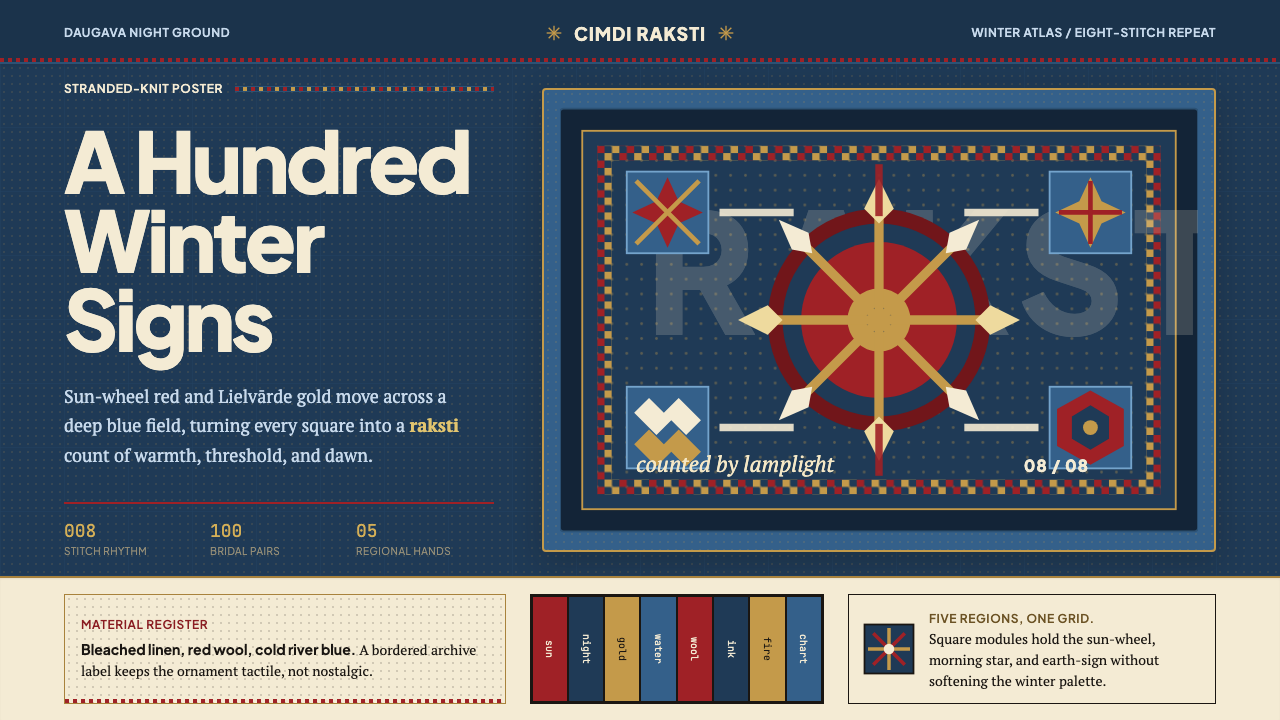 Latvian Knitted MittensWinter craft glows. Sun-wheel red and Lielvarde gold lock into an 8-stitch bl…
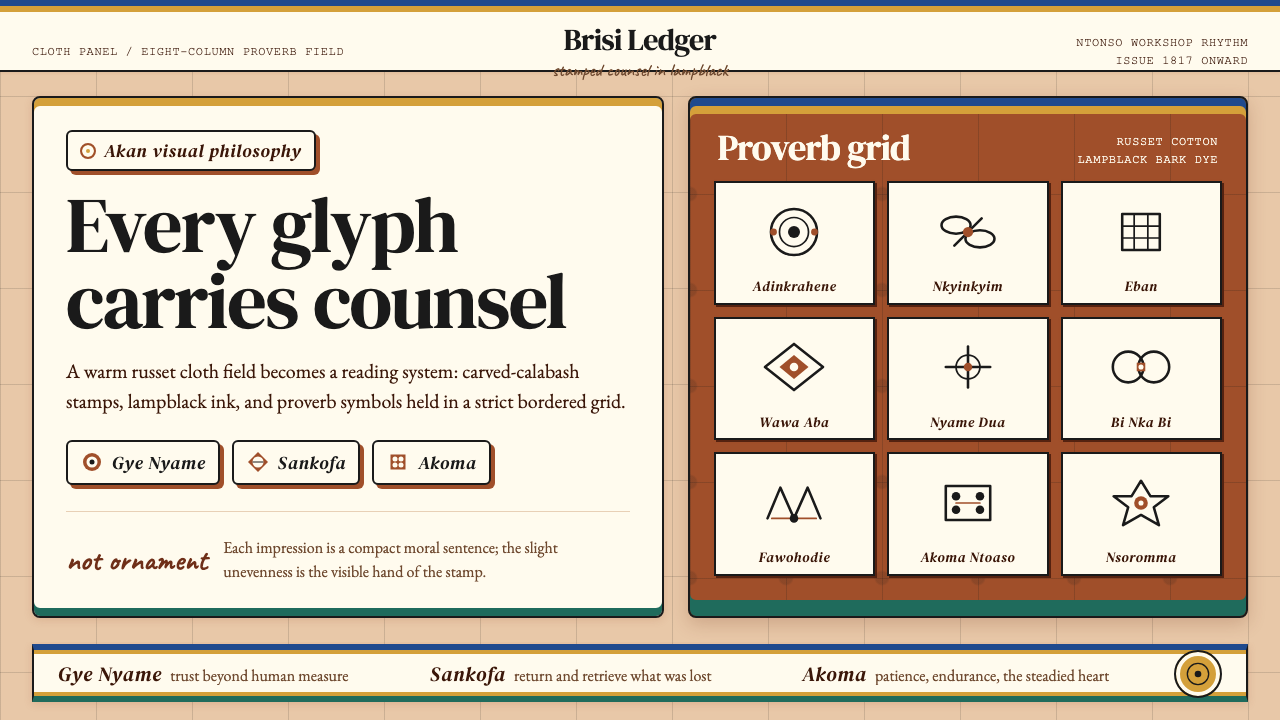 Akan Adinkra (Ghana)Proverbs become cloth. Russet grids, lampblack serif marks, and gold-edge ban…
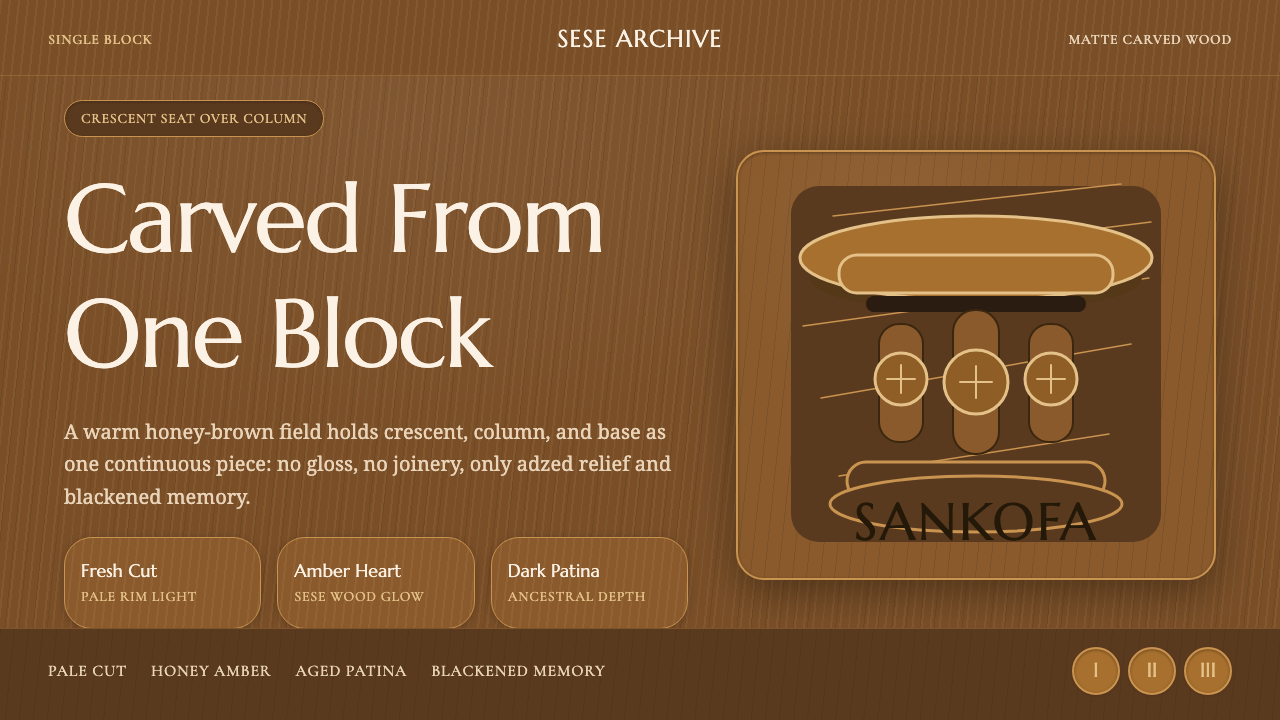 Akan Carved StoolMatte wood carries memory. Honey amber, Marcellus type, and crescent-column r…
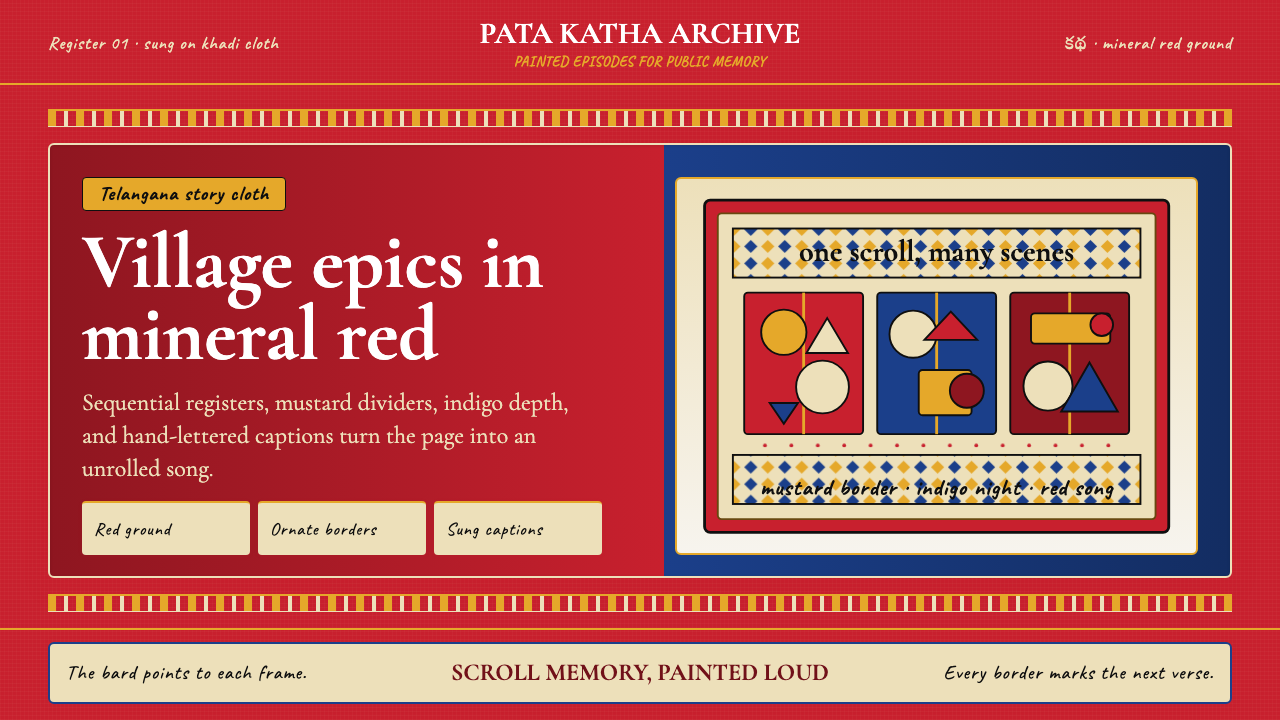 Andhra Cheriyal Scroll PaintingSaturated oral memory. Mineral red registers, mustard diamonds, and serif son…
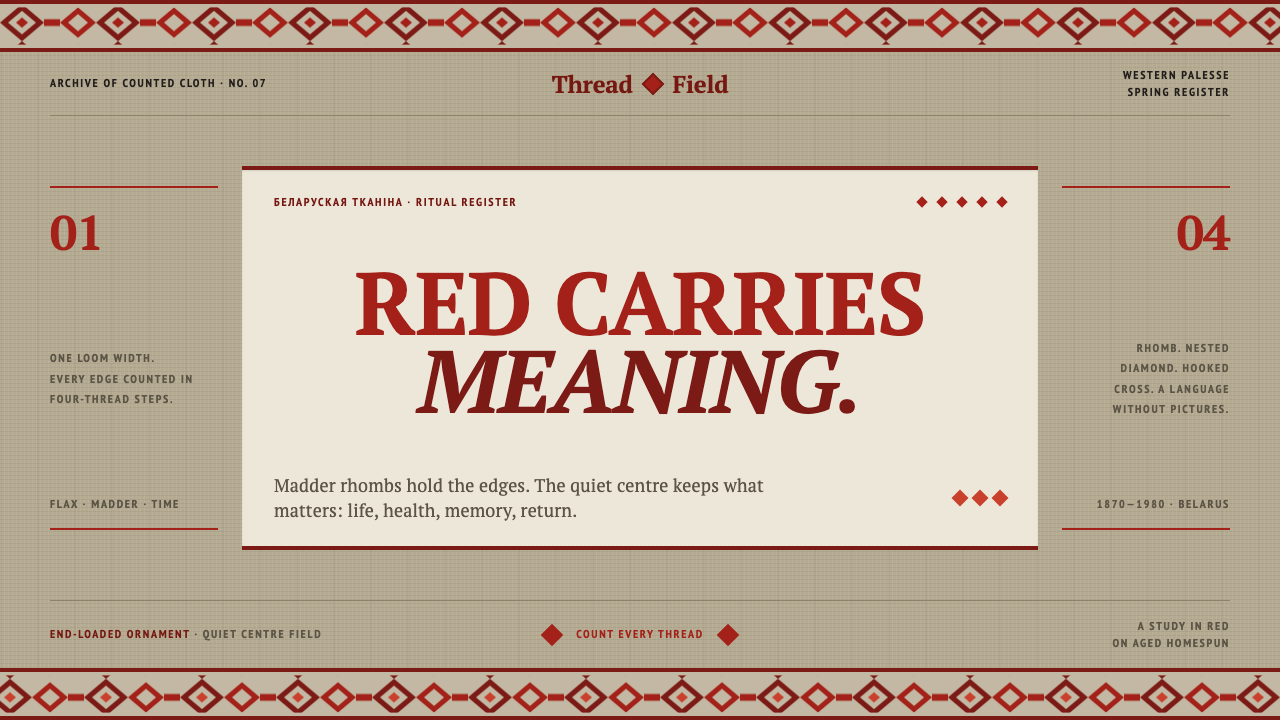 Belarusian RushnykRed carries meaning. Madder rhombs crowd aged flax edges while the woven cent…
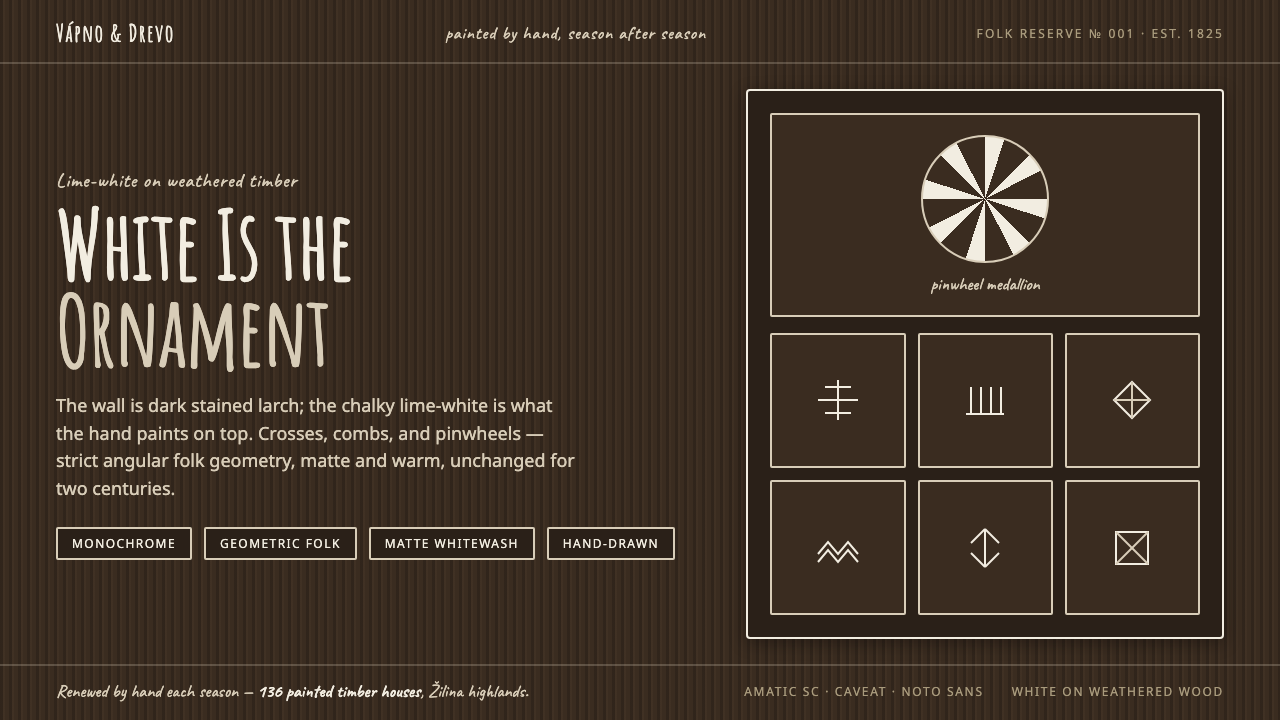 Čičmany Painted House OrnamentWhite is the ornament, not the page. Lime-white folk geometry on dark weather…