What is Otavalo Andean Textile?
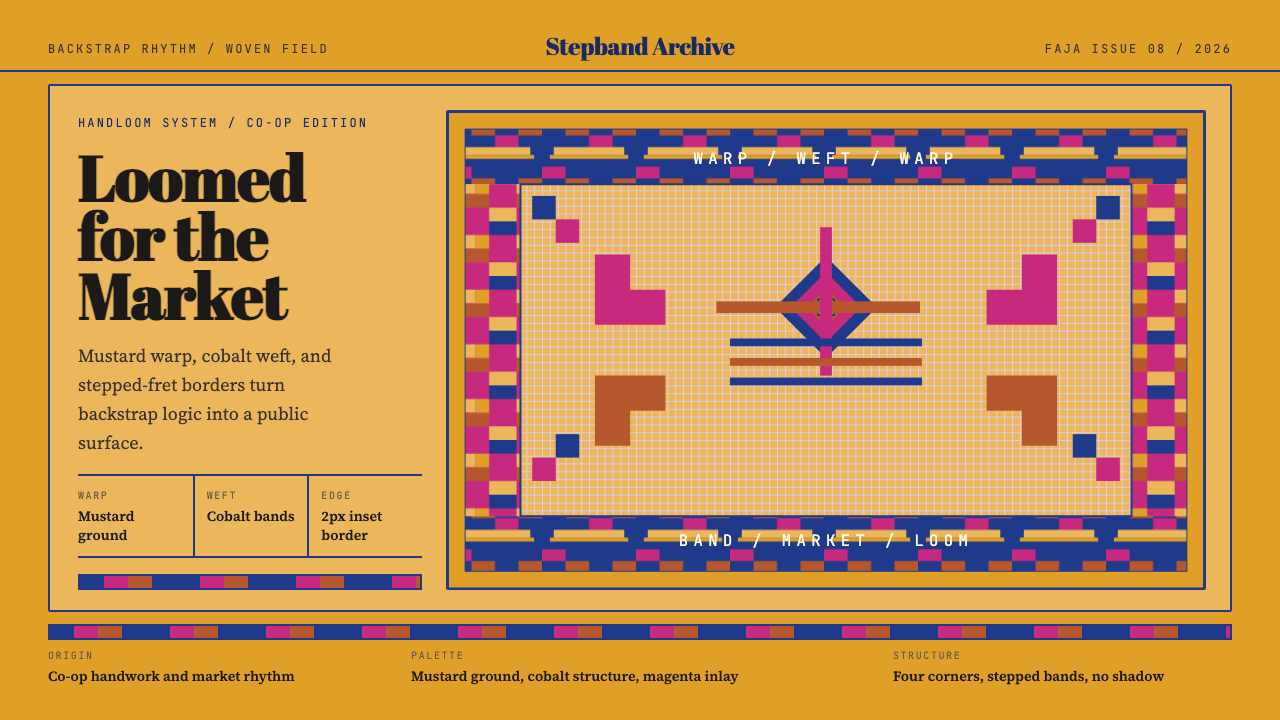
Five centuries of backstrap-loom geometry — mustard warp, cobalt weft, stepped fret — now speak the language of screens.
Otavalo Andean Textile in brief
The Otavalo Andean Textile design system translates the living weaving tradition of Ecuador's Imbabura highlands into a digital visual language. Its foundation is a saturated, unapologetically bold palette — mustard yellow and cobalt indigo above all — organized through stepped geometric bands, four-corner-symmetric layouts, and fret-patterned borders whose structural logic derives directly from the backstrap loom that Otavaleño weavers have used since pre-Incaic times.
Unlike many 'world textiles' aesthetics that flatten indigenous craft into surface decoration, this system preserves the underlying grammar of the weave. Color relationships are not arbitrary; they mirror the actual warp-and-weft decisions that a master weaver at the Saturday Plaza de los Ponchos market would make. Geometric bands repeat at consistent intervals, borders frame content as a faja (woven belt) frames the body, and the overall composition radiates outward from a central axis in four-way symmetry — a structural device central to both Andean cosmology and backstrap-loom construction.
The result is a design language that feels simultaneously ancient and immediately contemporary. It communicates warmth, cultural specificity, and craft authority without sentimentality, making it well-suited to contexts that require richness, identity, and the confident presence that comes from a tradition measured in centuries rather than trends.

Where does Otavalo Andean Textile come from?
The Otavalo Valley, nestled in Ecuador's Imbabura Province at an elevation of roughly 2,500 meters, has been a textile-producing center since well before the Inca expansion into the region in the late fifteenth century. Archaeological evidence shows that the Caranqui people — the pre-Inca inhabitants of the northern Ecuadorian highlands — wove cotton and camelid fiber on backstrap looms and developed the stepped fret and diamond geometric vocabulary that remains central to Otavaleño textile identity today. When the Inca incorporated the region circa 1495, they formalized textile production through the mit'a (rotational labor) system, expanding the weaving workforce but not fundamentally altering the existing geometric conventions.
Spanish colonial rule, beginning with the conquest of Quito in 1534, imposed the obraje (forced workshop) system, concentrating indigenous weavers in commercial textile factories that produced coarser woolen cloth for colonial markets. The obraje system was brutal — workers labored under debt peonage, often for generations — but it also inadvertently maintained weaving as the economic and cultural backbone of the Otavalo region. When the obrajes declined in the late eighteenth and early nineteenth centuries, Otavaleño weavers did not abandon textiles; they pivoted to cottage production and market trade. By the early twentieth century, the Saturday market at the Plaza de los Ponchos in Otavalo had become one of the largest and most famous indigenous markets in the Americas.
The 1960s marked a pivotal transformation: international tourism and growing awareness of indigenous craft among foreign buyers created an export market that allowed Otavaleño weavers to trade globally while remaining based in the highlands. Families such as the Conterón and Lema lineages — who had maintained master-weaver knowledge across generations — became entrepreneurial anchors of the new export economy. Weavers from Peguche and Iluman, the weaving villages adjacent to Otavalo, traveled to markets in Colombia, Europe, and eventually North America and Asia, making Otavaleño textiles among the most globally distributed indigenous handicrafts of the late twentieth century.
The 2010s through the mid-2020s brought a further evolution: fair-trade cooperatives, digital pattern archives, and a generation of Otavaleño designers trained in both traditional weaving and contemporary graphic arts began systematically codifying the visual grammar of the textile tradition. Organizations connected to the Pawkar Raymi (flowering festival) cultural revival worked to document historic pattern vocabularies and establish quality standards for co-op production. This synthesis — backstrap-loom heritage meeting fair-trade ethics and design-conscious branding — is the immediate source of the Otavalo Andean Textile design system as a digital aesthetic.
What defines the Otavalo Andean Textile look?
Saturated Core Palette
The palette is organized around two dominant hues — a warm, deep mustard yellow that reads as ochre in shadow and a cobalt indigo that carries the depth of natural dye at its richest saturation. Against these, a warm near-white or natural linen ground provides the visual breathing room that keeps the composition legible rather than overwhelming. Accent hues — deep burgundy, forest green, or terracotta — appear sparingly as the third or fourth voice in a composition, always subordinate to the mustard-cobalt axis. The key principle is that every color is fully committed: no pastels, no washed tones, nothing tentative.
Stepped Fret and Geometric Band Patterns
The stepped fret — a right-angled spiral motif that migrates across pre-Columbian Andean textiles from Ecuador to Peru to Bolivia — is the signature structural element. In the Otavalo system specifically, the fret appears as a repeating border device, framing content zones the way a woven faja frames the body. Within content areas, geometric bands run horizontally or vertically at regular intervals, dividing the composition into registers much as the loom divides warp into sections. Zigzag and diamond fills appear within these bands, always built from horizontal and vertical line segments rather than diagonal strokes — a direct consequence of the grid logic of weaving.
Four-Corner Symmetric Composition
Otavaleño textiles traditionally orient their central motif so that the composition mirrors itself both horizontally and vertically — a four-way rotational symmetry that reflects Andean cosmological thinking about the four cardinal directions and the balance of complementary forces. In the design system, this principle manifests as layout structures that radiate from a clear center point, with decorative or informational elements repeated at each corner or quadrant. It is not rigid grid symmetry in the Swiss sense but organic mirroring — the four quadrants carry the same visual weight even when their content differs slightly.
Warp-and-Weft Typographic Logic
Typography in the Otavalo system follows the structural clarity of the weave: headlines sit in bold, broad letterforms that echo the visual weight of the mustard warp bands, while body text is set in a clean, upright form that reads as the fine horizontal weft threading through the composition. Letterforms are never distorted, never italicized for decoration, and always spaced generously so that each word breathes — just as each geometric unit in a woven band is separated by a thread of ground color. The type hierarchy is defined by size and weight contrast rather than by color variation; color in type is reserved for the occasional accent word, much as a single thread of accent color appears in an otherwise monochromatic weaving band.
Tactile Surface Language
Where the Bauhaus insists on absolute flatness, the Otavalo system allows and celebrates a gentle suggestion of textile surface — not photographic texture, but a visual character that evokes the slight relief of woven threads without literally simulating fabric. Background fields carry a quiet warmth, as if light were falling across a linen ground. Borders have a solidity that reads as woven rather than drawn. This tactile quality is achieved through choices of overall density and visual rhythm rather than through any literal texture filter or image overlay; it is inherent in the pattern vocabulary itself.
Register and Band Rhythm
Composition in the Otavalo system is organized into horizontal or vertical registers — discrete zones separated by geometric bands, each register carrying a distinct informational or visual function. This register logic mirrors the structure of a poncho or manta, where clearly bounded zones of pattern alternate with plainer grounds. In practice, a page or slide might be divided into a header register, a primary content register, and a footer register, each bounded by a fret or band that marks the transition. This creates a natural reading hierarchy without requiring typographic tricks: structure is legible in the composition itself.
Celebratory Color Contrast
Otavaleño textiles are made to be worn at festivals — Pawkar Raymi, Inti Raymi — and the color system carries that ceremonial energy. Contrast levels are high, the interaction between mustard and cobalt is active rather than harmonious, and accent colors are used to punctuate rather than blend. This is not the restrained, tonal color pairing of Scandinavian design or the symbolic restraint of Bauhaus primaries; it is the confident, full-voiced color of a craftsperson who has spent years learning exactly how much each color can give before it overwhelms. The system is bold by design, and diluting its contrasts in the name of 'accessibility' or 'subtlety' works against its essential character.

Who shaped Otavalo Andean Textile?
Mariano Pichamba is among the most-cited master weavers of the Peguche community, a village immediately north of Otavalo whose weavers have historically produced some of the finest ponchos and tapestries in the region. Pichamba represents the artisan-entrepreneur model that became central to Otavalo's global reach from the 1970s onward: a master of traditional backstrap and treadle loom techniques who also navigated the export market without compromising the geometric precision and color saturation that define Peguche-style work. His lineage is credited with maintaining the integrity of stepped-fret border construction at a time when market pressure pushed many workshops toward simplified, faster patterns.
Though Tránsito Amaguaña (1909–2009) is known primarily as a political leader and indigenous rights activist rather than a textile artisan, her century-long life and legacy are inseparable from the context in which Otavaleño craft survived and gained international recognition. Her work organizing Cayambe-area indigenous communities against hacienda exploitation directly influenced the legal and social conditions that allowed Otavalo's Saturday market to operate freely, and her advocacy for indigenous education helped create the conditions under which weaving knowledge could be transmitted as cultural heritage rather than merely as colonial labor. She represents the political dimension without which the Otavalo textile tradition's current flourishing would not have been possible.
The Conterón family of Iluman — one of the weaving villages in Otavalo's immediate orbit — exemplifies the multigenerational artisan enterprise that sustained Otavalo's international reputation through the export boom of the late twentieth century. Working across backstrap-loom tapestry, commercial treadle production, and eventually cooperative branding, the Conterón lineage maintained pattern archives that documented historic geometric vocabularies at a time when market demand threatened to homogenize regional styles. Their work bridging traditional knowledge with fair-trade certification and design-conscious export branding made them a reference point for the 2010s codification of the Otavalo aesthetic as a coherent design system.
The Lema family is among the most widely recognized names in Otavaleño textile entrepreneurship, with members who established market stalls and wholesale operations across Ecuador, Colombia, and eventually Europe from the 1970s onward. What distinguishes the Lema lineage in the context of the design system is their role in quality standardization: as early exporters navigating both indigenous craft traditions and international buyer expectations, Lema family members had to articulate — in practical commercial terms — what made an Otavaleño textile visually and technically distinct from cheaper imitations. That articulation, carried out through market practice rather than academic codification, laid informal but durable groundwork for the formal design vocabulary that the Otavalo Andean Textile system now makes explicit.
Pawkar Raymi — the Kichwa flowering festival celebrated in Peguche in February — is less a single figure than a cultural institution that has become one of the most visible platforms for the contemporary articulation of Otavaleño identity. Since its revival and formalization in the 1990s, Pawkar Raymi has functioned as a design laboratory: festival visual materials, stage sets, ceremonial garments, and printed programs have all become occasions for Otavaleño artisans and designers to consciously articulate the relationship between traditional textile aesthetics and contemporary visual communication. The festival's consistent visual identity — rooted in the same stepped-fret, mustard-cobalt vocabulary as the wider textile tradition — is one of the most direct sources of the design system's contemporary form.
How do you use Otavalo Andean Textile today?
The Otavalo Andean Textile system carries a visual authority that comes from cultural depth rather than formal reduction. Applying it well requires understanding that every element — the mustard ground, the cobalt band, the stepped fret border — is a reference to a living craft tradition, not a freely interchangeable decoration. Used with this awareness, the system brings warmth, richness, and a sense of earned identity to any context that wants to communicate confidence and cultural groundedness.
For presentation slides, the system excels on ceremonial and high-stakes decks: product launches, cultural institutions, heritage brands, and organizations that want to communicate both tradition and contemporary relevance. A cover slide works best with a full bleed of the mustard ground, a single strong cobalt band anchoring the bottom third, and the title in bold upright type against the warm ground. The four-corner symmetric layout — placing a corner fret motif at each corner — frames the central content with dignity and weight. Content slides should maintain the register logic: a colored top band labels the section, the body content occupies the main register on a near-white ground, and a narrow footer band closes the composition. Data slides work well when chart elements are colored according to the mustard-cobalt-accent hierarchy, with bars and segments treated as geometric objects in their own right.
For web interfaces and dashboards, the system is well-suited to platforms with cultural, educational, or heritage mandates, as well as to e-commerce environments selling craft goods, luxury products, or anything where provenance and authenticity matter. Navigation bars and section headers benefit from cobalt grounds with mustard type, using the geometric band as a visual anchor. Card components should have clearly bounded borders — not soft shadows — that echo the fret-bordered registers of the textile. Pricing pages can use the tier-differentiation power of the accent palette: one tier in the mustard family, another in the cobalt family, a premium tier in a deep burgundy or forest green. Interactive states should feel decisive — a full-color fill on hover rather than a tint — consistent with the palette's commitment to full saturation.
For editorial and marketing work, the system supports layouts where visual richness and cultural specificity are part of the message. An editorial spread using this system might place a full-width cobalt header image or color field at the top, drop into a mustard-ground feature zone with stepped-fret borders framing pull quotes, then close with a near-white body text register. Marketing materials — posters, social cards, event graphics — benefit from the system's poster-like boldness: a single dominant color field occupying the majority of the composition, with the secondary color appearing only in the border or a typographic accent. The system also adapts well to packaging and physical print contexts, where the textile metaphor becomes literal and the tactile warmth of the color palette reads especially well on uncoated or textured paper stocks.
A common mistake when applying the Otavalo system is treating the geometric motifs as purely decorative elements that can be scaled down to subtle background patterns or used as light watermarks. The stepped fret and band patterns carry structural meaning in this system: they define zones, establish hierarchy, and mark transitions. When reduced to mere ornamentation, they lose their organizing function and the composition becomes visually busy without being structurally clear. The second common error is softening the palette — diluting the mustard toward beige or the cobalt toward slate — in the belief that more muted tones feel more 'sophisticated.' What actually happens is that the system loses the cultural energy that makes it distinctive. Full saturation is not a stylistic choice but a fidelity to the source material: a freshly loomed faja at the Plaza de los Ponchos is not beige and slate.

Otavalo Andean Textile — FAQ
Is the Otavalo system appropriate for brands with no connection to Ecuador or Andean culture?
Cultural appropriation is a real concern with any system grounded in indigenous craft. The practical guidance here is: consider whether your use honors or exploits. Using the aesthetic as a coherent design language while acknowledging its origins — in product copy, in design documentation, in the way you talk about the style choice — is qualitatively different from lifting geometric motifs as exotic decoration without context. The system is most appropriate for brands that want to communicate craft, warmth, cultural richness, and depth, and who are willing to engage with those values substantively rather than superficially. It is least appropriate for contexts where the aesthetic serves as a costume — a visual shortcut for 'ethnic' or 'artisanal' that carries no further commitment.
How does this system differ from other Andean or Latin American textile aesthetics?
Andean textile traditions are highly regional: Peruvian Cusco textiles, Bolivian Aymara weaving, Guatemalan Maya huipiles, and Otavaleño work are related by their shared pre-Columbian roots in backstrap-loom geometry but differ substantially in color system, motif vocabulary, and compositional logic. Otavaleño work is distinguished by the dominance of the mustard-cobalt dyadic, the particular stepped-fret border construction, the four-corner symmetric layout orientation, and a relatively restrained accent palette compared to the fuller chromatic range of Guatemalan or Bolivian traditions. Peruvian highland textiles often use a wider red-and-black palette with figurative animal or geometric motifs that differ from the abstract interlocked frets of the Imbabura tradition. Understanding these distinctions matters when applying the system: mixing motifs from different Andean traditions produces visual incoherence rather than richness.
Can the system work in a dark or night-mode variant?
A dark variant is possible but requires significant recalibration. The historic Otavaleño palette is not built around a dark ground — the loom works on natural fiber, and the 'dark' in traditional textiles is deep cobalt indigo or burgundy, not a neutral black or near-black. A dark variant works best when it takes deep cobalt as the primary ground (rather than neutral black), allows mustard yellow to perform as the dominant warm light against that ground, and restricts the neutral near-white to typography and fine border detail only. Using a neutral dark gray or black as the ground tends to flatten the cultural energy of the palette and push the result toward a generic 'dark mode' rather than a genuine dark expression of the textile system. The four-corner symmetric layout and stepped-fret borders remain effective at any ground value.
How should photography be handled within this design system?
Photography integrates well when it is treated as a textural element rather than a compositional anchor. Images of woven textiles, highland landscapes, market scenes, or craft processes work naturally within the system because they share the palette's warm ochre-and-blue visual world. Portraits of people should be handled with particular care — especially images of Otavaleño weavers or indigenous subjects — ensuring that photographic subjects are presented with dignity and contextual integrity, not reduced to atmospheric decoration. In layout, photography works best when contained within clearly bounded registers or frames consistent with the band-and-border logic of the system. Full-bleed photography can work for emotional impact but should be paired with a band or border overlay that maintains the system's geometric character rather than allowing the photo to read as a generic lifestyle image.
Does the system work for digital products that require high information density, such as data-heavy dashboards?
Yes, with a clear strategy for managing density. The register-and-band logic that organizes Otavaleño textiles is actually well-suited to information-dense layouts because it provides strong visual zoning without requiring the kind of heavy typographic hierarchy that some data-heavy interfaces depend on. The approach: use the cobalt-ground header band to establish primary navigation and context, reserve the mustard palette for primary metrics or key performance indicators that require immediate attention, and use the near-white register for dense tabular or body content where legibility is paramount. Geometric borders between information zones replace the soft dividers that would feel out of character. The key constraint is color budget: in a data-rich interface, resist the temptation to use all palette colors simultaneously at full saturation — assign each hue a specific semantic role and maintain that consistently across the entire interface.
Related design styles
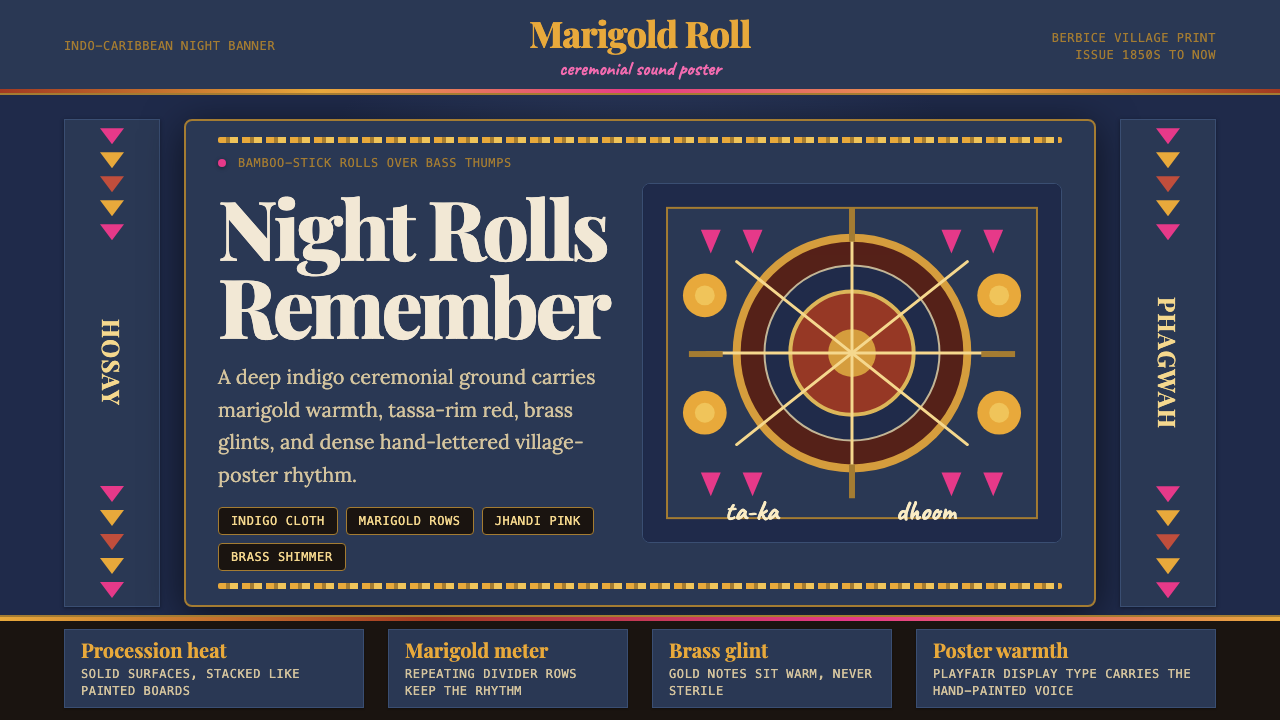 Guyanese Tassa DrumCeremony carries the beat. Indigo banners, Playfair type, and marigold rows g…
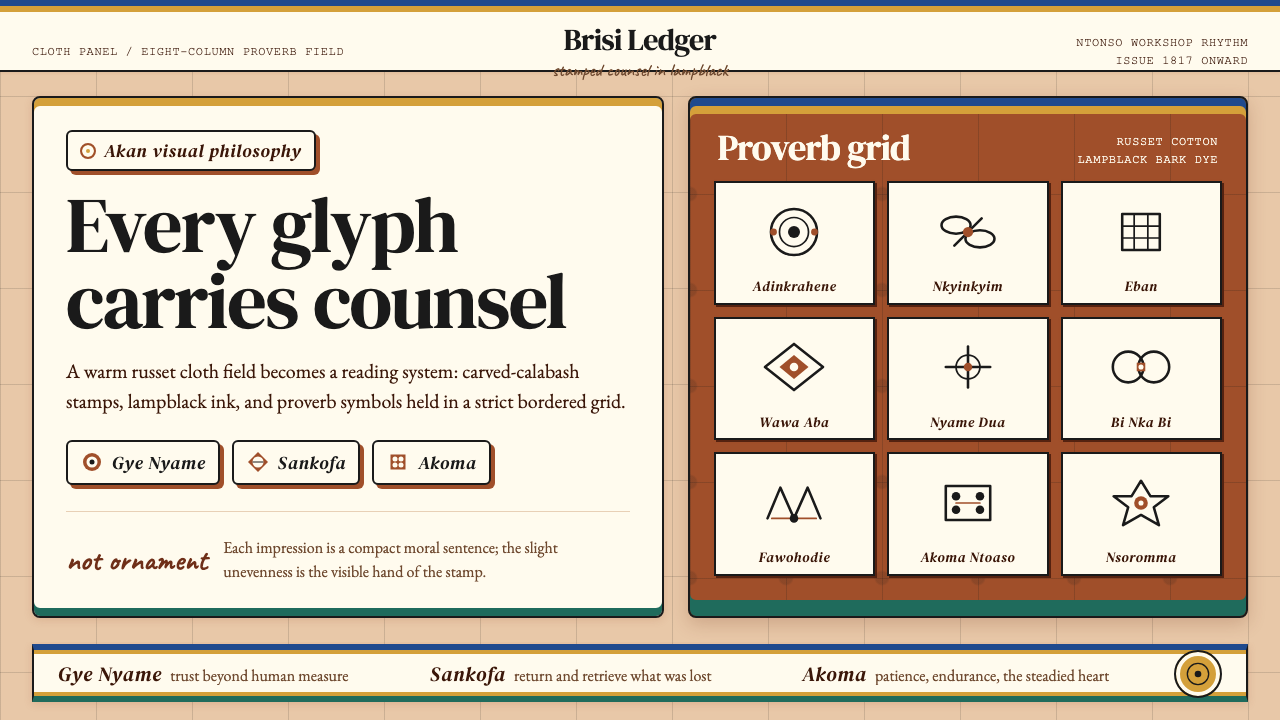 Akan Adinkra (Ghana)Proverbs become cloth. Russet grids, lampblack serif marks, and gold-edge ban…
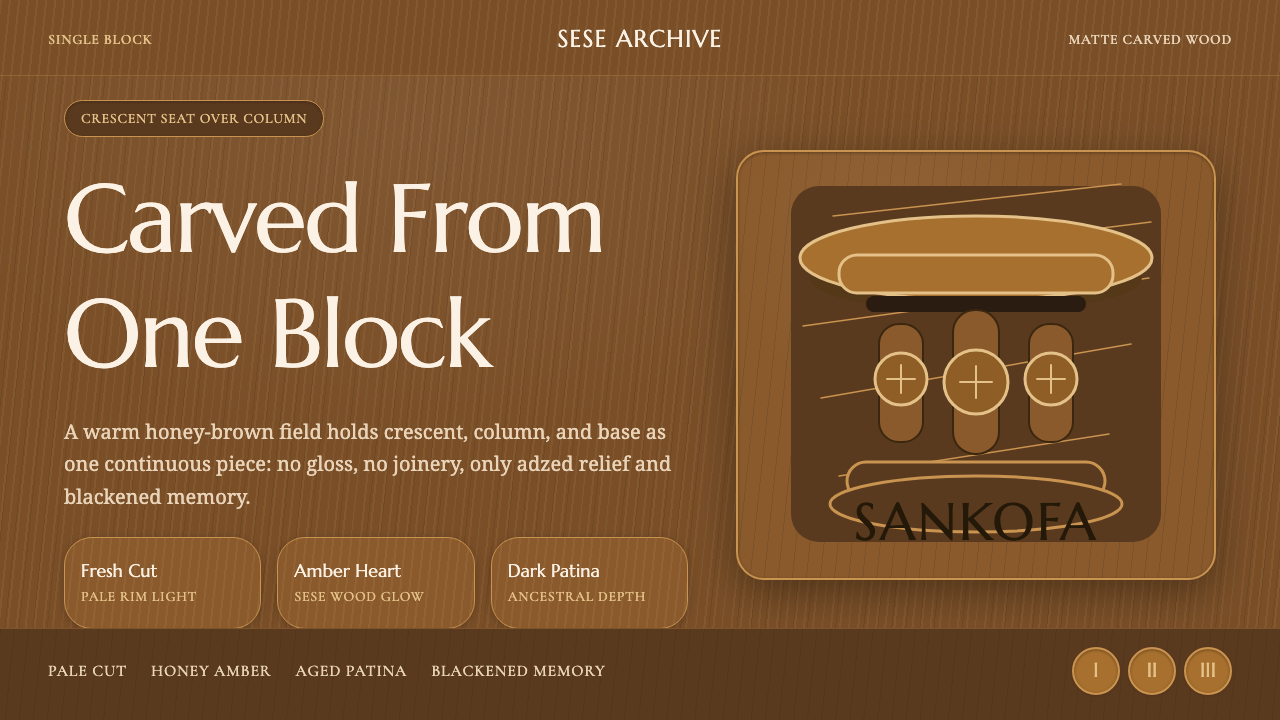 Akan Carved StoolMatte wood carries memory. Honey amber, Marcellus type, and crescent-column r…
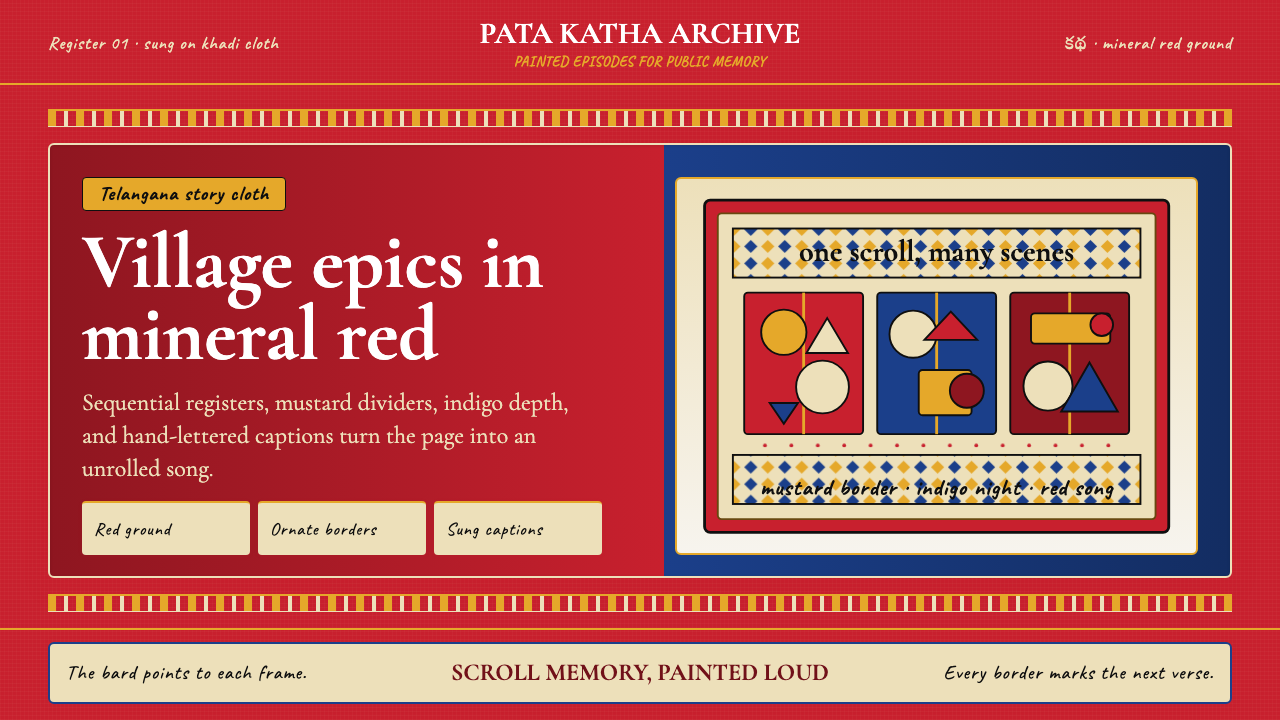 Andhra Cheriyal Scroll PaintingSaturated oral memory. Mineral red registers, mustard diamonds, and serif son…
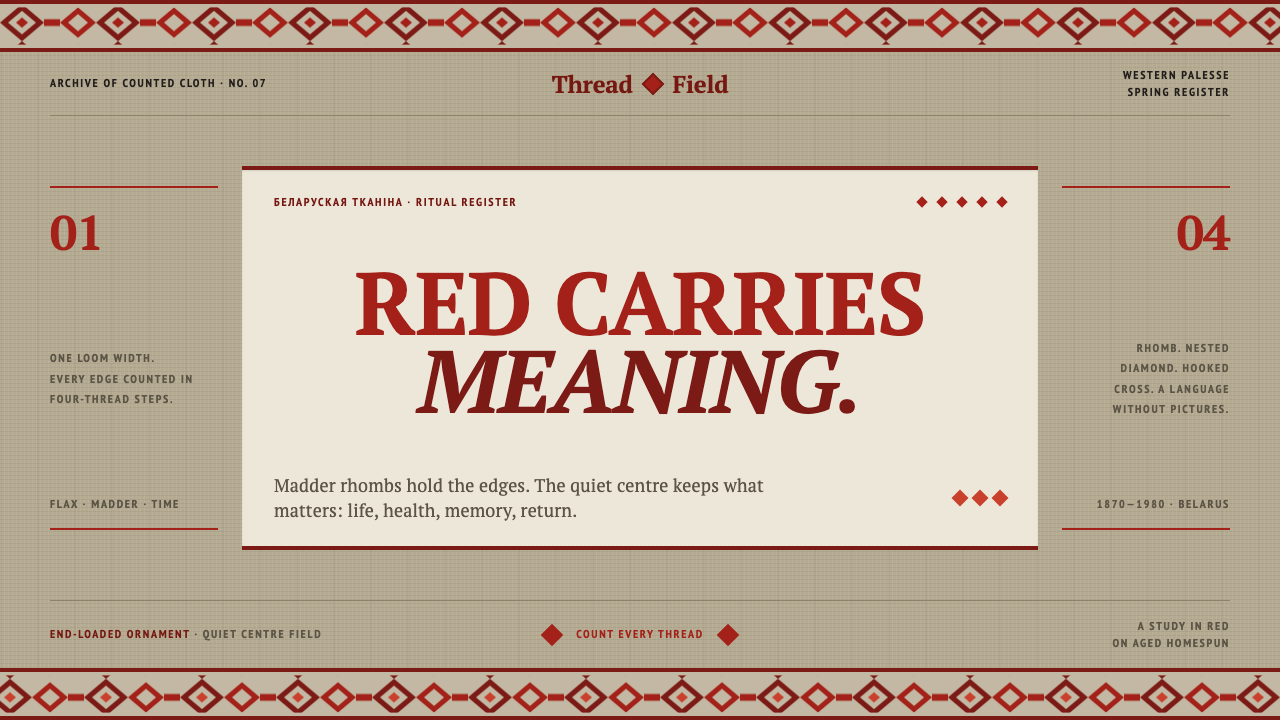 Belarusian RushnykRed carries meaning. Madder rhombs crowd aged flax edges while the woven cent…
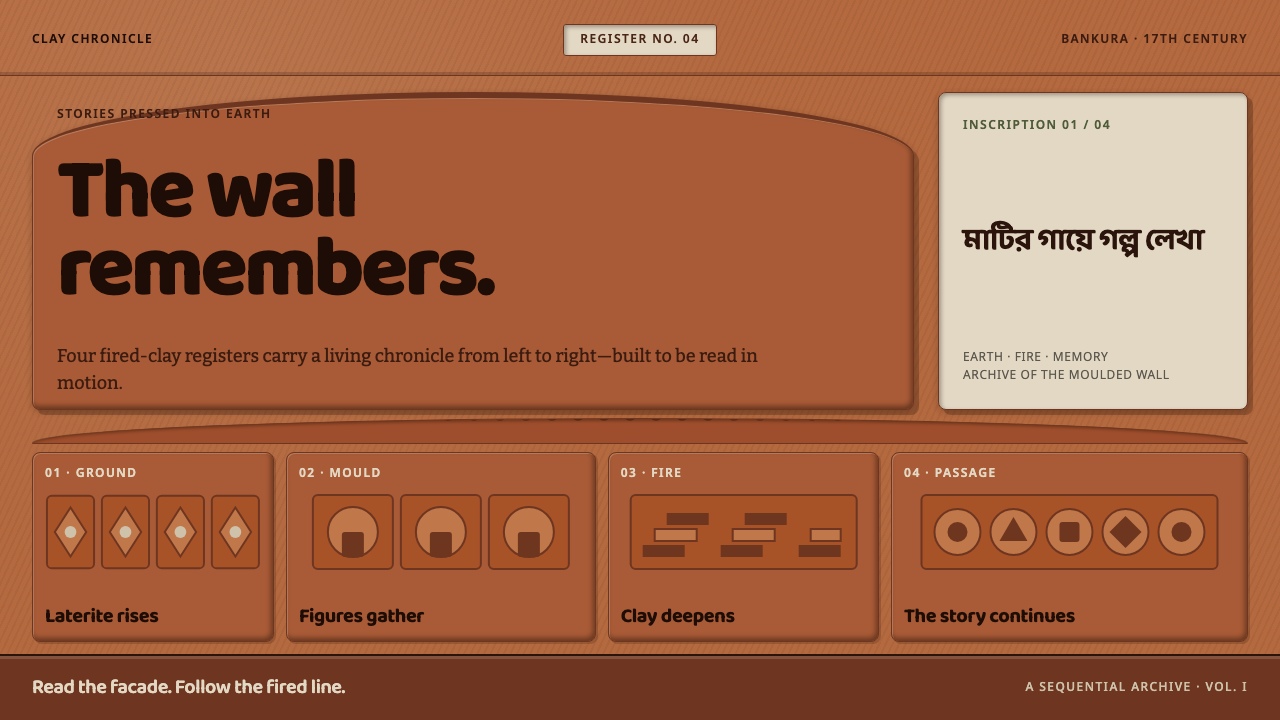 Bishnupur Terracotta TemplesThe wall tells the story. Fired-clay relief panels unfold in warm horizontal…