What is Marionette Theater?
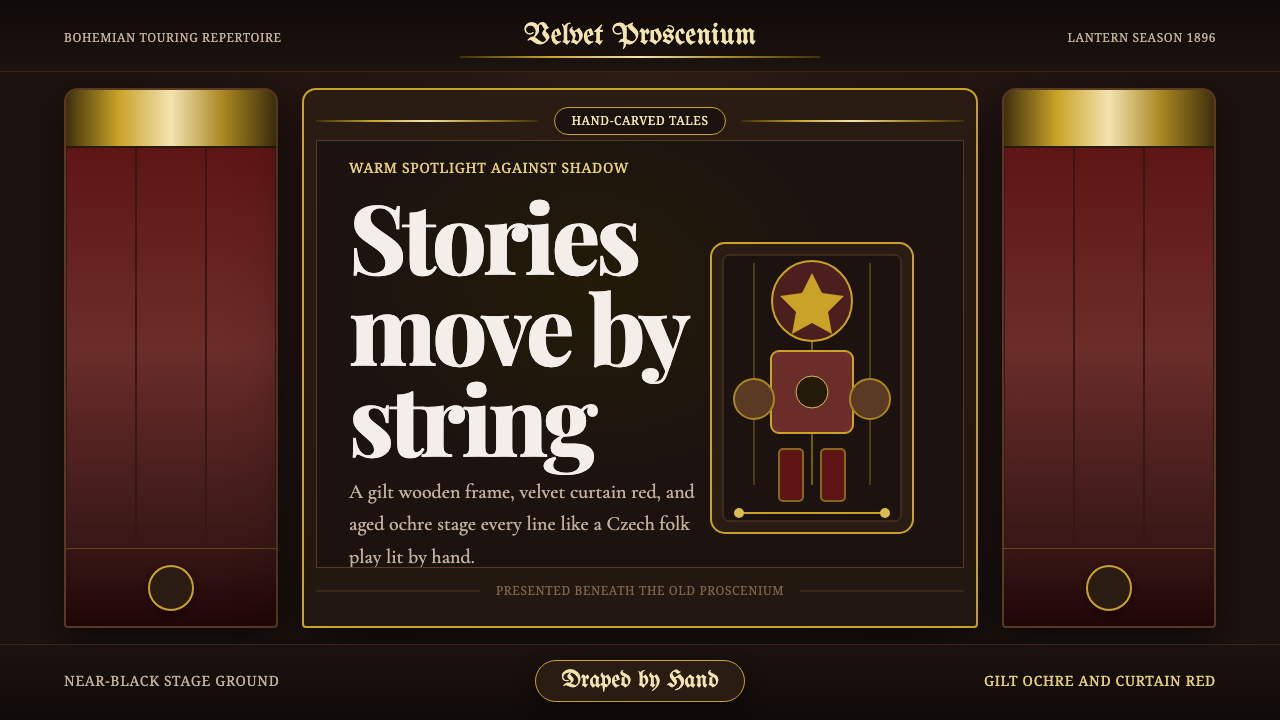
Marionette Theater stages design the way Bohemian puppeteers once staged folk tales — a carved wooden proscenium, a velvet curtain, and a single warm spotlight cutting through near-black shadow.
Marionette Theater in brief
Marionette Theater builds its visual world around the physical object of a traveling puppet stage: a hand-carved wooden proscenium arch framing a small curtained world, lit by a single warm spotlight against deep, near-black shadow. It borrows directly from the touring puppet theaters of the Czech lands, where every figure was carved and painted by hand and suspended on strings before a draped miniature stage, and it treats that theatrical framing device — the arch, the curtain, the spotlight — as the organizing structure for everything else.
The palette centers on theater-curtain red, aged-wood ochre, and gilt ornament, set against shadow so dark it reads almost as absence — the kind of blackness that exists just beyond the reach of a single stage light. Gold trim appears sparingly, tracing the edges of the proscenium arch and framing important elements the way gilt carving once framed a puppet stage's opening, never spread flat across a surface as a texture.
The overall effect is handmade and theatrical rather than industrial or digital: carved-serif lettering, warm directional lighting, and a strong sense of a framed, curtained world within the larger page all combine to produce a storytelling warmth that feels closer to a puppet show's opening curtain than to a conventional interface.
Where does Marionette Theater come from?
Puppet theater has deep roots across Europe, but the tradition most closely tied to this aesthetic is the Bohemian folk puppetry of the Czech lands, which flourished from the eighteenth into the nineteenth century as itinerant puppeteer families carried carved wooden figures and portable curtained stages from village to village, performing folk tales, religious dramas, and comic interludes for audiences who often had no other access to theater at all.
The most celebrated of these touring performers was Matěj Kopecký, a puppeteer whose family troupe became legendary across Bohemia in the early nineteenth century for their carved figures and their repertoire of moral folk tales, often performed in the Czech language at a time when German dominated official theatrical and cultural life — making itinerant puppetry, almost by accident, a quiet vehicle for Czech national and linguistic identity.
The craft persisted and eventually moved from village squares into permanent institutions: puppeteer Josef Skupa, working in the early twentieth century, created the enduringly popular puppet duo Spejbl and Hurvínek and helped establish puppetry as a respected professional theatrical art rather than purely an itinerant folk entertainment, while folklorist Jindřich Veselý founded a puppeteers' association and a dedicated puppetry journal that helped codify and preserve the craft's techniques.
The tradition's cultural weight was formally recognized in 2016, when puppetry in Czechia and Slovakia was inscribed on UNESCO's Representative List of the Intangible Cultural Heritage of Humanity, an acknowledgment that the carved figures, the portable proscenium stage, and the handmade theatrical craft behind them constitute a living heritage rather than a purely historical curiosity — the same handmade warmth this system draws on.
What defines the Marionette Theater look?
Color
The palette is anchored by theater-curtain red, aged-wood ochre, and warm gilt, set against shadow deep enough to read as near-black. Color is concentrated where the spotlight would fall — the curtain, the carved frame, the lit figure — while everything at the edge of that light recedes into darkness.
Proscenium Framing
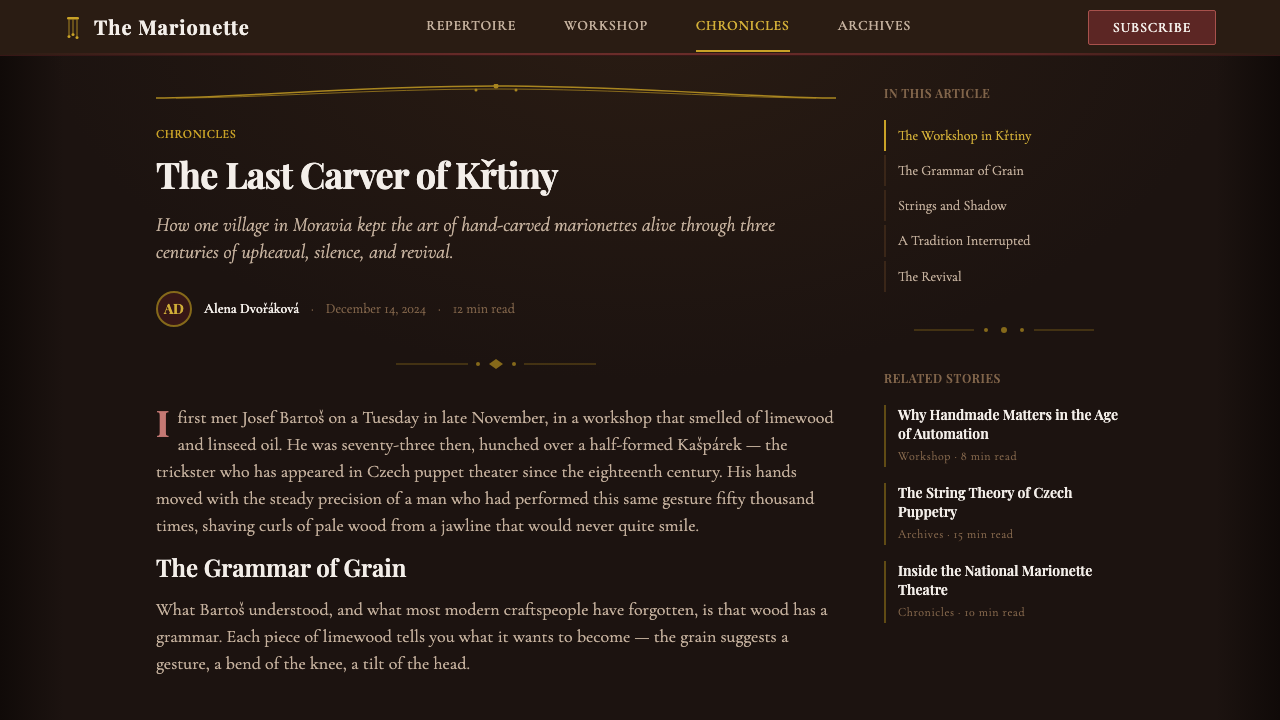
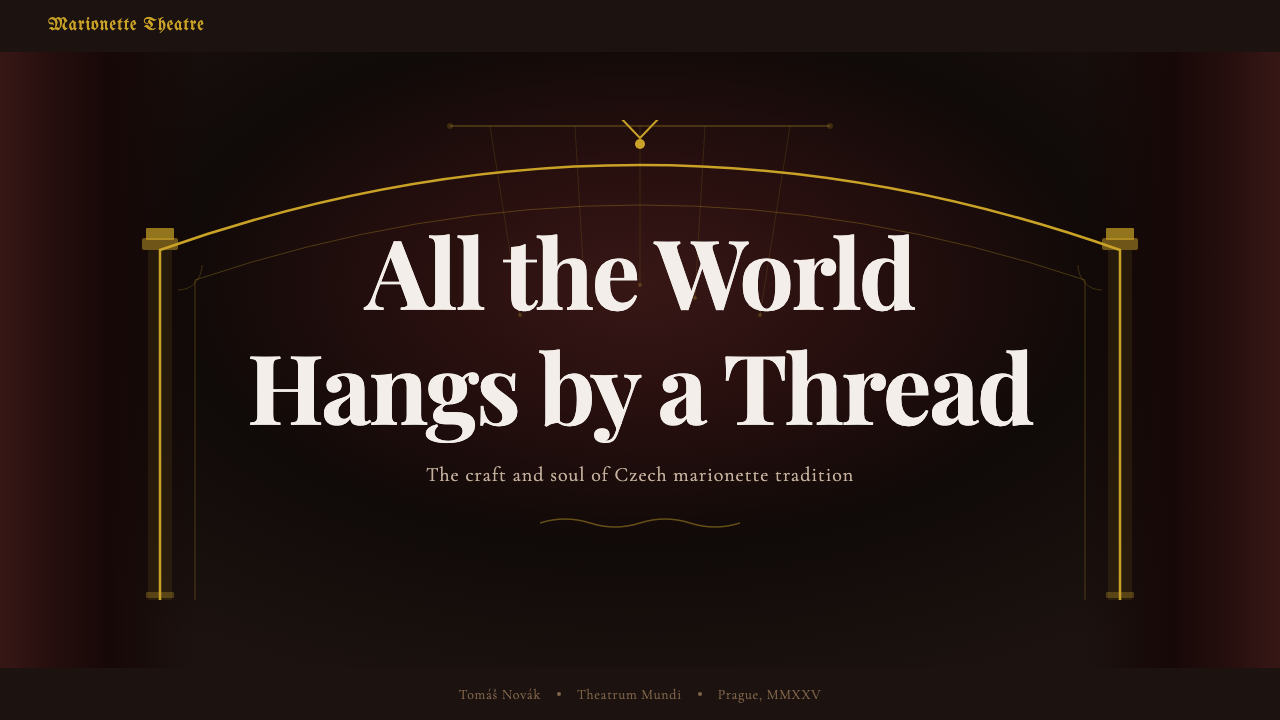
Content sits inside a literal or implied carved-arch frame, echoing a puppet stage's proscenium opening. This framing device does the work a border or card container might do elsewhere, but it carries theatrical weight — content feels staged and presented, not merely contained.
Single-Source Spotlight
Light comes from one warm, directional source rather than an even ambient wash, producing a strong falloff from bright center to deep shadow at the edges. This single-spotlight logic creates natural focal hierarchy without needing color or scale to do the same work.
Carved Ornament
Gilt scrollwork and carved ornamental detail trace the edges of frames and important elements — never spread flat as a repeating pattern. Ornament is treated as something a woodcarver's hand added at the border, marking where the stage ends and the world beyond begins.
Typography
Lettering takes on a carved, sculptural quality — serif forms with visible weight and dimension, as if cut from wood rather than printed flat. Headline type behaves like a carved sign above a stage rather than a neutral digital label.
Deep Shadow
Shadow is not merely dark but nearly total at the edges of the composition, standing in for the unlit backstage space beyond a puppet theater's small illuminated world. This depth of shadow is what makes the single spotlight feel dramatic rather than simply dim.
Who shaped Marionette Theater?
The most legendary of the Bohemian touring puppeteers, Kopecký led a family troupe renowned in the early nineteenth century for hand-carved figures and moral folk tales performed in Czech, quietly carrying national and linguistic identity through itinerant folk entertainment at a time when German dominated official culture.
This institution helped transform Czech puppetry from an itinerant village craft into a preserved, respected performance tradition with a permanent home, staging classic works with the same carved-figure, curtained-stage vocabulary that traveling puppeteers once carried from town to town.
Skupa created the beloved puppet duo Spejbl and Hurvínek in the early twentieth century and helped elevate Czech puppetry into a respected, professionally staged theatrical art, moving the craft from village squares into dedicated theaters without losing its hand-carved, hand-painted character.
A folklorist who founded a puppeteers' association and a dedicated puppetry journal, Veselý helped document, codify, and preserve the carving and performance techniques of Czech puppet theater, giving the itinerant craft an institutional record that outlasted any single traveling troupe.
The 2016 inscription of Czech and Slovak puppetry on UNESCO's Representative List formally recognized the carved figures, portable stages, and handmade theatrical craft as living heritage, cementing the cultural weight behind the handmade warmth this design system draws from.
How do you use Marionette Theater today?
Applying Marionette Theater well means treating every screen as a small stage, not a flat page. The proscenium frame, the single warm spotlight, and the deep surrounding shadow should always be present in some form, even when scaled down to a button or a card — the theatrical logic is what separates this from generic dark-and-gold decoration.
For presentation slides, a cover page benefits from a full carved-frame border with the title lit as if by a single spotlight against deep shadow, immediately establishing the theatrical premise. Content slides can use a lighter version of the frame as a section container, and data slides work well when a single highlighted figure or value is lit against a darker field of supporting numbers, echoing a spotlighted puppet against a dim stage.
For web interfaces, the style suits storytelling platforms, cultural and heritage brands, event and ticketing products, and any experience built around narrative reveal — a modal or onboarding flow that opens like a curtain rising works especially well. Buttons and calls to action read naturally in gilt-edged red against deep shadow, echoing a stage's most valuable prop.
For editorial and marketing work, the aesthetic suits long-form storytelling, folklore and cultural-heritage writing, and theatrical or event marketing. A pull quote or section break framed by a thin carved-looking border, lit against dark surrounding space, echoes the proscenium device without requiring a literal puppet illustration on every page.
A common mistake is treating this as generic dark-mode-plus-gold styling without the theatrical framing device — without the sense of a curtain, a stage edge, and a single light source, the system collapses into ordinary luxury decoration rather than staged storytelling. Another mistake is lighting the whole composition evenly, which erases the falloff from spotlight to shadow that gives the style its drama.
Marionette Theater — FAQ
What makes this different from a generic dark, gold-accented luxury theme?
The difference is the theatrical framing device — the sense of a proscenium arch, a curtain, and a single spotlight staging every element. A generic luxury theme uses dark backgrounds and gold accents decoratively; this system uses them to construct the specific illusion of a small lit stage inside a larger darkness, which is a structural idea, not just a color choice.
Why do carved wooden puppets specifically inform this aesthetic, rather than puppetry in general?
Because the Bohemian tradition this system draws from was defined by hand-carving and hand-painting as much as by performance — the physical object of the puppet, and the wooden stage that housed it, carried as much craft identity as the stories being told. That is why carved ornament and wood-grain warmth matter as much as the theatrical lighting.
Can this style work in a light or bright layout?
It resists a fully bright treatment, since the falloff from a warm spotlight into deep shadow is central to the effect. A lighter variant is possible if it keeps a strong local contrast — a genuinely lit, warm foreground against a genuinely darker surrounding frame — rather than spreading even brightness across the whole composition.
Does the style require an actual puppet or curtain illustration to read correctly?
No — the frame, the spotlight, and the shadow logic can carry the effect entirely on their own, the way a beautifully lit empty stage still reads as theatrical before a single puppet appears. Literal puppet or curtain imagery can reinforce the reference but risks tipping into costume if overused.
What kind of products or brands does this style struggle to fit?
It struggles in contexts that demand fast, flat, high-density information display — analytics dashboards, technical documentation, or data-heavy enterprise tools — since the deep shadow and single-spotlight logic actively work against showing many elements with equal clarity at once. It is best reserved for experiences built around narrative, reveal, and craft.
Related design styles
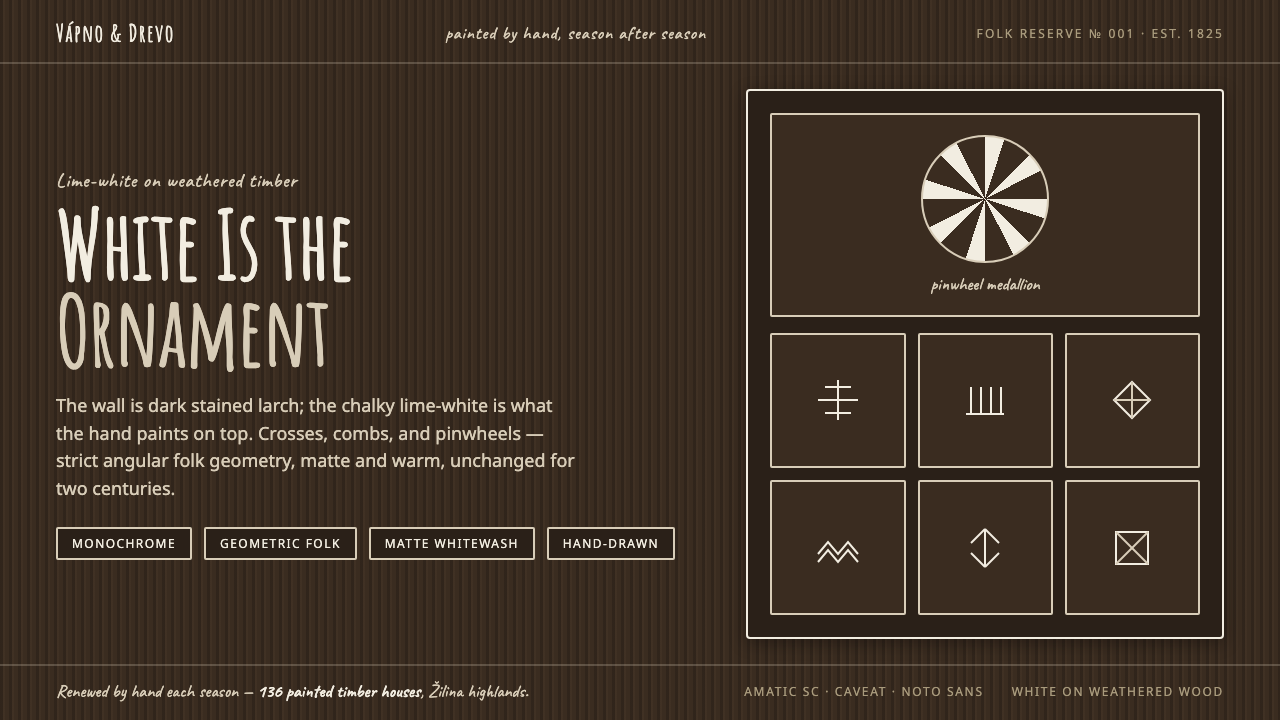 Čičmany Painted House OrnamentWhite is the ornament, not the page. Lime-white folk geometry on dark weather…
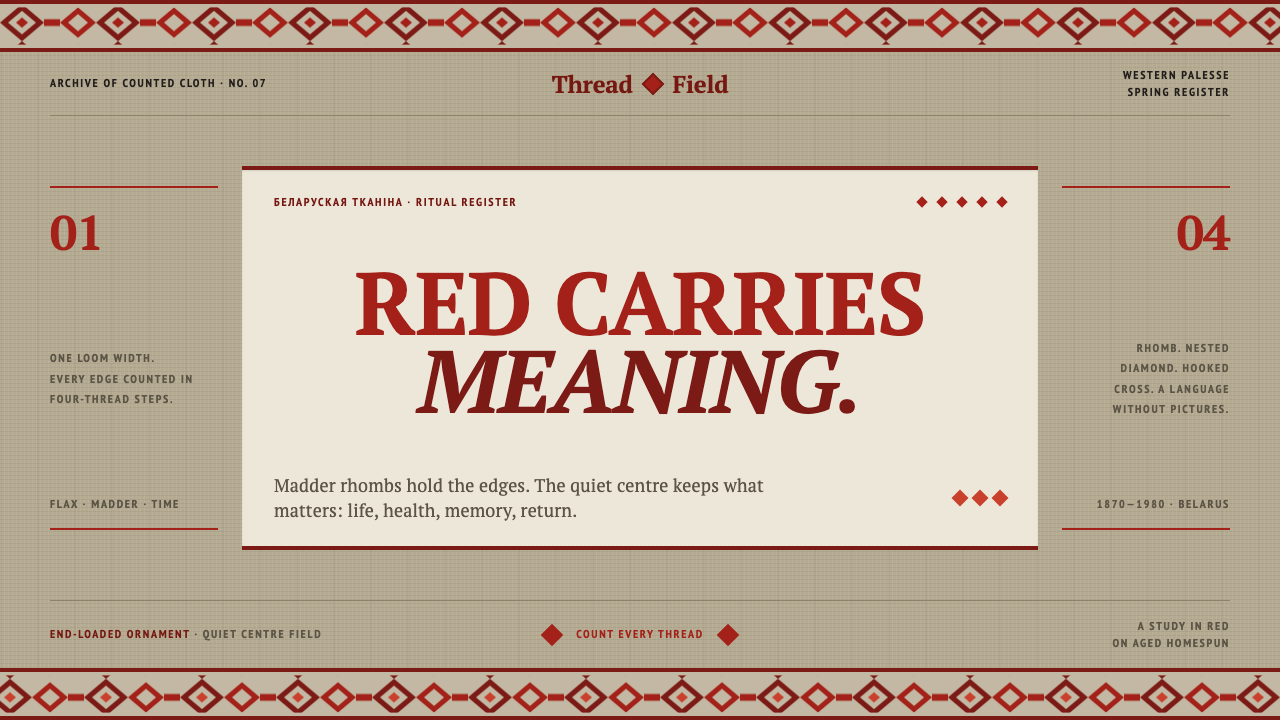 Belarusian RushnykRed carries meaning. Madder rhombs crowd aged flax edges while the woven cent…
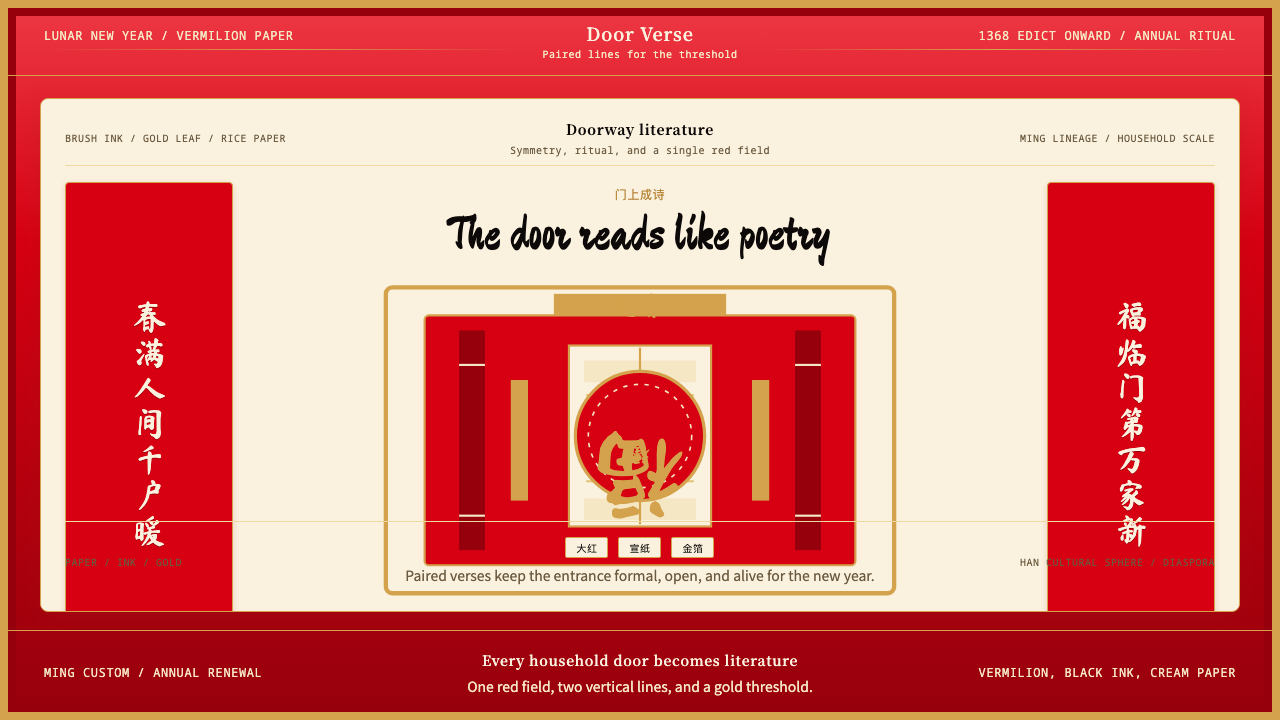 Chinese Spring Festival Red CoupletLiterature on the door. Vermilion paper, vertical pairs, and gold calligraphy.
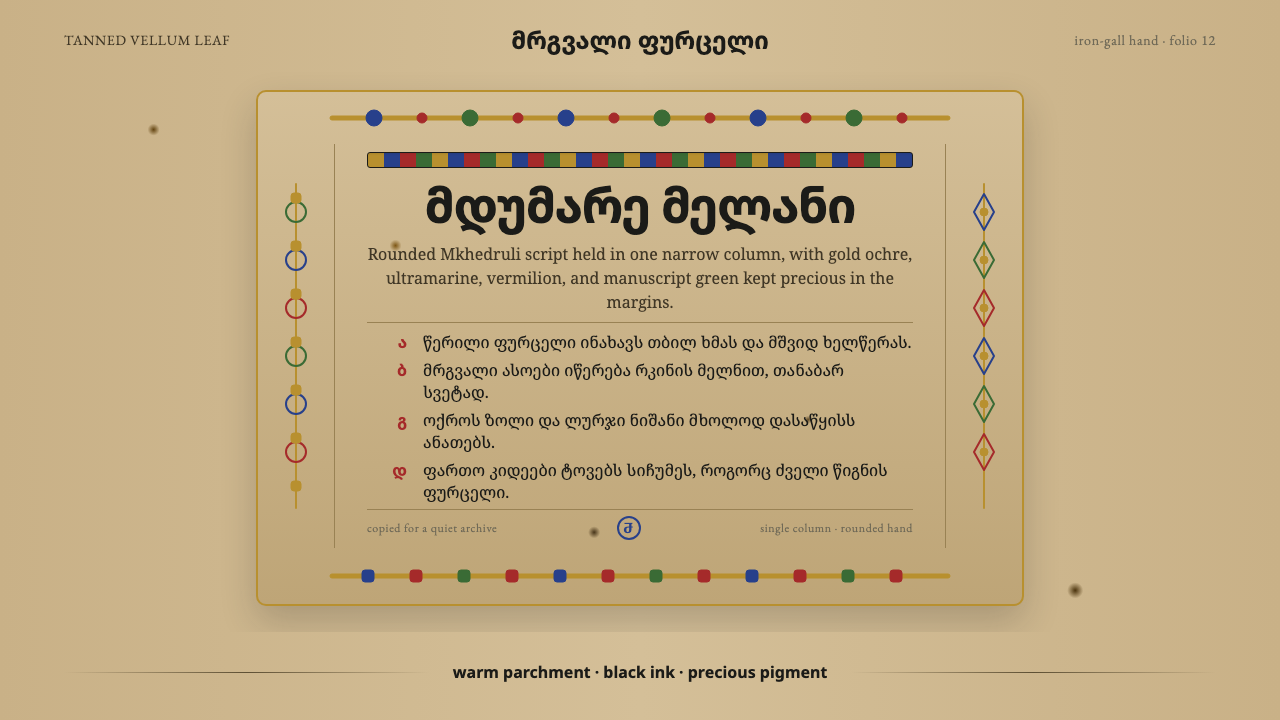 Georgian MkhedruliA manuscript breathes slowly. Tanned vellum, round Mkhedruli ink, ochre and u…
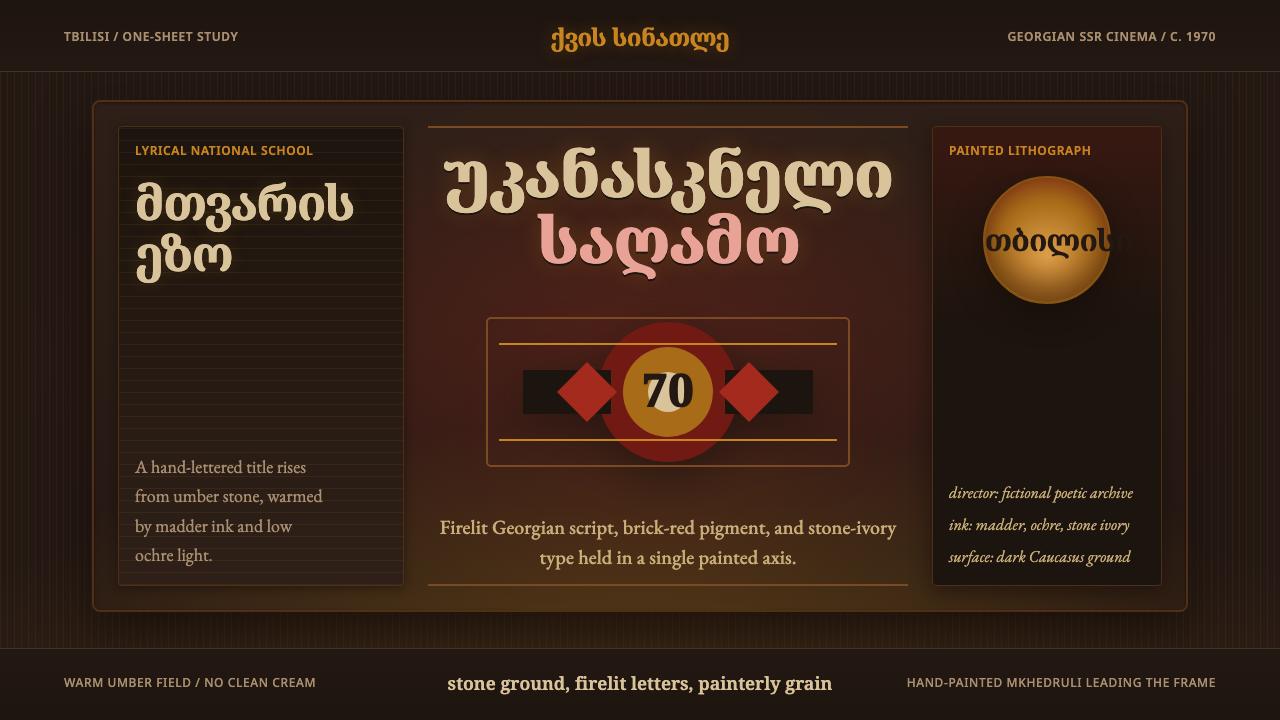 Georgian Soviet Cinema PosterFirelit and handmade. Mkhedruli serif titling glows in madder red and ochre o…
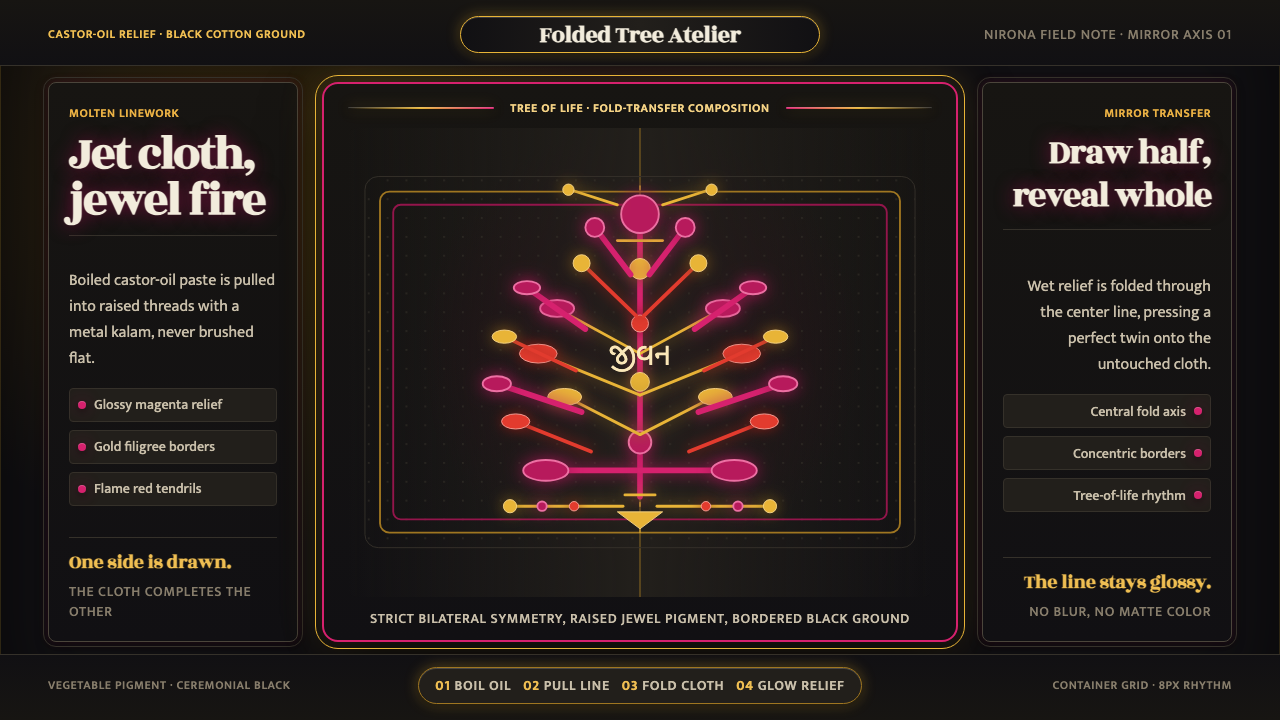 Kutch Rogan Castor-Oil PaintingGlossy symmetry holds the dark. Magenta castor-oil lines mirror across black…