What is Fijian Masi Tapa Stencil?
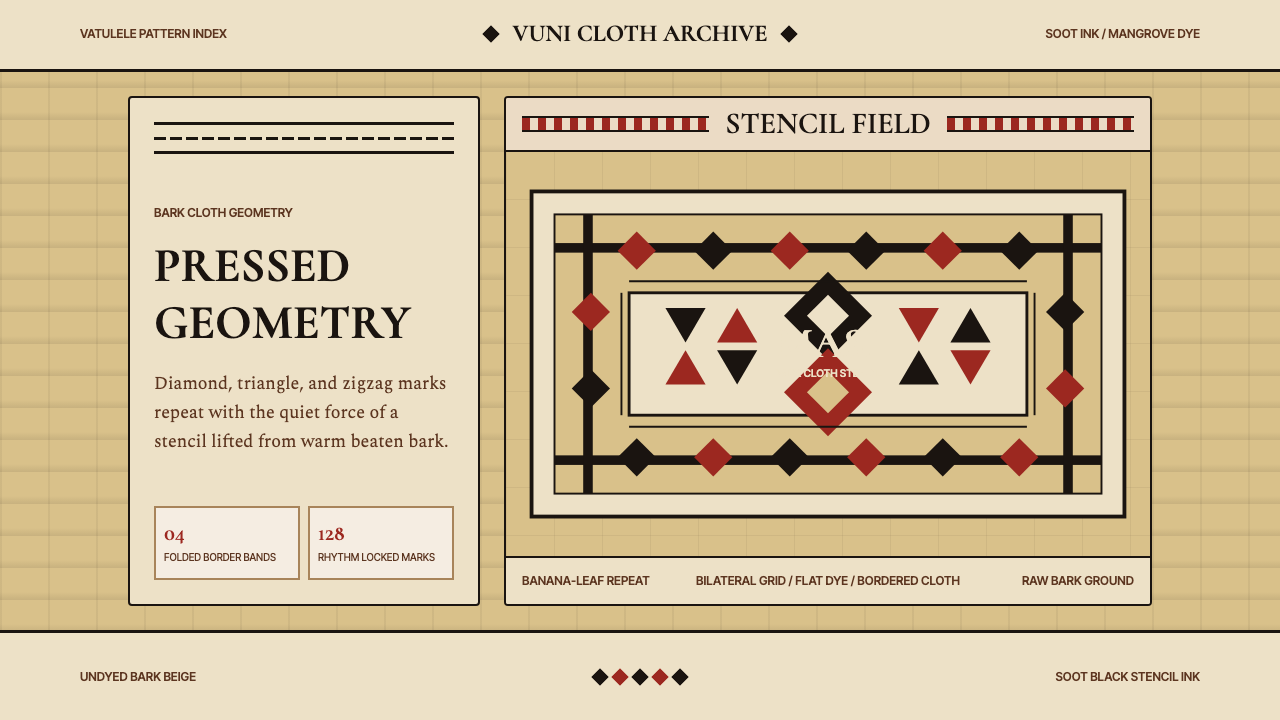
Fijian Masi Tapa Stencil translates the disciplined geometry of centuries-old bark-cloth printing — soot-black diamonds on warm bark beige, bound by rust-red bands — into a design language where ceremonial repetition becomes contemporary visual structure.
Fijian Masi Tapa Stencil in brief
Fijian Masi Tapa Stencil is a design aesthetic rooted in the bark-cloth printing traditions of Fiji, where women across island communities — most famously on Vatulele, in Cakaudrove, and throughout the Lau group — beat sheets of paper-mulberry bark into a supple cloth called masi, then applied bold geometric patterns using cut banana-leaf stencils and natural dyes. The visual result is characterized by disciplined repetition of diamond, triangle, and zigzag motifs across a warm, raw-fiber ground, held together by rust-red banding lines that mark rhythm and edge.
The aesthetic draws its entire palette from the materials of its origin: the undyed bark itself produces a warm beige that registers as organic and grounded; soot-black stencil ink delivers the geometric figures with a flatness that is striking without being cold; rust-red mangrove dye provides the structural bands and accents that give the composition its architectural sense of boundary. There are no secondary or tertiary hues competing for attention. Color is functional and symbolic, not decorative.
As a contemporary design system, Masi Tapa Stencil operates on the principle that restraint and repetition are not the same as simplicity. A single diamond motif is only a shape; a field of diamonds arranged with the disciplined consistency of a stencil becomes pattern, and pattern becomes ceremony. The aesthetic rewards design work that needs to signal both cultural depth and geometric confidence — an unusual combination that distinguishes it from both purely decorative tropical styles and purely rationalist grid systems.
Where does Fijian Masi Tapa Stencil come from?
The production of tapa cloth — bark cloth beaten from paper-mulberry (Broussonetia papyrifera) — is among the oldest textile traditions in Polynesia and Melanesia, and masi is Fiji's form of that practice. The technique arrived in Fiji through Austronesian settlement thousands of years before European contact, and by the time of early European exploration, masi production was deeply embedded in social and spiritual life. Cloth was exchanged at births, marriages, and deaths; it marked political alliance and status; it was presented to chiefs and wrapped around the bodies of the dead. The cloth itself was as much a social artifact as a textile.
The printing of geometric patterns onto masi developed in tandem with the ceremonial importance of the cloth. The most significant center of patterned masi production in Fiji is Vatulele Island, where women maintained — and continue to maintain — a specialized vocabulary of geometric motifs passed through family and community lineage. The patterns are not decorative elaborations of a blank surface; each motif carries cultural associations, and particular designs are associated with particular clans, occasions, or ranks. This embedded meaning gives Fijian masi its particular gravity as a visual system.
The stencil technique — cut from banana leaf or other available plant material — was the primary means of achieving the repetitive, sharp-edged geometry that distinguishes Fijian masi from the freehand tapa traditions of Tonga or Samoa. The stencil enforces a discipline of repetition: the same diamond or triangle is pressed across the surface again and again, and the slight variations introduced by hand pressure, dye concentration, and the natural irregularity of the bark surface produce what might be called a mechanical-organic quality — systematic yet alive. The borders and banding lines that frame the patterned fields are applied separately, often in the rust-red tone derived from the bark of red mangrove trees.
The flourishing of Fijian masi as a recognized art form in the outside world owes much to the scholarship of figures like Rod Ewins and Phyllis Herda, who documented the traditions and their cultural contexts in the latter half of the twentieth century. Sagale Buadromo and other women craft leaders helped sustain active production through periods when imported textiles threatened to displace indigenous cloth-making. Today, masi remains both a living craft tradition and a source of formal inspiration — increasingly referenced in graphic design, architectural surface treatments, and fashion across the Pacific and internationally.
What defines the Fijian Masi Tapa Stencil look?
Palette
The color system is derived entirely from natural materials: warm bark beige as the primary ground, soot-black as the stencil pigment for geometric figures, and rust-red as the structural accent used for borders and banding. The palette is intentionally narrow and earthbound — there are no cool hues, no purples or greens, and no neutralized greys. The warmth of every tone, from the lightest ground to the darkest figure, produces a visual coherence that reads as simultaneously ancient and refined.
Motif Vocabulary
The visual vocabulary centers on three geometric primitives — the diamond (or lozenge), the triangle, and the zigzag — arranged in repeating bands, grids, or nested configurations. These forms are not arbitrary; each has precedent in centuries of Fijian masi tradition and carries embedded cultural weight. In contemporary application, they function as a graphic shorthand for disciplined geometric order, signaling a system built through accumulated repetition rather than one-off composition.
Stencil Rhythm
Perhaps the most distinctive quality of this aesthetic is the rhythm produced by stencil repetition. Unlike hand-drawn pattern, which drifts and improvises, stencil work enforces a consistent beat: the same figure appears at regular intervals, with only the slight natural variations of pressure and material breaking the mechanical regularity. This quality — systematic yet not sterile — is difficult to achieve through software defaults and is what separates thoughtfully applied Masi-derived design from generic geometric pattern.
Banding and Border
Rust-red banding lines are not decorative additions — they are structural. In traditional masi, these borders define the edges of patterned fields and separate compositional zones. In contemporary design, they translate into frame elements, dividers, and horizontal rules that carry genuine visual weight rather than serving as afterthoughts. The border in this system is an active compositional element: it contains, separates, and provides counterpoint to the geometric density of the interior.
Surface Quality
Traditional masi is produced on a surface that is itself textural — beaten bark has a fibrous, slightly irregular quality that absorbs dye unevenly and gives the finished cloth a warmth that woven fabric lacks. In digital translation, this quality is referenced through the choice of warm-toned backgrounds and the avoidance of pure white or cold grey grounds. The surface is never neutral; it always reads as a material presence, grounding the geometric figures above it.
Ceremonial Restraint
Masi Tapa Stencil is not a maximalist aesthetic — the restraint is structural. The palette is narrow by necessity; the motif vocabulary is limited and repeating; the banding lines are spare. This restraint is what gives the style its ceremonial gravity. Overcrowding the visual field, introducing additional colors, or substituting freehand curves for the stencil's hard edge all undermine the system's essential character. More is not more in this aesthetic; exactness and economy are its virtues.
Warm Geometric Tone
Most geometric design traditions tend toward either cool rationalism (the Swiss grid, Bauhaus primary colors) or expressive boldness (Memphis, Constructivism). Fijian Masi Tapa Stencil occupies a less common register: the geometry is rigorous but warm, the repetition is systematic but organic, and the overall effect is grounded rather than clinical. This warmth is carried almost entirely by the palette and the bark-beige ground; the geometric logic itself is as strict as any rationalist system.
Who shaped Fijian Masi Tapa Stencil?
Vatulele Island is the acknowledged center of the finest and most complex patterned masi production in Fiji. The women of Vatulele — organized through family and community structures — are the custodians of the motif vocabulary and the stencil-cutting techniques that define the tradition at its highest level. Their work is not anonymous folk craft but a recognized specialist practice, and particular Vatulele families are associated with specific pattern lineages. The style's visual authority derives directly from the accumulated expertise of these women, whose knowledge of form, repetition, and cultural meaning makes the geometric system as sophisticated as any more formally theorized design tradition.
An Australian anthropologist and artist, Ewins was among the first scholars to produce systematic documentation of Fijian tapa cloth patterns and their cultural contexts. His research — conducted primarily in the latter decades of the twentieth century — helped establish masi as a subject of serious art-historical inquiry rather than ethnographic curiosity. By identifying and cataloguing the motif vocabulary and tracing regional and family-based variations, Ewins created the scholarly foundation on which later designers and cultural practitioners could draw when working seriously with this visual tradition.
A prominent Fijian cultural leader and craft advocate, Buadromo has been instrumental in sustaining and promoting traditional masi production through periods when imported materials and changing economic conditions threatened indigenous textile practices. Her work connects living craft knowledge to contemporary cultural identity and international design interest, and she represents the continuity between the tradition's ceremonial origins and its present-day visibility in global design discourse.
A New Zealand-based historian and anthropologist, Herda contributed foundational research on tapa cloth traditions across the Pacific, including Fijian masi, situating the practice within broader Polynesian and Melanesian textile histories. Her comparative scholarship illuminated what was distinctly Fijian in the masi tradition — particularly the stencil technique and the specific motif conventions of the Vatulele and Lau traditions — as distinct from related practices elsewhere in the Pacific.
How do you use Fijian Masi Tapa Stencil today?
Fijian Masi Tapa Stencil is a design system that rewards disciplined application. Its power comes from the interaction of a narrow palette, a restricted geometric vocabulary, and the rhythmic quality of stencil repetition — and any of these elements used in isolation produces less than the whole. The designer working in this style is not decorating a layout with exotic geometric shapes; they are constructing a visual system built on repetition, boundary, and material warmth.
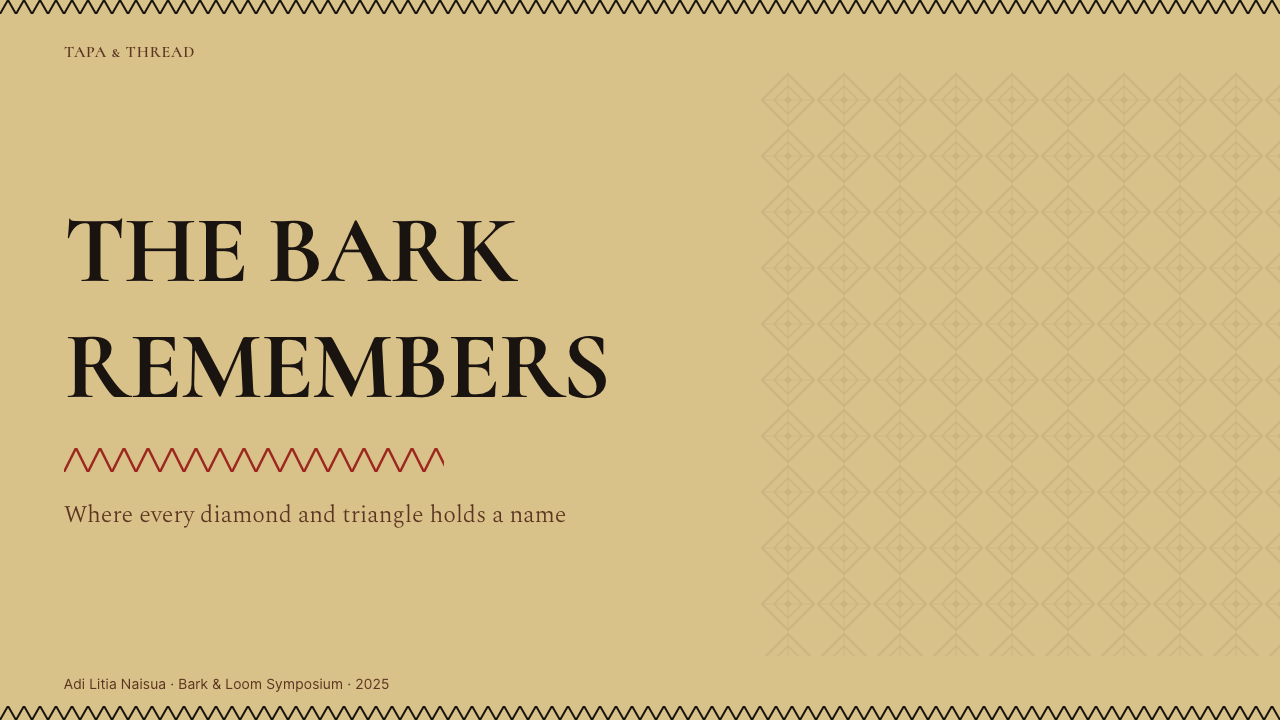
For presentation slides, the style is best suited to covers and section dividers that need to signal cultural grounding and geometric sophistication simultaneously. A cover built in this aesthetic typically uses the bark-beige ground as the background, positions a field of repeating diamond motifs at high contrast in soot-black, and frames the title and subtitle in rust-red banding. Content slides should use a cleaner version of the system — the geometric motifs can appear as border treatments or section markers rather than full-field patterns, keeping the slide readable while maintaining visual coherence. Data slides work well when charts and graph elements are rendered in the three-tone palette only, letting the system's color restrictions impose a natural hierarchy on the data.
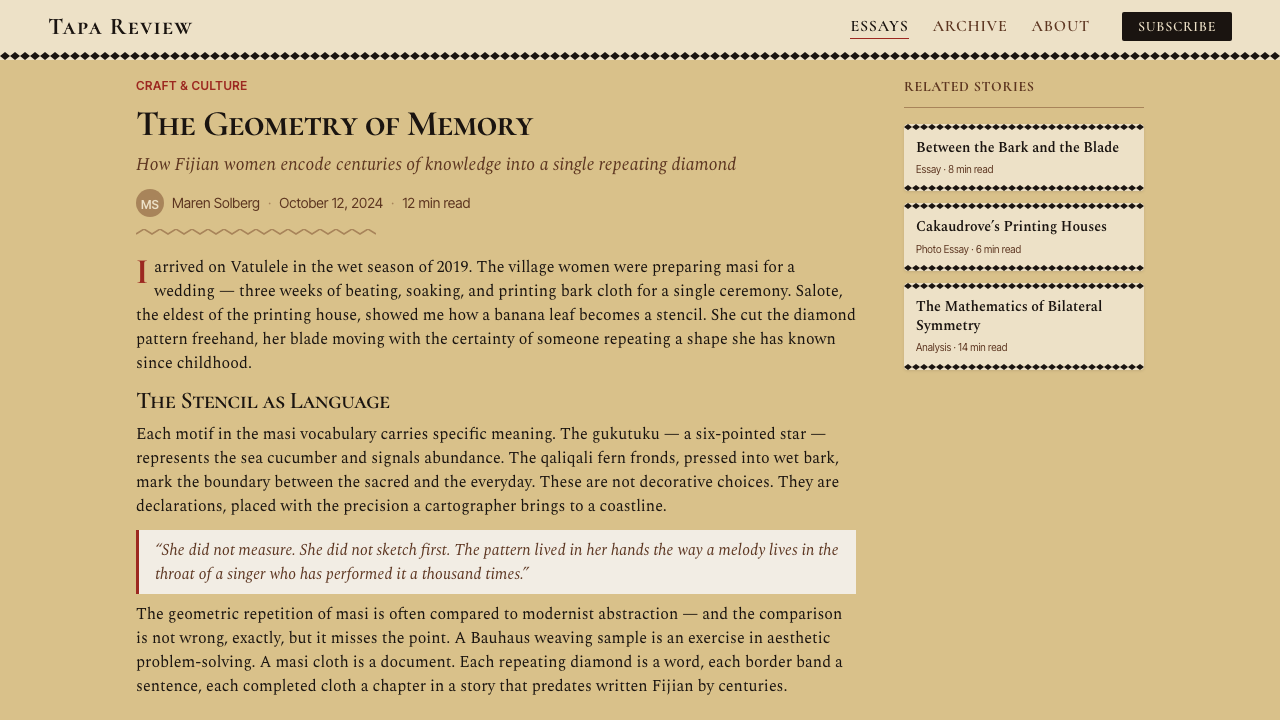
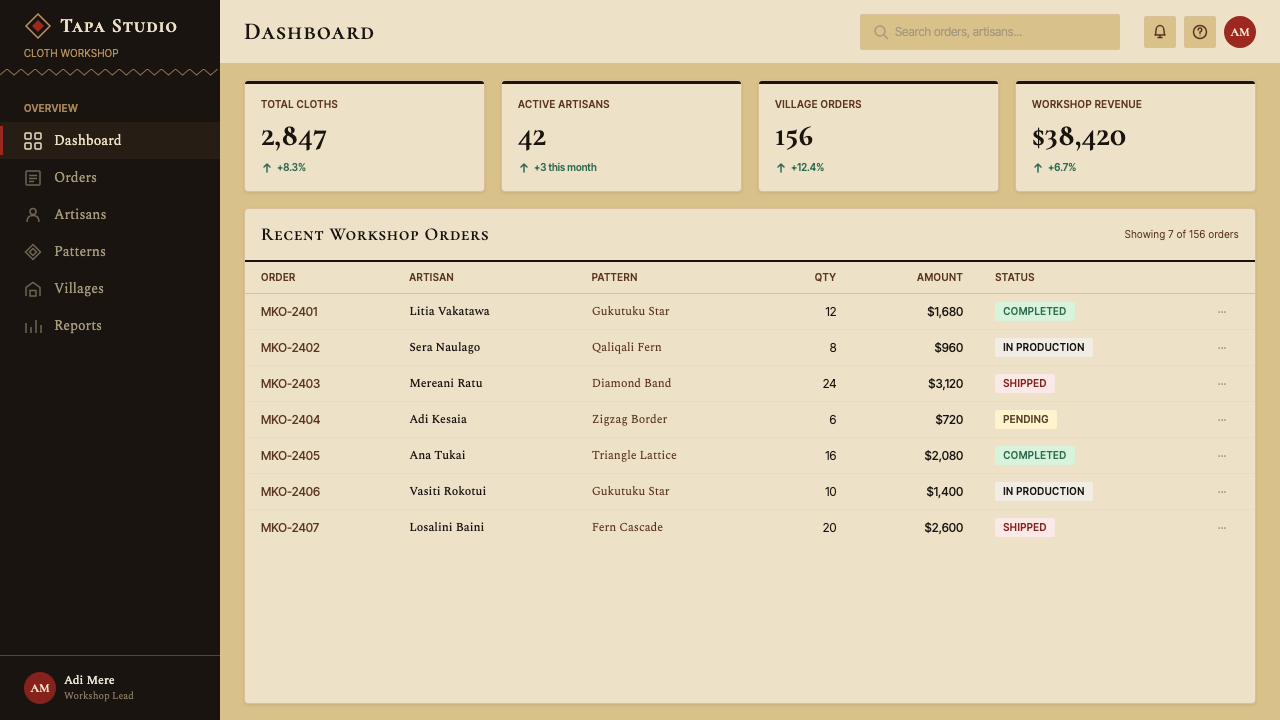
For web interfaces, the style maps naturally to dashboards, pricing pages, and brand landing pages where a sense of grounded authority and cultural distinctiveness is the goal. The practical approach: establish the bark-beige tone as a background for hero sections and feature blocks, use soot-black for primary text and interface elements, and reserve the rust-red accent strictly for calls to action, active states, or tier indicators. The geometric motif vocabulary can be introduced as surface pattern on hero image backgrounds, as decorative rules between sections, or as icon treatments — but the motif should always feel stencil-precise rather than hand-illustrated. For editorial and marketing contexts, the style supports strong header hierarchies and can carry long-form content with distinction when the body text is set against the warm ground and the sectional structure uses the rust-red border system.
For editorial and marketing work, the strongest application leans into the style's poster-like quality. Full-width feature sections can alternate between soot-black backgrounds with bark-beige type and warm beige backgrounds with black text — the rust-red enters only as accent, never as a primary field. Marketing headlines benefit from the style's geometric seriousness; the visual language communicates deliberateness and depth in a way that purely decorative tropical aesthetics do not. The style is particularly well-suited to cultural institutions, craft brands, Pacific-region tourism, and any product that wants to signal both elegance and geographic rootedness.
A common mistake when working with this aesthetic is treating the three-tone palette as permission to add warmth through additional earthy or botanical hues — ochre, olive, terracotta — in the belief that they extend the material character of the system. They do not. The restrictedness of the Masi palette is not a starting point for elaboration; it is the finish. Each additional hue dilutes the system's coherence and moves it from a disciplined geometric tradition toward a generic Pacific-inspired mood board. The other common error is softening the geometric edges — replacing the stencil's hard contour with rounded corners or gradient fills — which removes the precise, printed quality that gives the style its distinctive authority.
Fijian Masi Tapa Stencil — FAQ
Is this style appropriate for non-Pacific brands, or does it carry cultural ownership concerns?
The question deserves a direct answer. Masi is a living tradition, not an archaeological artifact, and its motifs carry ongoing cultural meaning for Fijian communities. Using the aesthetic thoughtfully — with acknowledgment of its origins, without claiming specific culturally significant motifs as original design work, and without producing goods that directly compete with Fijian craft producers in traditional markets — is the approach that distinguishes respectful reference from appropriation. For digital design work (slides, web interfaces, editorial layouts), the visual system is being referenced as a formal language, not reproduced as craft, which places it in the same category as referencing Bauhaus or De Stijl. Transparency about the source is advisable.
How does Masi Tapa Stencil differ from other Pacific or Oceanic pattern traditions?
The most distinctive feature of Fijian masi, compared to related tapa traditions in Tonga or Samoa, is the stencil technique and the resulting character of the pattern. Tongan ngatu tends toward freehand painted figures with more fluid, organic edges; Samoan siapo uses rubbing techniques that produce softer contours. Fijian masi stencil work is characterized by its sharp-edged geometry and the rhythmic, mechanical quality of identical repeated units — which is precisely what gives it such strong potential as a contemporary design reference. The color palette is also more restricted in Fijian masi: the soot-black and rust-red on bark beige is a consistent signature, whereas other Pacific tapa traditions sometimes use a wider range of natural dye tones.
Can this aesthetic work for dark-background designs?
It can, but with care. The canonical form of the aesthetic is light-ground: bark beige as the base, dark figures on top. Inverting to a dark ground — a very deep brown-black rather than a pure cold black, to maintain the material warmth — places bark-beige figures on a dark field and can be effective for dramatic moments: full-screen hero sections, event posters, packaging. The rust-red accent can remain in this inversion but should be used even more sparingly, as it becomes more assertive against a dark ground. What the dark version must not do is go cold: a pure digital black or cool grey ground severs the connection to the material tradition and produces something that reads as generic geometric pattern rather than masi-derived design.
How many geometric motif types should a Masi-influenced design use?
Fewer is always more. Traditional masi compositions typically develop one or two primary motif types within a panel, allowing the repetition to create depth and rhythm rather than variety. In contemporary design work, using more than two or three distinct geometric motif types simultaneously introduces visual competition that works against the aesthetic's defining quality of disciplined order. The system's power is in the accumulation of the same unit, not in the variety of units. If multiple motif types are needed for structural reasons — say, a border treatment that uses triangles while the interior field uses diamonds — they should be clearly separated by the rust-red banding system, not allowed to overlap or intermingle.
What kinds of products or industries is this style least suited to?
The style struggles in contexts that require high-density typographic layouts, because the warm-toned ground and geometric patterning compete with body text for visual attention at any significant pattern weight. It is also unsuited to products whose visual identity requires a cool, technology-forward register — blue-white interfaces, data-driven SaaS tools, financial platforms — because the material warmth of the palette reads as artisanal and warm rather than precise and analytical. Children's products are a poor fit: the palette lacks the brightness and variety that children's visual culture typically requires. And any context where lightness, airy whitespace, and minimal visual weight are the primary design values — certain luxury fashion, minimalist wellness brands — will find the stencil-pattern density and earthy palette at odds with the intended effect.
Related design styles
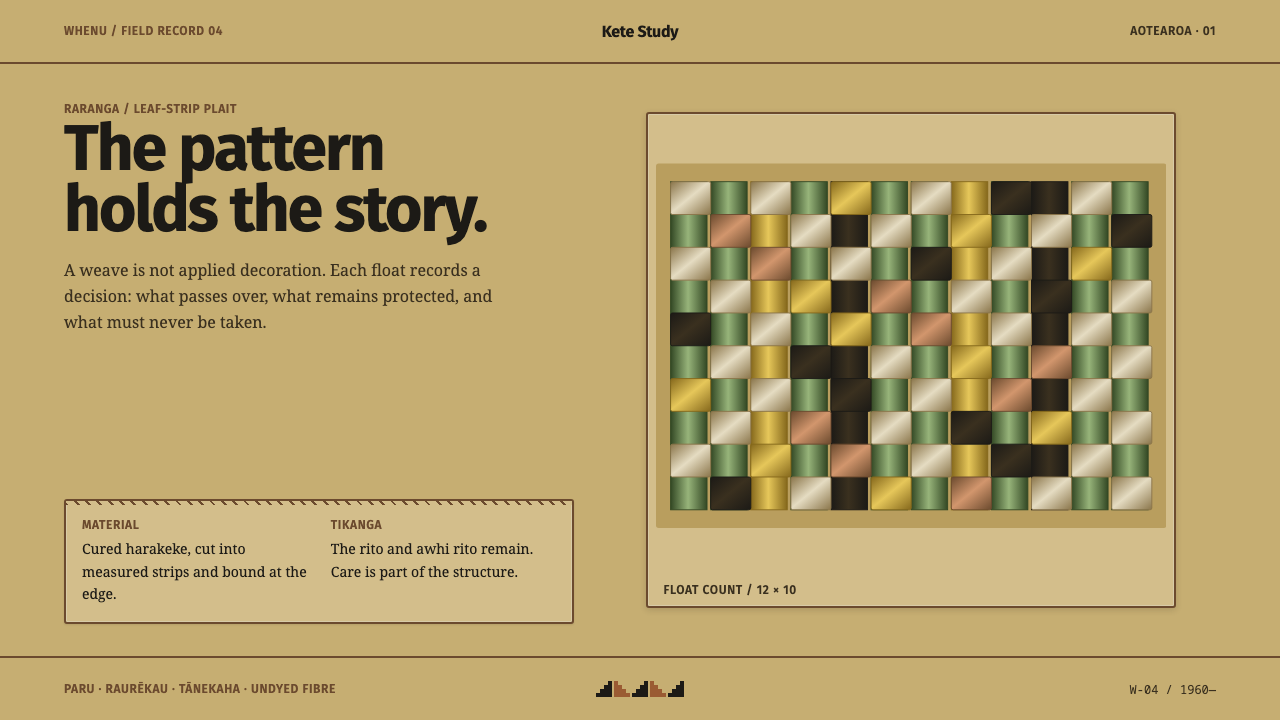 Harakeke Raranga WeavingStructure carries care. Honey-straw grids expose each green, bark and fibre s…
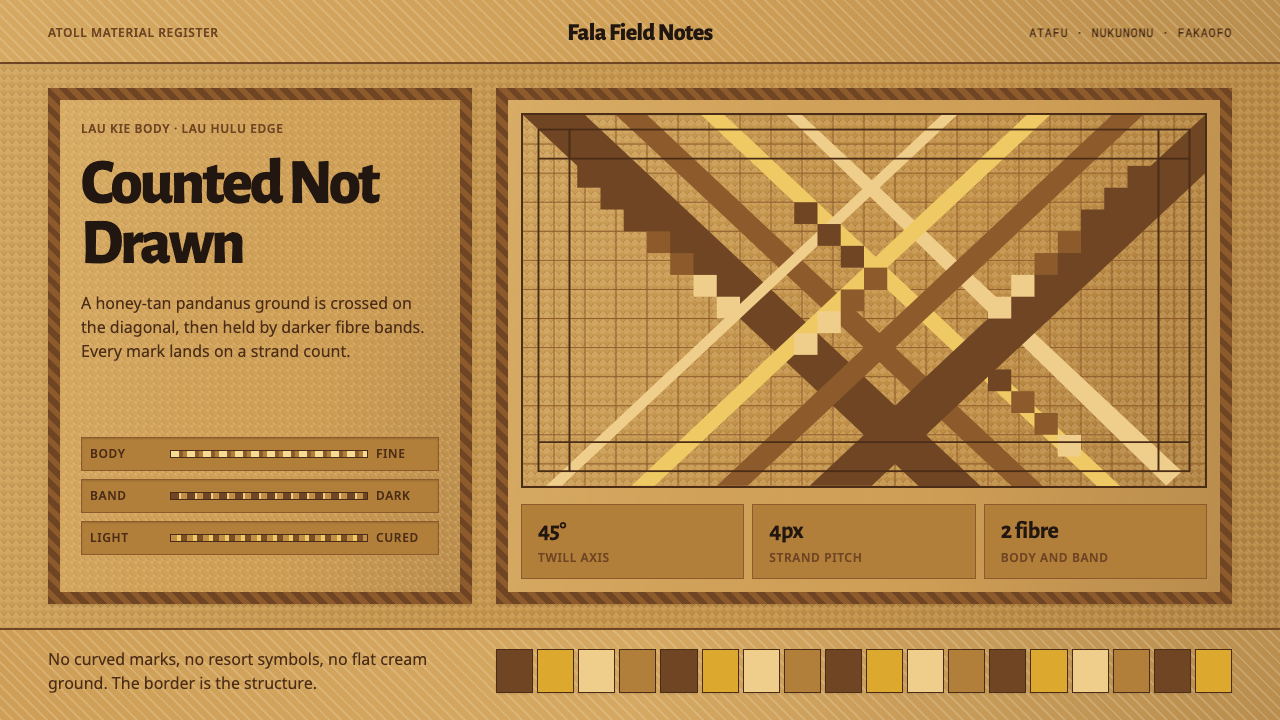 Tokelau Fala MatCounted, never drawn. Honey pandanus twill meets dark lau hulu border bands.
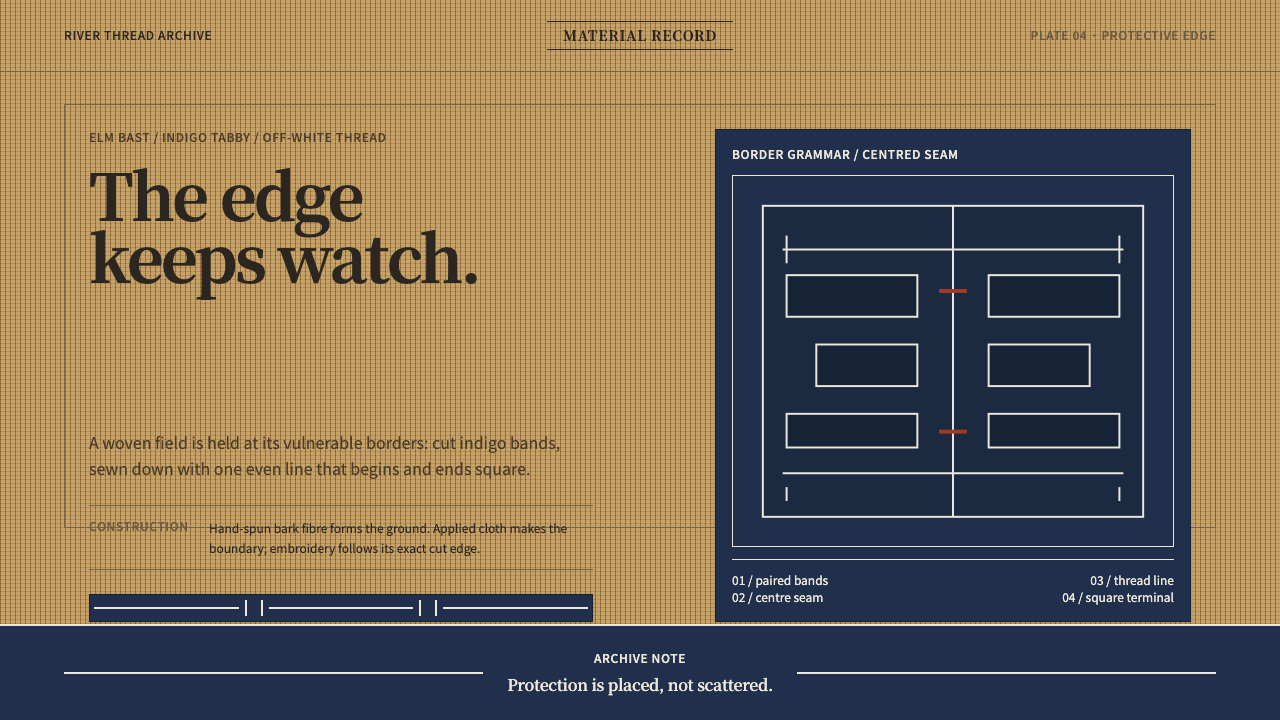 Ainu Attus RobeProtection is cut, not painted. Indigo bands and square-ended thread hold elm…
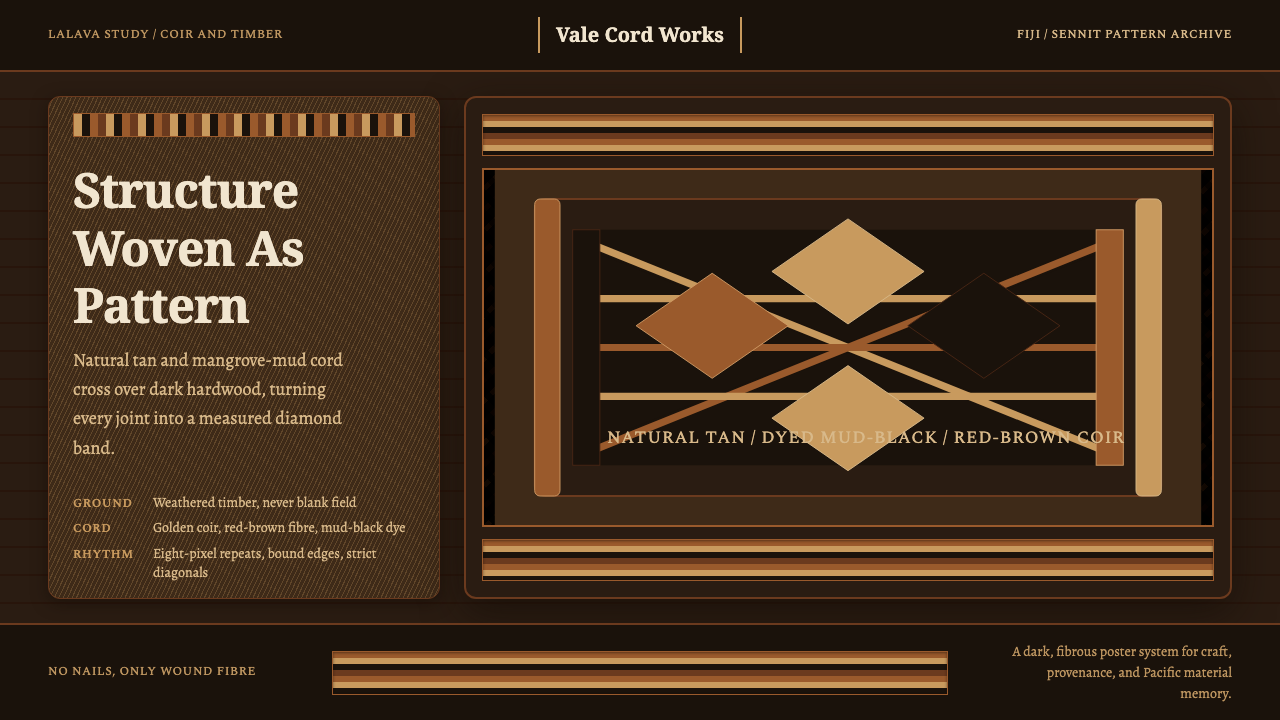 Fijian Magimagi LashingStructure becomes ornament. Tan coir diamonds bind mud-black timber in a stri…
 Kabyle PotteryBuilt band by band. Resin-warm kaolin carries manganese rules and iron-red ge…
 Kashgar Old TownEarth holds the field; ornament waits at one teal door, cut in a strict brass…