What is Paraguayan Ñandutí Spider-Web Lace?
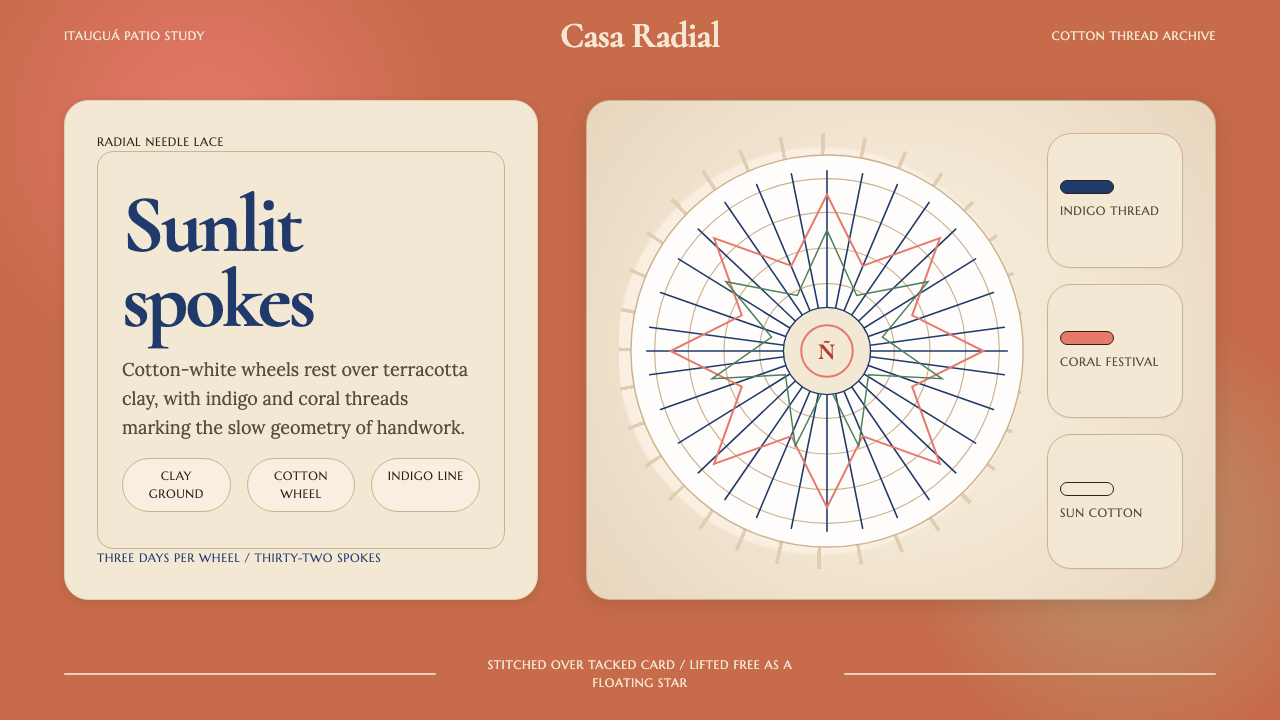
Ñandutí — Guaraní for spider web — is a radial needle-lace tradition from Paraguay's patio culture, transformed into a design language of sunlit terracotta grounds, cotton-white floating forms, and indigo spoke-lines that radiate outward like a wheel of thread lifted free from cardboard.
Paraguayan Ñandutí Spider-Web Lace in brief
Ñandutí spider-web lace is a needle-lace tradition unique to Itauguá, a town in Paraguay's departamento Central, where artisans — almost exclusively women — stitch cotton thread over tacked patterns on cardboard frames, working outward from a central point in 8, 16, or 32 radiating spokes. When the work is complete, the finished medallion is lifted free as a self-supporting wheel, bleached by midday sun to a warm ivory. The name, from Guaraní, simply means spider web, and the visual logic of the form bears out the metaphor: concentric rings of looped thread connecting radial spokes, the whole structure held by geometry rather than a ground fabric.
As a design system, Ñandutí spider-web lace channels the atmosphere of an Itauguá patio at noon: the deep warmth of terracotta clay underfoot, cotton-white lace surfaces catching the light, and thread accents in indigo and coral winding between the spokes. The palette is restrained but not muted — the terracotta ground reads as both earthy and luminous, the white forms seem to float rather than sit, and the accent threads carry just enough chromatic tension to keep the composition alive. Typography in this system pairs an elegant serif for headings with a warm, readable companion for body text, echoing the patience and fine-motor precision that each medallion demands.
The aesthetic register that Ñandutí lace establishes is one of crafted intimacy — not the cold precision of industrial design, but the measured repetition of a skilled hand returning to the same gesture dozens of times per wheel. Every visual choice within the system points toward this quality: soft warmth over clinical white, radial organization over rigid grids, decorative surface detail that is also structurally necessary. This is not ornament for its own sake but ornament as structure, exactly as a lace spoke is not decorative but load-bearing within the wheel.
Where does Paraguayan Ñandutí Spider-Web Lace come from?
The precise origins of Ñandutí in Paraguay are debated, but the most widely held account traces the technique to the arrival of Spanish missionaries and settlers in the seventeenth century. Spain's Torchon and bobbin-lace traditions, themselves descended from broader European needle-lace lineages, were carried to the New World as part of the domestic and ecclesiastical craft culture that colonial settlers brought with them. In Itauguá — a town some forty kilometers from Asunción — these European techniques encountered the Guaraní textile tradition, and over generations the two merged into a form that is neither purely European nor purely indigenous but distinctly Paraguayan.
The key transformation was the shift to radial structure. European bobbin lace typically follows a straight or diagonal repeat pattern across a pillow, producing lengths of fabric with border designs. Ñandutí abandoned this directional logic entirely and organized every medallion from a central point outward, in a composition that mirrors both the spider web of its Guaraní name and the rosettes of colonial ecclesiastical decoration. This radial grammar became the tradition's defining signature — so absolute that a Ñandutí piece without a clear center axis is almost unthinkable.
By the nineteenth and early twentieth centuries, Ñandutí had become Itauguá's primary craft industry and a significant source of income for the town's women. The technique was transmitted almost exclusively through female lineages, passed from mothers and grandmothers to daughters within the same household. The craft sustained families through the War of the Triple Alliance (1864–1870), one of the most devastating conflicts in South American history, which killed a substantial portion of Paraguay's male population and left women as the primary economic producers in many communities. In this context, Ñandutí was not simply a decorative art but an economic anchor.
The Festival del Ñandutí, held annually in Itauguá, was established to sustain the tradition's visibility and economic viability as industrial textiles made handcraft increasingly difficult to sell at fair prices. The festival draws buyers, journalists, and visitors from across Paraguay and internationally, and has helped establish Itauguá as a UNESCO-recognized center of intangible cultural heritage. Key figures in the tradition's documentation and promotion include Josefina Plá, the Spanish-born Paraguayan poet and cultural historian who wrote extensively on Paraguayan folk arts, and master lacemakers such as Ramona Ferreira, Felicita Vera, and Carolina Aguayo, whose work has been exhibited outside Paraguay and helped introduce the form to international audiences.
What defines the Paraguayan Ñandutí Spider-Web Lace look?
Radial Composition
Every visual element in the Ñandutí system is organized around a central point, with structure radiating outward in evenly spaced lines — mirroring the 8, 16, or 32 spokes of a lace medallion. This radial grammar replaces the conventional horizontal-vertical grid entirely; what might be a rectangular content block in another system becomes a wedge or a segment, and hierarchy is established by distance from center rather than by left-to-right reading order. The effect is simultaneously ancient — mandala-like, rosette-like — and immediately legible.
Color: Terracotta, Ivory, and Accent Threads
The palette draws from the physical materials and environment of lace-making in Itauguá. The ground tone is a warm terracotta — the color of fired clay floors and sun-baked plaster walls — providing a setting that is neither neutral nor dominant. Against this, the primary surface color is a bleached cotton-white, warm rather than cool, the tone of thread that has dried in outdoor light. Accent colors — deep indigo and a muted coral — appear only in secondary elements, acting as the colored threads a lacemaker might incorporate for a special piece or festival work. The overall palette reads as hand-made and place-specific, never clinical.
Surface Texture as Pattern
Where most design systems treat texture as optional atmosphere, this system treats it as a structural layer. The fine looped texture of stitched cotton — the characteristic fill of a Ñandutí medallion's intermediate rings — is abstracted into a surface pattern that gives areas between radial lines their visual weight. This texture does not simulate depth or shadow; it tiles flat, read as a field rather than a volume. The distinction is important: the goal is the quality of a lace surface lying in sunlight, not the illusion of three-dimensional weaving.
Concentric Ring Hierarchy
Just as a Ñandutí medallion builds outward in concentric rings of increasing complexity — the innermost rings tightest and most detailed, the outermost rings more open — the design system uses concentric zones to establish visual hierarchy. The central zone holds the primary content or call-to-action, the middle rings carry supporting information, and the outermost ring is reserved for metadata, credits, or secondary navigation. This mirrors the lacemaker's logic: the center commands the most attention precisely because it is the origin point of all structure.
Serif Typography with Craft Register
The typographic choices in this system reject the industrial sans-serif in favor of letterforms with warmth and deliberate elegance. An editorial serif with fine contrast between thick and thin strokes references the variation between the thicker cotton spokes and the finer infill threads of the lace. A secondary serif for body text is chosen for warmth and sustained readability over long passages rather than for technical precision. The combination reads as considered and careful — the typographic equivalent of three days' needlework — rather than fast or systematized.
Floating Form on Ground
A defining visual behavior of the Ñandutí medallion is that it is always seen as a distinct object against a surface, never embedded in it — when you set a lace wheel on a tablecloth or hold it to the light, it reads as figure against ground with high clarity. The design system replicates this quality: primary content elements are rendered as discrete, clearly bounded forms that seem to rest on or float above the terracotta ground, rather than blending into it. Edges are soft enough to avoid severity but crisp enough to maintain the figure-ground distinction.
Deliberate Repetition as Rhythm
Ñandutí lace achieves its visual richness not through variety but through the repeated application of a small set of stitches across many spokes and rings. The design system inherits this logic: visual rhythm comes from consistent repetition of a limited motif set — the spoke, the loop, the ring — rather than from novelty or surprise at each position. Layouts built in this system tend toward measured regularity rather than dynamic asymmetry, and the eye is invited to rest and travel across the pattern rather than to search for the next unexpected element.
Who shaped Paraguayan Ñandutí Spider-Web Lace?
Ramona Ferreira is one of the most celebrated living practitioners of Ñandutí lace-making in Itauguá, known for the extraordinary density and precision of her medallions and for her work passing the technique to younger generations. Her pieces have been exhibited internationally as examples of Paraguayan intangible cultural heritage, and she has been a consistent presence at the Festival del Ñandutí as both exhibitor and teacher. Her contribution to the tradition lies as much in transmission as in creation.
Felicita Vera is a master lacemaker whose work is particularly recognized for its use of color — incorporating the indigo and coral accent threads that distinguish festival-quality Ñandutí pieces from everyday work. Her medallions have been collected by Paraguayan cultural institutions, and her approach to color within the tradition has influenced how younger makers think about palette as an expressive rather than merely decorative choice. She represents a generation of lacemakers who treated the craft as both livelihood and artistic voice.
Carolina Aguayo has been instrumental in bringing Ñandutí lace to international audiences through exhibition work and cultural diplomacy, contributing to the tradition's recognition beyond Paraguay's borders. Her role has been as much ambassadorial as artisanal — demonstrating the technique at cultural events abroad and helping frame Ñandutí not merely as craft but as a sophisticated visual tradition worthy of serious design attention. Her efforts contributed to the broader documentation of the tradition that preceded its UNESCO recognition.
Josefina Plá (1903–1999) was a Spanish-born poet, playwright, ceramicist, and cultural historian who spent most of her life in Paraguay and became one of the country's most important chroniclers of folk and applied arts. Her writing on Paraguayan craft traditions, including Ñandutí, helped establish a critical and historical vocabulary for these practices at a time when they risked being dismissed as mere domestic craft. Plá understood the needle-lace tradition as a living document of Guaraní-Spanish cultural fusion and advocated for its preservation with the same rigor she brought to her literary work.
How do you use Paraguayan Ñandutí Spider-Web Lace today?
Ñandutí spider-web lace translates into digital design contexts best when the core logic — radial organization, warm ground color, floating white forms, deliberate repetition — is adopted as a structural commitment rather than a surface treatment. Using the terracotta palette and then laying out content in a conventional rectangular grid produces a decorative pastiche; building the layout itself around a radial or concentric logic produces something that genuinely channels the tradition. The style suits products that want to read as warm, crafted, and culturally specific rather than neutral and universal.
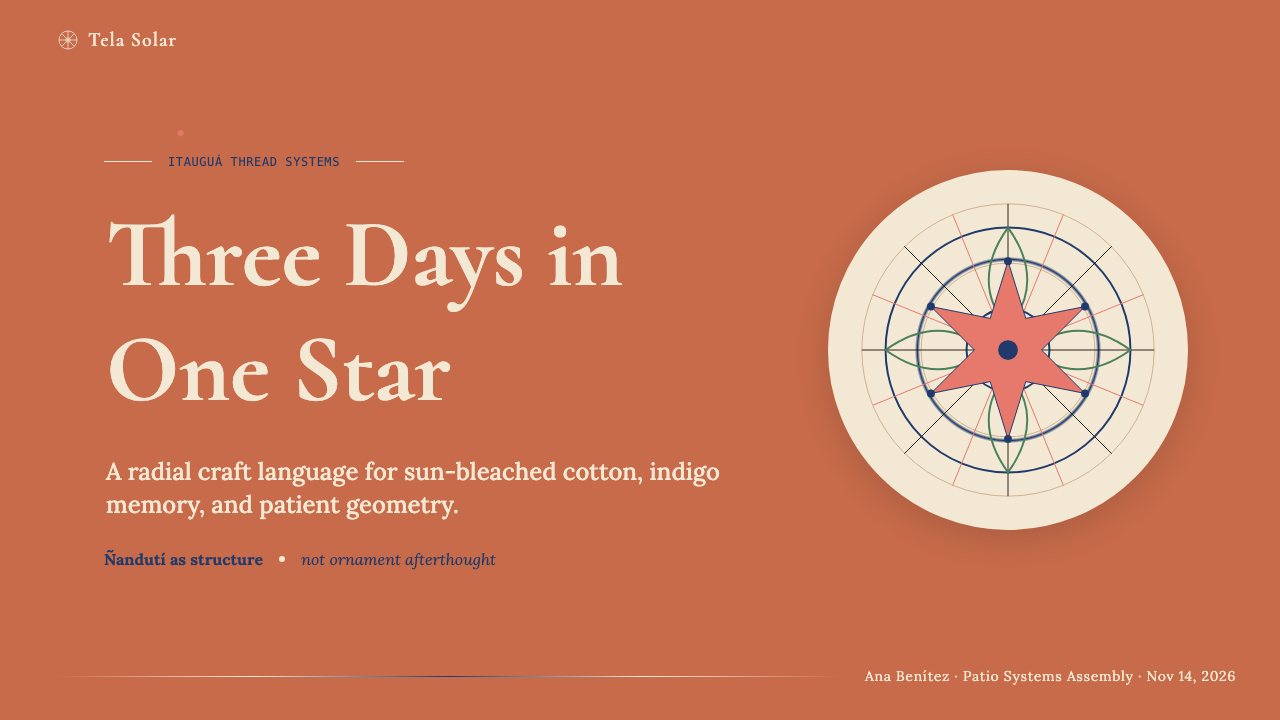
For presentation slides, the Ñandutí system works particularly well on title and section-break pages, where a full radial composition can anchor the viewer's attention at the center before reading outward. A title slide might use a large medallion-derived form as its focal element, with the presentation title placed at the center and subtitle or date text sitting in the middle ring. Content slides are better treated with more restraint: a warm terracotta background with white content cards and indigo or coral accent lines for emphasis achieves the palette's character without requiring a full radial layout on every page. Data slides should use the warm tones to humanize what might otherwise read as cold numerical content — bar charts in terracotta and ivory with indigo highlights read as considered rather than automated.
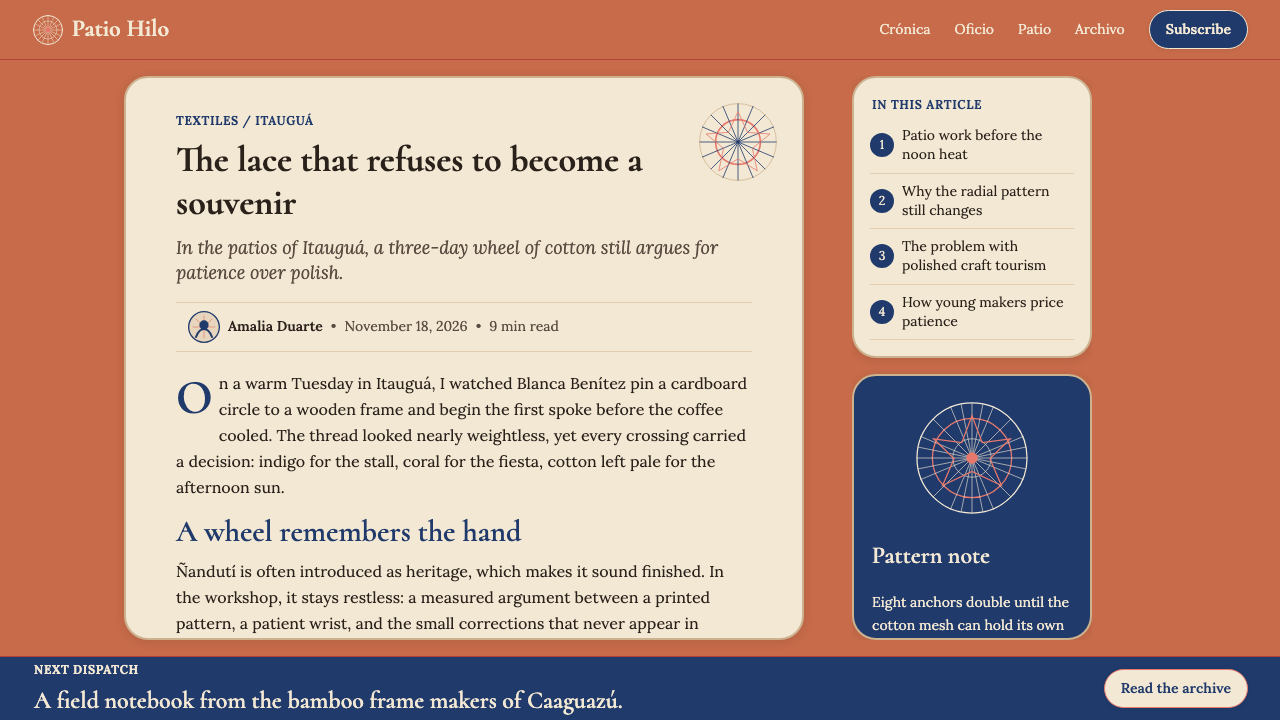
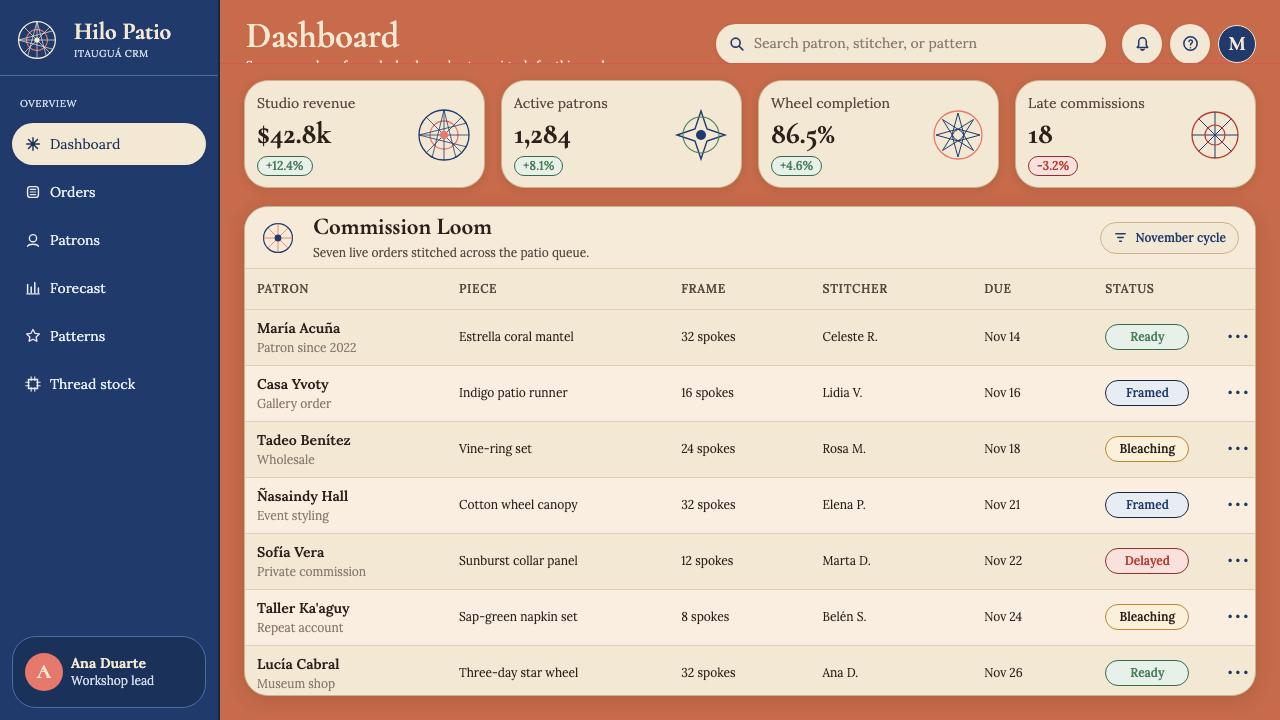
For web interfaces, the style is well suited to editorial landing pages, cultural institution sites, artisan marketplace pages, and any product that benefits from communicating handmade provenance or local origin. Dashboard and data-heavy interfaces are a more difficult fit — the radial and concentric logic can work for circular chart types, but rectangular data tables and left-to-right reading flows resist the system's native grammar. Where the style is applied to web, the key moves are: a warm near-terracotta background rather than neutral white or gray, generous whitespace (representing the open areas between lace spokes), and typographic choices that use elegant serifs with visible stroke contrast rather than geometric sans-serifs.
For editorial and marketing contexts, Ñandutí lace provides strong visual differentiation from the dominant tech-influenced minimalism that characterizes much contemporary work. A feature article opener using a full-page radial composition in terracotta and ivory will stand out in a content feed dominated by flat white layouts and sans-serif type. The style lends itself to campaigns that want to assert craft, heritage, cultural depth, or geographic specificity — tourism, artisan products, heritage brands, cultural events. In these contexts, the accent colors — indigo and coral — should be used with genuine restraint, as a lacemaker would use colored thread: occasionally, purposefully, for emphasis rather than decoration.
A common mistake when working with this aesthetic is treating the radial motif as decoration rather than structure — placing a medallion-inspired graphic element in a corner or header while the rest of the layout follows a standard rectangular grid. This produces a result that reads as themed rather than coherent. A related mistake is pushing the terracotta and ivory palette toward either extreme: too dark and the warmth becomes oppressive; too pale and the composition loses the grounded quality that distinguishes the style from generic cream-and-white minimalism. The palette works best in the middle register, where the ground color is unmistakably warm but still light enough for body text to read clearly against it.
Paraguayan Ñandutí Spider-Web Lace — FAQ
How does this style differ from other lace-inspired or folk-craft design systems?
Most folk-craft-inspired design systems use surface pattern — repeated motifs, border ornament, decorative fills — as their primary reference point, layering these elements onto conventional rectangular or grid-based layouts. Ñandutí works differently because the lace tradition itself has a governing spatial logic — radial organization from a center point — that can replace the underlying structure of a layout rather than merely decorating it. This makes it more compositionally distinctive and harder to pastiche superficially. The warm terracotta-and-ivory palette also distinguishes it from the cool whites and brights often associated with Nordic or East Asian folk-craft aesthetics.
Can the radial structure work in digital interfaces where users scroll vertically?
Radial composition is inherently suited to contained, framed contexts — a single screen, a slide, a print page — rather than to long scrolling documents. In scrolling interfaces, the full radial logic typically works only above the fold, as a hero or opening section that establishes the visual register before the layout transitions to a more conventional vertical structure for body content. Alternatively, radial motifs can appear at section transitions — as full-width dividers or background elements — reintroducing the visual language at intervals without requiring the entire page to be structured radially. Using the color palette and typographic character throughout, with radial elements as punctuation rather than continuous structure, is the most practical approach for long-form digital content.
Is this style appropriate for digital products targeting non-Paraguayan audiences?
The visual language of Ñandutí translates across cultural contexts because its core qualities — warmth, craft legibility, radial geometry, and restrained accent color — are not culturally exclusive even though their origins are specific. Most audiences will not know the lace tradition by name but will register the warmth, patience, and care that the aesthetic communicates. The risk of cultural appropriation is present, as with any tradition-inspired design work, and is best mitigated by accurate attribution, genuine engagement with the source tradition rather than decorative borrowing, and avoiding reduction of the style to a single exotic motif. A product that uses the system thoughtfully and situates its origins honestly is on solid ground; one that strips the tradition to a generic 'ethnic pattern' without acknowledgment is not.
What types of products should avoid this style?
Products that depend on the communication of speed, precision, or scalable rationality will find the Ñandutí aesthetic counterproductive. Fintech applications, real-time analytics dashboards, enterprise software, and products in categories where clinical cleanliness signals reliability should look elsewhere. The warmth and craft legibility that define the style work against the qualities these contexts need to project. Similarly, products that require very dense typographic content — legal documents, technical references, data-heavy reports — will find the radial and concentric composition logic difficult to reconcile with long-form reading flows. The style is genuinely excellent within its domain; knowing that domain is the most important design judgment.
How should the accent colors be rationed across a composition?
The indigo and coral accent colors should be thought of as the colored threads a lacemaker would choose for a special commission — present enough to be noticed, restrained enough that their appearance feels deliberate. A practical guide: the terracotta ground and ivory white together should account for the vast majority of surface area in any given composition. Indigo and coral, used together, should appear on no more than a small fraction of the total surface, and should generally not appear simultaneously at high saturation — one leads and the other is subordinate, just as a lacemaker working with two accent threads will typically use one as the dominant thread for a given ring and the other only for connectors or highlights. When in doubt, use less: the tradition values patience over abundance.
Related design styles
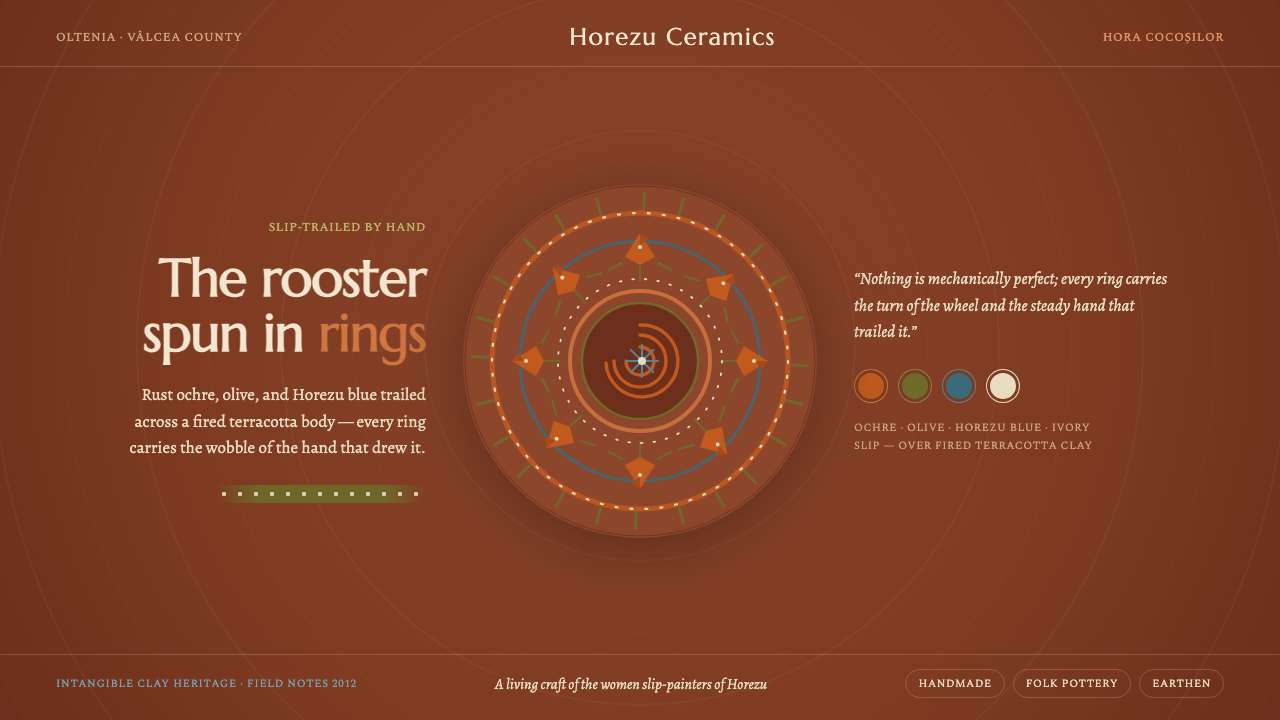 Horezu CeramicsWarm earth, steady hand. The Horezu rooster spun in ochre and olive slip acro…
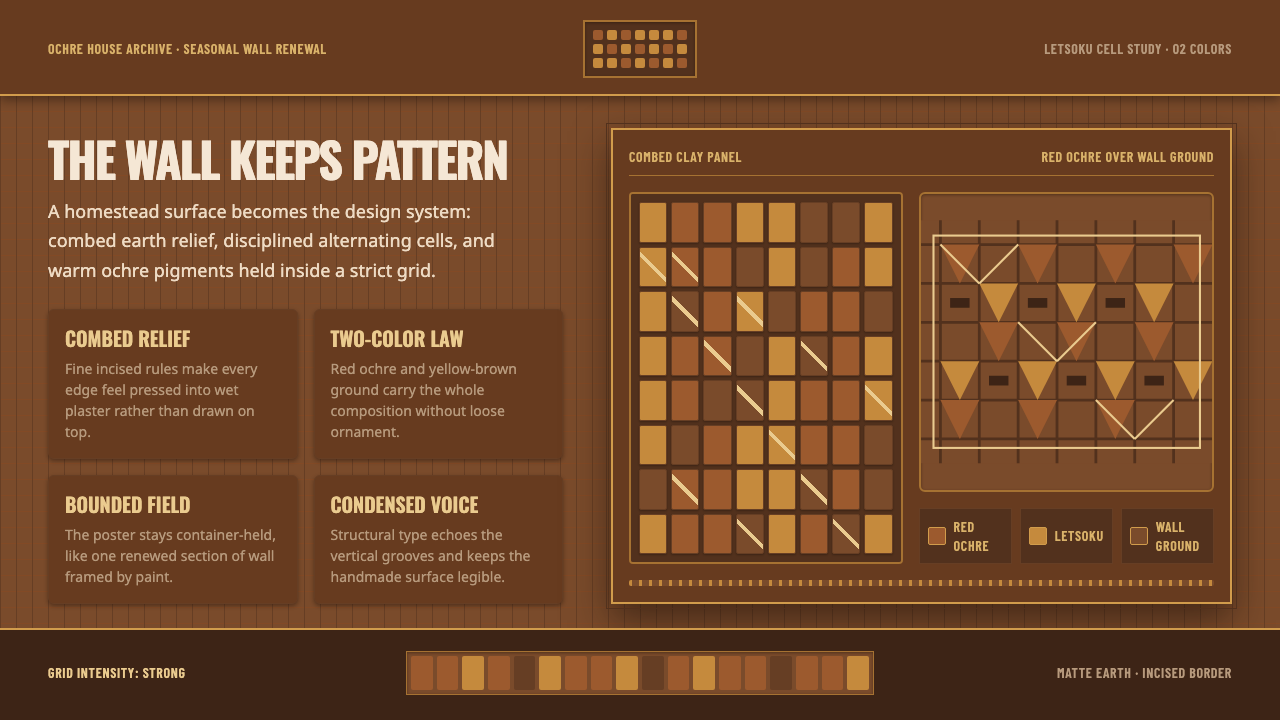 Sotho Litema Wall MuralEarth remembers the hand. Ochre cells and combed borders turn wall into patte…
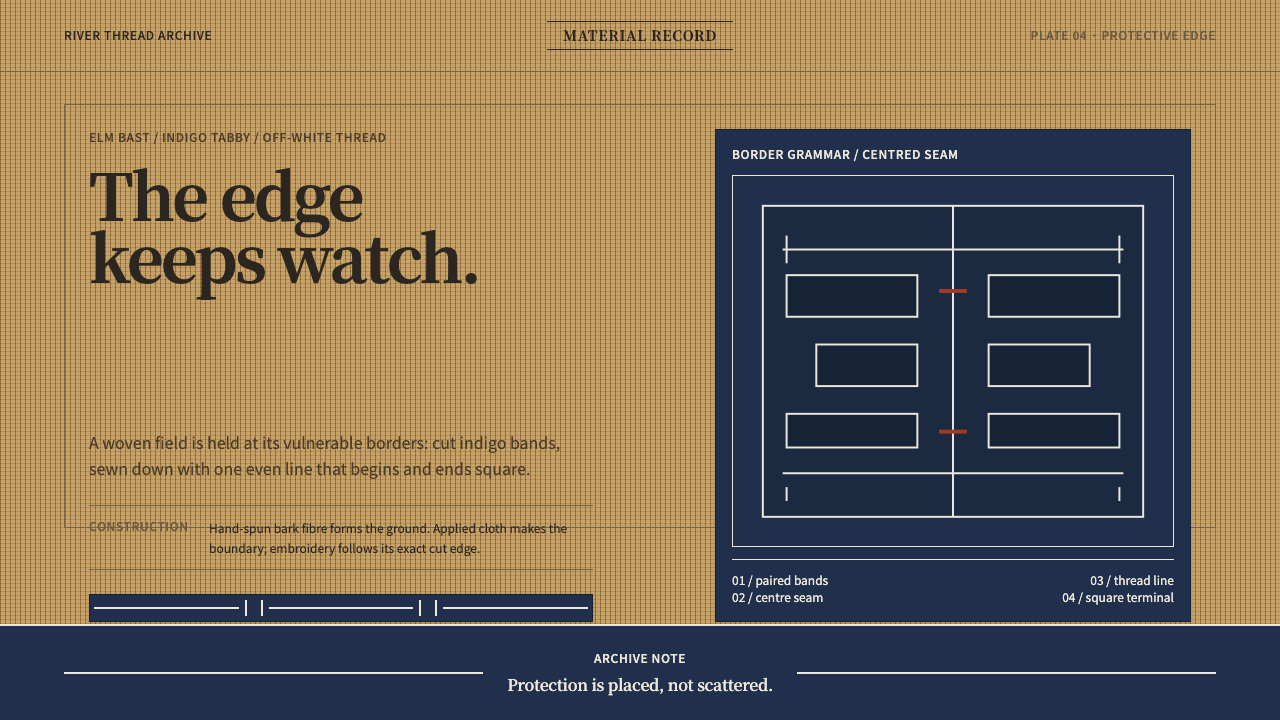 Ainu Attus RobeProtection is cut, not painted. Indigo bands and square-ended thread hold elm…
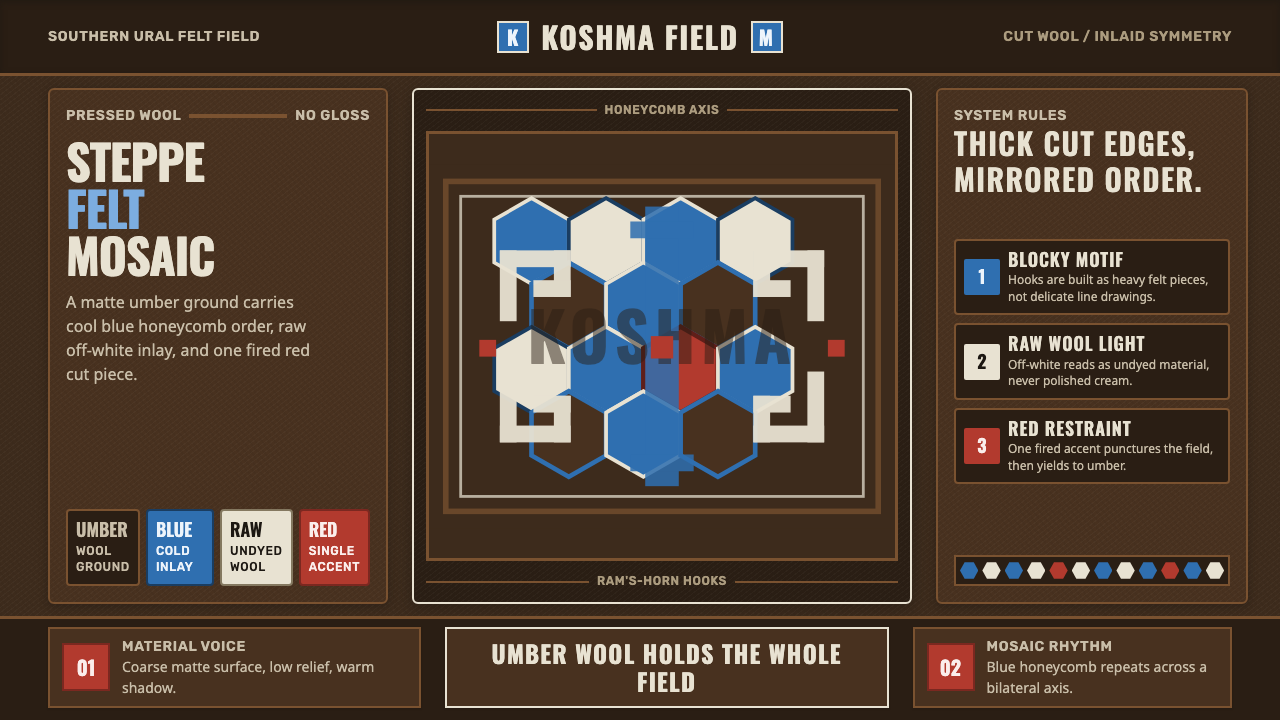 Bashkir Honeycomb Felt OrnamentSteppe craft feels weighty. Umber felt holds blue honeycomb and raw-wool hook…
 Djenné Mud MosqueBuilt from renewal. Banco brown, ochre caps, and toron grids feel hand-plaste…
 Fijian Magimagi LashingStructure becomes ornament. Tan coir diamonds bind mud-black timber in a stri…