What is Paraguayan Itauguá Ñandutí Spider Lace?
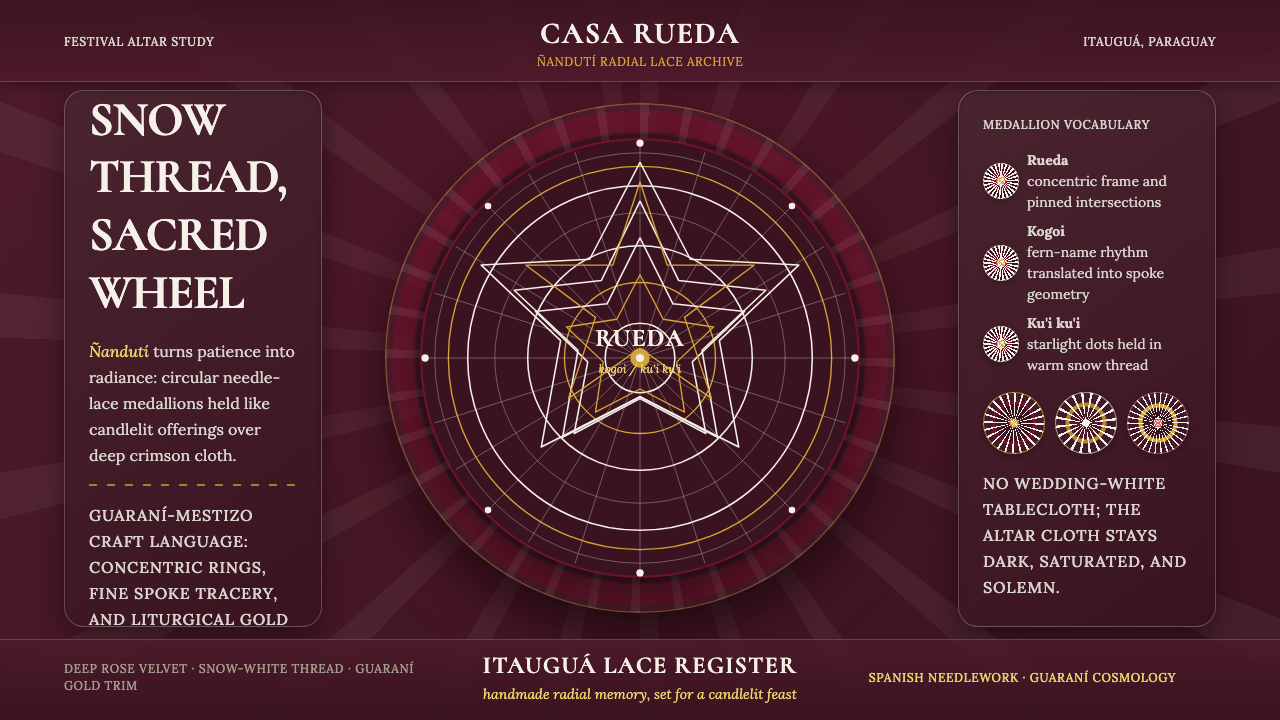
Ñandutí — the Guaraní word for spider web — is Paraguay's most celebrated needle-lace tradition, a radial sun of threads born from the meeting of Canarian craft and Indigenous cosmology on the banks of a colonial town.
Paraguayan Itauguá Ñandutí Spider Lace in brief
Ñandutí is a form of needle lace built entirely around the circle. Each piece begins at a central anchor point and grows outward in layered radiating threads, producing a medallion whose structural logic mirrors the spider's web that gives the craft its name. Unlike European bobbin lace, which builds pattern through crossings on a flat pillow, Ñandutí is constructed thread by thread in concentric rings, stitched onto a cushion with pins marking the radial axes. The result is a textile object that is simultaneously geometric and organic — precise in its scaffolding, breathing in its negative space.
The visual system that Ñandutí generates is unmistakable: deep, saturated grounds — rose velvet, midnight blue, forest green — against which snow-white medallions are suspended like lunar discs. Gold accent threads trace the outer borders of each piece and mark ceremonial finishings, recalling the gilt edges of ecclesiastical vestments. The overall effect is one of luminous contrast: a dark field that makes the white lace appear to generate its own light, with gold anchoring the whole composition in a register of the sacred and the festive.
The design language, when translated into visual systems beyond textile, carries four interlocking qualities: radial symmetry as the primary compositional logic; a palette of deep jewel grounds punctuated by white and gold; dense intricate patterning that rewards close inspection while reading clearly at distance; and a tonal weight that conveys ceremony without severity. It is not a minimalist system — it is a maximalist one governed by discipline. Every thread has a purpose; every void is intentional.
See the Paraguayan Itauguá Ñandutí Spider Lace design system
Where does Paraguayan Itauguá Ñandutí Spider Lace come from?
The origins of Ñandutí lie in a cultural collision that took place in the colonial frontier town of Itauguá, roughly forty kilometers from Asunción, during the seventeenth century. Spanish colonizers brought with them the needle-lace tradition of the Canary Islands — specifically the Tenerife lace technique, in which threads are worked outward from a central point on a circular frame. When this technique reached Paraguay, it entered a world already saturated with Guaraní visual culture: a cosmology organized around solar symbolism, patterns derived from local flora and fauna, and an oral naming tradition that identified each motif by its natural referent.
The synthesis that emerged was not a simple transfer of European technique. Guaraní artisans, most of them women, adapted the Canarian radial structure while replacing its European motif vocabulary with imagery drawn from the natural world of central Paraguay: butterflies, jasmine flowers, the mburucuyá passion flower, spiders, and river-birds. Each medallion was given a name — and the name was not decorative but taxonomic, identifying the specific natural pattern from which the lace structure derived. This naming practice embedded the craft within a living relationship between the maker and her environment, rather than within a purely technical tradition.
By the eighteenth and nineteenth centuries, Itauguá had become the recognized center of Ñandutí production, with lacemaking organized around family workshops in which techniques and pattern vocabularies were transmitted from mothers to daughters across generations. The craft became closely associated with the Festival del Ñandutí, an annual celebration in Itauguá that brought together lacemakers, musicians, and the broader Paraguayan community in a public display of the tradition's vitality. Festival altars displayed the most accomplished works of the town's master lacemakers — draped over velvet grounds, pinned against dark backdrops, illuminated by candles — in an aesthetic that later became the defining reference for the design system as a whole.
The twentieth century brought both crisis and revival. The wars and economic disruptions of the early and mid-century disrupted the generational continuity of many craft families, and the market for handmade lace contracted significantly with industrialization. The period following the fall of General Stroessner's dictatorship in 1989 and the democratic opening that followed sparked a cultural revival in which Paraguayan handicraft traditions were re-evaluated as carriers of national identity. Ñandutí was among the crafts that benefited most from this reassessment, receiving renewed institutional support and achieving recognition as a distinct Paraguayan cultural heritage. Contemporary lacemakers in Itauguá continue to practice the tradition both as living craft and as the basis for a visual language increasingly recognized internationally.
What defines the Paraguayan Itauguá Ñandutí Spider Lace look?
Radial Composition
Every Ñandutí medallion is organized around a central point from which all structural threads radiate outward, creating a composition that is simultaneously centripetal and expansive. In design application, this radial logic translates into layouts built around focal centers rather than horizontal or vertical axes: a central motif, emblem, or data point from which supporting elements extend like spokes. The eye is always drawn inward before being released outward, creating a reading experience that is contemplative rather than directional.
Deep Jewel Ground
The canonical ground of Ñandutí display is deep, saturated, and velvet in quality — rose, crimson, deep blue, or black — against which the white lace achieves maximum luminosity. This is not mere contrast for contrast's sake: the dark ground is the absorptive field that makes the intricate lacework legible at the fine-thread level. In design terms, the dark saturated ground is a commitment: it says that the foreground content is precious, worth close attention, and set apart from the noise of the everyday.
White Lace Luminosity
The white used in Ñandutí tradition is not off-white, cream, or ivory — it is pure, starched, textile white, the white of snow and of freshly bleached cotton. Against the deep grounds, this white appears to be self-illuminating, a quality that the festival altar aesthetic exploited fully by placing candles behind or below the displayed lace. In design application, elements occupying this role must carry the same tonal purity: no warmth, no grain, no softening. The white is categorical, not atmospheric.
Gold Accent and Ritual Framing
Gold in Ñandutí work functions as a ritual frame: it marks edges, completions, and the boundary between the sacred object and the profane surround. In the festival context, gold thread borders signal that the lace piece is finished, intentional, and consecrated. In design application, gold accent occupies the role of the finest structural divider — the element that says 'here the meaningful content begins and ends.' It should be used sparingly, at transitions and borders, never flooding a field.
Intricate Negative Space
What defines Ñandutí as lace — rather than embroidery or weaving — is that the voids are as constructed as the threads. The spaces between the radial lines and the concentric rings are not absences but deliberate openings, each shaped by the needle's path. The resulting negative space has a structured character: it reads as pattern, not as emptiness. In design terms, this means that white space in a Ñandutí-inspired system carries visible geometry — it is organized, not merely present. Gaps have shape and regularity.
Ceremonial Weight
The overall tonal register of Ñandutí is ceremonial: neither everyday nor austere, but elevated and intentionally slow. This is a tradition made for festival display, not for daily wear or utility. The aesthetic consequence is that everything is given full attention — no element is casual, no surface is unfinished, no transition is accidental. In design application, this translates into a system in which each component is treated as if it is worth lingering over: generous spacing, rich texture, compositions that reward study rather than demanding instant legibility.
Named Pattern Vocabulary
One of the most culturally distinctive features of Ñandutí is that each medallion pattern carries a name — a name derived from the natural world, referencing a specific flower, bird, or insect. This naming tradition means that the visual system is not abstract but taxonomic: it maintains a living relationship between form and referent. In design application, this principle suggests a system in which visual components are named for what they do or what they resemble, not for their position or hierarchy. Semantic naming, in other words, over structural naming.

See the Paraguayan Itauguá Ñandutí Spider Lace design system
Who shaped Paraguayan Itauguá Ñandutí Spider Lace?
Among the most celebrated master lacemakers of Itauguá, Doña Lidia Aquino represents the living continuity of the tradition's highest technical standard. Her work has been documented by Paraguayan cultural institutions as exemplifying the range of medallion complexity possible within the Ñandutí vocabulary — from simple radial patterns accessible to beginners to intricate multi-layered medallions requiring hundreds of individual needle passages. She is frequently cited as a central figure in the post-1989 revival that restored institutional recognition to the craft.
A Slovenian-born ethnologist who devoted her scholarly career to Guaraní culture and became one of the most rigorous documentarians of Paraguayan material culture and oral tradition. Susnik's anthropological work provided the academic framework through which Ñandutí came to be understood not merely as a decorative craft but as a carrier of Guaraní-Mestizo cultural synthesis — a practice in which European technical form and Indigenous symbolic vocabulary merged into something irreducibly Paraguayan. Her research established the naming tradition and its links to Guaraní natural philosophy as central to the craft's identity.
A contemporary Ñandutí practitioner and teacher who has worked to extend the tradition's pedagogical reach both within Paraguay and internationally. Fleitas represents the generation of lacemakers who have engaged with the craft's dual existence as living tradition and as cultural heritage to be documented, archived, and transmitted in formal educational settings. Her teaching practice bridges the informal apprenticeship model of family workshops and the institutional frameworks of national craft schools, adapting the transmission of technique without severing its connection to the naming and natural observation practices that define the tradition.
A major figure in twentieth-century Paraguayan visual art whose critical and curatorial work helped establish the intellectual basis for viewing Paraguayan craft traditions — including Ñandutí — as legitimate subjects of artistic and scholarly attention rather than as mere folk curiosity. Blinder's advocacy for the elevation of craft within Paraguayan cultural discourse contributed to the institutional conditions in which the post-1989 revival became possible, by establishing that the visual languages of craft traditions carry aesthetic and philosophical depth comparable to fine art.
How do you use Paraguayan Itauguá Ñandutí Spider Lace today?
Ñandutí as a design system is suited to contexts where ceremony, cultural depth, and visual richness are the desired signals — and where the audience is expected to linger rather than scan. It is not a speed-reading system. It rewards attention. Used correctly, it communicates that what it frames is precious, considered, and culturally grounded.
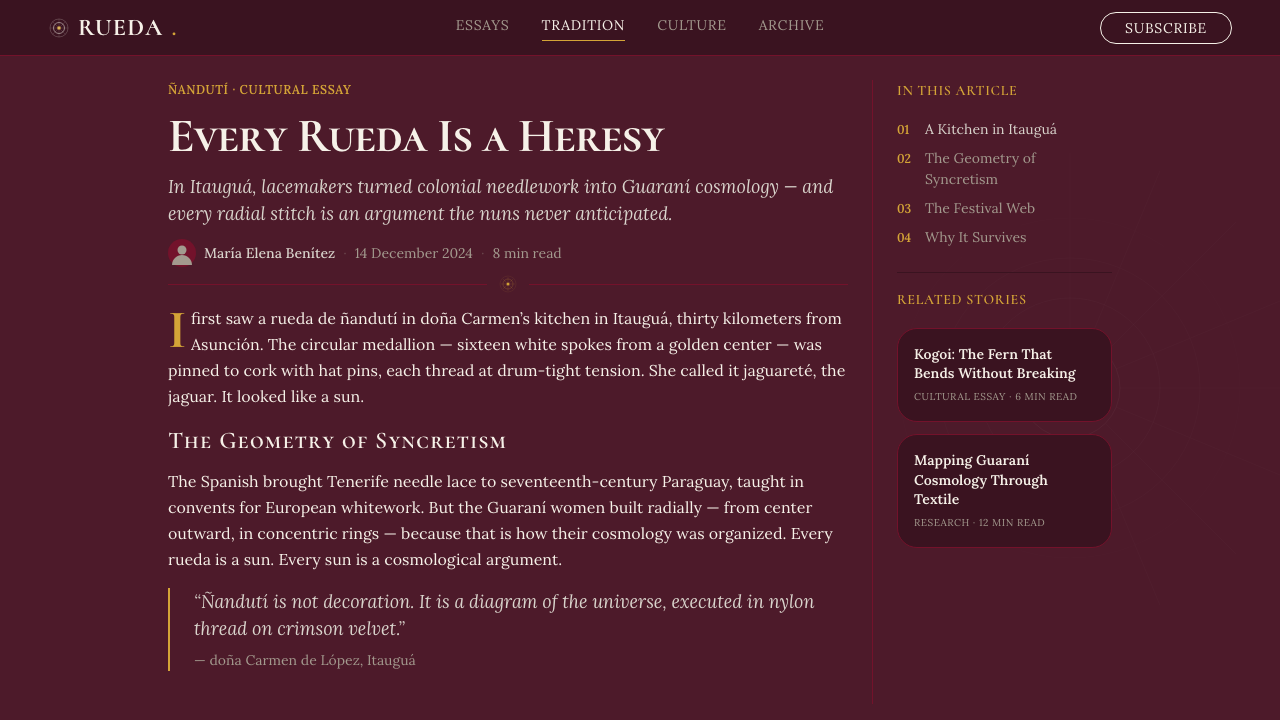
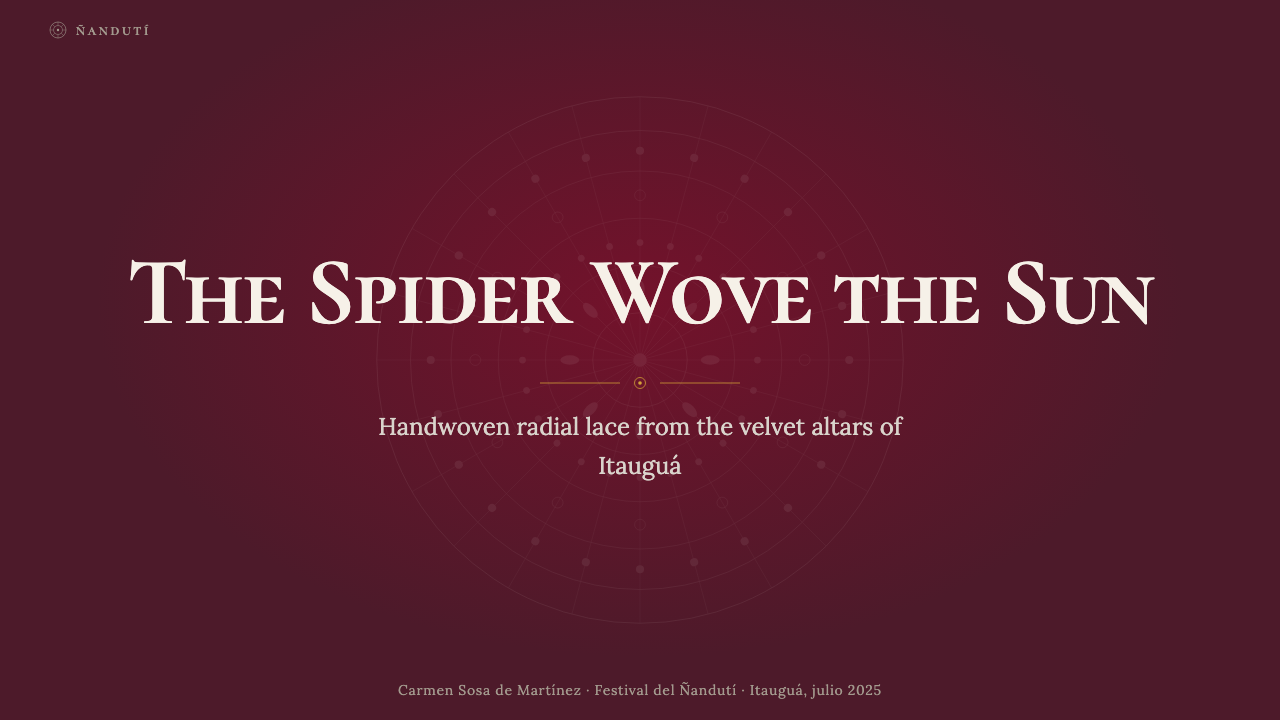
For presentation slides, Ñandutí works most powerfully on cover and section-break pages. A cover built on a deep rose or midnight-blue ground, with a large central medallion motif rendered in white, and a title set in gold or pure white, immediately signals a different register from standard corporate decks — ceremonial, curated, unhurried. Content slides should simplify significantly: use the deep ground and white typographic elements, but restrain the medallion patterning to subtle borders or watermark-level backgrounds. Data visualizations can adopt a radial form where the data structure permits — pie charts and radial progress indicators align naturally with the tradition's circular logic, rendered in the canonical palette.
For web interfaces, the style is best deployed in product pages, landing pages, and hero sections for brands in cultural, artisanal, luxury, or heritage contexts. A full-width dark ground with a centered radial motif and gold type creates a hero section that commands attention without relying on photography. Pricing pages can use the deep ground for the highlighted tier, signaling premium positioning through the visual vocabulary of ceremony rather than through comparative feature lists. Navigation and body text should be treated with more restraint — the deep ground works as an accent environment, not as a sustained reading environment.
For editorial and marketing contexts, the system supports long-form cultural storytelling, heritage brand campaigns, and event materials. A magazine layout using deep crimson grounds for pull-quote pages, white radial ornaments as section dividers, and gold trim on drop caps creates a visual environment that signals editorial investment and cultural seriousness. Event materials — programs, invitations, signage — benefit from the tradition's intrinsic association with festivity and ceremony: the aesthetic already carries the weight of celebration without requiring additional decoration.
A common mistake when applying this style is confusing richness with busyness. Ñandutí is intricate but never chaotic — every thread in the original lace is placed by a deliberate needle pass, and the geometry of the radial structure imposes order on the complexity. In design, this means that the medallion motifs and the density of pattern should appear in one zone at a time, not spread uniformly across every surface. A deep ground with a single centered motif is more powerful than a surface covered in repeating pattern. The gold accent loses its ritual authority if overused — it should mark edges, not fill fields.
See the Paraguayan Itauguá Ñandutí Spider Lace design system
Paraguayan Itauguá Ñandutí Spider Lace — FAQ
Is Ñandutí purely a Paraguayan tradition, or does it have international parallels?
Ñandutí has a direct technical ancestor in the Tenerife lace of the Canary Islands, which uses the same radial-from-center structural logic. However, the synthesis that occurred in Paraguay — replacing European pattern vocabulary with Indigenous Guaraní natural naming and imagery — produced a tradition that is culturally distinct despite its shared technical origins. Similar radial medallion lace traditions exist in other colonial contexts where European lace techniques met local craft cultures, but Ñandutí's combination of named patterns, festival display context, and specific color vocabulary (deep grounds plus white plus gold) gives it a visual identity that is not interchangeable with any of its relatives.
Can this style work in a light-ground version, or is the dark velvet ground essential?
A light-ground version is possible but requires care. The deep ground is not arbitrary — it is the absorptive field that makes the white medallion appear luminous. On a light ground, the same white motif becomes nearly invisible, and the entire dynamic of luminous contrast collapses. A light-ground adaptation needs to replace the white with a mid-tone — perhaps a warm gold or a muted rose — against the near-white field, keeping the gold accent but deepening it toward burnished ochre. The radial composition and the ceremonial weight can survive the inversion, but the specific relationship between dark ground and white lace, which is the core of the tradition's visual poetry, will not transfer directly.
How does Ñandutí relate to other Latin American textile-derived design traditions?
Latin American textile traditions are extraordinarily diverse, and Ñandutí occupies a specific position within that diversity. Its closest aesthetic relatives are other traditions built on radial and circular organization: the mandalic geometry of Andean weaving, the medallion patterns of Mexican rebozo, and the sunburst iconography common across pre-Columbian and post-colonial ceremonial objects in the region. What distinguishes Ñandutí within this family is the specificity of its color vocabulary — deep saturated ground plus pure white plus gold — and its origin as a needle-lace tradition rather than a woven one. Woven traditions typically use interlocking color blocks; needle lace uses thread over void. This structural difference gives Ñandutí a lightness and transparency that woven medallion traditions do not share, even when the pattern vocabulary is similar.
What is the Festival del Ñandutí and why does it matter for understanding the visual style?
The Festival del Ñandutí is an annual celebration held in Itauguá that brings together lacemakers, musicians, and the Paraguayan public in a communal display of the tradition. Its visual centrepiece is the festival altar: an arrangement in which the finest works of the town's master lacemakers are displayed against dark velvet grounds, illuminated by candles, and framed by gold trim. This altar aesthetic — dark ground, white medallion, gold border, candlelight — is precisely the visual vocabulary that the design system channels. Understanding the festival context explains why the style is inseparable from ceremony: it was not designed for everyday display but for ritual elevation, for the moment when a community publicly affirms that certain forms of making are worth collective reverence.
Does the named-pattern tradition have any parallel in digital design systems?
The Ñandutí practice of naming each medallion pattern after a natural referent — a flower, bird, or insect — is structurally analogous to the semantic naming conventions that modern design systems advocate for components and tokens. Just as the lacemaker names a pattern 'jasmine' because the thread arrangement evokes that flower, good design system practice names a component 'alert' rather than 'red-box' because the name describes what the element does, not what it looks like. The deeper parallel is the insistence that names carry meaning: in Ñandutí, a pattern name is not administrative but relational, linking the artifact to the natural world that inspired it. In design systems, semantic names link components to their communicative function rather than to their visual properties, making the system more resilient to visual change.
Related design styles
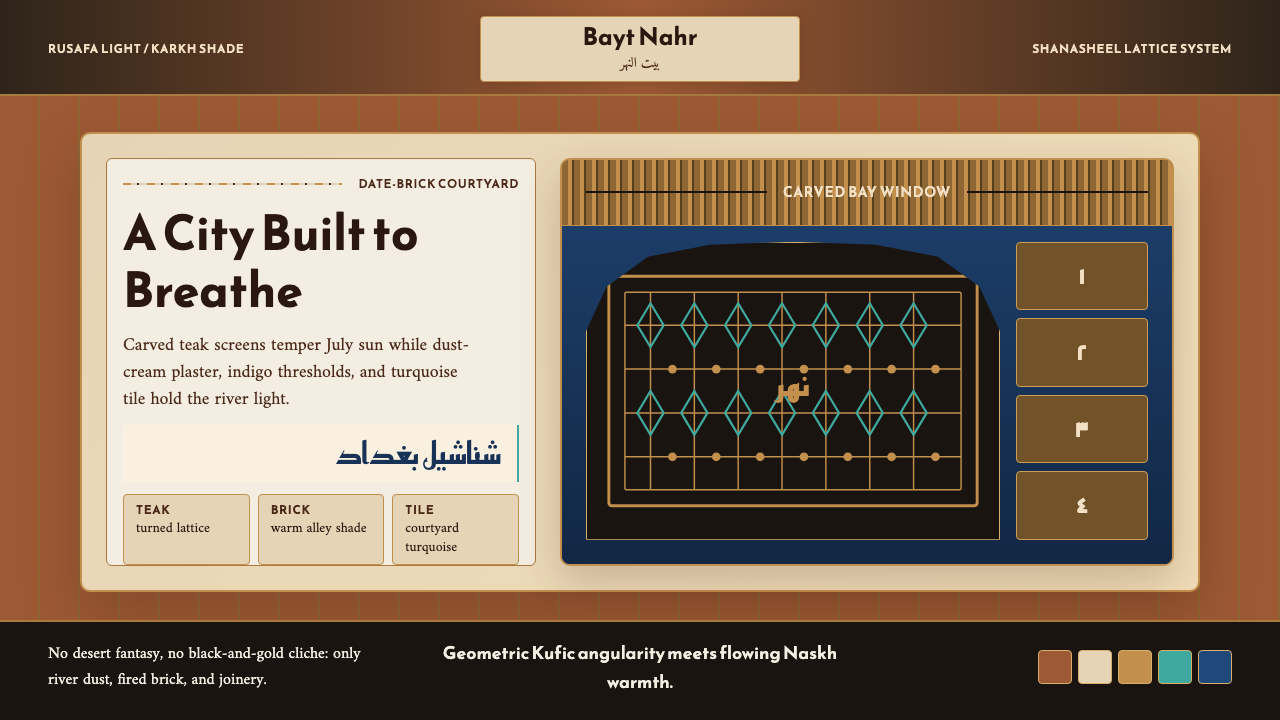 Iraqi Baghdad Shanasheel HouseBreathes through ornament. Date-brick ground, teak lattice, and turquoise til…
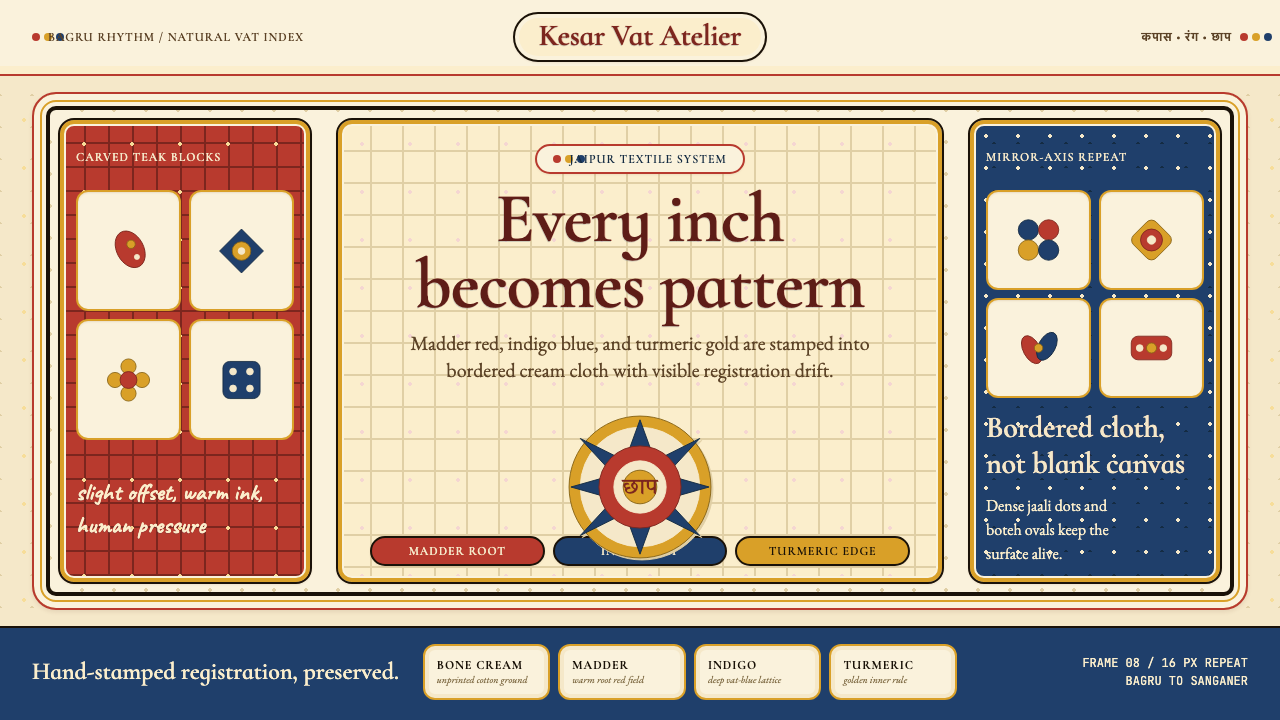 Indian Block PrintPattern claims every inch. Madder, indigo and turmeric stamp dense bordered c…
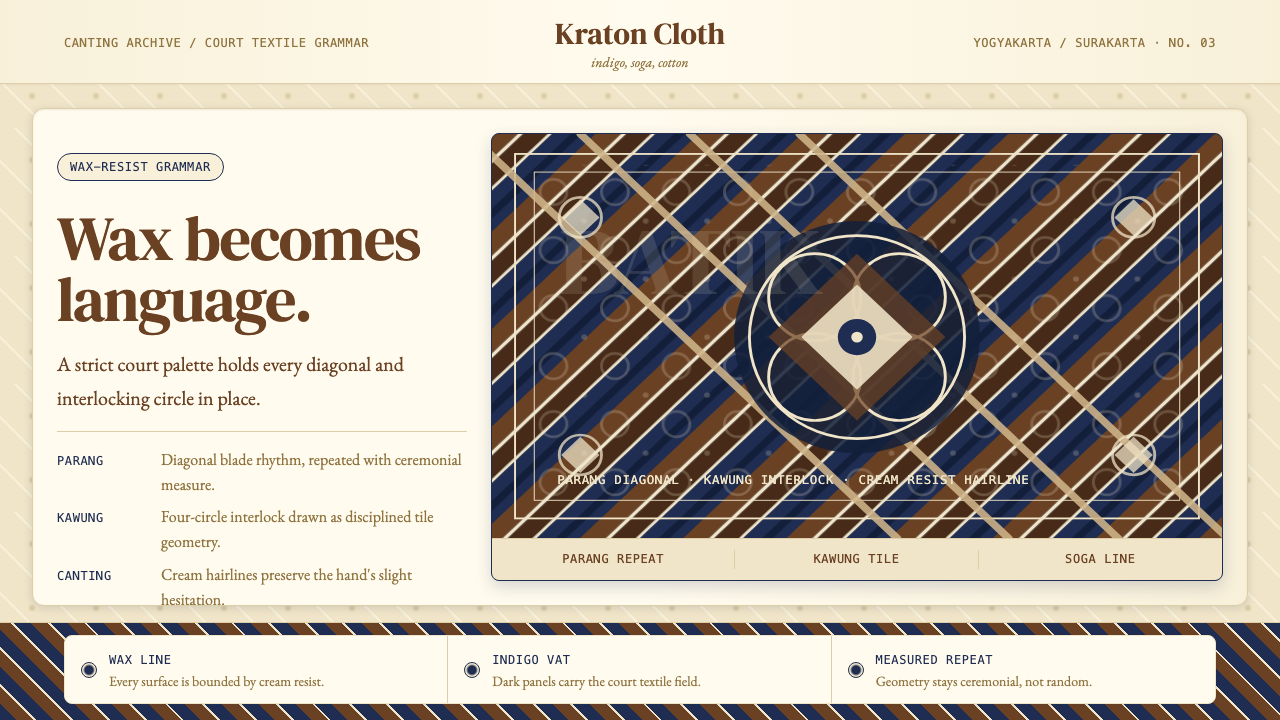 Javanese BatikCeremonial repetition. Indigo, soga, and cream frame a tiled canting motif.
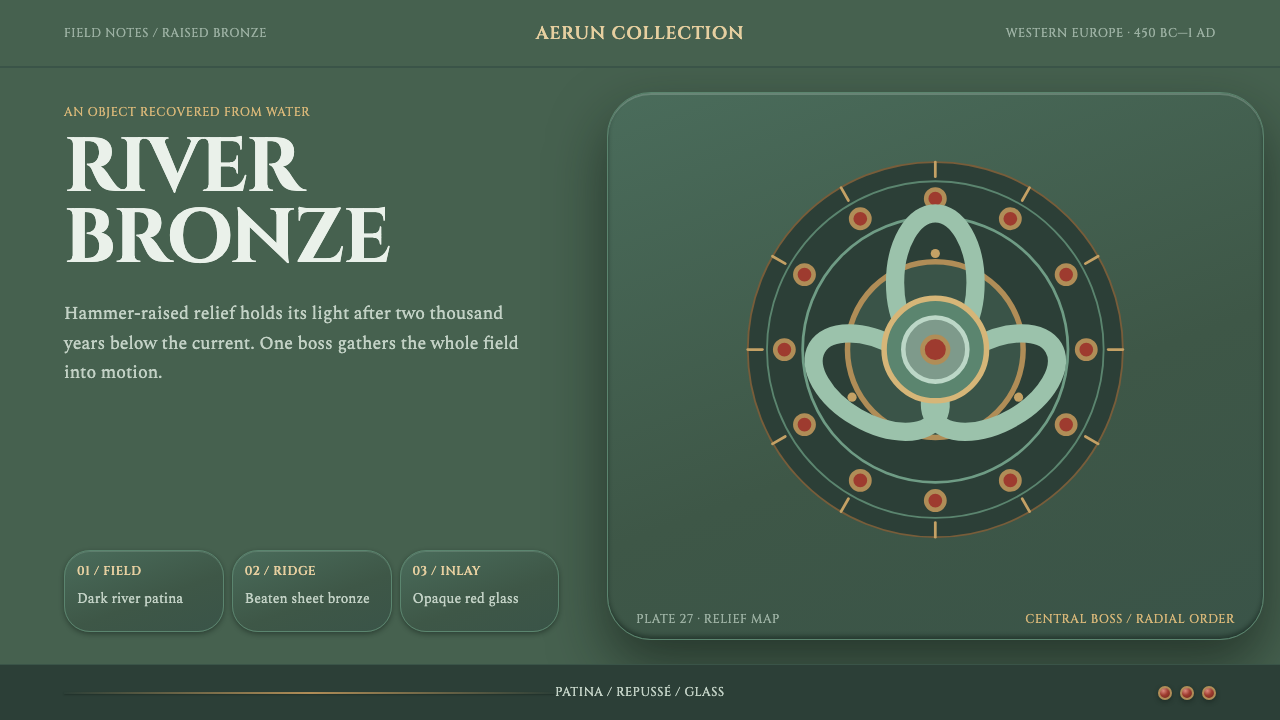 La Tène Celtic MetalworkMetalwork that still moves. Patina-green relief radiates from a bronze boss,…
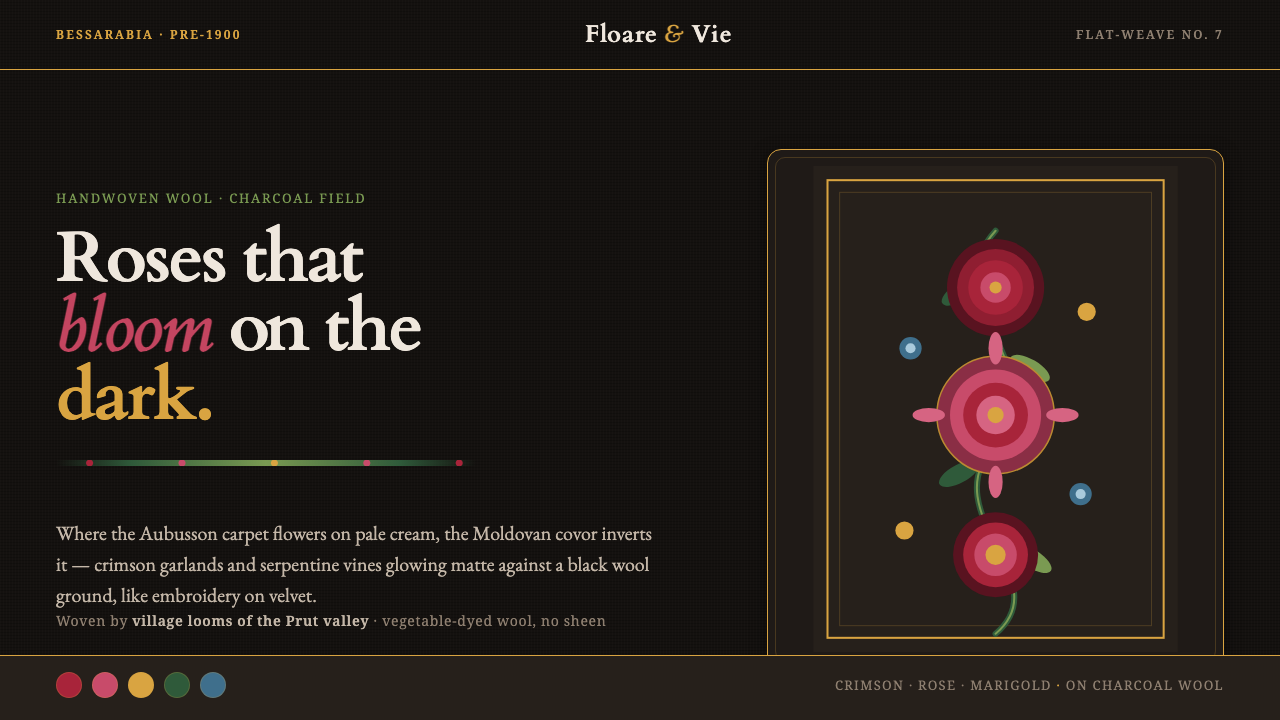 Moldovan Covor KilimRoses that bloom on the dark. Crimson garlands glow matte on a charcoal wool…
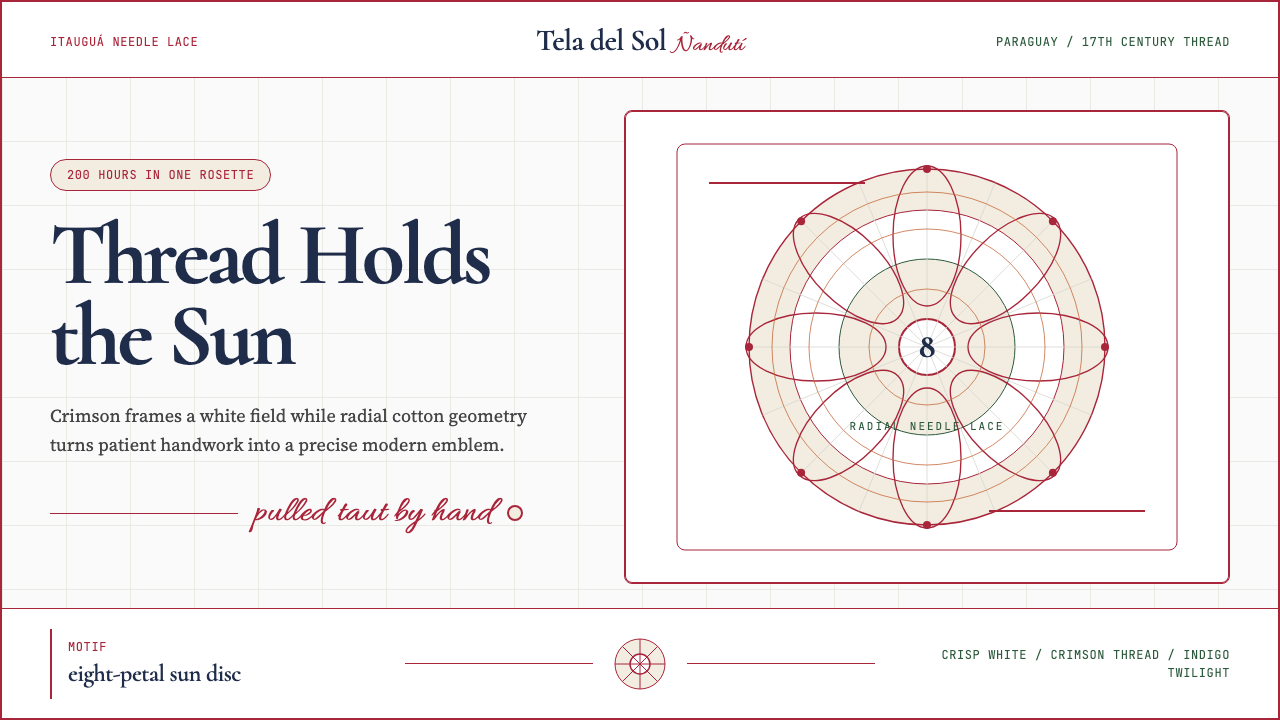 Paraguayan Ñandutí LacePatient craft, modern frame. Crimson lines pin radial lace on crisp white.