What is Javanese Batik?
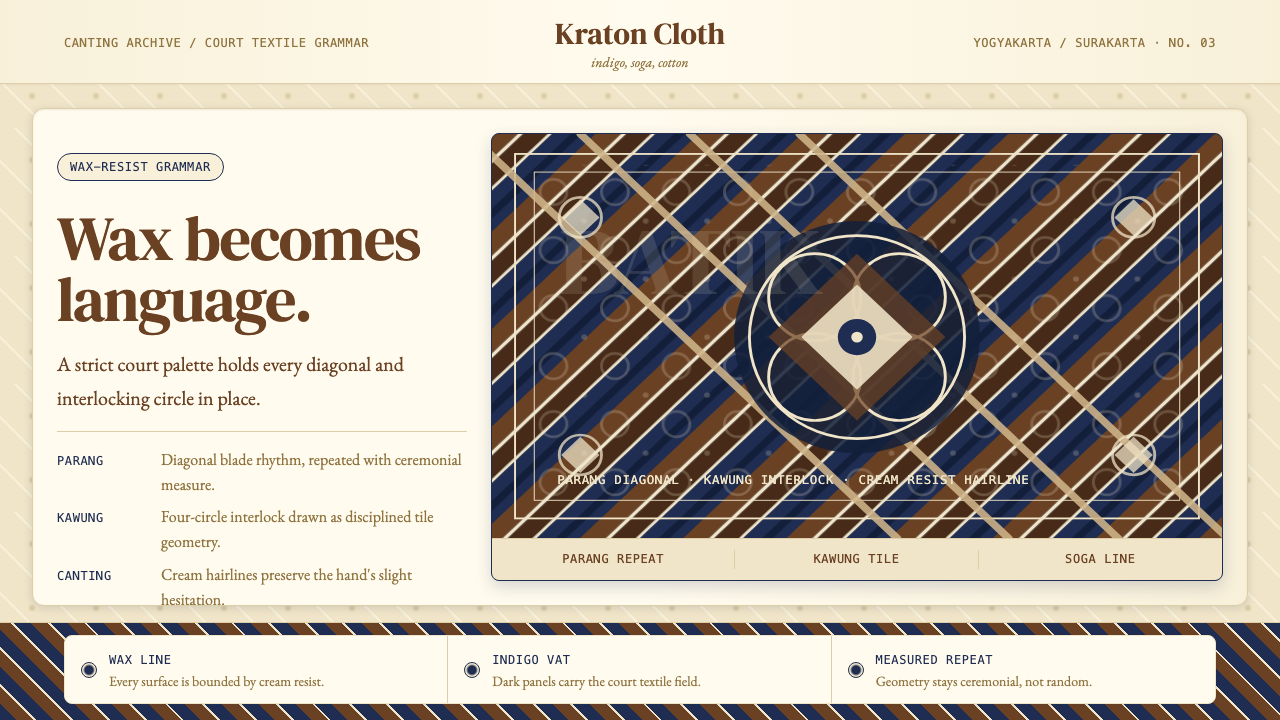
Javanese batik encodes centuries of court ceremony into handwoven wax-resist geometry — indigo, soga-brown, and cotton cream repeating across cloth with the slow precision of ritual.
Javanese Batik in brief
Javanese batik is the wax-resist textile tradition of Java, Indonesia, in which molten beeswax is drawn by hand onto cotton cloth using a small copper-spouted pen called a canting, then immersed in dye vats — most traditionally indigo and soga-brown — across multiple cycles. Where wax coats the cloth, dye cannot penetrate; after the wax is boiled away, the pattern appears in the undyed color of the cotton ground. The result is a fabric whose ornament and structure are inseparable: the motif is not applied to the surface but is the surface.
The visual language of court batik — known as batik keraton — is governed by strict color and pattern laws. The palette holds to three tones: deep indigo blue, warm soga-brown derived from the bark of the Peltophorum pterocarpum tree, and the undyed cream of the cotton itself. Motifs are not freely invented; they are inherited. Parang, the diagonal broken-blade repeat; kawung, the interlocking four-circle grid; truntum, the field of small jasmine flowers — each pattern carries social and ceremonial meaning, and certain designs were historically reserved for members of the royal family.
Translated from cloth to screen, batik functions as pattern-as-language. Its core unit is the tile: a precise mathematical repeat anchored by cream resist-lines, dense enough to read as texture from a distance and intricate enough to reward close attention. The aesthetic is simultaneously ceremonial and geometric — a quality shared by no other textile tradition, and one that gives batik-derived interfaces a gravity and warmth that purely abstract grid systems cannot replicate.

Where does Javanese Batik come from?
The roots of wax-resist dyeing in Java predate written records, with archaeological and textual references suggesting the practice existed in some form before the arrival of Islam in the fifteenth century. However, the codification of batik as a court art — with its regulated motif vocabulary, its hierarchical color system, and its association with royal ceremony — belongs to the era of the Mataram Sultanate, which consolidated power in central Java in the late sixteenth and early seventeenth centuries. The royal courts of Mataram treated batik production as a form of cultural governance: the right to wear certain patterns was a privilege of rank, and the workshops of the palace (kraton) trained generations of artisans in motif traditions that were passed down as closely as dynastic lineage.
In 1755, the Mataram Sultanate was divided by the Treaty of Giyanti into two successor courts: the Sultanate of Yogyakarta and the Sunanate of Surakarta (Solo). Both courts retained distinct batik traditions, and the split deepened regional stylistic differences that persist today. Yogyakarta batik tends toward a darker, more contrasted palette, with bold geometric parang and large-scale kawung patterns. Surakarta batik leans toward finer detail, more delicate soga-brown tones, and a denser, more intricate repeat. The two court styles effectively became the twin poles of the classical tradition, each generating its own roster of named and regulated motifs.
Alongside the court tradition, a parallel coastal batik culture — known as pesisir batik — flourished in port cities including Pekalongan, Cirebon, and Lasem. Pesisir batik absorbed the visual vocabularies of the Chinese, Dutch, Arab, and Indian traders who moved through Java's north coast. The result was a far more chromatic and pictorial style: phoenixes, peonies, and cloud formations entered the motif repertoire alongside indigenous kawung and parang. Pesisir batik from Lasem, produced by Chinese-Javanese (Peranakan) communities, is particularly prized for its vivid reds — derived from natural dyes unavailable in the inland courts — and its layered hybridization of Chinese and Javanese visual grammar.
The twentieth century brought both threat and renewal. Dutch colonial rule had complicated the economics of batik production from the nineteenth century onward, but the post-independence period after 1945 saw batik actively claimed as a marker of Indonesian national identity. President Sukarno wore batik at formal occasions, designers including Iwan Tirta worked to elevate court batik into international fashion, and the government promoted batik production across the archipelago. In 2009, UNESCO inscribed Indonesian batik on its Representative List of the Intangible Cultural Heritage of Humanity — a recognition that triggered both broader global interest and, within Indonesia, intensified debate about authenticity, industrial production, and the preservation of hand-drawn canting technique.
What defines the Javanese Batik look?
Color Discipline
Classical court batik operates on a three-tone palette: deep indigo, soga-brown, and undyed cotton cream. These are not arbitrary color choices — they are the direct result of the dyeing process. Indigo was derived from the Indigofera tinctoria plant cultivated across Java; soga-brown came from the bark of Peltophorum pterocarpum. The cream is the negative space: wherever wax resisted dye, the cloth's natural color remains. In interface applications, this three-tone discipline reads as solemn and authoritative, with the cream ground providing rest and the dark tones providing structure. Pesisir and Peranakan traditions introduced expanded palettes — vivid reds, pinks, and greens — which translate to livelier, warmer visual registers.
Pattern as Tile Repeat
Every major batik motif is built on a precise mathematical tile — a repeat unit that can extend across a surface of any dimension without visual interruption. Parang runs on a strict diagonal grid; kawung locks four equal circles into a grid that tesselates perfectly. This tile logic is not a modern abstraction imposed on a folk art — it is native to the canting technique, whose controlled wax line demands planning across the whole cloth before the dye vat. For interface design, the implication is that batik pattern works as a fill rather than a focal point: it is best deployed as a background field, a panel texture, or a bordered section accent, where its repetition creates rhythm without competing with content.
The Canting Line
The canting — a small copper cup with a thin spouted tip — deposits molten wax in a line whose width and pressure depend entirely on the artisan's hand. The resulting line is precise but not mechanical: it carries a slight tremor, a hairline variation, a warmth that machine-stamped batik cap cannot replicate. In design terms, this canting signature is the quality that distinguishes batik-derived aesthetics from purely geometric pattern systems. Outlines on batik-inspired interfaces should feel deliberate and refined rather than ruler-straight; the organic quality of the canting line — however subtly rendered — is what gives the style its handcraft authority.
Motif Hierarchy
Batik motifs are not decorative options to be mixed freely — they are a structured vocabulary with social meaning. Within the court tradition, the largest and most geometric motifs (parang rusak, kawung) sit at the highest register; smaller, more elaborate floral fills occupy secondary fields; and isen-isen — the background infill of tiny dots, spirals, or crosshatch — occupy the ground behind everything else. This three-tier hierarchy (primary motif, secondary infill, ground isen) maps naturally onto interface layering: a hero element, a supporting pattern fill, and a quiet textured ground.
Geometric Precision
Despite being handmade, classical batik motifs are exercises in rigorous geometry. Kawung's four circles are equal and equidistant; parang's broken diagonal repeats at an exact angle across the cloth; truntum's jasmine stars are uniform in scale throughout the field. This precision was not achieved by mechanical means but by internalized craft knowledge — artisans trained for years to draw by hand what a compass and ruler would otherwise produce. For digital applications, this means that batik-inspired geometry should be clean and exact at the unit level, even as the overall composition remains warm and handcrafted in feeling.
Spatial Density
Batik cloth rarely leaves large areas of undifferentiated ground. Even the cream ground is typically filled with isen-isen micro-patterns, and secondary motifs bridge the gaps between primary repeats. This high visual density is not clutter — it is the result of a craft philosophy that treats every square centimeter of cloth as accountable. In interface design, this density principle argues against large empty areas when using a batik-derived visual language; instead, background zones should carry quiet pattern that recedes without disappearing. Applied at appropriate scale, this layered density gives batik interfaces a richness and completeness that spare designs cannot achieve.
Ceremonial Weight
Batik was — and in many contexts remains — ceremonial cloth. Specific patterns were required for birth rites, circumcision, marriage, and royal audiences. This ritual dimension is embedded in the visual experience of batik: the measured pace of the repeat, the solemn restraint of the three-tone palette, and the evident labor of the canting hand all communicate deliberateness and gravity. Interfaces that draw on batik inherit this quality. They feel considered rather than casual, weighted rather than airy. This makes batik-derived design particularly suited to contexts where the user is being asked to pay attention — formal presentations, institutional communications, and platforms whose authority depends on visible craft.

Who shaped Javanese Batik?
Iwan Tirta (1935–2010) was the designer most responsible for elevating Javanese court batik into international high fashion. Trained as a lawyer before turning to textile design, he collaborated with the palace workshops of Yogyakarta and Solo to produce batik garments worn by Indonesian heads of state and displayed in major international exhibitions. His work insisted on the primacy of the canting-drawn line over machine-stamped alternatives, and he wrote and spoke extensively about batik's place in a living cultural tradition rather than as a museological artifact. His advocacy helped secure the conditions that led to UNESCO recognition in 2009.
Eliza van Zuylen (1863–1947) ran one of the most celebrated batik workshops in Pekalongan during the late colonial period, producing a style of pesisir batik that fused Javanese motifs with European floral and bouquet imagery to serve the tastes of Dutch colonial clients. Her workshop output — marked by fine detail, a confident European-Javanese hybrid palette, and unusually consistent quality — is today collected as art and studied as a document of the complex cultural negotiations of colonial Java. Her work represents the pesisir tradition at its most cosmopolitan.
Oey Soe Tjoen (active early-to-mid twentieth century) was the patriarch of a Peranakan Chinese batik dynasty in Kedungwuni, near Pekalongan, whose family workshop produced some of the most technically refined batik in the pesisir tradition. The Oey Soe Tjoen atelier is particularly associated with the development of the so-called buketan style — large, naturalistic floral bouquets of European origin rendered in fine canting line on a cream ground with vivid lokcan red. Work attributed to this workshop commands significant prices at international auction and is cited as evidence that batik can sustain the highest levels of craft precision.
Edward Hutabarat (born 1957) is a contemporary Indonesian fashion designer who has worked extensively with batik fabric — including both hand-drawn and printed varieties — to produce ready-to-wear collections that address a modern urban Indonesian audience. His work is significant in the post-UNESCO recognition landscape because he occupies a position between pure craft preservation and commercial accessibility, arguing that batik must continue to be worn and adapted rather than frozen in museum conditions. He has been influential in demonstrating how court and coastal batik motifs can be recontextualized within contemporary silhouettes without losing their cultural legibility.
How do you use Javanese Batik today?
Batik's visual logic translates into designed artifacts more completely than most historical textile traditions, because its underlying system — tile repeat, color restriction, layered density — is already structurally analogous to how digital design systems are organized. Applying it correctly requires understanding that batik is a pattern language, not a surface decoration: it should organize, not merely adorn. The designer's task is to extract the structural logic of the repeat, the color law, and the hierarchy of primary-secondary-ground, and apply those as system rules rather than reaching for a PNG of a batik fabric and layering it as a background image.
For presentation slides, batik works with particular power on cover and section-divider pages. A cover using the batik language should commit to the three-tone palette — deep indigo panel behind the title, cream type, and soga-brown accents on key words or decorative framing. The tile repeat, if used, should appear at a scale where its unit structure is just legible: not so small that it reads as noise, not so large that individual motif elements compete with the headline. Content slides should simplify radically — clean cream grounds, indigo or soga-brown headings in a serif typeface, and the batik pattern reserved for borders or small accent blocks. Data visualizations benefit from the palette's natural contrast: bar fills in indigo and soga-brown, with cream and a muted third tone for secondary series.
For web interfaces, batik-derived design is well suited to dashboards, institutional homepages, and premium e-commerce contexts where depth and cultural authority matter. The approach: use the three-tone palette as the foundational system, reserving the cream ground for content zones and the deep tones for navigation bars, hero panels, and high-emphasis components. Pattern fills work best in bordered containers — a sidebar, a card header, a footer band — where the repeat is framed and can be appreciated as intentional texture rather than accidental background noise. Pricing tables and tier displays benefit from the motif hierarchy concept: a primary tier receives a more prominent motif or color weight, while secondary and tertiary tiers use quieter ground tones.
For editorial and marketing work, batik supports a visual language that reads as both exotic and precise — a combination that suits luxury brands, cultural institutions, hospitality, and any context where the product's value is partly experiential. An editorial spread using batik language might employ an indigo full-bleed panel for a chapter opener, with the soga-brown used for pull quotes and subheadings, and the body text settled on cream. The tile pattern, if it appears, should do so in a margin or rule rather than competing with photography. Marketing campaigns can use pesisir-tradition color expansions — deeper reds, ochre yellows — to warm the palette for consumer-facing contexts while retaining the tile-repeat logic that gives the style its distinctive character.
A common mistake when applying Javanese batik aesthetics is treating the pattern as wallpaper — tiling it uniformly across an entire background at high opacity without regard for the reading hierarchy. Authentic batik cloth uses pattern purposefully: the primary motif occupies the most visible field, the secondary infill supports it, and the isen-isen ground recedes almost to invisibility. In digital work, this means the tile fill should be rendered at reduced opacity or in closely related tones on the ground layer, never at the same visual weight as the primary content. A second common mistake is expanding beyond the three-tone palette without acknowledging the system: adding a fourth color that is unrelated to indigo, soga-brown, and cream breaks the color law that gives classical batik its authority. If expansion is needed, draw from the pesisir tradition deliberately — introduce a new hue with the same intentionality that coastal batik introduced Chinese red, as a culturally meaningful addition rather than a decorative afterthought.

Javanese Batik — FAQ
What makes Javanese court batik different from other Indonesian batik styles?
Javanese court batik — produced in and around the royal courts of Yogyakarta and Surakarta — is defined by its strict three-tone palette (indigo, soga-brown, and cream), its regulated motif vocabulary with historical social restrictions, and its dense geometric repeat structure. Pesisir batik, produced along Java's north coast, is chromatically much richer and often incorporates imagery from Chinese, Dutch, and Arab visual traditions. Batik from other Indonesian islands — Madura, Bali, Sumatra — follows distinct regional conventions. For design purposes, court batik provides the most systematic and transferable visual grammar, while pesisir batik offers a warmer and more coloristically diverse starting point.
How should I handle the batik tile pattern at different screen densities and sizes?
Batik patterns are inherently scalable because they are geometric tile repeats, but the effective visual scale changes with screen density. At typical screen resolution, a tile that reads as intricate detail on fabric can dissolve into an indistinct texture. The practical rule is to size the tile so that the primary motif unit — one kawung circle, one parang diagonal — spans roughly the same visual angle as it would on a garment held at reading distance. On small mobile screens, this usually means a larger, less detailed tile variant; on high-density desktop displays, a smaller and more intricate version works well. In all cases, test at the actual output size rather than designing at high zoom where fine detail appears legible but will be lost in production.
Can batik aesthetics work in a dark-mode or dark-background layout?
Classical batik is inherently a light-ground tradition — the cream of undyed cotton is the visual rest state, and the deep tones of indigo and soga-brown emerge from it. A dark inversion is possible but requires rethinking the palette logic rather than simply reversing it. On a dark ground, the pattern lines that are cream-colored on the light version need to become the primary illuminated element — pale gold, warm off-white, or a reduced-saturation indigo. A dark batik variant works best when it evokes the look of batik viewed under low candlelight — which, historically, is exactly how ceremonial batik cloth was often seen. This means rich but muted tones, with the pattern emerging from the ground rather than sitting starkly on top of it.
Is there a risk of cultural appropriation when using batik motifs in commercial design?
This is a question worth taking seriously. Batik motifs — particularly the restricted court patterns like parang and kawung — carry specific cultural and ceremonial meanings within Javanese society. Using these patterns as mere visual decoration without acknowledgment of their origin or meaning can reasonably be experienced as appropriation. The more respectful and also the more creatively productive approach is to engage with batik as a design system: understand its structural logic, its color rules, its hierarchy of motifs, and then work within that system while making clear the cultural debt. Crediting the tradition explicitly in design documentation, collaborating with Javanese or Indonesian designers, and avoiding direct reproduction of the most symbolically charged restricted motifs in purely commercial contexts are all practices that demonstrate good faith.
How does batik-derived design differ from other Asian pattern traditions like ikat or shibori?
Ikat is a resist-dyeing technique in which threads are bound and dyed before weaving, producing characteristic soft-edged, slightly blurred pattern boundaries — the opposite of batik's precise wax-resist lines. Shibori is a Japanese folding and binding technique that produces organic, symmetrical, often circular or pleated resist patterns with a strong element of controlled accident. Batik is unique in its combination of geometric precision, dense tile-repeat structure, and the direct hand-drawn quality of the canting line. For design purposes: ikat gives you organic blur and warm imprecision; shibori gives you fold-symmetry and indigo gradients; batik gives you mathematical tile geometry with artisanal warmth. They are different tools solving different aesthetic problems, and mixing them unreflectively will produce incoherent results.
Related design styles
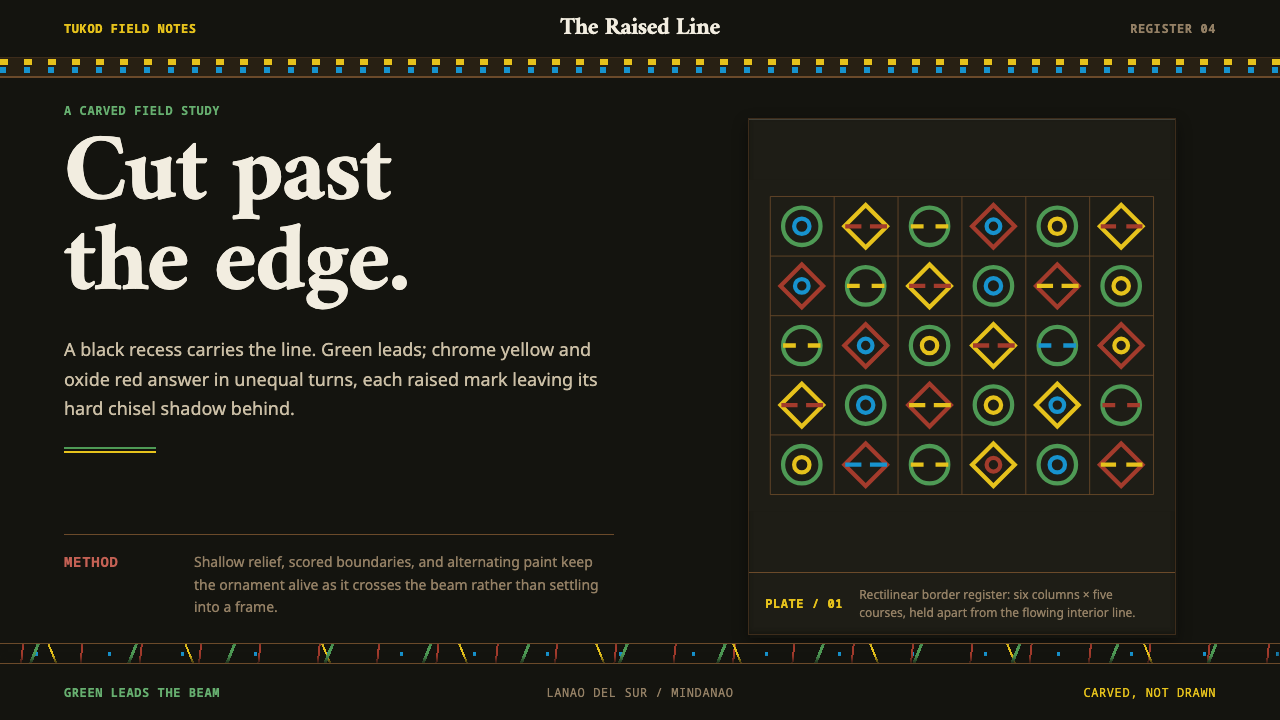 Maranao OkirCarving commands the field. Green, yellow and oxide-red lines rise from black…
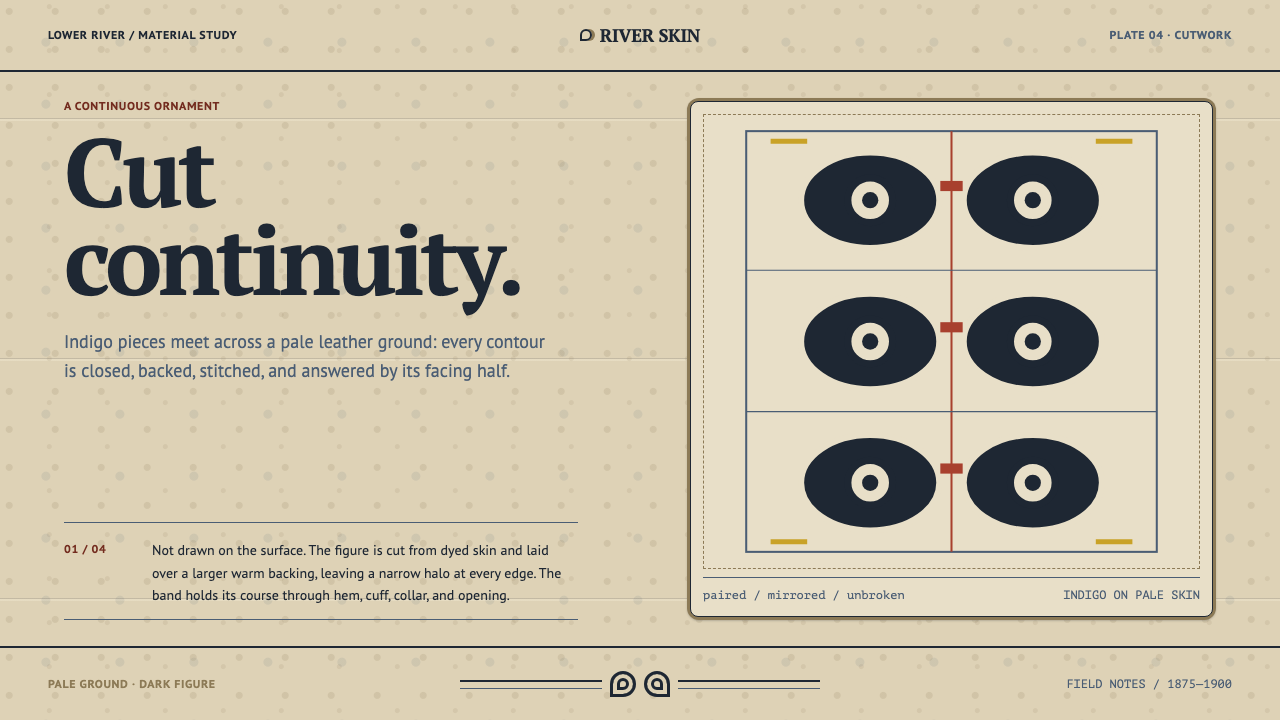 Nanai Amur SpiralCut continuity, never drawn. Dark indigo pairs run across mottled salmon-leat…
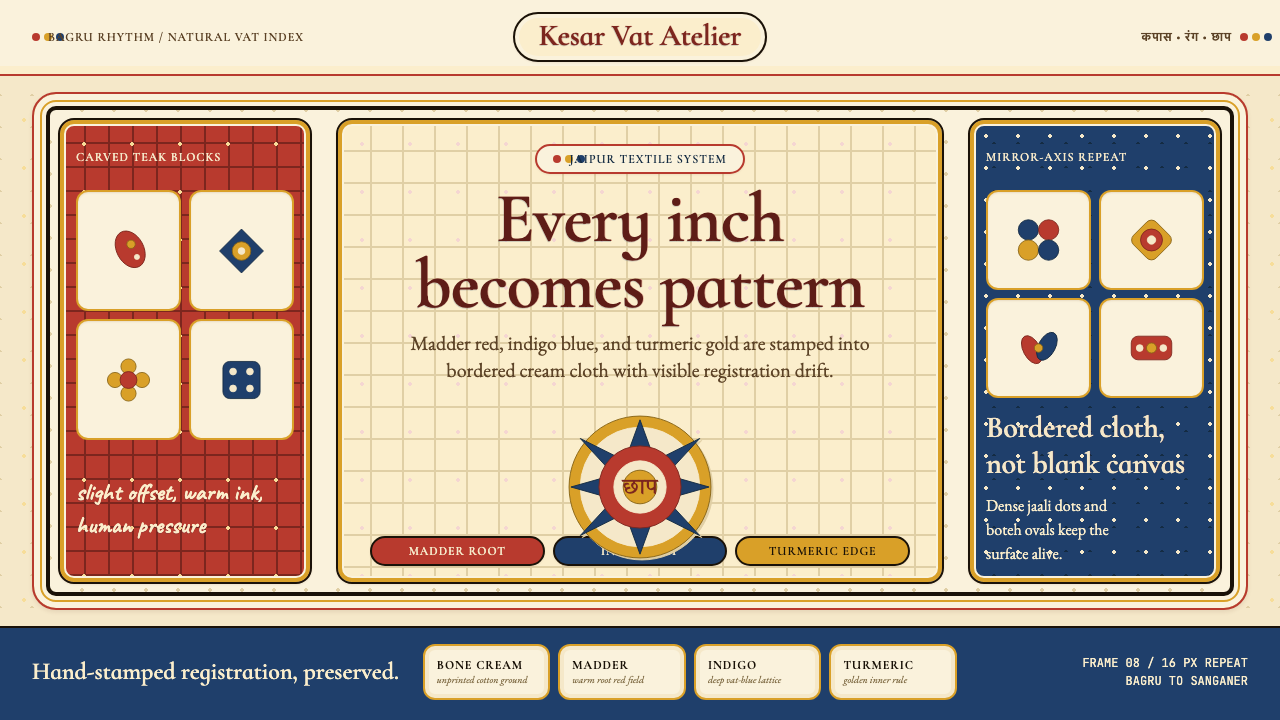 Indian Block PrintPattern claims every inch. Madder, indigo and turmeric stamp dense bordered c…
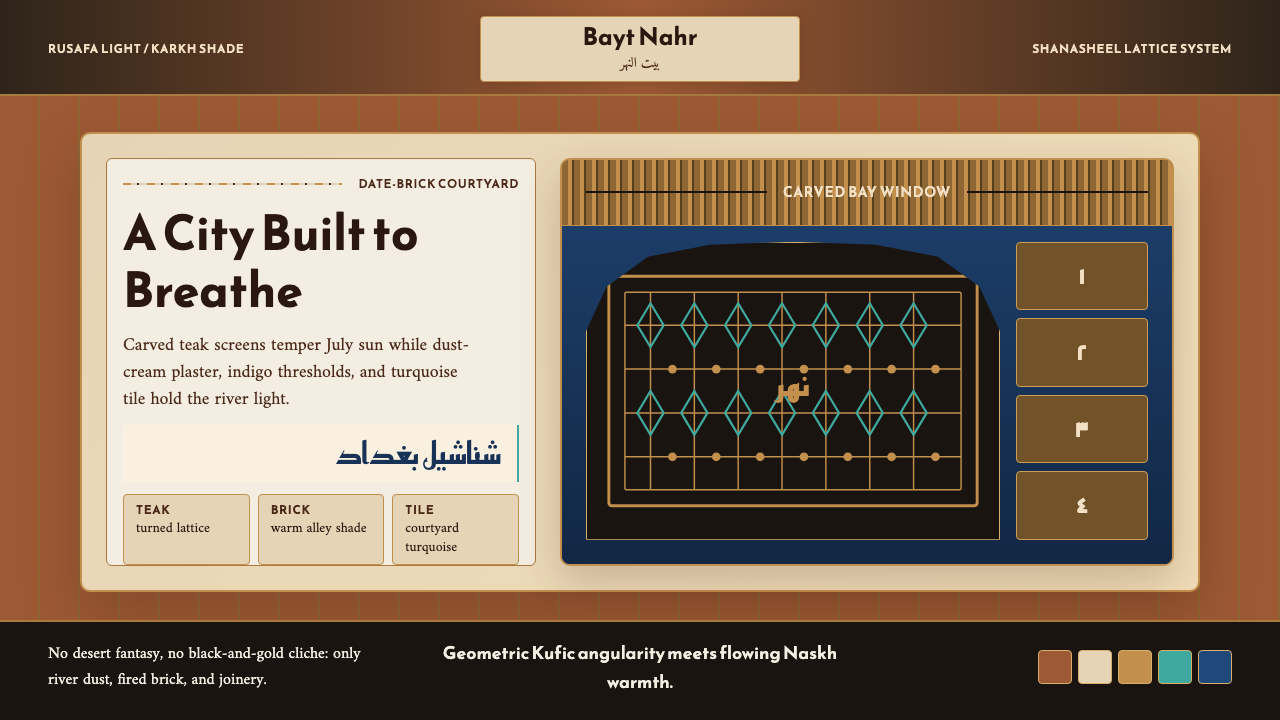 Iraqi Baghdad Shanasheel HouseBreathes through ornament. Date-brick ground, teak lattice, and turquoise til…
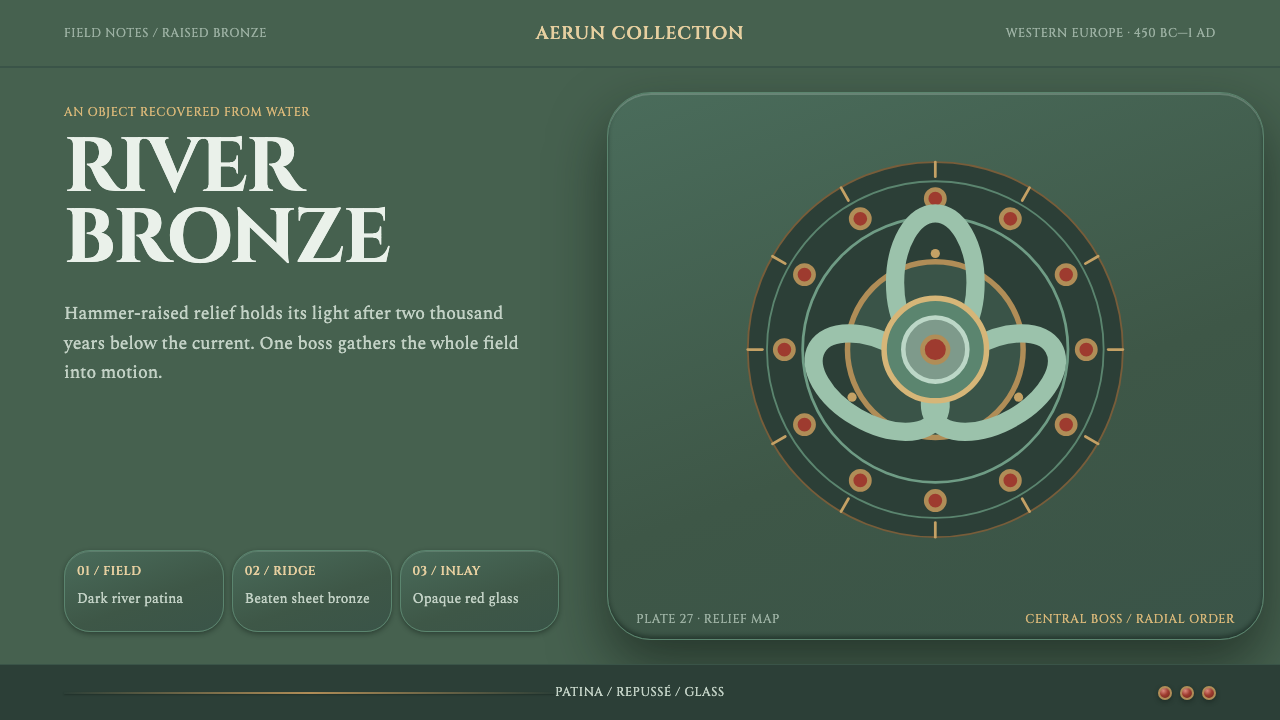 La Tène Celtic MetalworkMetalwork that still moves. Patina-green relief radiates from a bronze boss,…
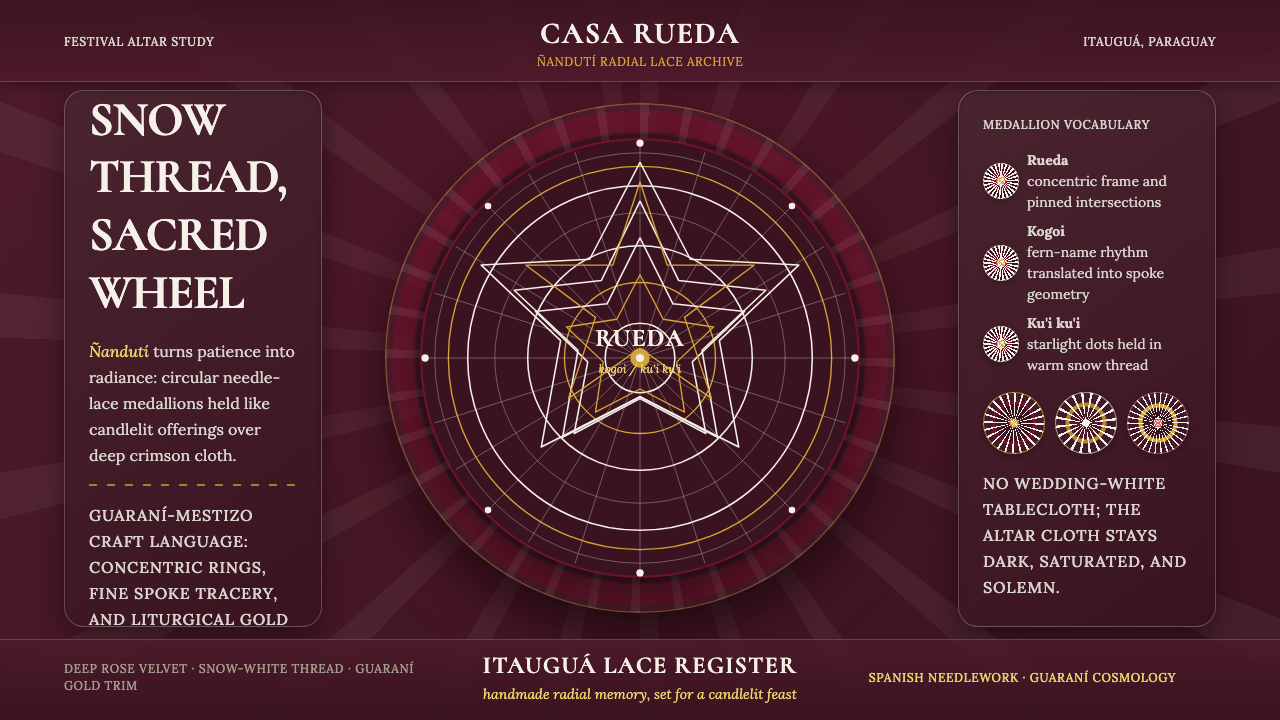 Paraguayan Itauguá Ñandutí Spider LaceReverent craft glows. Snow lace medallions radiate over rose velvet with Guar…