What is Indian Block Print?
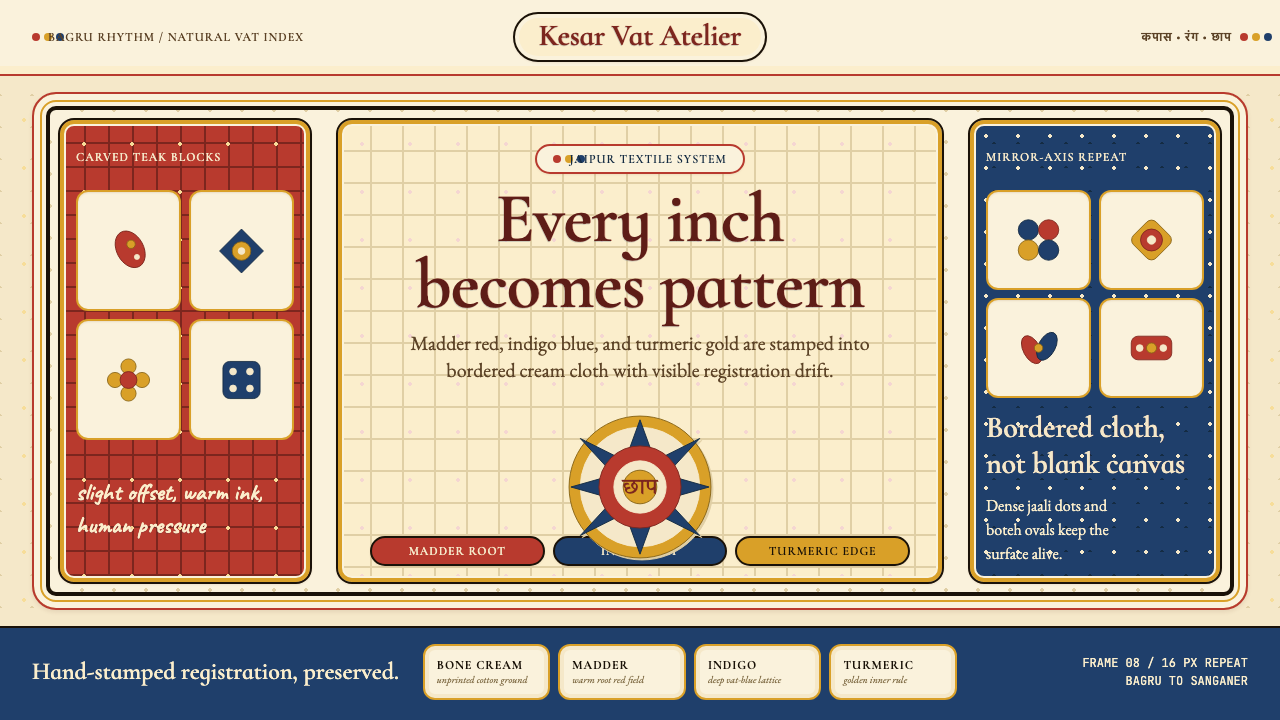
Every centimeter of cloth is pattern — Indian hand-block printing brings that millennia-old textile maximalism into interface design through saffron grounds, dense paisley repeats, and the deliberate imperfection of the hand-stamped mark.
Indian Block Print in brief
Indian Block Print is a design language rooted in one of the subcontinent's oldest continuous craft traditions: the stamping of carved wooden blocks dipped in natural plant-and-mineral pigments onto cotton and silk cloth. The visual result is dense, border-framed, and pattern-maximalist — every surface is treated as an opportunity for decoration rather than a field to be kept clear. This principle, when translated into graphic and interface design, produces work that feels simultaneously archaic and vivid: warm earthy grounds layered with botanical florals, geometric lattices, and the teardrop-shaped boteh motif that the West came to call paisley.
The aesthetic is defined by a specific relationship between figure and ground. Rather than silhouetting motifs against blank space, Block Print builds pattern on pattern — a floral repeat sits inside a geometric border, which itself rests inside a broader field of secondary repeat. Negative space is almost entirely absent in the textile source, though in interface adaptations a measured amount of breathing room is introduced to preserve legibility. Color is drawn strictly from the plant-and-mineral dyestuff palette: madder root reds, indigo blues, turmeric and saffron yellows, pomegranate-rind tawny, and the undyed ivory of the base cloth. No synthetic neons, no cold grays.
What distinguishes Block Print from other ornamental traditions is the character of its imperfection. Hand-carved teak blocks are inked by hand and pressed by hand; slight misalignment between successive stampings, uneven dye absorption, and the texture of the wooden block's grain all leave visible traces. This quality — called registration variation in textile terms — is not corrected but celebrated. In design systems that reference Block Print, perfectly mechanical repetition reads as wrong; a gentle drift in alignment, a subtle variation in tonal weight, and visible texture in fills are marks of authenticity rather than errors.

Where does Indian Block Print come from?
The craft of printing cloth with carved wooden blocks arrived in the Indian subcontinent no later than the twelfth century, with some textile historians placing its roots in earlier Persian and Central Asian stamping traditions. The earliest surviving printed textiles from the region show a command of repeat geometry and border articulation that implies a long prior period of development. By the sixteenth century, the workshops of Rajasthan and Gujarat had established the regional identities that persist to this day: Sanganer, just south of Jaipur, became known for fine white-ground floral prints in black and indigo; Bagru, roughly thirty kilometers to the west, developed a distinctively earthy palette using resist-printing with fermented castor oil followed by madder-root overdyeing.
The Mughal period — roughly 1526 to 1707 — brought transformative influence. Mughal court patronage demanded extreme refinement: finer block carving, more complex multi-block registration, and the incorporation of Persian motifs including the boteh, arabesque scrollwork, and the garden-paradise (bagh) as compositional framework. The imperial workshops at Agra, Fatehpur Sikri, and later Delhi set standards of intricacy that provincial centers like Jaipur adapted and democratized. It was during this period that the characteristic density of Indian Block Print — the total-surface coverage, the nested-border logic, the insistence that even background areas carry secondary pattern — was formalized as an aesthetic ideal rather than a practical expedient.
The colonial period (roughly 1757 to 1947) simultaneously damaged and documented the tradition. British machine-printed cottons undercut hand-block printers economically from the mid-nineteenth century onward, collapsing whole regional industries. At the same time, the colonial documentation impulse — exhibitions, pattern books, design surveys conducted for institutions like the Victoria and Albert Museum — preserved detailed records of motifs, block inventories, and dyeing sequences that might otherwise have been lost. Indian design reformers of the late nineteenth century, including those associated with the Arts and Crafts movement's Indian sympathizers, argued for preserving hand-block printing on both economic and cultural grounds.
The post-Independence revival, from the 1950s onward, restored commercial viability. Government handicraft boards subsidized block-printing cooperatives; design schools in Ahmedabad and Jaipur began treating the tradition as a subject of formal study rather than mere folk production. The decisive moment for international recognition came in the 1970s and 1980s, when designers including John Bissell and Faith Singh at Anokhi, and the French-Indian textile artist Brigitte Singh working from Jaipur, demonstrated that hand-block printed cloth could address international luxury markets without compromising craft authenticity. Their work established the visual grammar that contemporary designers reference: a warm but controlled palette, botanical and geometric motifs in dense repeat, and visible hand-process texture as a positive quality signal.
What defines the Indian Block Print look?
Color
The palette is built entirely from plant-and-mineral dye equivalents: madder-root red (a warm, slightly orange-tinged red), indigo (a deep blue with violet undertones), turmeric yellow, saffron orange, pomegranate tawny, and the undyed ivory of the base cloth. These are colors that absorb light rather than reflect it — muted, complex, never harsh. Madder and indigo are used as ground colors at high saturation on borders or feature panels; saffron and turmeric function as warm accent and highlight. No pure whites or cold grays enter the system; all neutrals are warm ivory or unbleached off-white.
Pattern Density
Block Print operates at maximum pattern density. The design principle is total-surface coverage: primary motifs fill the central field, secondary motifs fill the ground between primary motifs, and borders carry their own independent repeat. In interface applications, this density is modulated — reduced on interactive areas and data-heavy zones to preserve legibility — but the overall visual weight remains substantially higher than most Western digital design conventions. Empty space reads as compositional absence rather than restful breathing room.
Motif Vocabulary
Four motif families dominate. The boteh (paisley) — a teardrop with a curved tip, representing a cypress tree, a leaf, or a Zoroastrian flame — appears at multiple scales simultaneously. Floral medallions (sometimes called buti when small, boota when large) derive from Mughal garden paintings and carry associations with paradise and abundance. Jaali lattices — geometric grids of diamonds, octagons, and stars derived from carved stone architectural screens — provide structural counterpoint to the organic florals. Lotus, mango, and peacock motifs complete the vocabulary. In interface work these motifs appear as authentic silhouettes, never as stylized flat reductions.
Border Logic
Every panel, card, or compositional unit in Block Print is bounded by one or more decorative borders. The border is not a dividing line but a complete decorative band with its own running repeat — typically a vine scroll, a geometric chain, or a miniature boteh row. Borders nest inside each other: a broad outer border, a narrow inner guard border, and sometimes a second inner border before the main field begins. In interface design, this border logic translates naturally to card components, section dividers, and page frames — though digital borders are generally narrower in weight than their textile counterparts.
Registration Variation
The defining quality of hand-block printing is slight misregistration between successive stamps. Where a mechanical printer would produce perfect alignment, the block-printer's hand produces a drift of a millimeter or two — enough to create a halo effect, a faint double-contour, or a slight color bleed along motif edges. In textile work this is unavoidable; in design work referencing Block Print it is intentionally introduced as a texture signal. Fills gain a faint grain; outlines carry a soft double-edge; color boundaries are slightly fuzzy rather than hard. This quality is what prevents the style from reading as generic ethnic pattern and instead roots it in specific craft process.
Typography
Block Print has no native typographic tradition in the way that Western movements produced specific typefaces — the craft was image-first and text-secondary. In contemporary interface applications, typography is chosen to harmonize with rather than compete against the decorative density. Serif letterforms with calligraphic quality — drawn from humanist or transitional traditions — sit more naturally against botanical pattern than geometric sans-serifs do. Headlines can be set in a warm, slightly condensed serif; body text benefits from generous line spacing to provide contrast against the visual richness of surrounding ornament. Type weight is moderate rather than heavy; the ornament does enough structural work.
Texture and Surface
Smooth, frictionless surfaces are foreign to Block Print. The textile origin means every surface carries the memory of cloth: a slight linen grain in backgrounds, a pressed-ink texture in motif fills, the gentle irregularity of hand-cut block edges on outlines. In digital applications this texture is introduced through noise overlays, subtle grain fields, and slightly rough fill edges — not to simulate cloth literally but to maintain the hand-process warmth that distinguishes Block Print from digital-native ornamental styles. Fully flat digital fills without any surface variation feel sterile within this system.

Who shaped Indian Block Print?
The multigenerational printing families of Bagru and Sanganer, villages near Jaipur in Rajasthan, are the living repositories of block-print technique. Sanganer families, working largely in black and indigo on white ground, developed the fine floral repeat associated with refined Mughal taste. Bagru families developed a distinctly earthier approach centered on resist-printing with fermented castor-oil paste (dabu), followed by madder-root overdyeing to achieve characteristic rust and brick-red grounds. Both communities have maintained hereditary craft knowledge across generations despite the economic disruptions of colonial machine competition and post-Independence market shifts.
John Bissell, an American who settled in Jaipur in the 1960s, and his collaborator Faith Singh founded Anokhi in 1970, a retail enterprise that positioned hand-block printed cloth for the international design market without displacing the craftsmen who made it. Their model — commissioning from Sanganer printers while maintaining design quality standards — demonstrated that the tradition could be commercially self-sustaining without requiring export of raw blocks or dilution of technique. Anokhi became the template for an entire generation of Indian craft-based brands, and their design archive remains a reference for contemporary designers working in the Block Print vocabulary.
French-born textile designer Brigitte Singh relocated to Jaipur in the 1980s and established a studio working exclusively with Sanganer block-printers to produce cloth for the international luxury market. Her contribution was a refined color sensibility applied to traditional motif vocabularies: she introduced dusty rose, pale sage, and muted terracotta as companions to the classic madder and indigo grounds, extending the palette without departing from its natural-dye character. Her work has been influential in demonstrating that Block Print can be simultaneously faithful to craft origin and legible within international design contexts.
Founded by Charllotte Kwon in Vancouver, Maiwa is a craft organization and textile importer that has played an unusual role in the global legibility of Indian Block Print: through an extensive documentation program, Maiwa has published detailed technical accounts of natural-dye processes, block-carving sequences, and regional technique variations that are now widely used as teaching materials. Maiwa's workshops have trained textile practitioners across North America and Europe, creating a generation of Western designers and makers with substantive first-hand knowledge of the tradition's material logic — not merely its visual surface.
The Khatri community of Kutch in Gujarat maintains the Ajrakh tradition, a form of block printing distinguished by its double-sided printing (both faces of the cloth are registered) and its strict commitment to fully natural-dye processes including indigo vat dyeing and resist printing with natural clays. Ajrakh patterns are more geometrically rigorous than Rajasthani florals, built on eight-pointed star grids and bold medallion compositions that show clear Central Asian influence. The Ajrakh revival following the devastating 2001 Gujarat earthquake — coordinated through craft NGOs and supported by international design buyers — has become a widely cited example of craft resilience and cultural recovery.
How do you use Indian Block Print today?
Indian Block Print is among the most visually generous of historical design styles available to contemporary practitioners — it is pattern-first, color-warm, and texture-rich in ways that no other major tradition quite matches. Applying it well means internalizing what the textile source actually does: it layers decoration, it frames everything with borders, it treats every surface as an opportunity, and it wears its hand-process origins openly. A Block Print-derived layout that uses clean flat fills, cold neutrals, and empty space is not Block Print — it is borrowing the motifs while discarding the logic.
For presentation slides, Block Print is most effective when it is applied consistently across the full deck rather than used as decorative garnish on a single cover. Cover slides benefit from a full-bleed boteh or floral medallion pattern on a saffron or madder-red ground, with title text set in a warm serif reversed out in ivory. Section dividers can use a single bold border band — a jaali lattice or a vine scroll — to mark transitions. Content slides should use a warm ivory or off-white ground with decorative border frames on card components; data slides can introduce a gentle background texture to prevent the chart area from reading as a foreign element dropped into a patterned deck. The critical discipline is keeping all type areas clear of heavy pattern so that information hierarchy is not lost in decoration.
For web interfaces, Block Print translates best to contexts that benefit from cultural richness and warmth: e-commerce for craft and textile brands, cultural institution websites, boutique hospitality, wellness and spa booking interfaces, and editorial platforms covering art, food, or travel. The approach requires a two-tier background strategy: a warm patterned layer at low opacity for broad structural areas (headers, footers, section backgrounds), and a clean light ground for all reading and interaction surfaces (body text areas, form fields, product listings). Navigation and interactive elements should use the motif palette — madder red for primary actions, indigo for secondary — while maintaining clean legibility. Dashboard and data-heavy pages should treat the Block Print elements as framing rather than fill, using borders and header treatments to establish the style without allowing pattern density to compete with information density.
For editorial and marketing work, Block Print offers strong possibilities for campaign identity, packaging, and brand collateral. A brand built on Block Print typically leads with a hero motif — a single large boteh or floral medallion — used at scale on hero images, packaging, and environmental graphics, with secondary pattern fields used at reduced scale in supporting materials. Marketing page layouts work well with an alternating structure: full-width pattern-ground sections for brand statements, clean ivory-ground sections for product information or feature details. Editorial layouts benefit from using Block Print borders as section markers and pull-quote frames rather than as background fills, keeping long-form text readable while maintaining visual identity.
The most common mistake when applying Block Print is pattern promiscuity: using too many different motif families simultaneously at similar scale and weight. Authentic block-printed cloth typically organizes its density through hierarchy — a dominant primary motif, a clearly secondary fill, a tertiary ground — and contemporary design applications should observe the same principle. A second common error is substituting digital geometric patterns for actual Block Print motifs: clean vector lattices and flat diamond repeats do not carry the hand-process character that makes the style recognizable. A third pitfall is applying the style's color palette without its texture — madder red and indigo on ivory, rendered as perfectly flat solid fills, reads as vaguely South Asian decoration rather than Block Print specifically. The warmth and specificity of the tradition require surface variation even in digital contexts.

Indian Block Print — FAQ
How is Indian Block Print different from other South Asian pattern traditions like ikat or batik?
The differences are rooted in process, and process shapes aesthetics. Block print is additive and stamp-based: a carved block applies color to cloth in discrete, repeating units. This produces crisp-edged motifs with slight registration variation between units. Ikat is a resist-dyeing process applied to the yarns before weaving, which means the pattern is built into the cloth's structure rather than printed on its surface — the characteristic blurred or feathered edge of ikat is a structural artifact, not an error. Batik uses wax resist applied by pen or stamp to control dye penetration; the crackling of the wax creates the characteristic vein lines that identify the style. In design terms: block print has the crispest motif definition, ikat has the softest edges, and batik has the most distinctive surface micro-texture from wax crackle.
Can Block Print work effectively in a minimal or sparse layout, or does it always require pattern density?
It can, but with significant constraint. The tradition's visual logic is density-forward, and sparse application tends to produce results that feel unresolved — as if pattern was planned but not delivered. The most successful minimal applications concentrate the pattern into a single strong area (a full-bleed header, a prominent card border, a repeating sidebar element) and let that area do the representational work for the whole composition. The remaining space can be clean ivory or off-white. What does not work is scattering individual motifs at low density across a neutral ground — isolated boteh or floral elements on white tend to read as generic 'ethnic' decoration rather than as a considered design system. The key is commitment: either use pattern at meaningful density in designated zones, or let motifs be bold and singular rather than multiplied and sparse.
Is it culturally appropriate for designers outside India to use Block Print as a design style?
The question of cultural appropriation versus appreciation is real and worth taking seriously. Block Print is a living craft tradition practiced by identifiable communities whose economic livelihoods depend on recognition and demand for their work. Design that references the tradition meaningfully — attributing it accurately, understanding the regional and community specificity (Bagru vs. Sanganer vs. Ajrakh are meaningfully different), and if commercially applied, considering sourcing relationships with actual block-print producers — is substantively different from design that takes the visual surface while erasing the human origin. Using generic 'Indian' motifs without acknowledging the specific tradition, or applying the style to products that compete with or undercut actual craft producers, sits in more problematic territory. The minimum standard: know what you are referencing specifically, and communicate it accurately rather than generically.
How do I avoid Block Print looking dated or clichéd in a contemporary digital product?
The cliché version of Block Print in digital design typically involves generic paisley borders on a white background, applied without commitment to the tradition's actual visual logic. Avoiding this requires three things. First, depth of reference: use authentic motif vocabulary (boteh, floral medallions, jaali lattice, vine border) rather than generic exotic pattern, and understand the difference between Bagru earthy grounds and Sanganer white-ground florals. Second, system-thinking: apply the style as a coherent visual system with consistent color, consistent border logic, and consistent texture approach — not as decorative garnish on an otherwise generic layout. Third, contemporary purpose: Block Print works best when the product genuinely aligns with the tradition's values — craft, warmth, handmade quality, cultural specificity — rather than using it as purely surface styling for a product whose content is unrelated. A fintech dashboard in Block Print feels incongruous; a craft marketplace, a cultural travel platform, or a textile brand's editorial site feels resolved.
What is the difference between Bagru and Sanganer block print, and does it matter for design applications?
It matters both historically and practically. Sanganer printing is characterized by fine white or cream grounds with detailed floral and botanical repeat in black, indigo, and occasionally soft pink or red — the work is delicate, intricate, and associated with refinement. Bagru printing uses resist-printing with dabu paste (fermented castor oil and earth pigments) before overdyeing with madder root, producing characteristic earthy rust, brick-red, and ochre grounds with bold geometric and floral overlay — the work is more robust, more textural, and visually earthier. In design applications: Sanganer's vocabulary is more appropriate for fine, refined contexts — luxury goods, cultural editorial, intimate hospitality; Bagru's vocabulary reads better in rustic, craft-forward, or robustly earthy contexts — artisan food brands, sustainable fashion, cultural tourism. Mixing the two without acknowledging their difference tends to produce generic 'Indian' results rather than the specific character of either tradition.
Related design styles
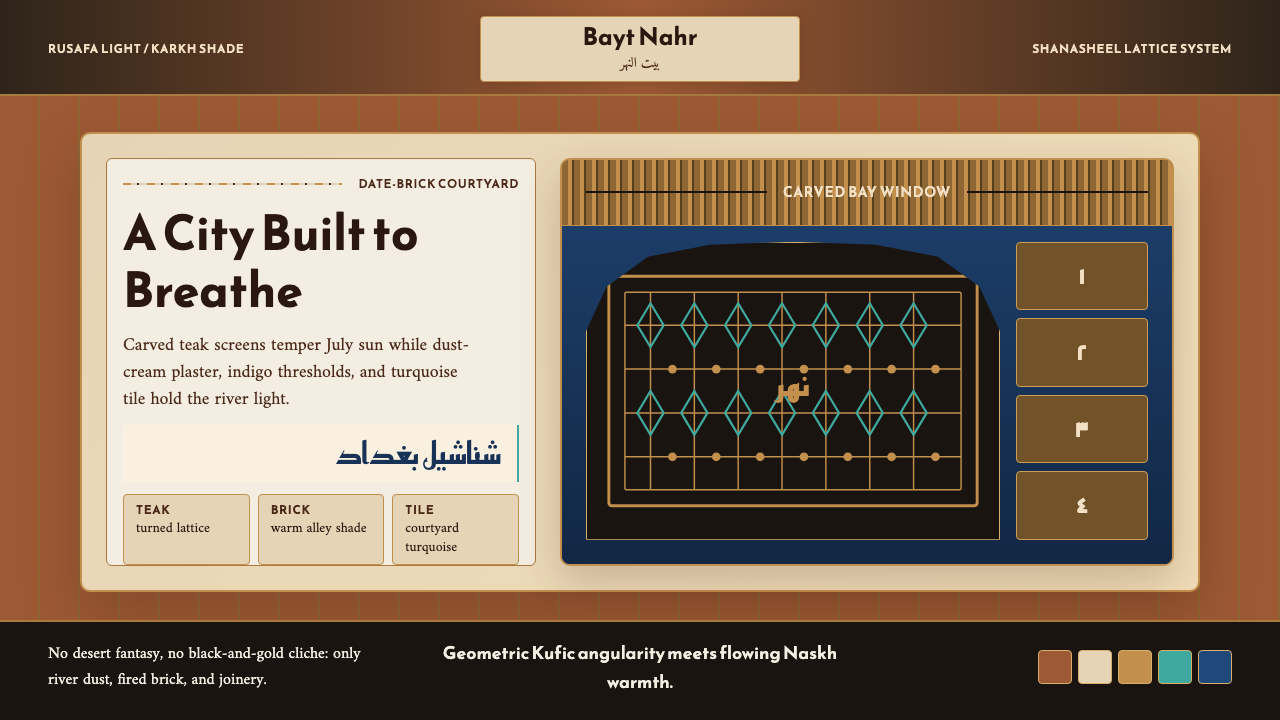 Iraqi Baghdad Shanasheel HouseBreathes through ornament. Date-brick ground, teak lattice, and turquoise til…
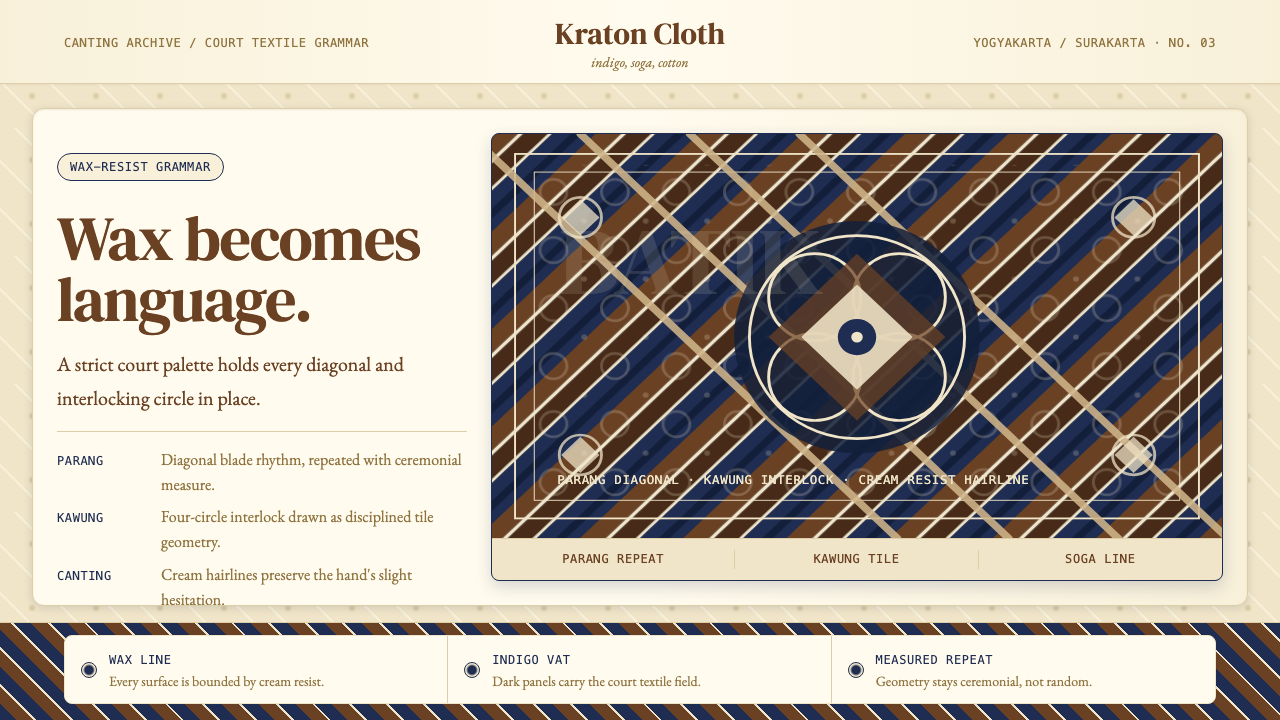 Javanese BatikCeremonial repetition. Indigo, soga, and cream frame a tiled canting motif.
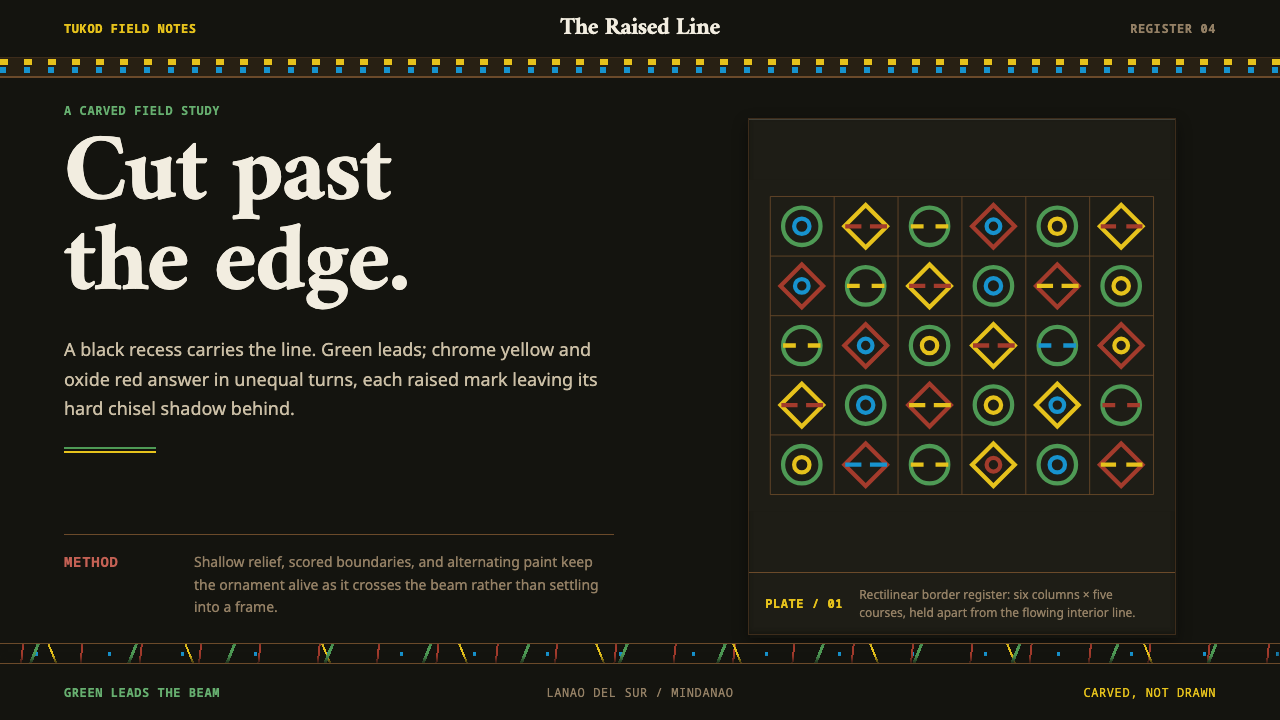 Maranao OkirCarving commands the field. Green, yellow and oxide-red lines rise from black…
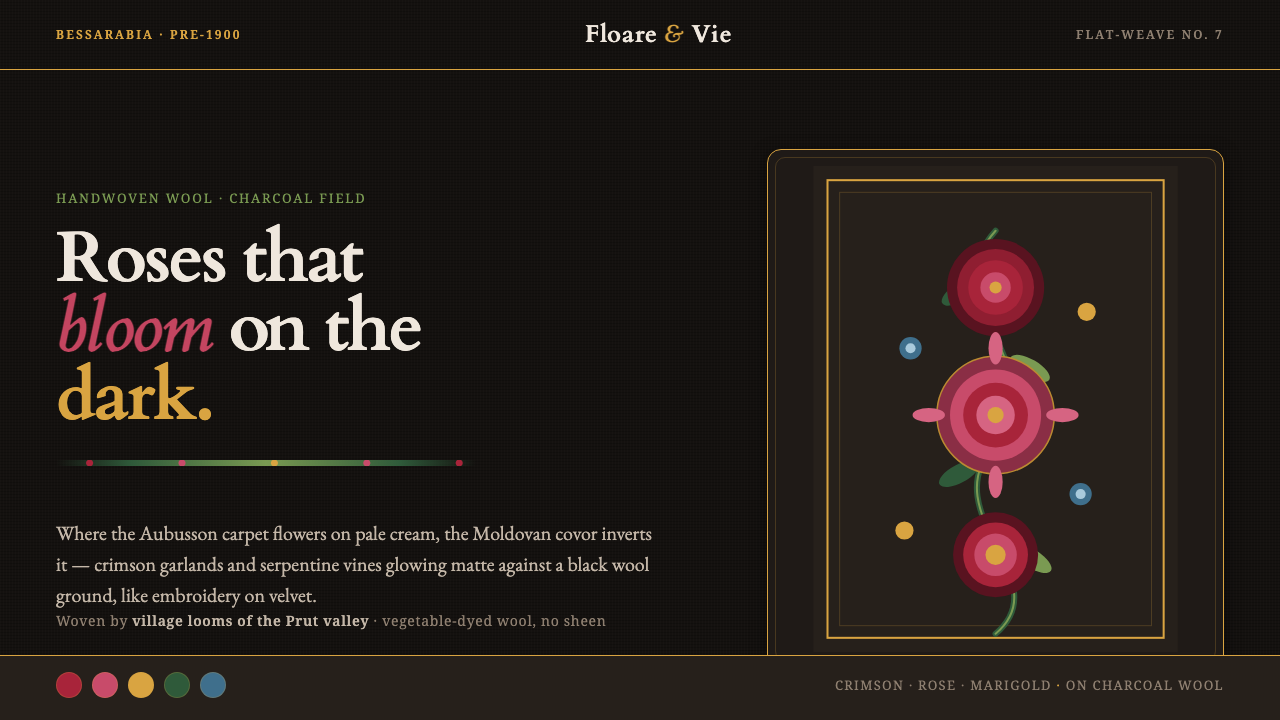 Moldovan Covor KilimRoses that bloom on the dark. Crimson garlands glow matte on a charcoal wool…
 Paraguayan Itauguá Ñandutí Spider LaceReverent craft glows. Snow lace medallions radiate over rose velvet with Guar…
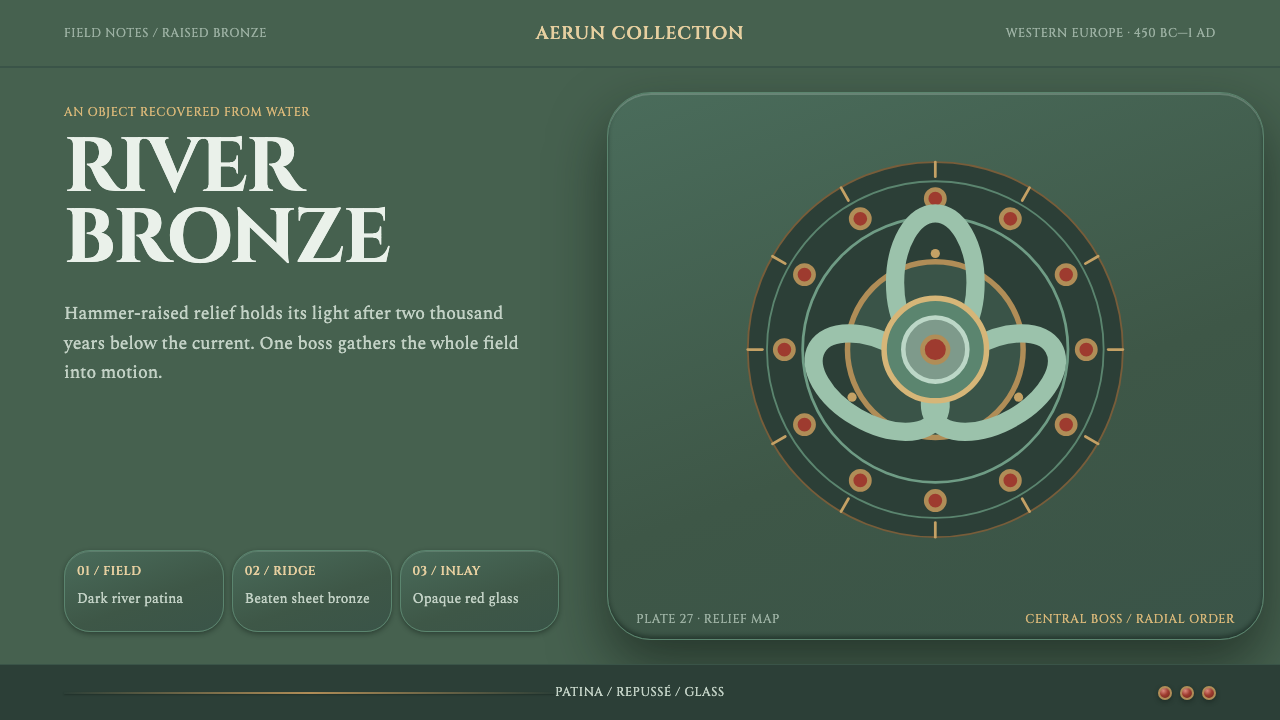 La Tène Celtic MetalworkMetalwork that still moves. Patina-green relief radiates from a bronze boss,…