What is Bengali Jamdani Muslin?
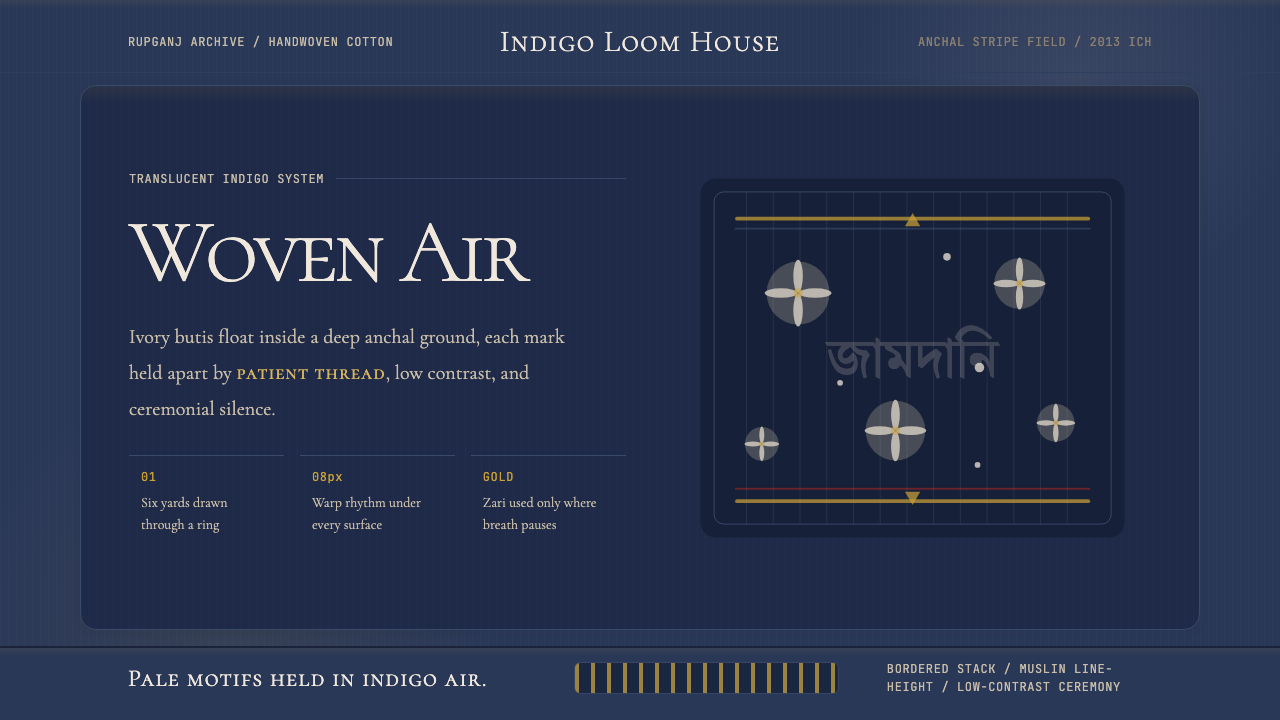
Jamdani is woven air — a tradition where ivory floral motifs appear to float inside indigo fabric so fine it was once called woven wind.
Bengali Jamdani Muslin in brief
Bengali Jamdani Muslin is one of the world's most refined textile traditions, originating in the Dhaka region of present-day Bangladesh. It is a form of figured muslin in which intricate floral and geometric motifs — known as butis — are woven directly into the cloth using a supplementary weft technique. Unlike embroidery, which adds thread on top of finished fabric, or printing, which deposits pigment on a surface, jamdani weaves its patterns into existence one thread at a time on the loom. The result is a textile where the decoration and the structure are inseparable: the motif is the cloth.
The visual character of jamdani is defined by its relationship between ground and figure. The base fabric is a pale, near-transparent muslin — sometimes so fine that six yards of sari cloth can pass through a finger ring — rendered in tones of natural cotton, dawn-grey, or deep indigo. Against this translucent ground, the supplementary weft threads form motifs of ivory, cream, or contrasting cotton. Because the ground fabric is sheer and the motif threads are slightly heavier, the patterns appear to hover inside the cloth, catching light differently from the weave around them. This pale-on-pale, float-within-float effect is jamdani's most distinctive quality.
The design system that emerges from this tradition is one of restrained luxury: deep indigo as the field, low-contrast botanical motifs as the surface language, and generous negative space as the organizing principle. It is a style defined not by boldness but by delicacy — by what can be seen only when held up to light, by the discipline of leaving most of the ground unmarked so that each worked motif reads with exceptional clarity.
Where does Bengali Jamdani Muslin come from?
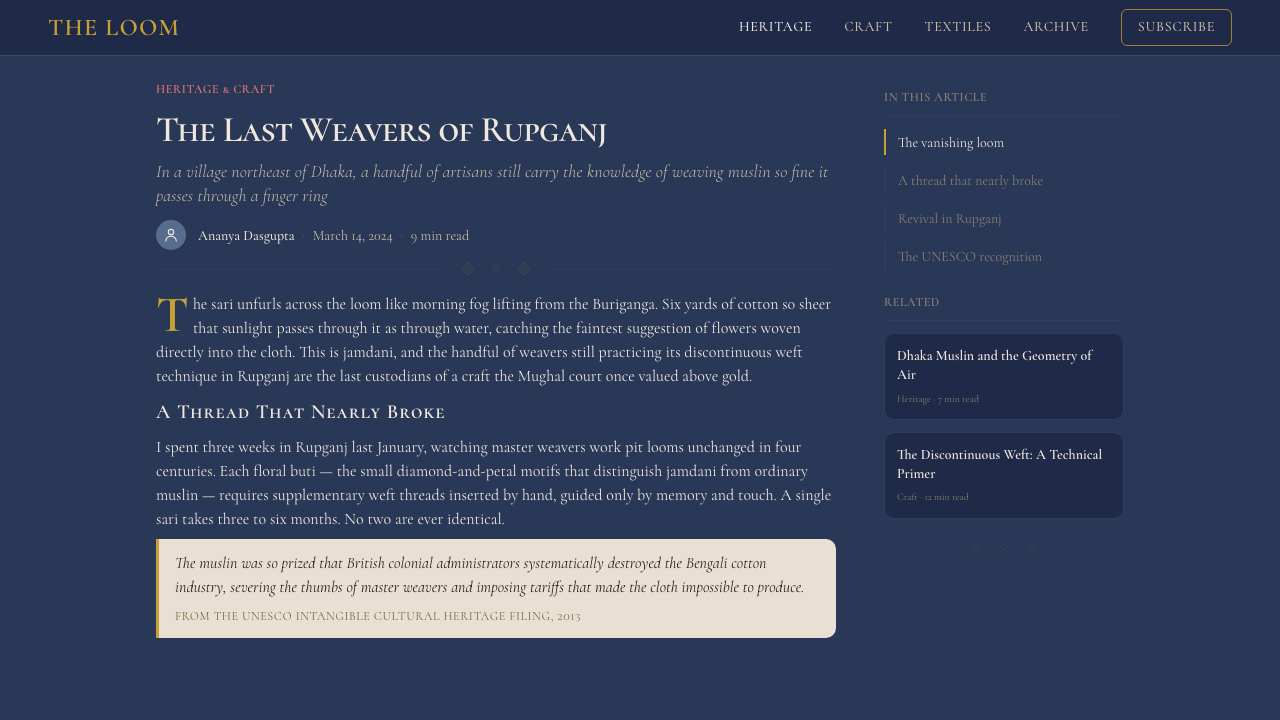
The earliest documented references to Dhaka muslin appear in accounts from ancient Indian and Arab traders who marveled at the near-invisible cloth produced in the Bengal delta. But it was under the Mughal emperors — particularly Akbar and Jahangir in the late sixteenth and early seventeenth centuries — that jamdani achieved its canonical status as a court textile. Mughal administrators established workshops in Sonargaon and the villages around Dhaka, where weavers worked under imperial patronage to produce muslin of increasingly extraordinary fineness. The cloth was given names that captured its almost impossible delicacy: woven air, running water, evening dew. Jamdani saris became gifts exchanged between emperors and offered as tributes at court.
The Persian word jamdani itself reveals the Mughal cultural context: jam means cup or goblet in Persian, and the suffix dani denotes a container or holder — the name suggests a vessel for beauty, a fabric that holds its patterned flowers as a cup holds wine. Weaving families developed their own pattern vocabularies passed down through generations, with motifs drawing from the Mughal garden aesthetic: flowering vines, stylized lotus blooms, the jaal lattice, and the booteh — the teardrop form that would later travel westward to become the paisley pattern of European textile trade.
The near-destruction of the tradition came in the nineteenth century under British colonial rule. The systematic dismantling of Mughal court patronage networks, combined with the flooding of Bengal markets with cheap machine-woven cloth from Lancashire mills, devastated the weaving communities of Dhaka. The finest muslin grades effectively ceased to be produced: the extreme fineness of historic Dhaka muslin required a specific humidity level found only in the mist-laden air near the Meghna and Brahmaputra rivers, and the weavers who possessed the physical skill — including uniquely fine fingertips — had little economic reason to transmit it. By 1850 the tradition had collapsed from its Mughal heights; by the late nineteenth century, historians noted that the finest historic grades could no longer be replicated.
Revival came in stages after the 1947 partition of British India and the 1971 independence of Bangladesh. Government programs, craft organizations such as the Bangladesh National Crafts Council, and researchers including Sonia Ashmore documented surviving weaving families and pattern archives. Activist and entrepreneur Ruby Ghuznavi became a key figure in connecting Dhaka weavers with contemporary markets. In 2013, UNESCO inscribed jamdani weaving on its Intangible Cultural Heritage list, a recognition that helped secure both international visibility and domestic state support. Today, active weaving communities continue in Rupganj, Sonargaon, and Phulia and Shantipur across the border in West Bengal, India, where a related tradition persists. The finest contemporary jamdani remains entirely handmade, with a single sari requiring months of collaborative work between two weavers seated at the same loom.
What defines the Bengali Jamdani Muslin look?
Color Field
The palette is built on deep indigo as the dominant ground — a rich, saturated blue-black derived from natural indigo dyeing on fine cotton. Against this dark field, motif threads in ivory, natural cream, or dawn grey create a characteristically low-contrast relationship. The effect is not bold contrast but luminous emergence: light figures floating within a dark ground, visible as much by texture and reflected light as by color difference. Secondary tones include the undyed natural cotton ground of traditional off-white jamdani, where motifs are only slightly heavier in thread weight, making them nearly invisible until the cloth moves.
Botanical Motifs
The buti — a small, self-contained floral or leaf motif — is the fundamental unit of jamdani pattern vocabulary. Butis are distributed across the cloth field in regular intervals, each one identical in design but placed by hand, producing a rhythm that is mechanical in intention but slightly organic in execution. Larger repeat patterns include the jaal, a continuous lattice of vines or flowering stems that covers the entire cloth like a transparent net. The anchal border at the sari's end concentrates the densest pattern work: a wide stripe of heavier supplementary weft forms stripes, chevrons, or massed butis that anchor the fabric's edge. All motifs are stylized rather than naturalistic — the lotus, vine, and leaf forms are geometric interpretations of botanical reality, not representations.
Translucency and Negative Space
The extraordinary fineness of jamdani ground fabric means that negative space is never truly empty — it is a field of near-visible air, a ground that admits light and reveals what lies behind it. This translucency shapes the entire visual system: compositions must breathe, dense patterning would obliterate the material's essential quality, and the unmarked ground between motifs is as deliberate and important as the motifs themselves. The principle that emerges is one of disciplined restraint: the ratio of worked surface to unworked ground is kept low, ensuring that each buti reads as precious and distinct rather than as part of a crowded allover pattern.
Woven Texture as Surface
In jamdani, the surface texture is the decoration. The supplementary weft threads that form motifs are slightly raised from the base weave, catching light at a different angle and creating a subtle dimensional quality without any added ornamentation. When the cloth moves, butis shift between visible and near-invisible as light strikes them from different directions. This play of presence and absence — motifs that reveal themselves only under certain conditions — defines the visual experience. Any design system derived from jamdani must honor this quality: texture, not color contrast, is the primary expressive tool.
Spacing and Rhythm
Jamdani's compositional structure is governed by regular interval and measured rhythm. Butis repeat at consistent distances, forming an implied grid across the cloth surface — but one that is felt rather than seen, since the ground fabric is not marked or divided. This sense of underlying order within apparent openness translates directly into layout principles: generous spacing between elements, consistent visual cadence, and a refusal to fill every available area. The border stripe — the anchal — functions as a clear framing device, concentrating dense pattern work at the edge while leaving the central field lightly populated.
Restraint and Low Contrast
Jamdani is fundamentally a pale-on-pale tradition. The most admired historic specimens are those in which the motifs are least distinguishable from the ground in static viewing — where the beauty reveals itself only through movement, light, and close examination. This aesthetic principle of deliberate low contrast runs counter to most design conventions that prioritize legibility and immediate impact. It asks for patience from the viewer and rewards sustained attention. In contemporary applications, this quality translates to color relationships that whisper rather than shout: barely-there tonal shifts, surfaces that reward closer inspection, and a general avoidance of stark dark-on-light or bright-on-dark contrasts.
Cultural Embeddedness
Unlike purely formal design languages, jamdani carries an irreducible cultural and geographical specificity. Its motifs — the booteh, the jaal, the flowering vine — are linked to Mughal court aesthetics, Bengali craft inheritance, and the specific ecology of the Dhaka riverine delta. This embeddedness means the style communicates origin and place as part of its meaning, in ways that purely geometric or abstract visual systems do not. When jamdani-derived aesthetics appear in design work, they carry implicit references to South Asian textile heritage, to handcraft and time-intensive making, and to a tradition of luxury that is ecological rather than industrial in character.

Who shaped Bengali Jamdani Muslin?
The master weavers who worked under Mughal imperial patronage in the sixteenth and seventeenth centuries are collectively responsible for establishing jamdani's canonical vocabulary. Working in the organized workshops of Sonargaon and Dhaka, they developed the pattern grammar — jaal, buti, anchal — that persists today. Their names are largely unrecorded in the historical archive, but their aesthetic decisions shaped a textile tradition that would be recognized four centuries later as a UNESCO Intangible Cultural Heritage. Mughal court records describe the presentation of jamdani to the emperor as gifts of exceptional value, positioning the weavers' skill as a form of imperial tribute.
Ruby Ghuznavi is among the most important figures in the contemporary revival of Dhaka muslin and jamdani weaving. Working from the 1980s onward as a textile activist and entrepreneur in Bangladesh, she established direct market relationships between traditional jamdani weavers — whose incomes were threatened by the availability of cheaper machine-made alternatives — and buyers in both domestic and international markets who valued handwoven cloth. Her work helped demonstrate that jamdani could sustain itself economically not through government subsidy alone but through authentic market demand for its irreplaceable qualities.
British textile historian Sonia Ashmore produced some of the most significant scholarly documentation of Dhaka muslin and jamdani in the modern period, drawing on collections held in UK museums and archives including the Victoria and Albert Museum. Her research traced the trajectory of Dhaka muslin from its Mughal heights through its colonial-era near-destruction and into its contemporary revival, connecting surviving physical specimens — some barely visible to the naked eye — to historical records of their production. This scholarly documentation became an important foundation for craft revival programs and for the UNESCO inscription application.
The Bangladesh National Crafts Council has served as an institutional anchor for jamdani preservation and promotion since Bangladesh's independence in 1971. The Council's work has included documenting surviving weaving families, supporting craft fairs and exhibitions that give jamdani access to contemporary buyers, advocating for the geographical indication status that identifies authentic Dhaka jamdani as a product of specific origin, and coordinating with UNESCO on the Intangible Cultural Heritage inscription that was granted in 2013. Its ongoing role involves balancing preservation of traditional techniques with the economic adaptations that allow weaving communities to survive in a changed market.
How do you use Bengali Jamdani Muslin today?
Jamdani as a design system rewards thoughtful application — it is a style built on qualities that have no shortcut: patience, restraint, and a willingness to let beauty emerge slowly rather than announce itself immediately. Applying it well means internalizing its core principle: the unmarked ground is as important as the worked surface, and low contrast is a feature rather than a failure.
For presentation slides, jamdani offers a distinctive alternative to high-contrast, bold-typography approaches. A cover built on this system works with a deep indigo or near-black field, ivory or cream title type that sits low-contrast against it, and a single botanical motif — isolated, not repeated — as the primary visual element. The effect is closer to a luxury textile label or a museum catalog than to a standard corporate deck. Content slides benefit from generous line spacing and wide margins that honor the negative-space principle: text should not crowd the frame. If color is used to differentiate data or sections, it should come from the jamdani tonal range — pale ivories, soft greys, muted indigo — rather than from saturated bright colors that would break the palette's quiet authority.
For web interfaces, the style is best suited to contexts where considered, unhurried experience is the desired quality: cultural institutions, craft and luxury brands, editorial platforms, or any product that wants to communicate heritage and handcraft. Dashboard and data-heavy applications are less natural fits — the deliberately low contrast and restrained color range can reduce the immediate scannability that data interfaces require. Where jamdani aesthetics do appear in web UI, they work best in hero sections, landing pages, and feature introductions where a slower, more immersive quality is appropriate. Navigation and interactive elements should use a slightly higher-contrast treatment of the same palette to ensure usability without breaking the visual system.
For editorial and marketing work, the style has natural affinity with textile, fashion, South Asian heritage, cultural tourism, and artisan craft categories. A jamdani-derived layout for a print editorial might use an indigo ground at section dividers, with near-white text set at generous measure and leading. Marketing pages can use the buti as a recurring decorative element — small, isolated, and placed with intention — rather than as a pattern fill. The anchal border logic translates to page design as a concentrated header or footer stripe where pattern density increases, framing an otherwise open composition.
A common mistake when applying jamdani aesthetics is over-saturating the palette or increasing contrast to compensate for perceived visual weakness. The instinct to make things more readable, more impactful, or more immediately attention-commanding works directly against the tradition's essential quality. Reaching for brighter ivories, adding text outlines, or darkening indigo toward pure black all represent departures from the source aesthetic. The style requires trust in subtlety: if it reads as almost-invisible at first glance, that is correct. The second look is where jamdani lives.
Bengali Jamdani Muslin — FAQ
What makes jamdani different from other Indian subcontinent textile traditions?
The defining distinction is the supplementary weft technique applied to muslin of extraordinary fineness. In most South Asian figured textiles — brocades, ikats, block prints, embroideries — the pattern is either structurally integrated into a heavier cloth or added to the surface after weaving. Jamdani's patterns are woven in during the making of a base cloth so fine it is nearly transparent, meaning the decorative element and the structural element are inseparable, yet the ground fabric itself carries no pattern at all except where the supplementary thread intervenes. This creates a visual quality — patterns that float within rather than on the surface — that no other textile technique exactly replicates.
Can jamdani aesthetics work for dark-background digital interfaces?
Dark backgrounds are actually the tradition's home territory. The canonical jamdani palette begins with deep indigo — a dark, saturated ground — so applying the aesthetic to dark digital interfaces is historically grounded rather than a forced inversion. The key is preserving the low-contrast relationship between ground and figure: ivory or pale grey text and motifs against near-black should maintain a whisper-level contrast rather than pushing toward full white-on-black legibility. The challenge in digital contexts is that accessibility standards for body text require legibility ratios that the jamdani palette's subtlety can violate. The solution is to reserve the low-contrast approach for decorative elements and headings while ensuring body text meets accessibility requirements — a practical adaptation that honors the spirit if not the exact letter of the tradition.
How does the jamdani booteh relate to the Western paisley pattern?
The booteh — a stylized teardrop or bent-tip floral motif — traveled from Mughal textile traditions into European consciousness through the Kashmir shawl trade of the eighteenth and nineteenth centuries. European manufacturers in Paisley, Scotland (and later elsewhere) copied the booteh form onto machine-woven textiles, giving it the name by which it is known in the West. The European paisley is a simplified, often more symmetrical and more densely repeated version of the original Mughal form. In jamdani, the booteh appears as an isolated, carefully spaced buti — a single motif in dialogue with ground — rather than as the allover tiling pattern that European paisley typically produces. Understanding this history matters for design application: using jamdani aesthetics is not the same as using paisley, and conflating the two produces a muddy cultural reference.
Why is jamdani associated with darkness and indigo rather than lighter natural cotton tones?
Historic jamdani existed across a range of grounds — the finest and most celebrated specimens were often the undyed natural cotton, which produces the subtle off-white-on-off-white effect that requires light and movement to see at all. The association with indigo comes from the anchal, the ornate border stripe of a jamdani sari, which frequently employed indigo-dyed grounds to create a contrasting frame around the lighter field. In the design system derived from jamdani, the indigo ground is emphasized because it translates most directly to digital and screen contexts: the near-black indigo field creates a rich, non-harsh dark surface that feels consistent with the textile's sensory qualities — deep, resonant, and associated with natural dye rather than industrial printing. The choice is an interpretation of the tradition rather than a strict reproduction.
How does jamdani navigate the tension between cultural specificity and broad design application?
This is among the most honest questions to ask of any culturally specific design tradition. Jamdani is not a universal formal language like grid-based Swiss typography or constructivist geometry — it carries specific cultural meanings tied to Bengali heritage, Mughal court aesthetics, and the living craft communities of Bangladesh and West Bengal. Applying it without awareness of this context risks reducing it to surface texture — indigo fields and ivory dots — disconnected from its meaning. The responsible path is to understand what the tradition is doing aesthetically and why, and to apply its principles — restrained luxury, disciplined negative space, low-contrast surface richness — with awareness of their origin. Attribution in design contexts, honest acknowledgment of sources, and avoiding the reduction of the tradition to pastiche are all part of working with culturally embedded aesthetics in good faith.
Related design styles
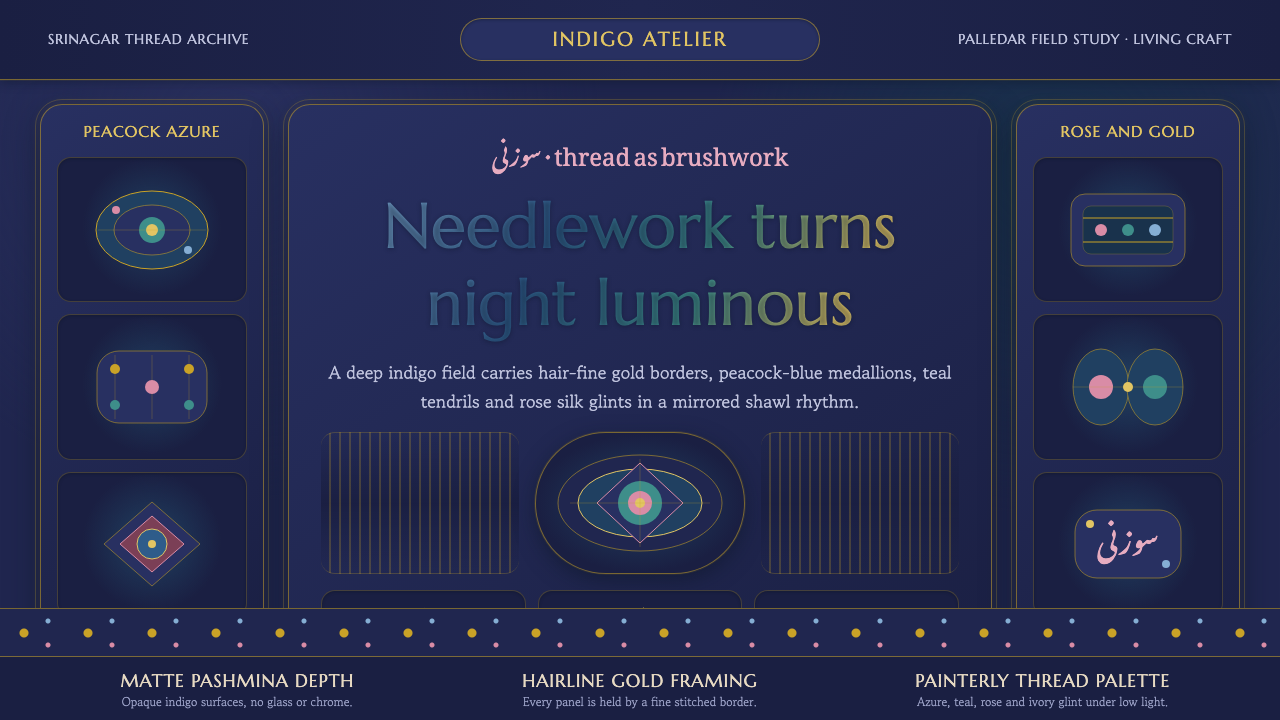 Kashmiri Sozni Shawl EmbroideryNight made luminous. Indigo ground, gold hairlines and silk medallions stitch…
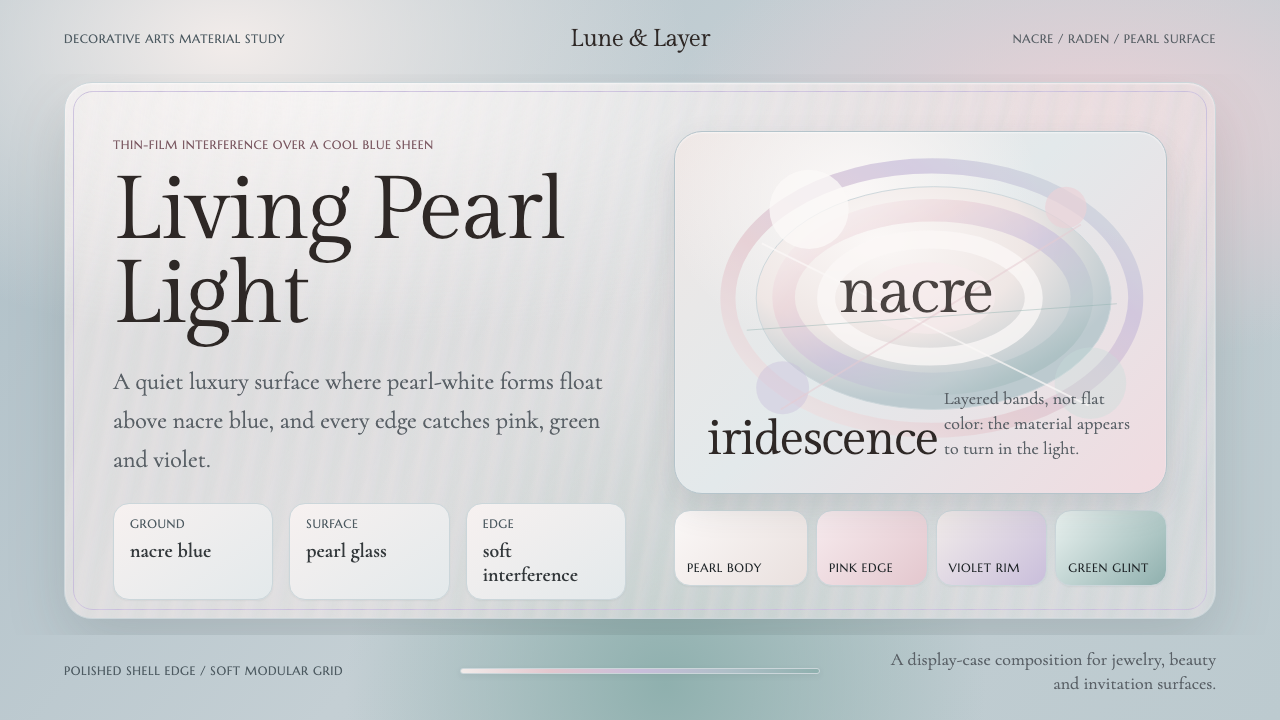 Mother-of-Pearl NacreQuietly expensive shimmer. Nacre blue ground with pearl panels and pink-viole…
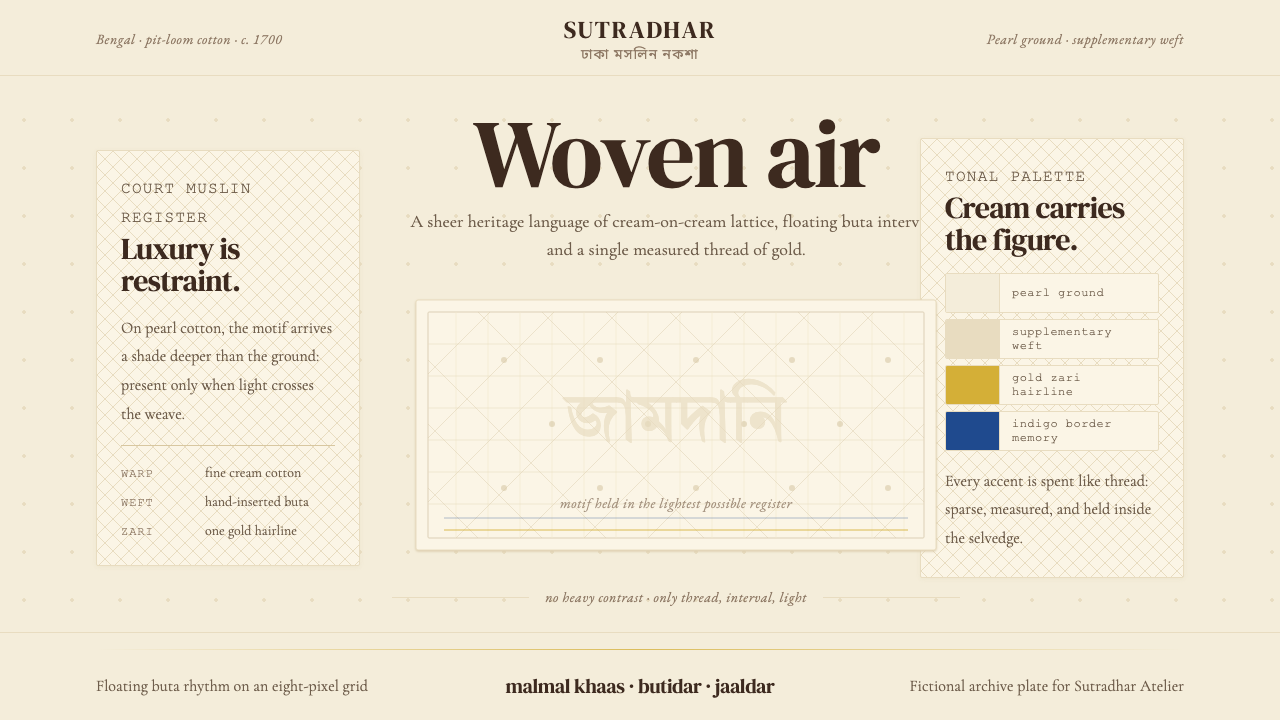 Bengali Jamdani WeavingLuxury whispers. Pearl cream, tonal buta, and one gold hairline make woven ai…
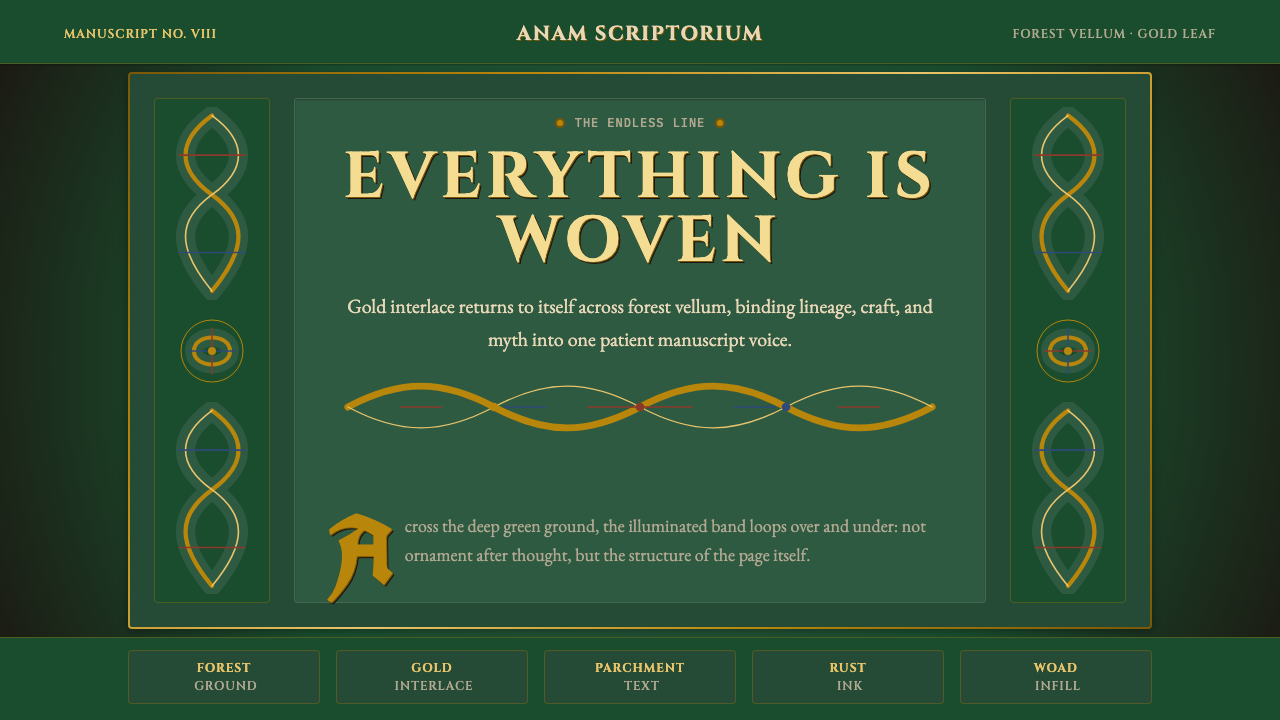 Celtic KnotworkEverything is connected. Gold Cinzel interlace frames forest-green vellum.
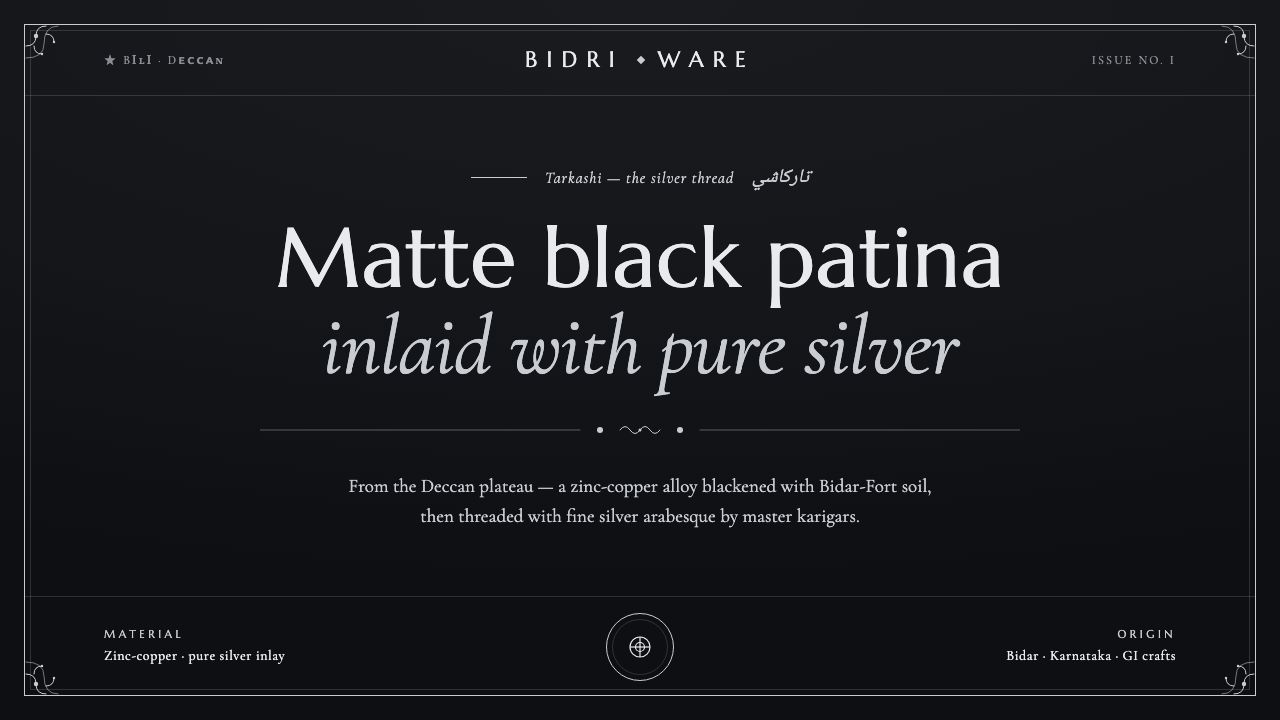 Bidriware Black MetalMonochrome luxury, hammered by hand. Matte-black Deccan patina threaded with…
 Georgian Minankari CloisonnéJewel-deep and wire-fenced. Lapis enamel, gold seams, emerald cells, glossy s…