What is Maharashtra Paithani Peacock Saree?
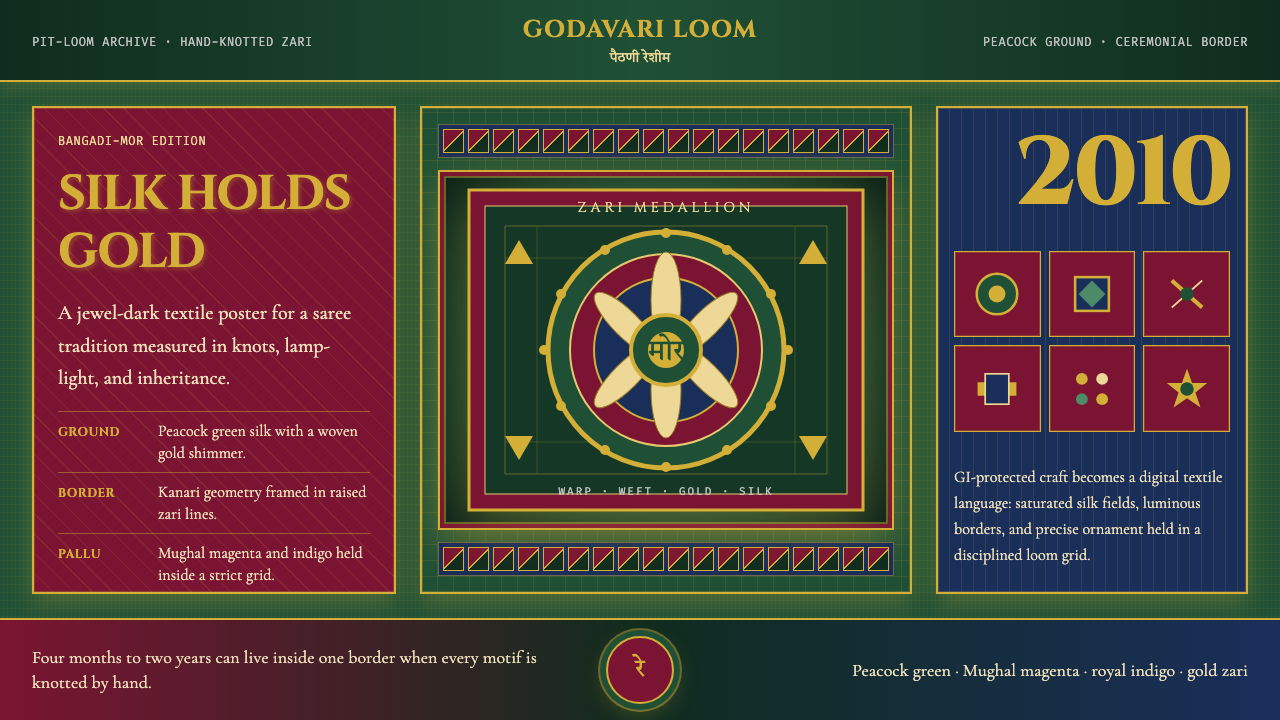
Paithani silk weaves two thousand years of Maharashtrian ceremony into every thread — peacocks, gold zari, and jewel-saturated color that makes digital flatness feel like an apology.
Maharashtra Paithani Peacock Saree in brief
Maharashtra Paithani Peacock Saree is a design tradition rooted in one of India's oldest and most technically demanding handwoven textiles: the Paithani saree, made in the town of Paithan on the banks of the Godavari River in Maharashtra. The style takes its name from the most iconic motif in the Paithani vocabulary — the peacock, rendered in gold zari thread against fields of saturated silk — and translates the saree's material grandeur into a complete visual system for contemporary surfaces.
The aesthetic is defined by opulence that feels earned rather than applied. Where many decorative traditions use ornament to fill space, Paithani ornamentation carries structural weight: the bangadi-mor (peacock-in-circle) motifs that anchor each saree's pallu (end panel) and the kanari (border) function like architectural keystones, giving the composition both rhythm and gravity. Translating this into a design system means treating ornamental elements as load-bearing rather than cosmetic — borders do not decorate edges, they frame and contain; motifs do not scatter, they anchor.
The color language is anchored by peacock green — a deep, iridescent teal that shifts in quality depending on context — supported by Mughal magenta as the dominant warm accent and gold as the universal highlight. Surfaces carry the visual weight of woven silk rather than printed pigment: backgrounds suggest depth and sheen, not flatness. This is a style fundamentally about material richness, and every design decision should ask whether it honors or cheapens the underlying sensibility.
Where does Maharashtra Paithani Peacock Saree come from?
The Paithani tradition traces its origins to the Satavahana dynasty, which ruled the Deccan plateau from roughly 200 BCE onward and made Paithan — then known as Pratishthana — a major center of trade, scholarship, and textile production. Historical accounts and artifacts suggest that silk weaving with gold thread was practiced here for centuries before the tradition received its formal name. The town's position on the Godavari River made it a crossroads for raw silk arriving from Bengal and China and gold thread spun from wire drawn in regional workshops.
The tradition reached its most celebrated height during the Peshwa period (1707–1818), when the Maratha Confederacy's prosperity brought the sarees into the courts and ceremony halls of Maharashtra's nobility. Peshwa patronage drove refinements in both the complexity of motifs — the peacock-in-circle became a hallmark of prestige — and the quality of silk and zari sourced for master weavers. A fully worked Paithani from this period, with its oblique-twill silk ground and individually hand-knotted gold motifs, could take a master weaver and his family one to two years to complete. These were not garments; they were heirlooms.
The Mughal influence on Paithani is visible in the magenta and ruby tones that enter the palette alongside the older jewel greens and ochres. As the Deccan courts engaged with Mughal aesthetics during the sixteenth and seventeenth centuries, saree colorways absorbed the richer, warmer range associated with Mughal court dress while retaining the structural density of the indigenous weaving tradition. The result was a hybrid aesthetic — as opulent as Mughal miniature painting, as structurally intricate as Deccan stone carving.
Following a period of decline in the nineteenth and early twentieth centuries — a consequence of cheaper imported textiles and the disruption of traditional patronage networks — the tradition was revived through sustained government and institutional support. The Maharashtra State Handicrafts Development Corporation, scholars like Mira Seth who documented India's surviving handloom traditions, and individual master weavers like those in the Desai lineage worked to restore both the technical knowledge and the market for authentic Paithani. Geographical Indication protection was granted in 2010, legally defining the region, materials, and techniques that qualify a saree as a genuine Paithani — a recognition that the tradition is as much intellectual property as it is craft.
What defines the Maharashtra Paithani Peacock Saree look?
Color Palette
The palette centers on peacock green — a deep, shifting teal evoking the iridescent plumage of the Indian peafowl — and is supported by Mughal magenta, a warm saturated rose-violet that functions as the dominant card and surface color, and gold, which appears as highlight, border, and typographic accent. Secondary tones include deep indigo and ruby, borrowed from other traditional saree colorways. The overall effect is of saturated jewel tones that hold their depth even in digital rendering, never washing out into pastels.
Ornamental Borders
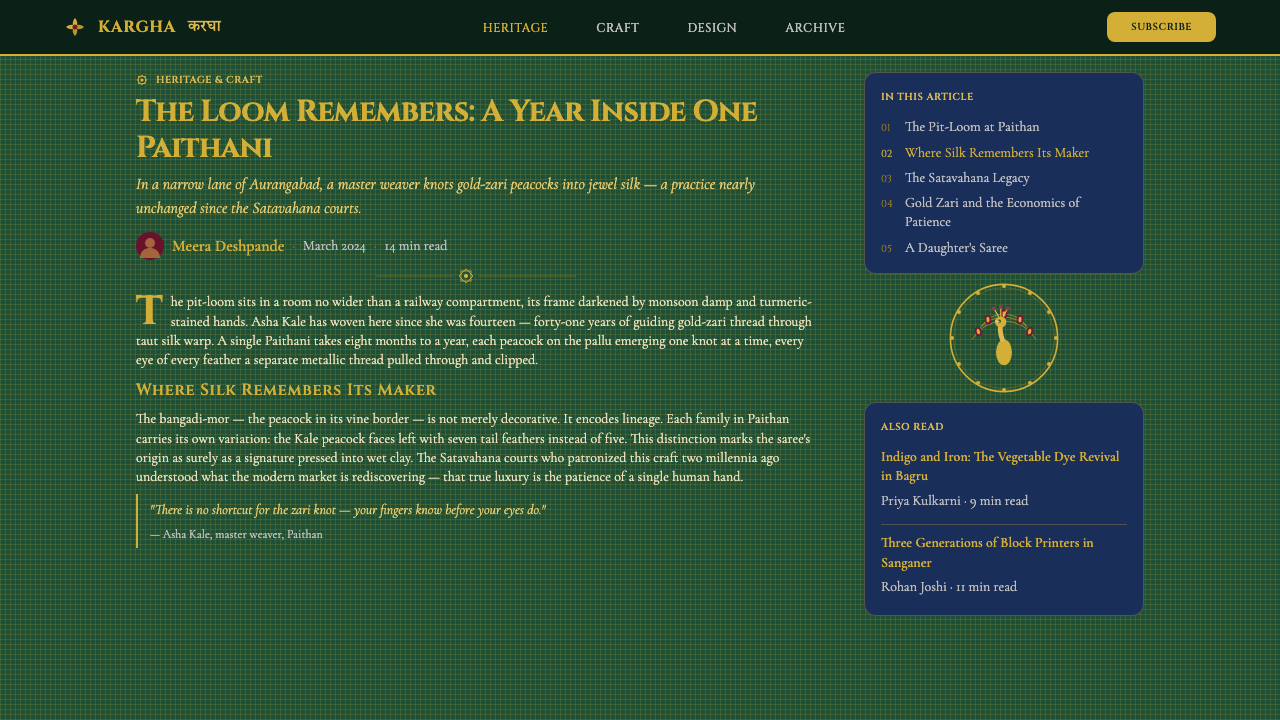
The Paithani's kanari (side border) and pallu (end panel) are not afterthoughts — they are the saree's primary sites of compositional complexity, where the densest zari work is concentrated. In digital translation, borders carry this same structural authority: they are wide, elaborately patterned, and optically active, functioning as internal frames that give compositions a sense of enclosure and formality. A border in this system is never a thin line; it is a zone of visual density that separates interior from exterior space.
Peacock and Floral Motifs
The bangadi-mor — a peacock rendered within a circle — is the Paithani's most prestigious motif, appearing on the finest sarees as a marker of master weaving. Alongside it, lotus flowers, parrots, and stylized vine-and-leaf patterns build a secondary vocabulary of natural forms. In digital application, these motifs are used as focal ornaments rather than tiling patterns: a single large peacock motif might anchor a hero section, while lotus-derived geometric rosettes appear at corner intersections of grid layouts, reinforcing rhythm without overwhelming legibility.
Gold Zari as Typography Accent
In the original saree, gold zari thread is knotted into the silk ground to create raised, gleaming motifs that catch and scatter light. In typographic terms, this translates to letterforms and display text treated as luminous rather than flat: headline type carries an implied shimmer through careful use of weight contrast, drop shadows that suggest metallic relief, or outline strokes in warm gold tones. Body text remains restrained — dark silk-colored ink on a jewel-toned ground — reserving the zari effect for titles, pull quotes, and navigational waypoints.
Jewel-Ground Depth
Paithani silk grounds are not merely colored — they are luminous from within, because the silk fiber itself refracts light differently from every angle. Digital surfaces cannot replicate this literally, but they can evoke it through layered depth: card surfaces sit slightly above backgrounds, casting soft warmth-toned shadows; backgrounds carry a subtle directional sheen suggesting woven texture rather than printed ink. The goal is never to simulate silk literally but to communicate the quality of weight, depth, and material intention that the original conveys.
Symmetry and Ceremonial Formality
Unlike modernist design traditions that favor asymmetric dynamism, Paithani compositions are broadly symmetrical along the vertical axis — a reflection of the saree's bilateral structure and its use in ritual contexts where balance signals honor and completeness. Page layouts in this system tend toward centered hierarchy: a central motif or title flanked by balanced ornamental fields, navigation elements that mirror across a midline, and section breaks marked by symmetrically composed dividers rather than raw horizontal rules.
Dark Ground, Light Ornament
The most celebrated Paithani sarees use a dark jewel-toned ground — deep peacock green, royal indigo, or black-shot teal — against which gold zari and lighter silk motifs gleam. This reversal of the Western figure-ground convention (light background, dark type) is fundamental to the aesthetic: the depth comes first, and the ornament is revealed against it, like gold threading visible only when the fabric is held to light. This makes the Paithani system naturally suited to dark-mode digital environments, where the same reveal logic applies.
Who shaped Maharashtra Paithani Peacock Saree?
A practicing master weaver from the Paithan region whose family has sustained the tradition across multiple generations, Madhuri Desai represents the lineage of craft knowledge through which the most technically demanding aspects of Paithani weaving — the precise knotting of zari motifs, the maintenance of the oblique-twill silk ground — have been transmitted. Practitioners like Desai are the living archive of the tradition, and their continued work is what makes authentic Paithani distinguishable from mechanized imitations.
An IAS officer and scholar who devoted decades to documenting and advocating for India's handloom traditions, Mira Seth's work — particularly her multi-volume study of India's textile heritage — helped establish the academic and policy framework through which traditions like Paithani received institutional support and international recognition. Her research made visible the economic and cultural stakes of handloom decline at a time when policy attention was oriented toward industrial textile production.
The governmental body most directly responsible for the post-Independence revival and institutionalization of the Paithani tradition. Through procurement programs, weaver cooperatives, design training, and market linkage efforts, the MSHDC helped ensure that master weavers had both a viable livelihood and access to the quality materials — particularly high-grade silk and genuine gold zari — required to maintain the tradition's standards. The Corporation's role in navigating the Geographical Indication application in 2010 codified protections that continue to define what may legally bear the Paithani name.
Though not individual figures in the modern sense, the Satavahana rulers (c. 200 BCE – 200 CE) created the material and economic conditions under which the Paithani tradition first emerged. By making Paithan a major trading city on the Godavari River, the dynasty enabled the convergence of raw silk from distant sources, gold-working expertise, and a court culture that valued and commissioned fine textiles. The tradition's two-thousand-year continuity is inseparable from the infrastructure the Satavahanas established.
The Peshwa rulers of the Maratha Confederacy (1707–1818) were the tradition's most important historical patrons, transforming Paithani from a regional craft into a national prestige object. Their courts created demand for the most complex and time-intensive sarees — particularly those featuring the bangadi-mor — and their wealth funded the importation of the finest gold wire from which zari thread was drawn. The Peshwa period established the technical and aesthetic standards against which authentic Paithani has been measured ever since.
How do you use Maharashtra Paithani Peacock Saree today?
The Paithani Peacock Saree style is among the most rewarding historical aesthetics to apply digitally, precisely because it operates on principles opposite to modernist minimalism. Where minimal styles succeed through absence, this style succeeds through accumulation — but accumulation that is internally structured, not chaotic. Applying it well requires understanding the difference between richness and clutter, and maintaining that distinction rigorously across every surface.
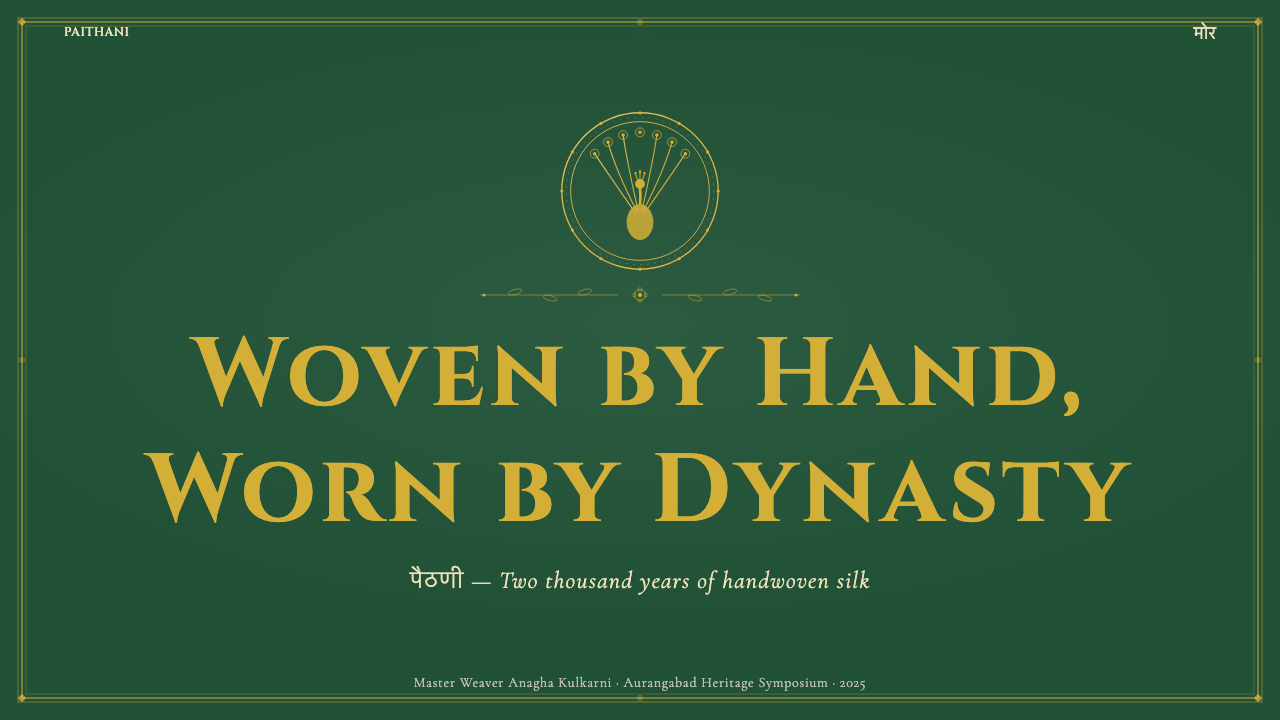
For presentation slides, the system works with particular strength on ceremonial or high-stakes contexts: annual reviews, keynote addresses, cultural institution presentations, or any situation where gravitas and pride of craft are the intended emotional register. A cover slide benefits from a full jewel-toned background — deep peacock green or Mughal magenta — with a centrally composed title in gold-toned type, flanked by symmetrical ornamental border elements drawn from the kanari tradition. Content slides should restrain the ornament: a single zari-style border running along one edge, text in a clean legible weight on a slightly lighter ground, and data visualizations that treat bar segments and chart elements as motif-like blocks of color rather than generic chart defaults.
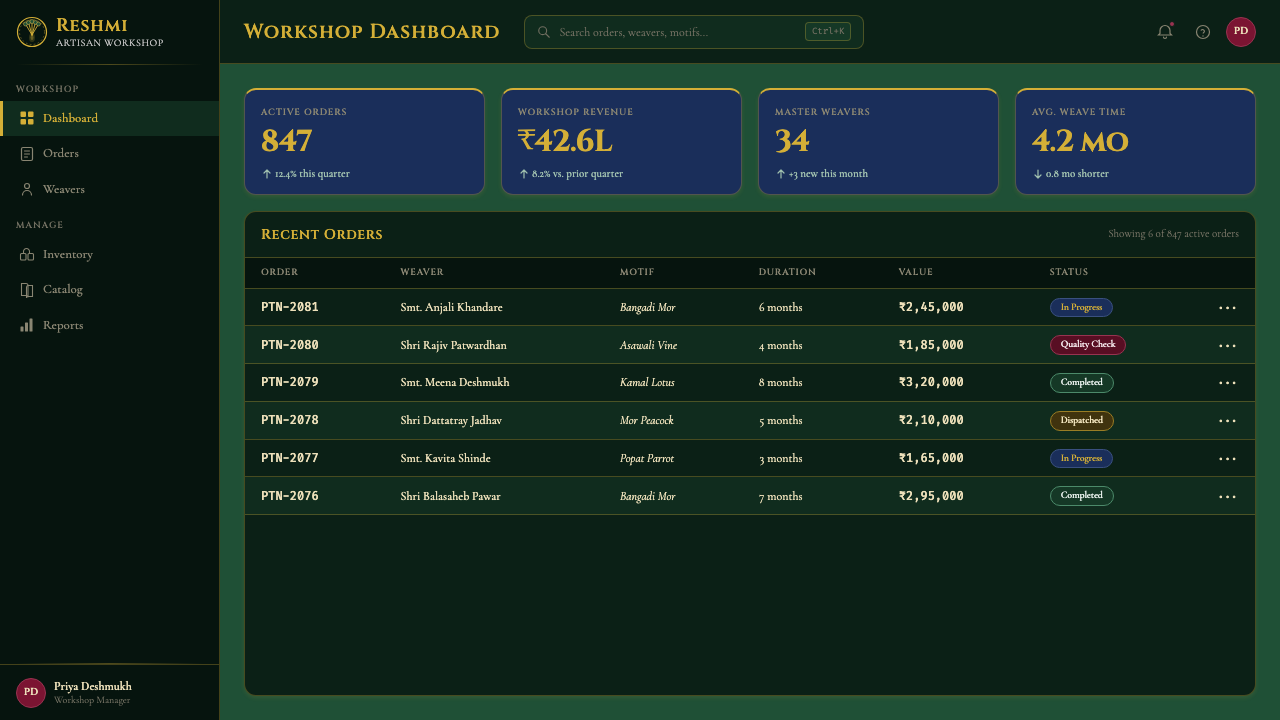
For web dashboards and interfaces, the style calls for a different calibration than minimalist systems. Navigation bars carry weight — either a deep jewel-toned background or a prominent gold-accented top border. Card components sit against a slightly warmer background and cast warmth-toned shadows suggesting elevation. State changes — hover, active, selected — use the gold accent rather than generic blue to communicate interaction. The system is particularly well suited to cultural platforms, luxury commerce, editorial publishing, and any interface where the product's value is explicitly tied to heritage, craft, or aesthetic distinction.
For editorial and marketing contexts, the Paithani system supports layouts where imagery and text share visual weight rather than imagery dominating by default. A long-form article could open with a full-bleed jewel-toned header block carrying the title in zari-style type, then transition to a lighter reading surface for body content, with ornamental drop caps or pull quotes rendered in the gold-and-green palette to recall the opening register. Marketing pages can use the style's inherent sense of ceremony to frame product launches or collection introductions — each section separated by a border element that mimics the pallu's transition between body and end panel.
The most common mistake when applying this style is treating it as a pattern library rather than an integrated system. Dropping peacock motifs onto an otherwise neutral interface does not produce a Paithani aesthetic — it produces a decorated neutral interface. The style's power comes from its internal consistency: every surface, every shadow, every typographic choice, every color selection should share the same material logic. A second common mistake is over-saturating all surfaces simultaneously. In the original saree, the deepest saturation is concentrated in specific zones — the pallu, the kanari — while the silk ground elsewhere is rich but not blinding. The same zoning discipline should apply digitally: choose one or two dominant surfaces to carry full jewel intensity, and let supporting surfaces be warmer and slightly quieter.
Maharashtra Paithani Peacock Saree — FAQ
How does the Paithani style differ from other South Asian textile-inspired design aesthetics?
The most important distinction is the Paithani system's structural use of ornament. Many South Asian textile-inspired aesthetics use pattern as surface decoration — applied over a layout rather than integrated into its architecture. Paithani, by contrast, places its ornamental density at structurally significant zones: borders function as frames, not decoration; motifs anchor focal points rather than tiling fields. The palette is also distinctive: while many related aesthetics use warm ochres, terracottas, and reds as dominant tones, Paithani centers on the cool jewel intensity of peacock green against warm magenta — a tension that gives the style its particular visual energy.
Is this style appropriate for interfaces that need to be highly functional and information-dense?
It can be, but it requires disciplined zoning. The Paithani visual system is not inherently incompatible with high information density — the saree itself packs enormous visual complexity into a coherent whole — but that coherence depends on having clear zones of rest and zones of richness. In a dense interface, apply the ornamental intensity to structural elements: navigation frames, section headers, key metric displays. Keep reading surfaces — body text areas, data tables, form fields — restrained, using the jewel-toned palette as depth and color rather than ornament. The style works against legibility only when ornamental and functional elements compete for the same visual plane.
What distinguishes authentic use of this style from kitsch or cultural appropriation?
The distinction lies primarily in intentionality and structural understanding. Kitsch treatment of Paithani aesthetics typically reduces the tradition to its most recognizable surface features — the peacock motif, the jewel colors — applied without understanding the compositional logic that makes those features meaningful in context. A peacock dropped onto a generic card component is decoration; a peacock motif used to anchor a compositional zone, flanked by border elements that reference the kanari structure, within a palette that maintains the silk-and-gold material register, is design reasoning. Cultural appropriation becomes more fraught when the aesthetic is used to sell products unrelated to the tradition without acknowledgment; using it thoughtfully in educational, cultural, or design contexts — with accurate attribution — occupies different ethical ground.
Can this style work in a light-mode context, or is it inherently a dark-background system?
The tradition's most celebrated expression uses dark jewel-toned grounds, and the digital system is strongest in that mode — dark backgrounds allow the gold and ornamental elements to gleam as they do in the physical textile. However, a light-mode variant is workable. The key is to preserve the richness by using warm ivory or deep cream rather than flat white as the background, and to increase the weight of the gold and magenta accents so they read with sufficient presence against the lighter field. Light-mode Paithani tends to feel more like a daytime ceremonial aesthetic and less like the deep nocturnal glamour of the dark variant. Both are valid; the choice should reflect the emotional register the product needs to occupy.
How should motion and animation be handled in a Paithani-inspired interface?
Motion in this system should reference the quality of the textile itself: the slow, weighted reveal of a saree unfolding rather than the rapid, bouncy transitions of contemporary digital defaults. Entrances should be deliberate — elements that emerge into view from behind a border, or unfold from a central anchor point — rather than sliding in from off-screen without ceremony. Gold accent elements can carry a subtle shimmer or sheen transition on interaction, evoking the way zari thread catches light at different angles. What to avoid entirely: jittery or fast-paced micro-interactions that undercut the system's sense of weight and deliberateness, and decorative animations applied to every element simultaneously — save motion for moments of transition and emphasis, and let the composition itself carry the visual energy between those moments.
Related design styles
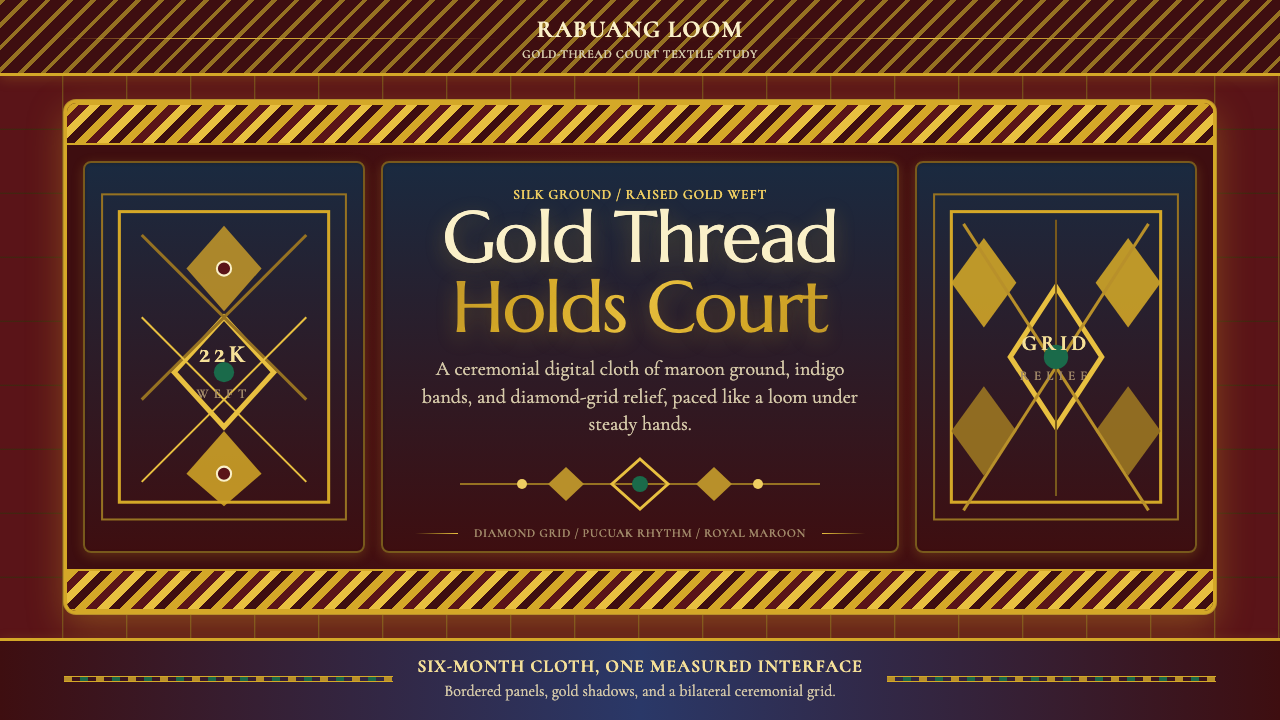 Sumatran Songket (Pandai Sikek)Courtly weight glows. Maroon silk, Cormorant small caps, and gold diamond gri…
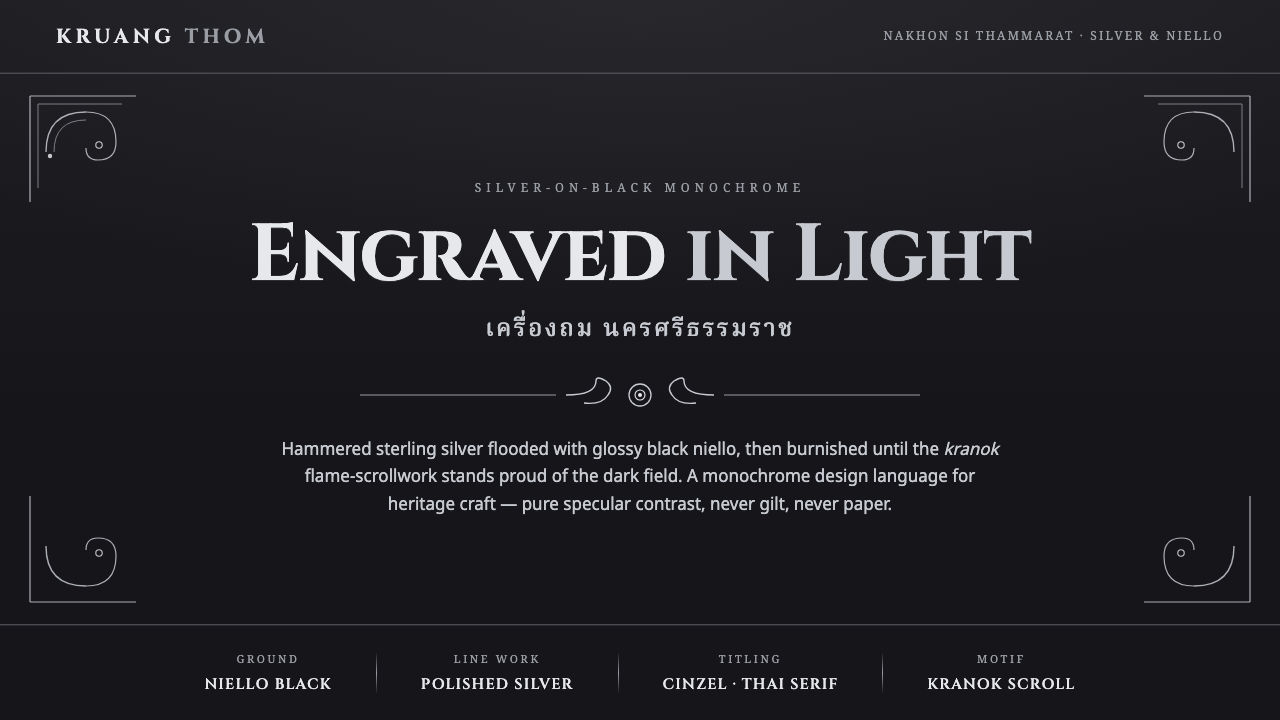 Thai Nielloware ThomSilver-on-black, never gilt. Polished kranok scrollwork glints proud of a glo…
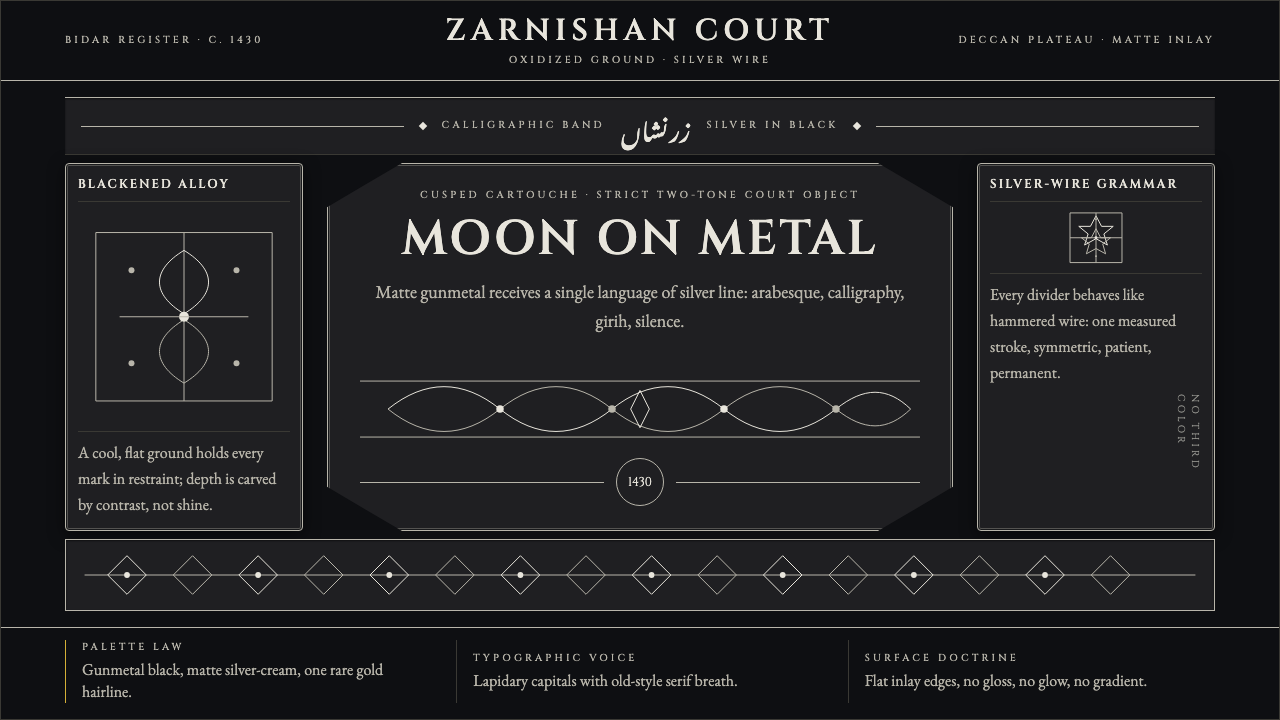 Bidri Deccan MetalworkCourtly darkness, tooled by silver. Cinzel caps and hairline arabesques cut g…
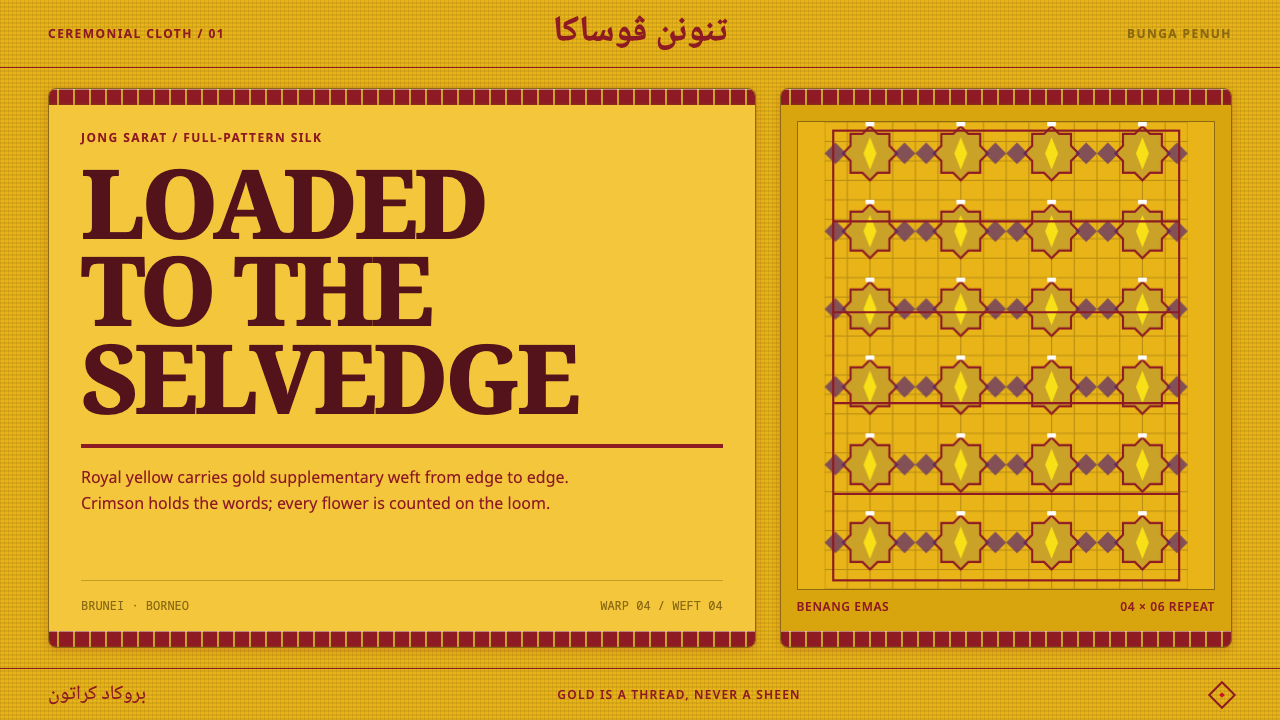 Bruneian Jong SaratNo resting ground. Royal yellow and thread-built gold pack every stepped repe…
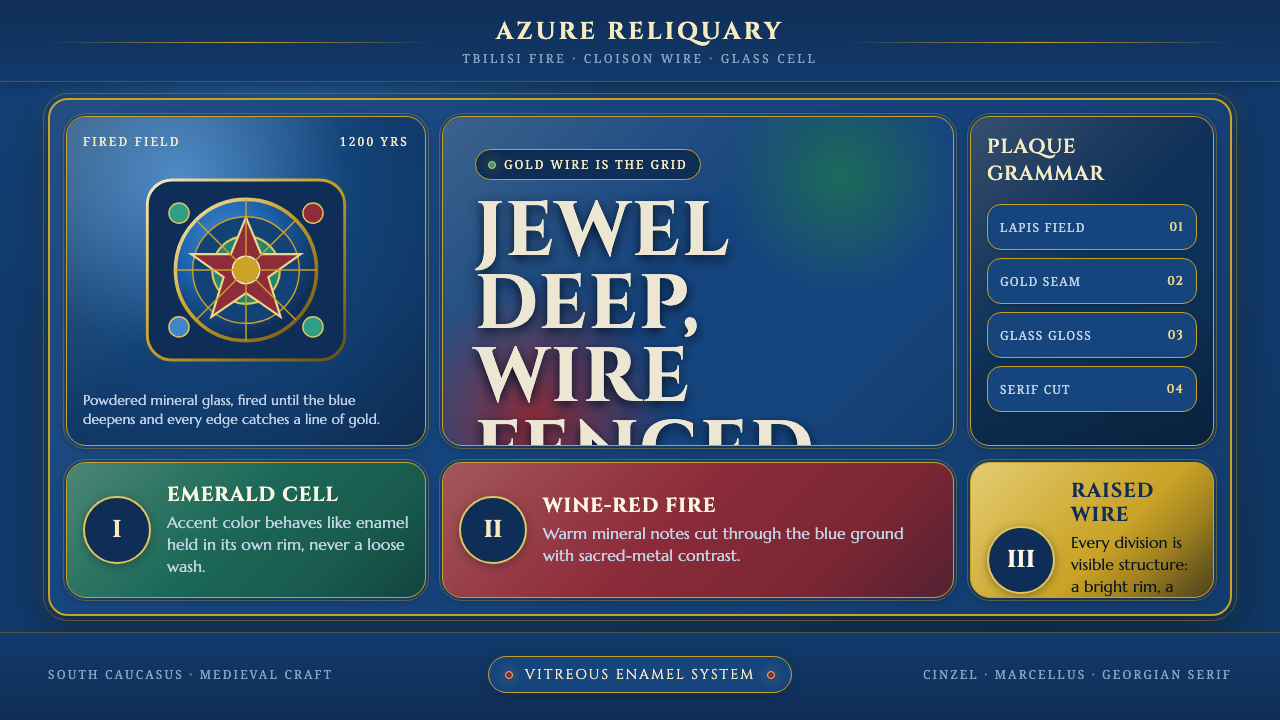 Georgian Minankari CloisonnéJewel-deep and wire-fenced. Lapis enamel, gold seams, emerald cells, glossy s…
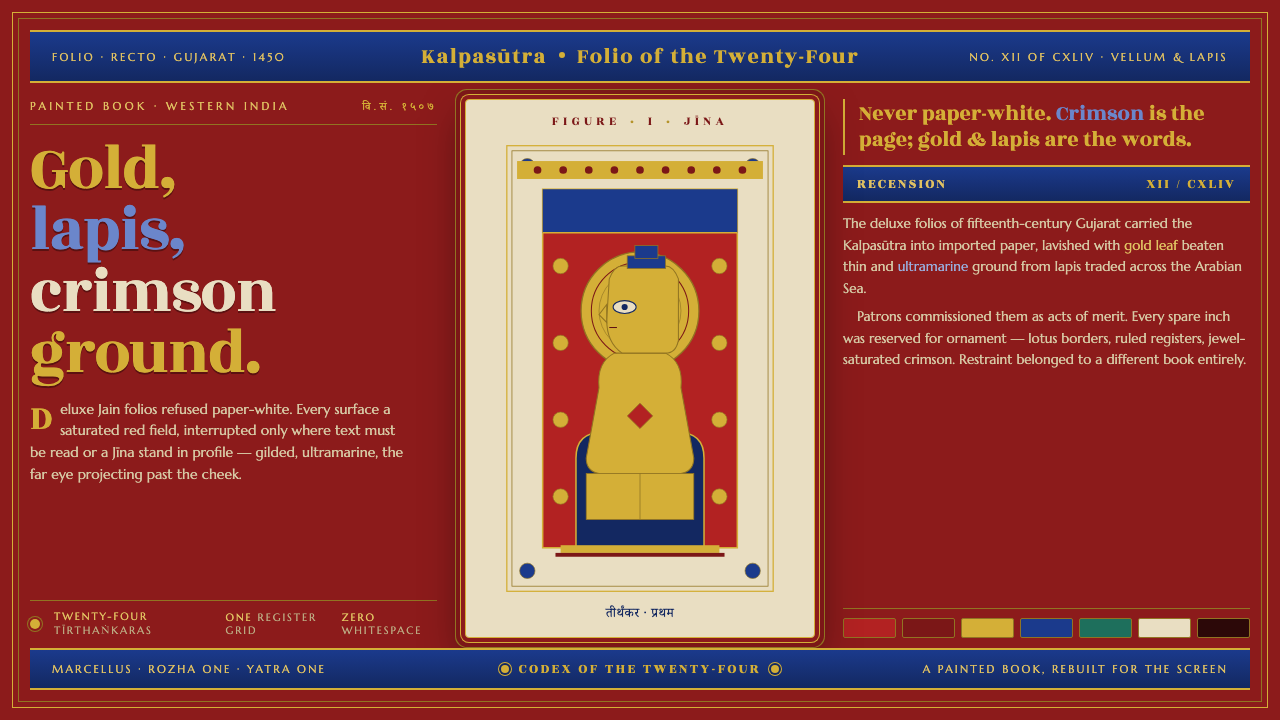 Jain Kalpasutra ManuscriptNever paper-white. Gold leaf and lapis figures on jewel-crimson, lotus-ruled…