What is Kosovar Prizren Filigree Silver?
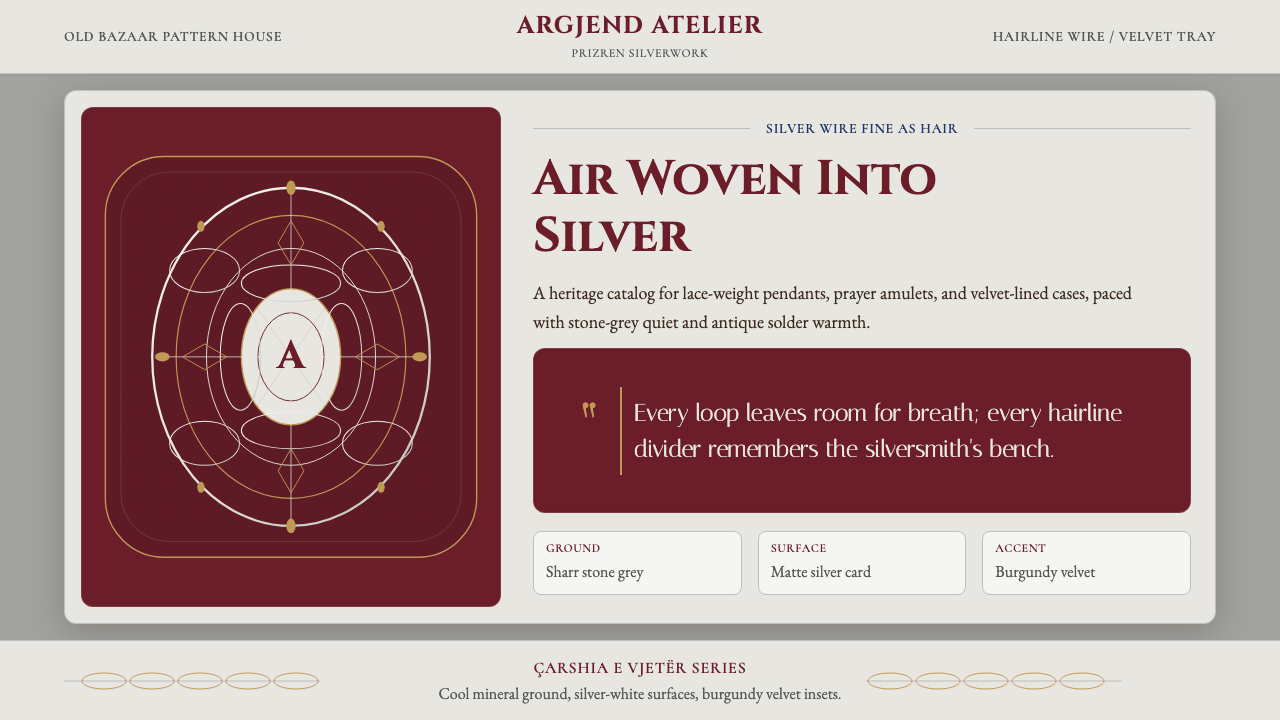
Prizren filigree turns silver wire finer than human hair into coiled lace — and this design system translates that craft discipline into a palette of cool stone grey, deep burgundy velvet, and hairline geometry.
Kosovar Prizren Filigree Silver in brief
Kosovar Prizren Filigree Silver is a design system rooted in one of the oldest continuous silversmithing traditions in the Balkans. Prizren filigree — known locally as filigranu — is the art of drawing silver into wire so fine it approaches the diameter of a human hair, then coiling, twisting, and soldering those threads into bridal pendants, prayer amulets, and ceremonial belt ornaments. The craft's visual signature is negative space: the lacework is defined as much by the air inside its spirals as by the silver that forms them.
Translated into a screen and print design system, this tradition yields a distinctive palette and a rigorous set of structural principles. Cool Sharr-mountain stone grey serves as the primary ground, evoking the dressed limestone of Prizren's old bazaar buildings. Silver-white card surfaces catch light the way polished metalwork does. Deep burgundy velvet — the traditional display cloth on which silversmiths lay finished pieces — provides the system's darkest accent. Antique gold, borrowed from the color of solder at the point of joining, and a resonant indigo drawn from the Sinan Pasha Mosque's tilework complete the palette.
What makes this system unusual is its equation of restraint with richness. Filigree jewelry looks dense and elaborate from a distance, but up close it is mostly open air held in place by near-invisible wire. A design system built on this principle treats whitespace not as the absence of content but as the structural material itself — as essential as the dividing lines, the spiral ornaments, and the small-capitals type that reference the craft bench.
Where does Kosovar Prizren Filigree Silver come from?
Prizren, in southern Kosovo, has been a silversmithing center since at least the sixteenth century, when the city flourished as a crossroads of Ottoman trade routes connecting the Adriatic coast to the Anatolian interior. The Old Bazaar — Çarshia e Vjetër — concentrated craftsmen by trade in the Ottoman guild tradition, and the silver quarter (argjendar) became one of the densest and longest-lived concentrations of filigree expertise anywhere in the Balkans. By the nineteenth century, when filigree reached its widest circulation as an export craft, Prizren pieces were reaching markets from Thessaloniki to Vienna.
The technique itself descends from a broader Mediterranean and Middle Eastern filigree tradition that traveled along the same Ottoman trade networks, but Prizren developed a recognizable regional character. Local smiths favored tighter, more geometric coil patterns over the floral scrollwork common in coastal Adriatic workshops. The characteristic concentric ring frames and the use of fine twisted wire as a ground for applied spiral elements — rather than a smooth sheet metal backing — mark Prizren pieces as distinct even among expert eyes. The craft was transmitted family to family, often between women who handled the finest finishing work, and the knowledge of specific spiral sequences was treated as proprietary.
The collapse of Ottoman markets in the late nineteenth and early twentieth centuries, followed by the disruptions of two World Wars and Yugoslav-era industrial policy, brought the trade close to extinction. By the mid-twentieth century, only a handful of family workshops remained in operation. The survival of the tradition into the present is largely attributable to a small number of master smiths — Zeqir Berisha and Naim Ferri among them — who continued working through the Yugoslav period and who trained the next generation. Hatixhe Berisha, who operated her own workshop, represents a line of women practitioners whose role in preserving the finest finishing techniques is historically underrecorded.
Today, Prizren filigree is recognized as part of Kosovo's intangible cultural heritage, and the Old Bazaar district has seen modest revival investment. The craft occupies an ambiguous position — cherished as national emblem and tourist draw, yet practiced by only a few dozen active smiths. This tension between celebration and precarity is built into the design system's sensibility: it treats filigree as a living reference, not a museum artifact, which means adapting its visual grammar to contemporary contexts without flattening the specific knowledge that makes it extraordinary.
What defines the Kosovar Prizren Filigree Silver look?
Palette
The palette is composed of four primary tones drawn directly from the physical craft: cool stone grey (the limestone of Prizren's old bazaar walls), silver-white (the reflective surface of polished filigree), deep burgundy (the velvet display cloth), and antique gold (the color of solder at joining points). Indigo drawn from the Sinan Pasha Mosque's tilework appears as a secondary accent. The palette reads as both archival and austere — no warm pastels, no bright saturated hues. Color carries material memory rather than emotional signal.
Hairline Dividers
Borders and dividing rules in this system are drawn at the thinnest weight that remains visible — referencing silver wire stretched to its limit before it breaks. These hairline rules mark section boundaries, frame content areas, and separate typographic hierarchies without adding visual mass. Where multiple rules appear together, they are spaced in concentric arrangements that echo the concentric ring frames used in physical filigree pendants. The line is the system's most basic gesture, and its fineness is the source of the style's characteristic tension between strength and delicacy.
Filigree Spiral Ornaments
Corner ornaments, section markers, and decorative accents in this system are derived from the coiled wire spirals of actual filigree work — simplified into geometric glyphs that retain the sense of hand-crafted rotation. These ornaments appear sparingly: a single spiral at a section break, paired spirals flanking a headline, or a complete concentric arrangement framing a central element. They are never used as background texture or repeated patterns. Each occurrence is as deliberate as a solder joint — placed because it marks a structural point, not for visual decoration.
Typography
Type in this system is set in serif letterforms — ideally classical cut display serifs — at wide tracking and in small capitals for primary headings. This treatment references the engraved inscriptions on Ottoman-era silver pieces, where letters were spaced to accommodate the metalworker's chisel rather than the printer's convenience. Body text sits in a quieter weight and measure, allowing the display lettering to carry architectural weight. The combination of wide tracking and small-capitals conveys both formality and age without resorting to historical pastiche.
Negative Space as Material
The defining structural principle of filigree is that the object is mostly air — the wire defines the boundary of voids, not the voids themselves. Applied to a design system, this means whitespace is treated as a positive structural element rather than the absence of content. Margins are generous to the point of feeling ceremonial. Sections breathe. Content is placed with the deliberateness of a silversmith positioning a coiled element before soldering. This generosity of space distinguishes the system from mere minimalism: the emptiness is purposeful and precise, not the result of having nothing to say.
Texture and Material Reference
Unlike purely geometric or flat-design systems, this one permits subtle surface quality where it serves the material reference — a card surface may carry a faint grain suggesting handmade paper or dressed stone, and display panels may suggest the nap of velvet through tonal variation rather than photographic texture. These material references are always implied, never literal. No photographic textures; no skeuomorphic drop shadows. The surface quality is more like the memory of a material than the material itself.
Shadow and Frame
Where cards or content blocks are elevated from their ground, the shadow treatment is thin and precise — a narrow offset in a tone darker than the ground, suggesting the shadow cast by a pendant resting on a display cloth rather than the diffuse glow of a floating interface element. Frames, where used, favor the concentric and the rectangular rather than the rounded. Corner ornaments may substitute for continuous frames, marking the corners of a content area without enclosing it completely — the filigree logic again: define the boundary without filling it.
Who shaped Kosovar Prizren Filigree Silver?
One of the most recognized living Prizren filigree masters, Zeqir Berisha represents the continuity of a family workshop tradition through the Yugoslav period and into independent Kosovo. His work has been documented in cultural heritage surveys and exhibited as a reference example of the craft at its highest technical level. Berisha's practice spans the full range of filigree forms, from small amulet work requiring wire tension control at the limit of human dexterity to larger ceremonial pieces where compositional organization across the whole medallion becomes the primary challenge.
Hatixhe Berisha operated her own silversmithing workshop in Prizren at a time when women's independent craft enterprise was unusual in the region. Her presence in the historical record as a named practitioner — rather than as an anonymous contributor to family workshop output — is significant. Women in Prizren silversmithing traditionally handled the most delicate finishing stages, including the final positioning and soldering of the smallest spiral elements, where control of heat and wire tension is most critical. Hatixhe Berisha's documented independent practice helps recover this contribution from its historical invisibility.
Naim Ferri is among the silversmith practitioners whose continued work through periods of economic and political disruption is credited with preventing the total break in transmission of filigree technique. In craft traditions where knowledge passes through direct apprenticeship and physical demonstration rather than written documentation, a single generation's interruption can be irreversible. Ferri's sustained practice during the difficult decades of the late twentieth century represents the kind of individual continuity on which the survival of this tradition depends.
Gjon Buzuku was a sixteenth-century Albanian Catholic priest who produced the first known printed book in the Albanian language — a Catholic missal published in 1555. His connection to this design system is oblique but meaningful: the era of Buzuku's work coincides with the period in which Prizren's silversmithing culture was consolidating its distinctive character under Ottoman patronage. His name is associated with the literate, multilingual, Ottoman-era Kosovo that was the cultural context in which Prizren filigree developed — a reminder that the craft emerged not in isolation but within a sophisticated urban trading world.
How do you use Kosovar Prizren Filigree Silver today?
Prizren Filigree Silver is a system built for contexts where craftsmanship, heritage, and attention to detail are the primary value proposition — luxury goods, cultural institutions, artisan brands, premium editorial, and high-end service companies. It is not a utility system; it does not accelerate reading or compress information density. Its purpose is to make the reader feel that what they are looking at has been made with exceptional care.
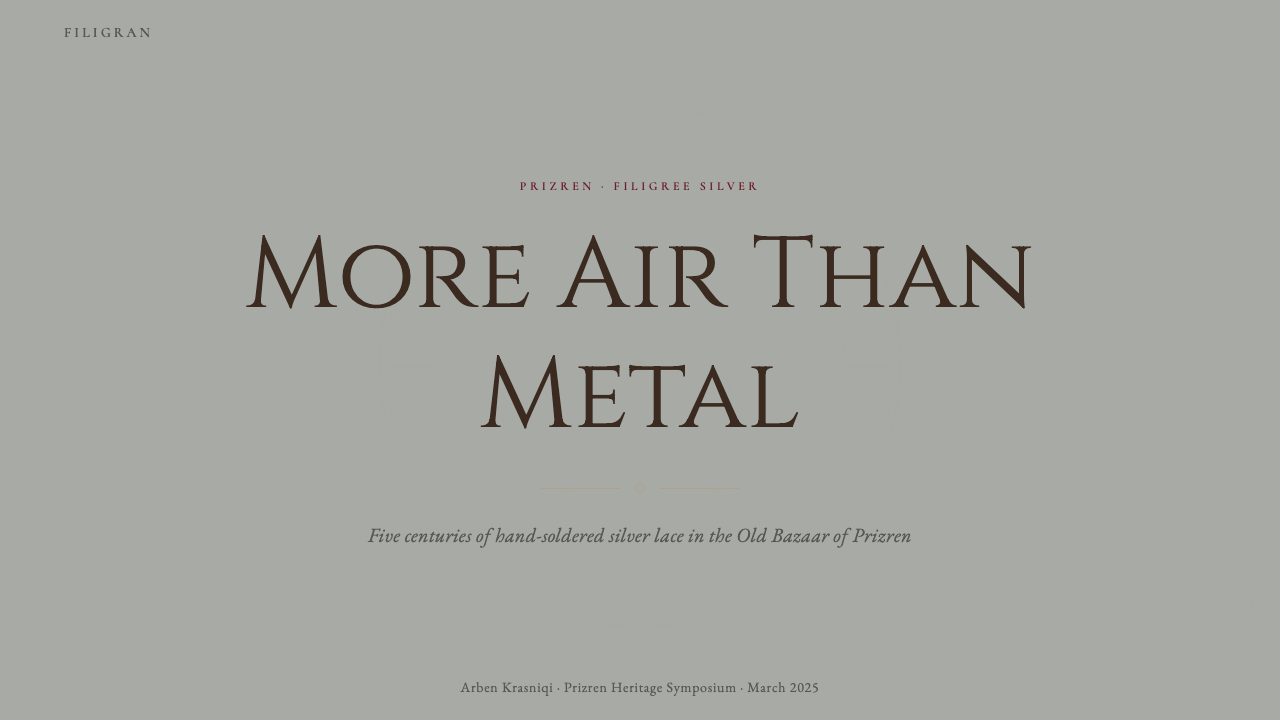
For presentation slides, the system excels at cover pages that need to convey heritage and seriousness without formality becoming stiffness. A cover in this system places the title in wide-tracked small capitals on a stone grey ground, uses a single hairline rule beneath it, and positions a filigree spiral ornament at one corner as the only decorative element. Content slides should honor the negative-space principle: one primary message per slide, generous margins, and section transitions marked by a hairline rule rather than a background color change. Data presented in this system works best as simple ruled tables or single-chart slides, where the chart's frame references the concentric ring vocabulary.
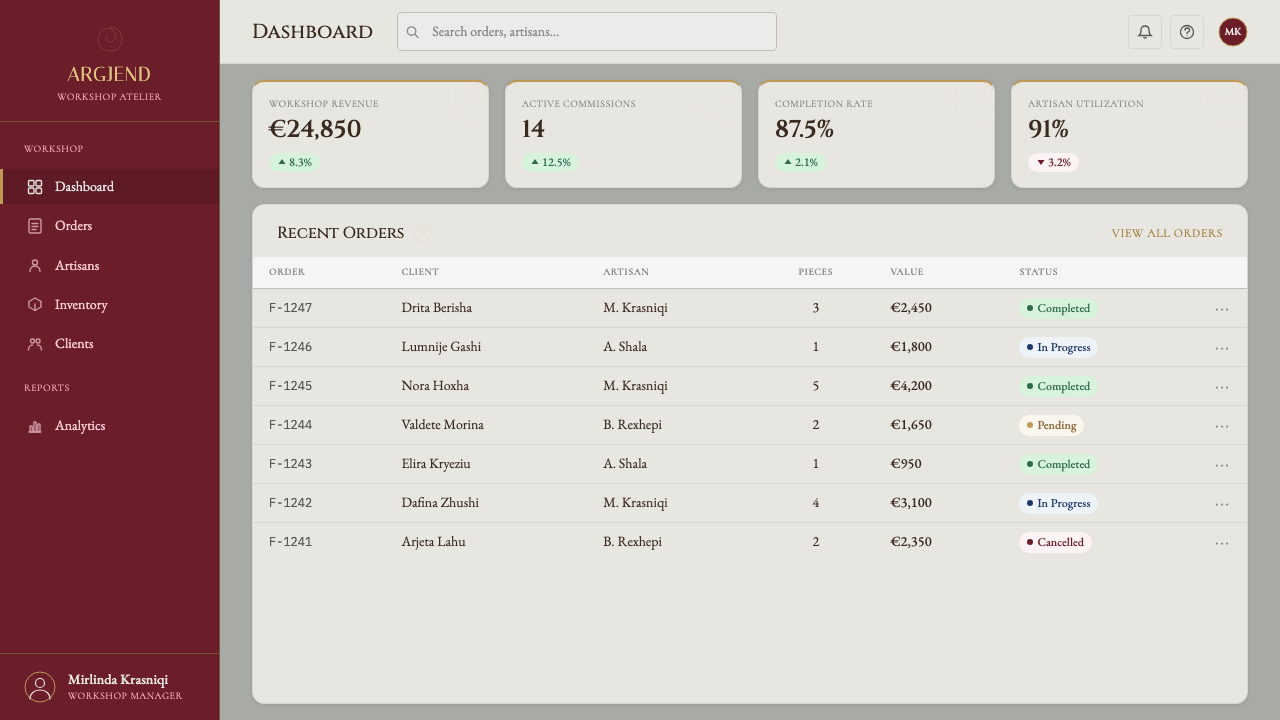
For web user interfaces, the system suits landing pages, product pages, and editorial contexts more naturally than application dashboards. A dashboard in this register risks feeling slow — the generous whitespace that creates ceremony in a presentation feels like wasted screen real estate in a dense information environment. Where the system is applied to pricing pages, the effect is strong: tier differentiation through background shift from silver-white to burgundy velvet reads as a meaningful distinction rather than a marketing flag. Navigation should be typographic and sparse; iconography, if used, should be reduced to the simplest possible geometric form.
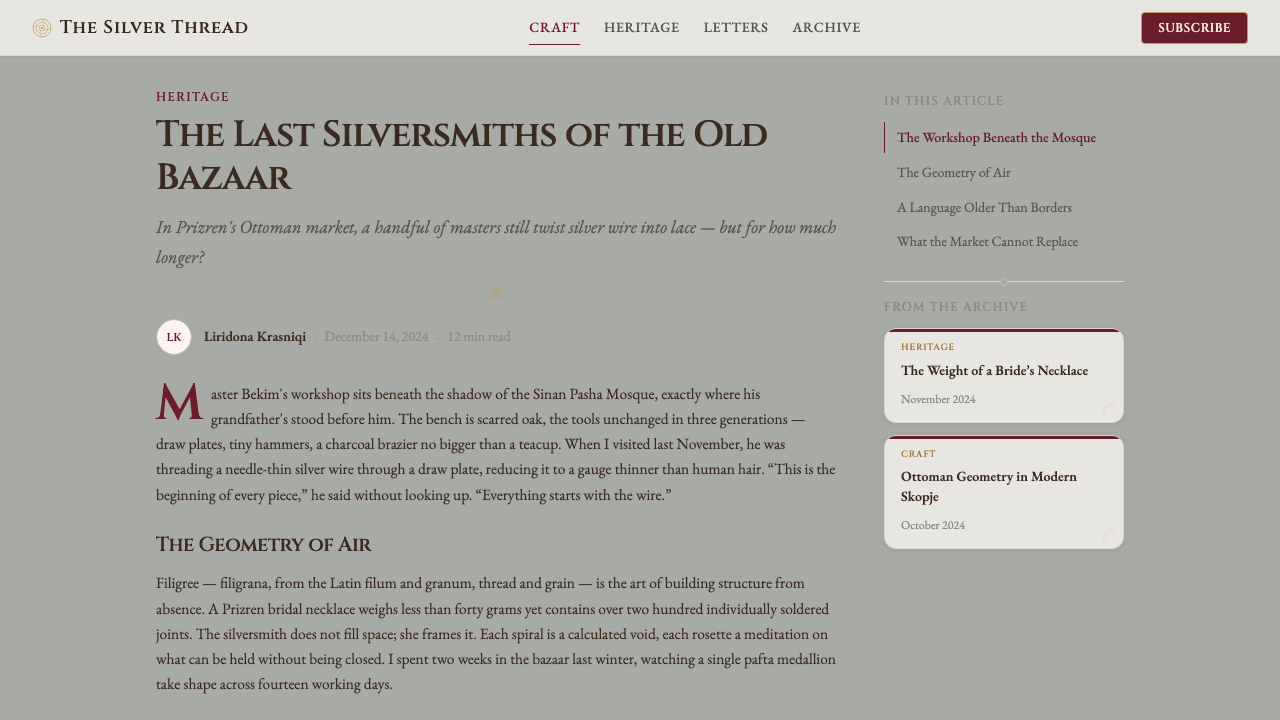
For editorial and marketing work, this is where the system is most at home. Long-form articles benefit from the wide-margin layout — call-outs and pull quotes live in the margin rather than interrupting the text column, creating the visual rhythm of a well-typeset book rather than a web article. Campaign materials gain authority from the palette's archival quality. The burgundy-and-silver combination reads as both premium and culturally specific, which makes it effective for regional heritage brands, cultural tourism, and institutional communication. Marketing materials should use the filigree spiral ornaments at key visual anchors — the beginning of a section, the framing of a central image — and nowhere else.
A common mistake when applying this system is interpreting the ornamental vocabulary as permission to add more decorative detail. The system is built on filigree's paradox: extreme craft investment in service of apparent simplicity. When designers begin adding additional ornamental elements — borders within borders, multiple spiral variants, texture overlays — the result loses the tension that makes the original compelling. The spirals work because there are very few of them. The hairlines work because they are the only lines present. Every addition reduces the power of what remains.
Kosovar Prizren Filigree Silver — FAQ
Is this system appropriate for digital products, or is it primarily a print style?
The system works in digital contexts, but it requires careful adaptation. The hairline rules that define the style must be rendered at sufficient weight to remain visible on screen at all viewing sizes — what reads as a hairline in print can disappear on a low-density display. The generous whitespace that creates the system's ceremonial quality can feel appropriate on large desktop viewports and in long-form reading contexts, but on small screens it may produce layouts where content feels lost. For mobile interfaces, the ornamental vocabulary should be simplified further — one spiral ornament maximum per screen, used only at the most structurally significant moment.
How does this style relate to other Balkan or Ottoman design traditions?
Prizren filigree shares a broad family resemblance with filigree traditions from across the Mediterranean, the Middle East, and parts of South and East Asia — the technique of working precious metal wire into open-lattice forms is ancient and widely distributed. Within the Balkan region specifically, Prizren's filigree is distinguished from Serbian, Greek, or Turkish variants primarily by the geometry of its coil patterns and its characteristic concentric framing vocabulary. The design system draws from the Prizren tradition specifically rather than from a generic 'Ottoman' or 'Balkan' aesthetic, and this specificity is where its visual distinctiveness lives.
Can this system work for a contemporary or technology brand, or is it too historical in register?
It can work, but the brand's positioning must genuinely warrant the heritage register — not as decoration but as an accurate signal of the brand's values. A craft-focused technology company, a platform for artisan markets, a service for heritage conservation, or a product where the experience of individual attention and exceptional care is the differentiator — these align with the system's values. A fast-moving consumer technology product, a social platform, or any brand whose primary promise is speed, scale, or accessibility will find this style working against them: its deliberateness reads as slowness, its ceremony as friction. The honest question is whether the brand actually embodies care the way filigree does — not whether the aesthetic looks beautiful applied to it.
What is the correct use of the burgundy velvet tone — should it appear as a background or only as an accent?
Both uses are legitimate, but they serve different functions and should not be mixed freely. As a full background — a full-bleed velvet panel — burgundy is the equivalent of the display cloth on which a silversmith presents finished work: it is a ceremonial context that elevates what is placed on it. This use is high-impact and should be rare, reserved for the most important element on a page. As an accent — a thin rule, a typographic highlight, a small ornament — burgundy marks emphasis without dominating. Mixing both uses on the same page dilutes the impact of each. Choose one register and commit to it across the layout.
How should this system handle imagery and photography?
Photography in this system should be treated with the same restraint as the ornamental vocabulary. Macro or close-up images of the filigree craft itself — wire, hands, finished pieces — are naturally aligned with the system's material references. For other subjects, photography works best when it is formally composed, high in tonal contrast, and cropped to isolate a specific object or detail rather than presenting a broad scene. Full-bleed photography as backgrounds should be used exceptionally rarely and only where the image has the same austere quality as the palette. Never use photography as pure atmosphere or lifestyle imagery — that register is at odds with the system's craft-first sensibility.
Related design styles
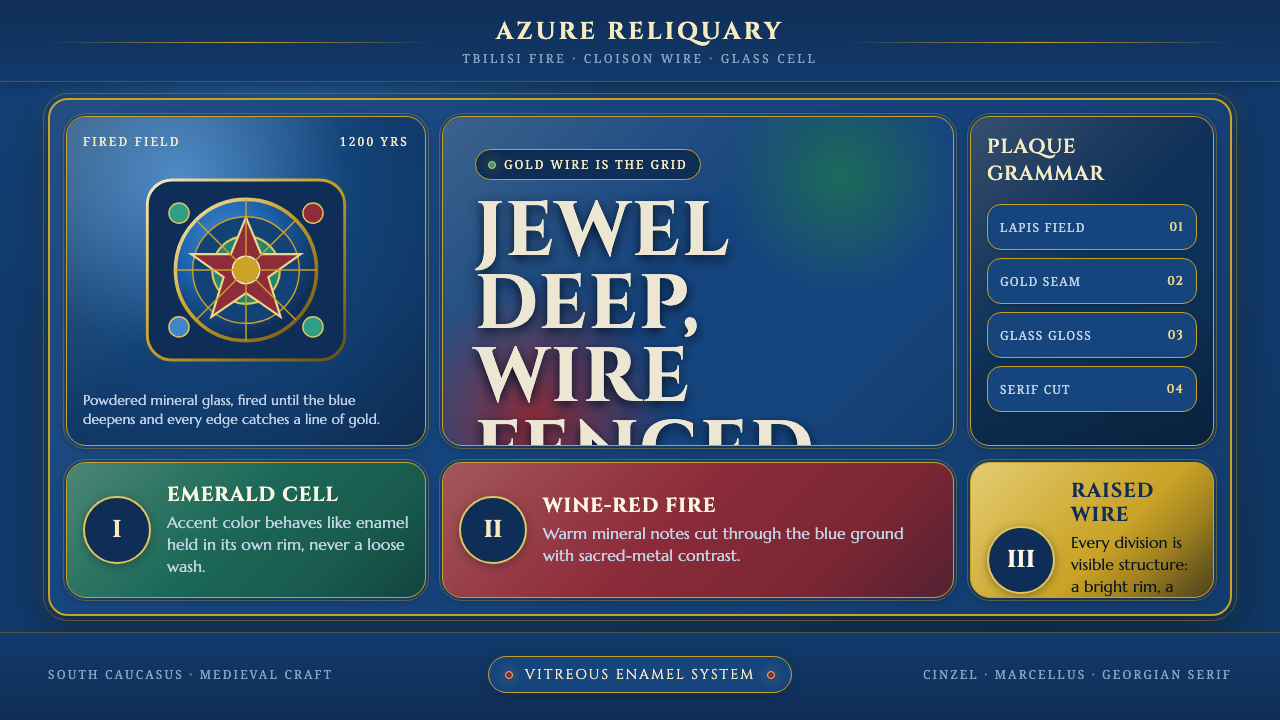 Georgian Minankari CloisonnéJewel-deep and wire-fenced. Lapis enamel, gold seams, emerald cells, glossy s…
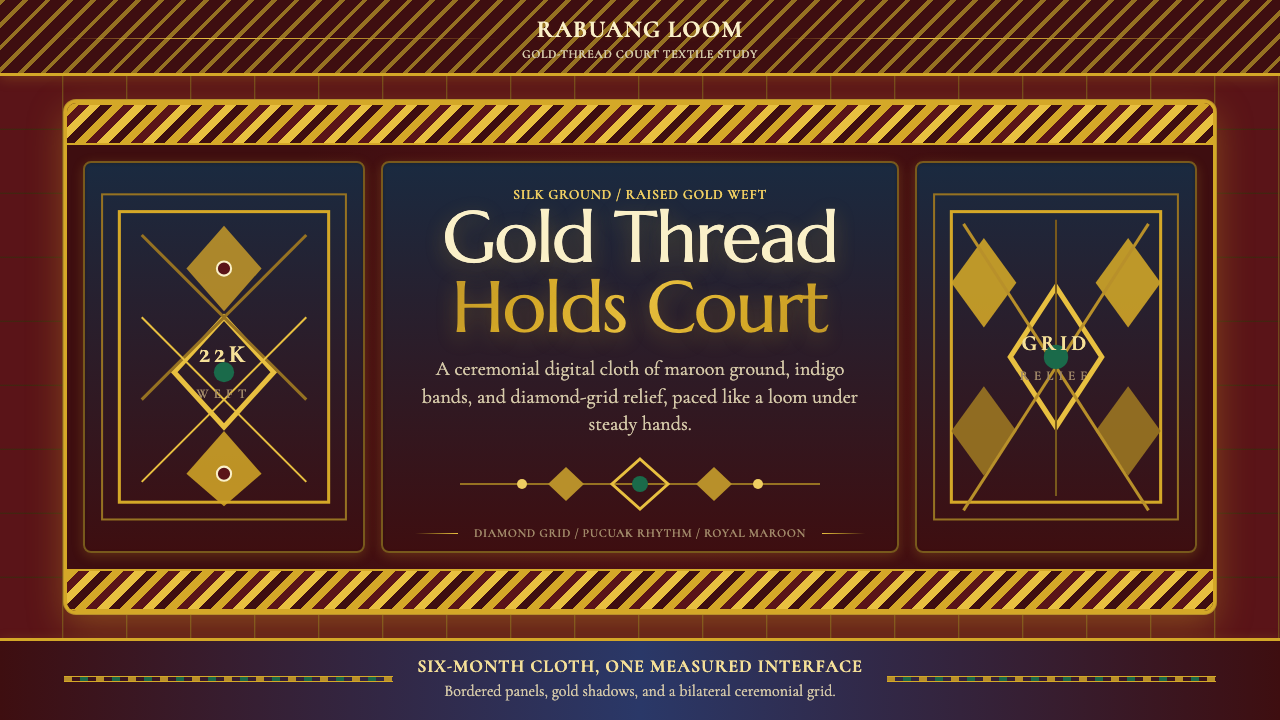 Sumatran Songket (Pandai Sikek)Courtly weight glows. Maroon silk, Cormorant small caps, and gold diamond gri…
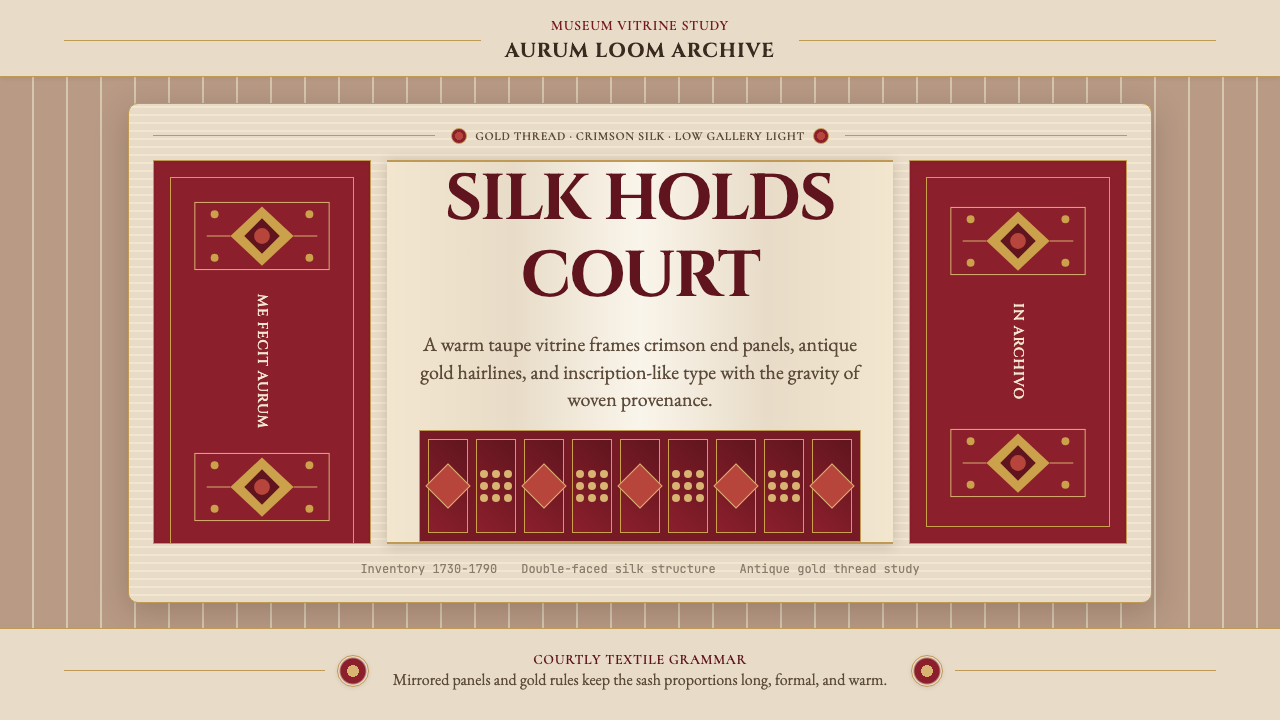 Belarusian Slutsk SashCourtly silk, vitrined. Taupe ground, crimson panels, Cinzel type, antique go…
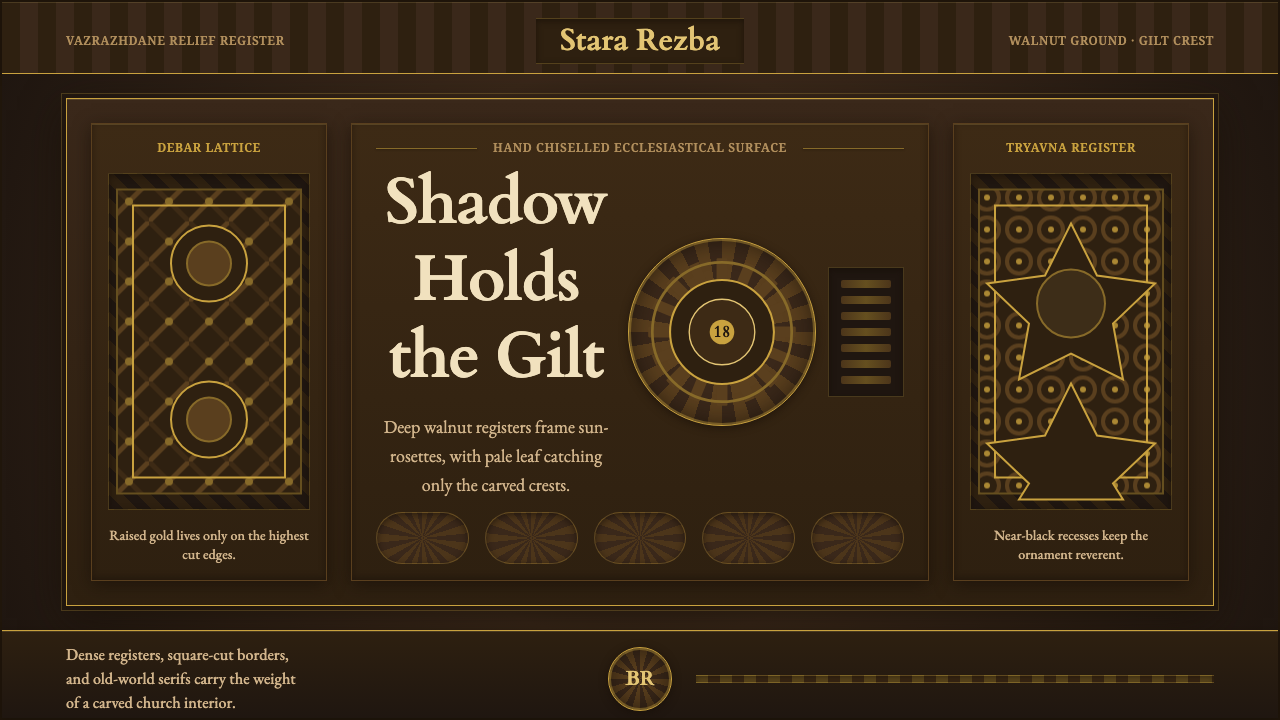 Bulgarian Revival WoodcarvingDark devotion in relief. Walnut panels, Cardo serifs, and gilt rosettes catch…
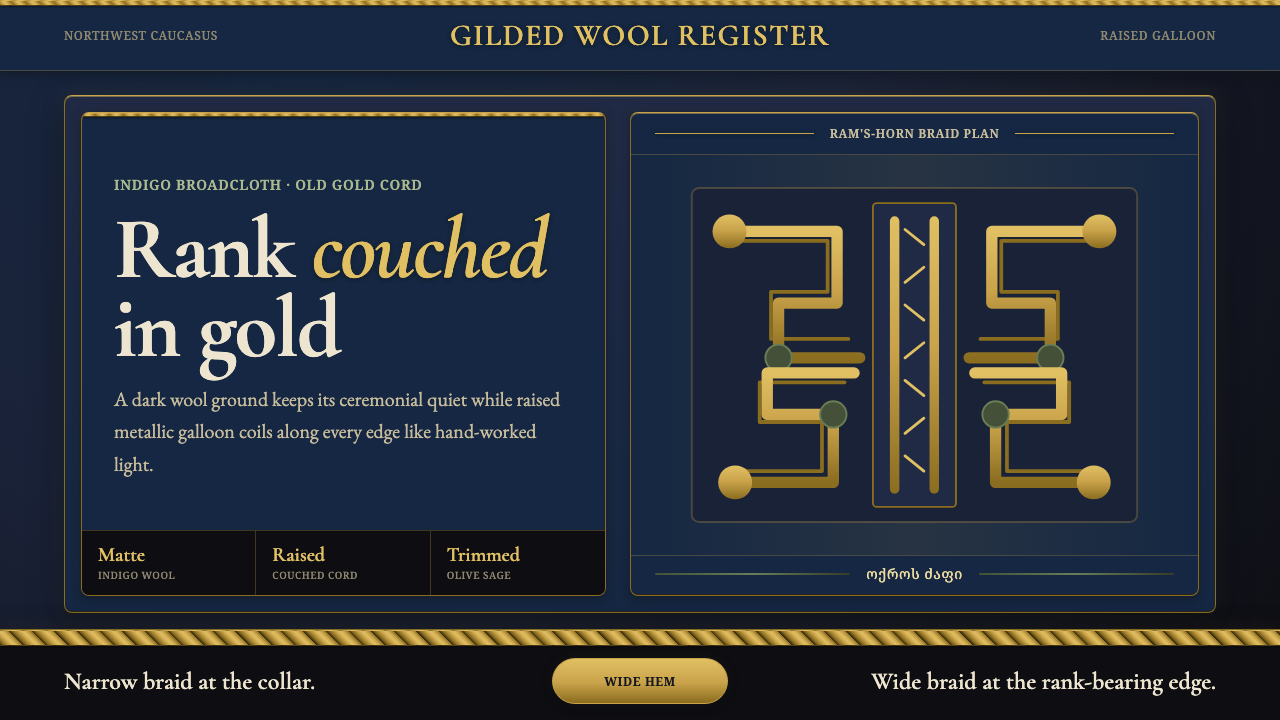 Circassian Adyghe Gold BraidCourtly gold on dark wool. Raised braid edges coil over indigo-black panels.
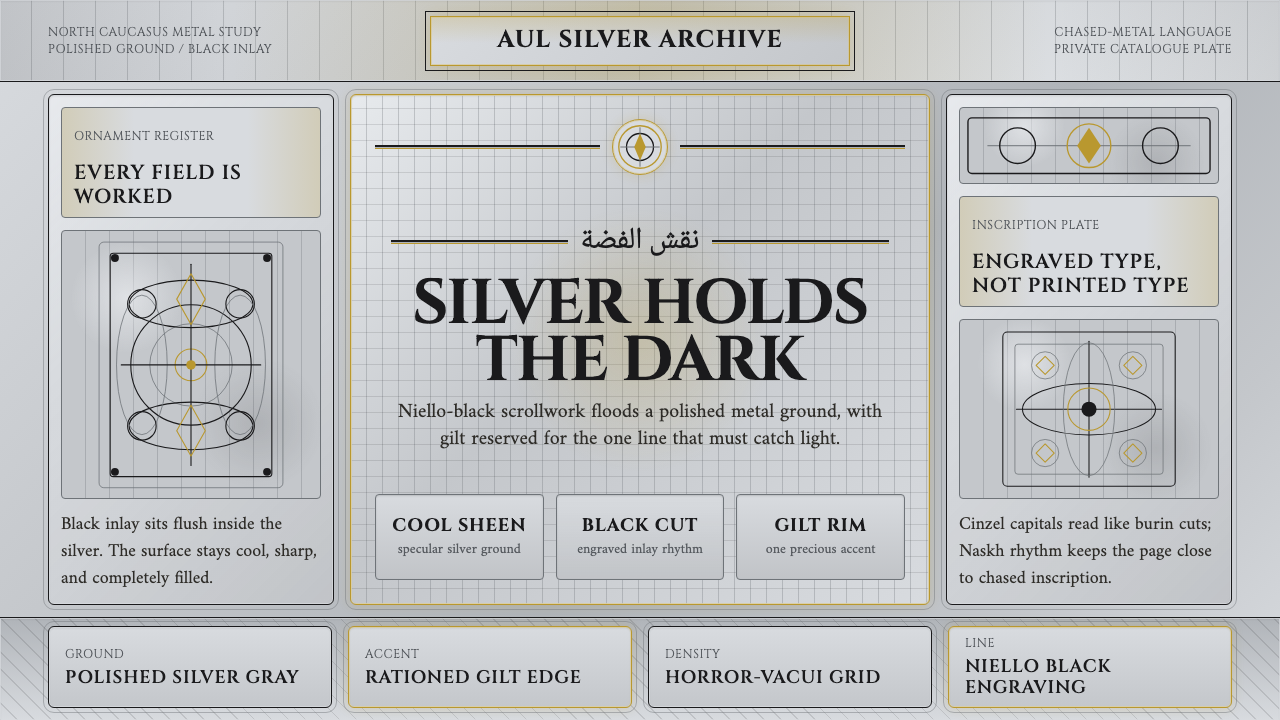 Dagestan Kubachi Silver NielloSilver made obsessive. Niello-black scrolls cover cool metal, with one ration…