What is Javanese Batik Tulis (Keraton Sogan)?
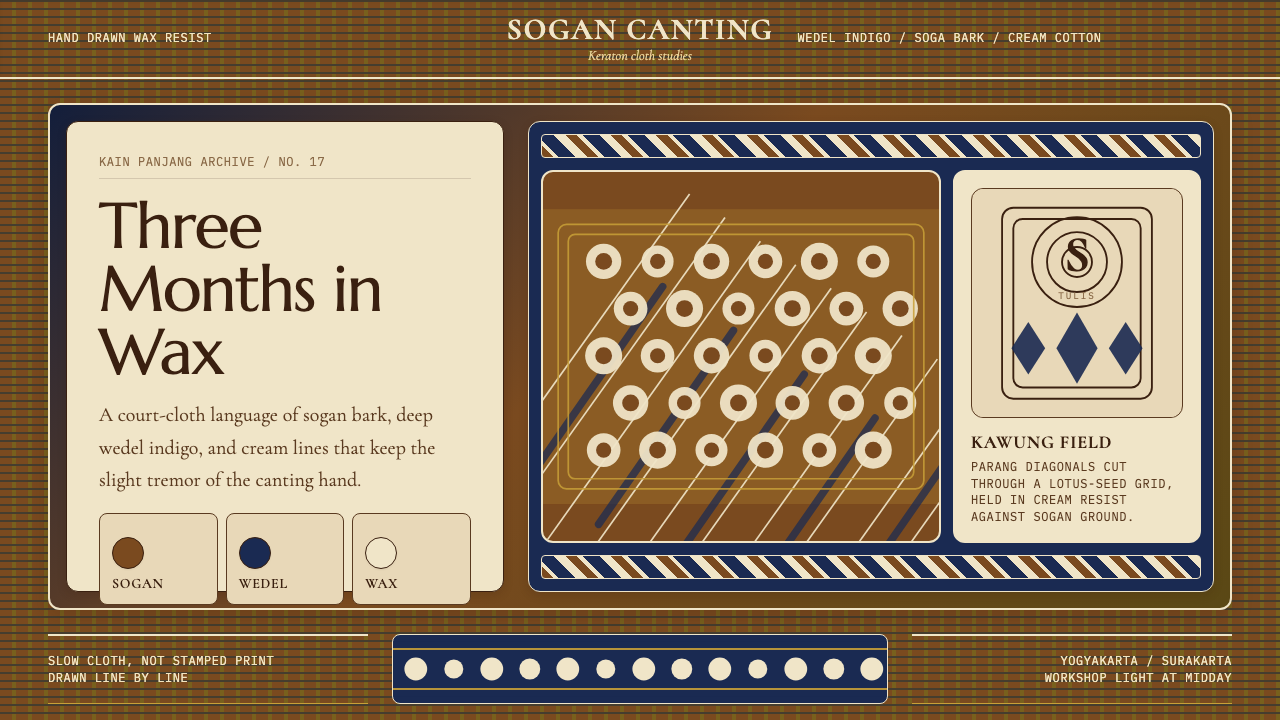
Javanese batik tulis is patience made visible — three to six months of hand-drawn wax lines and repeated dye baths produce cloth so dense with meaning that royal courts once forbade commoners from wearing it.
Javanese Batik Tulis (Keraton Sogan) in brief
Javanese batik tulis is the most labor-intensive textile tradition in Southeast Asia. Each cloth is drawn entirely by hand using a canting — a small copper-spouted kettle that the artisan holds like a pen, guiding molten wax along lines memorized through years of apprenticeship. The wax resists the dye wherever it lands, and the negative space it creates becomes the pattern. After waxing, the cloth is submerged in a dye bath, the wax is scraped away, and the process begins again for the next color. A single finished cloth can represent months of continuous labor.
The visual language that emerges from this process is unlike anything produced by printing or weaving. Lines have a characteristic slight tremor — the inevitable trace of a human hand guiding liquid wax — and densely packed motifs fill every centimeter of the surface with geometric precision. The palette of the royal keraton workshops centers on warm sogan brown, extracted from the bark of the soga tree, and deep indigo drawn from fermented woad leaf. Against these two saturated grounds, cream wax-resist lines articulate the intricate motifs with a warmth and subtlety that no printed substitute has ever matched.
The term tulis (written) distinguishes hand-drawn batik from cap (stamped) batik and from mechanically printed imitations. Among collectors and scholars, tulis is recognized as the highest expression of the tradition — not because it is older, but because the hand that draws it is present in every line. Each cloth is simultaneously a textile, a document of labor, and a meditation on pattern as spiritual discipline.
Where does Javanese Batik Tulis (Keraton Sogan) come from?
The roots of Javanese batik reach back at least to the eighth century, when wax-resist dyeing techniques spread across maritime Southeast Asia along trade routes connecting India, China, and the Indonesian archipelago. Early Javanese courts absorbed these techniques and began transforming them into a courtly art form, codifying motifs and restricting the most sacred patterns to the royal family and nobility. By the time of the Mataram Sultanate in the sixteenth and seventeenth centuries, batik had become inseparable from Javanese identity, ritual, and political order.
The systematic codification of batik as a court art was carried furthest under Sultan Agung of Mataram, who reigned from 1613 to 1645. His court established hierarchies of motif — the parang rusak (broken blade), kawung (lotus seed), and semen (organic vines) patterns became restricted to royalty and high officials. Wearing a forbidden motif was not merely a fashion transgression; it was a political statement and, in some interpretations, a spiritual trespass. This association between specific patterns and social rank persisted until Indonesian independence in 1945, when the restrictions were formally dissolved.
The two great keraton (palace) cities of Central Java — Yogyakarta and Surakarta (Solo) — developed distinct regional styles that remain recognizable today. Yogyakarta batik tends toward bold contrast, with deep indigo grounds and strong white resist lines. Surakarta batik, particularly the sogan style associated with the Pakubuwono dynasty, favors warmer brown grounds and softer, more intricate patterning. Pakubuwono X, who ruled from 1893 to 1939, was a significant patron who documented court batik patterns and supported the workshops that preserved the keraton tradition through the colonial period.
In the twentieth century, batik tulis faced two existential pressures: the mass production of cap and printed imitations, which undercut its economic viability, and the broader disruption of traditional court culture. The designer Iwan Tirta, working from the 1960s onward, played a critical role in repositioning batik tulis as a luxury material suitable for contemporary fashion and diplomacy — creating batik garments worn at international summits and collaborating with global fashion houses. K. R. T. Hardjonagoro (Go Tik Swan), a Chinese-Javanese court scholar and designer, similarly devoted his life to documenting and reviving archaic court patterns that were at risk of being lost. In 2009, UNESCO inscribed Indonesian batik on the Representative List of the Intangible Cultural Heritage of Humanity, a recognition that both validated the tradition and created new international demand for authentic handmade cloth.
What defines the Javanese Batik Tulis (Keraton Sogan) look?
Color
The keraton palette is built on three natural dyestuffs: sogan brown from the soga tree bark, indigo from fermented woad leaf, and the undyed cream of the base cloth. These three tones — warm earth, cool deep blue, and soft natural white — form a deliberately narrow range that reads as simultaneously luxurious and restrained. Color is never flat or uniform; the layering of multiple dye baths creates depth and variation within each tone, so that sogan brown shifts from amber to near-black depending on the density of dyeing. Bright or secondary colors are structurally absent from the classical keraton style.
Pattern Density
Keraton batik fills the entire surface of the cloth with interlocking motifs. There is no empty ground — every centimeter carries pattern. This horror vacui is not mere decoration but a philosophical stance: emptiness in the cloth implies incompleteness in the spiritual or social order the cloth represents. Parang diagonal blade motifs interlock at precise angles without interruption; kawung circles tessellate edge to edge. The result is a surface of extraordinary visual density that rewards close inspection with continuously finer levels of detail.
Line Quality
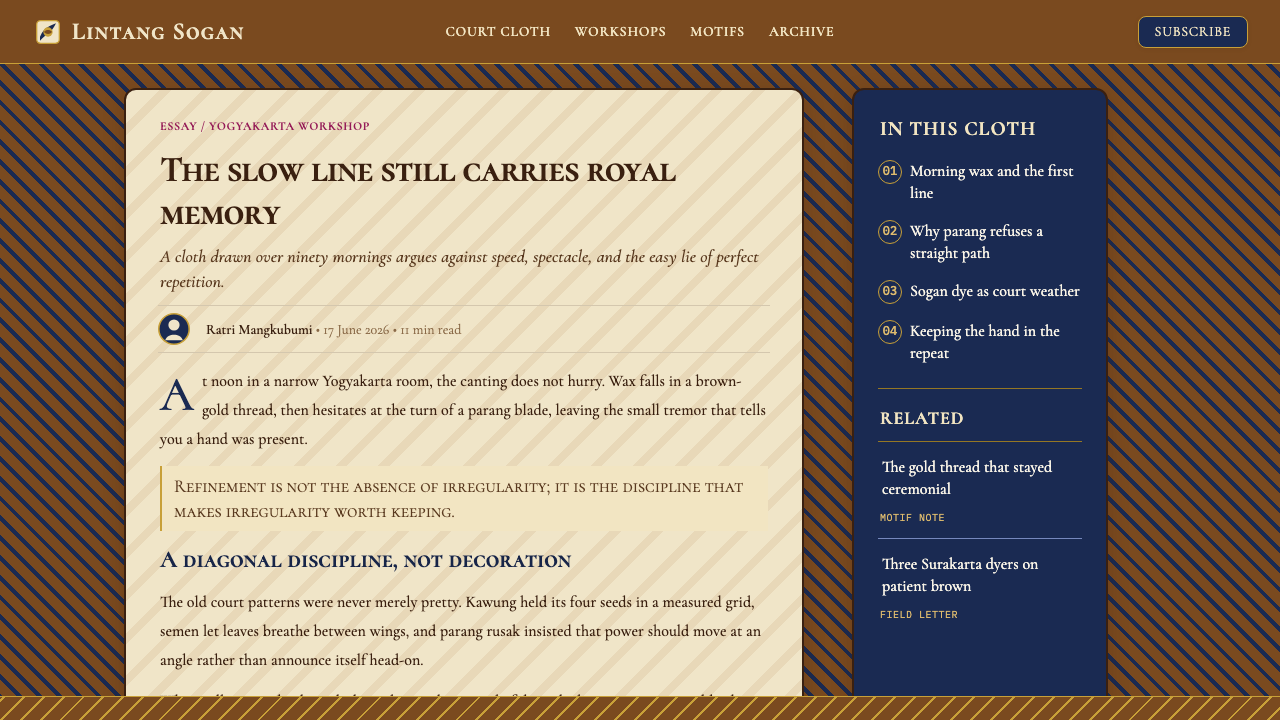
The defining mark of batik tulis is the slight tremor in every line. Because the canting is hand-held and liquid wax cools rapidly, even a master craftsman's lines carry a micro-wobble that no mechanical process replicates. This quality is not a flaw but the signature of the hand — the visual equivalent of breath in a sung note. A line that is perfectly straight and mechanically uniform is, by this aesthetic, impoverished: it reveals the absence of a human being. The wobble is what makes a tulis cloth alive.
Sacred Geometry
The major court motifs are rigorously geometric. The parang is a continuous diagonal blade form that tiles across the cloth at a strict angle. The kawung is a precisely arranged grid of four-lobed circles, each lobe touching the next without gap or overlap. The semen is more organic, but its tendril and vine forms follow a lattice structure that distributes weight evenly across the surface. This underlying geometric discipline gives the cloth an architectural quality: it is pattern governed by spatial law, not freely improvised.
Layered Time
The batik tulis surface is the record of a sequence of decisions made over months, not a single compositional act. Each dye bath adds a layer; each waxing session adds a set of lines; the final cloth is the accumulation of all of them. This layering is visible in the depth of the color and the slight variations where one pass of wax overlaps another. Unlike a painting or a print, which are made at a single moment, a batik tulis cloth is a temporal object — its surface is duration made material.
Motif Hierarchy
Not all batik patterns carry equal cultural weight. The forbidden court motifs — parang, kawung, semen, and a handful of others — occupy the highest tier of the visual hierarchy, their geometric discipline and historical associations marking them as the most symbolically loaded. Below them sit regional motifs associated with specific cities or workshops, and below those are the pesisir coastal batik patterns, which are livelier, more colorful, and draw on Chinese and European decorative vocabularies. Applying the keraton aesthetic means working primarily within the upper tier of this hierarchy.
Restraint as Luxury
The keraton aesthetic does not signal status through brightness or novelty. It signals status through investment of time and skill. A sogan cloth with a narrow palette of brown, indigo, and cream, densely covered in a royal motif drawn by a master craftsman, is more prestigious than any brighter or more complex imitation. This is restraint deployed as a display of mastery: the narrower the palette and the more complex the pattern, the more visible the labor and knowledge behind the cloth. Applied to design, this means that simplicity of means and complexity of execution are not in conflict — they are the same gesture.
Who shaped Javanese Batik Tulis (Keraton Sogan)?
Sultan Agung of Mataram, who reigned from 1613 to 1645, was the ruler most responsible for codifying batik tulis as a court art with a strict hierarchy of motifs. Under his reign, certain patterns — including the parang and kawung — were formally restricted to the royal family and senior nobility. This act transformed batik from a textile craft into a political instrument, binding cloth to rank in a way that shaped Javanese court culture for the next three centuries.
The ninth Susuhunan of Surakarta, who ruled from 1893 to 1939, was a major patron of batik tulis during the colonial period. Pakubuwono X actively documented court patterns and supported the keraton workshops at a time when cheap imported cloth and printed imitations posed an existential threat to handmade batik. His sustained patronage helped preserve the sogan style that is now considered the definitive expression of the Surakarta tradition.
Iwan Tirta was the Indonesian fashion designer who most dramatically repositioned batik tulis for the modern world. Working from the 1960s through the 2000s, he created batik garments for state occasions, diplomatic gifts, and international fashion collections, collaborating with luxury houses and dressing heads of state. His work demonstrated that the keraton aesthetic could hold its own in contemporary luxury fashion without being simplified or diluted — the density and labor of the cloth were themselves the argument.
Known also as Go Tik Swan, K. R. T. Hardjonagoro was a Chinese-Javanese court scholar, designer, and cultural preservationist who spent his career documenting and reviving archaic court batik patterns. He was one of the first to systematically record the meanings and restricted-use protocols associated with the major keraton motifs, and he trained a generation of craftspeople in techniques that were at risk of disappearing. His scholarly and practical work forms a significant part of the foundation on which contemporary understanding of batik tulis rests.
How do you use Javanese Batik Tulis (Keraton Sogan) today?
The Javanese batik tulis aesthetic translates into contemporary design work through three core commitments: a palette of near-earth naturals rather than synthetic brightness, an embrace of surface density over empty minimalism, and a visible trace of the hand rather than mechanical perfection. Applying it well requires resisting the urge to simplify — this style rewards complexity, not reduction.
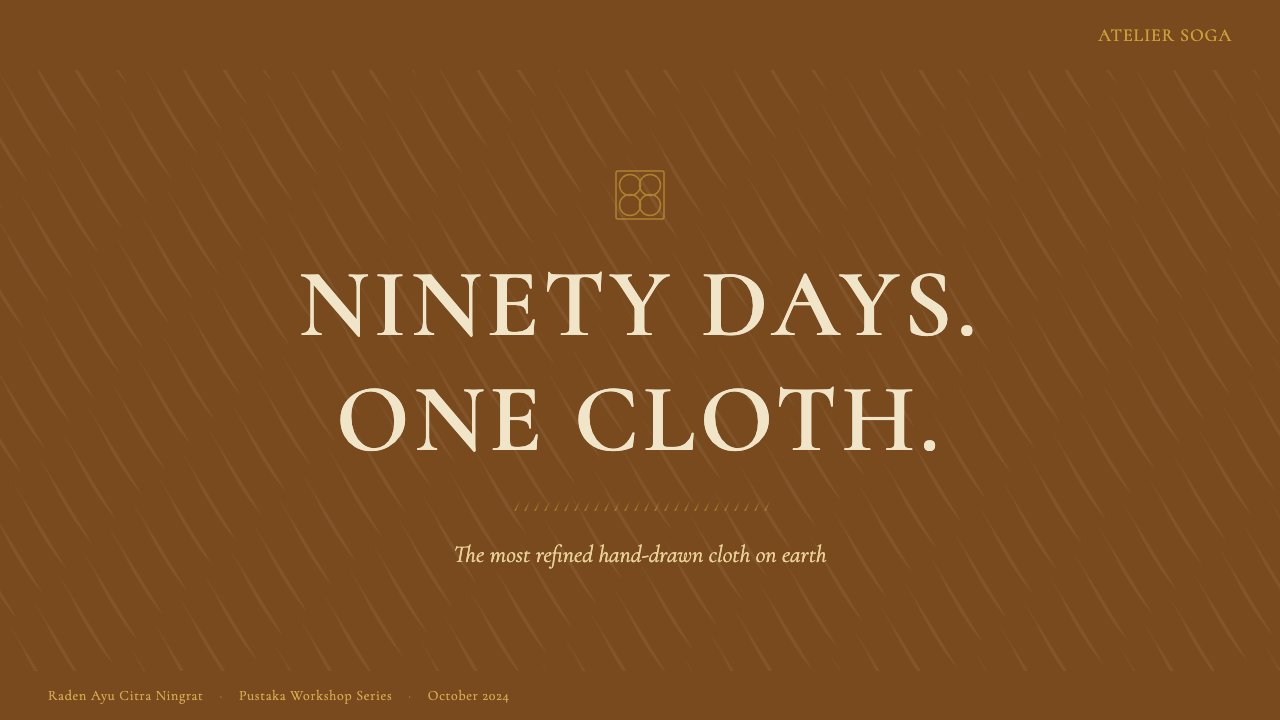
For presentation slides, the keraton aesthetic works best as a backdrop register rather than a primary organizational system. Cover slides benefit from a deep sogan-brown or indigo ground with the title set in a light, fine-weight typeface that allows the background pattern to breathe through it. Content slides should use the narrow palette consistently — resist the urge to introduce bright accent colors for highlights. Data visualization takes on a warmth and distinctiveness when charts are rendered in the two or three tones of the natural palette, with pattern-fill textures used sparingly to differentiate categories. The effect reads as authoritative and culturally specific rather than generic.
For web interfaces, batik-derived visual language suits editorial contexts, cultural institutions, luxury e-commerce, and heritage brands more readily than software dashboards or analytical tools. A dashboard that borrows batik motifs as decorative backgrounds risks visual noise that impairs readability at small scales. Used as section borders, divider patterns, or background textures on landing and marketing pages, the motifs work better — their density becomes an asset when contained, a liability when spread across functional UI. Pricing pages and feature grids benefit from restraint: use the palette for background warmth and a single repeated geometric form for structural accents, leaving the motif density for hero moments only.
For editorial and marketing design, batik tulis offers a rare combination of visual authority and cultural specificity. A magazine spread or brand campaign built around the keraton palette communicates craft, heritage, and deliberateness — associations that are difficult to fabricate with generic modern styles. The motif vocabulary works well at large scale as full-bleed backgrounds or as textures behind large type, and at small scale as decorative marks or pattern fills within illustrations. In both cases, the sogan-indigo-cream triad should remain the color anchor; introducing additional colors dilutes the aesthetic coherence that gives the style its weight.
A common mistake when adapting this aesthetic is reducing it to surface decoration — applying the motif pattern as a clip-art texture while the underlying design system remains generically modern. Batik tulis is not a texture; it is a complete visual philosophy built on density, restraint, and the visible trace of labor. If the motif appears but the palette is full-spectrum, or if the motif appears but the layout is airy and sparse, the result is costume rather than conviction. The most effective applications internalize the aesthetic's core logic — narrow palette, dense pattern, patient geometry — and let the motif emerge as an expression of that logic rather than an addition to it.
Javanese Batik Tulis (Keraton Sogan) — FAQ
What distinguishes batik tulis from other batik types?
Batik tulis (written batik) is drawn entirely by hand using a canting, a small copper-spouted vessel that delivers liquid wax in a controlled line. Batik cap (stamped batik) uses a copper stamp to apply wax in repeated impressions, producing uniform patterns much faster. Printed batik is mechanically reproduced on fabric using rotary printing and bears no wax resist at all. The three are visually distinguishable to a trained eye: tulis has the characteristic micro-tremor of a hand-held line; cap has perfectly repeated impressions with slight gaps at stamp junctions; printed batik has none of the waxy depth of either. Tulis is the most labor-intensive and the most prestigious, and it commands significantly higher prices than cap or printed equivalents.
Can the motifs be used freely in contemporary design?
The legal restrictions on wearing forbidden court motifs were dissolved at Indonesian independence in 1945, so there is no longer a formal prohibition. However, the cultural weight of the sacred patterns — particularly parang, kawung, and semen — remains significant in Javanese and broader Indonesian contexts. Using them thoughtlessly, especially in commercial contexts that trivialize or misrepresent the tradition, is widely considered disrespectful. The most sustainable approach is to engage with the aesthetic vocabulary of the tradition — the palette, the density, the geometric discipline — rather than directly appropriating the most symbolically loaded sacred motifs without acknowledgment of their cultural significance.
How does this style work in dark-mode or dark-background designs?
The keraton palette is inherently dark-ground-capable. Deep indigo and sogan brown are both darker tones that read as backgrounds against cream or light-colored motif lines. A dark-mode design built on an indigo ground with cream wax-resist lines and sogan accents is entirely consistent with the historical aesthetic — in fact, deeply dyed indigo grounds are among the most celebrated expressions of the tradition. The key adjustment is ensuring that the cream or light elements retain enough contrast against the deep ground to preserve the characteristic motif legibility. Bright white should be used more sparingly than in light-mode applications; the slightly warm, natural cream tone is truer to the source material.
What makes this style feel luxurious rather than just complex?
Luxury in the batik tulis tradition is not communicated through brightness, novelty, or variety — it is communicated through the visible investment of time and skill. A cloth that took three months to draw signals mastery not through ostentation but through the accumulation of careful decisions made across thousands of hand-drawn lines. In contemporary design, this translates to restraint of palette combined with complexity of execution: fewer colors used with greater precision, patterns that reveal more detail the longer you look, and a surface that rewards sustained attention. Complexity that can be perceived immediately is novelty; complexity that reveals itself slowly is craft.
Is this style appropriate for digital products aimed at global audiences?
It works well for global audiences when it is applied through its structural principles rather than as surface decoration. A design system built on a narrow earth-toned palette, dense geometric patterns, and visible craft texture communicates deliberateness and warmth across cultural contexts — these are human values, not exclusively Javanese ones. Where cultural specificity becomes a liability is when the motifs are used recognizably as Javanese court patterns without the surrounding context acknowledging their origin. For audiences already familiar with the tradition, direct reference is a strength; for audiences who will encounter it without context, the structural principles — density, restraint, patient geometry — are both more universally legible and more respectful of the source material.
Related design styles
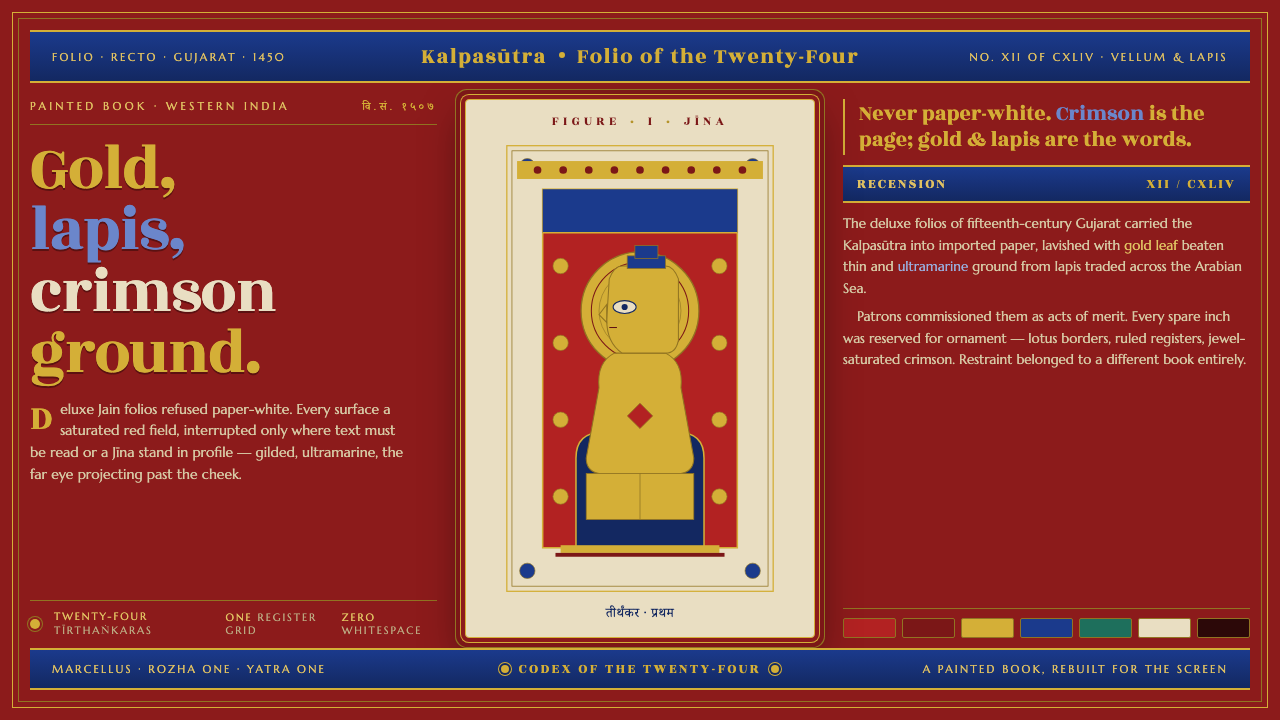 Jain Kalpasutra ManuscriptNever paper-white. Gold leaf and lapis figures on jewel-crimson, lotus-ruled…
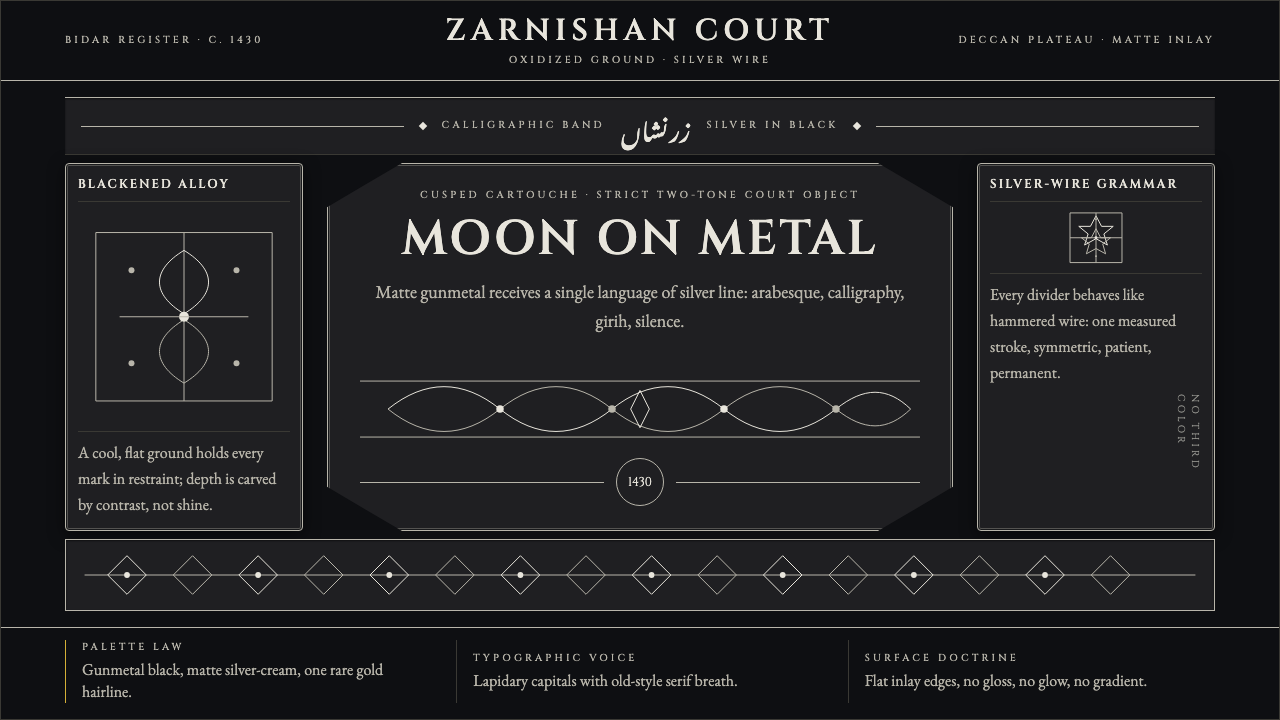 Bidri Deccan MetalworkCourtly darkness, tooled by silver. Cinzel caps and hairline arabesques cut g…
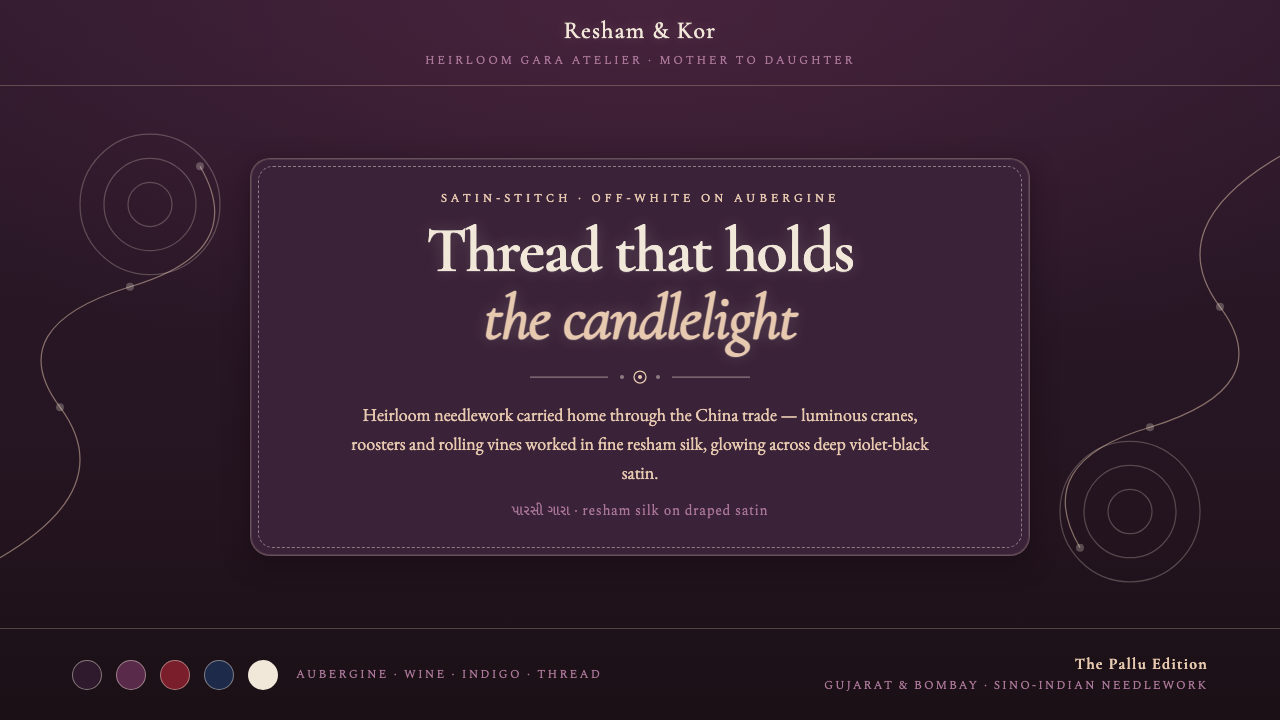 Parsi Gara EmbroideryHeirloom needlework, made digital. Off-white silk vines glow over deep auberg…
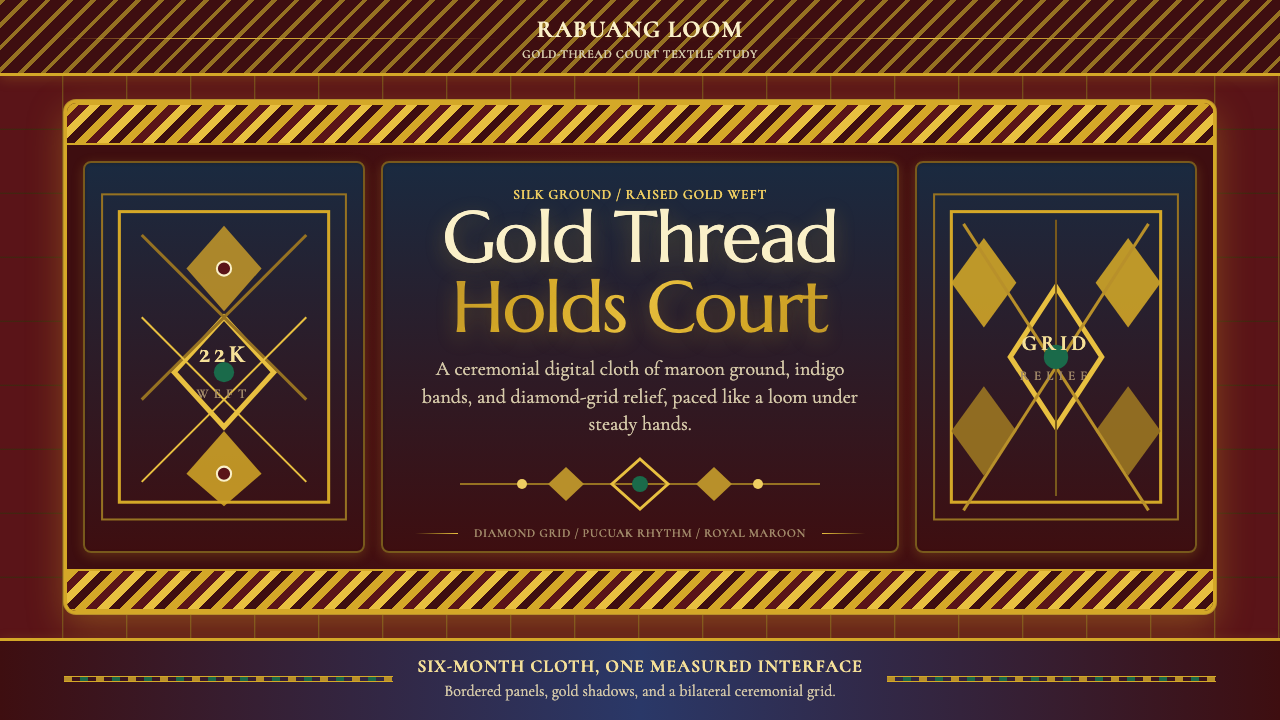 Sumatran Songket (Pandai Sikek)Courtly weight glows. Maroon silk, Cormorant small caps, and gold diamond gri…
 Thai BenjarongRoyal density. Gold-line enamel cells pack green, cobalt, and vermilion on ir…
 Uzbek Bukhara Gold ZardoziCourtly density. Ruby velvet, gold Cinzel type, and star medallions leave no…