What is Sumatran Songket (Pandai Sikek)?
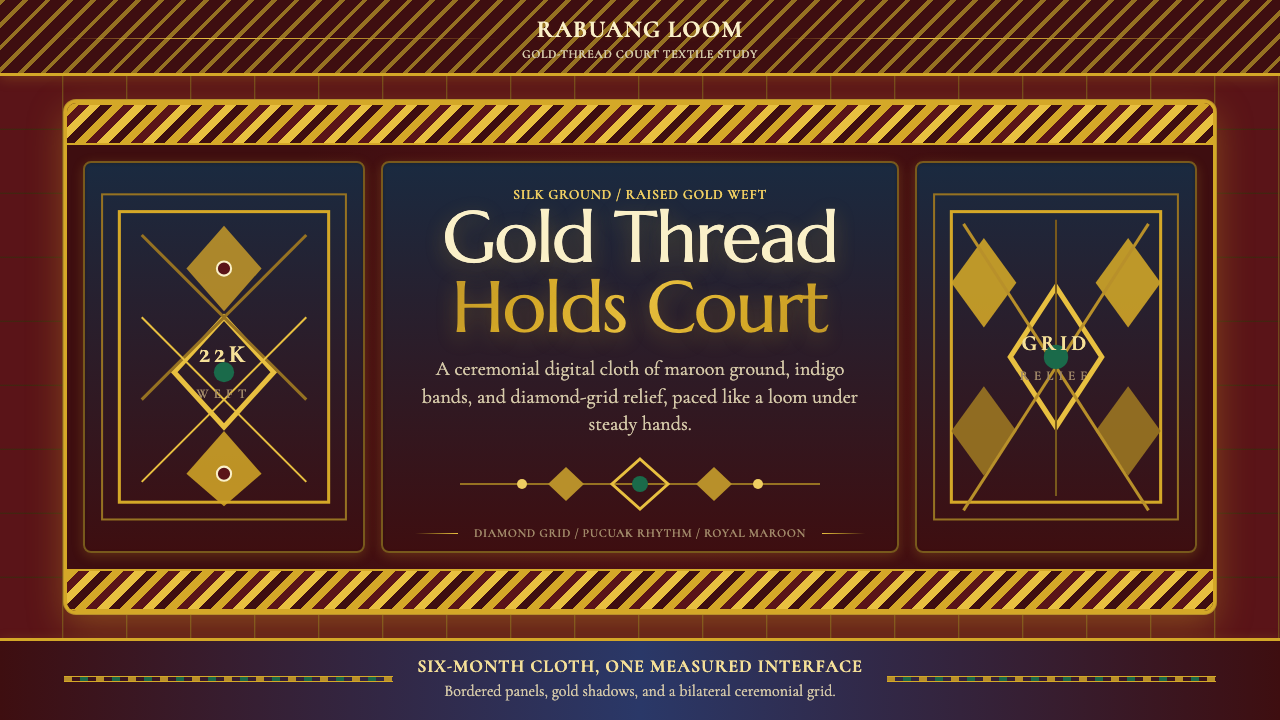
Pandai Sikek songket translates six centuries of Minangkabau royal weaving — gold-thread motifs blazing against deep maroon silk — into a design language of ceremonial weight and glittering precision.
Sumatran Songket (Pandai Sikek) in brief
Sumatran Songket (Pandai Sikek) is a design system rooted in the most gold-saturated woven textile tradition of maritime Southeast Asia. Originating in the West Sumatran highlands, songket cloth is defined by its supplementary gold-thread wefts hand-woven into silk warps, producing raised, glittering motifs against a deep maroon ground. The Pandai Sikek village in the Bukittinggi highlands became the undisputed center of this tradition, its weavers producing cloth dense enough that a single ceremonial skirt — the limpapeh — could take up to six months to complete.
The visual language of songket is built around structured opulence: diamond grids (the classic balapak lattice), diagonal rhythms drawn from the pucuak rabuang bamboo-shoot motif, and the repeated geometry of buffalo-horn and floral forms. Gold thread is not applied as accent but as the primary structural element — it defines edge, fills field, and asserts hierarchy through its density. Against the deep maroon silk ground, this gold-on-crimson contrast reads as both ceremonially weighty and visually electric.
As a digital design system, Sumatran Songket (Pandai Sikek) translates these loom-derived properties into interface language. Maroon silk grounds carry the visual authority of the ceremonial cloth; gold-thread borders and diamond-grid compositions give layouts a structure that feels both ancient and precisely considered. The result is a style suited to contexts that demand richness without excess — where ornamentation must also function as organization.
Where does Sumatran Songket (Pandai Sikek) come from?
The roots of Pandai Sikek songket reach into the 14th-century courts of the Minangkabau people, whose matrilineal highland civilization developed one of the most sophisticated textile cultures in insular Southeast Asia. Minangkabau society organized itself around the adat — a complex system of customary law governing land, inheritance, and ceremony — and ceremonial cloth was integral to every significant adat occasion: weddings, initiations, installations of village headmen, and royal audiences. Cloth encoded rank; the weight of gold thread in a piece communicated the social standing of its wearer as clearly as any verbal announcement.
The Pagaruyung kingdom (approximately 1500–1820) brought Minangkabau textile culture to its richest expression. The royal court at Pagaruyung, near present-day Batusangkar, maintained weavers as specialists attached to the palace, and the ceremonial requirements of court life drove the development of increasingly complex supplementary-weft techniques. The pucuak rabuang motif — a stylized bamboo shoot with strong diagonal energy — and the buffalo-horn (tanduk kerbau) form became emblems of Minangkabau visual identity during this period, appearing not only on textiles but on the distinctive curved rooftops of the traditional Minangkabau house (rumah gadang).
The Pandai Sikek village, in the Agam Regency of West Sumatra, emerged as the pre-eminent center of fine songket production some time before the 19th century. The village's name — which translates roughly as 'skillful village' — reflects its long-standing reputation. Weaving in Pandai Sikek is embedded in the matrilineal structure of Minangkabau life: looms are household objects, weaving knowledge passes from mother to daughter, and the prestige attached to fine cloth production reinforces the social standing of the women who master it. The Bundo Kanduang — the ideal of the wise, authoritative Minangkabau mother — is associated with the sponsorship and gifting of fine songket as acts of social generosity and leadership.
After the disruptions of the Padri War (1803–1837) and the subsequent Dutch colonial period, the Pandai Sikek weaving tradition experienced periods of contraction and revival. The most significant modern revival began in the 1980s, driven partly by Indonesian government cultural preservation programs and partly by renewed domestic and international interest in traditional textiles as markers of regional identity. Researchers including Bernhard Bart and textile scholars such as Hassanah Tan contributed documentation and support that helped weavers articulate and transmit the tradition's full technical complexity. Today, Pandai Sikek songket is produced both for ceremonial use within West Sumatran Minangkabau communities and for collectors and the high-end textile market internationally.
What defines the Sumatran Songket (Pandai Sikek) look?
Ground and Gold Contrast
The defining visual tension of songket is the relationship between the deep maroon silk ground and the dense gold-thread supplementary weave. The maroon is not a background in the conventional sense — it is a structural field that gives the gold its luminosity. Gold on crimson reads at high contrast even at a distance, producing a sense of ceremonial authority that no lighter or more neutral ground could achieve. This contrast is the heart of the system.
Diamond Grid Structure
The balapak diamond lattice is the primary organizing geometry of Pandai Sikek songket. Fields are divided into repeating diamond units, each potentially filled with a sub-motif. This grid is not decorative but structural — it establishes the underlying rhythm of the cloth and determines how supplementary motifs are positioned and spaced. In interface application, the diamond grid functions as a compositional system: it creates order through repetition rather than through the strict horizontal-vertical logic of Western grid systems.
Diagonal Rhythm
The pucuak rabuang motif — the stylized bamboo shoot that has been a Minangkabau visual emblem for centuries — introduces a strong diagonal energy into what might otherwise be a purely orthogonal composition. This diagonal rhythm is not incidental but thematic: bamboo shoots grow at an angle, and the motif captures that upward, forward movement. In design application, the diagonal read provides visual dynamism within a dense, repeating pattern — preventing rigidity while preserving the ceremonial weight of the overall system.
Gold as Structure, Not Accent
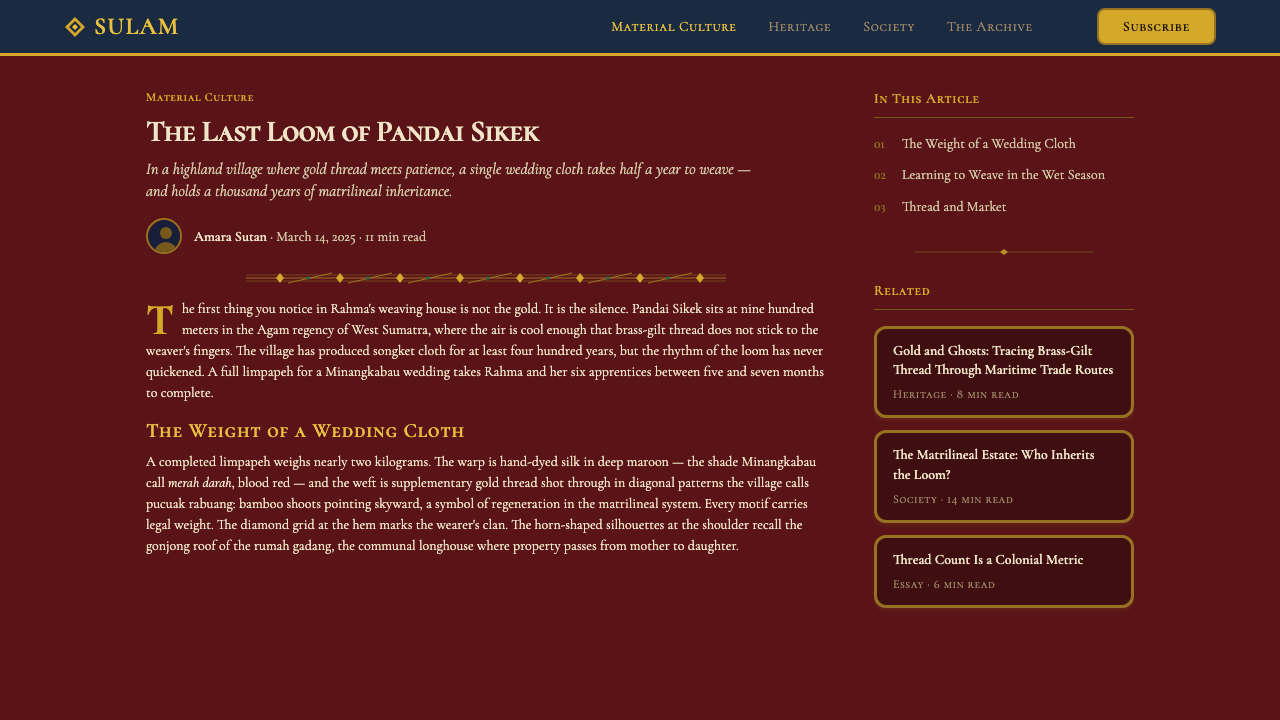
In most design traditions that use gold as a color, it appears sparingly — as an accent line, a highlight, or a badge element. In songket, gold is the primary constructive material: it fills entire motif fields, builds borders, and defines the edges of compositional zones. This reversal of the typical accent relationship means that gold must be treated with the same compositional seriousness as the ground color. In digital application, surfaces and borders rendered in gold carry structural authority, not decorative luxury.
Ceremonial Weight and Density
Songket cloth is physically heavy — the gold thread adds substantial mass to the silk ground. This material property translates visually into a sense of density and consequence. The style does not use generous negative space; instead, it fills compositional fields deliberately and richly. Motifs are placed with precision but without restraint. In interface terms, this means that spacing is purposeful rather than spacious, and that every visual zone carries active content. The result is a rich, considered density rather than decorative clutter.
Symmetry and Bilateral Balance
Unlike design traditions that seek asymmetric tension, Minangkabau songket composition is fundamentally bilateral. Motifs repeat across vertical and horizontal axes; central medallions balance flanking borders; the overall field reads as a unified, mirrored whole. This symmetry is not static but ceremonially stable — it communicates order, completeness, and the kind of formal authority appropriate to ritual contexts. In interface application, this bilateral logic translates well to headers, dividers, and full-width display compositions.
Motif Hierarchy
Songket compositions are rarely flat in their motif organization. A central large-scale motif — often a royal or sacred form — is surrounded by secondary motifs at smaller scale, which are in turn bordered by edge treatments of still-finer detail. This nested hierarchy of visual importance allows the eye to read the composition across multiple levels of scale simultaneously. In interface terms, this translates to a clear visual hierarchy where major content elements, supporting elements, and boundary treatments each occupy a defined register.
Who shaped Sumatran Songket (Pandai Sikek)?
The tradition of songket in Pandai Sikek is maintained not by named individual artists but by a community of master weavers whose knowledge has been transmitted through matrilineal household lineages across generations. These anonymous masters are the collective authors of the tradition's most technically demanding achievements — the limpapeh ceremonial skirts and selendang shoulder cloths whose gold-thread density has defined the Pandai Sikek standard. Their expertise encompasses not only the mechanics of the supplementary-weft loom but the entire vocabulary of Minangkabau motifs and their ceremonial meanings.
The Bundo Kanduang is not a historical individual but the cultural ideal of the authoritative Minangkabau matriarch — the wise, socially powerful woman who embodies the highest values of adat. As patrons of ceremonial weaving, Bundo Kanduang figures have historically been the primary commissioners and custodians of fine songket, using the gift and display of extraordinary cloth as instruments of social leadership. The figure's association with songket links the textile directly to female authority and the governance of Minangkabau customary life.
Bernhard Bart is among the researchers who contributed systematic documentation of the Pandai Sikek songket tradition, particularly in the context of the 1980s revival. His work helped establish a scholarly record of the technical processes, motif vocabularies, and social contexts of fine Minangkabau weaving at a time when the tradition faced real risks of knowledge loss. This kind of documentation — translating tacit craft knowledge into written and photographed record — has been essential to subsequent preservation, teaching, and the development of the contemporary songket market.
Hassanah Tan is a textile scholar whose work on Malay and Minangkabau weaving traditions has contributed to the broader understanding of songket within the regional context of the Malay courtly textile continuum. Scholarship of this kind positions Pandai Sikek songket not as an isolated local craft but as a node within a wider network of courtly textile cultures extending across the Malay Peninsula, Sumatra, and the island world of maritime Southeast Asia — a framing that enriches the understanding of both the tradition's depth and its visual relationships to neighboring textile cultures.
How do you use Sumatran Songket (Pandai Sikek) today?
Sumatran Songket (Pandai Sikek) is a style of ceremonial density and structured opulence — it rewards applications where richness and authority are deliberate design goals rather than constraints to be avoided. Applying it well requires embracing its defining logic: gold is structure, maroon is ground, and the diamond-grid rhythm organizes every compositional decision. It is not a style that tolerates arbitrary decoration added on top of otherwise neutral layouts.
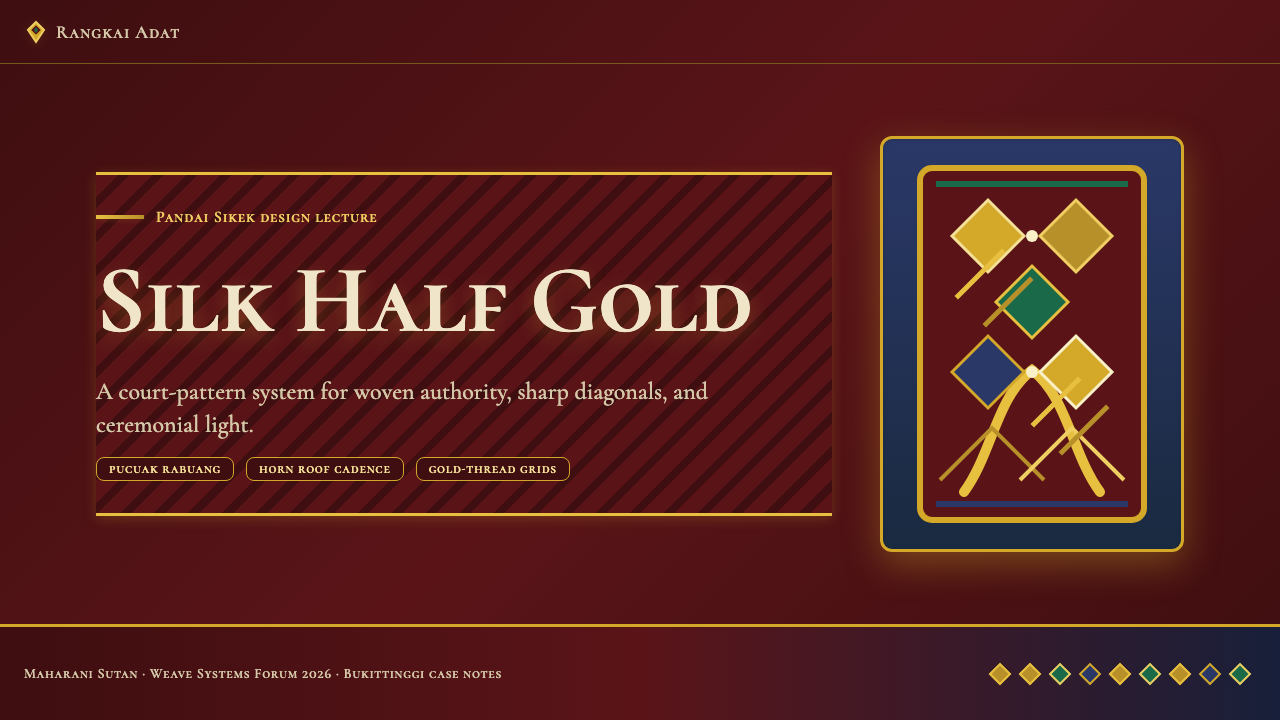
For presentation slides, the style works powerfully on cover and title pages where the full visual weight of the maroon-and-gold system can be deployed without visual fatigue. A cover built on this system uses the deep maroon as the full-bleed background, positions a title in a gold or light-on-dark treatment at generous scale, and uses a subtle diamond-grid texture or gold border treatment to frame the composition. Content slides require more restraint: one dominant maroon or dark accent zone, gold used for section headers or key callouts only, and generous use of the maroon ground with light text for body content. Data slides translate well when chart elements adopt the gold-on-maroon contrast — bars, segments, and highlights rendered in gold against a deep background produce a clarity that conventional light-ground data slides rarely achieve.
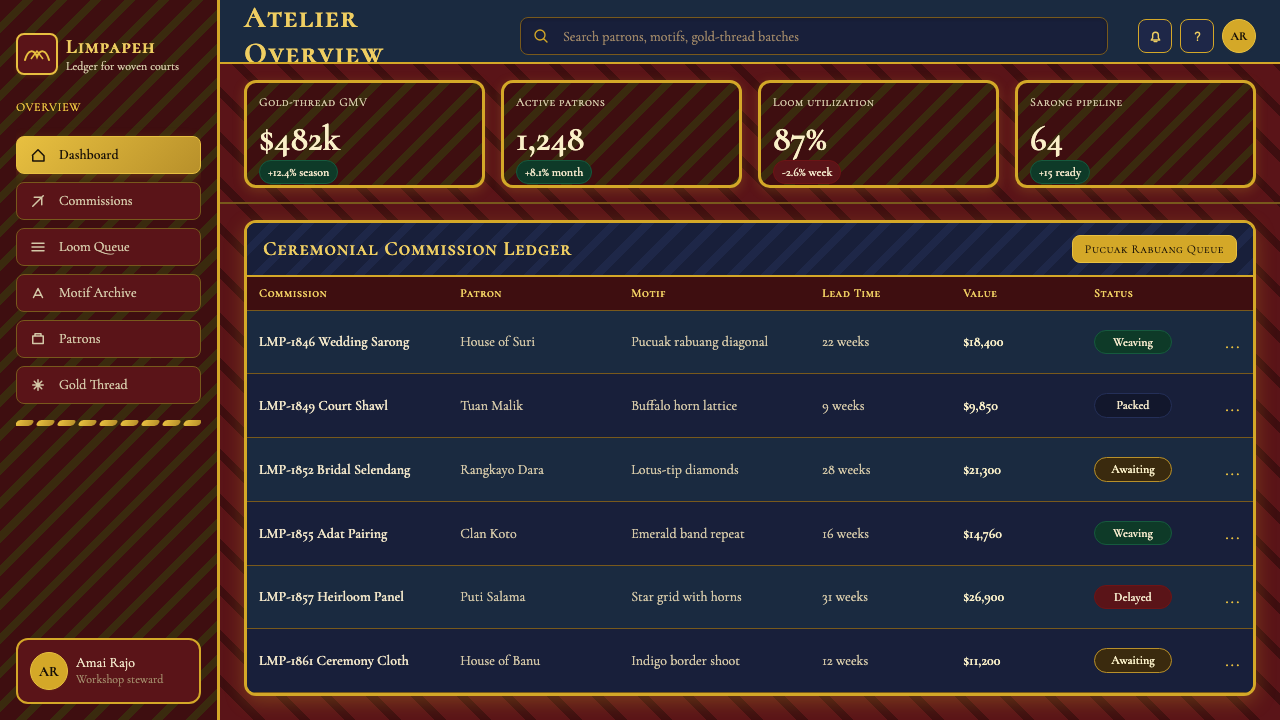
For web interfaces, this system suits premium editorial contexts, luxury brand dashboards, heritage institution portals, and cultural product pages where the visual language must communicate both depth and authority. The approach: set the primary background in deep maroon or a near-black variant of it, use gold for borders, dividers, active states, and primary interactive elements, and reserve near-white or warm cream for body text and secondary content zones. Navigation should be typographic in character — clean letterforms in light or gold tones, with gold underlines or diamond indicators marking active states. Pricing pages work well with this system when tier differentiation is achieved through density of gold treatment rather than color substitution: a premium tier card might have a full gold border and maroon ground, while a standard tier uses only a gold accent rule.
For editorial and marketing applications, the songket system creates strong cover and feature layouts for publications dealing with craft, culture, heritage, fashion, or luxury goods. A chapter opener or editorial spread uses the maroon ground at full bleed, with a large-scale title treatment in gold letterforms and a secondary text zone in near-white. Section dividers rendered as gold border elements — whether a full diamond-pattern band or a single geometric rule — give editorial flow a ceremonial punctuation. Marketing pages for products that want to signal heritage and craftsmanship benefit from the system's implicit narrative: the density and precision of the pattern vocabulary communicates that what is being offered has been made with considered care.
A common mistake is treating the gold-and-maroon palette as a synonym for generic luxury design — applying the colors without the structural logic that gives them meaning in the songket tradition. Generic luxury design often floats gold text on dark grounds with generous white space and soft gradients. Authentic songket-derived design fills its compositional fields with considered pattern and uses gold as a structural element rather than a floating accent. A second common error is applying the diamond-grid motif purely as a background texture, disconnected from any compositional function. In the source tradition, the diamond lattice is itself the organizational structure — in interface application, it should serve an equivalent organizing role, not simply decorate a neutral surface.
Sumatran Songket (Pandai Sikek) — FAQ
What makes Pandai Sikek songket different from other songket traditions in Southeast Asia?
Songket traditions exist across the Malay world — in Terengganu (Malaysia), Palembang (South Sumatra), Bali, and elsewhere — but Pandai Sikek is distinguished by the exceptional density of its gold-thread supplementary weave and the complexity of its motif vocabulary. A Pandai Sikek piece at its finest is almost entirely gold-covered on the face, with the maroon silk ground visible only in the interstices between motifs. This density is both a technical achievement and an aesthetic statement: the cloth is heavy, luminous, and visually overwhelming in a way that communicates the full weight of its ceremonial purpose. Palembang songket, by contrast, tends to use slightly more open gold-thread arrangements with a stronger ground showing; Balinese songket often incorporates colored threads alongside gold.
How does the matrilineal social structure of the Minangkabau affect the design tradition?
Profoundly and in multiple ways. Because Minangkabau society passes clan identity, land rights, and household authority through the female line, women are the social and economic center of Minangkabau life. Weaving — as a skill that passes from mother to daughter, practiced on a loom that is a household possession, producing cloth that plays essential roles in every adat ceremony — is one of the primary ways in which female knowledge and female social power are expressed and reproduced. The most ceremonially significant songket pieces are associated with rites of passage that mark a woman's transitions through life: the cloth given at marriage, the cloth used at a daughter's installation. This means the design tradition is not externally imposed on its makers — it is produced by the people for whom it carries the deepest social meaning.
Can the dark maroon-and-gold system work effectively in digital interfaces designed for everyday use, or is it too ceremonially heavy?
The ceremonial weight is real, and it is a feature rather than a bug — but it does mean the system has genuine limits in everyday-use contexts. For a dashboard that users interact with all day, every day, the maroon-and-gold combination at full saturation will cause visual fatigue and may read as oppressive rather than authoritative. Two approaches mitigate this. First, pull back the saturation of the ground color toward a deep warm brown or near-black rather than pure maroon, reducing the intensity while preserving the tonal character. Second, treat the gold as an accent and border system on a near-neutral ground, reserving the full maroon-and-gold expression for high-stakes moments: onboarding screens, premium feature callouts, or celebration states. This lets the system signal its cultural depth without imposing ceremonial density on every interaction.
Is the pucuak rabuang motif sacred or restricted in any way, or is it freely usable in design?
The pucuak rabuang and other Minangkabau motifs are cultural rather than strictly religious symbols, and they appear freely on household objects, architectural elements, and everyday textiles alongside their use in ceremonial cloth. There is no formal restriction on their use in design contexts outside Minangkabau culture, though thoughtful application — using the motifs as a design system learns from them rather than as copyable surface decoration — is both more respectful and more effective. The deeper principle is that the geometry and diagonal rhythm of the pucuak rabuang carry their visual authority precisely because they emerge from a coherent cultural system; designers who understand that system will apply its logic rather than its surface, and will produce work that honors its origins while serving new contexts.
How does this design system relate to other Southeast Asian textile-derived visual traditions?
Pandai Sikek songket belongs to a broader Malay courtly textile continuum that includes the gold-thread weaving traditions of Terengganu, the kain limar silk ikat of Palembang, and the royal textiles of the Brunei sultanate. These traditions share a core vocabulary of supplementary-weft gold patterning, diamond lattice structures, and the social function of cloth as a medium of rank and ceremonial exchange. The differences are significant: Minangkabau songket is distinguished by its matrilineal social embedding and its particular motif vocabulary, while Terengganu weaving tends toward slightly looser compositions with different regional motifs. In the broader Southeast Asian context, songket's structural use of gold relates it to the Javanese batik tradition's use of pattern as cultural encoding — though the specific visual languages are entirely distinct. Designers working with any of these textile traditions will find that the structural principles — pattern as hierarchy, ornament as information, cloth as social document — transfer usefully across specific regional vocabularies.
Related design styles
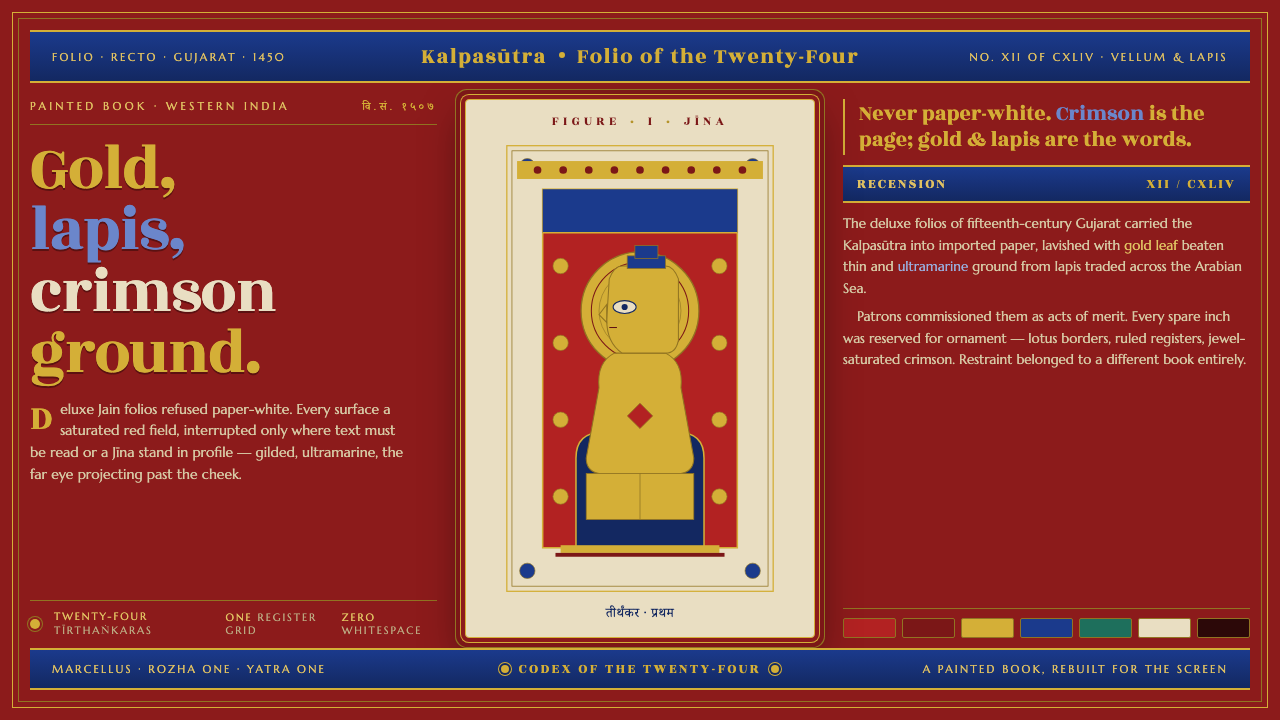 Jain Kalpasutra ManuscriptNever paper-white. Gold leaf and lapis figures on jewel-crimson, lotus-ruled…
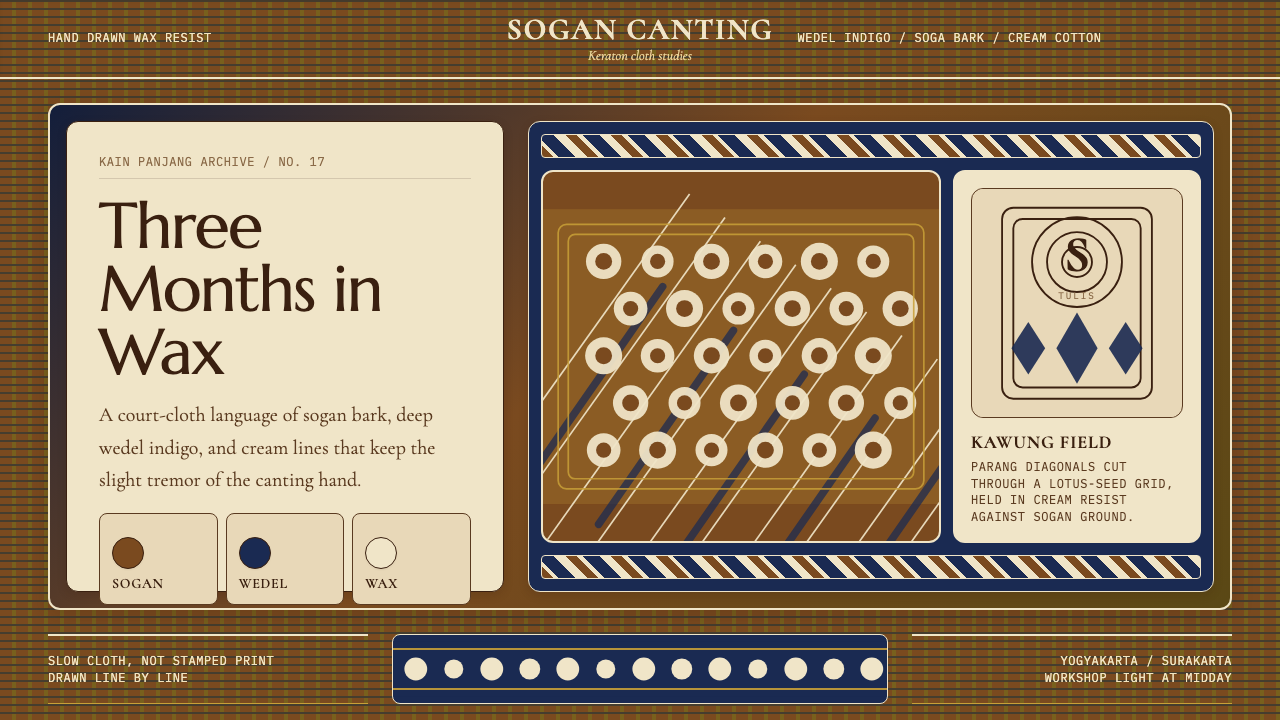 Javanese Batik Tulis (Keraton Sogan)Patience made visible. Sogan brown, indigo, and cream wax-lines form dense co…
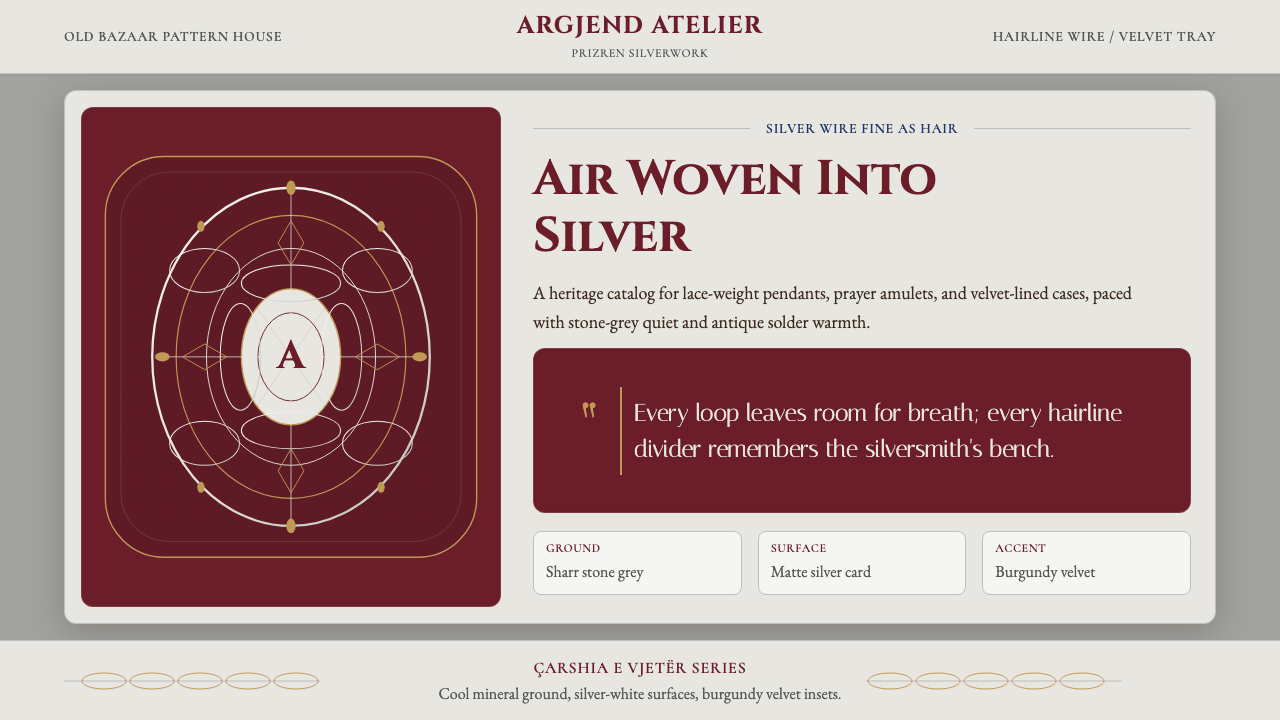 Kosovar Prizren Filigree SilverAir becomes ornament. Burgundy velvet and stone grey frame Cinzel type with c…
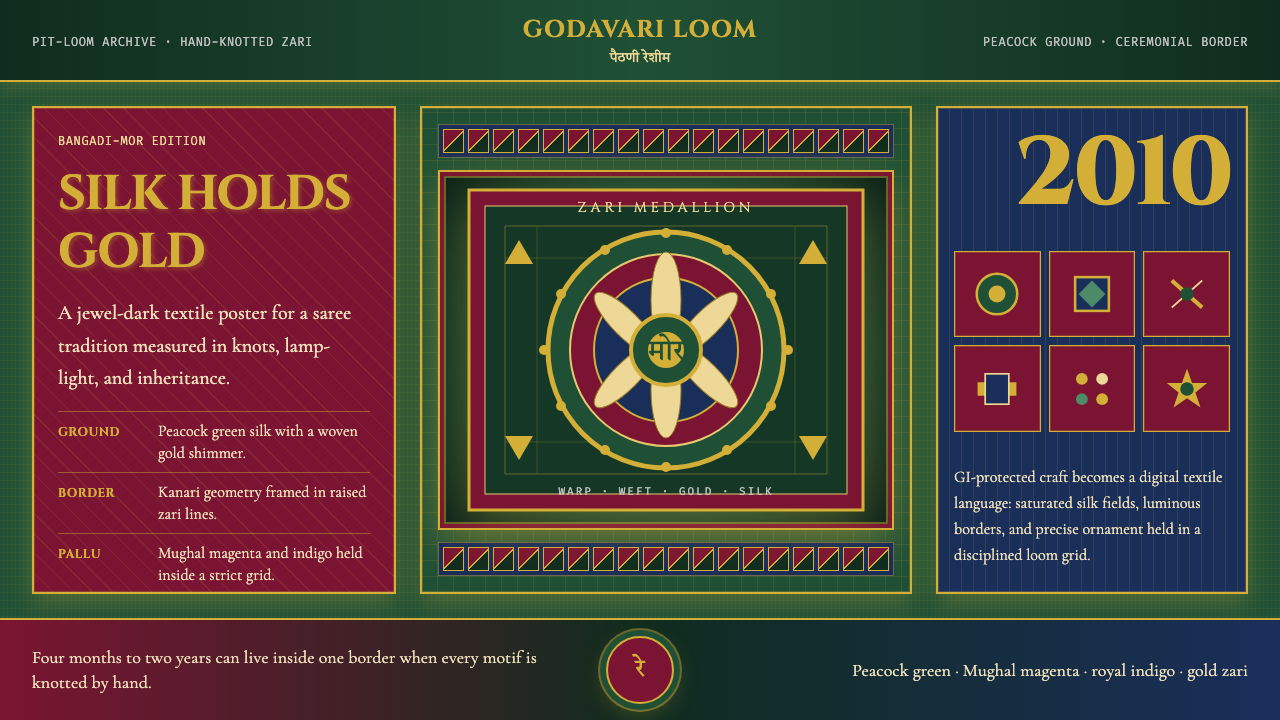 Maharashtra Paithani Peacock SareeSilk carries ceremony. Peacock green, Mughal magenta, and gold grids shimmer…
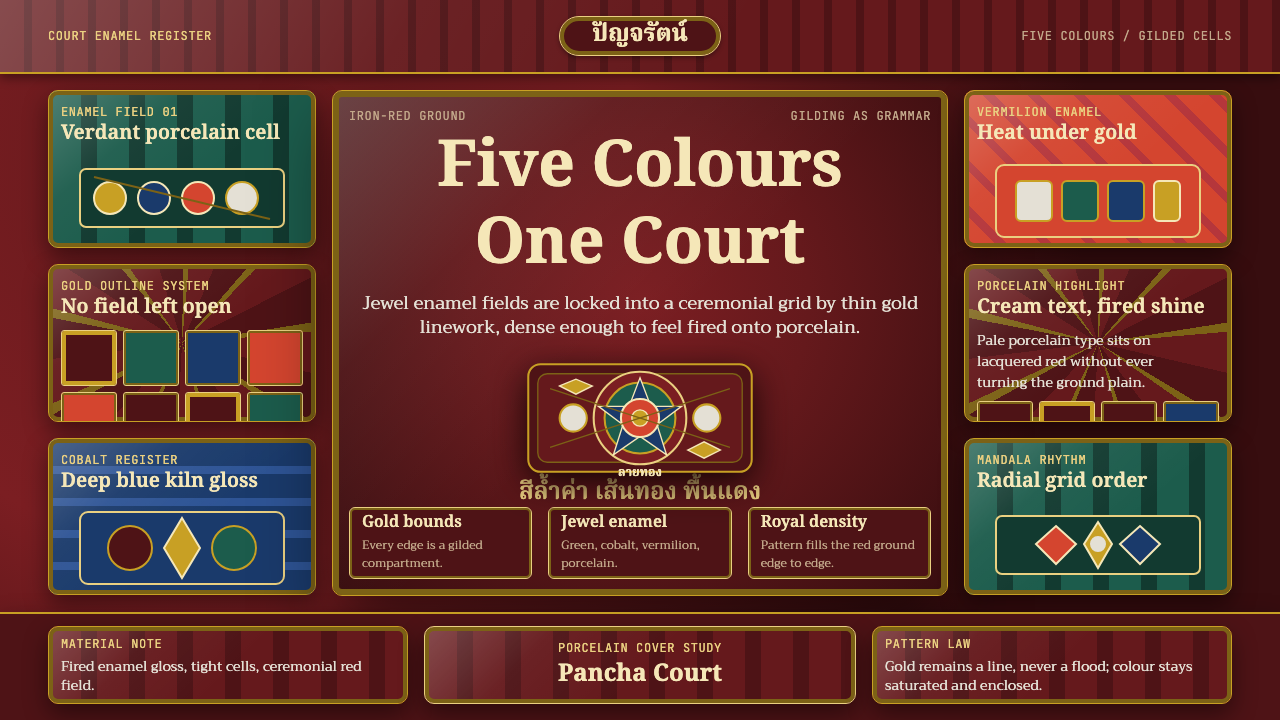 Thai BenjarongRoyal density. Gold-line enamel cells pack green, cobalt, and vermilion on ir…
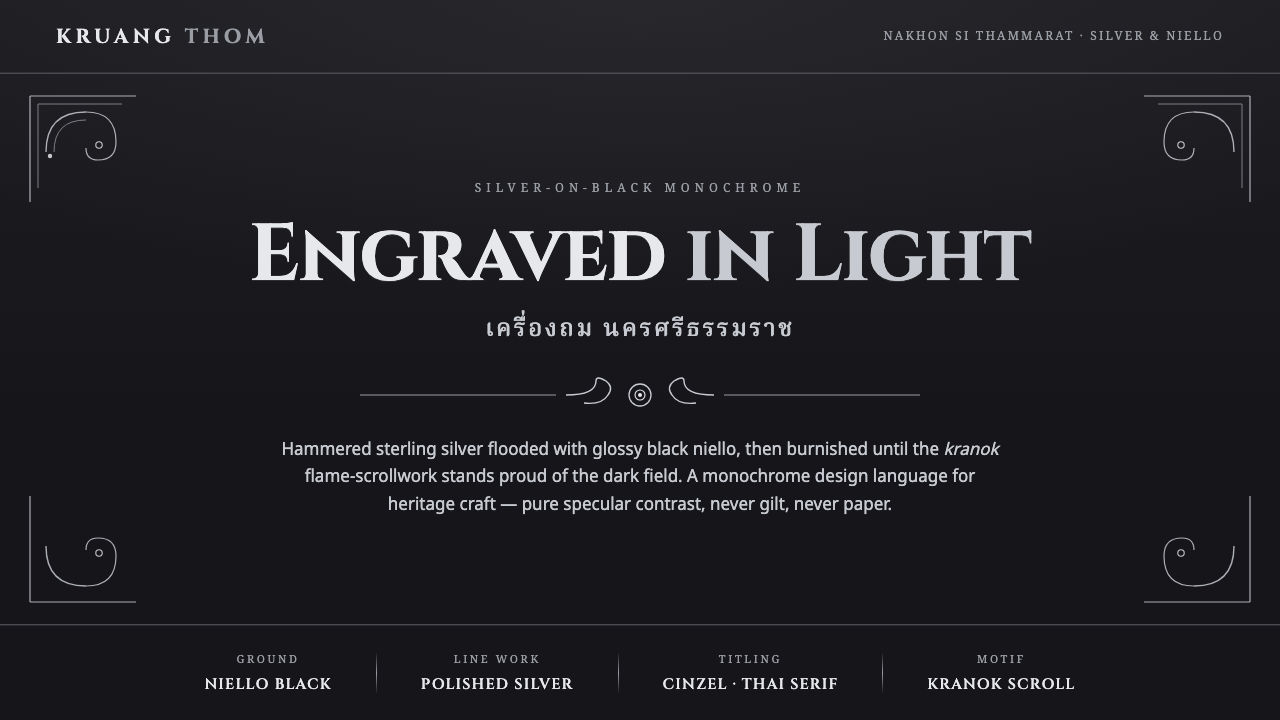 Thai Nielloware ThomSilver-on-black, never gilt. Polished kranok scrollwork glints proud of a glo…