What is Bidri Deccan Metalwork?
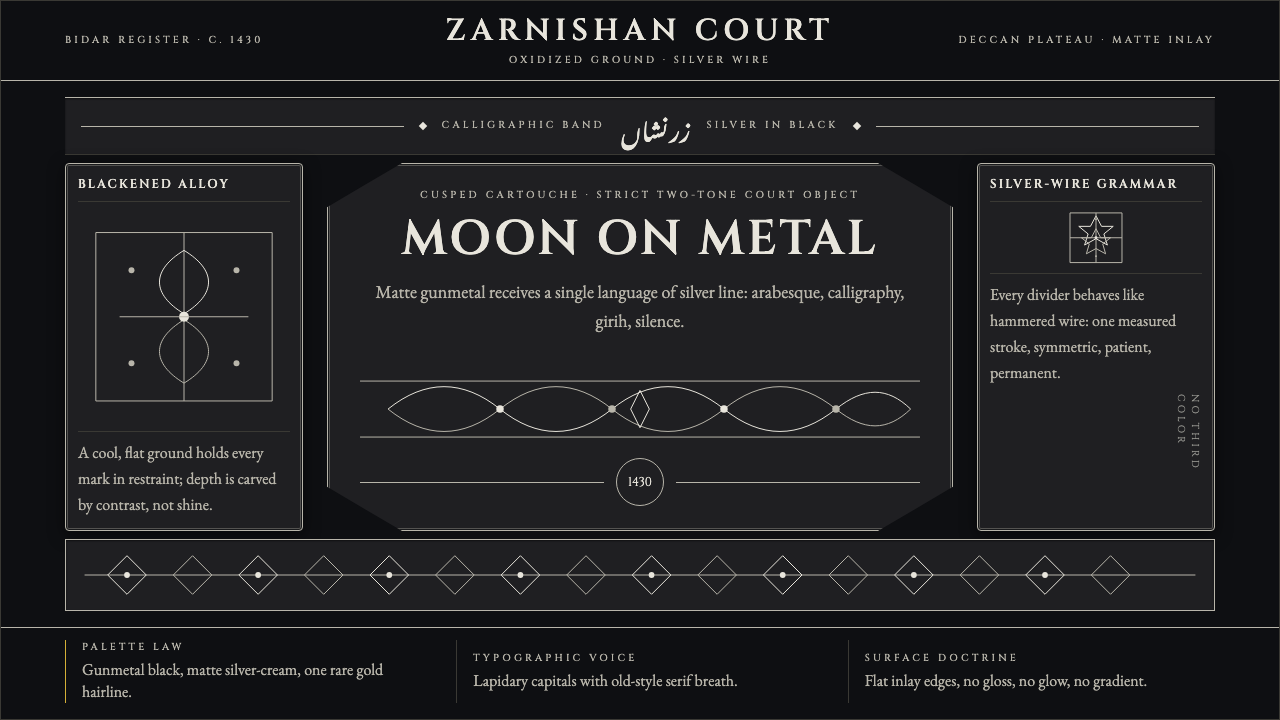
Born in a Deccan sultanate workshop around 1430, Bidri metalwork achieves the most extreme chiaroscuro in all of craft history — pure matte gunmetal-black against pure matte silver, and nothing else.
Bidri Deccan Metalwork in brief
Bidri is the inlay metalwork tradition of the Deccan plateau in southern India, named for the city of Bidar in present-day Karnataka. Its defining visual characteristic is absolute: a body of zinc-copper alloy oxidized by a paste made from local soil to a deep, cool gunmetal-black, then inlaid with patterns of pure silver wire and sheet. The result is a two-value system of maximum contrast — the darkest possible matte ground against the brightest possible matte silver — with no third color, no gradient, no tonal gradation of any kind.
The patterns themselves draw from a rich convergence of traditions: Persian floral arabesque with its interlocking vine-and-blossom grammar, geometric girih with its star-and-polygon lattices derived from Islamic architectural ornament, Koranic calligraphy rendered in elegant silver script, and occasionally Indian motifs such as the lotus and the paisley. These pattern vocabularies are not mixed casually — they are applied with architectural precision, each occupying its own register or band on the surface of a vessel, panel, or ornamental object.
What makes Bidri distinctive among the world's inlay traditions is the permanence of its tonality. The gunmetal-black oxidation achieved through the local Bidar soil-paste is chemically stable — it does not polish away with handling, unlike many patinas. This means the aesthetic contract of the object — absolute black ground, absolute silver inlay — holds for centuries. The Salar Jung Museum in Hyderabad holds examples, including celebrated hookah bases and betel-nut boxes, in which the contrast reads with the same intensity today as it did when they left the workshop.

Where does Bidri Deccan Metalwork come from?
Bidri metalwork originated in Bidar around 1430, during the reign of Sultan Ahmad Shah Wali Bahmani of the Bahmani Sultanate, the first major Islamic dynasty to control the Deccan plateau. The sultanate maintained close diplomatic and cultural ties with Persia, and it is widely held that Persian metalworkers — possibly from Khorasan or Isfahan — were among those who established or transmitted the technical tradition in Bidar. The local soil of Bidar, rich in sal ammoniac and particular mineral salts, proved uniquely suited to the oxidation process, and Bidar thus became the exclusive origin of the finished black ground that defines the style. Craftsmen elsewhere who attempt the technique do not achieve the same depth of matte black.
Under successive Deccan sultanates — the Adil Shahi rulers of Bijapur and the Qutb Shahi rulers of Golconda in the sixteenth and seventeenth centuries — Bidri patronage expanded dramatically. These courts were among the wealthiest and most cosmopolitan in Asia, maintaining Persian as the language of administration and poetry, hosting scholars and artists from Iran, Central Asia, and the Ottoman world, and commissioning luxury objects at a scale that sustained entire craft communities. Bidri ware became the prestige gift object of the Deccan courts: hookah bases, betel-nut boxes, ewers, trays, and decorative panels produced for rulers, nobles, and diplomatic exchange.
The eighteenth century brought further patronage under the Nizams of Hyderabad, the successor state that came to dominate the Deccan after the Mughal Empire's decline. The Nizams, among the wealthiest rulers in the early modern world, maintained Bidar's workshops as a living craft institution. European colonial travelers and merchants encountered Bidri ware and transmitted its reputation to Western audiences; examples entered the collections of the Victoria and Albert Museum in London and museums across Europe. The colonial encounter did not fundamentally alter the craft's aesthetic vocabulary — the two-value black-and-silver system remained canonical — though it introduced new object types suited to European taste.
The twentieth century brought existential pressures: industrialization, changing patronage, and the decline of aristocratic courts. The craft survived through a combination of community resilience and state support. In 2009, Bidri metalwork received a Geographical Indication tag under Indian law, formally recognizing Bidar as the sole legitimate origin of authentic Bidri ware and protecting the craft against imitation from other regions. Today, several hundred craftspeople — concentrated in Bidar's old city, many from families tracing their practice through multiple generations — continue to produce work using techniques and soil-paste formulations essentially unchanged from the Bahmani period.
What defines the Bidri Deccan Metalwork look?
Ground Color
The ground of every Bidri object is a deep, cool, blue-tinged matte black — not the warm brown-black of iron patina or the glossy black of lacquer, but a uniquely flat, almost absorptive darkness achieved through chemical oxidation with local Bidar soil-paste. This particular tone is irreproducible outside Bidar because the mineral composition of the soil is site-specific. In design application, the ground anchors the entire visual system: everything else — pattern, text, accent — reads as figure against this absolute field.
Inlay Metal
The inlay is always pure silver — not silver-tone alloy, not white gold, but silver chosen for its specific optical quality: a cool, slightly warm-edged brightness that contrasts with the blue-black ground in the most legible possible way. The silver is applied in two forms: fine wire hammered into incised grooves for line work and arabesques, and thin sheet cut and pressed into broader channels for solid fills and calligraphic elements. The junction between black ground and silver inlay is always crisp — no solder, no filler, no transition material, just the immediate hard edge of one against the other.
Pattern Grammar
Bidri pattern draws from three primary vocabularies that are treated as distinct registers, rarely blended on the same surface zone. Persian floral arabesque — continuous interlocking scrolls of stylized vine, leaf, and blossom — covers broad ground areas with a rhythm that is dense but never congested. Geometric girih — star polygons, hexagons, and interlaced bands derived from Islamic architectural tiling — appears on borders and handles, where its structural rigidity frames the organic arabesque. Persian and Koranic calligraphy occupies the most prestigious register, typically a central cartouche or inscription band, rendered with the same precision as manuscript lettering.
Two-Value Constraint
The aesthetic discipline of Bidri is its most radical formal feature: the palette is structurally limited to two values — the darkest matte ground and the brightest matte inlay — with no intermediate tone permitted. There is no gilding, no colored enamel, no patinated copper accent. Historically, gold inlay was occasionally used in the most luxurious court commissions, but even then it appeared as a second inlay tone alongside silver rather than as a third hue. In the canonical tradition, the two-value rule holds absolutely. This creates a system of extreme legibility: any pattern, however intricate, reads instantly because foreground and background are at maximum contrast.
Surface Topology
Bidri surfaces are flush rather than raised. The silver inlay sits precisely level with the surrounding metal ground — it does not protrude, and the ground is not recessed around it. This flush quality means the tactile experience of a Bidri object is completely smooth, while the visual experience is one of dramatic depth and contrast. The eye reads the silver as floating above the black, creating an illusion of relief that the hand contradicts. This perceptual tension between what is seen and what is felt is intrinsic to the style's effect.
Object Forms
The canonical Bidri object vocabulary is Mughal-Deccan court material culture: the hookah or huqqa base (the most celebrated form), the paan-daan or betel-nut box, the ewer and basin set, the tray and platter, the decorative panel, the sword hilt and dagger handle. Each form has an established system of surface division — the hookah base is treated in horizontal bands of differing pattern density; the paan-daan alternates central medallion with corner fills; the ewer handles and spouts are treated as separate ornamental zones. The object forms have been extended in the modern period to include jewelry, buttons, and decorative tiles, but the canonical vocabulary remains associated with Mughal-Deccan court objects.
Craft Hierarchy
Traditional Bidri production is divided between specialists: the ustad or master craftsman who designs and executes the most complex inlay work, the craftsmen who handle roughing, filing, and finishing of the alloy body, and those who manage the oxidation process with the soil-paste. The design step — incising the pattern into the metal surface before inlay begins — determines the visual quality of the finished piece and is the most prized skill. Master ustads memorized pattern vocabularies that could be adapted to any surface, any scale, any object form, allowing the tradition to remain compositionally inventive within its strict two-value constraint.

Who shaped Bidri Deccan Metalwork?
Sultan Ahmad Shah Wali Bahmani, who ruled the Bahmani Sultanate from 1422 to 1436, is credited in local tradition as the founding patron of Bidri metalwork. His court at Bidar attracted Persian craftsmen and artists who brought technical knowledge of metalworking traditions from the Iranian plateau. Whether or not a single founding moment can be attributed to his reign, the Bahmani court's Persianate cultural orientation — its patronage of Persian poetry, architecture, and luxury craft — created the conditions in which a Persian-Indian metalwork synthesis could emerge and flourish.
Abdullah bin Kaiser is identified in craft historical sources as among the earliest named master craftsmen of the Bidri tradition. His significance lies not only in technical achievement but in the codification of the pattern vocabulary and the training of subsequent generations of ustads. The transmission of named masters within the Bidar craft community represents an unusual degree of historical continuity for a non-literary craft tradition, and Abdullah bin Kaiser's name anchors the early genealogy of the discipline.
Shah Mustafa Quadri represents the mid-period development of Bidri under Deccan Sultanate patronage, when the craft reached its greatest formal complexity. Associated with the elaboration of calligraphic inlay — the most technically demanding element of the Bidri vocabulary — his work exemplifies the integration of Sufi literary culture into the material tradition. Calligraphic Bidri pieces bearing devotional or poetic inscriptions were among the most valued objects in Deccan court gift exchanges, and the standards established by craftsmen of his generation shaped the tradition for the centuries that followed.
Muhammad Abdul Rauf is among the craftsmen recognized for sustaining the Bidri tradition through the disruptions of the twentieth century — colonial transition, the integration of the princely states into independent India, and the collapse of aristocratic patronage networks. His work and teaching helped maintain the technical standards of inlay precision and soil-oxidation chemistry during a period when many comparable craft traditions in the subcontinent contracted severely or disappeared entirely. The survival of Bidri as a living practice owes substantially to craftsmen of his generation who bridged the court era and the contemporary craft economy.
How do you use Bidri Deccan Metalwork today?
Bidri is among the most atmospherically distinctive historical styles available to contemporary designers, because its core constraint — absolute matte black ground, absolute matte silver inlay, no third value — is both highly specific and highly transferable. Applying it correctly requires understanding what the system is doing: using maximum luminance contrast to create legibility without color, using dense pattern to reward close looking, and using the quality of the black ground itself as the primary surface material rather than a neutral background.
For presentation slides, the Bidri palette works with exceptional power on cover pages and section dividers. A cover built on this system places the title in a cool silver tone against a deep gunmetal-black ground, surrounded by a border of stylized geometric or arabesque ornament rendered in the same silver. The effect is immediately palatial and authoritative — appropriate for luxury product launches, cultural institution presentations, or any context requiring gravitas without ostentation. Content slides in this mode should resist the temptation to introduce additional colors: the hierarchy of information is established through silver-tone weight and density variation, reserving the densest ornamental treatment for primary headings and using thinner, sparser silver lines for secondary structure.
For web interfaces, Bidri translates most naturally to dark-mode dashboards and premium pricing pages where the product is positioned at the high end of its category. The approach requires a near-black background — not a generic dark gray, but a tone with the cool, slightly blue-shifted quality of the original gunmetal — with interactive elements, active states, and key data points rendered in a silver or cool near-white tone. Ornamental borders and dividers can carry subtle arabesque or geometric pattern at low opacity to invoke the tradition without overwhelming functional content. Navigation and typography should be clean and hierarchical: the ornamental register and the functional register must remain clearly distinguished.
For editorial and marketing applications, the style supports exceptionally strong editorial covers, luxury brand identity systems, and cultural institution communications. A Bidri-derived editorial layout uses the full-bleed dark ground for feature pages, silver-tone display type for headlines, and reserves any ornamental patterning for borders, drop caps, or section markers. In marketing contexts, the two-value constraint is itself the message: brands that adopt this palette communicate exclusivity, craft heritage, and the confidence that comes from working with a reduced rather than expanded visual vocabulary. Marketing pages work well with alternating full-width blocks — dark-ground-with-silver-type and silver-ground-with-dark-type — treating the inversion as the Bidri craft tradition treats the relationship between ground and inlay.
The most common mistake when applying Bidri-derived design is breaking the two-value constraint by introducing a third hue — a gold accent, a warm highlight, or a colored call-to-action button. Each addition dilutes the system's defining power. The authority of Bidri comes precisely from its refusal to negotiate: the ground is the ground, the inlay is the inlay, and the entire expressive range of the design must be found within that relationship. A second common mistake is using a generic dark background — warm charcoal, blue-navy, or neutral dark gray — rather than the specific cool blue-black that gives the style its singular atmosphere. The quality of the black is not incidental; it is the foundation on which the silver reads correctly.

Bidri Deccan Metalwork — FAQ
Is Bidri purely Islamic in its aesthetics, or does it draw from Hindu visual traditions as well?
Bidri's foundational vocabulary — Persian arabesque, geometric girih, calligraphy — is firmly grounded in Indo-Islamic tradition. However, the Deccan sultanates were syncretic courts that patronized both Islamic and Hindu artistic traditions, and Bidri craftsmen occasionally incorporated Indian motifs: the lotus, the paisley derived from the mango leaf, and occasionally animal figures drawn from the Indian decorative vocabulary. These Indian elements were typically absorbed into the arabesque rhythm rather than appearing as standalone motifs. The result is a predominantly Persianate aesthetic with genuine Indian inflection — not a fusion in the superficial sense, but a synthesis developed over centuries of cohabitation on the Deccan plateau.
Why is the black ground so important — can a dark gray or navy substitute?
The specific quality of the Bidri black — cool, matte, slightly blue-shifted, achieved through a chemical oxidation process rather than paint or pigment — is not incidental to the aesthetic; it is the aesthetic. The silver inlay reads the way it does because of the precise tonal and surface relationship between the two materials. A dark gray introduces a midtone that softens the contrast and moves the system toward conventional dark-mode design. A navy introduces a hue that competes with the cool neutrality of the silver. Neither reproduces the visual logic of Bidri. In design application, the closest approximation is a near-black with a cool, desaturated blue quality — but even then, the surface quality (matte versus glossy, textured versus smooth) matters as much as the hue.
How does Bidri relate to other inlay metalwork traditions, such as Japanese damascene or Florentine niello?
Bidri, Japanese damascene, and Florentine niello share the broad technical category of inlay metalwork — in each, a contrasting material is set into a prepared ground — but they are aesthetically and technically distinct. Japanese damascene (zogan) works primarily with gold inlay against iron, producing a warm, precious quality rather than Bidri's cool chiaroscuro. Florentine niello uses a black sulfur-based compound as the inlay material set against silver or gold, inverting Bidri's value relationship. Bidri is unique in using chemical oxidation of the base alloy itself to create the ground color rather than applying a surface coating, and in its strict two-value matte-on-matte system. Of all comparable traditions, Persian Koftgari metalwork is the closest ancestor — Bidri can be understood as a Deccan elaboration of Persian wire-inlay technique, transformed by Indian pattern vocabulary and the unique chemistry of Bidar soil.
What does the Geographical Indication tag mean for the tradition, and how does it affect contemporary practice?
The 2009 GI tag establishes in Indian law that only metalwork produced in Bidar using the traditional zinc-copper alloy and the local soil-paste oxidation process may be sold as genuine Bidri ware. This has two practical effects. First, it creates legal protection against producers in other regions who make visually similar objects using different materials or industrial processes — protecting both the craft community's market and the consumer's ability to purchase what they believe they are purchasing. Second, it creates an incentive for practitioners to maintain the traditional process rather than substituting less labor-intensive modern alternatives. For contemporary designers working with the Bidri aesthetic, the GI tag is a reminder that the tradition is a living practice tied to a specific community and geography, not merely a visual style available for appropriation.
Is Bidri appropriate for brands or products that have no connection to South Asian culture?
The question of cultural context is legitimate and worth taking seriously. Bidri is a living tradition with a specific geographic, religious, and community history — it is not a generic historical style detached from its origins. That said, design history is substantially a history of aesthetic vocabularies crossing cultural boundaries, and the Bidri visual system — its two-value constraint, its dense patterned ornament, its absolute matte contrast — has genuine formal properties that are transferable to contexts beyond its origins. The responsible approach is to apply the aesthetic with knowledge of its source, to avoid presenting the style as merely decorative exoticism, and to be aware that the deeper the design engages with Bidri's specific pattern vocabulary (particularly calligraphy), the more careful the cultural contextualization needs to be. A design that draws on the broad tonal and contrast logic of Bidri is different from one that reproduces Islamic calligraphy as purely decorative element.
Related design styles
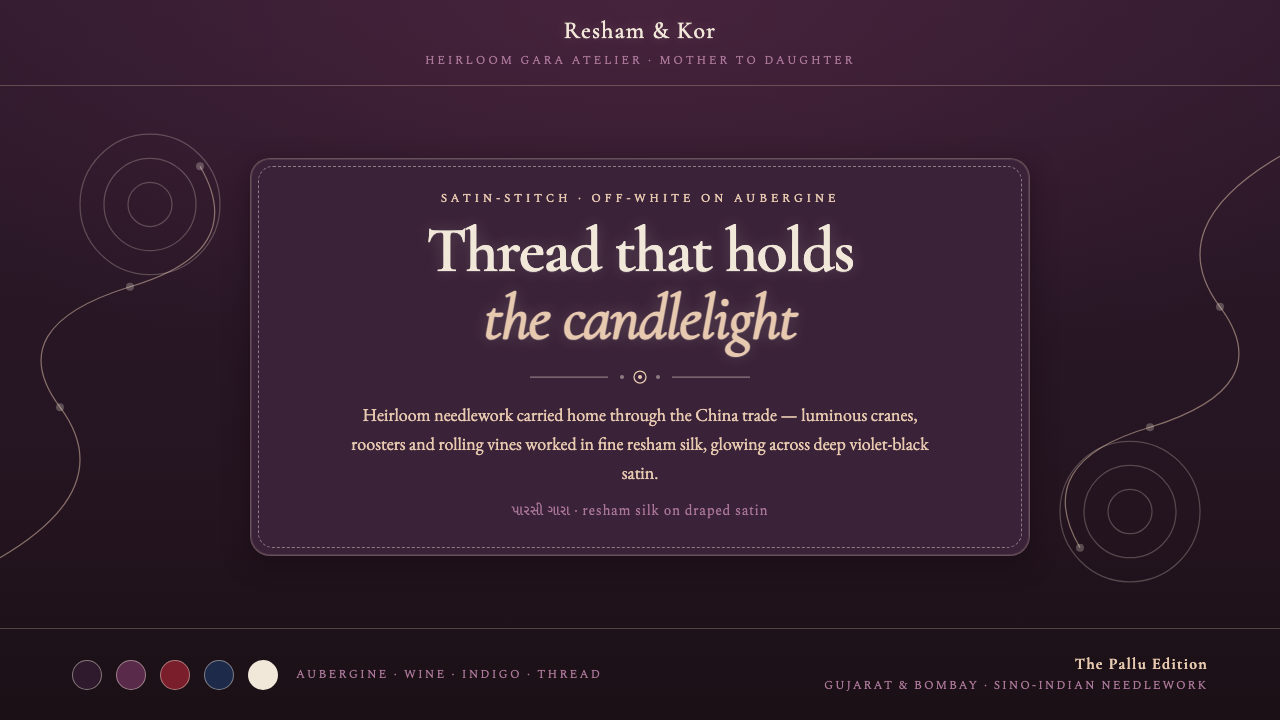 Parsi Gara EmbroideryHeirloom needlework, made digital. Off-white silk vines glow over deep auberg…
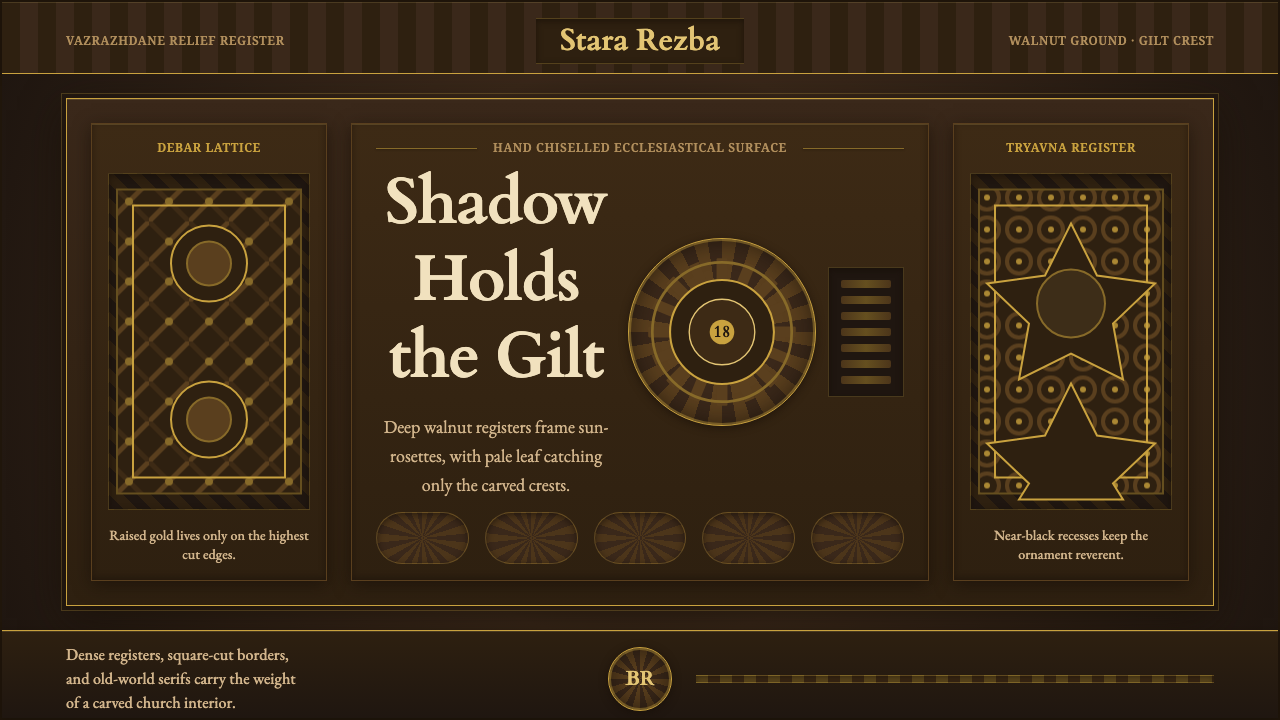 Bulgarian Revival WoodcarvingDark devotion in relief. Walnut panels, Cardo serifs, and gilt rosettes catch…
 Circassian Adyghe Gold BraidCourtly gold on dark wool. Raised braid edges coil over indigo-black panels.
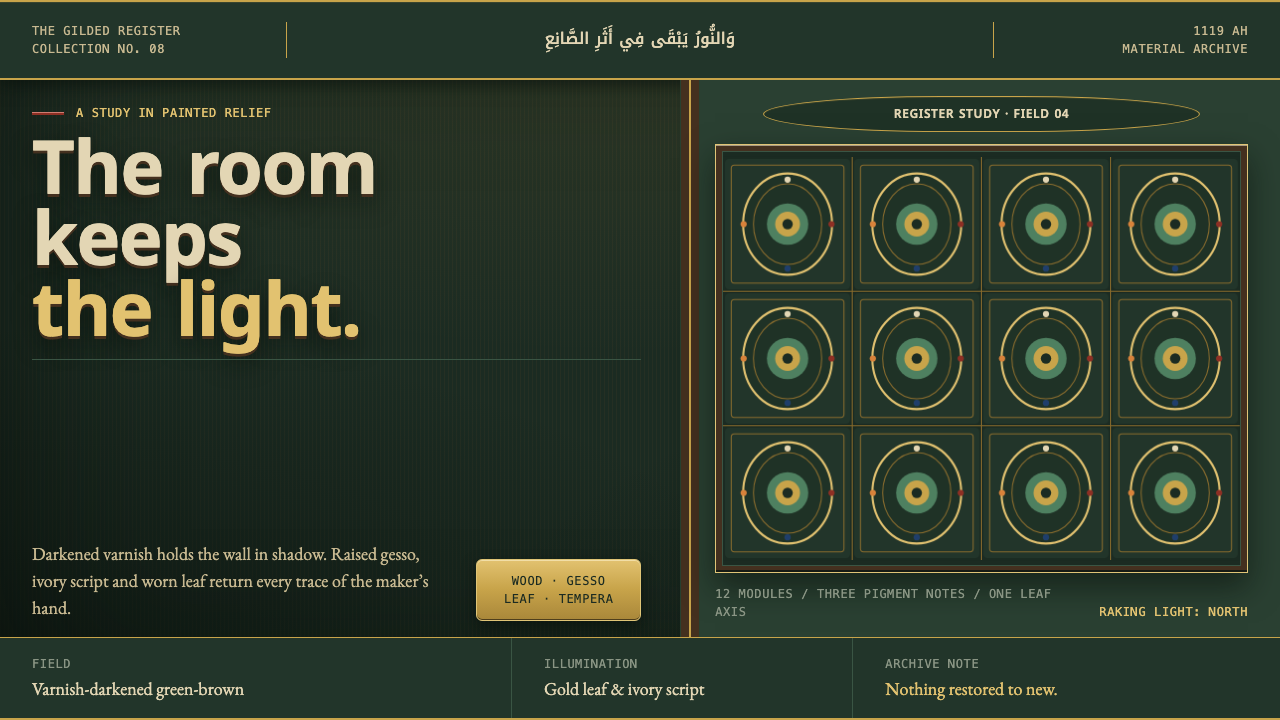 Damascus Ajami RoomDarkness makes the gilding glow. Ivory script and gold relief cross a varnish…
 Jain Kalpasutra ManuscriptNever paper-white. Gold leaf and lapis figures on jewel-crimson, lotus-ruled…
 Javanese Batik Tulis (Keraton Sogan)Patience made visible. Sogan brown, indigo, and cream wax-lines form dense co…