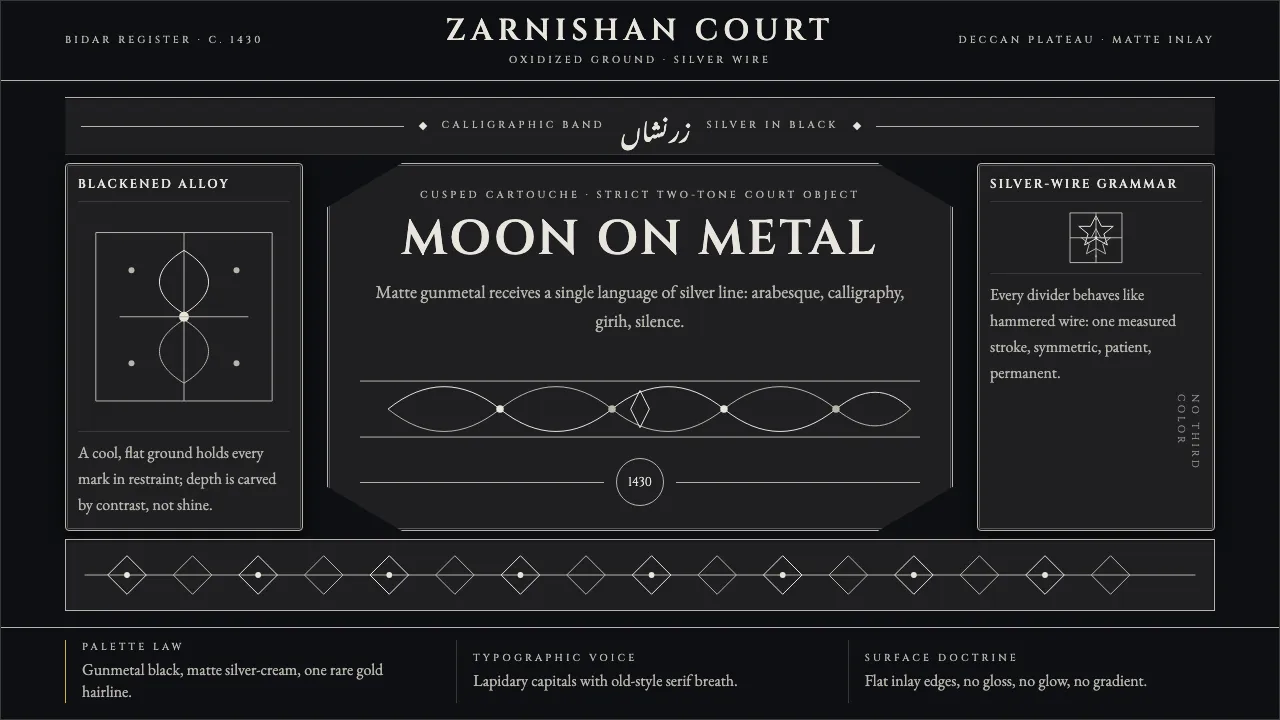
About Bidri Deccan Metalwork
Bidri is the Deccan-Indian inlay metalwork tradition born c. 1430 in Bidar, Karnataka: a zinc-copper alloy body oxidized to deep gunmetal-black by local soil-paste, then inlaid with bright silver wire and sheet patterns of floral arabesque, geometric girih and Persian calligraphy.
The discipline is absolute: pure matte gunmetal-black ground, pure matte silver inlay, no third color, no gradient, no shading — just chiaroscuro contrast at maximum intensity. The silhouette of a Salar Jung Museum bidri hookah is the brand: cool blue-charcoal body wrapped in silver-wire arabesque bands.
- Origin
- Bidar (Karnataka), Deccan plateau, India
- Era
- c. 1430 founding under Bahmani Sultanate; peak 1500s–1850s under Adil Shahi, Qutb Shahi, Nizam of Hyderabad; GI-tag protected 2009
- Key figures
- Abdullah bin Kaiser · Muhammad Abdul Rauf · Shah Mustafa Quadri · Sultan Ahmad Shah Wali Bahmani
- Movements
- Indo-Islamic luxury metalwork · Deccan Sultanate court material-culture · Persian-Indian style synthesis
Bidri Deccan Metalwork design spec
Colors
Typography
The other 11 sections — buttons, cards, spacing, motion, techniques and more — open once you unlock. Download the DESIGN.md or send it to your AI in one click. Unlock once, yours forever.
Sign up nowStyles similar to Bidri Deccan Metalwork
Also inspired by crafts & folk art, with a close feel.
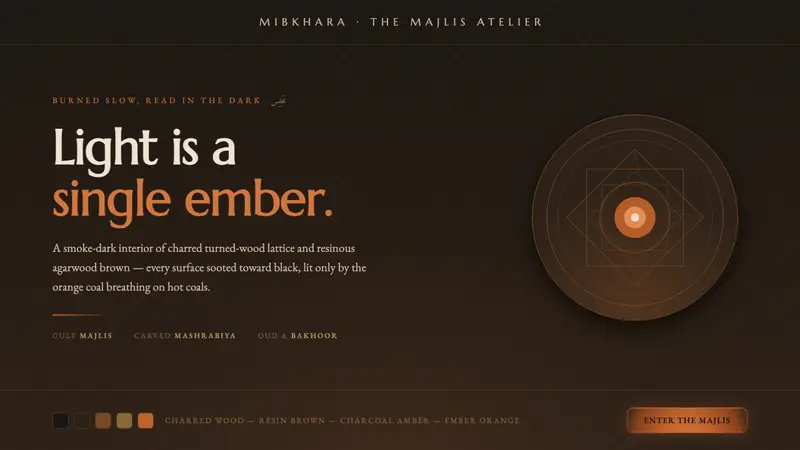 Oud Incense MashrabiyaLight is a single ember. Charred near-black mashrabiya lattice, resin browns, one ember-orange coal.
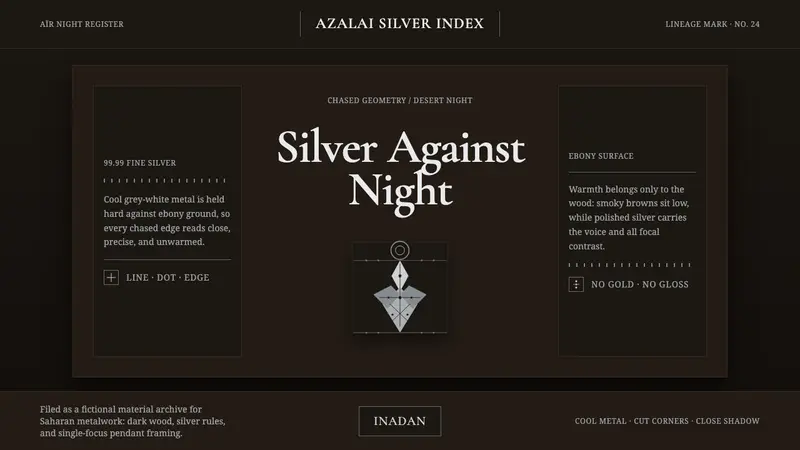 Tuareg Agadez Cross SilverSilver refuses warmth. Cool chased geometry cuts across ebony-dark surfaces.
 Russian Palekh Lacquer MiniatureBlack lacquer turns mythic. Gold ovals hold crimson, lapis, and emerald tempera.
 Bulgarian Revival WoodcarvingDark devotion in relief. Walnut panels, Cardo serifs, and gilt rosettes catch crest light.