What is Islamic Geometric Art?
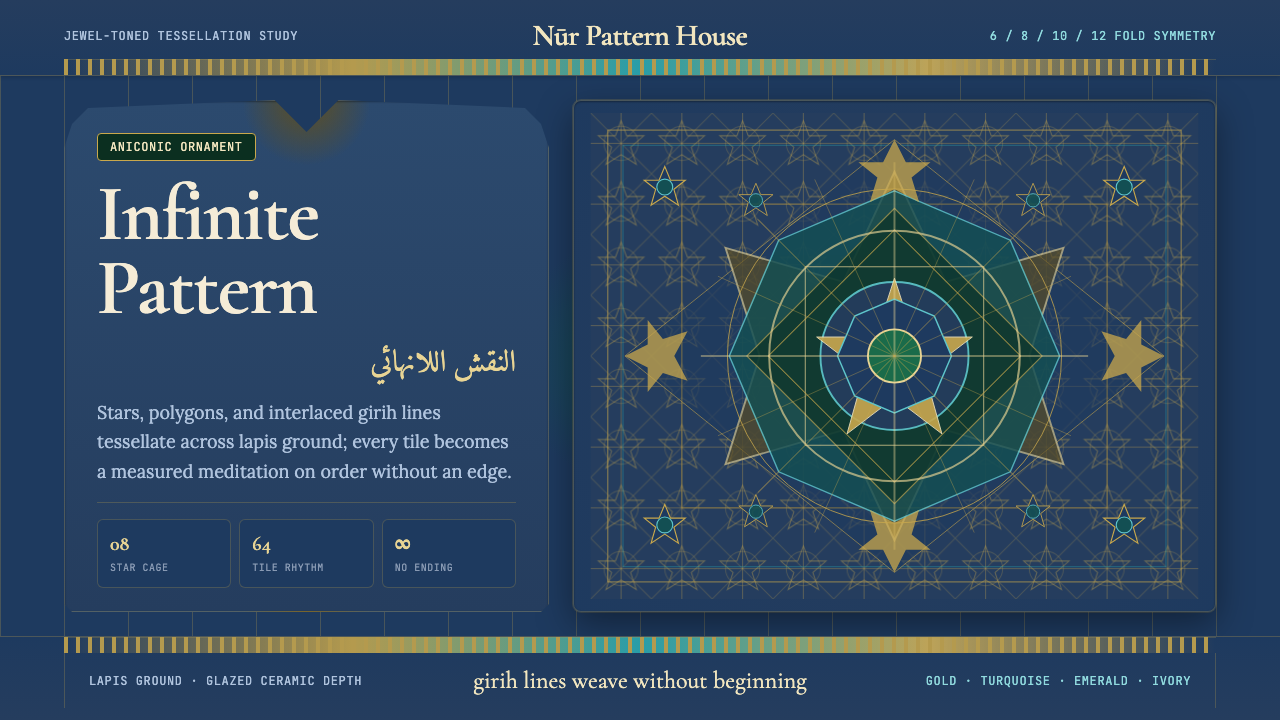
Islamic geometric art is the infinite pattern — stars, polygons, and arabesques tessellating without beginning or end across the walls of the world's greatest mosques and palaces.
Islamic Geometric Art in brief
Islamic geometric art is a visual tradition built entirely on mathematical order. Its vocabulary — radiating star polygons, interlocking girih lines, and endlessly repeating arabesques — emerged across a vast geographic and temporal arc stretching from eighth-century Baghdad to seventeenth-century Isfahan, and its practitioners achieved geometric complexity that Western mathematics would not formally describe until centuries later.
The aesthetic is instantly recognizable: dense, jewel-toned grounds of lapis blue, burnished gold, turquoise, and emerald, covered by interlocking patterns where no surface is left empty. Every motif radiates from a central point of symmetry — six-fold, eight-fold, ten-fold, or twelve-fold — and the design continues as if it could tile outward forever. The effect is simultaneously rigorous and meditative, conveying both the precision of mathematical law and the endlessness of the divine.
Unlike ornamental traditions that rely on representational imagery, Islamic geometric art is fully abstract. Figural depiction was avoided in sacred contexts, which directed artistic energy toward pattern, geometry, and calligraphy. The result is a tradition in which mathematical ingenuity and spiritual aspiration are inseparable — each pattern is an argument about the structure of creation, rendered visible on tile, plaster, wood, and stone.

Where does Islamic Geometric Art come from?
The tradition took shape during the early Islamic caliphates, beginning with the Umayyad dynasty in the seventh and eighth centuries. As Islam expanded rapidly across the Middle East, North Africa, Persia, and Central Asia, it absorbed and synthesized the mathematical and artistic knowledge of older civilizations — Hellenistic geometry, Sassanid Persian decorative systems, and Byzantine mosaic craft. The prohibition of figural imagery in religious contexts created a vacuum that geometric pattern filled with remarkable inventiveness.
By the ninth and tenth centuries, under the Abbasid caliphate centered in Baghdad, Islamic scholars had translated and extended the geometric works of Euclid and Apollonius. This mathematical culture directly informed artistic practice. Craftsmen and court geometers collaborated on problems of tessellation — how to fill a flat surface perfectly with repeating shapes — producing solutions of extraordinary elegance. The girih tile system, which uses a set of five interlocking polygonal tiles to generate complex star patterns, is now understood to encode quasi-crystalline geometry that Western mathematics did not independently discover until the 1970s.
The tradition reached its apogee across several regional high points. In al-Andalus, the Nasrid rulers of Granada completed the Alhambra palace complex between the thirteenth and fifteenth centuries; its tiled walls display seventeen of the seventeen possible plane symmetry groups — a fact recognized only by modern crystallographers. In Persia, the Timurid and Safavid dynasties transformed mosque interiors into total geometric environments: the Shah Mosque in Isfahan, completed in 1629, covers every surface — dome, vault, arch, wall, and floor — with coordinated ten- and twelve-fold star patterns in turquoise, cobalt, and gold. In Anatolia and the Ottoman Empire, the tradition was carried into woodwork, manuscript illumination, and tilework at the Topkapi Palace and the Blue Mosque in Istanbul.
The tradition did not die with the classical period. Zellij tilework — the mosaic technique of cutting glazed ceramic into precise geometric tessera and assembling them into patterns — remained a living craft throughout North Africa and is still practiced by master craftsmen in Morocco, Tunisia, and Algeria. In the twentieth century, the Dutch artist M.C. Escher, who visited the Alhambra in 1922 and again in 1936, credited its geometric patterns as a direct inspiration for his tessellating graphic works. Contemporary mathematicians including Roger Penrose and Peter Lu have returned to girih patterns as sources for understanding aperiodic tiling and quasi-crystalline structures.
What defines the Islamic Geometric Art look?
Radial Symmetry
Every major motif in Islamic geometric art is organized around a central point from which lines radiate outward in equal angular intervals. Six-fold symmetry — based on the hexagon and equilateral triangle — is the most common foundation, but eight-fold, ten-fold, and twelve-fold systems appear throughout the tradition. The choice of symmetry order determines the entire character of the pattern: six-fold systems feel organic and interlocked, ten-fold systems convey a dense, almost crystalline complexity, while twelve-fold patterns achieve the greatest visual grandeur and are typically reserved for dome interiors and monumental architectural features.
Infinite Tessellation
The defining formal ambition of Islamic geometric art is that the pattern has no visual beginning or end. Designs are constructed to tile a surface without interruption, with the boundary of a wall or panel treated as an arbitrary cut through an infinite field rather than a compositional edge. This is achieved through careful attention to repeat units — the smallest geometric cell that, when replicated in all directions, regenerates the full pattern. Master geometers of the classical period developed repertories of hundreds of such repeat units, each capable of generating a visually distinct pattern from the same underlying symmetry system.
Jewel-Toned Palette
The canonical color vocabulary of Islamic geometric art is drawn from the minerals and dyes of the medieval Islamic world: lapis lazuli blue for deep backgrounds, burnished gold for primary structural lines, turquoise for secondary star cells and accent zones, emerald green for connecting passages, and ivory or cream for calligraphic and figural areas where they appear. These colors are saturated and opaque — they absorb and hold light rather than reflecting it diffusely. In tilework, the colors are fixed in ceramic glaze and thus permanent; in manuscript illumination, they are intensified with metallic leaf. No gradients appear within individual color zones; each hue is a flat, jewel-like field.
Girih Line Structure
Girih — from the Persian word for 'knot' — refers to the system of interlocking strap lines that form the visible skeleton of Islamic geometric patterns. These lines weave over and under one another in a consistent alternating sequence, creating the illusion of braided or woven strands running across the surface. The girih lines are typically rendered in a contrasting color — gold over lapis, or white over deep blue — and their width is calibrated to create a visual rhythm between the line itself and the colored polygon cells it encloses. In the most sophisticated examples, such as those at the Alhambra, the over-under weave is maintained consistently across the entire pattern, requiring extraordinary geometric planning.
Total Surface Coverage
One of the most striking differences between Islamic geometric art and Western decorative traditions is the rejection of empty space. Where a Western frieze might leave a plain field around a central motif, Islamic geometric composition fills every zone: primary star patterns occupy the dominant cells, secondary subsidiary patterns fill the interstices, arabesque vegetal ornament weaves through the narrowest passages, and calligraphic bands frame the whole. This horror vacui — literally 'fear of empty space' — is not merely decorative exuberance; it is a theological statement that the divine ordering principle extends to every part of creation, leaving no void.
Mathematical Rigor
Islamic geometric patterns are not approximations — they are exact geometric constructions, drafted with compass and straightedge following precise angular relationships. A ten-pointed star, for instance, requires angles that do not resolve into simple fractions, and yet the classical craftsmen achieved near-perfect results through accumulated geometric knowledge codified in workshop manuals. Modern analysis has revealed that some patterns, particularly those using girih tiles, encode mathematical properties — including quasi-crystalline aperiodic tiling — that were not independently described in Western science until the late twentieth century. The patterns are, in this sense, mathematical discoveries rendered in ceramic and stone.
Arabesque Integration
Pure geometric pattern rarely appears alone; it is almost always accompanied by arabesque — the sinuous, bifurcating vegetal ornament derived from stylized leaves, vines, and scrolls. The arabesque serves as the organic counterpart to the strict geometry, filling interstices that the rigid polygon system cannot reach and softening the overall effect with curved movement. In the most accomplished examples, the arabesque is itself geometrically disciplined: its spiraling stems obey consistent angular rules, and its leaf forms are drawn to exact proportional relationships. The interplay between the strict geometry of the star grid and the flowing curves of the arabesque is one of the tradition's most distinctive pleasures.

Who shaped Islamic Geometric Art?
The architects of Islamic geometric art are, with very few exceptions, unknown by name. The tradition was transmitted through workshop practice, oral instruction, and manuscript compendiums — such as the Fi Tabaqat al-Atibba of Ibn Abi Usaybi'a and the pattern scrolls preserved in the Topkapi collection — rather than through signed individual works. This anonymity is not accidental: it reflects a theological position in which the artist effaces the self before the mathematical order of creation. What survives is not the signature of individuals but the collective intellectual achievement of a civilization sustained across nine centuries and three continents.
The tenth-century Persian mathematician Abu al-Wafa al-Buzjani (940–998) worked at the Abbasid court in Baghdad and wrote a treatise — On the Geometric Constructions Necessary for the Artisan — that directly bridged mathematical theory and decorative craft. The work describes how to construct complex polygonal patterns using compass and straightedge, providing the geometric underpinning for many of the star-and-polygon configurations that would define Islamic geometric art for the following centuries. Abu al-Wafa represents the rare documented case in which a professional mathematician directly addressed the geometric problems of practicing craftsmen.
Eric Broug is a Dutch designer and educator who has done more than any contemporary figure to make the construction methods of Islamic geometric art legible to a general audience. His books — including Islamic Geometric Patterns (2008) and Islamic Geometric Design (2013) — provide step-by-step compass-and-straightedge construction guides that reveal the underlying logic of patterns typically encountered only as finished artifacts. Broug has also taught workshops internationally and collaborated with institutions including the Victoria and Albert Museum, making the tradition accessible to designers, architects, and educators who seek to engage with it authentically rather than superficially.
Keith Critchlow (1933–2020) was a British scholar of sacred geometry whose book Islamic Patterns: An Analytical and Cosmological Approach (1976) was among the first Western academic studies to examine Islamic geometric art as a systematic cosmological language rather than mere decoration. Critchlow argued that the patterns encode Neoplatonic and Pythagorean ideas about the mathematical structure of reality, filtered through Islamic theology. His work influenced a generation of architects, artists, and design educators, and helped establish the intellectual seriousness with which Islamic geometric art is now studied across disciplines.
Though not an Islamic artist himself, the Dutch graphic artist M.C. Escher (1898–1972) is inseparable from the tradition's modern reception. Escher visited the Alhambra in 1922 and returned in 1936, spending days copying the tile patterns by hand. He later described the Alhambra as 'the richest source of inspiration I have ever tapped.' The mathematical principles he absorbed from those walls — periodic tiling, transformation symmetry, and the possibility of constructing infinite visual fields from finite repeat units — became the foundation of his celebrated graphic works depicting impossible tessellations and metamorphoses. Escher serves as the most visible demonstration of how Islamic geometric art has functioned as a generative mathematical resource for modern visual thinking.
How do you use Islamic Geometric Art today?
Islamic geometric art is among the most visually distinctive historical styles available to contemporary designers, but it demands more structural understanding than styles built on simpler graphic vocabularies. Applying it successfully requires grasping what the system is actually doing: building organized complexity from a small number of geometric rules, creating depth through layered pattern rather than through light and shadow, and using color to separate figure from ground rather than to signal emotional temperature. Designers who approach it as a surface texture — applying a star motif as they would a background pattern — will produce work that reads as cultural pastiche rather than genuine engagement.
For presentation slides, the style is most powerful on cover and divider pages where full-bleed pattern can make an immediate visual impact. A cover works well when a single large star polygon — rendered in gold lines against a deep lapis ground — occupies most of the surface, with the title placed in a central cleared zone or a contrasting panel. Content slides require more restraint: introduce the geometric sensibility through borders, section markers, and data-visualization shapes rather than full-pattern backgrounds, which overwhelm text. Data slides can adopt the geometric vocabulary directly — pie charts redrawn as star polygons, bar charts arranged as interlocking tiled units — lending statistical content the visual authority of the tradition without sacrificing legibility.
For web interfaces, the style maps well onto dashboards, pricing pages, and platform landing pages where the goal is to convey authority, depth, and cultural richness. The approach: use a deep-toned background — lapis or near-black — with gold or turquoise as primary interactive accent colors, and introduce geometric pattern as a decorative layer in hero sections and section dividers rather than behind all content. Card components can be bordered with thin geometric frames; navigation and headers work best when kept typographically clean, allowing the pattern elements to carry the ornamental weight. Pricing tiers can use the symmetry vocabulary to differentiate tiers visually — simpler polygonal forms for basic tiers, more elaborate star constructions for premium.
For editorial and marketing work, the style supports both luxury and cultural-authority positioning. A feature article layout using this vocabulary might place an eight- or twelve-fold star pattern as a full-width opening image, then shift to a clean typographic interior for body content, with geometric ornaments marking section breaks. Marketing pages benefit from the poster-like quality: full-width hero sections with jewel-toned grounds alternate with light sections for feature lists, and calls-to-action are rendered in gold or turquoise with geometric frame accents. The style is particularly effective for brands in architecture, fashion, hospitality, cultural institutions, and luxury goods — anywhere that heritage, craftsmanship, and mathematical precision are genuine brand values.
The most common mistake when working with this style is treating the star motifs as isolated decorative elements dropped onto an otherwise conventional layout. Authentic Islamic geometric composition is a total system: the pattern, the color, the ground, and the text zones are all designed in relation to one another. A single star motif floating on a white background looks borrowed; a coordinated system of geometric borders, accent colors drawn from the traditional palette, and typographic choices that respect the geometric rhythm looks considered. A second frequent error is selecting the most complex and elaborated patterns — such as sixteen-fold star constructions — for contexts where the viewer has limited time or screen space; for digital interfaces in particular, simpler six- or eight-fold patterns with clean color separation are almost always more effective than maximum geometric complexity.

Islamic Geometric Art — FAQ
Is Islamic geometric art the same as arabesque?
They are related but distinct. Islamic geometric art refers specifically to patterns built from precise polygonal geometry — star polygons, girih lines, and tessellating tiles — constructed with compass and straightedge. Arabesque refers to the sinuous, continuously branching vegetal ornament derived from stylized leaves and vines. In practice, the two systems almost always appear together: the geometric grid provides the structural framework, and the arabesque fills the interstices and softens the overall surface with organic movement. Thinking of them as separate is analytically useful but historically artificial — in any major example of the tradition, the two are designed as a single unified surface.
Can this style work on a light background, or does it require a dark ground?
Historically, Islamic geometric art appears on both dark and light grounds depending on the medium and context. Tilework, particularly zellij and Iznik ceramic, frequently uses deep lapis or cobalt backgrounds to maximize the luminosity of the colored tile fragments. Manuscript illumination and architectural plasterwork, however, often use ivory, cream, or near-white grounds with the geometric lines rendered in dark ink or incised channels. For contemporary applications, a light-ground version is entirely viable and may be preferable in digital contexts where dark interfaces create readability challenges. The key is to maintain the palette's jewel-toned quality: cream or soft warm white as the ground, with gold, deep teal, or saturated terracotta as pattern colors, rather than defaulting to the neutral grays of generic design systems.
How do I use this style without it feeling culturally appropriative?
The question is one of depth and acknowledgment rather than prohibition. Islamic geometric art is a historical and mathematical tradition of extraordinary richness, and design traditions have always been cross-cultural — the style has influenced Escher, the Art Deco movement, and countless architects worldwide. What distinguishes respectful engagement from superficial borrowing is whether the designer understands the geometric system well enough to apply it coherently, whether the application is appropriate to the context (a brand positioning itself as culturally aware versus one using a star polygon as an unexamined decoration), and whether the design credits or contextualizes the tradition when appropriate. Using the patterns in a decorative context with no acknowledgment of their origin is different from using them in a project that explicitly draws on the tradition's mathematical and cultural depth.
What makes a geometric pattern authentically Islamic rather than just geometric?
Several structural features distinguish Islamic geometric patterns from generic geometric design. First, the organizing symmetry: Islamic patterns are built on radial symmetry systems — particularly six-, eight-, ten-, and twelve-fold — whereas generic geometric design more commonly uses bilateral or four-fold symmetry. Second, the tessellating logic: Islamic patterns are designed to tile infinitely without interruption, with no implied frame or focal center that stops the eye. Third, the girih over-under weave: the interlocking strap lines that cross over and under one another in alternating sequence are a specifically Islamic formal convention. Fourth, the color logic: the jewel-toned palette of lapis, gold, turquoise, and emerald against deep grounds is historically specific. A pattern can be geometrically complex without sharing any of these features; an authentic Islamic geometric pattern will typically exhibit all of them.
Is this style appropriate for digital products, or is it better suited to print?
The style works in both contexts but requires different calibration. In print — posters, editorial spreads, packaging — the full density of the pattern can be used without readability concerns, and the jewel-toned palette reproduces beautifully in high-quality offset printing. In digital contexts, the primary challenge is screen resolution and interface hierarchy: very fine girih lines and small pattern cells can dissolve at typical screen densities, and full-pattern backgrounds create visual noise behind text. The solution for digital applications is to use the pattern selectively — as hero backgrounds, section dividers, or card accents — and to simplify the geometric vocabulary to six- or eight-fold patterns with bold line weights and clear color separation. Dark-mode digital interfaces are particularly well-suited to the deep-ground version of the palette; light-mode interfaces work better with the cream or ivory-ground variant.
Related design styles
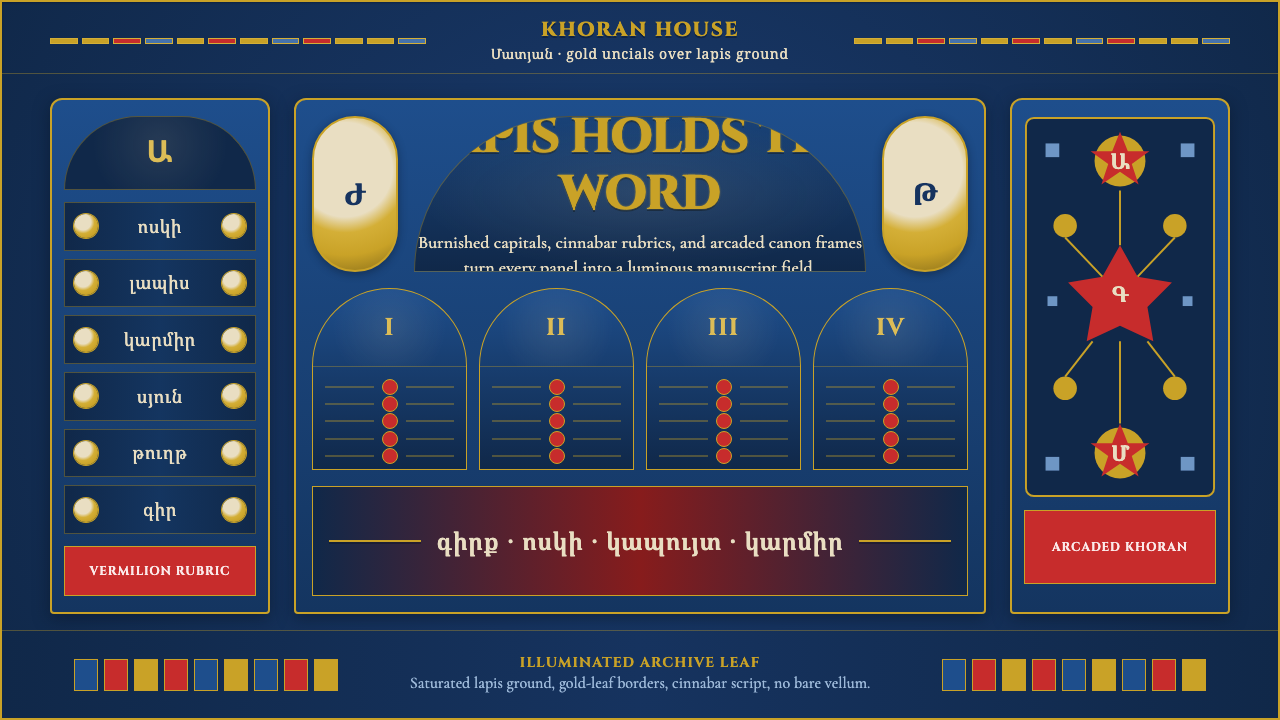 Armenian Manuscript FolkloreJewel-dense devotion. Lapis ground, gold uncials, and vermilion arcades fill…
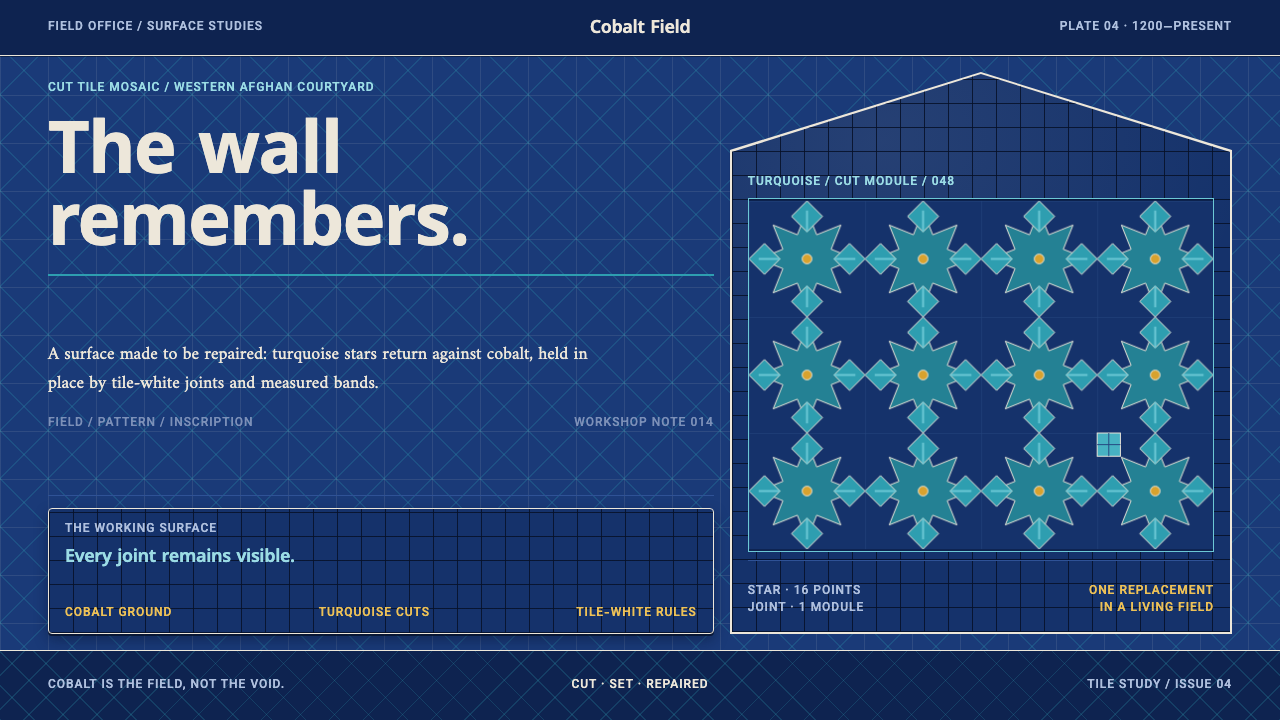 Herat Friday Mosque TileHistory is built to be repaired. Cobalt fields lock turquoise stars into tile…
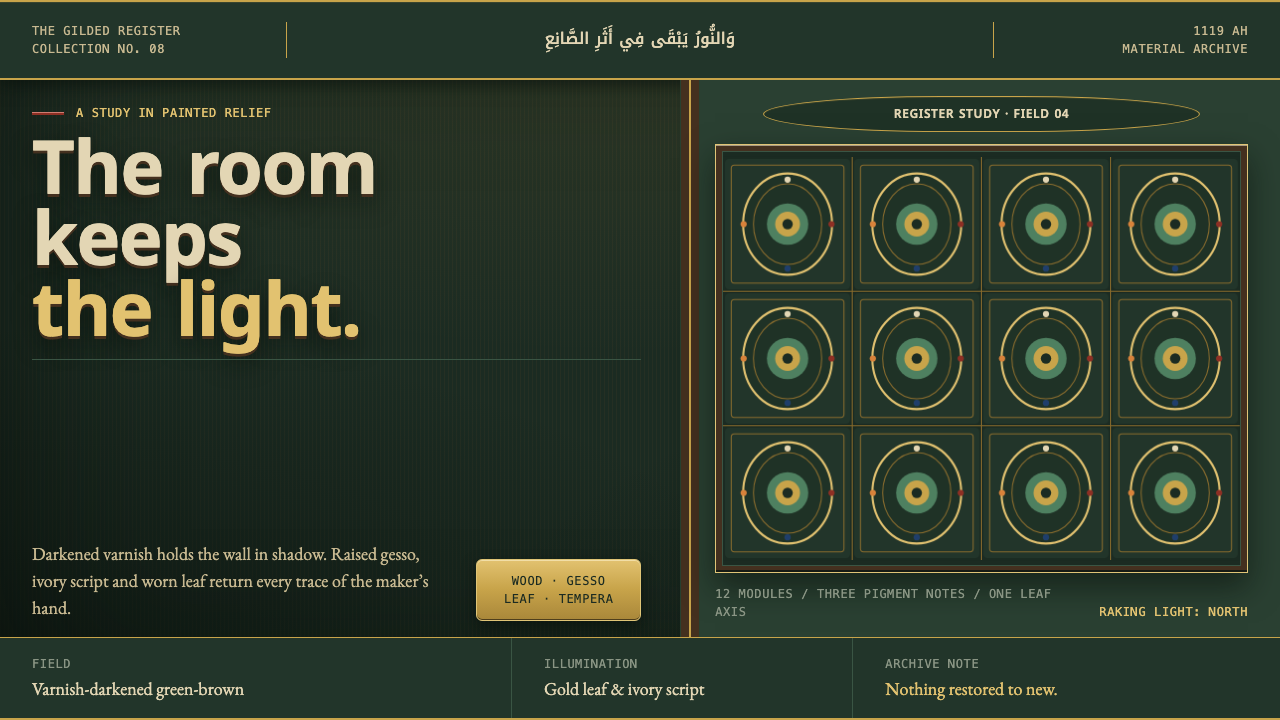 Damascus Ajami RoomDarkness makes the gilding glow. Ivory script and gold relief cross a varnish…
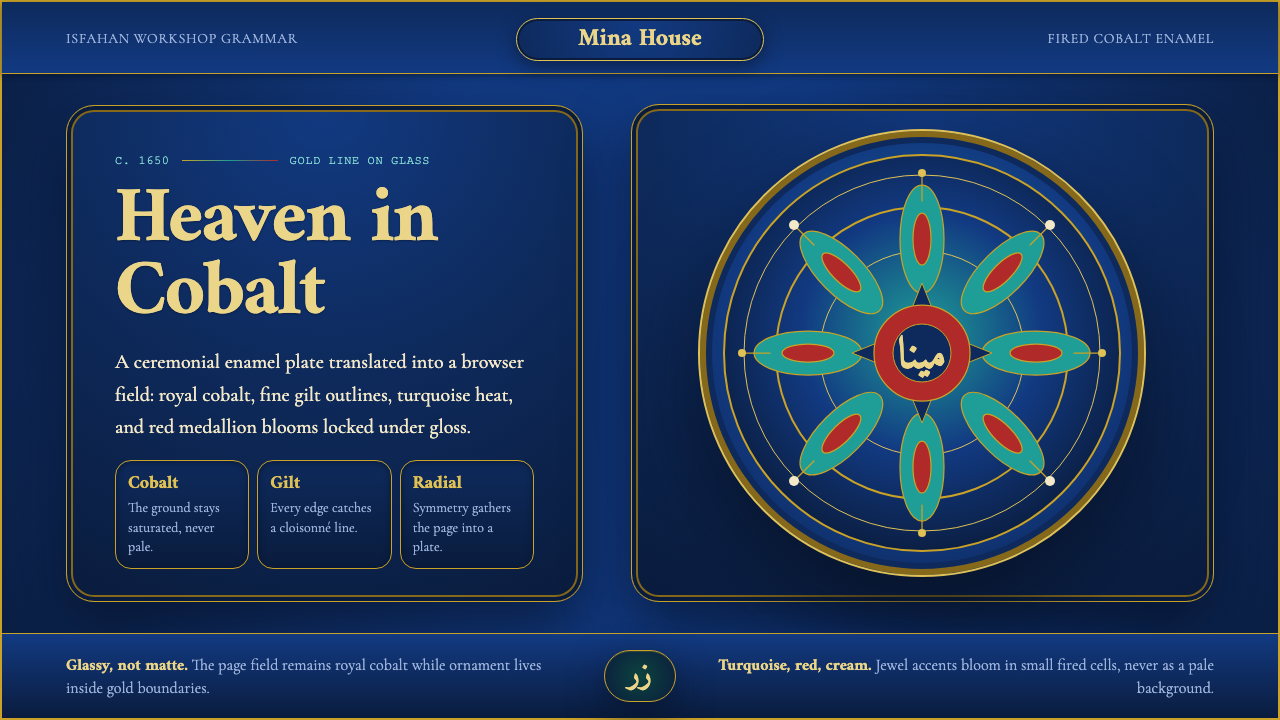 Isfahan Minakari EnamelJewel-bright ceremony. Cobalt enamel, gold cloisonné lines, and radial blooms…
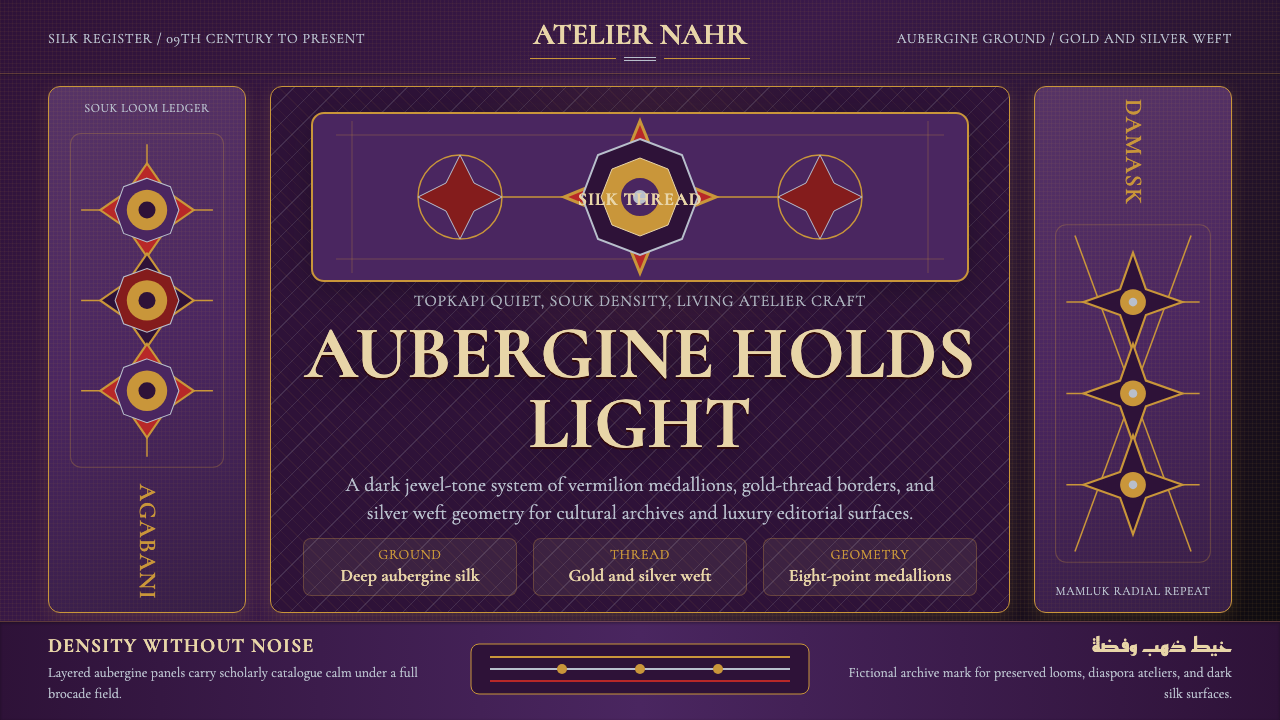 Syrian Damascene BrocadeDark silk shimmers. Aubergine ground, Cormorant SC, gold medallion grid.
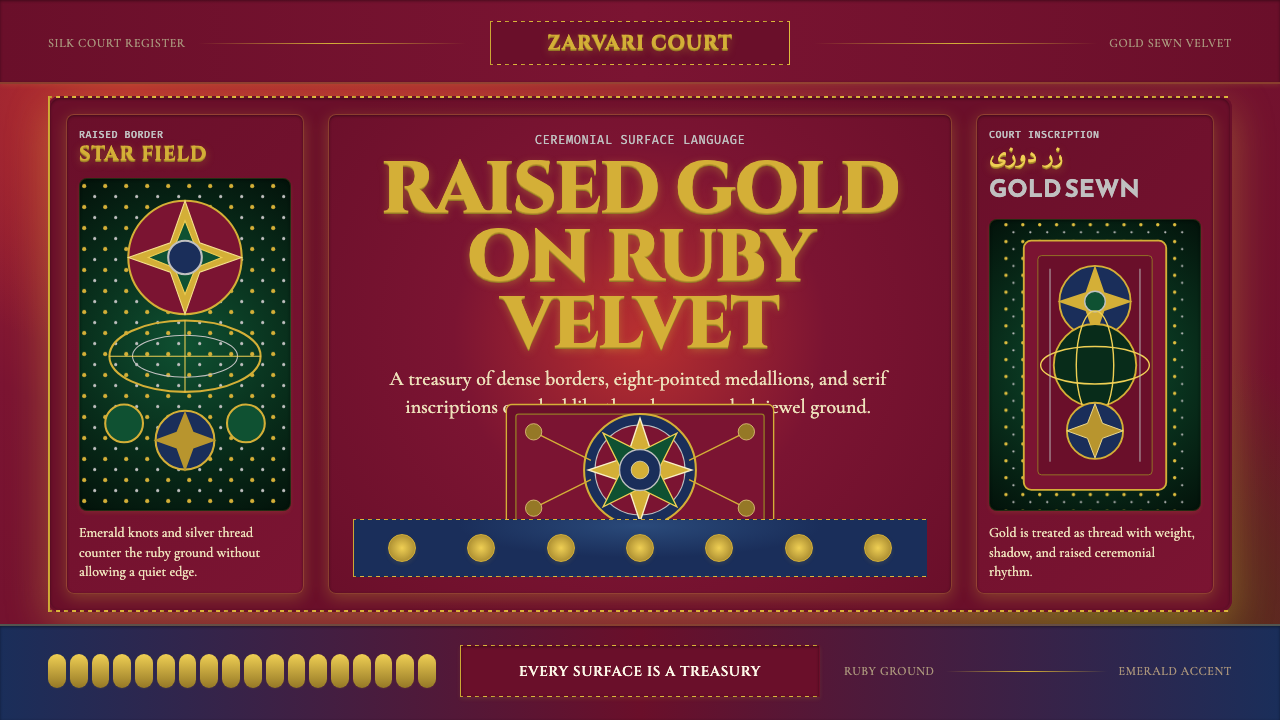 Uzbek Bukhara Gold ZardoziCourtly density. Ruby velvet, gold Cinzel type, and star medallions leave no…