What is Syrian Damascene Brocade?
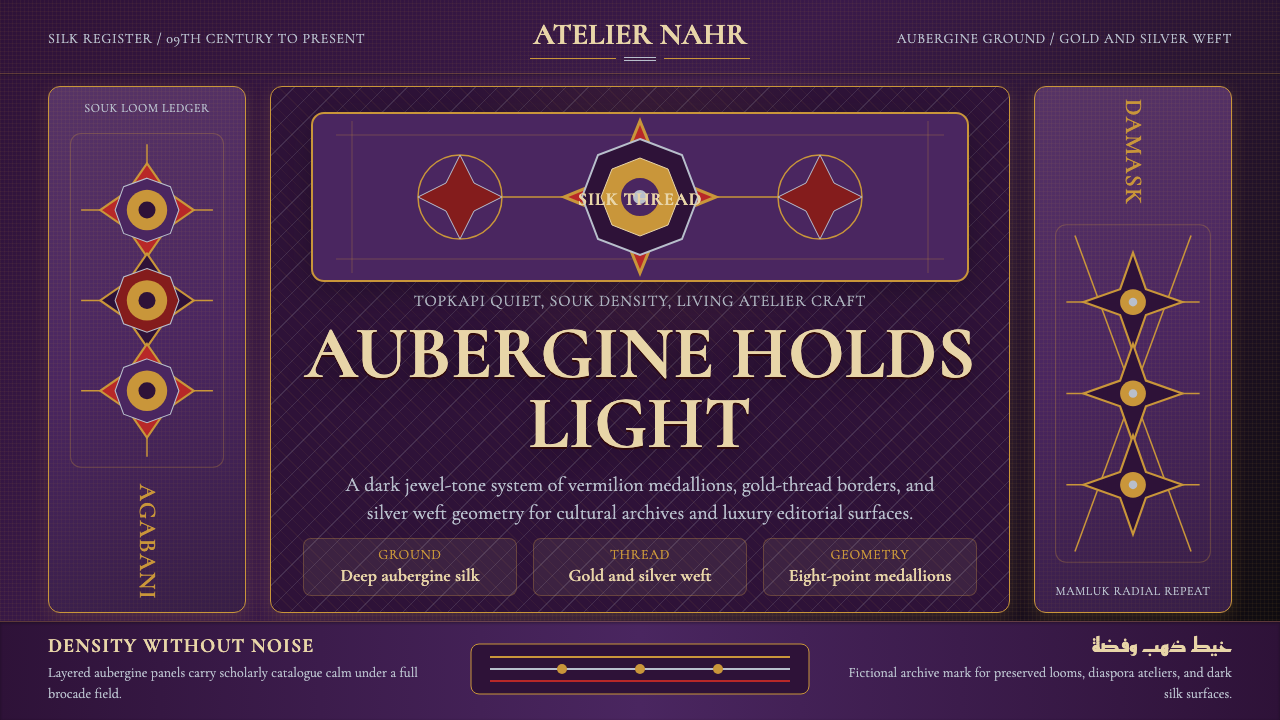
For a thousand years, Damascus wove gold and silver into silk so dense and luminous that Crusaders, Ottoman sultans, and Renaissance merchants all coveted the same cloth.
Syrian Damascene Brocade in brief
Syrian Damascene brocade — known locally as agabani — is one of the oldest continuously practiced luxury textile traditions in the world. The technique involves weaving supplementary gold or silver metallic threads into a ground of lustrous silk, creating raised patterns that shimmer differently depending on the angle of light. The ground cloth is typically dyed in deep, saturated jewel tones — aubergine, midnight blue, crimson, or forest green — against which the metallic weft creates a dense arabesque geometry of medallions, palmettes, and interlocking vegetal scrolls.
As a visual and design language, Damascene brocade carries the weight of this material richness into its aesthetic principles. The style is defined by layered density rather than negative space: pattern fills the field, medallion geometries nest inside one another, and the relationship between ground and motif is one of complementary tension rather than figure-ground contrast. The overall effect is opulent but controlled — a richness achieved through disciplined repetition rather than visual chaos.
The design system that emerges from this tradition channels jewel-tone color saturation, arabesque medallion geometry, and a visual authority reminiscent of pages from a Topkapı Palace catalogue. It reads simultaneously as ancient and contemporary — a vocabulary that has survived the fall of empires and the dispersal of its craftsmen, emerging with its essential grammar intact.
Where does Syrian Damascene Brocade come from?
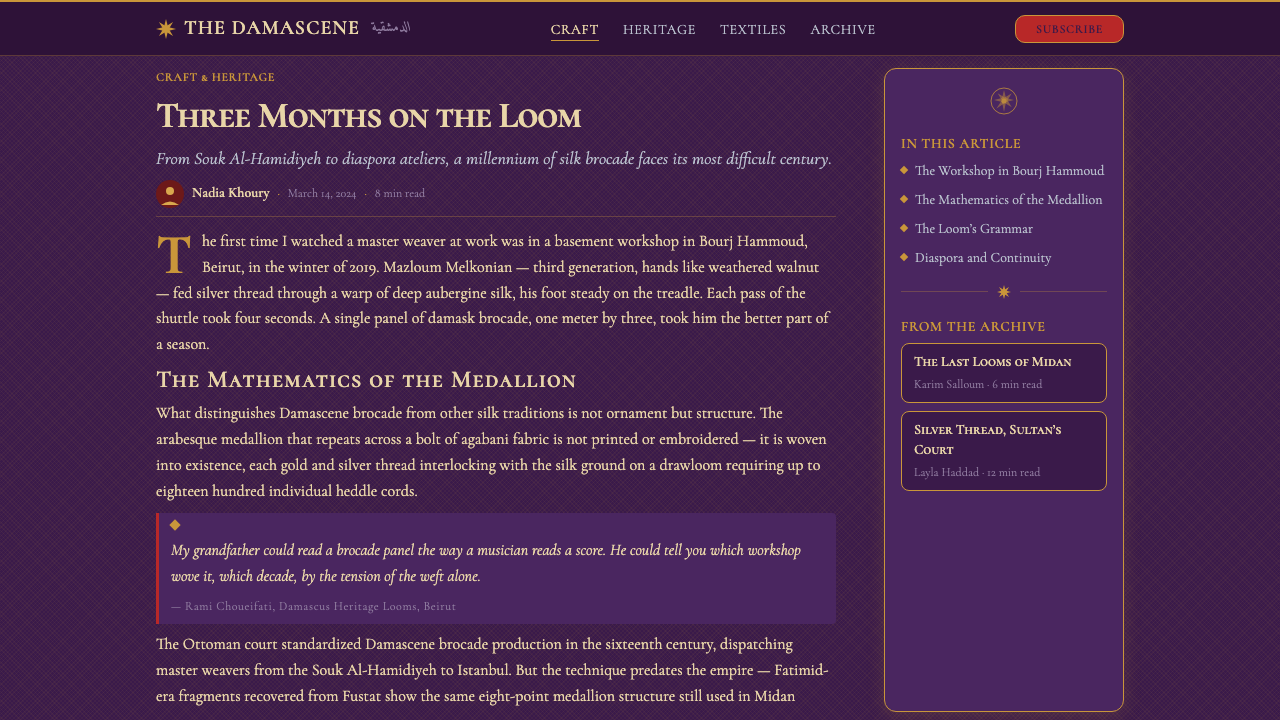
Damascus — the city that gives the style its name — sits at the crossroads of ancient trade routes connecting the Mediterranean world to Persia, Central Asia, and beyond. Silk weaving arrived in Syria from China via the Silk Road, and by the ninth century, Damascene workshops had developed distinctive brocading techniques that combined Chinese silk-weaving knowledge with Persian arabesque pattern vocabulary and local metallic-thread innovations. The Mamluk sultans of the thirteenth through fifteenth centuries were the first great patrons of this tradition, commissioning kaftans, tent hangings, and ceremonial furnishings of extraordinary technical complexity.
Under Ottoman rule from the sixteenth century onward, Damascene brocade reached perhaps its greatest refinement. Sultan Suleiman the Magnificent maintained royal workshops in Damascus that produced textiles for the imperial court in Constantinople, and the surviving examples from this period — preserved in the collections of Topkapı Palace and the Victoria and Albert Museum — show a technical mastery in the integration of metallic thread with silk ground that has never been surpassed. The motifs of this period became canonical: the elongated medallion, the cloud band borrowed from Chinese art, the palmette spray, and the large-scale repeat grid that would define the tradition for centuries.
The craft survived the decline of the Ottoman Empire, the colonial period under French mandate, and the political upheavals of the twentieth century, concentrated in the workshops of Souk Al-Hamidiyeh and the surrounding neighborhoods of the Old City of Damascus. Key weaving families — including the Mazloumian family — maintained Jacquard looms imported from Lyon alongside older hand-operated draw looms, sustaining a continuous thread from medieval guild practice to mid-twentieth-century commercial production. The artisan Antoine Choueifati was among those who documented and transmitted this knowledge in the latter decades of the century.
The Syrian civil war that began in 2011 severely disrupted this community. Many master weavers left Damascus for Turkey, Lebanon, Jordan, and further diaspora destinations, establishing new ateliers that carry the tradition forward under displaced conditions. Some workshops in the Old City survived and have resumed partial operation. The continuity of Damascene brocade today is the work of a scattered but determined community of craftspeople who understand that the technique itself is a form of cultural memory — one that must be embodied and practiced to remain alive.
What defines the Syrian Damascene Brocade look?
Color Ground
The foundational color is a deep, saturated jewel tone — aubergine, midnight blue, crimson, or deep forest green — used as the silk ground against which all other visual information is read. These are not merely dark backgrounds but positively colored fields with their own visual weight and warmth. The depth of the ground color is essential to the shimmering effect of the metallic pattern: the contrast between the matte-to-lustrous ground and the reflective thread creates the characteristic damascene shimmer.
Metallic Pattern Layer
Over the deep silk ground, a second visual register is created by the supplementary gold or silver weft — a pattern layer that appears to float above the surface rather than sit within it. This raised, shimmering layer carries the primary motifs: medallions, borders, arabesque scrolls, and geometric lattice. The relationship between ground and metallic layer is the core visual tension of the style: both are fully realized, neither is subordinate, yet they do not compete — they complete each other.
Arabesque Medallion Geometry
The primary organizational motif is the medallion — an elongated or circular geometric form that anchors the repeat unit and from which secondary patterns radiate. Damascene medallions are never simple circles or ovals; they are elaborated with pointed lobes, interlocking cartouches, and interior floral or calligraphic elaborations that reward close inspection. The medallion form connects Persian carpet design, Ottoman architectural tilework, and Mamluk manuscript illumination — it is a shared vocabulary of Islamic luxury arts.
Dense Field Composition
Unlike Western textile traditions that use ground color as breathing space, Damascene brocade fills the field almost completely. The repeat unit is large and complex, often incorporating multiple nested scales of pattern — a large medallion containing a medium palmette containing small geometric fills. This horror vacui principle means that the eye is continuously engaged; there is no visual rest, only a directed journey through levels of pattern that reveal themselves at different viewing distances.
Symmetrical Repeat Structure
The repeat unit in Damascene brocade is radially or bilaterally symmetrical, reflecting the underlying logic of the Jacquard loom as well as the geometric principles of Islamic pattern-making. This symmetry is never rigid or mechanical-feeling in authentic examples — the arabesque scrollwork introduces enough organic variation within the constraints that the repeat reads as natural rather than manufactured. The design system captures this balance between geometric order and botanical fluidity.
Lustrous Material Presence
The entire visual logic of Damascene brocade depends on how materials catch and reflect light — the different sheen of silk versus metallic thread, the way the same cloth looks different at morning light and candlelight. In digital design interpretations, this material memory is conveyed through careful management of reflective surface qualities: elements that carry the metallic pattern layer are treated with subtle luminosity, while ground-color elements remain richly saturated but non-reflective. The contrast is not merely dark versus light but matte versus lustrous.
Authoritative Stillness
Despite the visual density and the richness of surface, finished Damascene brocade compositions communicate a quality of stillness and settled authority rather than restless energy. This quality comes from the bilateral symmetry of the repeat, the predictable hierarchy from large medallion to small infill, and the deep ground color that holds everything together. The style carries the visual register of official documents, ceremonial dress, and sacred architecture — contexts where luxury signals not extravagance but permanence.

Who shaped Syrian Damascene Brocade?
Baybars, the Mamluk sultan who ruled from 1260 to 1277, was among the earliest great patrons of Damascene luxury textiles. Under his reign, Damascus became a center of court textile production, and the workshops that supplied his campaigns and ceremonies established many of the technical and aesthetic conventions that would define the tradition for centuries. The heraldic lion associated with Baybars appears in several surviving textile fragments from this period.
Under Suleiman's reign (1520–1566), Damascene brocade reached its greatest imperial patronage. Suleiman maintained royal workshops in Damascus as part of the broader Ottoman system of craft guilds and imperial endowments, and textiles produced during his era set standards of complexity and quality that represent the style at its historical peak. The Ottoman court's demand for Damascene cloth helped establish the repeating medallion format that would become the tradition's most recognizable visual signature.
The Mazloumian family represents the model of the hereditary weaving dynasty that sustained Damascene brocade through the modern era. Operating from the traditional workshops of the Old City, they maintained both the technical knowledge of traditional hand-draw-loom weaving and the transition to industrialized Jacquard production imported from the French textile city of Lyon. Their ateliers served domestic ceremonial markets, international luxury buyers, and museum conservation clients — bridging craft continuity with commercial viability across the twentieth century.
Choueifati is among the artisans and scholars who worked to document and transmit the technical and aesthetic knowledge of Damascene brocade in the latter decades of the twentieth century, a period when the tradition faced pressures from cheap imports and shifting consumer preferences before the more severe disruptions of the civil war era. His work represents the preservation effort that allows the tradition's design vocabulary to survive into contemporary practice.
The collective institution of the Damascene textile guild — operating through the workshops of Souk Al-Hamidiyeh and the surrounding Old City neighborhoods — represents the structural mechanism by which the tradition was transmitted across generations. Guild organization meant that technical knowledge was embodied in workshop practice rather than written documentation, passed from master to apprentice through direct instruction. The guild's dispersal after 2011 is the primary continuity risk to the tradition, as the knowledge it held cannot be recovered from texts alone.
How do you use Syrian Damascene Brocade today?
Damascene brocade is a style that carries explicit cultural and historical weight, and this is simultaneously its greatest asset and its primary design challenge. Used thoughtfully, it brings an authority and richness that few other historical styles can match. Used carelessly, it risks feeling like costuming rather than design — a surface borrowed without understanding what gives the surface its meaning. The key is to internalize the structural logic of the style (dense field, radial symmetry, jewel-ground and metallic-pattern contrast) and apply it through contemporary materials, rather than simply sampling historic patterns.
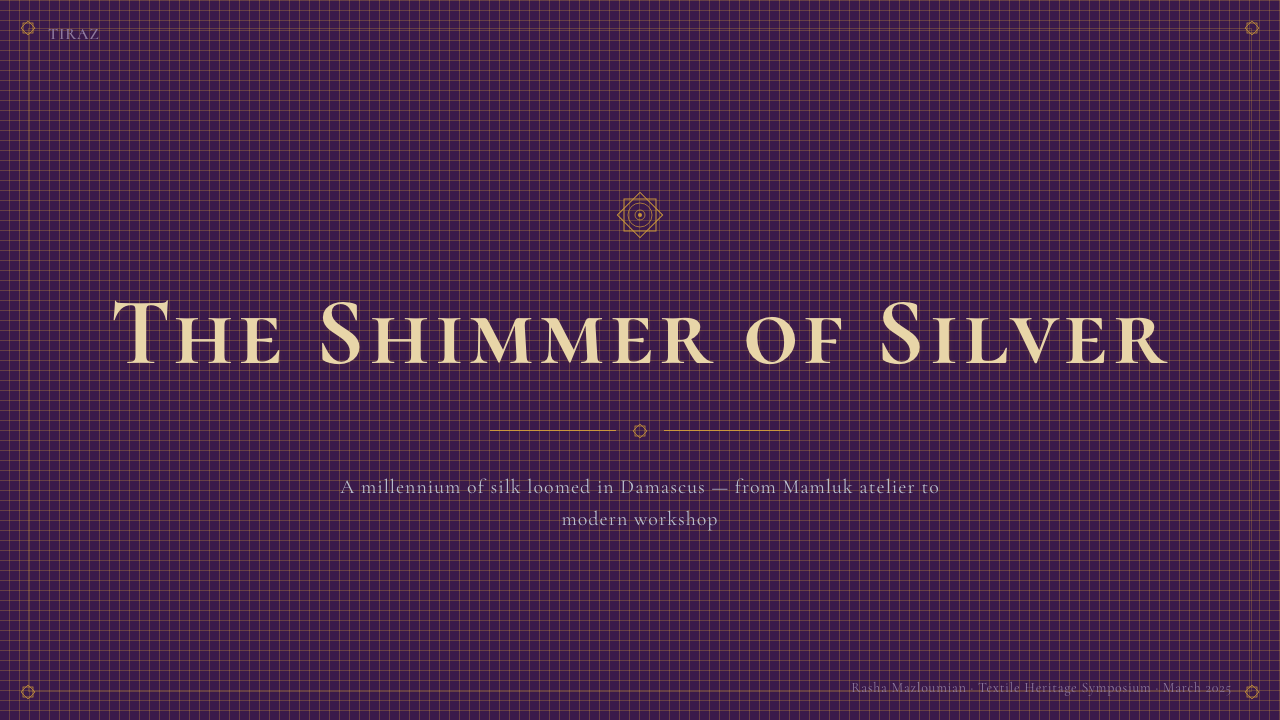
For presentation slides, Damascene brocade works most powerfully on cover and section divider pages where the full visual weight of the style can be deployed without competing with text-heavy content. A cover treated in this system might use a deep aubergine or midnight blue field as the background, with a large medallion motif in a gold or champagne tone centered or asymmetrically placed, and the title set in a high-contrast light typeface that sits cleanly over the dark ground. Content slides should pare back to the color logic alone — deep jewel-tone accent colors against neutral grounds — keeping the ornamental density for structural frames rather than body content.
For web interfaces, the style is best suited to contexts where prestige, heritage, and material richness are part of the product's value proposition — luxury hospitality, museum or cultural institution sites, heritage fashion brands, and collector-facing platforms. Dashboard and navigation elements benefit from the style's strict symmetry and hierarchical clarity; the medallion logic translates well to card layouts where a central featured element is surrounded by secondary information. Avoid applying the full pattern density to data-heavy or functionally complex UI components, where it will compete with the information the user needs to read.
For editorial and marketing work, the style supports richly layered feature spreads and campaign pages where immersive visual experience is the primary goal. A Damascene-influenced editorial page might use a full-bleed jewel-tone background, a centrally placed oversize motif or typographic element, and body text set in a warm off-white that echoes the metallic weft rather than clashing with it. Marketing campaigns in this style work well for launches where the brand wants to signal craft, heritage, or limited-edition exclusivity — the visual language of royal commissions and centuries-old workshops translates into contemporary luxury positioning.
A common mistake when applying this style is treating it as purely ornamental — using the pattern as wallpaper behind otherwise unrelated design decisions. Damascene brocade is a total aesthetic system in which pattern, color, symmetry, and material quality are all in service of a unified effect. If you apply the pattern but use clashing typefaces, mismatched color temperatures, or generic layout grids that ignore the style's inherent symmetrical logic, the result will feel fragmented. Commit to the full system: jewel-ground color, metallic-register highlights, centered or radially organized layouts, and typefaces with enough weight and presence to hold their own against the rich visual field.
Syrian Damascene Brocade — FAQ
What is the difference between damascene brocade and other Islamic textile traditions?
Damascene brocade shares the arabesque motif vocabulary and jewel-tone palette with related traditions from Persia, Turkey, and Central Asia, but its specific technical signature — the agabani technique of supplementary metallic weft on silk ground — and its geographic concentration in Damascus give it a distinct character. Persian velvets from Safavid Iran use a cut-pile technique that produces a different surface quality; Ottoman silk ikats from Bursa have a feathered, blurred-edge pattern aesthetic. Damascene brocade is characterized by a particularly high density of metallic thread coverage, giving it a heavier shimmer-to-ground ratio than most comparable traditions.
Can this style work on light backgrounds, or does it require a dark ground?
Historically, Damascene brocade was almost exclusively produced on dark or saturated grounds — the deep silk color is essential to the optical effect of the metallic thread shimmer. A light-background interpretation is possible in contemporary design but requires significant rebalancing. On a cream or warm white ground, the metallic-register layer should shift from gold to a deeper bronze or copper, and the arabesque pattern density may need to be reduced to avoid the composition reading as overwhelming. The essential character of the style — layered density, radial symmetry, pattern-on-ground contrast — can survive the light inversion, but the specific quality of brooding opulence that is the style's signature mood is a product of the dark ground.
How should this style be adapted for screen legibility, given its visual density?
The visual density of traditional Damascene brocade is calibrated for a textile context where the pattern is read at a distance and up close as a surface experience, not as information to be parsed. For screen applications, the principle is to use the full pattern density only in non-interactive visual zones — hero sections, full-bleed decorative backgrounds, or section dividers — and to create clear, uncluttered zones for text and interactive elements where the pattern recedes or disappears entirely. A dark solid of the ground color alone, without the arabesque overlay, provides enough visual identity while giving text the contrast and breathing room it needs. Think of the pattern as the architectural framework and the text zones as the rooms within it.
Is it appropriate for brands outside the Middle East to use this style?
Damascene brocade has been an internationally traded luxury textile since the medieval period — the word 'damask' itself entered European languages through medieval trade, and the cloth was worn by European royalty and clergy for centuries. The style has always operated across cultural boundaries as a shared vocabulary of luxury and craft mastery. Contemporary use by non-Syrian or non-Middle Eastern brands is appropriate when it is grounded in genuine knowledge of and respect for the tradition's origins, and when the application honors the aesthetic seriousness of the system rather than reducing it to superficial pattern borrowing. Crediting the tradition explicitly in brand communication — acknowledging Damascus, the Mamluk and Ottoman periods, and the contemporary diaspora artisans who carry the craft forward — transforms the application from appropriation to appreciation.
How does this style relate to contemporary Syrian cultural identity?
For Syrian communities, and particularly for the diaspora community that has been displaced since 2011, Damascene brocade carries a weight that goes beyond aesthetics. It is one of the most recognized symbols of Syrian cultural achievement and material sophistication — a craft that predates the current political situation by centuries and that represents a form of cultural continuity that war cannot erase. Diaspora artisans who continue producing agabani in Turkey, Lebanon, or France are engaged in an act of cultural preservation as much as commercial practice. Design work that engages seriously with this tradition, particularly when it supports or acknowledges the craftspeople who sustain it, participates in that continuity.
Related design styles
 Armenian Manuscript FolkloreJewel-dense devotion. Lapis ground, gold uncials, and vermilion arcades fill…
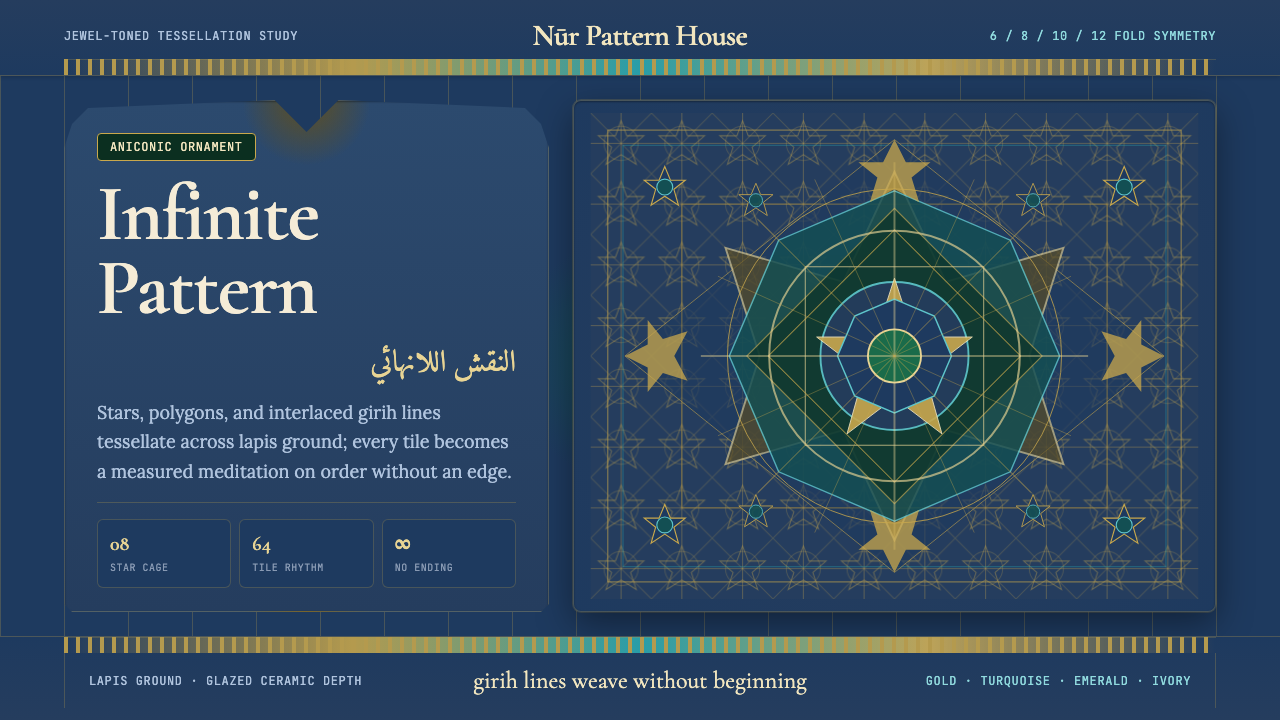 Islamic Geometric ArtInfinite order, fully tiled. Lapis ground with gold girih lines and turquoise…
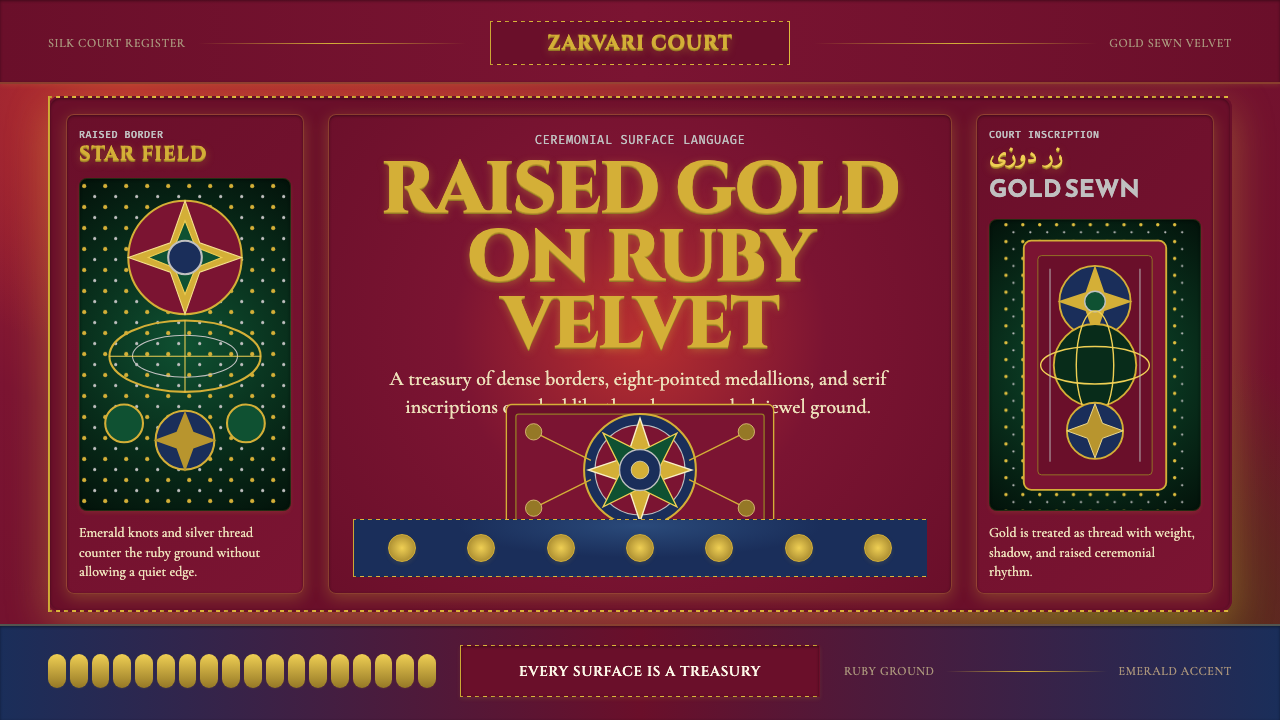 Uzbek Bukhara Gold ZardoziCourtly density. Ruby velvet, gold Cinzel type, and star medallions leave no…
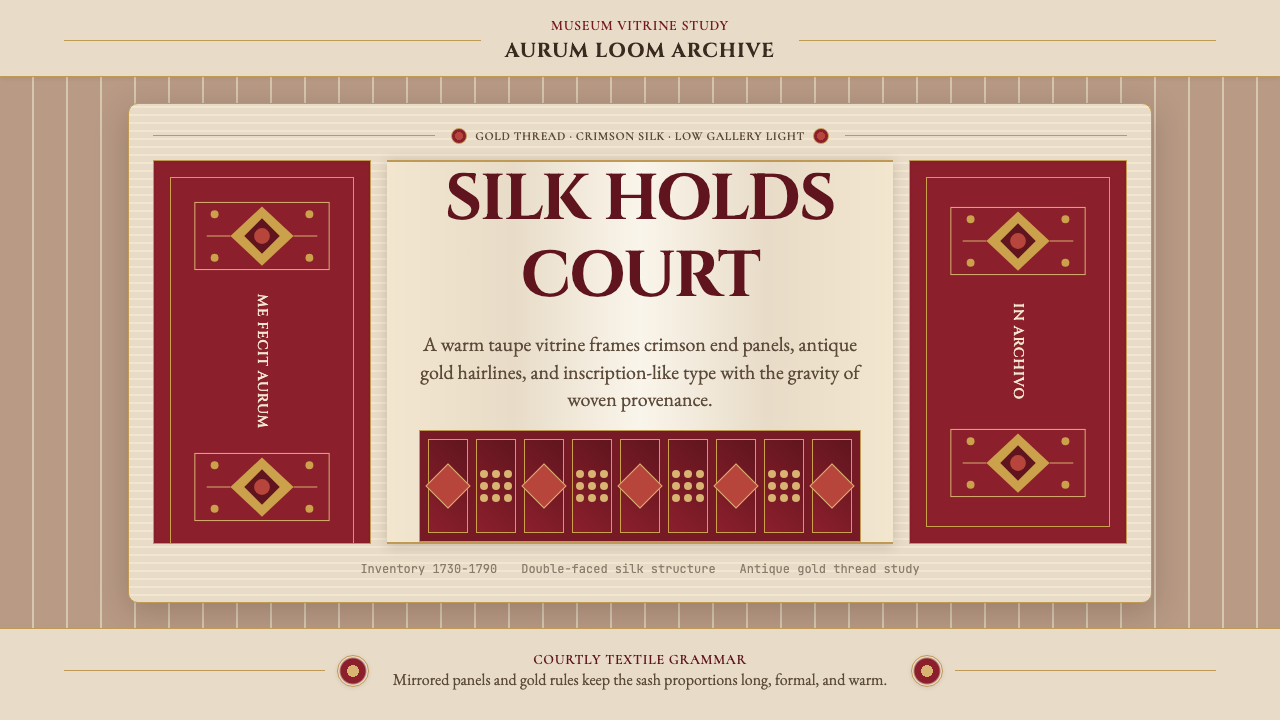 Belarusian Slutsk SashCourtly silk, vitrined. Taupe ground, crimson panels, Cinzel type, antique go…
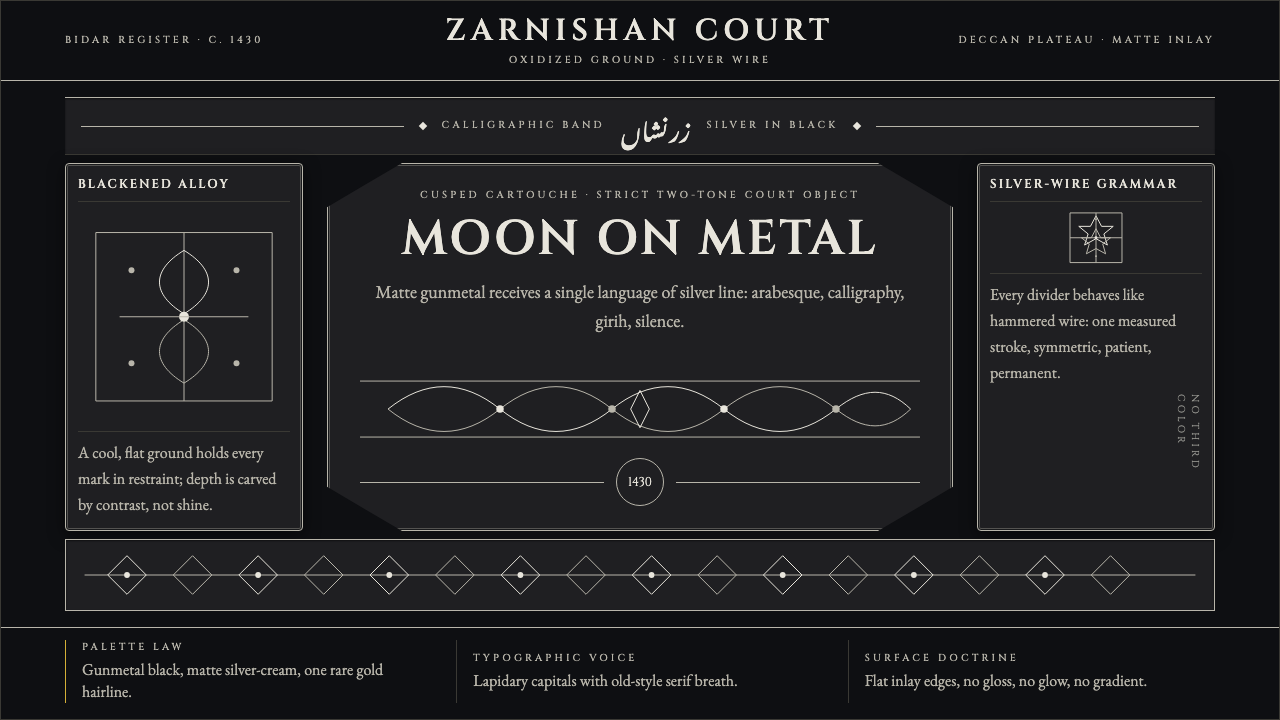 Bidri Deccan MetalworkCourtly darkness, tooled by silver. Cinzel caps and hairline arabesques cut g…
 Bulgarian Revival WoodcarvingDark devotion in relief. Walnut panels, Cardo serifs, and gilt rosettes catch…