What is Byzantine Tyrian Purple (Imperial Court)?
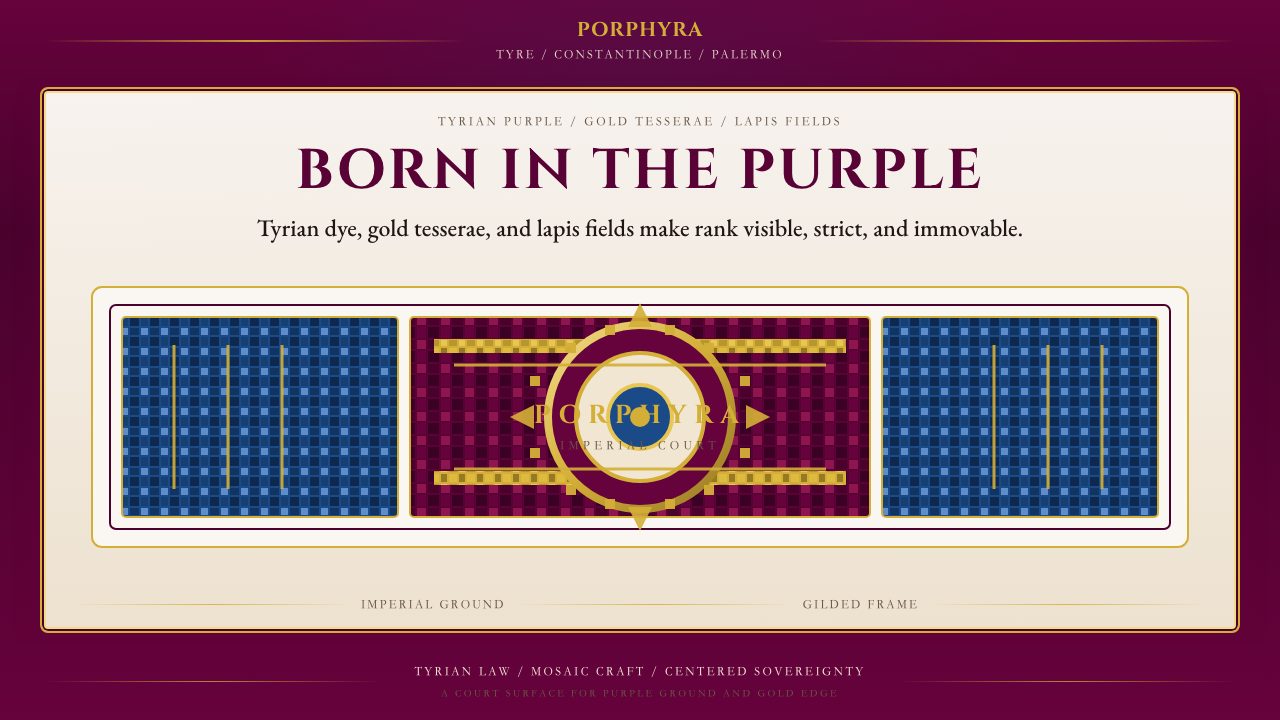
For over a millennium, a single color held the force of imperial law — worn only by emperors, woven from the sea, and encoded into every mosaic, manuscript, and court ritual of the Byzantine world.
Byzantine Tyrian Purple (Imperial Court) in brief
Byzantine Tyrian Purple (Imperial Court) is a design system rooted in the visual grammar of the Eastern Roman Empire at its height — the dense, gold-saturated, symmetrically ordered aesthetic of mosaic basilicas, imperial portraiture, and illuminated manuscripts produced between the fourth and fifteenth centuries. Its foundation is a deep blood-mineral purple of extraordinary richness, counterpointed by imperial gold accents, lapis-toned mosaic fields, and cream tessera surfaces bordered by hairline gilded rules.
Where most historical styles draw their power from simplicity or restraint, Byzantine visual language achieves authority through density and precision. Every surface is considered, every border is articulated, every element is placed within a hierarchical order that makes rank and sanctity immediately legible. This is not ornamentation for its own sake — it is a system of visual law, in which the relative brightness of gold, the depth of purple, and the centrality of a figure together constitute a grammar of power that a Byzantine courtier or worshipper could read as fluently as text.
The result is a style of unmistakable gravitas — suited to contexts where authority, heritage, and ceremonial weight are not merely desirable but essential. It operates at the opposite pole from minimalism: rather than communicating trust through absence, it communicates trust through accumulation — the slow, convincing weight of gold on purple, of precision upon precision.

See the Byzantine Tyrian Purple (Imperial Court) design system
Where does Byzantine Tyrian Purple (Imperial Court) come from?
Tyrian purple is one of the oldest luxury materials in human civilization, with Phoenician dye production documented as early as around 1500 BCE along the coast of the eastern Mediterranean. The color was extracted from the mucous glands of the murex sea snail — primarily Murex brandaris and Hexaplex trunculus — through a process that required crushing thousands of shells, fermenting the organic material in open vats for days under the sun, and then boiling and reducing the resulting liquid into a concentrated dye bath. Ancient sources record that a single gram of pure Tyrian purple required approximately twelve thousand murex snails to produce. The stench of the process was so extreme that dye works were by law required to be located outside city walls.
The color's rarity and cost made it politically potent long before the Byzantine period. Alexander the Great reportedly found enormous stocks of purple cloth at Persepolis, already centuries old and valued at staggering sums. Roman emperors progressively restricted its use: Julius Caesar limited its civilian application, Nero prohibited non-imperial purple entirely, and later emperors refined these sumptuary laws into a comprehensive system of chromatic rank. By the time Constantinople emerged as the new Rome in the fourth century under Constantine I, the association of Tyrian purple with imperial sovereignty was absolute. To be 'born in the purple' — porphyrogennetos — meant being born in the purple-draped imperial birthing chamber of the Great Palace, a distinction so important that it became a formal title and a criterion for legitimate succession.
The golden age of Byzantine visual culture spans roughly from the reign of Justinian I in the sixth century through the era of the Macedonian and Komnenian dynasties in the tenth through twelfth centuries. It was during these periods that the characteristic visual grammar crystallized: the hierarchical mosaic programs of churches like San Vitale in Ravenna (consecrated 547 CE), where the famous apse panels place Justinian and Empress Theodora in absolute frontal symmetry, surrounded by gold ground, clothed in purple, their feet slightly overlapping to signal proximity to the divine; the illuminated manuscripts of the Macedonian Renaissance, in which purple-dyed vellum received gold and silver lettering reserved for scripture and imperial proclamation; and the ivory diptychs and enamel reliquaries produced by court workshops whose technical refinement set a standard unmatched in Europe for centuries.
The tradition extended and transformed through the Norman-Byzantine synthesis of twelfth-century Sicily, where Roger II of Sicily — himself a Latin king who controlled former Byzantine territories — deliberately commissioned mosaics in the Byzantine court style for the Palatine Chapel in Palermo and the Cathedral of Monreale. This political mobilization of Byzantine aesthetics demonstrates the style's function as a transferable language of legitimate authority: Roger was not Byzantine, but by adopting its visual grammar he claimed alignment with the most powerful symbolic tradition in the Mediterranean world. The fall of Constantinople in 1453 did not extinguish the tradition — Byzantine visual conventions were preserved in the Eastern Orthodox church, in the manuscript workshops of Mount Athos, and in the visual programs of Russian imperial iconography, where they remained active well into the modern era.
What defines the Byzantine Tyrian Purple (Imperial Court) look?
Color Field Hierarchy
The palette operates across four distinct registers: a deep blood-mineral purple as the sovereign ground, imperial gold as the primary accent and surface ornament, a rich lapis blue as the mosaic field or secondary ground, and warm cream as the content surface for legible text and imagery. Each register occupies a fixed position in the visual hierarchy — purple commands the frame, gold articulates structure, lapis provides depth, and cream receives information. Mixing these registers indiscriminately breaks the hierarchical logic the system depends on.
Gold Tessera Patterning
Byzantine gold is never used as a flat fill. In mosaic originals, each gold tessera was set at a slightly different angle to catch and scatter candlelight, producing a surface that shimmers and breathes. In contemporary application, this quality is approached through intricate surface patterns — geometric interlace, star-and-cross registers, chevron borders — executed in gold against purple or lapis grounds. These patterns serve as the primary visual texture of the system, replacing the plain backgrounds that characterize Western European medieval styles with a continuously ornamented field.
Frontal Symmetry and Centrality
Byzantine composition is organized around a strict central axis. Figures face the viewer directly — never in three-quarter profile, almost never in full side view. The central element, whether a Christ Pantocrator, an enthroned emperor, or a logo mark, is absolutely centered and given the largest scale. Flanking elements mirror each other precisely. This rigid symmetry is not compositional timidity — it is a deliberate formal statement that the central subject exists outside ordinary space and time, beyond perspective's distortion. In design application, this mandates centered layouts on hero and cover surfaces, with bilateral symmetry in decorative borders and ornamentation.
Hierarchical Figure Scaling
In Byzantine visual practice, the size of a figure indicates rank rather than spatial position. The emperor or Christ is largest; bishops and courtiers are medium-scaled; attendants and soldiers are smallest, regardless of their physical position in the scene. This inverted-perspective logic — where importance determines scale — translates directly into typographic hierarchy in contemporary work. The most important information is largest, regardless of grid position; secondary information is visibly smaller; supporting detail is subordinate and close-set. Scale does the work that color does in Western modernist systems.
Hairline Gilded Borders
Byzantine illuminated manuscripts and icons consistently frame content surfaces with precision borders — narrow rules in gold that separate the cream content field from the decorative ground. These borders are not decorative additions but structural necessities: they define the sacred space within which information resides and signal that what is enclosed is of a different order than what surrounds it. In contemporary design, this principle manifests as fine-line gold borders around cards, panels, and modal surfaces, executed with precision rather than looseness. A border that wavers or is casually applied destroys the ceremonial quality the system requires.
Lapis Mosaic Fields
Alongside purple, a deep lapis blue derived from the mineral ultramarine functions as a second ground color associated with the celestial and the sacred — the blue that appears in the robes of the Virgin, in the vault of heaven behind Christ, and in the deep enamel panels of reliquaries. In a contemporary system, lapis serves as the background for secondary panels, sidebars, data visualization grounds, and navigational areas that are authoritative but subordinate to the imperial purple core. Its depth and richness ensure that it reads as intentional and precious rather than incidental.
Iconographic Precision
Byzantine art was never casual in its imagery. Icons followed strict compositional formulae — the tilt of a head, the gesture of a hand, the arrangement of drapery folds — that had been codified over generations and were understood to carry specific theological meanings. Every visual decision was consequential. Translated into design practice, this principle demands that no element appear arbitrarily: every ornamental motif should be drawn from the established vocabulary of Byzantine geometric interlace, palmette, vine scroll, or cross-in-square; every typographic decision should be deliberate and repeatable. The system should feel governed, not assembled.

See the Byzantine Tyrian Purple (Imperial Court) design system
Who shaped Byzantine Tyrian Purple (Imperial Court)?
Theodora, co-ruler with Justinian I, is most powerfully present in the mosaic panel at San Vitale, Ravenna (547 CE), where she appears as a full-frontal, hieratically scaled figure clothed entirely in imperial purple and dripping with gold jewels, a jeweled crown, and a hem embroidered with the Magi — establishing her as a sacred as well as imperial presence. Her mosaic portrait is perhaps the single most analyzed image in Byzantine art history, representing the fusion of court ceremonial, Christian theology, and political propaganda that defines the system's visual ambitions.
Justinian I (r. 527–565 CE) presided over the height of Byzantine imperial culture and commissioned the two works most central to this style's visual vocabulary: the Church of Hagia Sophia in Constantinople and the mosaic program of San Vitale in Ravenna. His legal codification of sumptuary law — restricting the wearing of Tyrian purple under penalty of death — formalized what had previously been custom into enforceable statute, transforming the color from social convention into legal reality. His architectural and artistic commissions set the formal language that Byzantine court aesthetics would follow for another nine centuries.
Constantine I established Constantinople as the new imperial capital in 330 CE and oversaw the formal Christianization of the Roman Empire, setting the stage for the synthesis of Roman imperial imagery and Christian iconography that defines Byzantine aesthetics. His court ceremonial elaborated the use of purple as the exclusive imperial color, and his building program — including the original Hagia Sophia and the imperial palace complex — established the architectural and spatial context within which Byzantine visual culture would develop. The concept of the porphyrogennetos, the emperor born in the purple chamber, originates in the symbolic world he created.
Roger II (r. 1130–1154) was a Norman king who ruled former Byzantine territories in southern Italy and Sicily. His deliberate adoption of Byzantine court visual language — commissioning Greek mosaicists to decorate the Palatine Chapel in Palermo and the Cathedral of Cefalù in the full Byzantine style — represents the most significant instance of the style's export and political appropriation. His throne room mosaic, in which he appears receiving his crown directly from Christ, uses the hierarchical scale, gold ground, and frontal symmetry of Byzantine imperial iconography to claim a divine authority equivalent to that of the Eastern emperor. This demonstrates the style's function not merely as aesthetic but as political argument.
The illuminated manuscripts produced in Constantinople during the Macedonian dynasty (867–1056 CE) represent the technical and aesthetic pinnacle of Byzantine book art. These anonymous court workshops produced manuscripts on purple-dyed vellum with gold and silver lettering, along with iconic miniatures in which figures of extraordinary refinement appear against flat gold grounds. Their work established the canonical figure types — the elongated proportion, the dished face with large eyes, the schematic drapery — that defined Byzantine figuration for centuries. Though their individual names are lost, their visual conventions formed a shared grammar reproduced across the empire and beyond.
How do you use Byzantine Tyrian Purple (Imperial Court) today?
Byzantine Tyrian Purple is among the most architecturally demanding historical styles to apply correctly, because its authority derives from systematic completeness rather than surface decoration. Adopting the purple-and-gold color combination without also applying the hierarchical composition, the tessera patterning, the frontal symmetry, and the hairline border framework produces something that reads as vaguely theatrical rather than genuinely imperial. The style requires commitment to its entire grammar, not selective borrowing of its most recognizable elements.
For presentation slides, the system works with exceptional power on cover and section-break pages. A cover should be structured as a true mosaic composition: a deep purple ground or lapis blue field, a centered title in gold letterforms of substantial weight, a decorative gold border precisely framing the content area, and a horizontal band of geometric interlace ornament above or below the title block. The hierarchy must be unambiguous — one dominant element, everything else clearly subordinate. Content slides should shift to a cream ground with black body text, a refined gold hairline border framing the slide area, and accent elements in gold or lapis reserved strictly for headings and call-outs. Data slides suit a lapis ground with gold chart elements, where each data series occupies a clearly differentiated visual register.
For web interfaces and dashboards, Byzantine Tyrian Purple is best deployed at the tier of high-stakes, high-authority applications: financial reporting platforms, institutional portals, luxury e-commerce environments, or any context where the product needs to signal permanence, trust, and premium positioning. The approach centers on a cream or near-white primary content ground with black body text, and reserves the deep purple and gold for navigational chrome, tier badges, pricing tier headers, and hero sections. Card components should carry fine gold borders rather than soft shadows; state changes should use gold highlights rather than generic blues. Pricing tiers benefit particularly from the hierarchical logic — the premium tier rendered in full imperial purple with gold accents, the standard tier in lapis, the entry tier in cream.
For editorial and marketing work, the style's natural register is ceremonial announcement: luxury brand campaigns, premium product launches, institutional anniversary materials, museum exhibition identities, and award or recognition programs. Full-spread layouts work best with a purple or lapis ground occupying the outer frame and a cream panel centered within it, following the mosaic logic of ground and tessera. Pull quotes and key statistics can be set in gold against purple with the same hierarchical weight as a Byzantine inscription. Marketing pages deploying this style should commit to a slow, considered pacing — ample space between sections, wide margins, deliberate transitions — rather than the rapid feature-stacking of contemporary digital marketing.
The most common mistake when applying this system is conflating richness with chaos. Byzantine visual culture was extraordinarily dense, but it was also extraordinarily ordered — every decorative element occupied a fixed position within a system of rules. Introducing the color palette and gold ornament without the underlying compositional discipline produces a result that reads as overwrought and confused rather than authoritative and elegant. A second common error is using the purple as a background color for body text: the depth of the color makes sustained reading uncomfortable, and the system's own logic — which assigns cream to content surfaces — provides the correct solution. The purple commands the frame; the cream receives the information.

See the Byzantine Tyrian Purple (Imperial Court) design system
Byzantine Tyrian Purple (Imperial Court) — FAQ
How is Byzantine Tyrian Purple different from other dark, luxury design styles?
Most contemporary luxury design — including many dark-palette styles — achieves richness through material references: deep blacks, muted golds, and restrained typography that implies premium positioning through absence. Byzantine Tyrian Purple operates on an entirely different principle: it communicates authority through abundance, density, and hierarchical precision. The gold is not a whisper but an announcement; the ornament is not a hint but a program. The style's complexity is also historically grounded — every decorative motif, every compositional convention, every color relationship carries a documented history of meaning. This gives it an authenticity that purely invented luxury aesthetics cannot replicate.
Can this style work in a light or minimal layout, or does it require full immersion?
It can be applied at varying intensities, but lighter applications require care to avoid producing results that look merely purple-tinted rather than genuinely Byzantine in character. A minimal invocation — cream ground, black body text, fine gold hairline borders on key panels, and a single purple accent element — can carry Byzantine character without the full density of a mosaic-patterned cover. What cannot be removed without losing the style's identity is the hierarchical precision: even a light application must place the primary element with absolute centrality and define clear rank among secondary elements. The gold hairline border is the minimum credible signal of the system's heritage.
Why is frontal symmetry so important to this style, and when is it appropriate to break it?
Byzantine frontal symmetry is not simply an aesthetic preference — it is a theological and political statement that the central subject exists beyond ordinary perspective, outside the contingency of a single viewpoint. In the mosaic tradition, a figure shown in profile or three-quarter view occupies human, temporal space; a figure shown frontally addresses the viewer from a position of absolute authority. In design application, this means that hero compositions, logo placements, and primary call-to-action elements should always be centered. Asymmetry is appropriate for supporting elements and body content — sidebars, data lists, image captions — that are understood to be within ordinary informational space rather than at the level of ceremonial proclamation.
Is this style appropriate for digital products, or does it belong primarily to print and physical spaces?
The style is fully viable for digital products, but the translation requires discipline. In physical mosaics, the gold tessera shimmer emerged from the interplay of individual tiles and candlelight — an optical effect impossible to replicate literally on screen. Digital application must instead achieve the equivalent effect through precise surface patterning, carefully weighted gold tones, and the quality of border execution. The hierarchical logic of the style — its assignment of roles to purple, gold, lapis, and cream — maps directly onto the component hierarchy of a digital interface. The style's natural digital contexts are premium institutional products, high-value transactional interfaces, and cultural sector platforms where conveying heritage and authority is a genuine product requirement.
What kinds of products or brands should avoid this style?
Byzantine Tyrian Purple is poorly suited to products where approachability, warmth, or playful energy are core values. Its visual grammar is inherently distancing — it places the central subject on a pedestal and asks the viewer to approach rather than inviting them in casually. Consumer wellness brands, children's education platforms, casual social applications, food and beverage companies, and start-ups seeking to project informality and accessibility will all be misserved by this style. It is also poorly suited to contexts where iterative, rapidly updating information — news feeds, social timelines, live data streams — dominates the interface, since the style's ceremonial pacing is incompatible with the logic of continuous refresh. Use it where permanence and gravity are genuine virtues, not where they would work against the product's core relationship with its users.
Related design styles
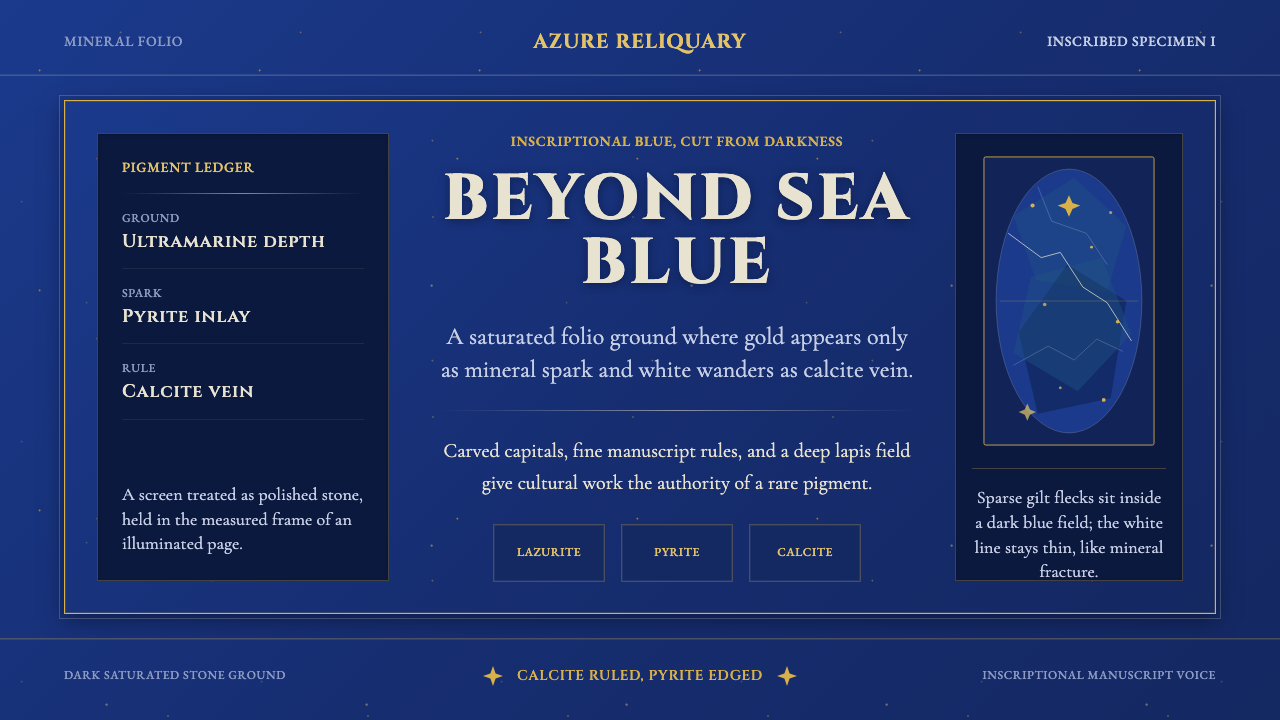 Badakhshan Lapis LazuliStone as manuscript. Ultramarine field, pyrite flecks, calcite veins, carved…
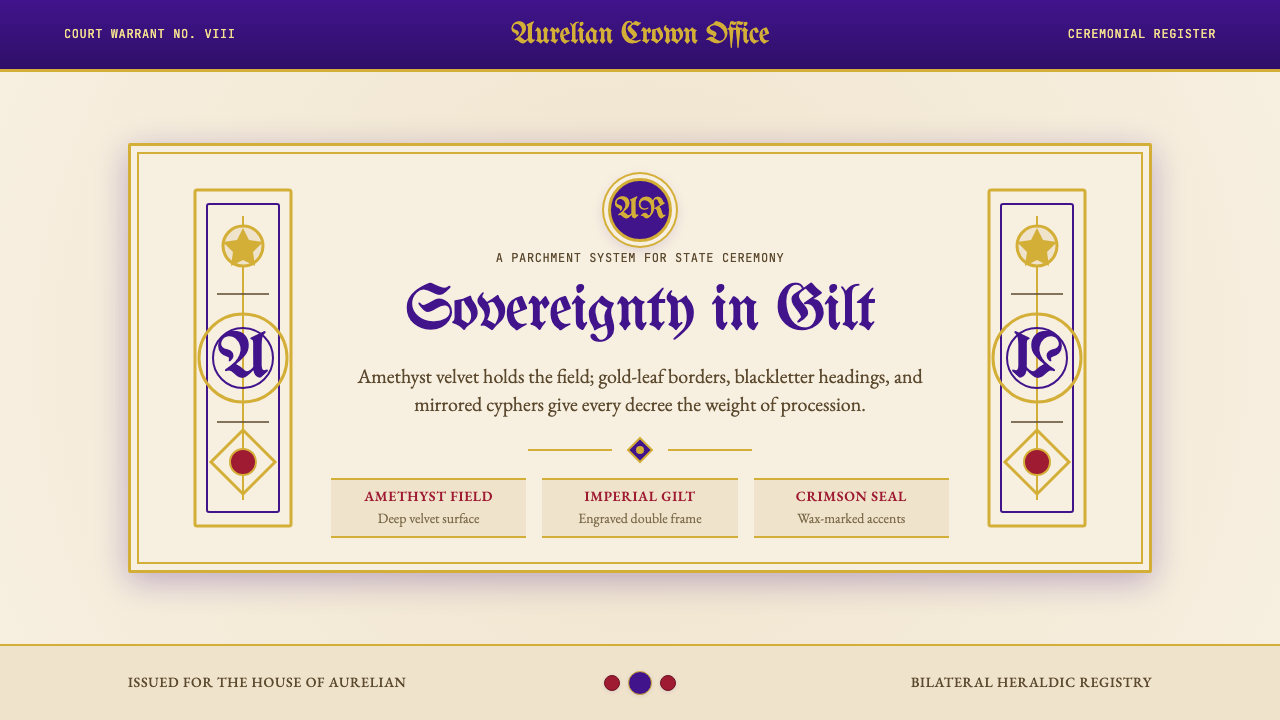 British Royal MonarchyCeremony becomes structure. Amethyst panels, gilt borders, blackletter, mirro…
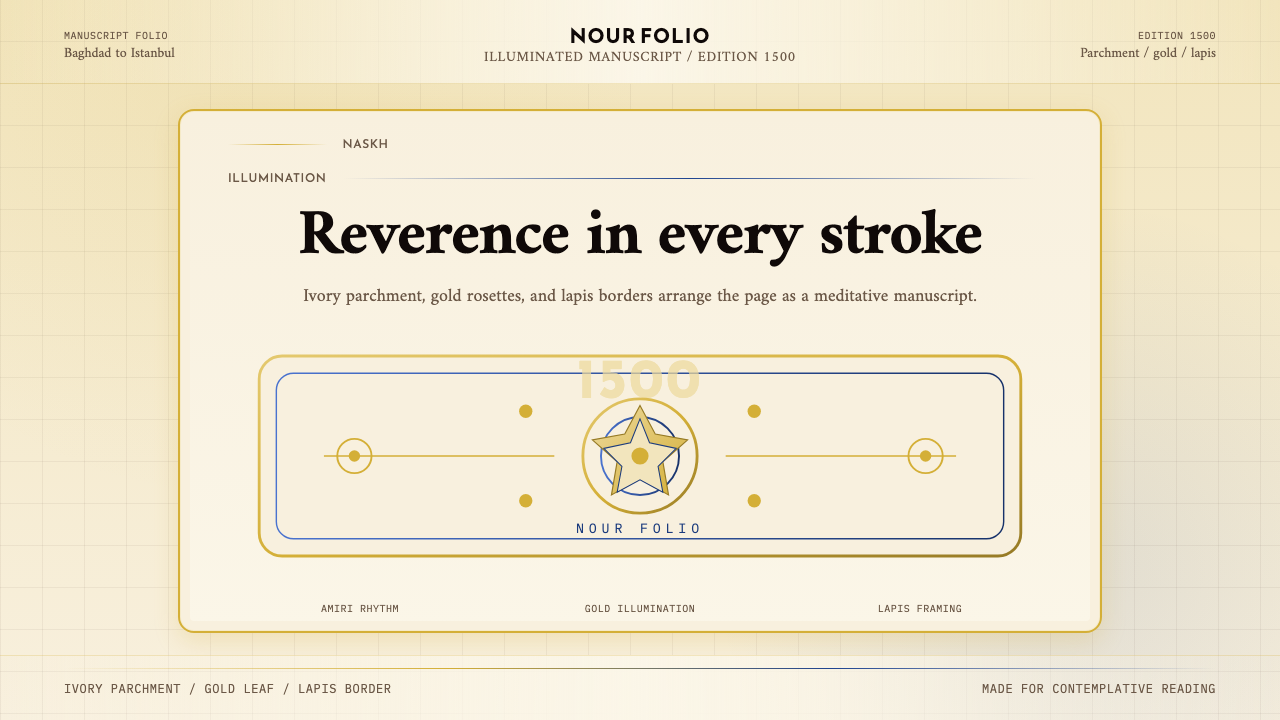 Naskh Quranic (1500)Reverence in every stroke. Ivory parchment, gold rosettes, and lapis framing.
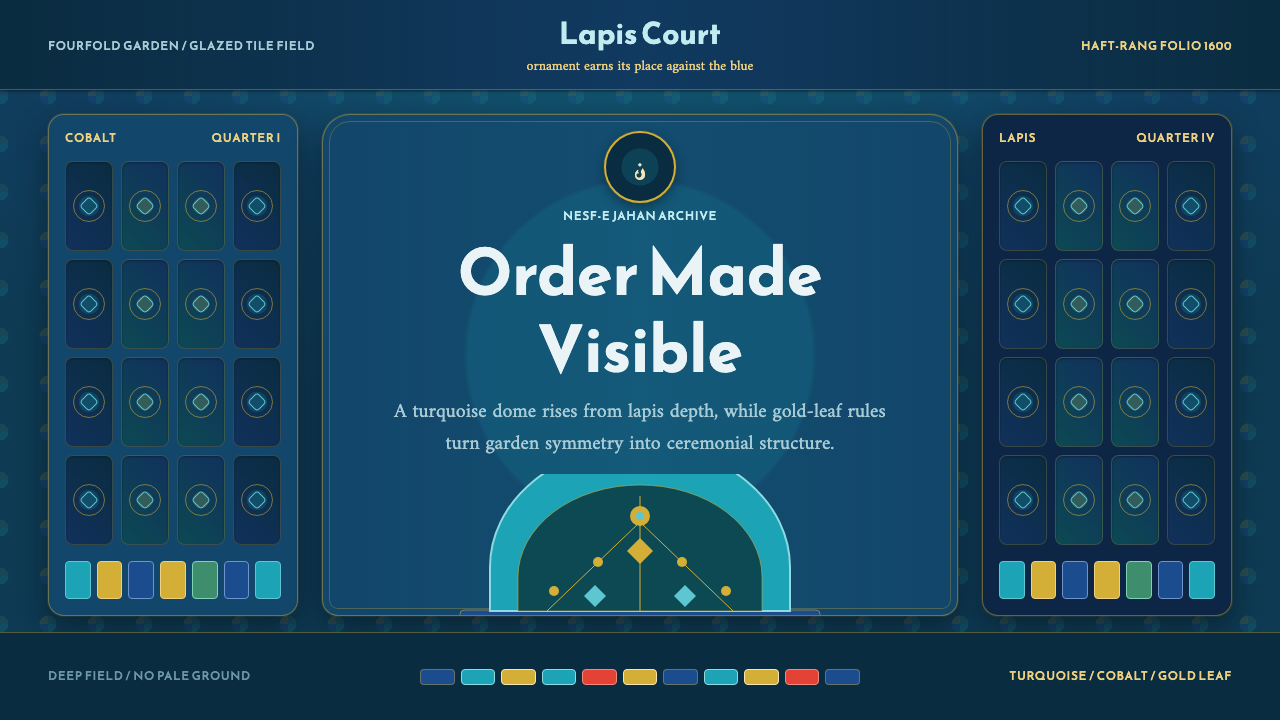 Safavid IsfahanOrnament is order. Turquoise domes and gold rules lock into a deep lapis grid.
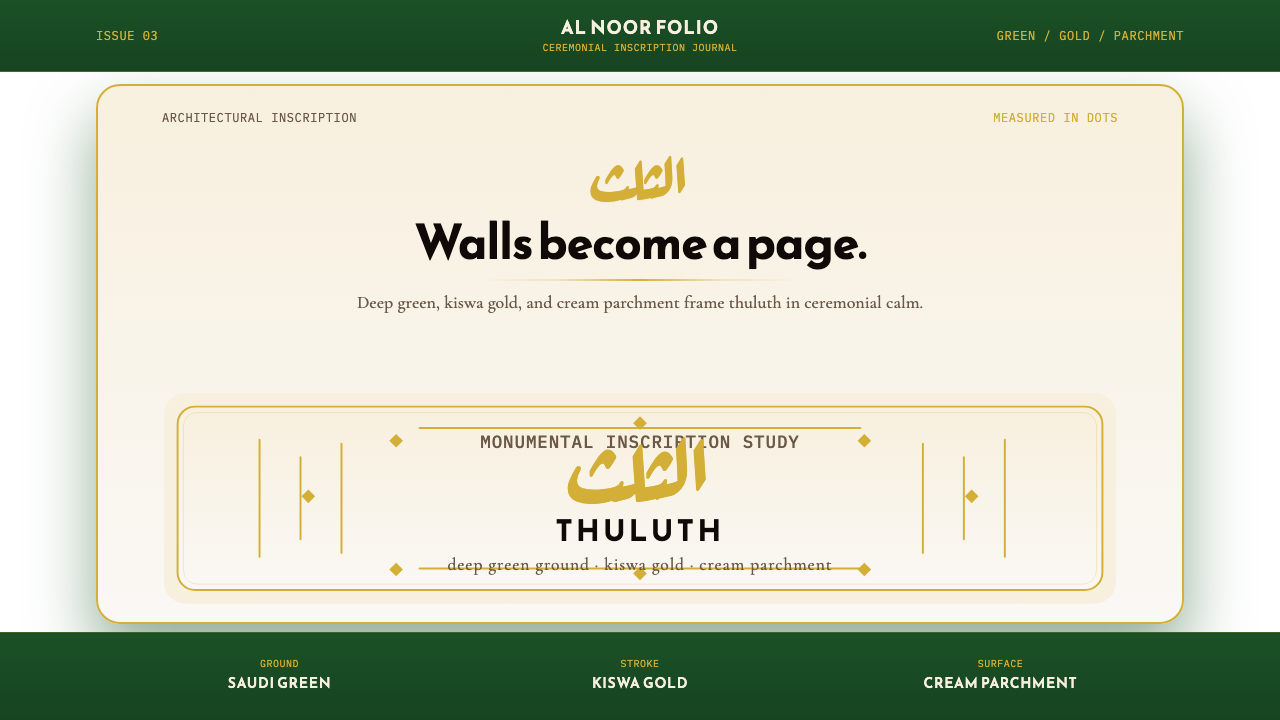 Saudi Thuluth CalligraphyMonumental calm in gold. Deep green, thuluth type, and cream parchment symmet…
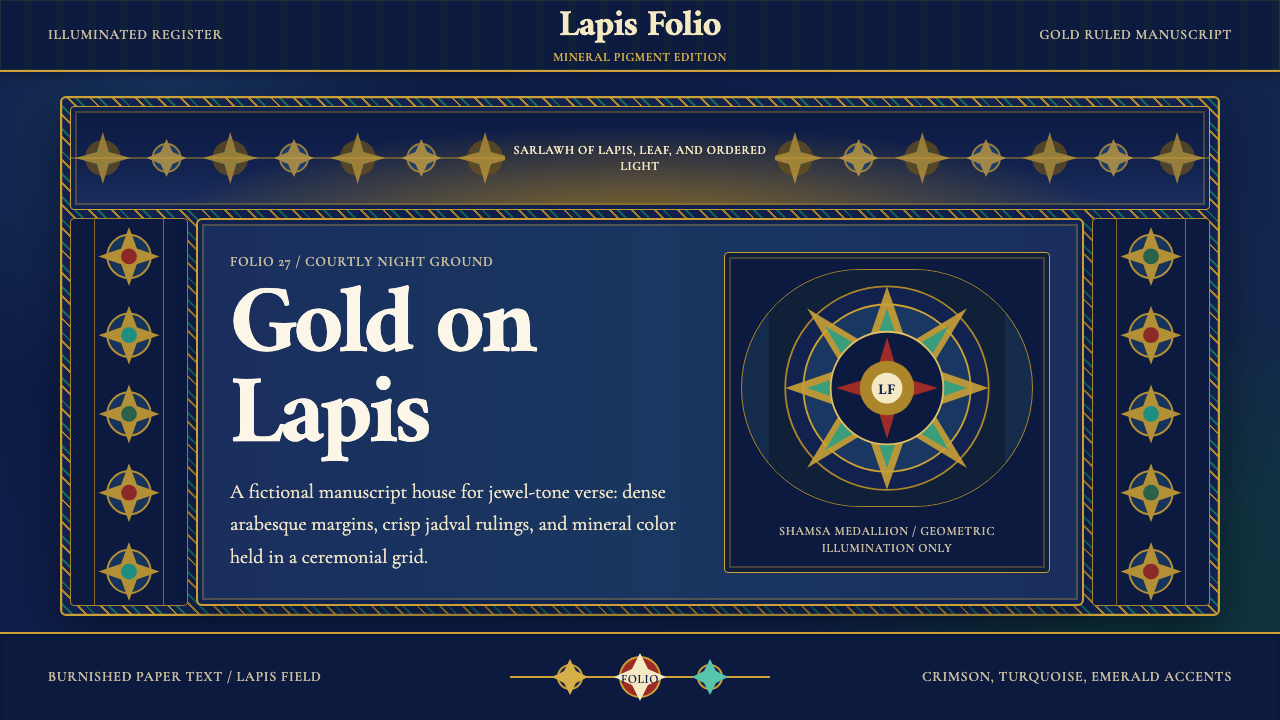 Timurid Manuscript (Herat)Courtly density glows. Lapis ground, Amiri type, and gold jadval geometry hol…