What is Timurid Manuscript (Herat)?
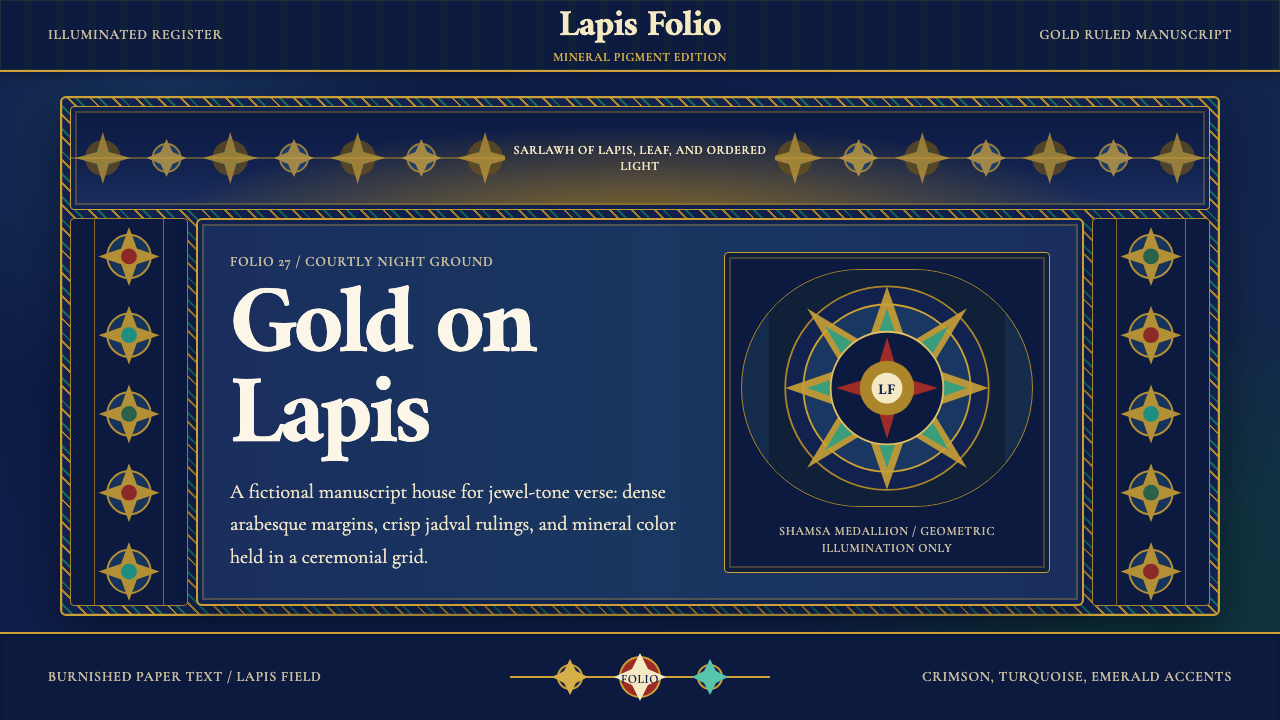
Timurid manuscript illumination from Herat glows with courtly density — a lapis-blue ground, gold jadval framing, and jewel-like ornament built for royal poetry folios.
Timurid Manuscript (Herat) in brief
Timurid Manuscript illumination, associated above all with the city of Herat, represents the height of Persian book arts — a tradition where every page of a manuscript, not just its illustrations, was treated as a designed object. The style this system distills concentrates on the framing and ornamental apparatus that surrounded the text and miniature paintings: dense floral-arabesque borders, gold rulings that separate text blocks, and illuminated headpieces marking the opening of a new section or poem.
The dominant ground is an ultramarine lapis blue, one of the most prized and expensive pigments available to any premodern workshop, and its use across large fields signals the resources a royal patron was willing to commit to a single manuscript. Gold-leaf ornament sits atop that blue, while crimson, turquoise, and emerald punctuate the composition the way mineral pigments punctuate a jeweler's setting — used precisely, not liberally.
The overall effect is one of extraordinary refinement rather than raw density for its own sake: unlike styles that fill every surface indiscriminately, Herat illumination organizes its ornament around a clear architecture — a central text block, a frame, a headpiece — so that even the most elaborate page remains legible as a structured object rather than an undifferentiated field of pattern.

Where does Timurid Manuscript (Herat) come from?
Herat, now in Afghanistan, became the preeminent center of Persian manuscript arts under the patronage of the Timurid dynasty in the fifteenth century — a period following Timur's conquests when his successors redirected the empire's wealth toward cultural and artistic production rather than continued military expansion. The royal kitabkhana, or atelier, was less a single workshop than an institution combining calligraphers, painters, illuminators, and bookbinders under unified royal direction.
The patronage of Shah Rukh, Timur's son, established Herat as a capital of learning and book production, and this royal investment continued under his own son Baysunghur, who personally directed the kitabkhana and is credited with commissioning some of the era's most celebrated manuscripts. The line of patronage culminated later in the century under Sultan Husayn Bayqara, whose court oversaw what many historians regard as the final and most refined flowering of the Herat school before the Safavid transition.
The most consequential figure within this institutional structure was the master painter Kamal ud-Din Bihzad, who led the royal kitabkhana and whose work set the standard against which later Persian and Mughal manuscript painting would be measured for generations. Bihzad's influence extended well beyond his own paintings — the illuminators and border artists working under his direction absorbed his sense of proportion and color discipline into the ornamental apparatus surrounding the miniatures themselves.
This body of work sits within the broader fields of Persian miniature painting, Timurid illumination specifically, and Islamic book arts more generally — a tradition in which the physical book, bound and complete, was understood as a unified artistic statement rather than a container for separately valued illustrations, and in which ornament, calligraphy, and image were designed to function as a single coherent page.
What defines the Timurid Manuscript (Herat) look?
Color
Ultramarine lapis blue dominates as the primary ground, chosen historically for its rarity and expense as much as its visual depth. Crimson, turquoise, and emerald appear as precise mineral-pigment accents, while gold-leaf ornament sits atop the blue rather than competing with it as a separate field.
Gold Jadval Framing
The jadval — a system of fine gold rulings that frame the text block and separate it from surrounding ornament — provides the structural skeleton of the page. This framing device is what keeps an otherwise densely ornamented composition legible as a hierarchy: text inside the frame, ornament outside it.
Floral-Arabesque Borders
Dense scrolling vine and blossom ornament fills the border zone around the text block, rendered with fine, controlled linework rather than loose or gestural drawing. The density of the border stands in deliberate contrast to the cleaner text block it surrounds.
Illuminated Headpieces
A sarlawh, or illuminated headpiece, marks the opening of a new chapter or poem with a symmetrical ornamental panel, often combining gold, blue, and accent colors in a denser concentration than the rest of the page. This device signals structural hierarchy within the manuscript, much like a chapter heading.
Nasta'liq Calligraphy
The flowing, right-to-left nasta'liq script carries the poetic text at the heart of each folio, its diagonal, cascading rhythm treated as a visual element in its own right rather than merely a vehicle for words. The calligraphy's proportions and spacing are coordinated with the surrounding frame and ornament.
Structured Density
Unlike ornamental styles that fill every surface without distinction, Herat illumination organizes its density around a clear architecture — text block, frame, border, headpiece — each zone carrying a different concentration of ornament so the page reads as structured rather than uniformly busy.
Symmetry within the Frame
Ornamental panels, especially headpieces, favor bilateral symmetry, reinforcing a sense of formal order even amid dense pattern. This symmetry contrasts with the asymmetric compositions of the narrative miniatures the illumination often accompanies.

Who shaped Timurid Manuscript (Herat)?
Bihzad led the royal kitabkhana at Herat and later Tabriz, and his work set the standard for Persian manuscript painting for generations. While best known for his miniature paintings, his influence shaped the illuminators and border artists working alongside him, embedding his sense of proportion and restraint into the ornamental apparatus of Herat manuscripts.
As Timur's son and successor in the eastern half of the empire, Shah Rukh redirected royal resources toward cultural patronage, establishing Herat as a center of learning and manuscript production. His reign set the institutional foundation — the royal kitabkhana, the scholarly court — that later Herat illumination depended on.
Shah Rukh's son personally directed the kitabkhana and is credited with commissioning some of the era's most celebrated manuscripts, including a renowned copy of the Shahnameh. His hands-on involvement in atelier direction exemplifies how closely royal patrons in this tradition were engaged with the actual production of illuminated books.
The court of Sultan Husayn Bayqara oversaw what is often regarded as the final and most refined flowering of the Herat school in the late fifteenth century, before the region's political transition to Safavid rule. Manuscripts produced under his patronage represent the style at its technical peak.
How do you use Timurid Manuscript (Herat) today?
This style rewards content that wants to feel courtly, refined, and precious, where every element is treated as worthy of a frame. On a presentation cover slide, the lapis ground with a centered gold-lined panel — echoing a sarlawh headpiece — signals formality before any content appears; the border ornament should stay within a defined frame rather than bleeding to the edges. Content slides work best when each block of information sits inside its own gold-ruled frame, mirroring the jadval discipline that separates text from surrounding ornament.
For web interfaces, the style suits premium cultural, educational, or heritage platforms — museum digital collections, rare-book or archive interfaces, high-end invitation or ceremony-related products — more than everyday utility software, where its density would slow task completion. A hero section can use the lapis ground with a gold-framed panel holding the primary message, while secondary content areas keep the frame-and-border logic in smaller, quieter doses.
In editorial and marketing contexts, the style suits long-form storytelling about craft, history, or courtly culture, where a reader expects to slow down and look closely. A pull-quote can be set inside a small gold-lined frame against the lapis ground, echoing a headpiece in miniature, while body text should stay in a clean, uncluttered block — resisting the temptation to extend the border ornament into the reading area itself.
Because the system depends on the contrast between an ornamented frame and a comparatively clean interior, it does not translate well into layouts with no clear boundary between content and decoration — a page where ornament and text intermingle freely loses the hierarchy that makes Herat illumination legible. Content with large amounts of continuous body text should isolate the ornamental vocabulary to headers, section breaks, and margins rather than spreading it throughout.
A common mistake is treating this as simply 'gold and blue with floral patterns.' The style's coherence comes specifically from the jadval framing system that separates zones of different ornamental density — omitting that structural frame and scattering floral motifs freely across the page produces visual noise rather than the disciplined density the tradition is known for.

Timurid Manuscript (Herat) — FAQ
Why is lapis blue so central to this style rather than another color?
Lapis-derived ultramarine was among the most expensive pigments available to premodern workshops, since the mineral had to be imported and processed through a labor-intensive extraction method. Using it across large fields of a manuscript was a direct, visible signal of the resources a royal patron was committing — the equivalent of a modern luxury brand choosing a material specifically because of its cost and rarity, not only its appearance.
What is the functional purpose of the jadval gold framing?
The jadval separates the text block — the actual poetic or narrative content — from the surrounding ornamental border, giving the eye a clear boundary between 'content to be read' and 'ornament that frames it.' Without this device, a densely illuminated page could become disorienting; with it, even the most elaborate folio remains navigable, because the reader always knows where the text begins and ends.
How does this style differ from other Islamic manuscript traditions, such as Ottoman or Mughal illumination?
While all these traditions share a common vocabulary of gold framing, floral arabesque, and calligraphic integration, Herat illumination under Timurid patronage is particularly known for the refinement and restraint of its border ornament relative to later, sometimes denser regional variations, and for a specific palette dominated by lapis blue. Ottoman and Mughal manuscript arts, which developed later and absorbed Herat's influence, often introduced broader color ranges and different proportional systems suited to their own courts.
Can this style be applied to digital products without feeling like a historical costume?
Yes, if the underlying structural logic — a clear frame separating content from ornament, restrained use of an expensive-feeling primary color, symmetry within bounded panels — is preserved even when the literal motifs (arabesque scrollwork, calligraphic script) are simplified or omitted. Applying the color and framing discipline without the literal historical ornament lets a product feel considered and premium without appearing to costume itself in an unrelated cultural artifact.
Related design styles
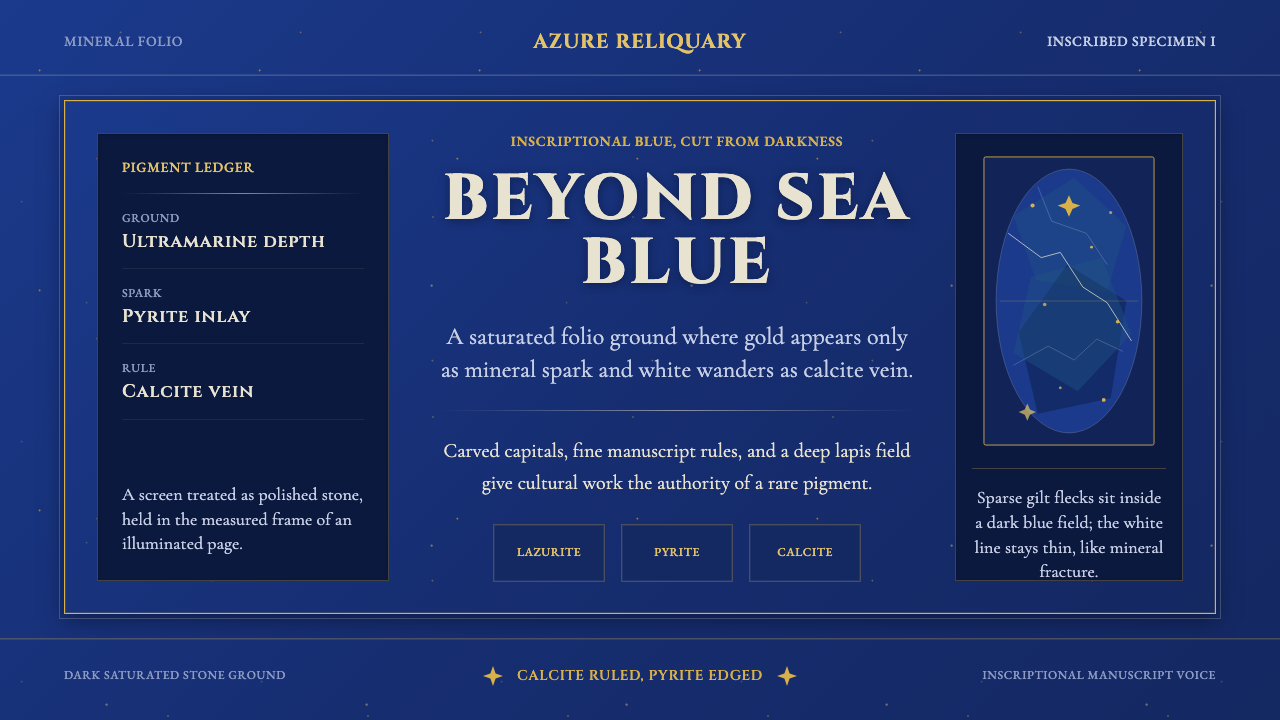 Badakhshan Lapis LazuliStone as manuscript. Ultramarine field, pyrite flecks, calcite veins, carved…
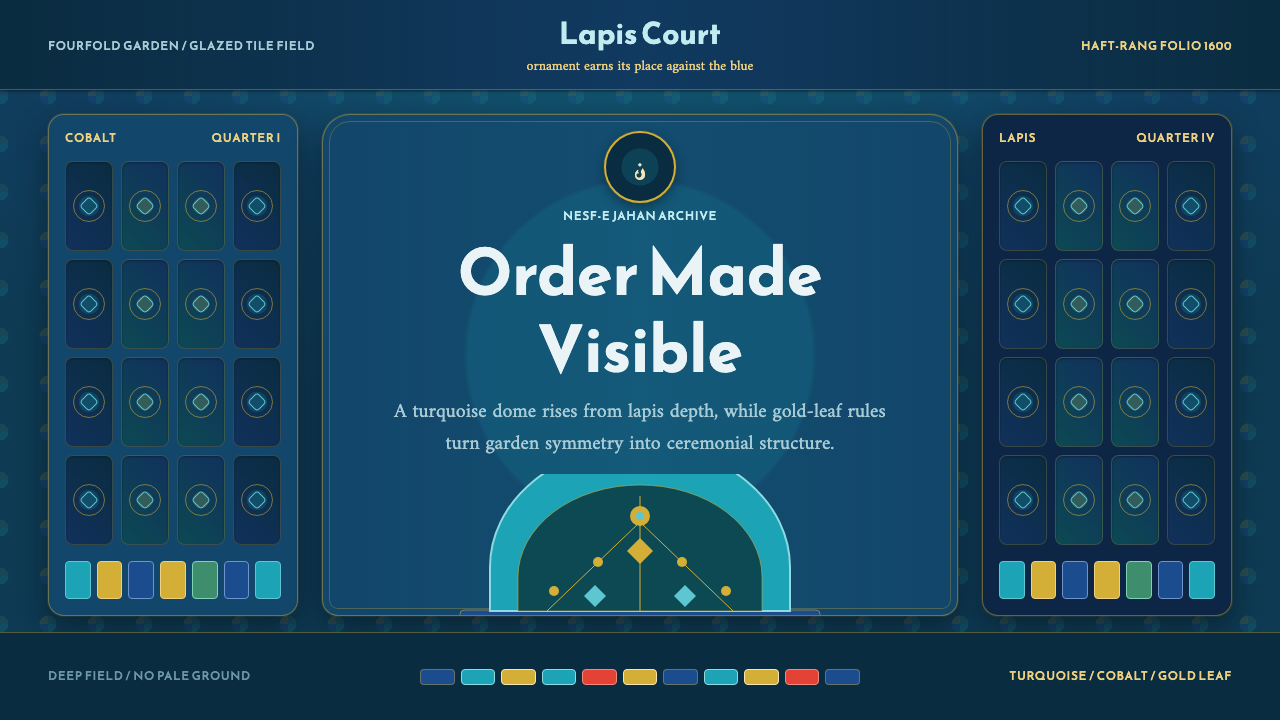 Safavid IsfahanOrnament is order. Turquoise domes and gold rules lock into a deep lapis grid.
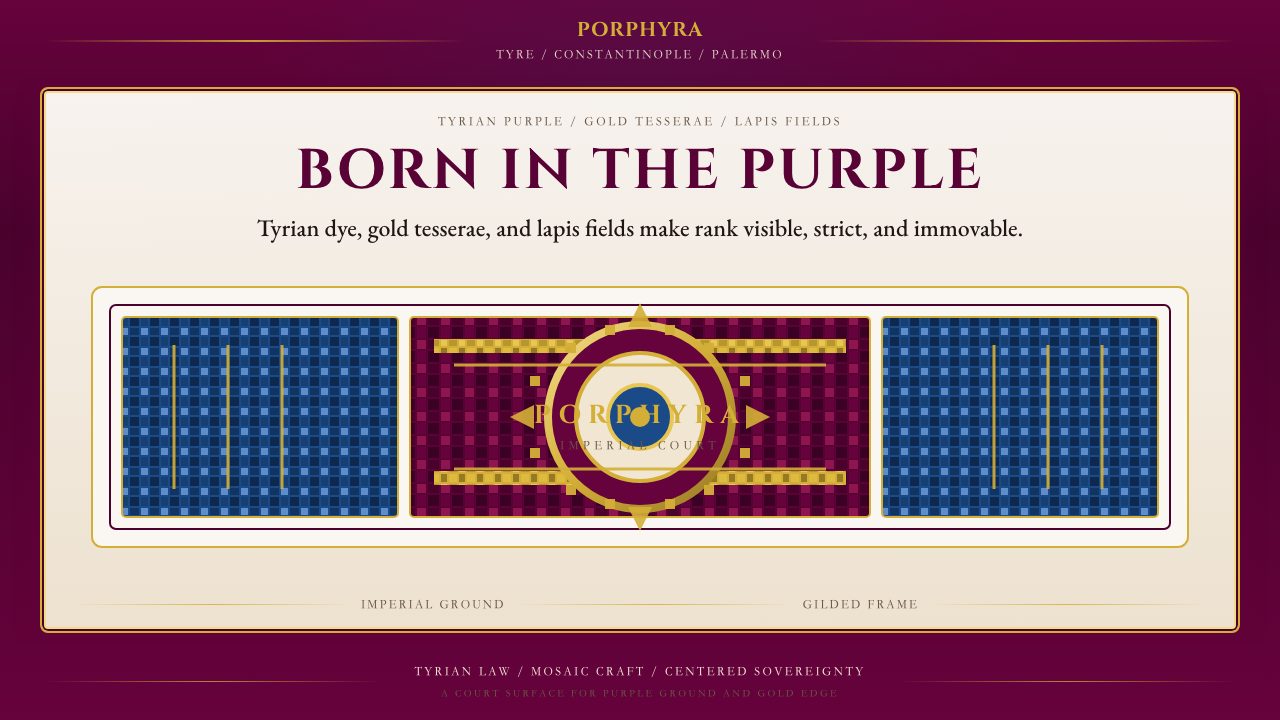 Byzantine Tyrian Purple (Imperial Court)Imperial rank made visible. Tyrian purple, gold tesserae, and centered symmet…
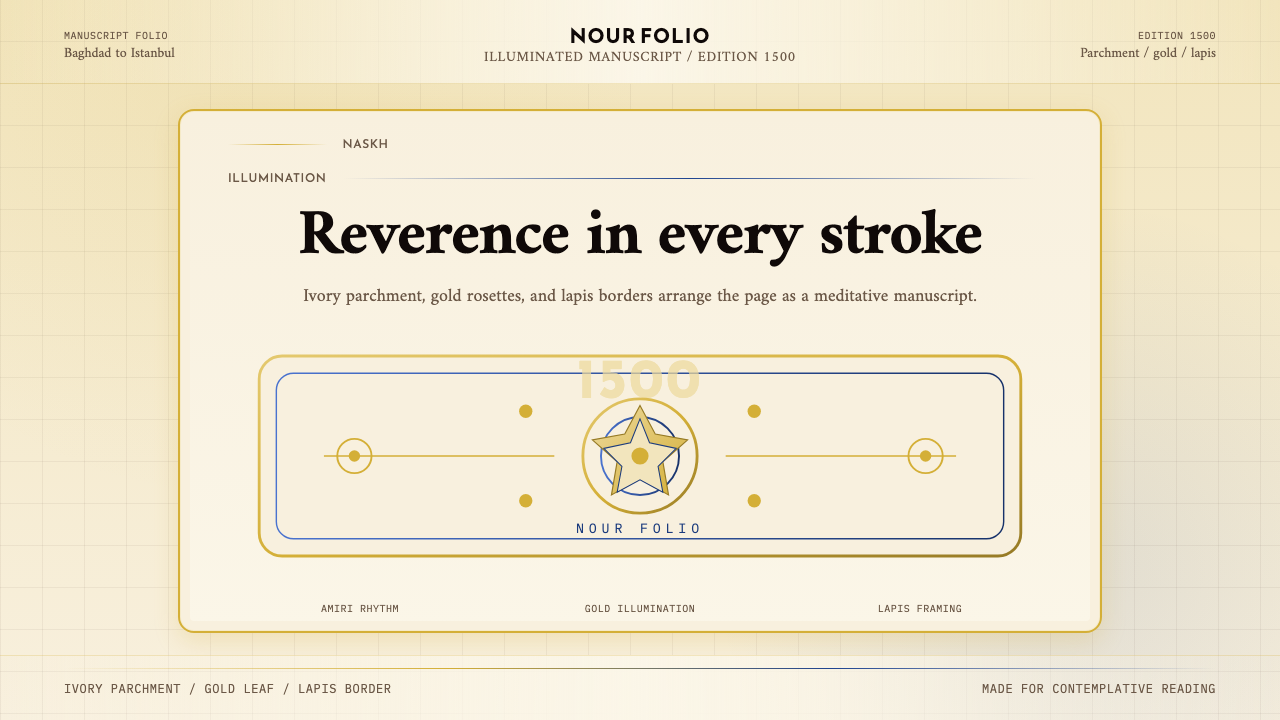 Naskh Quranic (1500)Reverence in every stroke. Ivory parchment, gold rosettes, and lapis framing.
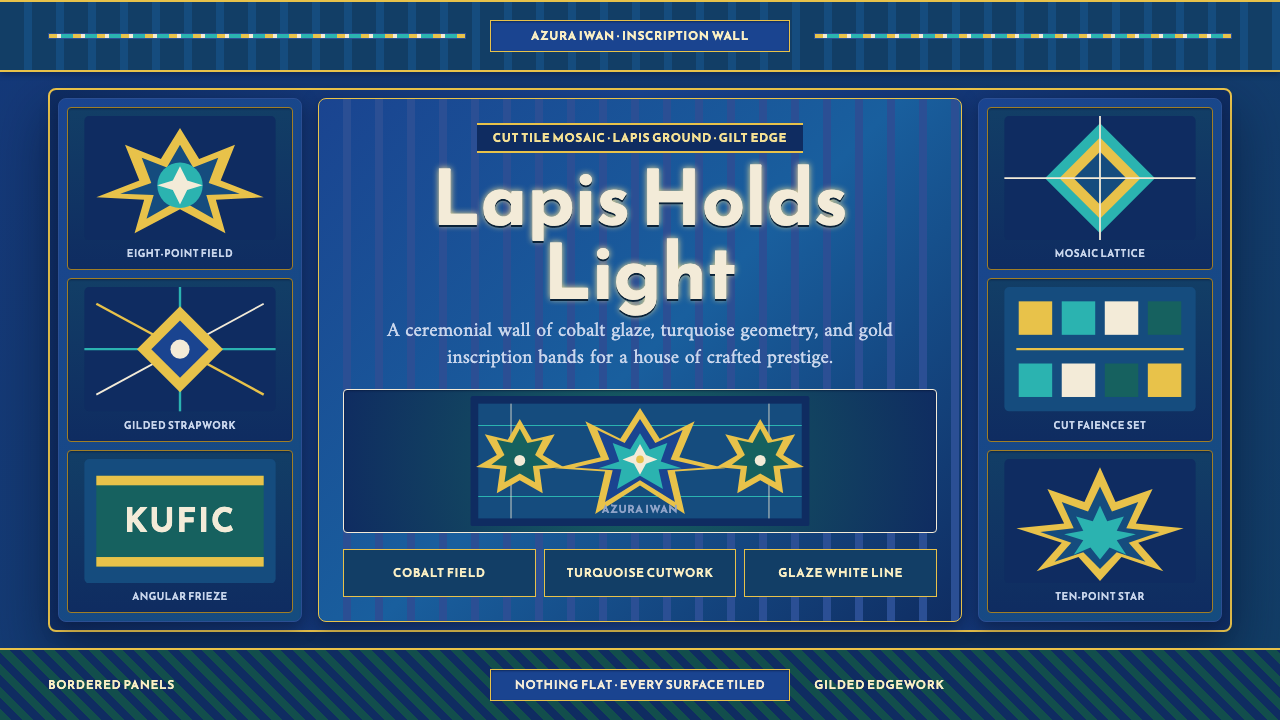 Samarkand TileworkOrnament is the architecture. Lapis panels, gold Kufic bands, and star geomet…
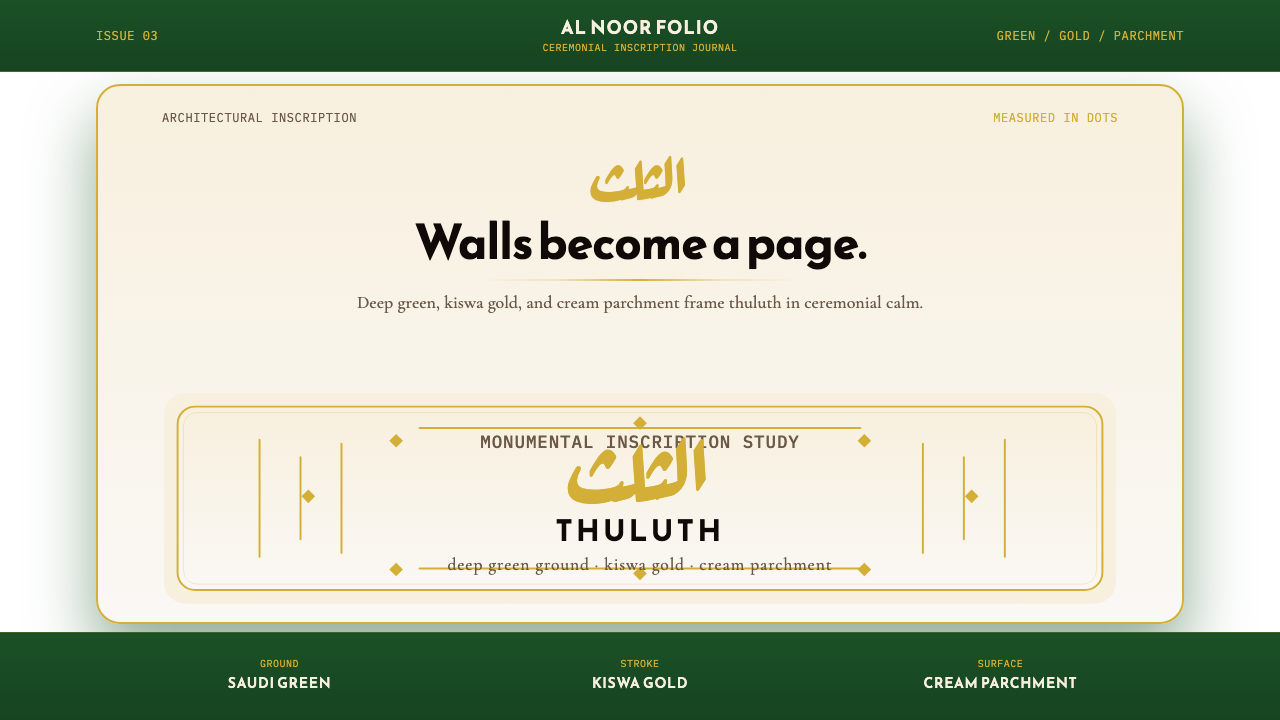 Saudi Thuluth CalligraphyMonumental calm in gold. Deep green, thuluth type, and cream parchment symmet…