What is Naskh Quranic (1500)?
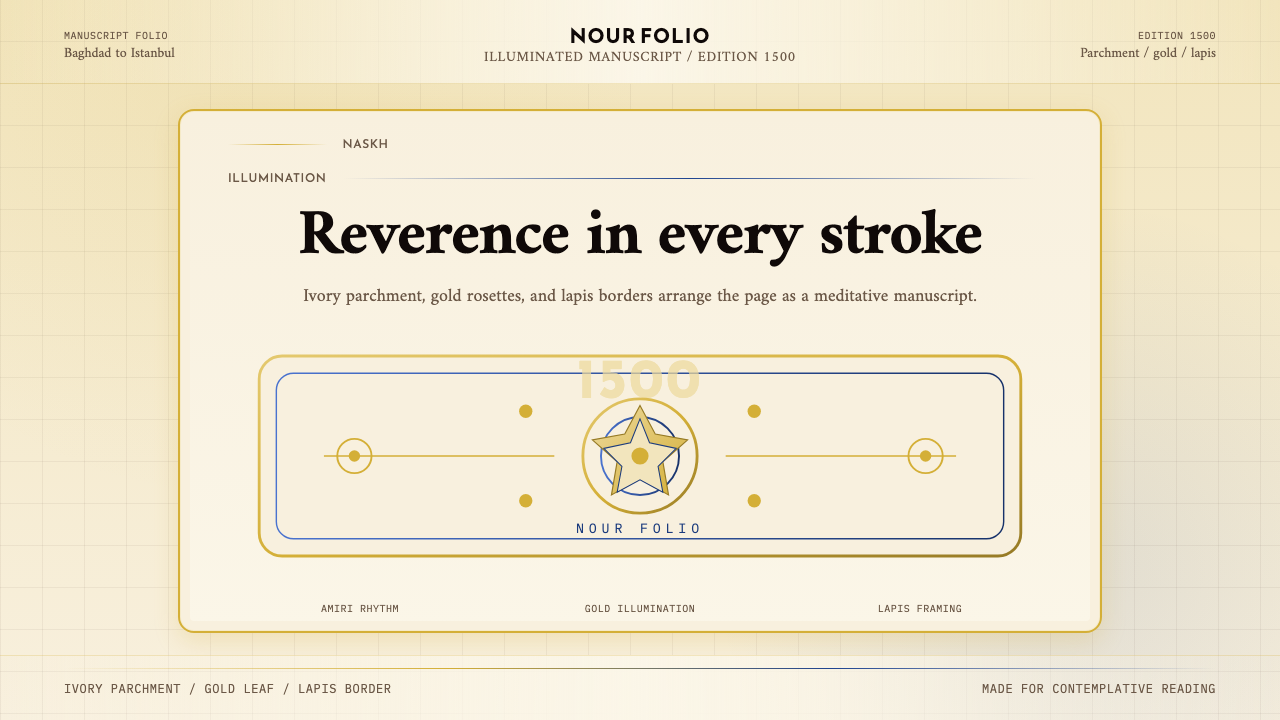
Naskh Quranic carries a millennium of sacred precision — ink-black calligraphy, gold-leaf rosettes, and lapis borders born in Baghdad and refined across the courts of three empires.
Naskh Quranic (1500) in brief
Naskh Quranic (1500) is a design system rooted in the manuscript tradition of Qur'an copying as it reached its apex in the courts of the Mamluk, Ottoman, and Mughal empires. The visual language is built from a small but deeply intentional set of elements: aged ivory or warm parchment grounds, ink-black calligraphic letterforms with their characteristic horizontal flow, gold-leaf illumination rosettes marking verse divisions, lapis-blue border frames, and vermilion or deep red used sparingly for diacritical markers and chapter headings. Together these elements create a visual field that is simultaneously opulent and disciplined — every gilded flourish is placed according to centuries-old compositional rules.
The system draws its authority from the act of copying itself. In Islamic manuscript culture, the Qur'an scribe was not merely a craftsman but a devotional practitioner; each stroke of the reed pen was understood as an act of reverence. This inheritance shapes the aesthetic character of the style: weight, deliberateness, and an unusual generosity of space around every letterform. No element crowds another. The page breathes. Translated into contemporary digital contexts, these qualities produce interfaces and documents that feel measured, trustworthy, and unhurried — qualities increasingly rare in visual culture.
What distinguishes Naskh from other Arabic scripts — and from later calligraphic traditions — is its proportional system. Ibn Muqla's tenth-century codification established each letterform's geometry in relation to a rhombic dot unit, creating a script where the visual weight of every character is rationally derived rather than intuitive. This underlying geometric rigor, invisible to the casual viewer but present in every curve and horizontal, makes Naskh the most legible and the most reproducible of the classical Arabic scripts, which explains both its adoption for Qur'an copying and its survival into modern digital Arabic typefaces.

Where does Naskh Quranic (1500) come from?
The story of Naskh begins in tenth-century Abbasid Baghdad with a bureaucrat-turned-calligrapher named Ibn Muqla (886–940 CE). As a vizier of the Abbasid caliphate, Ibn Muqla occupied one of the most powerful administrative positions in the medieval Islamic world, but his enduring legacy is a geometric theory of letterform. He devised a proportional system — the first of its kind in Arabic calligraphy — in which each letter's correct form was derived from a fixed rhombic dot unit made by the reed pen. The diameter of the letter alif, the height of letters, the length of horizontal strokes: all were expressible as multiples of this foundational unit. The result was a script that could be taught, corrected, and replicated with a precision that earlier Arabic writing lacked. Naskh — meaning roughly 'copying' or 'transcription' — took its name from its primary function.
Over the following two centuries, Ibn Muqla's system was received, tested, and perfected by a succession of calligraphic masters in Baghdad. The most celebrated of these was Ibn al-Bawwab (died 1022 CE), whose surviving Qur'an manuscript — held today in the Chester Beatty Library in Dublin — is considered the earliest extant complete Qur'an in Naskh script. Ibn al-Bawwab refined the proportional rules and introduced an increased fluency and curve into the letterforms that transformed Naskh from a geometric exercise into a living aesthetic. He was followed by Yaqut al-Musta'simi (died 1298 CE), the last great Baghdad master, who further softened the script and established the conventions that Mamluk, Ottoman, and Mughal scribes would inherit and elaborate.
The Mamluk sultans of Egypt (1250–1517) were among the greatest patrons of Qur'an production in Islamic history. Their court workshops produced large-format manuscripts — sometimes called 'royal Qur'ans' — with pages so large a single line of text might span the width of an outstretched arm. The Mamluk contribution to the visual language of the Naskh Quranic style was principally in illumination: the geometric carpet pages, the interlocking star-polygon rosettes that marked verse divisions, the polychrome borders interweaving blue, gold, and red in precise geometric lattices. These illumination conventions, developed across the thirteenth and fourteenth centuries, became the compositional grammar that later imperial traditions would inherit.
The Ottoman calligraphic school, centered in Istanbul from the late fifteenth century onward, received this inheritance and subjected it to a new wave of refinement. The pivotal figure was Sheikh Hamdullah (1436–1520), a calligrapher who reportedly copied the style of Ibn al-Bawwab's manuscripts directly, working from examples in the Topkapi library. Sheikh Hamdullah's reform introduced a new balance between horizontal and vertical stress in the letterforms, producing a Naskh that felt simultaneously weighty and airy. His students and their students formed the Ottoman calligraphic lineage that trained master scribes for three centuries, standardizing the Naskh Quranic aesthetic to a degree of refinement that has never been surpassed. It is this Ottoman-Hamdullah synthesis — parchment ground, imperial gold, lapis accent, precise proportional letterform — that the design system labeled Naskh Quranic (1500) distills into a contemporary visual vocabulary.
What defines the Naskh Quranic (1500) look?
Ground and Color Field
The foundational ground is warm ivory or aged parchment — not a cold white, but a tone that reads as material, as something that has absorbed warmth over time. Against this ground, ink-black calligraphy and deep lapis blue establish the primary visual poles, with imperial gold occupying a third, luminous register. Vermilion or warm deep red appears at a much lower frequency, used only for the most semantically important marks. The palette is narrow and hierarchical: every color has a role, and no color enters the composition speculatively.
Calligraphic Line Quality
Naskh letterforms are defined by their proportional precision and their characteristic horizontal emphasis. The baseline of each word runs with a controlled flow, letter connections made with decisive, smooth joins. Vertical strokes are upright and moderately weighted; curved bowls are generous and open. The overall impression is of a script that is legible at small sizes because every stroke is purposeful, and beautiful at large sizes because the proportional relationships between strokes are so carefully calibrated. No element wavers or rushes.
Gold Illumination and Rosettes
Gold in the Naskh Quranic tradition is not decoration in the contemporary sense — it is demarcation. Gold rosettes mark the end of each Qur'anic verse; gold medallions signal the completion of five or ten verses; gold border bands separate the text field from the margin. Applied sparingly and according to a semantic system, gold reads as a structural element that makes the document's hierarchy immediately legible without requiring the reader to decode typographic size differences alone. The illuminated ornament always serves orientation.
Generous Line Spacing and Margin
The spacing conventions of Qur'an manuscripts are among the most generous in any pre-modern writing tradition. Lines of text are separated by enough vertical distance that the diacritical marks above and below each letter — the vowel markers, the pronunciation guides — never touch the lines above or below. Margins are wide, historically serving as the space for annotations, interlinear glosses, and the chain of scholastic commentary. In a contemporary application, this generosity of white space produces a layout that breathes and invites sustained reading rather than hurried scanning.
Geometric Border Architecture
The border systems of Mamluk and Ottoman Qur'an manuscripts are among the most sophisticated geometric constructions in any decorative tradition. Multiple concentric bands — a narrow gold line, a broader lapis band with geometric or arabesque infill, an outer guard band in a contrasting color — frame the text field on all four sides. The corners resolve the meeting of horizontal and vertical bands through specially constructed corner pieces, often featuring a small geometric medallion. This border architecture communicates that the page has been deliberately bounded, that the text within it is set apart from the ordinary world.
Hierarchy Through Ornament, Not Scale
Unlike most Western typographic traditions where hierarchy is signaled primarily through size, the Naskh Quranic system uses ornament type and color to signal hierarchy while keeping text size relatively stable. A chapter heading is distinguished by gold rubric and a surrounding medallion, not by being dramatically larger than the verse text. A verse marker is a red numeral inside a gold circle, not a change in type scale. This approach makes the page visually cohesive — the text block reads as a unified texture — while still providing clear navigational structure for the reader.
Material Warmth and Patina
The Naskh Quranic style carries an unmistakable sense of material history — the warmth of vellum and parchment, the slight unevenness that handmade paper gives to ink, the oxidized depth of old gold leaf. In a digital application, this quality is evoked not through photographic texture overlays but through careful tonal choices: a background that reads as warm rather than neutral, gold tones that lean toward amber rather than chrome, deep blues that feel dense and mineral rather than luminescent. The effect is a surface that feels aged without being distressed.

Who shaped Naskh Quranic (1500)?
Ibn Muqla was the Abbasid vizier who established the first systematic geometric theory of Arabic letterforms, deriving each character's proportions from a rhombic dot unit made by the reed pen. His codification transformed Arabic calligraphy from a craft transmitted through imitation into a teachable discipline with measurable standards. Every subsequent master of Naskh — including Ibn al-Bawwab, Yaqut, and Sheikh Hamdullah — worked within the framework Ibn Muqla established, even as they refined and humanized his strict geometry. He is considered the founding theorist of classical Arabic calligraphy.
Ibn al-Bawwab is credited with humanizing Ibn Muqla's geometric system, introducing a greater fluency and elegance into Naskh letterforms without abandoning their proportional rigor. His surviving Qur'an manuscript — the earliest known complete Naskh Qur'an, now in the Chester Beatty Library in Dublin — demonstrates a script of extraordinary refinement, with letterforms that feel both inevitable and alive. He also contributed to the development of Qur'anic illumination conventions, and his manuscripts show the early integration of gold and color as structural markers that later imperial workshops would elaborate into the full Mamluk and Ottoman decorative systems.
Yaqut al-Musta'simi served as the court librarian of the last Abbasid caliph in Baghdad and is remembered as the final great master of the Baghdad calligraphic school. He made a decisive technical innovation — cutting the reed pen nib at an oblique angle rather than straight — that gave Naskh a new range of thick-to-thin contrast within a single stroke. Yaqut is also credited with standardizing the sub-styles of Naskh and the related scripts (Thuluth, Muhaqqaq, Rayhan, Riq'a, Tawqi) into a coherent system of six scripts. The Mongol sack of Baghdad in 1258 destroyed his institutional world, but his calligraphic tradition survived through his students and shaped the Ottoman and Mamluk workshops that followed.
Sheikh Hamdullah of Amasya is the figure who brought Naskh to its Ottoman peak. Working from manuscripts he reportedly studied directly in the Topkapi Palace library, he reformed the prevailing calligraphic conventions to produce letterforms with a new balance — upright, proportional, flowing — that struck Ottoman patrons and aesthetes as a recovery of the authentic classical style. Sultan Bayezid II reportedly held the inkpot for Sheikh Hamdullah as he wrote, an act that signals the extraordinary prestige calligraphy held at the Ottoman court. His reforms became the foundation of the Istanbul school, whose masters trained Qur'an scribes for the next three centuries.
The Mamluk royal workshops of Cairo, operating under the patronage of successive Mamluk sultans from the mid-thirteenth through the early sixteenth centuries, were the primary engines of the Naskh Quranic illumination tradition. These ateliers brought together calligraphers, illuminators, gilders, and binders under a single patronage system to produce large-format Qur'ans that were donated to mosques and madrasas as acts of royal piety. The geometric illumination conventions they developed — carpet pages, star-polygon rosettes, polychrome geometric borders — became the visual grammar that Ottoman and Mughal workshops inherited. No single named figure dominates the Mamluk tradition; its achievement is collective and institutional.
How do you use Naskh Quranic (1500) today?
Naskh Quranic (1500) is a style for contexts where gravity, trustworthiness, and cultural richness need to be communicated without resorting to generic luxury cues. Its visual language — warm grounds, controlled gold, deliberate spacing — works best when the content itself merits sustained attention: financial instruments, scholarly publications, premium cultural institutions, heritage brands, and any product that wants to distinguish itself through depth rather than speed.
For presentation slides, the style divides naturally across cover and content pages. A cover slide benefits from a full parchment-tone ground with the title set in a single weight of upright, well-spaced type, flanked by a pair of gold-tone decorative rules or a simplified border panel. A centered or offset illuminated rosette — even as a simplified geometric motif — signals the tradition without literalism. Content slides should be treated as text manuscripts: generous line spacing, wide left margins reserved for labels or call-out figures, and section breaks marked by a thin gold rule rather than a color block. Data slides should resist the temptation to use color decoratively: chart elements adopt the palette's hierarchy — lapis for primary series, gold for key data points, parchment ground — so the decoration and the data are the same system.
For web interfaces, the style is particularly well suited to dashboards, pricing pages, and documentation portals where the user needs to trust the information being presented. The approach is structural: set the page on a warm near-white ground, use a single column of well-spaced body text for content-heavy pages, and reserve the lapis and gold tones for interactive elements, labels, and state indicators. Borders matter in this style — card components benefit from ruled edges rather than soft shadows. Navigation should be typographic and deliberate, with adequate horizontal spacing between items. The characteristic Naskh margin — wide, intentional — translates directly into the padding systems of a UI component library.
For editorial and marketing contexts, the style supports long-form reading experiences and premium positioning. A Naskh-derived article layout uses a moderate column width for body text, preserves a wide outer margin for annotations or pull quotes, and uses ruled horizontal bands — thin gold-tone lines — as the primary organizational device between sections rather than white space alone. Marketing pages work well with the style's compositional weight: a full-width hero with parchment ground and centered calligraphy-style headline, followed by feature sections that alternate between dense typographic blocks and illumination-inspired ornamental dividers. The restraint required by the tradition — no element exists without purpose — keeps marketing layouts from becoming cluttered.
A common mistake when applying Naskh Quranic is treating gold as a general-purpose accent color rather than a semantic marker. In the source tradition, gold marks specific categories of information — verse endings, chapter headers, navigational markers — and its power comes from that specificity. When gold is applied freely to decorative borders, button backgrounds, and background patterns simultaneously, it loses its role as a signal and becomes noise. Similarly, the parchment ground should remain ground: using warm ivory as a content color over a dark background inverts the entire compositional logic. The style's warmth derives from depth and restraint, not from saturation.

Naskh Quranic (1500) — FAQ
Is Naskh Quranic appropriate only for Arabic-language content, or can it work for other languages?
The style is fully applicable to non-Arabic content. The design language of Naskh Quranic — parchment grounds, gold illumination, lapis borders, generous spacing — is architectural rather than linguistic. It does not require Arabic letterforms to function; it requires the compositional logic and the tonal palette. A Latin-type interface using this palette and spacing system will read as richly historical and trustworthy without any calligraphic letterforms at all. Where Arabic or Arabic-influenced scripts appear in the design, they reinforce the cultural specificity; where they do not, the illumination geometry and color system still carry the style's identity.
How do I use gold in this style without it looking cheap or decorative?
The key is semantic restriction. In the manuscript tradition, gold marks exactly three categories: verse endings, chapter headings, and navigational markers. Translate this into contemporary work by assigning gold to a specific category — key data labels, active navigation states, primary call-to-action — and using it nowhere else. The tonal quality matters as well: gold that leans toward deep amber reads as aged and material; gold that leans toward bright chrome reads as metallic decoration. The former belongs to this system; the latter undermines it. When in doubt, use less gold than feels sufficient — the style's visual weight comes from the parchment-lapis-black relationship, with gold as a precisely deployed third element.
Can Naskh Quranic work in a dark-background or night-mode interface?
A dark inversion is possible but requires careful rethinking rather than simple color reversal. The style's warmth comes from the parchment ground; inverting to black loses that warmth entirely and risks producing something cold and generic. A more successful dark adaptation uses a very deep warm brown or dark umber as the ground rather than pure black, preserving the sense of material depth. Lapis blue, which reads as a cool complement against parchment, becomes a primary element against dark grounds. Gold retains its role as semantic marker. The critical principle: the dark variant should feel like the inside of a manuscript cover at night, not like a night-mode interface that has applied the color palette without understanding its logic.
What kinds of typefaces work alongside this style for body text?
The style calls for type that is upright, well-proportioned, and unhurried — qualities that align with high-quality traditional serif designs rather than contemporary geometric or humanist sans-serifs. For Latin scripts, typefaces with visible calligraphic heritage — those whose contrast between thick and thin strokes echoes the reed pen — read most authentically within this visual system. Very condensed, very wide, or heavily stylized letterforms conflict with the style's compositional gravity. For Arabic and Persian text, any of the major scholarly Naskh digital typefaces — designed for serious reading rather than for brand personality — are appropriate; avoid designs that lean toward decorative Thuluth-adjacent styles or toward contemporary geometric Arabic. What matters most is that the type feels considered and settled, not experimental.
How does this style differ from other Islamic or Middle Eastern inspired design styles?
The most important distinction is that Naskh Quranic is a manuscript tradition, not an architectural or surface-pattern tradition. Styles derived from Islamic geometric tilework, muqarnas, arabesque surface decoration, or Ottoman textile patterns have different compositional logics — they are primarily about the infinite repeat, the modular unit, and pattern density. Naskh Quranic is about the page: the single text block, the bounded margin, the hierarchical use of color as semantic marker. It is closer in compositional structure to a medieval European illuminated manuscript than it is to a geometric tile panel. This distinction matters in application: designs that combine both logics — tiling the background with a geometric pattern while also using the manuscript spacing and color system — usually fail because they are trying to be two different traditions simultaneously.
Related design styles
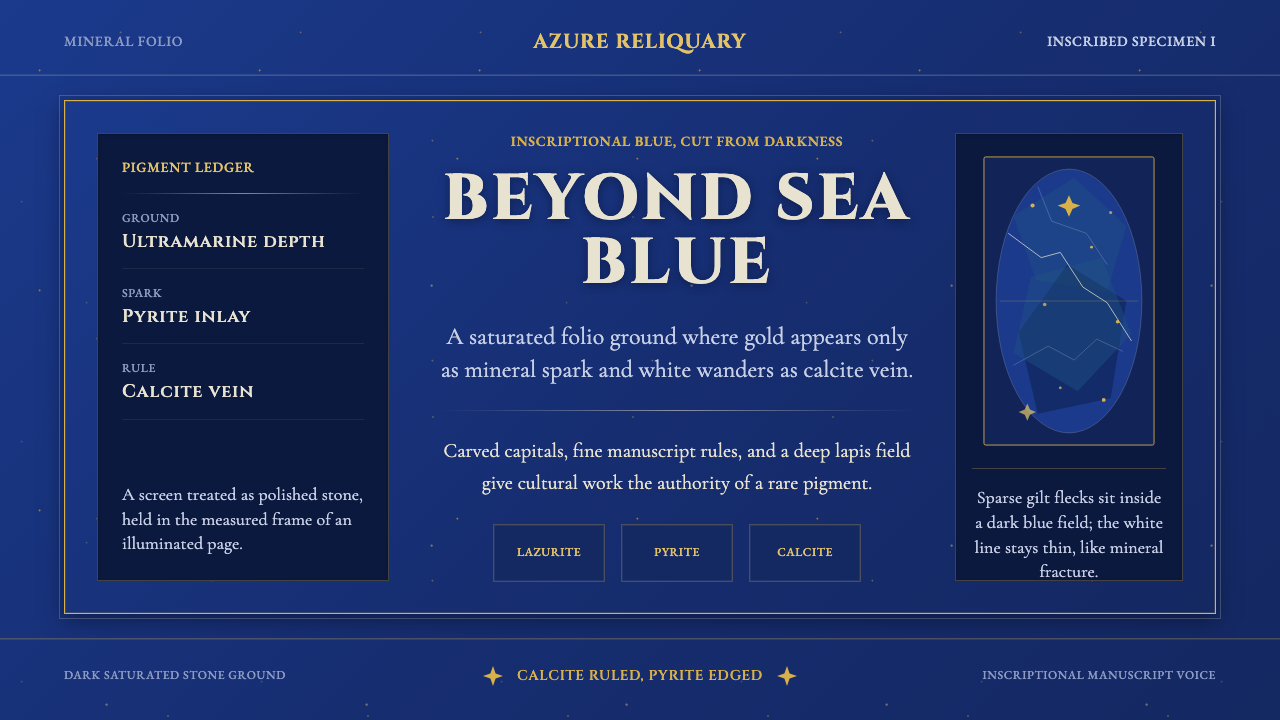 Badakhshan Lapis LazuliStone as manuscript. Ultramarine field, pyrite flecks, calcite veins, carved…
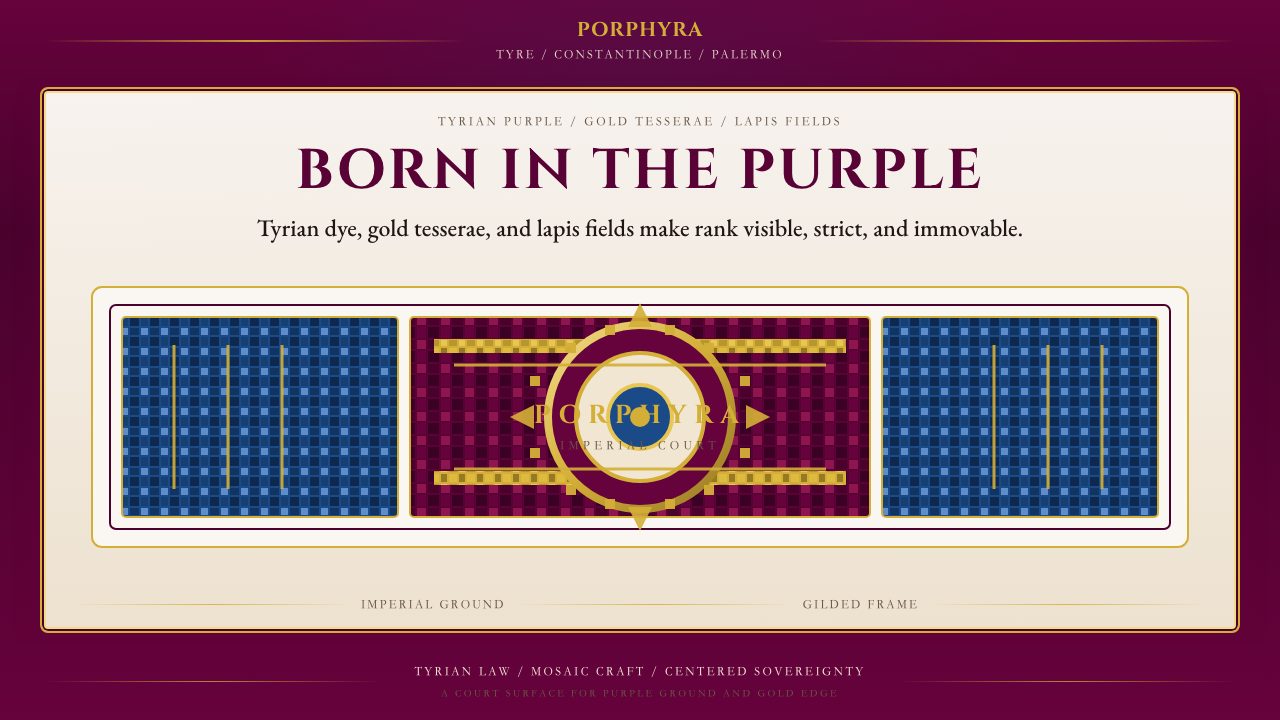 Byzantine Tyrian Purple (Imperial Court)Imperial rank made visible. Tyrian purple, gold tesserae, and centered symmet…
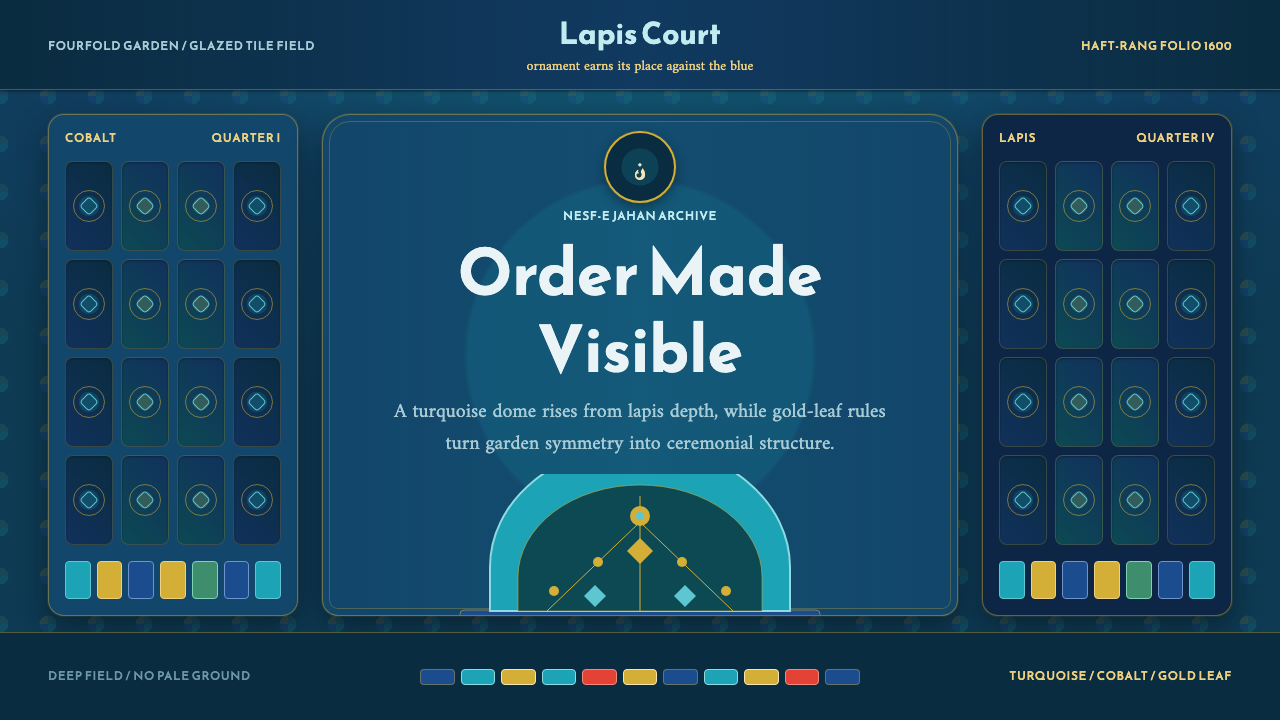 Safavid IsfahanOrnament is order. Turquoise domes and gold rules lock into a deep lapis grid.
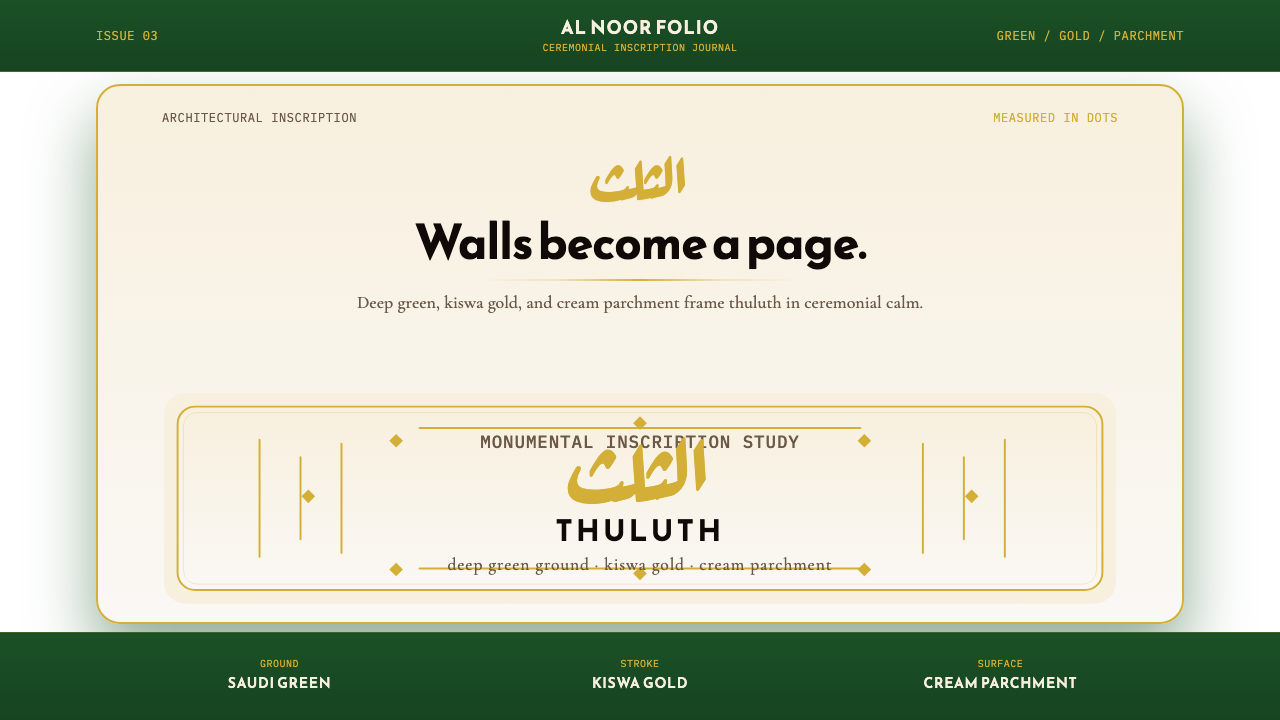 Saudi Thuluth CalligraphyMonumental calm in gold. Deep green, thuluth type, and cream parchment symmet…
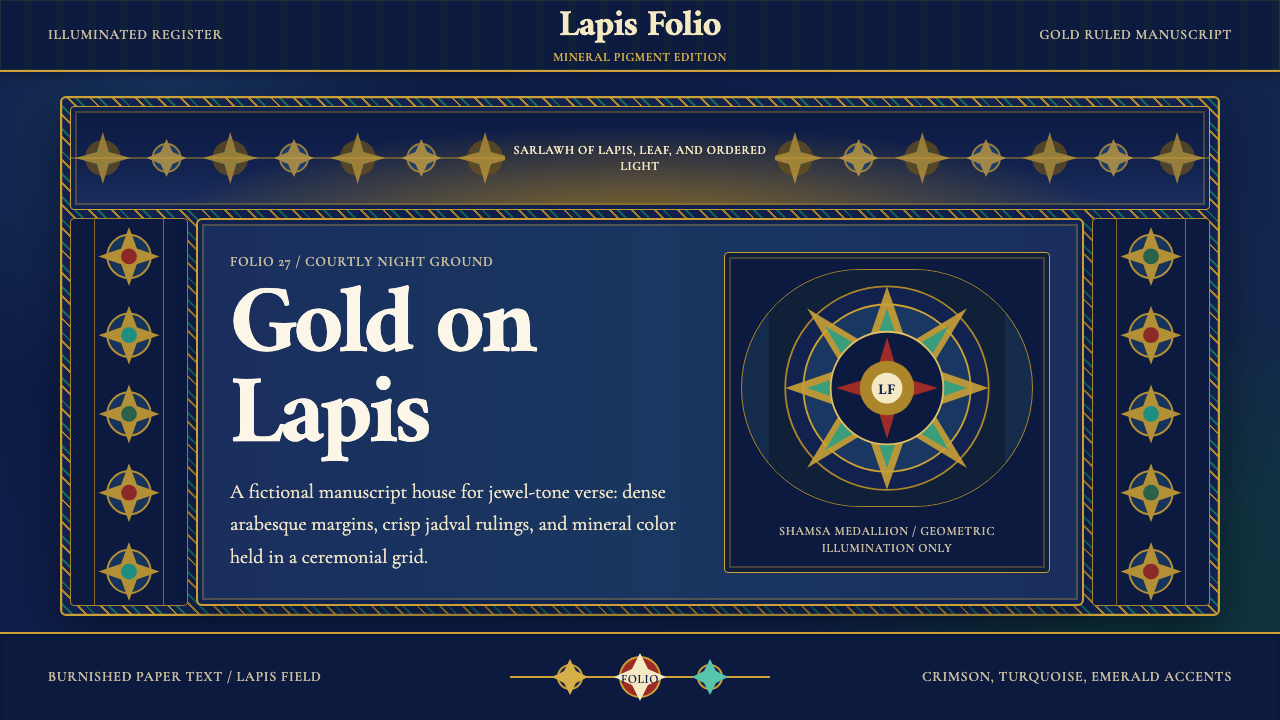 Timurid Manuscript (Herat)Courtly density glows. Lapis ground, Amiri type, and gold jadval geometry hol…
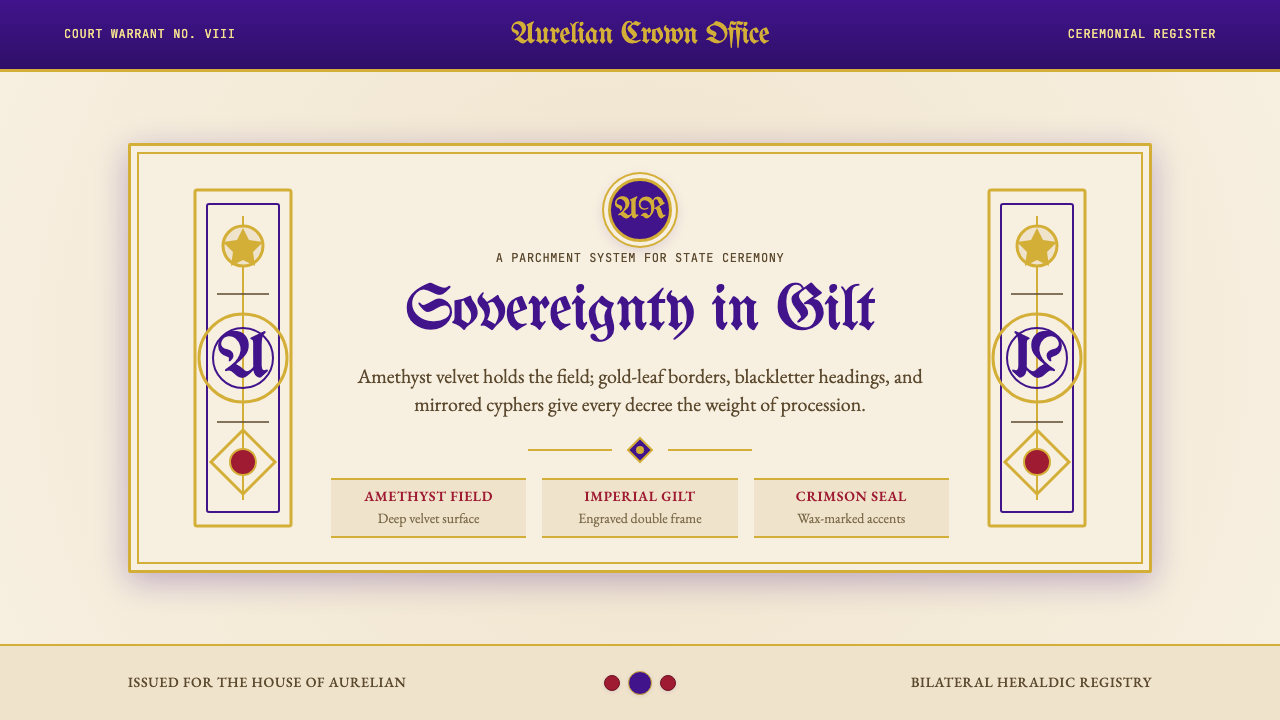 British Royal MonarchyCeremony becomes structure. Amethyst panels, gilt borders, blackletter, mirro…