What is British Royal Monarchy?
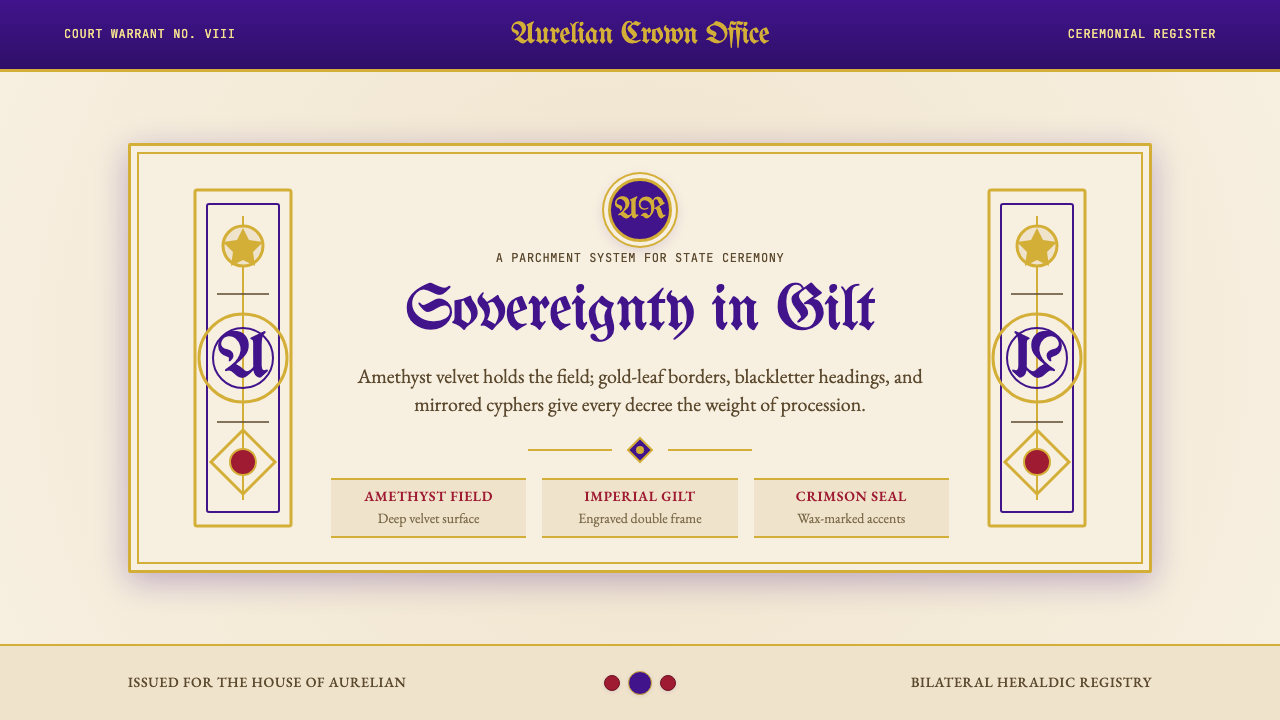
Eight centuries of court protocol compressed into a single visual language: coronation purple, imperial gold, and blackletter symmetry that still commands the page.
British Royal Monarchy in brief
British Royal Monarchy design is the visual grammar of sovereign authority — a system distilled from coronation ceremonies, royal warrants, heraldic proclamations, and state documents accumulated across eight centuries of British court life. Its most recognizable elements are deep amethyst purple, ornate gilt framing, ermine cream grounds, and the layered typographic hierarchy of blackletter display headings descending through classical titling to refined roman body text.
Unlike fashion-driven historical styles, this aesthetic is not a period curiosity. It continues to appear in live use: on the London Gazette, which has published royal proclamations since 1665; on royal warrants awarded to tradespeople who supply the Crown; on coronation programmes, state invitations, and the ceremonial documents that mark transitions of monarchical power. The visual logic is one of institutional permanence — every design choice signals that what is being communicated has the weight of centuries behind it.
The defining compositional principle is bilateral symmetry organized around heraldic conventions. Coats of arms, royal ciphers, and supporting motifs — lion and unicorn supporters, crown and orb charges, garter motto bands — are composed along a strict vertical axis. Ornate borders and framing devices echo the illuminated manuscripts of the medieval scriptorium. The overall effect is one of contained ceremony: maximum ornamentation in service of maximum legibility of authority.

Where does British Royal Monarchy come from?
The visual roots of British Royal Monarchy design stretch to the High Middle Ages, when heraldry emerged across Western Europe as a practical identification system for armored knights and their retinues. In England, the College of Arms — formally incorporated by royal charter in 1484 under Richard III — became the permanent authority responsible for granting, recording, and regulating coats of arms. The compositional grammar it codified: supporters flanking a central shield, a helm and mantling above, a crest at the apex, and a motto scroll below, became the structural template for royal visual identity that persists to this day.
The typographic dimension of the style crystallized in the fifteenth and sixteenth centuries, when blackletter (Gothic) script dominated official English documents. Royal proclamations, letters patent, and parliamentary statutes were set in dense, vertically stroked letterforms that visually encoded authority through sheer formal density. Even as Roman letterforms gradually displaced blackletter in commercial print from the seventeenth century onward, official royal documents conserved Gothic headings as deliberate archaism — a typographic signal that the document belonged to a tradition older and weightier than contemporary commercial printing.
The Victorian and Edwardian eras — roughly 1837 through 1910 — represent the period when this aesthetic was most comprehensively formalized and amplified. Queen Victoria's coronation in 1838 and her Diamond Jubilee in 1897 produced vast quantities of ceremonial print material that established visual templates copied and refined across subsequent decades. The Gothic Revival, championed by architects and designers including Augustus Pugin, provided an intellectual framework: medieval forms were not backward-looking pastiche but morally serious alternatives to industrial vulgarity. Royal Warrant holders — firms granted the right to display the royal arms and the phrase "By Appointment" — proliferated, each adding to the stock of imagery associating gilded heraldry with quality and legitimacy.
Contemporary practice is maintained by a small community of specialist craftspeople. Tim Noad, Herald Painter to the College of Arms, and Andrew Jamieson, a leading heraldic artist, represent the living tradition of hand-illuminated royal documents — letters patent, grants of arms, and commemorative addresses that are still produced using traditional vellum, gold leaf, and pigment techniques. The coronation of King Charles III in May 2023 generated a new wave of ceremonial material that drew directly on this centuries-long visual tradition, demonstrating that the style remains a living system rather than a museum piece.
What defines the British Royal Monarchy look?
Color
The palette is built around deep amethyst purple — the color of coronation robes and velvet throne canopies — paired with textured imperial gold that recalls hammered leaf applied to illuminated manuscripts and royal seals. Ermine cream, derived from the white-and-black fur historically reserved for royalty, serves as the primary ground color, lending parchment warmth to the overall field. Scarlet and navy appear as secondary heraldic hues, always subordinate to purple and gold. The palette communicates exclusivity through its association with materials historically restricted by sumptuary law to those of royal rank.
Typography
The typographic system operates across three distinct registers. Display headings use blackletter — the Gothic letterforms found on the masthead of the London Gazette and the headers of royal proclamations — whose dense vertical strokes and ornate finishing details carry unmistakable associations with official authority. Titling and subheadings shift to classical roman faces in the tradition of Trajan inscriptions, evoking imperial permanence through upright proportion and strong modulation between thick and thin strokes. Body text settles into refined old-style roman letterforms, legible at smaller sizes and elegant in continuous reading. The progression from Gothic display to classical titling to roman body mirrors the formal hierarchy of state documents.
Bilateral Symmetry
Heraldic composition demands strict symmetry along a central vertical axis. Supporting figures — the lion of England and the unicorn of Scotland — flank the royal arms in perfect lateral balance. Text blocks, ornamental borders, and decorative cartouches mirror each other across this axis. This symmetry is not the functional, tension-based balance of modernist design but ceremonial equivalence: both sides of the composition are equal because both sides of the sovereign's authority are equal. Asymmetric layouts are essentially foreign to this tradition; deviation from bilateral balance reads as incompleteness or informality.
Ornate Framing
Borders and frames are not incidental containers but primary compositional elements. Decorative borders on royal documents range from interlaced strapwork derived from Renaissance ornament to naturalistic sprays of national flowers — Tudor rose, Scottish thistle, Welsh leek, Irish shamrock — rendered with botanical precision. Inner panels may be further subdivided by gilded rules, rope motifs, or chain borders. Cartouches — ornamental frames enclosing text or imagery — appear at corners and along margins, breaking the rectangular field into a composition of nested frames. The effect is that every document occupies its own visual world, bounded and complete.
Gold as Structure
In authentic heraldic tradition, gold (or, in heraldic language) is one of only two metals — the other being silver — and functions as a rule-governed design element rather than mere decoration. The rule of tincture forbids placing a metal upon a metal or a color upon a color, ensuring that gold borders and fields always contrast legibly against the darker hues surrounding them. In applied design, this translates to a structural use of gold: gilded rules divide sections, gold letterforms highlight titles, gold borders define primary panels. The material richness is real but purposeful — every gold element earns its place by organizing hierarchy.
Heraldic Motifs
The vocabulary of British royal heraldry is specific and codified. The royal arms quarter the three golden lions of England against red, the red lion of Scotland against gold, and the golden harp of Ireland against blue. The garter — a blue ribbon bearing the motto 'Honi soit qui mal y pense' in blackletter — encircles the shield. The royal cipher combines the sovereign's initial with 'R' for Rex or Regina. The motto 'Dieu et mon droit' appears on a scroll below. These are not decorative options but regulated symbols whose misuse has legal consequences. Applied design may reference or allude to these forms without reproducing them exactly, but fidelity to their proportions and placement conventions is essential for the aesthetic to read as authentic.
Texture and Material Allusion
Unlike the flat, material-agnostic surfaces of modernist design, the British Royal Monarchy aesthetic actively alludes to physical materials: the nap of purple velvet, the uneven surface of hammered gold leaf, the slight translucency of vellum, the aged warmth of parchment. In digital and print applications, this is achieved through subtle textural grounds — not photorealistic reproductions of fabric or skin, but gentle surface variation that prevents the background from reading as purely neutral. The overall tactile quality of the style is one of luxurious weight: objects and documents presented within this visual system feel as though they could be lifted and held, not merely viewed.

Who shaped British Royal Monarchy?
Incorporated by royal charter in 1484, the College of Arms is the oldest continuously operating heraldic authority in the world and the ultimate source of the visual grammar that defines British Royal Monarchy design. Its Officers of Arms — including Garter Principal King of Arms, the senior herald — grant coats of arms, record pedigrees, and organize state ceremonies including coronations. The College's archive of grants and records, stretching back to the fifteenth century, constitutes the primary visual library of the style.
Tim Noad serves as Herald Painter to the College of Arms, one of the most demanding specialist roles in the continuity of traditional heraldic art. He produced hand-illuminated documents for the coronation of King Charles III, working in the same tradition of gold leaf, vellum, and mineral pigments that has characterized royal documentary art since the medieval period. His work demonstrates that the visual standards of the style are not approximated by digital production but maintained through the continuation of craft techniques unchanged in their essentials for centuries.
Andrew Jamieson is a leading British heraldic artist whose work spans grants of arms, ceremonial addresses, and commemorative commissions for royal and civic bodies. His practice bridges the illuminated manuscript tradition with contemporary interpretations of heraldic design, demonstrating the range of application — from strictly canonical royal documents to more freely interpreted ceremonial work — that the style supports. Jamieson has contributed to public understanding of heraldic art through both commissions and publications documenting the technical and aesthetic principles of the tradition.
The architect and designer Augustus Welby Northmore Pugin (1812–1852) is the intellectual architect of the Victorian Gothic Revival that provided the British Royal Monarchy aesthetic with its most influential modern elaboration. Pugin argued, in 'Contrasts' (1836) and 'The True Principles of Pointed or Christian Architecture' (1841), that Gothic forms were morally as well as aesthetically superior to the classical and the industrial. His decorative schemes for the rebuilt Palace of Westminster — the building that houses the UK Parliament and provides the visible backdrop to royal ceremonial life in London — established the neo-Gothic interior vocabulary that reinforced the connection between Gothic ornament, royal authority, and national identity.
The coronation of King Charles III on 6 May 2023 at Westminster Abbey provided the most recent major commission of British Royal Monarchy design in its fully ceremonial form. The coronation programme, invitation, and associated printed material adhered closely to the established visual conventions — blackletter headings, gilded borders, the royal arms and cipher, bilateral symmetry — while incorporating Charles's personal cypher and new heraldic elements specific to his reign. The event demonstrated that this visual system is actively maintained and updated at each succession, not preserved as static heritage but renewed through each new reign.
How do you use British Royal Monarchy today?
British Royal Monarchy is among the most legible of historical design styles for applied use, because its visual conventions carry near-universal recognition in English-speaking and international contexts — centuries of association with legitimacy, ceremony, and authority mean that audiences decode the signals immediately. Applying it correctly requires understanding that the system communicates through accumulation: every individual element — the gold border, the blackletter heading, the symmetric layout, the cream ground — reinforces the same set of associations. Removing too many of these elements produces something that reads merely as ornate rather than authoritative.
For presentation slides, the style works with exceptional strength on ceremonial or high-stakes covers: annual reports addressing shareholders or trustees, award ceremony programmes, institutional anniversary decks, and any presentation that needs to establish gravity before the first word is read. A cover constructed on this system might place a centrally symmetrical heraldic composition — a bordered panel containing a monogram or device within a gilded frame — against a deep amethyst or cream ground, with the title in blackletter or a strongly modulated classical typeface. Content slides should simplify considerably: a horizontal gilded rule as a divider, generous margins, body text in a refined roman face, and accent color confined to headings or key data. Data slides work well with ornamental borders framing charts and tables, treating each data panel as a document within the document — contained, bordered, and formally labeled.
For web user interfaces, this style is most naturally suited to contexts where ceremony and prestige are primary user expectations: luxury e-commerce, subscription tiers for premium services, hospitality and hotel brands, private membership organizations, and arts institutions with royal patronage or historical gravitas. The approach: choose a cream or warm white background, use deep amethyst or navy as the primary interaction color, reserve gold for borders, dividers, and premium tier indicators. Navigation and headings in a strongly modulated or classical typeface carry the style's authority; avoid geometric sans-serifs, which undercut the historical register. Symmetric layout structures work better than asymmetric grids — this is a style that prefers centered alignment and vertical axis composition over modernist tension-based balance. Pricing pages become highly effective in this mode: the premium tier framed by a gilded border against a deeper background ground immediately communicates top-tier status.
For editorial and marketing work, the British Royal Monarchy aesthetic creates immediate authority in sectors that benefit from heritage associations: financial services, professional organizations, legal firms, luxury consumer goods, and institutions marking significant anniversaries or milestones. Editorial layouts should use wide outer margins for ornamental borders or heraldic devices, with body text in a well-set roman face running at a comfortable measure. Section breaks work effectively as full-width ornamental rules or small heraldic ornaments — a crown, a rose, a simple geometric rosette — rather than mere typographic spacing. Marketing materials achieve their strongest impact when the heraldic composition is reproduced at a scale large enough to be immediately read: a full-bleed amethyst cover with a centered gilded device and title in classical lettering requires no explanatory context. The style also supports effective certification and award design — quality marks, seals, and badges that carry genuine authority within the visual system.
The most common mistake when applying this style is treating it as purely decorative, adding gilded ornaments to a layout that otherwise follows modernist or neutral conventions. The result is incoherence: the ornament signals ceremony, but the layout signals efficiency, and the two systems cancel each other out. Authenticity requires committing to the compositional principles — bilateral symmetry, layered typographic hierarchy, bounded and framed panels — not merely borrowing surface decoration. A second common error is color confusion: deep amethyst and imperial gold are specific in tone and saturation; substituting generic purple or brassy yellow produces an effect that reads as costume rather than ceremony. A third error is typographic inconsistency — mixing blackletter headings with geometric sans-serif body text collapses the historical register that gives the style its authority.

British Royal Monarchy — FAQ
Is this style appropriate for modern digital products, or does it only work for print?
It works in digital contexts, but requires selective application. The full heraldic vocabulary — vellum grounds, gilded leaf borders, blackletter headings, bilateral symmetry — is most effective in high-ceremony digital moments: splash screens, membership confirmation pages, premium tier presentation, award or certification display. Applying the complete style to functional interfaces such as dashboards or data-entry forms creates friction. The productive approach is to establish the style through primary visual elements — a classically proportioned typeface, an amethyst and gold color system, symmetric layout containers — and allow functional elements to operate more neutrally within that established register. Digital surfaces can communicate the aesthetic without requiring every element to perform its full ceremonial weight.
How does this style differ from Gothic Revival or general Victorian ornament?
British Royal Monarchy design is a specific subset of the broader Victorian decorative tradition and of the Gothic Revival aesthetic. What distinguishes it is the heraldic armature: the compositional logic of the royal arms, the specific heraldic vocabulary of tinctures and charges, and the institutional authority of the College of Arms standing behind the conventions. General Victorian ornament is exuberant and eclectic — it borrows from Gothic, Rococo, Renaissance, and Japonisme simultaneously. Gothic Revival is an architectural and ecclesiastical movement with its own vocabulary of pointed arches and tracery. Royal heraldic design is more disciplined: it has a rulebook, a governing institution, and a narrower palette of legitimate forms. The distinction matters in practice because general Victorian ornament can legitimately mix motifs; authentic royal heraldic design cannot.
Can this style work for brands that have no royal or British connection?
Yes, with honest application. The associations the style carries — legitimacy, heritage, ceremony, authority, premium quality — are valuable across many sectors regardless of literal royal connection. The key is to use the visual language as a system of connotation rather than as literal claim. A law firm, a private bank, a heritage whisky brand, or a luxury hotel can employ the typographic hierarchy, the amethyst and gold palette, the symmetric framing, and the formal weight of the style to communicate a sincere positioning around tradition and quality. Problems arise when the heraldic vocabulary is used so literally — including reproductions of royal arms or phrases like 'By Royal Appointment' without actual authorization — that it implies a connection that does not exist. This is both aesthetically incoherent and, in the United Kingdom, legally regulated.
How should photography or illustration be handled within this style?
Imagery is handled carefully in authentic royal design. Portraiture — formal, frontal, and usually oil-painted in the historical tradition — is the dominant figurative mode; photography, when it appears in ceremonial contexts, is treated with the same compositional formality: centered subject, formal attire, and a setting or background that reads as stage rather than environment. Illustrations in heraldic documents are rendered in the flat, outlined style of medieval illumination: figures and animals are stylized rather than naturalistic, colors are applied as flat fills within defined outlines, and shading is minimal or absent. In applied design, photography should be framed formally — within bordered panels rather than bleeding to edges — and treated to heighten contrast and formality. Documentary or reportage photography is inconsistent with the style's register; imagery should feel timeless rather than contingent.
What is the biggest risk when adapting this style for non-ceremonial contexts?
The greatest risk is irony — the style tipping from authoritative into pompous or self-parodying. This happens when the visual weight of the style is applied to content that does not carry commensurate substance. A startup's landing page in full royal heraldic dress will read as parody, not prestige, because the audience immediately perceives the mismatch between the ceremony of the presentation and the newness of the offering. The style demands content that has genuinely earned its formality: an institution with real history, a service with real stakes, a document with real authority. A secondary risk is execution quality: the style is highly sensitive to craftsmanship. Approximately-drawn heraldic borders, misapplied ornament, or typographic inconsistencies read as pastiche rather than homage, and the more the style is associated with genuine royal documents of high craft quality, the more visible any shortfall in execution becomes.
Related design styles
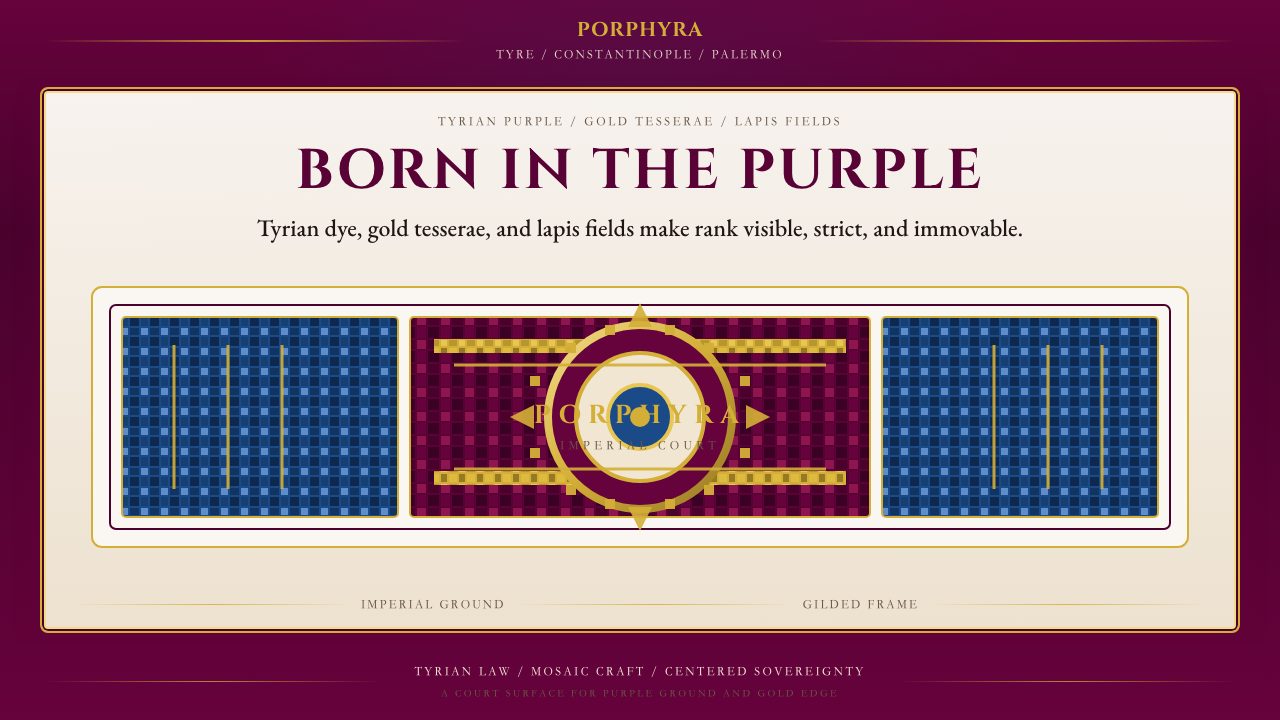 Byzantine Tyrian Purple (Imperial Court)Imperial rank made visible. Tyrian purple, gold tesserae, and centered symmet…
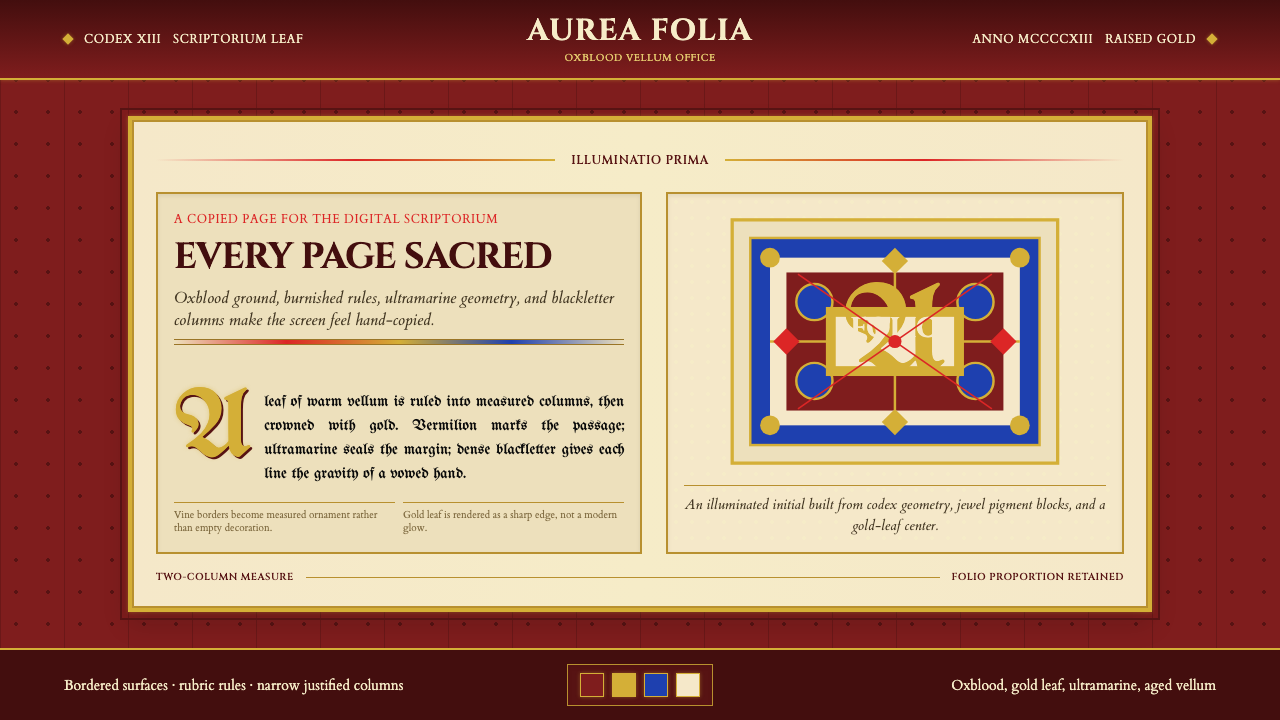 Medieval Illuminated ManuscriptTreats every page as sacred. Oxblood vellum, Cinzel capitals, gold-rule borde…
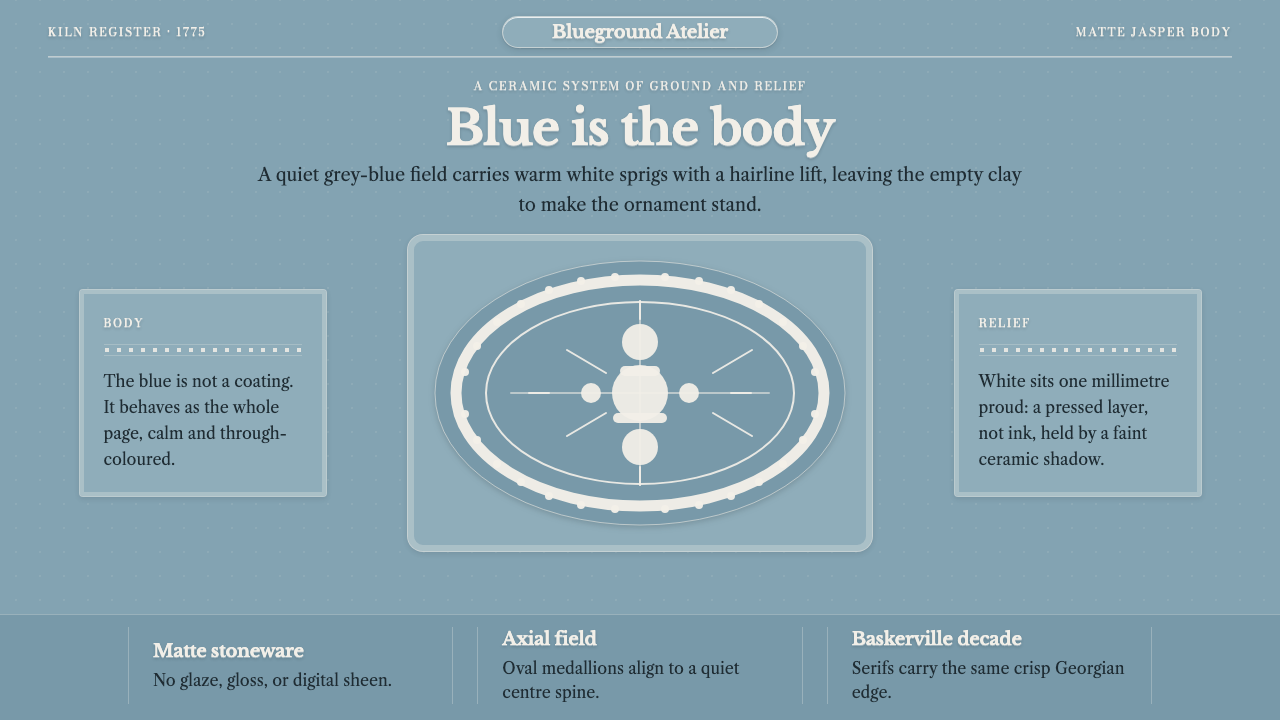 Wedgwood JasperwareMatte authority. Blue-grey clay ground carries raised white Baskerville relie…
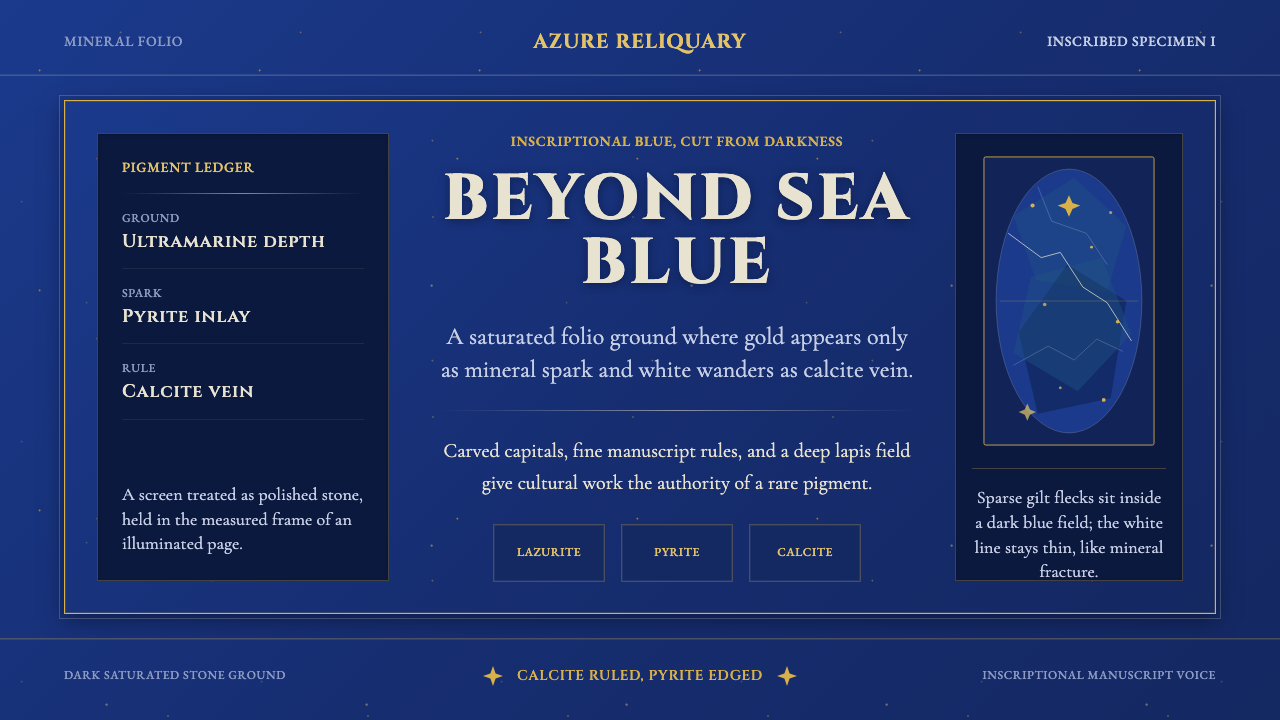 Badakhshan Lapis LazuliStone as manuscript. Ultramarine field, pyrite flecks, calcite veins, carved…
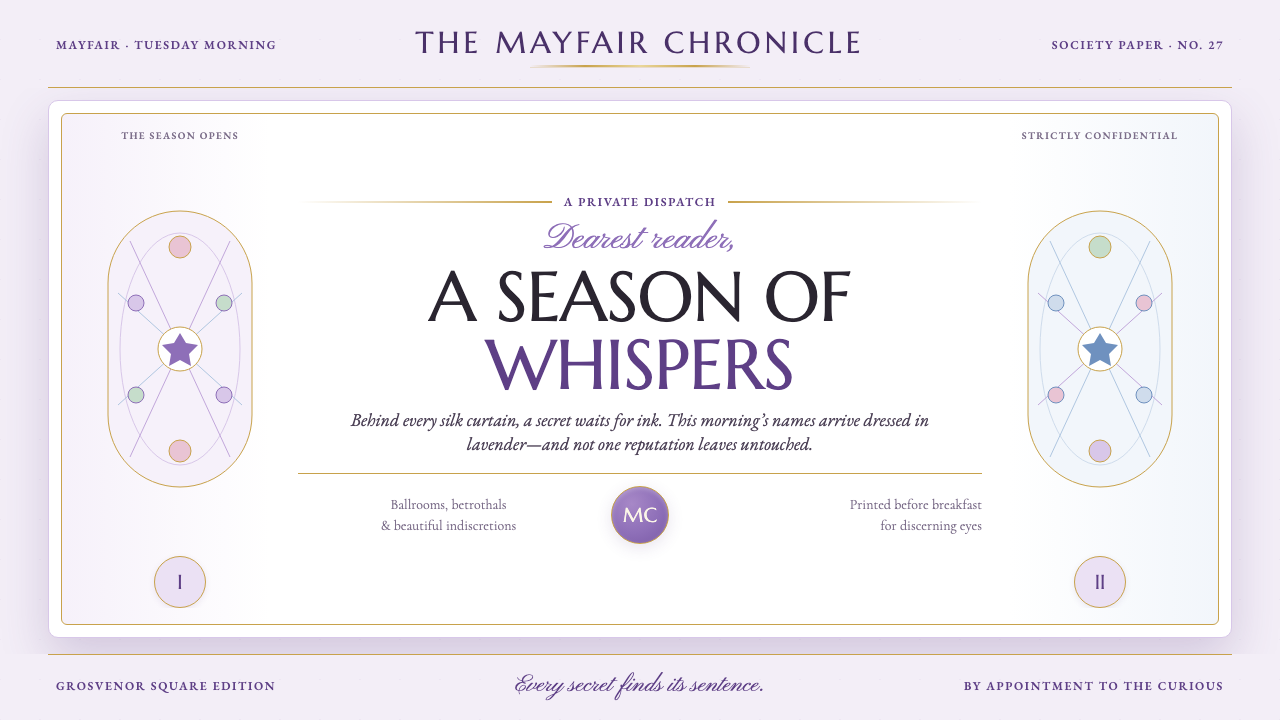 Bridgerton Regency (2020)Scandal wears lavender. Wisteria pastels and gilt rules frame a sharp letterp…
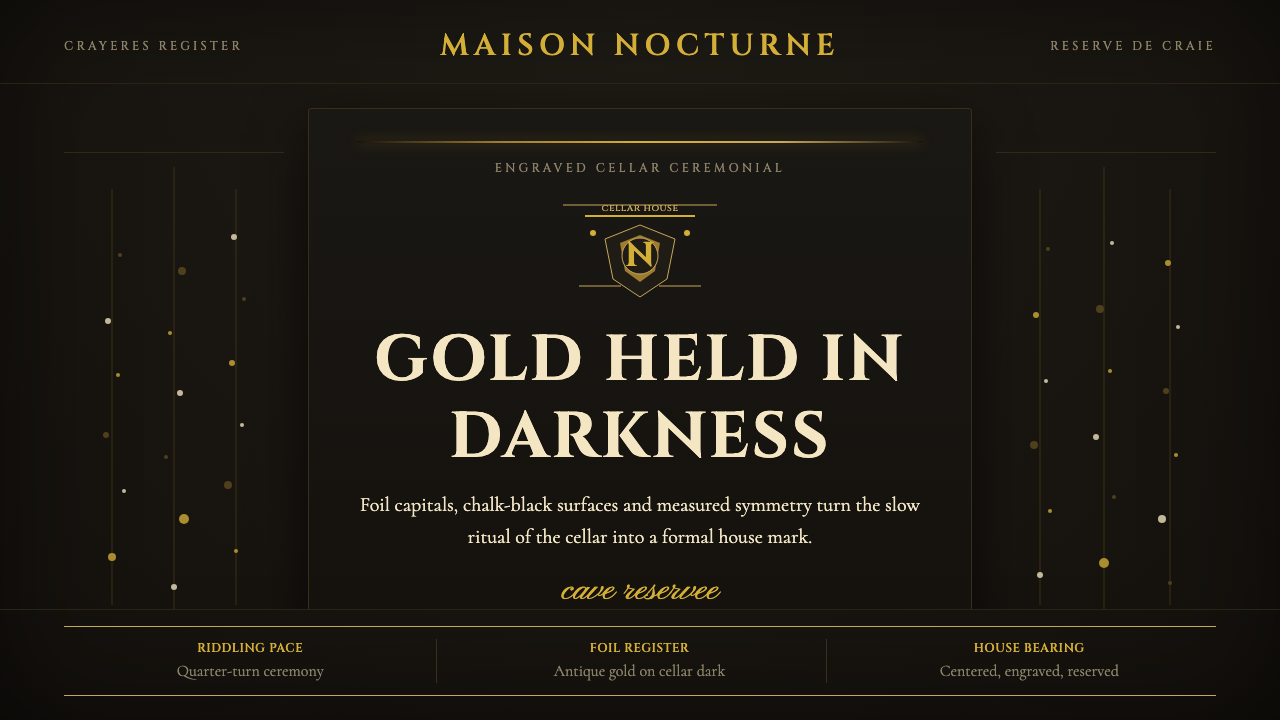 Champagne MaisonGrandeur without glitter. Cinzel capitals and gold foil rules glow in cellar…