What is Medieval Illuminated Manuscript?
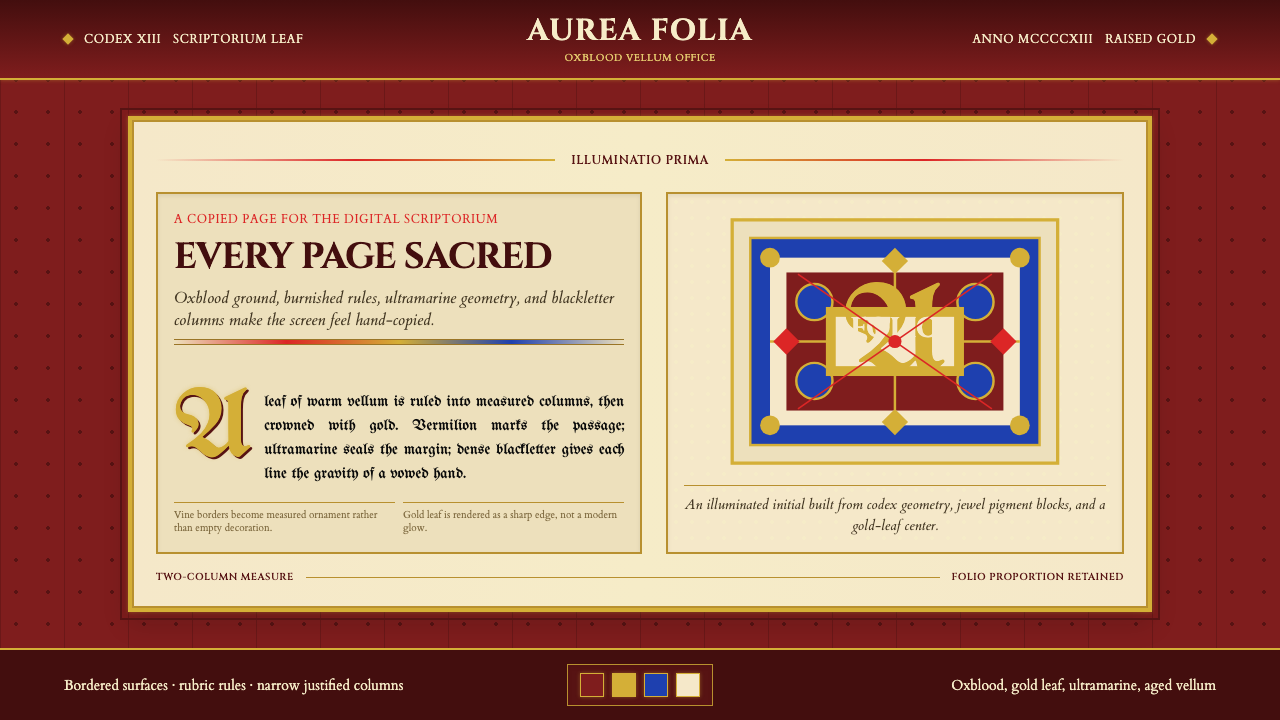
From the Book of Kells to the Très Riches Heures, medieval illuminated manuscripts treated every page as a sacred object — gold leaf, ground lapis, and blackletter script fused into the most labor-intensive book art the world has ever produced.
Medieval Illuminated Manuscript in brief
Medieval illuminated manuscripts are hand-produced books — principally religious texts, Books of Hours, bestiaries, and chronicles — whose pages were adorned with pigments of extraordinary richness: gold and silver leaf, lapis lazuli ground to an intense ultramarine, vermilion extracted from cinnabar, and verdant copper-based greens. The word 'illuminated' refers literally to the way gold leaf catches candlelight, making a page appear to radiate its own inner glow. These were not decorative afterthoughts; the visual program of a manuscript was as theologically intentional as its text.
The aesthetic is immediately recognizable. Intricate interlace borders — knotwork patterns of zoomorphic creatures, vines, and geometric ribbons — frame text columns set in dense, compressed blackletter script. Miniature narrative paintings occupy historiated initials and full-page panels. Grounds are rich and saturated: deep oxblood crimson, burnished gold, and night-blue ultramarine dominate. Every surface is treated as space to be filled and honored — negative space as a concept did not exist in this tradition. Hierarchy was communicated through scale, color intensity, and the density of gold application rather than through emptiness.
Because a single elaborately decorated folio could require a month of a trained illuminator's labor, manuscripts of this kind were among the most expensive objects in the medieval world. Commissions came from royalty, high clergy, and wealthy lay patrons who understood that the visual splendor of a devotional book was itself an act of piety — an offering of the finest materials and the most skilled craft to the glory of God or the commemoration of the powerful dead.

Where does Medieval Illuminated Manuscript come from?
The tradition of decorating manuscripts with pigment and precious metal stretches back to late antiquity, but the form we recognize as illuminated manuscript art reached its first flowering in the monastic scriptoria of Ireland and Northumbria during the 7th and 8th centuries. The Book of Kells — produced around 800, likely at the monastery of Iona before being brought to Kells in Ireland — represents the apex of this Insular tradition. Its carpet pages, full-page compositions of interlaced knotwork of almost hallucinatory complexity, show no precedent in Mediterranean book arts; they derive from metalwork traditions of the Celtic and Germanic peoples translated into an ink-and-pigment medium.
The Lindisfarne Gospels, produced on the tidal island of Lindisfarne off the Northumbrian coast around 715–720 and attributed to the monk Eadfrith, demonstrate the same Insular ambition at a slightly earlier moment. Eadfrith worked alone, producing a book in which each evangelist portrait, each decorated incipit page, and each cross-carpet page represents a distinct visual program — a total of some 259 folios, of which the illuminated pages still astonish conservators who examine them under magnification and find no evidence of underdrawing, suggesting the patterns were executed directly and with total command.
The Carolingian Renaissance of the late 8th and early 9th centuries brought a different sensibility to manuscript production. Under Charlemagne and his successors, the court scriptoria at Aachen, Tours, and Reims produced books that fused the Insular interlace tradition with figural representation drawn from late Roman models — producing a new visual synthesis in which classical architectural frames enclose figures that move with some of the weight and gesture of late antique painting. This Carolingian synthesis would feed directly into the Romanesque manuscript tradition of the 11th and 12th centuries.
The Gothic period — roughly the 13th through 15th centuries — saw illuminated manuscript production shift from monastic workshops to urban commercial ateliers employing specialist craftspeople: parchment makers, scribes, rubricators, illuminators of borders, illuminators of miniatures, and gilders, each working on separate campaigns that were later assembled into a single book. The Très Riches Heures du Duc de Berry, commissioned by John, Duke of Berry around 1413 and executed primarily by the Limbourg brothers, represents the summit of International Gothic illumination. Its calendar miniatures depicting the months of the year — peasants laboring in winter fields, aristocrats hawking against summer skies — brought a new naturalism and depth of observation to a tradition that had previously privileged symbolic over representational concerns. The introduction of printing by Gutenberg around 1450 did not immediately end manuscript production; luxury illuminated manuscripts continued to be commissioned well into the early 16th century, when the printed book finally displaced them entirely.
What defines the Medieval Illuminated Manuscript look?
Color
The palette is built from pigments of extraordinary material value: lapis lazuli ground to a deep, luminous ultramarine that no synthetic pigment has fully replicated; vermilion of a warm, slightly orange red; verdigris and malachite-based greens; lead white; and lamp black. These are deployed against grounds of oxblood crimson, burnished gold, or the natural cream of prepared vellum. The color relationships are saturated and jewel-like — there are no neutrals, no muted tones, no deliberate understatement. Every hue is used at its most intense, because these pages were meant to overwhelm the viewer with the evidence of costly material devotion.
Gold Leaf and Gilding
Gold is not merely a color in illuminated manuscripts — it is a theological statement. Applied as beaten leaf over a raised gesso ground, gold in a manuscript catches and redirects light, creating an effect that is physically different from any painted yellow: it moves as the reader moves, it shines in candlelight, and it signals the divine or the celestial in a way that paint cannot approximate. The quantity of gold used — in borders, in backgrounds, in the halos of saints, in the decorated initials — was a primary measure of a manuscript's value and the patron's devotion.
Interlace and Zoomorphic Ornament
The most distinctive ornamental system of the Insular tradition is interlace: continuous ribbon-like bands that weave over and under each other in patterns of almost impossible geometric regularity. In the most complex examples — carpet pages from the Book of Kells or the Lindisfarne Gospels — a single page may contain thousands of individually drawn ribbon segments, each following the over-under rule without a single error visible to the naked eye. Zoomorphic interlace takes the additional step of making the ribbons into elongated animal bodies: birds with extended necks, serpents biting their own tails, dogs whose limbs dissolve into knotwork. These patterns were understood as symbolic — unending, self-referential form signifying the infinite and the divine.
Blackletter Script and Hierarchy of Script
The scripts of illuminated manuscripts are themselves visual elements as much as linguistic ones. The formal Carolingian minuscule and its Gothic successors — textualis, rotunda — are scripts of exceptional consistency and density: each letterform is constructed from a small set of strokes repeated with metronomic regularity, producing a page of text that has a strong visual texture, almost like woven fabric. Within a single manuscript, multiple scripts of different formality levels might appear: the most ceremonial hand for liturgical text, a smaller and quicker hand for glosses and commentary, red rubrics marking divisions. This hierarchy of scripts communicates a layered reading experience before the reader has processed a single word.
Historiated Initials and Miniature Painting
Among the most technically demanding features of illuminated manuscripts are historiated initials — decorated letters whose interior spaces contain narrative scenes painted at a scale of sometimes only a few centimeters. The skill required is extraordinary: painters worked with single-hair brushes, their pigments mixed to precise consistencies, producing faces, drapery, and architectural backgrounds in spaces no larger than a thumbnail. Full-page miniatures — independent paintings occupying an entire folio — are painted with an equally fine touch, though at a scale that allows for more compositional ambition. The spatial conventions of these miniatures differ sharply from post-Renaissance painting: figures are hierarchically scaled, not perspectivally proportioned; backgrounds are gold or flat color rather than receding space.
Border Ornament and Total Surface Coverage
In the most elaborate manuscripts, every margin is filled: vine-scroll borders carry birds, snails, hybrid creatures, grotesque faces, and tiny genre scenes that comment — sometimes satirically — on the main text. This principle of horror vacui, the filling of all available surface, distinguishes illuminated manuscript aesthetics from nearly every other design tradition. There is no concept of white space as rest or breathing room; every empty area is an opportunity for ornament. The viewer's eye moves continuously across the page, never settling, always finding new detail. This all-over surface activation is one of the most challenging qualities to translate into digital work without producing visual chaos.
Vellum Ground and Material Presence
The physical substrate of a manuscript — vellum prepared from calf, sheep, or goat skin — is not neutral. It has a warm cream or ivory tone, a slight translucency when held to light, and a surface that accepts pigment and gold differently from paper. In design work drawing on this tradition, the material quality of the ground matters: a warm off-white or parchment tone rather than a cold clean white; a surface that feels weighted and precious rather than airy and frictionless. The sense of density and physical presence — the feeling that each page is an object, not a surface — is one of the tradition's most powerful atmospheric qualities.

Who shaped Medieval Illuminated Manuscript?
Eadfrith became Bishop of Lindisfarne in 698 and is credited by the 10th-century Aldred colophon as the sole creator of the Lindisfarne Gospels, though modern scholarship debates how much of the execution one person could have completed. The book's carpet pages — each a unique geometric and zoomorphic program — suggest not only extraordinary technical skill but a systematic visual intelligence that had internalized the full repertoire of Insular knotwork and could invent within it. Eadfrith represents the monastic illuminator at his most self-sufficient: theologian, scribe, and painter in one person.
Pol, Herman, and Johan Limbourg — three brothers from Nijmegen in present-day Netherlands — worked for John, Duke of Berry from around 1405 until their deaths, likely from plague, in 1416. Their masterwork, the Très Riches Heures, remained unfinished at their deaths and at the Duke's death the following year, and was completed by other hands decades later. The Limbourgs brought to manuscript illumination a new attention to observed reality: their calendar miniatures contain accurate depictions of specific chateaux, identifiable constellations, and agricultural practices rendered with an ethnographic precision that has made the manuscript a primary source for historians of medieval material culture. Their figure painting shows awareness of Italian panel painting — particularly the spatial innovations of Siena — absorbed and fused with the jewel-like surface brilliance of the northern tradition.
The Book of Kells was produced by an unknown number of artists — modern codicological analysis has identified at least four distinct illuminating hands — working probably at the monastery of Iona on the western coast of Scotland, with the book then brought to the monastery of Kells in County Meath after Viking raids on Iona in the early 9th century. These artists, whose names are entirely lost, produced the most complex ornamental program in the history of Western book art. The Chi-Rho page alone — a monogram of Christ's name — contains interlace, zoomorphic ornament, and hidden figurative detail at a density that rewards microscopic examination: angels, otters, cats, and a human face have been identified by scholars in passages that read as pure abstract pattern to the casual eye.
Jean Pucelle was the leading Parisian illuminator of the early 14th century, active roughly between 1310 and 1334. His work in the Book of Hours of Jeanne d'Evreux — a tiny book painted almost entirely in grisaille, a monochromatic grey technique that simulates the appearance of carved ivory — introduced Parisian illumination to the spatial ideas of Italian painting, particularly the architecturally framed interiors of Duccio and Giotto. Pucelle's drolleries — the small grotesque creatures and hybrid figures that populate the borders of his manuscripts — are among the most inventive in the French Gothic tradition, and his integration of marginalia into coherent visual programs that relate to the main text established a standard that later Parisian workshops would follow for generations.
The anonymous illuminator known as the Master of the Rohan Hours — named for the Rohan family who owned the manuscript — was active in Paris and possibly Angers in the early 15th century. His style is the most emotionally extreme in the history of French illumination: figures are elongated, angular, and painted with an expressionistic energy that anticipates later Northern European traditions. His full-page miniature of the Dead Man before God — a skeletal figure lying beneath a vast divine presence — is among the most psychologically intense images produced in the manuscript tradition, combining gold-ground formality with a rawness of emotion that sits entirely outside the courtly refinement of his contemporaries the Limbourg brothers.
How do you use Medieval Illuminated Manuscript today?
Applying the illuminated manuscript aesthetic to contemporary design requires understanding what made the originals visually overwhelming — and being selective about which qualities to translate. The full medieval program, applied wholesale, produces visual noise rather than visual richness: every surface covered, every color at maximum saturation, borders competing with content for attention. Successful contemporary applications identify one or two key qualities — the jewel-toned palette, the gold-leaf accent, the interlace border motif, the blackletter typographic weight — and commit to those while exercising restraint everywhere else.
For presentation slides, the manuscript aesthetic works best as a theatrical device. A cover slide can carry the full visual weight: a rich oxblood or ultramarine ground, a single large ornamental motif or border element, a title set in a formal blackletter-influenced typeface, and a restrained gold accent. Content slides should immediately simplify — one key color from the palette used as an accent, a generous ground that reads as parchment-warm rather than cold white, and typographic hierarchy defined by weight and size alone. Data slides in this style work when charts and diagrams are treated as ornamental objects: a bar chart whose bars are filled in the manuscript palette, perhaps with a thin gold rule as axis line, reads as intentional and considered rather than decorated.
For web interfaces, the manuscript palette and surface richness suit editorial-forward contexts: literary publications, museum collection pages, cultural heritage platforms, premium brand storytelling, and any interface where slowing the reader down is a feature rather than a problem. A dashboard in this style sets a warm parchment-tone background, uses deep oxblood or ultramarine for primary navigation and headers, and applies gold sparingly — as hover states, as decorative rules, as the active indicator in a tab system. Pricing pages can use a tiered architecture where the premium tier is distinguished not by a highlighted border in the conventional sense but by a full gold or deep-color ground that signals material value directly.
For editorial and marketing work, the style supports a sense of occasion and cultural weight that few other aesthetics can match. A magazine feature spread using this vocabulary might open with a full-bleed page in deep ultramarine, set the article title in a letterform with calligraphic weight, and use a narrow interlace border element as a running header marker. Marketing campaigns built on this aesthetic signal exclusivity, craft, and timelessness — appropriate for heritage brands, premium cultural institutions, and any product positioning itself against the disposability of contemporary mass-market design. Social card formats work well with a single dominant color ground, a central image or typographic statement, and a thin ornamental border as the primary compositional frame.
A common mistake when working with this aesthetic is confusing richness with legibility. Medieval illuminators could afford to fill every surface because their audience was small, trained, and devotionally motivated — they would spend an hour with a single page. Contemporary audiences are scanning, not studying. The practical rule: keep the full ornamental density for images, covers, and moments of emphasis, but strip the interior of working content pages back to one or two palette colors, generous spacing, and a single typographic hierarchy. The manuscript tradition's greatest lesson for contemporary design is not its density but its conviction — the sense that every visual decision was intentional, considered, and made to honor the material and the reader alike.

Medieval Illuminated Manuscript — FAQ
Is this aesthetic appropriate for digital-first products, or does it only work in print?
It works in digital contexts when applied with restraint. The key challenge is that manuscript richness depends on material qualities — the physical weight of vellum, the movement of gold leaf in light — that digital screens approximate but cannot replicate. Digital work in this aesthetic succeeds when it captures the color relationships (deep jewel tones, warm parchment grounds) and the compositional logic (all-over surface intention, hierarchical scale) rather than trying to simulate the physical materials through texture overlays or fake parchment effects, which tend to read as costume rather than conviction.
How do you balance the tradition's density with modern readability requirements?
By treating density as a foreground tool rather than a ground condition. In original manuscripts, density was everywhere because the devotional experience was the point and time was not a constraint. In contemporary work, density should appear where you want to signal importance, occasion, or visual arrest — covers, hero sections, chapter openers, special callouts — while the working body of the content uses the palette and typographic weight of the tradition but with modern spacing logic. The ornamental border, for instance, can frame a section header without filling the entire page margin.
Can the manuscript style work for secular or commercial brands, or does it feel exclusively religious?
The religious origin does not limit contemporary application. What the tradition communicates is not theology but a set of values: extreme craft, material richness, the sense that what is being presented is worth sustained attention and is irreplaceable. These are values that translate directly to heritage luxury brands, cultural institutions, premium publishing, and any brand positioning itself as handmade, rare, or historically grounded. The aesthetic would be out of place for a mass-market consumer product, but not because it is religious — because it communicates scarcity and deliberateness that contradicts mass-market positioning.
What is the single most common mistake when applying this aesthetic?
Reaching for a faux-parchment texture as the first move. Texture overlays — simulated aging, vellum grain, ink bleed — are the design equivalent of a costume: they signal the style without embodying its logic. Authentic manuscript aesthetics is not primarily a texture system; it is a color system, a hierarchy system, and an attitude toward surface coverage. Getting the palette right — the specific warmth of an oxblood ground, the depth of an ultramarine, the weight of gold used as accent rather than fill — does more work than any texture overlay. Apply the texture last, if at all, and only to elements where material presence is the specific point.
How does this style relate to other ornate historical aesthetics like Art Nouveau or Victorian decorative design?
All three traditions share a commitment to surface decoration and a rejection of plain functionalism, but their ornamental logics are distinct. Art Nouveau derives its forms from organic nature — flowing plant stems, insect wings, the female figure — and uses continuous curved line as its primary generator. Victorian decorative design accumulates historical references eclectically, mixing Gothic, Moorish, Renaissance, and classical motifs in a single object. Illuminated manuscript ornament, by contrast, is geometrically generated: interlace follows strict mathematical rules, and even the zoomorphic elements are built from the same ribbon logic as the abstract knotwork. If Art Nouveau is lyrical and Victorian is encyclopedic, manuscript ornament is architectural — a system of rules generating infinite variation.
Related design styles
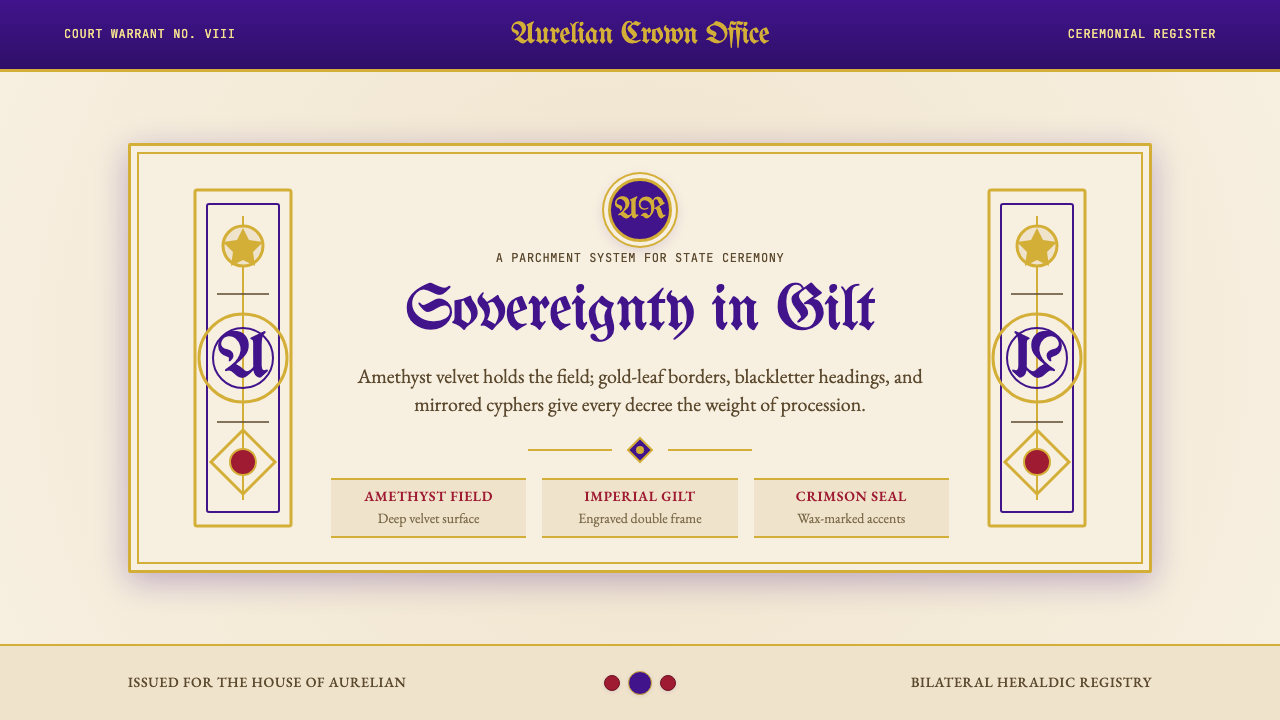 British Royal MonarchyCeremony becomes structure. Amethyst panels, gilt borders, blackletter, mirro…
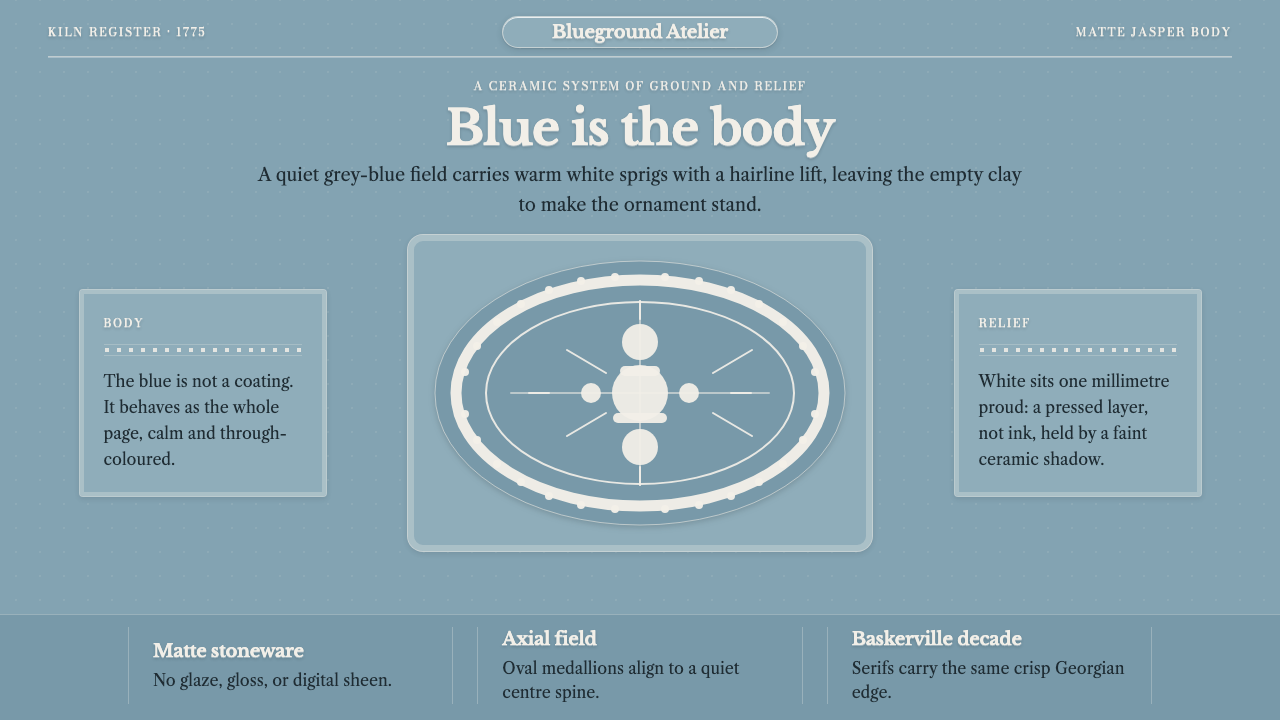 Wedgwood JasperwareMatte authority. Blue-grey clay ground carries raised white Baskerville relie…
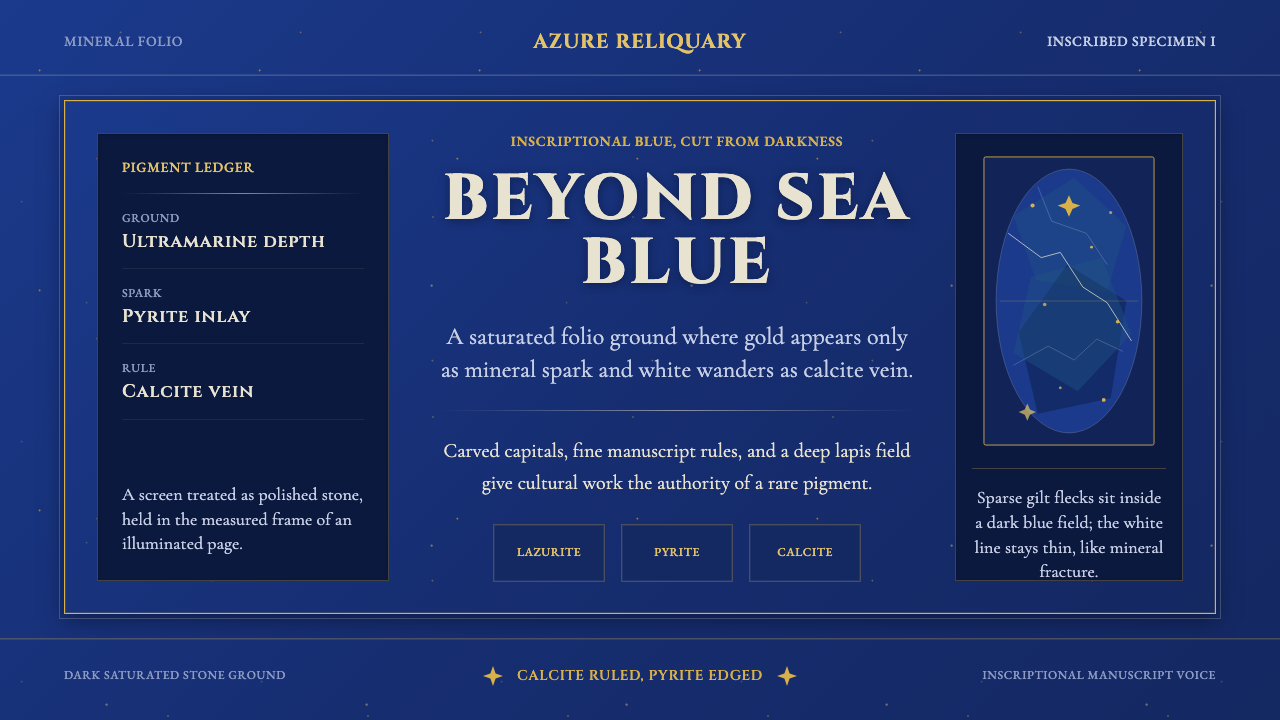 Badakhshan Lapis LazuliStone as manuscript. Ultramarine field, pyrite flecks, calcite veins, carved…
 Byzantine Tyrian Purple (Imperial Court)Imperial rank made visible. Tyrian purple, gold tesserae, and centered symmet…
 Champagne MaisonGrandeur without glitter. Cinzel capitals and gold foil rules glow in cellar…
 Naskh Quranic (1500)Reverence in every stroke. Ivory parchment, gold rosettes, and lapis framing.