What is Saudi Thuluth Calligraphy?
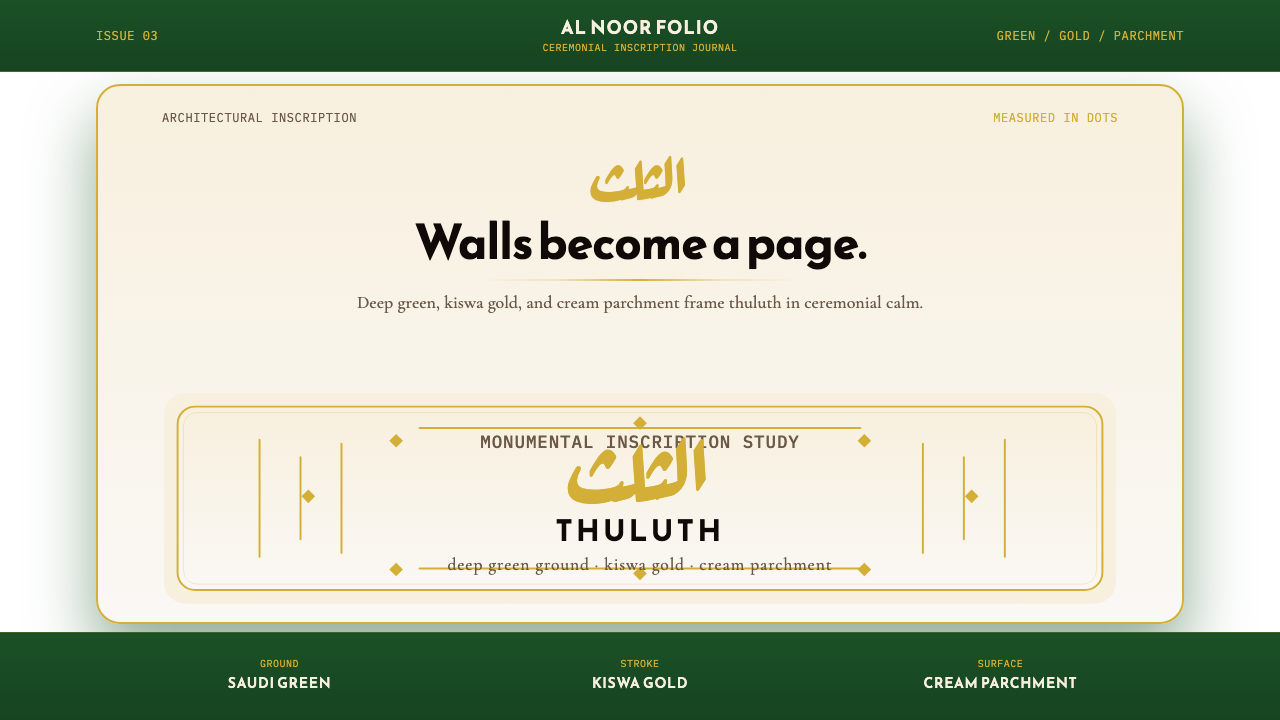
Saudi Thuluth Calligraphy transforms language into architecture — monumental strokes, sacred symmetry, and the deep green and imperial gold of a civilization that made scripture into design.
Saudi Thuluth Calligraphy in brief
Thuluth is the great display script of the Islamic world — a calligraphic tradition in which each letter rises two to three times the height of the more common Naskh hand, with sweeping ascenders, elaborate interlocking forms, and decorative flourishes that transform a single word into a composition. The name derives from the Arabic for 'one third', referring to the proportion of the reed pen's cut that governs the stroke weight relative to the letter body. This proportional discipline, established by master calligraphers in Baghdad around the tenth century, is what gives Thuluth its characteristic combination of grandeur and precision.
The Saudi state application of Thuluth draws on three visual anchors: the deep emerald green of the national flag, the warm imperial gold associated with the Kaaba's embroidered kiswa, and a cream parchment tone that functions as the reading surface. Together these three tones produce a palette that signals both religious sanctity and national authority — a design language of sacred grandeur that is simultaneously ornamental and institutional.
The result is a visual system unlike any in the global design canon. Where most display traditions choose between decoration and authority, Saudi Thuluth insists on both. The letters are genuinely complex — overlapping, stacked, and interwoven — yet the overall composition reads with commanding clarity because every elaborate element is in perfect symmetrical relation to the others. Understanding this style means understanding that ornament here is not added to structure: ornament is the structure.

Where does Saudi Thuluth Calligraphy come from?
The script known as Thuluth was codified in Baghdad around 940 CE by the vizier and calligrapher Ibn Muqla, who developed the first geometric theory of Arabic letterforms. Ibn Muqla's method — based on a rhombic dot unit derived from the pen's cut — established a proportional system in which every letter's height, width, and curvature could be expressed as a precise multiple of that foundational unit. This was not merely an aesthetic innovation; it was the creation of a grammar, a set of rules rigorous enough to be taught, standardized, and judged. Thuluth emerged as the grandest of the scripts legible under Ibn Muqla's system, reserved for monumental inscriptions on mosque facades, Quranic manuscripts of ceremonial importance, and official court documents.
The tradition was advanced and refined across centuries. In thirteenth-century Baghdad, Yaqut al-Musta'simi — court calligrapher to the last Abbasid caliph — introduced a beveled cut to the reed pen that produced softer, more curved letterforms with richer tonal variation within a single stroke. His revision is considered the pivotal refinement that transformed Thuluth from a formal script into a true art form. The tradition then spread outward along trade and pilgrimage routes: Damascus, Cairo, and Istanbul each became major centers of calligraphic culture, and Ottoman Turkey in particular elevated the script to a state art form, with Sheikh Hamdullah and later Hafiz Osman setting the canonical standards that subsequent generations studied and emulated.
The encounter between this long-established calligraphic tradition and the modern Saudi state created a specific and distinctive visual language. When the Kingdom of Saudi Arabia was formally unified in 1932, the new state required a visual identity that could express both Islamic legitimacy and national sovereignty — Thuluth, as the script most associated with sacred inscription and royal decree, became the natural vehicle. The deep green of the national flag, derived from Islamic symbolic tradition, was paired with the gold associated with the Kaaba's kiswa, the embroidered black cloth that covers the sacred structure in Mecca and whose golden calligraphic bands of Quranic text are among the most recognized images in the Islamic world.
The twentieth century brought calligraphers who worked at the intersection of traditional mastery and modern institutional design. Mohamed Abdul Qadir and his contemporaries adapted classical Thuluth letterforms for use in contexts that earlier generations could not have imagined: state emblems, banknotes, official signage, broadcast typography, and eventually digital screen environments. This adaptation required decisions about which aspects of the tradition were essential — the proportional logic, the weight relationships, the compositional symmetry — and which were contingent on hand-production in ways that could be translated without loss into new media. The result is a living tradition: technically demanding, rigorously governed, and actively evolving in contemporary Saudi cultural and institutional life.
What defines the Saudi Thuluth Calligraphy look?
Color Palette
The palette is built on three tones of historical and symbolic specificity: deep emerald green, warm imperial gold, and cream parchment. The green carries the weight of national and religious identity — it is the green of the Saudi flag and of the Islamic symbolic tradition more broadly. The gold references the Kaaba's kiswa, the embroidered cloth covering that has used gold calligraphic banding for centuries. Cream functions as the neutral reading surface that allows both gold and green to assert their full visual weight without collision. Black appears as a fourth element, used for structural lines and fine detail within letterforms.
Letterform Scale and Proportion
Thuluth letters are governed by a proportional system in which every dimension — stroke weight, ascender height, the depth of curves — derives from a single foundational unit: the rhombic dot formed by the reed pen's angled tip. In practice, this means that letters are substantially larger relative to their stroke weight than in most other scripts, producing a kind of monumental spaciousness within each character. The vertical ascenders of letters like alif and lam extend dramatically above the body line, creating a rhythmic alternation of height that gives Thuluth compositions their characteristic skyline quality.
Symmetry and Compositional Structure
Thuluth compositions, particularly in their Saudi institutional form, are organized around strong bilateral symmetry. A phrase or title is arranged so that its visual mass is balanced left and right around a central vertical axis, with the most elaborate letterforms positioned at the extremities and the central letters serving as anchors. This symmetry does not produce static equality — the composition is alive with rhythmic variation in ascender height and the interplay of curved and straight strokes — but it creates a sense of formal completeness and authority that is immediately legible as monumental.
Interlocking and Stacking
One of Thuluth's most distinctive technical features is the practice of stacking letters vertically and interlocking them horizontally to achieve visual density and compositional unity within a constrained space. Where a simpler script would spread a phrase across a wide horizontal band, Thuluth contracts that phrase into a tighter, more compact mass by nesting shorter letters beneath longer ones, threading the curved terminals of one letter through the open space of another, and layering secondary words above or below the main line. This creates compositions of remarkable visual richness that read as unified objects rather than sequences of characters.
Stroke Calligraphy and Weight Variation
The reed pen held at a consistent angle produces dramatic variation in stroke weight within a single letterform: the broad stroke cut perpendicular to the pen's direction is thick and authoritative, while the stroke running parallel to the cut is a hairline of near-invisibility. This modulation — which no mechanical typeface can fully replicate — is what gives Thuluth its visual energy at close range. The thick-to-thin transitions within each letter create a sense of controlled velocity, as though the stroke is accelerating through its curve. In digital and print applications that seek to honor this quality, the letterforms must be drawn or selected to preserve this weight contrast rather than standardizing to a uniform stroke.
Decorative Flourishes and Diacritics
Thuluth is the most ornamental of the classical Arabic scripts in its canonical form, and decorative flourishes are not optional additions but structural components of the visual system. Extended terminals sweep into wide arcs; short descender vowels are positioned with as much care as the letters themselves; and the interplay between the primary letterforms and secondary diacritical marks — the short vowel signs, the shadda and sukun — creates a visual texture of controlled complexity. In Saudi institutional applications, this ornamental richness is retained rather than simplified, because it is precisely the complexity that communicates the seriousness and legitimacy of the content.
Sacred and Monumental Register
Beyond its technical characteristics, Saudi Thuluth Calligraphy operates in a register of meaning that is inseparable from its visual form. The script carries associations with the Quran, with royal decree, with architectural inscription in the holiest sites of the Islamic world. This means that applications of the style inherit these associations whether intended or not — the style cannot be made casually ironic or purely decorative without disturbing its semantic weight. Used correctly, this association is an asset: no other visual system conveys the same combination of religious gravity, national identity, and aesthetic grandeur. Used carelessly, it risks appearing either appropriative or trivializing.

Who shaped Saudi Thuluth Calligraphy?
Ibn Muqla served as vizier to three Abbasid caliphs and is credited with creating the first geometric theory of Arabic calligraphy — a proportional system based on the rhombic dot that made it possible to teach, standardize, and judge letterforms against an objective measure for the first time. Before Ibn Muqla, Arabic scripts were transmitted through informal apprenticeship with no consistent proportional framework. His codification elevated calligraphy from a skilled craft to a codified discipline, and the scripts he governed — including Thuluth — became the basis for all subsequent classical Arabic calligraphic tradition.
Yaqut served as court calligrapher to the last Abbasid caliph in Baghdad and is credited with a technical refinement that reshaped Thuluth permanently: he cut the reed pen at an angle rather than straight across, producing a beveled tip that allowed for softer curves, greater stroke-weight variation within a single letter, and a quality of fluid movement that earlier pens could not achieve. He survived the Mongol sack of Baghdad in 1258, and his work in the decades afterward is credited with preserving and transmitting the classical tradition through the destruction of its primary cultural center. He is often described as the master who completed what Ibn Muqla began.
Sheikh Hamdullah is the figure most responsible for establishing Thuluth as a canonical Ottoman state art form. Working in Istanbul under the patronage of Sultan Bayezid II, he synthesized the earlier Iraqi and Egyptian Thuluth traditions and developed the clean, generous, highly refined letterforms that subsequent Ottoman calligraphers would study as the standard for nearly five centuries. His approach emphasized clarity within complexity — letters that are individually elaborate but collectively organized with a sense of inevitable rightness. The Ottoman canonization of his style meant that copies of his work were produced and circulated as models throughout the Islamic world, creating a shared aesthetic standard from Istanbul to Cairo to the Hijaz.
Mohamed Abdul Qadir represents the generation of Saudi and Arab calligraphers who faced the challenge of adapting the classical Thuluth tradition to the demands of modern institutional design — state emblems, printed currency, official signage, and broadcast media. Working in an era when the choice between hand-lettering and mechanical type was becoming urgent, Abdul Qadir and his contemporaries made critical decisions about which aspects of classical Thuluth were non-negotiable (the proportional logic, the specific weight relationships between thin and thick strokes, the symmetrical compositional structure) and which could be adapted to new production methods without loss of essential character. His work informs the way contemporary Saudi institutional typography reads today.
The kiswa — the embroidered black cloth that covers the Kaaba in Mecca and is replaced annually — carries bands of Quranic text worked in gold-wrapped thread, and the calligraphers responsible for designing those letterforms occupy a unique position in the history of Thuluth. Because the kiswa is the most viewed and most reproduced piece of Arabic calligraphy in the world, its letterforms function as a de facto standard for monumental Thuluth, setting expectations for weight, curvature, and proportion that influence Saudi institutional typography and the broader visual culture of the Islamic world. The calligraphers who have worked on the kiswa across generations remain among the most consequential practitioners of the tradition, even when their individual names are less widely known than those of historical masters.
How do you use Saudi Thuluth Calligraphy today?
Saudi Thuluth Calligraphy is a style of exceptional specificity — it carries deeply established cultural and religious associations that shape how every application will be received. Applying it effectively requires understanding not just the visual system but the contexts in which that visual system will be read. Used in appropriate contexts — cultural institutions, governmental or diplomatic communications, ceremonial and commemorative materials, publications addressing the Islamic world or Middle Eastern heritage — it is among the most powerful and distinctive design languages available. The first step is always to confirm that the context warrants the style's weight.
For presentation slides, the style works best in contexts of institutional gravity or cultural celebration. A cover slide built on this system places the title in symmetrically composed Thuluth letterforms against the deep green ground, with gold used for the display typography and cream for any secondary text. The composition should be centered and formally balanced — asymmetric Bauhaus-style tension is antithetical to Thuluth's aesthetic logic. Content slides should follow a similar restraint: generous margins, one strong typographic hierarchy, and the palette used at full saturation only for the most important elements. Data slides can take a diagrammatic quality where charts and visual elements are treated as geometric compositions on a parchment-toned field, with the deep green reserved for primary data series.
For web interfaces, the style is best suited to contexts where ceremonial dignity is an asset rather than a barrier: cultural heritage platforms, institutional landing pages, event microsites for religious or national occasions, and editorial publications addressing history and identity. Dashboard and pricing contexts are typically a poor fit — the style's ornamental richness works against the scannability that data-dense interfaces require. Where it is applied to web UI, the approach should favor restraint: the calligraphic elements as focal points, the palette as the primary system-wide signal, and the body content set in a complementary clean typeface rather than attempting to extend the calligraphic register into functional text.
For editorial and marketing work, the style supports strong single-image or full-spread compositions where the calligraphic element is treated as both typography and illustration simultaneously — the headline is the artwork. Book covers, cultural event posters, commemorative publications, and editorial spreads in publications addressing Islamic culture or Saudi heritage all benefit from the style's combination of visual richness and legible authority. In marketing contexts, the style works well for brands seeking to position themselves within Saudi national identity or Islamic cultural heritage, but requires sensitivity: the visual system's associations are not neutral branding choices but carry meaning that audiences will read carefully.
A common mistake when applying this style is treating the calligraphic element as decorative overlay on an otherwise standard layout — a Thuluth title above a generic content grid, for instance. This approach creates a visual dissonance between the ceremonial register of the calligraphy and the ordinary register of everything around it, and the result reads as superficial rather than authoritative. The style works when the entire composition — color, proportion, spacing, the relationship between typographic and empty space — is organized around the same logic as the calligraphy itself. Another frequent error is reducing the palette by substituting approximate equivalents for the specific tones the system depends on: a bright lime green is not the deep national flag green, and a pale yellow is not imperial gold. The symbolic weight of the palette is inseparable from the accuracy of its tones.

Saudi Thuluth Calligraphy — FAQ
Can this style be used by non-Muslim or non-Saudi designers and brands?
Yes, but with care and cultural awareness. The style is not exclusive to Muslim or Saudi practitioners — it has been applied globally in the contexts of Islamic cultural institutions, international diplomacy, tourism, and cultural exchange. The key consideration is intent and context: applications that engage seriously with the tradition — that use it to communicate about Islamic heritage, Saudi culture, or the calligraphic tradition itself — are generally received differently from applications that use the visual surface without acknowledging its cultural depth. The style is not simply a font choice; it is a cultural statement, and it will be read as one.
How does Thuluth work in bilingual Arabic-English layouts?
Bilingual layouts pairing Thuluth with Latin text require careful attention to visual register. Thuluth is a display-weight, ceremonially elaborate script; pairing it with a generic Latin sans-serif at similar sizes produces jarring tonal dissonance. The most successful bilingual applications treat the Thuluth element as the primary typographic event — the feature, the title, the institution name — and the Latin text as a supporting element set in a typeface whose proportions and weight complement rather than compete with the calligraphic register. A Latin serif with strong stroke contrast will harmonize better than a flat-stroked geometric sans-serif. The two scripts should not be treated as equivalent; the hierarchy should be clear, and the Thuluth element should command the visual space.
What distinguishes Thuluth from other classical Arabic scripts like Naskh or Diwani?
Naskh is the script of continuous reading — smaller, more regular, optimized for legibility in extended text, and the basis for most printed Arabic today. Thuluth is its monumental counterpart: larger, more elaborate, with dramatic ascenders and a richness of decorative detail that makes it unsuitable for body text but commanding in display contexts. Diwani is the script of the Ottoman chancery — flowing, heavily connected, with extreme rightward lean and complex ligature systems that make it highly expressive but relatively difficult to read at speed. Thuluth occupies the middle position in terms of legibility: more readable than Diwani, more ceremonial than Naskh. The Saudi state uses all three in different contexts — Naskh for administrative text, Thuluth for emblems and ceremonial typography, and Diwani for certain historical and diplomatic documents.
Is it necessary to use actual Thuluth calligraphy, or can the style be approximated with contemporary Arabic typefaces?
Contemporary Arabic display typefaces exist that draw on the Thuluth tradition and can be used for digital and print applications where commissioning original hand calligraphy is not feasible. The important distinction is between typefaces that genuinely interpret the Thuluth proportional and stylistic tradition and those that merely borrow a few Thuluth-like curves while otherwise following a different structural logic. A typeface that preserves the characteristic stroke-weight contrast, the ascending letter heights, and the interlocking compositional logic of Thuluth will produce work that reads as authentically within the tradition. A typeface that simply has pointed terminals and rounded forms but lacks these structural qualities will read as a generic Arabic display face, not as Thuluth.
How should the green-gold-cream palette be balanced across a multi-page document or multi-screen interface?
The three-tone palette works on a clear hierarchy: cream or parchment is the dominant ground — the largest area in any given composition — and should be used for all reading surfaces and background fields. Deep green functions as the structural accent, used for major headers, section markers, bordered elements, and backgrounds of featured or cover-level components. Imperial gold is the most precious tone and should be used most sparingly — for the calligraphic display element itself, for active or selected states in interactive contexts, or for a single high-emphasis call-to-action per view. When gold appears across too many elements, it loses its symbolic weight and the palette collapses into visual noise. A useful test: if you removed the gold from a layout and the hierarchy still read clearly, the gold is probably in the right places.
Related design styles
 Badakhshan Lapis LazuliStone as manuscript. Ultramarine field, pyrite flecks, calcite veins, carved…
 Byzantine Tyrian Purple (Imperial Court)Imperial rank made visible. Tyrian purple, gold tesserae, and centered symmet…
 Naskh Quranic (1500)Reverence in every stroke. Ivory parchment, gold rosettes, and lapis framing.
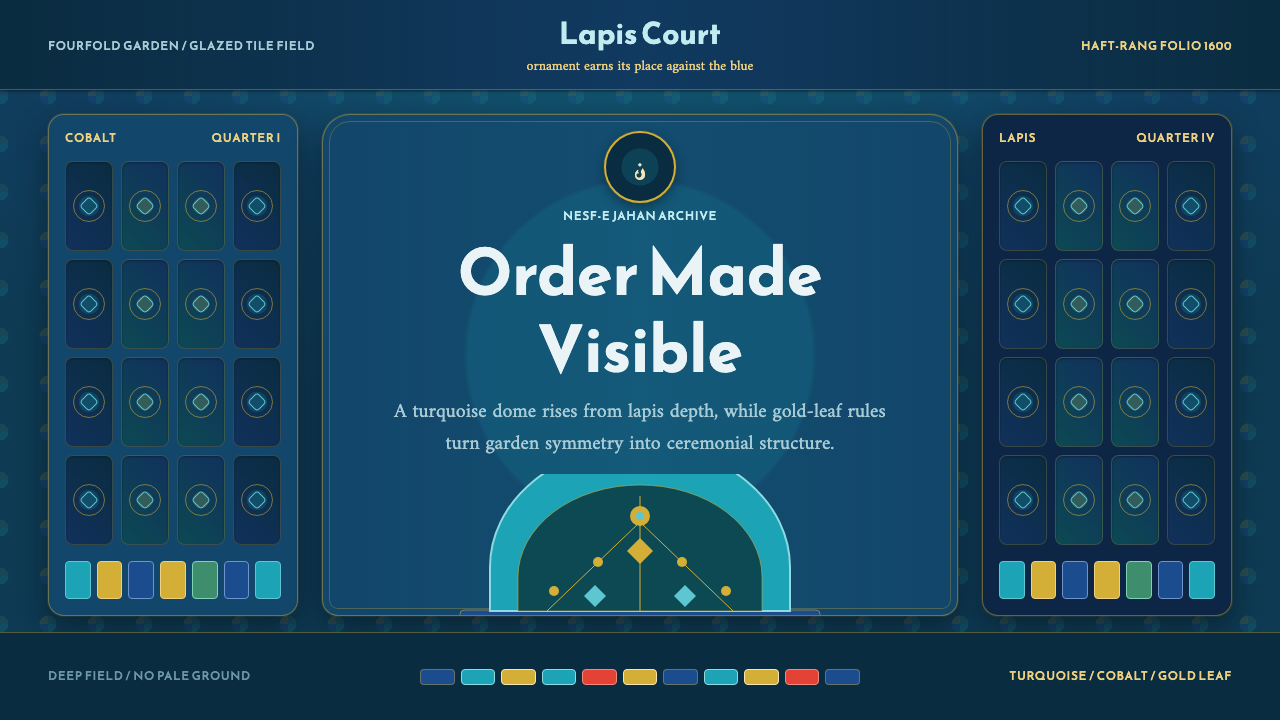 Safavid IsfahanOrnament is order. Turquoise domes and gold rules lock into a deep lapis grid.
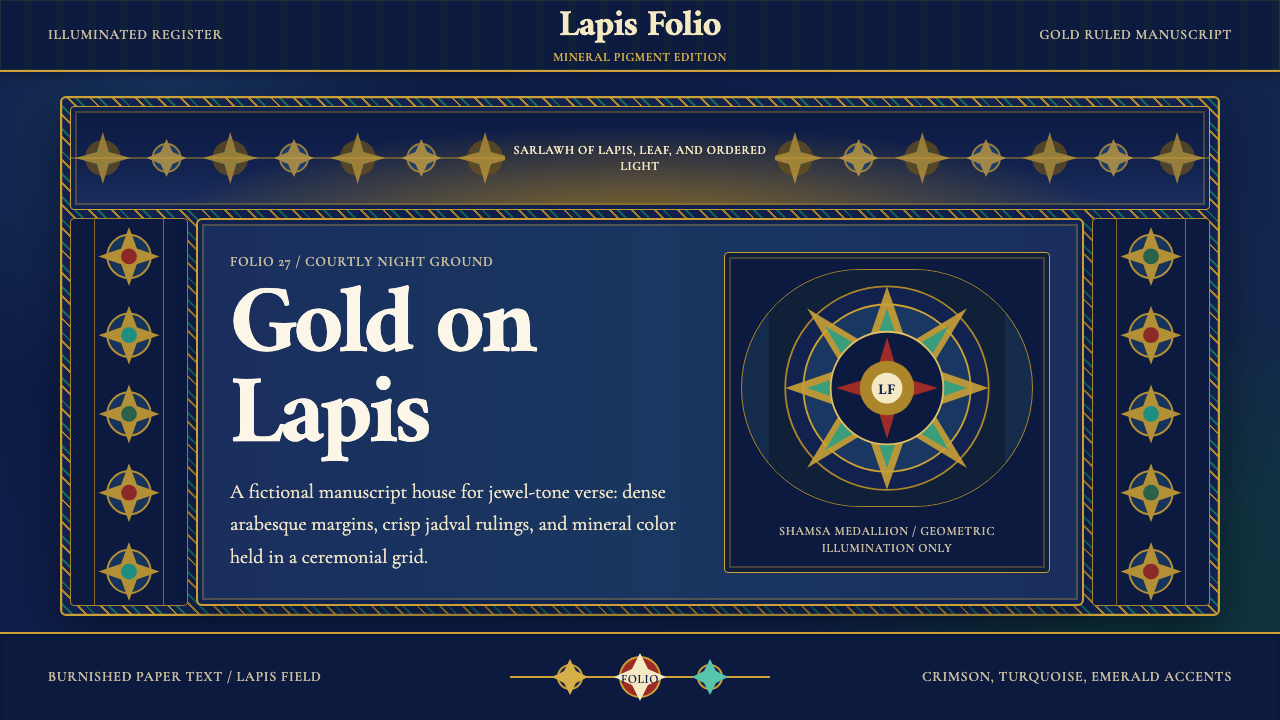 Timurid Manuscript (Herat)Courtly density glows. Lapis ground, Amiri type, and gold jadval geometry hol…
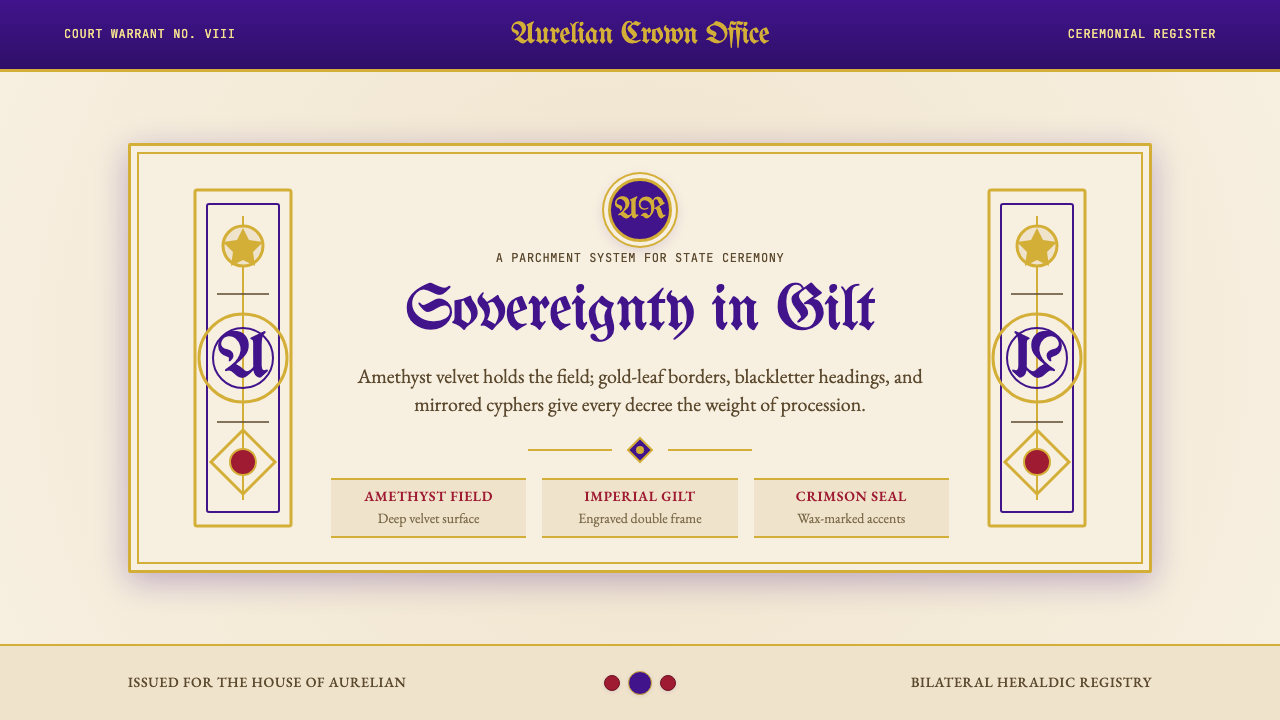 British Royal MonarchyCeremony becomes structure. Amethyst panels, gilt borders, blackletter, mirro…